

TL;DR: How to Hire Top Remote Developers
- Define the Role First: Use a precise role scorecard and choose the right hiring model (FTE, Contractor, Fractional) before you start. The wrong model leads to wasted time and budget.
- Source in High-Signal Channels: The best AI/ML talent isn't on mainstream job boards. Find them through their open-source contributions (e.g., on
LangChain,PyTorch), niche Discord communities, and curated networks. - Vet for Remote-First Skills: Replace abstract algorithm tests with a practical, containerized take-home project that mimics a real task. Assess asynchronous communication and proactive ownership, not just coding ability.
- Onboard Deliberately: A structured 30-60-90 day plan is non-negotiable. The goal is to integrate a new developer into your culture and codebase, not just give them a laptop. Assign an onboarding buddy.
- Next Step: Audit your current process against our checklist. Book a 20-minute scoping call to define your next hire and get matched with pre-vetted AI engineers in under two weeks.
Who This Is For
This guide is for technical leaders who need to hire elite remote AI and machine learning talent without wasting months on a broken process.
- CTOs / Heads of Engineering: You need a repeatable system to find and vet specialized engineers who can contribute to your core product from day one.
- Founders / Product Leads: You're scoping new AI features and need to build a high-performing, capital-efficient team quickly.
- Talent Ops / Hiring Managers: You're tasked with building a pipeline of top-tier remote developers and need a practical framework that works.
If you're tired of sifting through thousands of unqualified applicants from job boards, this playbook is for you.
A Modern Framework for Hiring Remote Developers
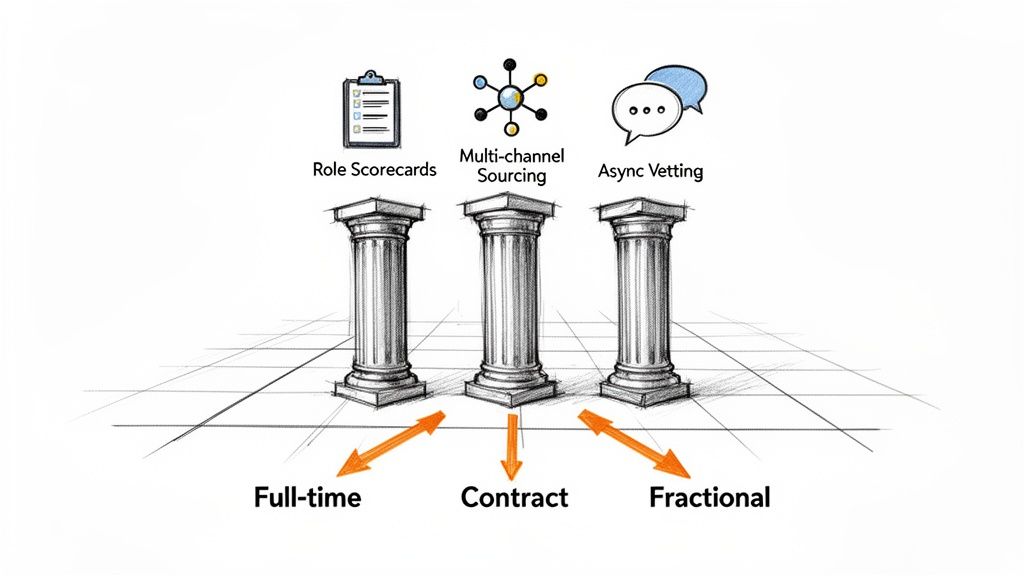
Our framework focuses on three pillars: precise role definition, high-signal sourcing, and async-first vetting.
The market for top-tier remote talent has changed. While headlines talk about "return to office," the demand for specialized remote AI and machine learning (ML) engineers has never been higher. Posting a remote role triggers an avalanche of applications, making it nearly impossible to spot true experts.
This guide skips the generic advice to give you a repeatable system for building a high-performing, distributed AI team. For a deeper dive into the fundamentals, the ultimate guide to hiring remote developers is a great starting point.
Step 1: Choose the Right Hiring Model
Before sourcing, decide on the engagement model. Each comes with trade-offs in speed, cost, and integration.
- Full-Time Employees (FTEs): Best for core, long-term projects where you need deep institutional knowledge and cultural integration. Expect a longer hiring cycle and more overhead.
- Contractors: Ideal for projects with a defined scope and timeline, like building a specific AI feature. Contractors offer flexibility and can start quickly but don't offer the same long-term commitment.
- Fractional Talent: A secret weapon for startups. Access a seasoned expert—like a fractional Head of MLOps—for strategic guidance without the full-time executive cost.
One of the biggest mistakes we see is using the same lengthy, multi-stage interview process for a short-term contractor that you would for a full-time Staff Engineer. Your process must match the model.
Remote Hiring Model Decision Matrix
Use this matrix to align your business needs with the right hiring model.
Mapping your needs to this matrix before you search saves significant time and resources.
Step 2: Find and Attract Top-Tier Remote Developers
To find the best remote developers, you must go where they are, not where recruiters are. The top 1% of AI talent isn't applying on job boards; they are contributing to open-source projects and solving problems in niche communities.
Your sourcing strategy must shift to these high-signal environments. We consistently find elite candidates in specific Discord servers for Large Language Model (LLM) engineers, on Kaggle competition leaderboards, and among key contributors to open-source projects our clients use.
Go Where The Best Engineers Gather
Use a sniper rifle, not a shotgun. Pinpoint the online spaces where your ideal developers already operate.
- Niche Communities: Find specialized groups like the "EleutherAI" Discord for large-scale AI models or subreddits like
r/MachineLearning. Active participation shows passion. - Open-Source Contributions: An engineer's GitHub profile is their real portfolio. Look for meaningful contributions to projects like LangChain, PyTorch, or Hugging Face Transformers.
- Curated Talent Networks: Vetted platforms like ThirstySprout provide a pre-qualified pipeline, saving you from sorting through thousands of unqualified applicants.
This targeted approach is necessary. Global demand for AI talent is extreme; we're seeing a need for 3X more machine learning engineers than are available. To learn more, see our analysis on developer hiring trends and the market deficit.
Practical Example 1: Sourcing an MLOps Engineer via GitHub
A fintech client needed an MLOps engineer with specific experience in Kubeflow and model deployment latency.
- Identify Target Repo: We searched GitHub for popular open-source MLOps tools related to their stack, focusing on the Kubeflow Pipelines repository.
- Analyze Contributors: We filtered for contributors who had made substantial, recent pull requests—not just documentation fixes. We looked for complex bug fixes or feature additions.
- Craft Hyper-Personalized Outreach: We reached out to a top contributor with a message that referenced their specific work: "Saw your recent PR on the Kubeflow Pipelines repo addressing model prediction latency. We're tackling a similar challenge at scale and thought your expertise would be a game-changer."
This approach has a response rate over 50% because it demonstrates genuine respect for their expertise, unlike generic recruiting spam.
Step 3: Design a Vetting Process That Predicts Performance
A flawed vetting process is the #1 reason remote hires fail. Many companies hire candidates who excel at abstract algorithm tests but struggle in an autonomous, distributed environment.
Your hiring system must assess the traits that predict success in a remote-first world: production-readiness, asynchronous communication, and problem ownership.
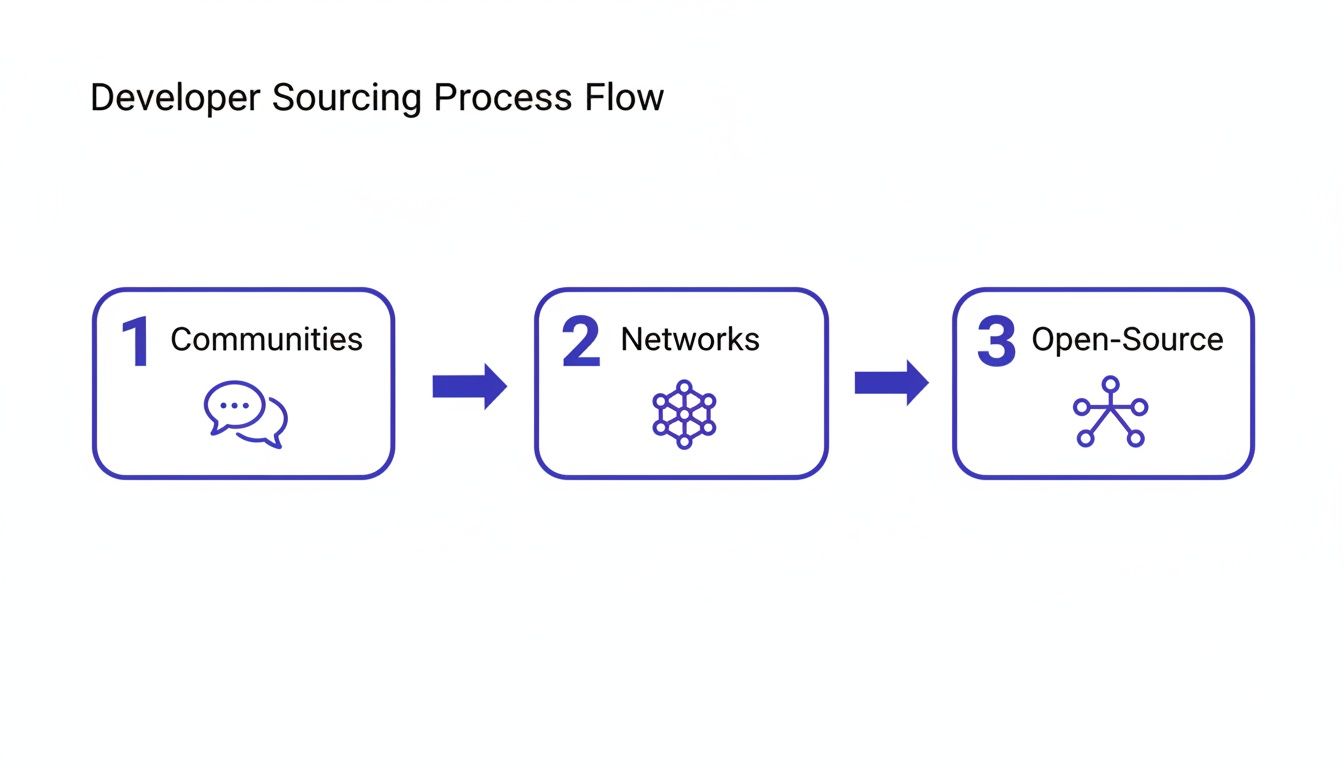
A high-signal sourcing process feeds directly into a vetting system focused on practical skills.
Replace the Algorithm Test with a Practical Challenge
Traditional coding challenges rarely reflect daily engineering work. A better approach is a practical, take-home assessment that mirrors a real task.
Practical Example 2: A Real-World Take-Home Challenge
For a Senior AI Engineer role, we use a small but complete project.
- The Task: Build a simple FastAPI endpoint. It must accept a user query, retrieve relevant documents from a provided corpus using a sentence-transformer model, and return the top three results.
- The Requirements: The submission must be a containerized application using Docker with a clear
README.md. It must also include unit tests to validate the core logic. - What We're Really Assessing: We're not just looking for a working endpoint. We evaluate code structure, dependency management, testing habits, and documentation quality. These are the traits of a senior engineer who thinks about production systems.
This challenge reveals far more than a timed quiz. It shows if a candidate works independently, writes maintainable code, and communicates their work clearly—critical remote-first skills.
Evaluate System Design and Remote Collaboration
For senior roles, the system design interview is critical. You must assess how they reason about distributed systems and trade-offs.
For an MLOps role, ask them to design a CI/CD pipeline for machine learning models. Dig into model versioning, automated testing, and deployment strategies. Probe for remote-first soft skills with targeted questions.
Key Questions to Test Remote Readiness:
- "Describe a project where requirements were vague. How did you get the clarity you needed without waiting for a meeting?"
- "Walk me through a complex technical decision you documented for your team. What format did you use, and what was the outcome?"
- "Tell me about a time you resolved a critical production issue when your team was spread across different time zones. How did you coordinate?"
These questions reveal real-world asynchronous communication and problem-solving skills. Learn more in our deep dive into our candidate vetting engine.
Use a Standardized Scorecard
To eliminate bias, use a standardized interview scorecard. This forces interviewers to evaluate every candidate on the same competencies.
AI Engineer Interview Scorecard Template
This structured approach ensures you make data-informed decisions, not ones based on gut feelings.
Step 4: Craft Competitive Offers and Navigate Global Compliance
You’ve found the perfect candidate. Now comes the offer. Top remote engineers evaluate the entire package, not just the salary. A competitive offer signals you understand and support a remote-first lifestyle.
Structuring A Compelling Global Offer
Start with global and regional salary benchmarks from sources like Levels.fyi or Pave. Then, add benefits that remote workers truly value:
- Learning & Development Stipend: A budget for courses or conferences shows investment in their growth.
- Home Office Setup: A one-time allowance for ergonomic equipment makes an immediate impact.
- True Flexibility: Be explicit about your expectations for synchronous vs. asynchronous work. This signals trust.
For startups, be transparent about equity. Provide the number of options, strike price, 409A valuation, and vesting schedule.
Navigating Contracts and Compliance
Hiring internationally presents a legal maze. You have two primary options: hiring as an independent contractor or using an Employer of Record (EOR).
- Contractors: Faster and cheaper upfront but carry misclassification risk.
- Employer of Record (EOR): An EOR acts as the legal employer in the developer’s country, handling local payroll, taxes, and benefits for a fee. For core, long-term team members, the compliance and peace of mind an EOR provides is almost always worth the investment.
For U.S.-based companies, you must first manage your domestic payroll and tax obligations. This starts with getting a federal Employer Identification Number (EIN). This guide on how to apply for an EIN number is a great resource that walks you through this foundational step.
Step 5: Nail the Onboarding for a High-Performing Team
A great hire can become disengaged due to a chaotic, sink-or-swim onboarding. The first 90 days are your single best opportunity to integrate a new engineer into your team’s culture, workflows, and codebase. A structured plan is non-negotiable for remote teams.
A phased 30-60-90 day plan builds momentum without overwhelming new hires.
A 30-60-90 Day Onboarding Plan
This phased approach prevents overwhelm and creates a clear path to full productivity.
Days 1–30: Focus on Integration and Learning
The goal is to build a solid foundation, not ship a massive feature.
- Assign an Onboarding Buddy: Pair them with a tenured engineer who isn't their manager to answer "silly" questions about team norms and tools.
- Environment Setup & First PR: Their first task should be a small, well-documented bug fix. Merging a pull request in the first few days is a huge win.
- Documentation Deep Dive: Block out dedicated time for them to read key documents: architecture diagrams, READMEs, and recent technical specs.
Days 31–60: Focus on Contribution and Ownership
Shift from learning to doing. The engineer should start taking on small-to-medium-sized tasks.
- Assign a Clear First Project: Give them a well-scoped project with a measurable outcome they can complete in this 30-day window.
- Introduce Asynchronous Rituals: Guide them through async project demos using tools like Loom, contributing to written technical proposals, and providing thoughtful code reviews.
- Schedule a 30-Day Check-in: A formal feedback session with their manager clarifies expectations and sets goals for the next month.
Days 61–90: Focus on Impact and Autonomy
The new hire should operate as a fully integrated team member.
- Tackle a More Complex Task: Assign a project that requires collaboration with another engineer to test their ability to navigate dependencies.
- Encourage Proactive Improvements: They should feel comfortable identifying and suggesting improvements to the codebase or team processes.
- Set Long-Term Goals: Define their performance and growth goals for the next 6–12 months, aligning their ambitions with company objectives.
Remote Developer Onboarding Checklist (Template)
Use this checklist to create a repeatable and effective onboarding experience.
[ ] Pre-Onboarding (Week Before Start)
- Ship laptop and necessary hardware.
- Create accounts for all required systems (Email, Slack, GitHub, Jira, AWS).
- Send welcome packet with schedule for first week.
- Assign an Onboarding Buddy.
[ ] Week 1: Integration & Setup
- Day 1: Welcome call with manager and team.
- Review the "Day One Checklist" (links to tools, key contacts).
- Complete local development environment setup.
- Merge first small pull request (e.g., fix a typo, update a dependency).
- Schedule 1:1 meetings with key team members.
[ ] First 30 Days: Learning & First Contributions
- Complete documentation deep dive (architecture, key services).
- Shadow a code review session with Onboarding Buddy.
- Take on 2-3 well-defined starter tickets.
- 30-day check-in with manager to review progress and set 60-day goals.
[ ] Days 31-90: Ownership & Impact
- Assign first small, independent project.
- Lead a project update via an async Loom video.
- Contribute a meaningful code review for a teammate.
- 90-day review: Discuss impact and define long-term growth goals.
What to Do Next
You have the playbook. Now it's time to execute. Here are three practical steps you can take today to start hiring elite remote AI engineers.
- Audit Your Current Process: Use our checklist to perform a quick internal review. Identify the gaps in your sourcing, vetting, or onboarding.
- Scope Your Next Hire: Book a free 20-minute scoping call. We’ll help you define the exact technical and soft skills for your next critical hire.
- See the Talent Firsthand: View sample profiles of our pre-vetted remote developers to see the caliber of expertise you can have on your team in as little as two weeks.
A systematic process is how you find, attract, and win the right person. Use these steps to build momentum and avoid the common mistakes that slow other teams down.
References & Further Reading
- Global Salary Data: Levels.fyi, Pave
- Developer Hiring Trends: How to Hire AI Engineers
- Our Vetting Process: ThirstySprout Candidate Vetting Engine
- Project Management Tools: Jira, Confluence, Notion
At ThirstySprout, we handle these complexities for you. We connect you with pre-vetted, senior remote AI and ML developers from our exclusive talent network, so you can focus on building. You can start a pilot project in under two weeks.
Hire from the Top 1% Talent Network
Ready to accelerate your hiring or scale your company with our top-tier technical talent? Let's chat.