

You're probably here because your startup has reached the same point many teams hit at once.
The dashboards don't match finance. Product wants funnel data that isn't reliable. Growth wants attribution. Your ML roadmap exists, but the training data is scattered across Postgres, Stripe, Salesforce, and event logs. Engineers are writing one-off scripts to keep reports alive, and nobody trusts the numbers for long.
That's usually when founders write a bad data engineering job description. They list every tool they've heard of, mix analyst, BI, and platform work into one role, and end up hiring either too senior, too narrow, or just wrong for the problem.
A strong data engineering job description does one thing well. It defines the business outcomes the role owns, the systems they'll build, and the boundaries around adjacent work. If you get that right, hiring gets easier and onboarding gets faster.
TL;DR
- Hire a data engineer when data reliability has become a product and operating risk, not just an annoyance.
- Write the role around value, not tool bingo. Focus on trusted reporting, faster access to new data, and stable pipelines.
- Clarify boundaries early between pipeline work, metadata ownership, and BI/dashboard support.
- Use the templates and scorecard below to avoid the usual startup hiring mistakes.
- If you need help de-risking the search, the practical next step is to Start a Pilot or See Sample Profiles at the end.
What Is a Data Engineer and Why Your Startup Needs One
Monday morning, the CEO asks for revenue by channel. Finance pulls one number from Stripe. Growth shows another in the dashboard. Product has a third based on event data. Nobody is lying. Your systems just disagree, and nobody owns the path from raw data to a number the business will act on.
That is the gap a data engineer fills.
A data engineer builds and maintains the pipelines, models, and data foundations that turn scattered operational data into something teams can trust. In a startup, the role is less about mastering a specific warehouse or orchestration tool and more about making key decisions possible without spreadsheet debates, broken joins, or brittle scripts hidden in one engineer's laptop.
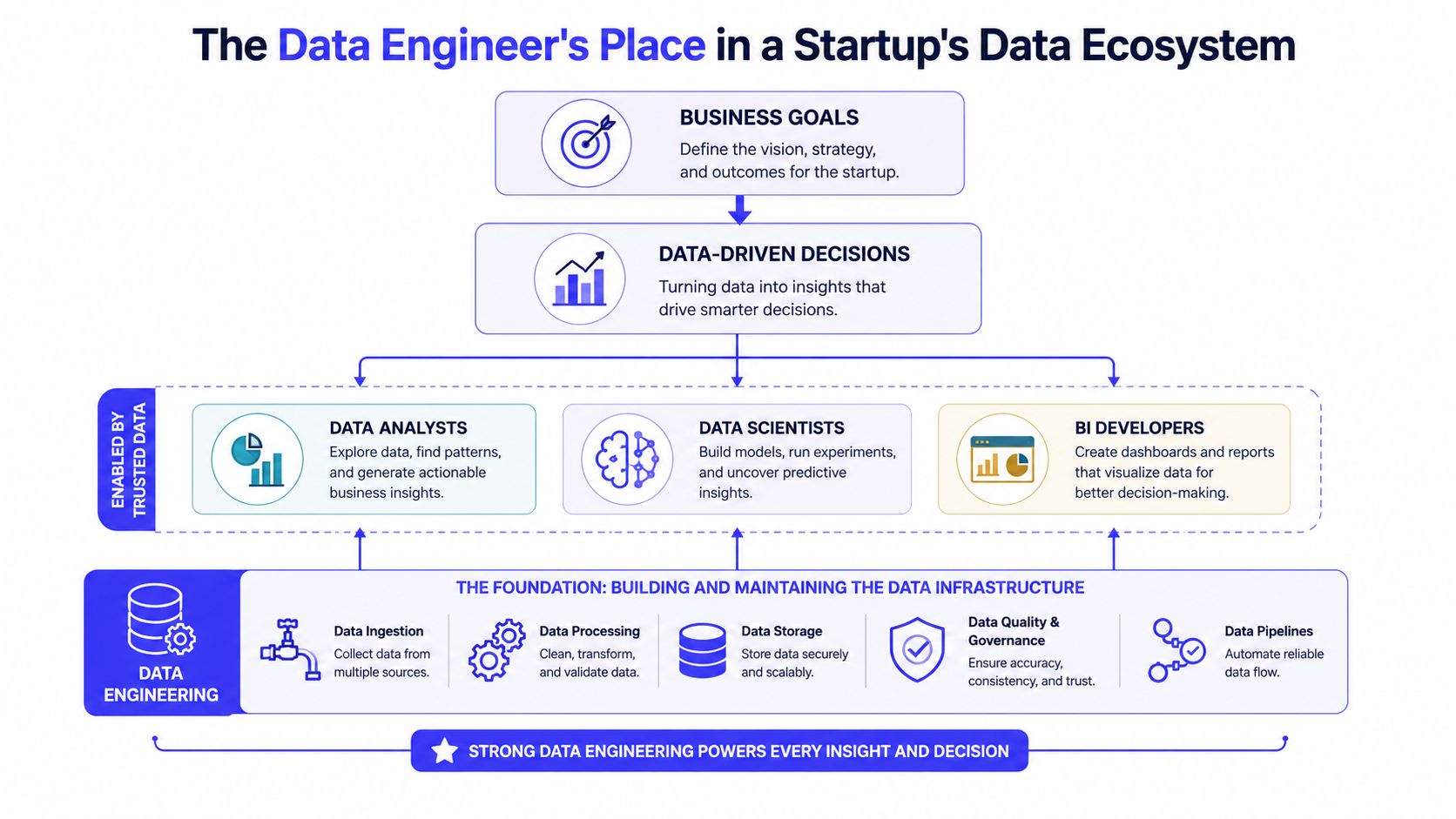
Founders often miss one part of the job. The first data engineer is usually not just moving data from A to B. They are also defining metric logic, cleaning up metadata, documenting source meaning, and deciding what belongs in BI versus what belongs in the warehouse. In early teams, those lines blur. A good hire handles that ambiguity without becoming a catch-all for every reporting request.
The cleanest way to separate roles is by business outcome:
- Data engineer: makes data reliable, available, and usable across systems
- Data analyst: answers business questions and drives reporting
- ML engineer: deploys and monitors models in production
That sounds tidy on paper. In startups, it rarely is.
If your analyst spends half the week fixing broken pipelines, remapping fields, or recreating core tables, you do not have an analyst capacity problem. You have a data engineering problem. If your product or growth engineers are maintaining ad hoc syncs between Postgres, Stripe, HubSpot, and event data, the cost is not just technical debt. It is slower decisions and lower trust in every KPI.
When the role becomes necessary
You usually do not need a dedicated data engineer on day one. Early on, a strong analyst plus application engineers can cover basic reporting if the source systems are simple and the business can tolerate some manual work.
The hire becomes necessary when data reliability starts affecting execution:
- Reports break after product or schema changes, and fixes depend on whoever notices first
- Each new integration turns into custom glue code with no shared patterns
- Metric definitions drift across teams, so leadership meetings focus on whose dashboard is right
- Operational workflows depend on late or inconsistent data, which slows sales, finance, support, or lifecycle marketing
- Analysts spend more time preparing data than using it
A practical rule I use is simple. Hire your first data engineer when trusted data becomes an operating requirement, not a nice-to-have for reporting.
Why startups get this hire wrong
Many early job descriptions ask for everything at once. Warehouse architecture, BI ownership, reverse ETL, governance, machine learning support, experimentation, and dashboard design. That usually produces one of two bad outcomes. You hire someone very senior who should be shaping systems but gets buried in ticket work, or you hire a tool specialist who can build pipelines but cannot define what the business needs.
A better approach is to hire for the constraint in front of you.
If the company needs stable ingestion, cleaner models, and one source of truth for core metrics, write the role around those outcomes. If you also need dashboard ownership and stakeholder support, say that clearly instead of hiding it under "nice to have" bullets. If metadata quality and documentation are weak, include them. Startups often separate data engineering, cataloging, and BI too early in the hiring brief and then wonder why the first hire cannot reduce confusion across teams.
Data engineer vs analyst vs ML engineer
Use this decision rule:
| If your main problem is... | Hire first |
|---|---|
| Messy data movement between systems | Data engineer |
| Reporting, dashboarding, and business questions | Data analyst |
| Training, serving, and monitoring models | ML engineer |
Two examples make this clearer.
A Seed-stage SaaS company with Stripe, HubSpot, Salesforce, and product events usually gets more value from a data engineer than from an ML engineer. The business needs clean pipeline, conversion, retention, and revenue data before it needs prediction.
A fintech startup with an underwriting model may still need a data engineer before adding more ML headcount. If ingestion is unstable, feature availability is inconsistent, or historical data is poorly modeled, model work slows down fast.
If you are still unsure, compare your role draft against what experienced data analytics recruiters screen for in early-stage teams. The distinction is usually obvious once you frame the job around outcomes. Analysts use trusted data. Data engineers create the conditions for trust.
Core Data Engineer Responsibilities and KPIs
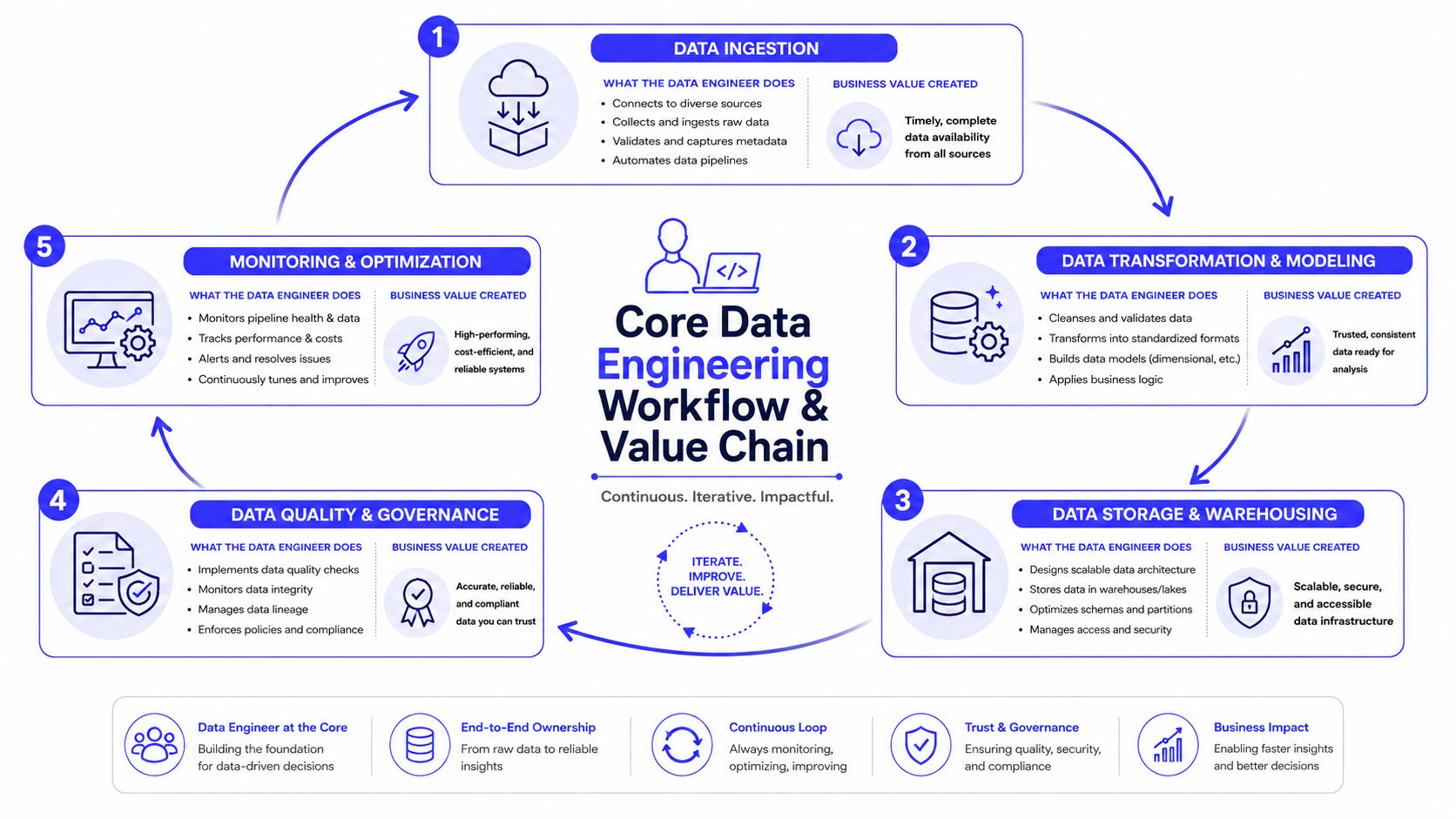
The role gets clearer when you stop listing tasks and start grouping ownership. For an early-stage or scaling company, I'd break responsibilities into three buckets. Infrastructure, pipelines, and governance.
Here's the workflow most startups are really hiring for.
A useful primer for non-technical hiring managers is this short video:
Data engineers are responsible for designing and maintaining scalable, fault-tolerant data pipelines that ingest, transform, and deliver data from heterogeneous sources. Poorly optimized Spark jobs can create multi-hour latency spikes, which then ripple into analytics and business decisions, as explained in Splunk's breakdown of data engineer responsibilities.
Infrastructure ownership
This is the foundation. It includes storage layout, warehouse design, orchestration setup, environment management, access patterns, and enough observability that failures don't stay hidden.
For a founder, the KPI shouldn't be “uses the right architecture.” It should be:
- Warehouse reliability
- Pipeline uptime
- Cost visibility
- Time to onboard a new source
Mini-case. If your engineer can add NetSuite as a new source cleanly, document lineage, and make it available for finance reporting without breaking downstream jobs, that's meaningful output. If they produce elegant Terraform but finance still exports CSVs by hand, the role isn't creating value.
Pipeline and transformation work
This is the part most job descriptions mention, but they rarely define success well.
A solid hire should be able to:
- Ingest data from APIs, databases, and event streams
- Transform raw tables into stable business models
- Handle schema drift, retries, and backfills
- Reduce manual work for analysts and operators
A startup-friendly KPI set looks like this:
| Responsibility area | KPI a founder can track |
|---|---|
| Data ingestion | Time to get a new source into the warehouse |
| Transformation | Time from raw data to analyst-ready model |
| Reliability | Failure rate of scheduled jobs |
| Freshness | End-to-end data latency |
The best startup data engineers shorten the path from “we need this data” to “the team can use it safely.”
Governance, quality, and business trust
Many first hires underperform because the company didn't explicitly request these details. Data quality, naming standards, access controls, documentation, lineage, and metric definitions are all inherent to the role.
A founder doesn't need to micromanage technical controls. But the job description should make one point explicit. The engineer is accountable for trust, not just movement.
A practical KPI set:
- Number of recurring data quality issues reaching dashboards
- Percentage of critical models with owner and documentation
- Time to detect and resolve broken upstream changes
What doesn't work is hiring someone to “build pipelines” while assuming trust, metadata, and dashboard readiness will appear on their own. They won't.
Essential Skills and Technology Stack
The fastest way to ruin a data engineering job description is to ask for every modern data tool in one post.
Startups don't need a unicorn. They need a builder who is strong in fundamentals and can learn adjacent tools without drama. The baseline matters more than the logo soup.
Must-have skills for the first hire
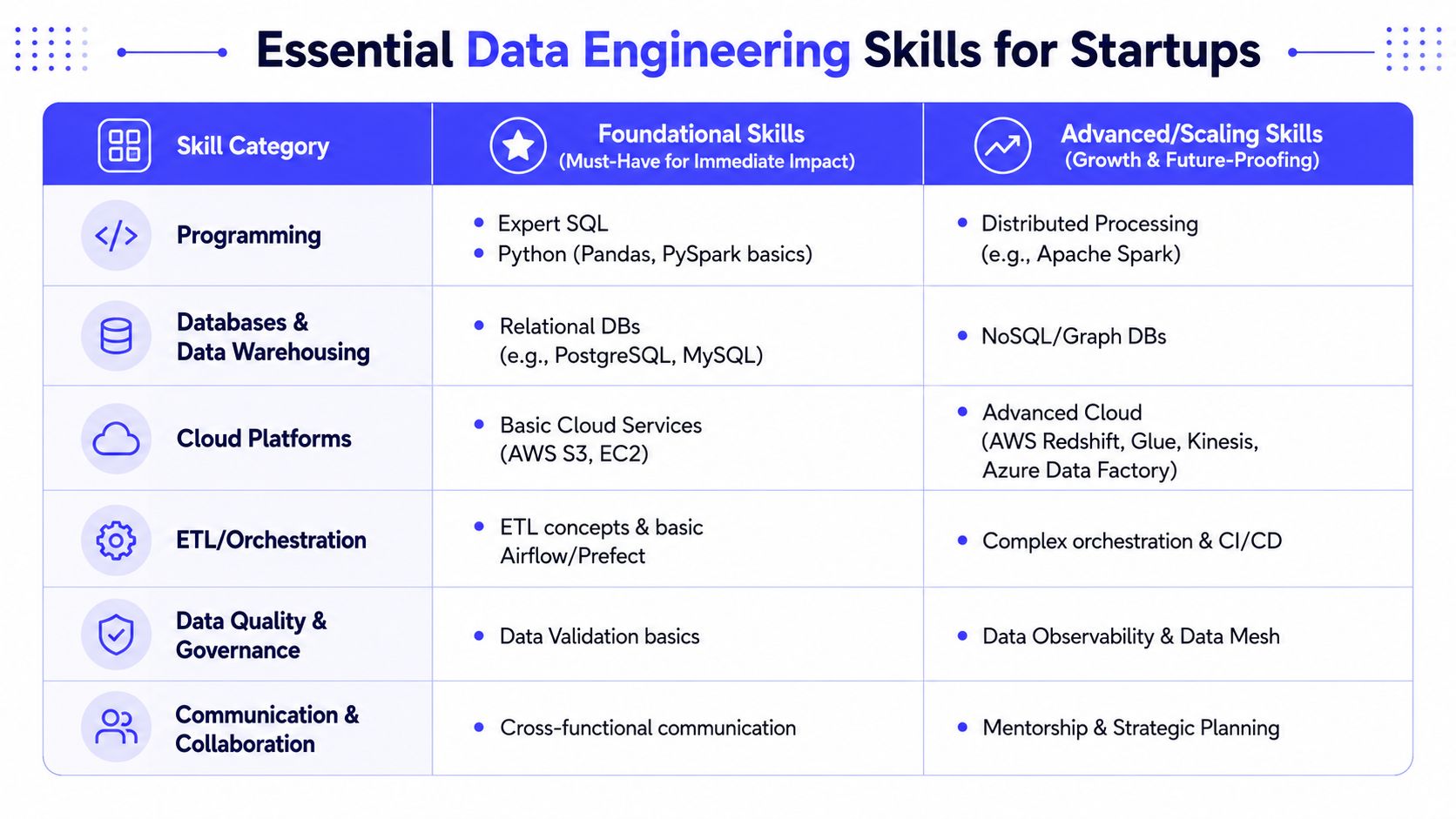
For a Series A or similar startup, these are the skills I'd prioritize:
- SQL depth. Not basic joins. The person should be comfortable modeling data, debugging query performance, and shaping analyst-ready tables.
- Python fluency. Enough to build and maintain ETL or ELT jobs, work with APIs, and automate repetitive tasks.
- One cloud environment. AWS, Azure, or GCP. Depth in one is better than surface familiarity across all three.
- Orchestration basics. Airflow, Dagster, Prefect, or the equivalent patterns even if the exact tool differs.
- Warehouse literacy. Redshift, BigQuery, Snowflake, or another warehouse where downstream teams work.
Data engineers also need proficiency in big data frameworks like Hadoop, Spark, or Kafka, and core languages such as Python, Java, or SQL, because those are considered essential requirements in enterprise-grade environments, as outlined in this data engineer skill overview.
What to add when you're scaling
A later-stage team may need more specialization.
That can include:
- Streaming systems such as Kafka
- Distributed processing with Spark
- Stronger governance and observability
- Cross-team architecture thinking
- Metadata and semantic layer discipline
Hiring filter: Knowing one warehouse deeply and one orchestration approach well is usually more useful than listing ten tools from conference slides.
Here's a simple split for hiring managers:
| Stage | Prioritize |
|---|---|
| Early startup | SQL, Python, one cloud, one warehouse, orchestration |
| Scaling platform | Spark, Kafka, cost optimization, governance, metadata |
If you want candidates to understand the cloud side of the role better before they apply, examples from adjacent infrastructure roles can help. I've found Resumey.Pro cloud engineer examples useful for spotting how strong candidates describe systems ownership versus just listing services.
And if your stack is still taking shape, this guide to best data pipeline tools is a practical way to narrow the role to the tools you'll use.
Data Engineer Career Path and Seniority Levels
Most hiring mistakes here come from seniority mismatch, not candidate quality.
A startup says it wants a senior data engineer. What it often means is, “We need someone who can work without hand-holding.” That's not enough. You need to define the scope they'll own.
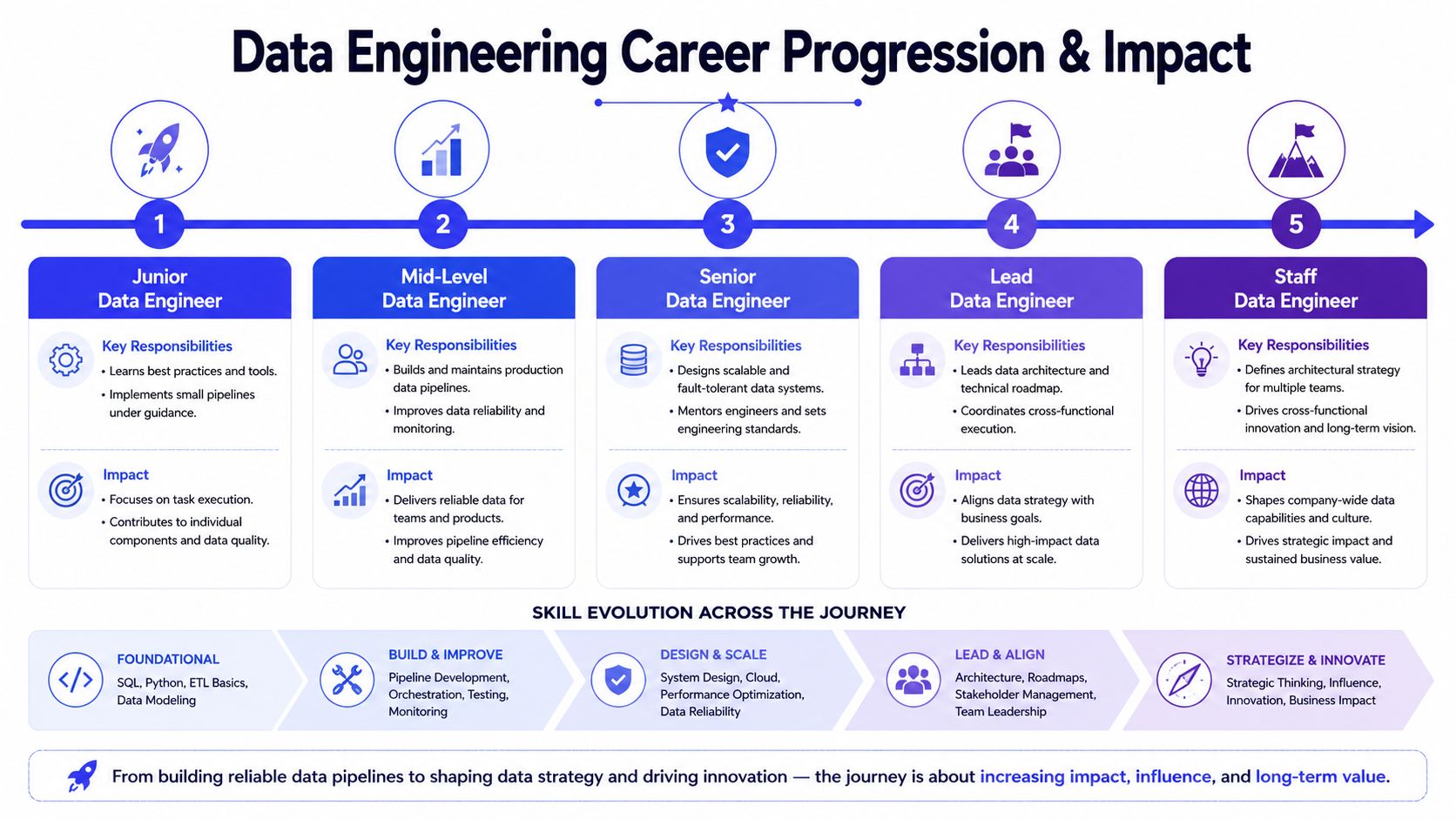
How scope changes by level
Here's the practical difference.
| Level | Primary focus | Example project | Expected impact |
|---|---|---|---|
| Junior | Maintain and debug existing pipelines | Fix failing ingestion job and add tests | Keeps known systems running |
| Mid-level | Build from spec | Add new product event pipeline into warehouse | Expands usable data coverage |
| Senior | Design systems and models | Redesign customer 360 model across product and billing data | Improves trust and decision speed |
| Staff | Set platform strategy | Define warehouse, orchestration, governance, and ownership model across teams | Shapes multi-team data direction |
What startups usually need first
Most early-stage companies don't need junior. They don't have enough structure to support one well.
They often also don't need staff first, unless the business already has multiple teams depending on a shared platform. In practice, the first strong hire is usually mid-level or senior, depending on data complexity and internal support.
If nobody on your team can review data architecture decisions, hire for proven ownership, not raw potential.
There's useful compensation context in Europe too. Benchmark data shows Junior Data Engineers average €35K, mid-level professionals average €50K, and Senior Data Engineers command €60K–€70K annually in major European markets. The same source notes that 65% hold bachelor's degrees and 22% hold master's degrees, which helps calibrate education expectations without over-indexing on pedigree, according to Société Générale's career overview for data engineers.
A simple hiring rule by stage
Use this if you're choosing level fast:
- Pre-product-market fit. Only hire if data work is blocking sales, operations, or core product reporting.
- Series A to B. A senior individual contributor often gives the best mix of speed and hands-on execution.
- Multi-team scaleup. Add lead or staff only when platform decisions, standards, and team coordination become core work.
For interview preparation from the candidate side, I sometimes point people to broader expert career interview advice because strong candidates tend to communicate system trade-offs better when they've prepared examples clearly. That helps both sides.
Data Engineering Job Description Templates
Most templates fail because they describe a generic market role instead of your real operating problem.
A usable data engineering job description should answer four questions fast. What data the engineer will own. Who uses it. What systems exist today. What success looks like in the first stretch of the role.
Employers typically require three or more years of hands-on experience with Python, SQL, and data visualization tools, along with familiarity with AWS services such as Redshift and RDS, according to LinkedIn's hiring guide for data engineers. That's a decent floor for production-readiness. It still needs tailoring.
Template one for full-time senior data engineer
Job title
Senior Data EngineerAbout the role
We're hiring a Senior Data Engineer to build and own the pipelines, warehouse models, and data quality standards that support reporting, product analytics, and future machine learning use cases.What you'll own
- Build and maintain ETL or ELT pipelines from into
- Define transformation logic and data models used by analytics and operational teams
- Set up monitoring, alerting, and failure recovery for production data jobs
- Document lineage, metric definitions, and ownership for critical datasets
- Partner with engineering, product, and finance on trusted business reporting
What good looks like
- New data sources move into production without brittle one-off scripts
- Analysts spend less time cleaning raw tables
- Leadership can trust core metrics across dashboards
Requirements
- Strong SQL and Python
- Production experience with cloud data infrastructure
- Experience building and maintaining reliable ETL processes
- Clear communication with non-data stakeholders
Template two for project-based contractor
Job title
Data Engineering ContractorEngagement goal
Deliver a focused data foundation project, such as warehouse migration, source integration, event pipeline cleanup, or analytics model redesign.Scope
- Audit current pipelines and failure points
- Implement priority integrations
- Improve reliability and observability
- Hand off documentation and operating runbooks
Best for
- Backlog reduction
- Migration work
- Temporary bandwidth during growth or fundraising
Template three for fractional strategic advisor
Job title
Fractional Data EngineerWhy this role exists
We need senior guidance on architecture, tooling choices, and hiring without committing to a full platform build yet.Responsibilities
- Define the target data architecture
- Review current warehouse and pipeline setup
- Set standards for modeling, documentation, and ownership
- Support vendor and hiring decisions
Ideal profile
Someone who has built data foundations in growing companies and can turn ambiguous startup needs into a practical roadmap.
One useful companion resource for interview design is Underdog's guide to effective data scientist interviews. It's aimed at a nearby role, but the structure helps hiring managers avoid abstract technical grilling and focus on actual work samples.
Interview Questions and Hiring Checklist
A strong interview process for this role should test three things together. Can the candidate build reliable systems. Can they make sane trade-offs. Can they connect the work to business use.
That last part matters more now than many hiring teams realize. Data roles are becoming “very tool-specific,” but the market is shifting toward engineers who optimize workflows for business impact, not only technical execution. The broader point is that modern data engineering is moving toward strategic alignment, as noted in this discussion on the direction of data engineering roles.
Question bank that surfaces real signal
Use a mix of technical, system, and behavioral prompts.
- Technical prompt
“A source API changes its schema without warning and breaks a core dashboard. How do you detect it, contain impact, and recover?” - SQL and modeling prompt
“How would you model revenue so finance and product don't pull different numbers from the same warehouse?” - System design prompt
“Design a clickstream pipeline that feeds both daily reporting and near-real-time product monitoring.” - Behavioral prompt
“Tell me about a pipeline or modeling change you made that improved a business process, not just the system itself.” - Boundary prompt
“Where do you draw the line between data engineering, metadata management, and BI support in a small team?”
A candidate who talks only about tools without naming users, decisions, or failure impact usually isn't ready for startup ownership.
Data Engineer Interview Scorecard
| Competency | Question Area | Score (1-5) | Notes / Red Flags |
|---|---|---|---|
| SQL and modeling | Complex joins, metric definitions, warehouse modeling | Confuses reporting logic with source truth | |
| Pipeline engineering | Ingestion, retries, backfills, schema drift | Talks about happy path only | |
| System design | Batch vs streaming, storage, orchestration | Over-engineers small startup needs | |
| Data quality | Testing, observability, lineage, alerts | Treats quality as analyst responsibility | |
| Business alignment | KPI impact, stakeholder communication | Cannot explain who benefits from the work | |
| Scope judgment | Role boundaries with BI and metadata | Says “I can do everything” without trade-offs |
Hiring checklist you can use today
- Define the first business outcomes. Trusted revenue reporting, product event reliability, or faster data onboarding.
- List the actual systems in play. Postgres, Stripe, Segment, HubSpot, Snowflake, Looker, whatever is real today.
- Choose the right level. Mid-level, senior, contractor, or fractional.
- Use one practical take-home or live exercise. Keep it close to the work.
- Score for ownership and judgment. Not just syntax and tool recall.
- Close the loop quickly. Strong candidates won't wait through vague multi-round drift.
Data Engineer Salary Ranges and Next Steps
Founders usually make the same hiring mistake here. They budget for a pipeline builder, then ask that person to define metrics, clean up event tracking, support dashboards, and own data documentation. That is a wider role, and the salary band should reflect it.
Salary should follow business scope, system complexity, and ownership. A startup with one product database and a few SaaS sources can often hire a strong mid-level engineer. A company that needs trusted board reporting, self-serve analytics, and clean metadata across product, finance, and go-to-market systems is hiring for broader judgment, not just ETL work.
This is the part many job descriptions miss. The line between data engineering, BI enablement, and metadata ownership is blurry in early-stage teams. If you expect one person to build pipelines, maintain the warehouse, define semantic models, and keep metric definitions consistent, say that plainly and pay for it. AltexSoft covers this shift in its discussion of evolving data engineer responsibilities.
A practical rule works well. Budget toward the top of your band when the role includes any two of these: metric governance, dashboard enablement, lineage or documentation ownership, data quality standards, or direct support for leadership reporting. Those responsibilities affect decision quality. They are not side tasks.
Before you post the role, do three things:
- Rewrite the job description around outcomes such as trusted revenue reporting, faster onboarding of new data sources, or fewer broken dashboards
- Separate must-have ownership from nice-to-have tools so candidates understand where they will be judged
- Check adjacent compensation bands, including analytics engineer salary benchmarks, if your role blends warehouse modeling, BI support, and data platform work
If you want to hire a data engineer without wasting a month on the wrong profile, ThirstySprout can help you scope the role, meet vetted senior candidates, and move from job description to working pilot fast. You can Start a Pilot or See Sample Profiles to compare full-time, contract, and fractional options.
Hire from the Top 1% Talent Network
Ready to accelerate your hiring or scale your company with our top-tier technical talent? Let's chat.