

You're probably in one of two situations right now. You have a product that works, and you're under pressure to “add AI” without turning your roadmap into a science project. Or you have a strong idea for a first AI feature, but you're not sure whether the actual problem is product strategy, data readiness, or team gaps.
Most founders get stuck because they treat AI like a feature request. It isn't. A solid product development strategy for AI has to decide what problem is worth solving, what evidence is enough to build, which risks must be reduced before launch, and which people need to own each part. If you skip that sequence, you usually get one of two bad outcomes: a polished demo nobody adopts, or a technically clever system the team can't maintain.
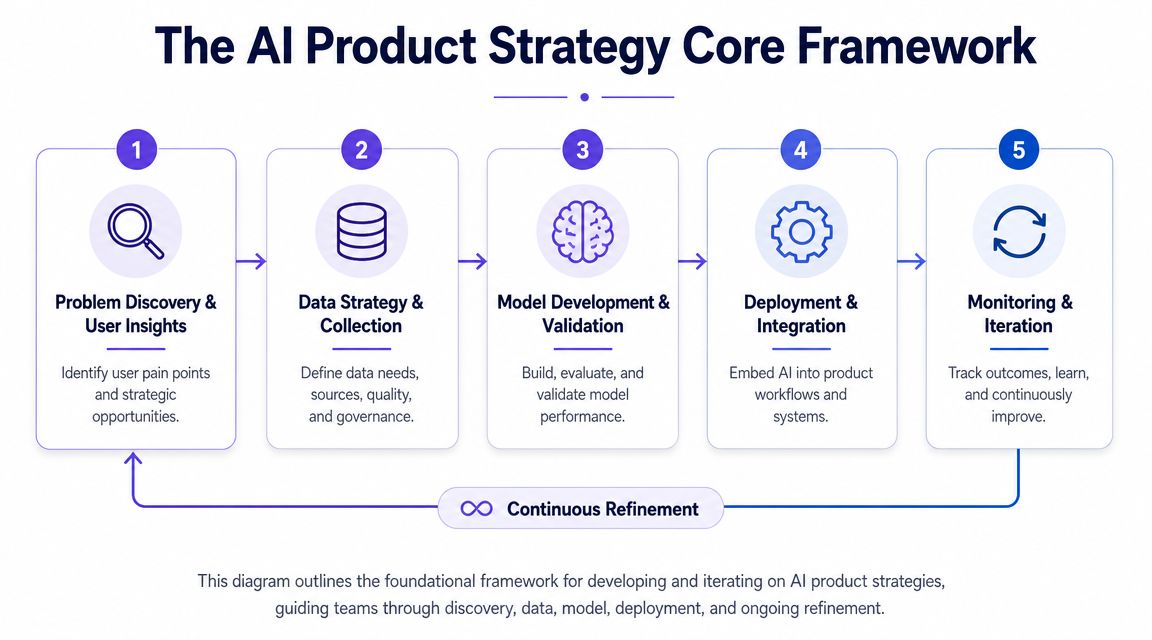
The Core Framework for AI Product Strategy
If you're building your first AI feature, use a simple sequence: Vision, Discovery, Build, Scale.
That sequence works because product development stopped being an ad hoc craft long ago. Modern staged development became formalized in the 1960s–1980s as a structured path from idea to launch, and Atlassian describes the core stages as idea generation, screening, concept testing, business analysis, development, and launch in its guide to product development strategy. For AI teams, that structure matters even more because uncertainty is higher and the cost of building the wrong thing rises fast.
TLDR for founders and CTOs
- Start with a business problem, not a model choice.
- Validate user pain before you scope pipelines, prompts, or fine-tuning.
- Build the smallest workflow that proves value in production context.
- Staff the team around execution bottlenecks, not org-chart habits.
- Keep post-launch measurement in the plan from day one.
Practical rule: If your AI feature can't be described as “for this user, in this workflow, to improve this outcome,” it's too early to build.
Who this is for
This framework fits founders, CTOs, and product leaders who need to ship an AI capability in weeks, not spend months debating architecture in the abstract. It's especially useful if your team has strong software engineers but limited experience with AI product discovery, evaluation, or MLOps.
The four stages that actually work
Vision comes first. Write one sentence that names the user, the job to be done, and the business outcome. “Use AI to improve support” is weak. “Help support reps draft accurate replies faster inside the existing ticket workflow” is usable.
Discovery is where many teams either save money or waste it. Talk to users. Review support transcripts. Inspect failure modes in the current workflow. Decide whether AI is the right mechanism at all. Sometimes a rules engine, better search, or improved UX solves the problem faster.
Build means creating the narrowest version that can survive real usage. That usually means one workflow, one user type, clear fallback behavior, and strong instrumentation. If you need outside help shaping that work, a scoped engagement like product development consulting services can help align product, engineering, and delivery before a full build starts.
Scale only begins after the first release proves usefulness. Now you improve quality, expand coverage, harden monitoring, and integrate the feature more tightly into the product.
Mini case on an AI support bot
A SaaS company wants an AI customer support bot. The wrong move is to start by picking a model and wiring up chat.
A better path looks like this:
Vision
The target is faster first-response drafting for support agents, not “AI chat” in general.Discovery
The team reviews tickets and finds that repetitive billing and setup questions are high-volume and structured enough for AI assistance.Build
They launch an internal agent assist tool before exposing anything to end users. The AI drafts replies. Humans approve or edit.Scale
After collecting usage feedback, they add retrieval from the help center, improve guardrails, and extend into customer-facing self-service only where answer quality is stable.
That's what good product development strategy looks like in AI. It reduces assumption risk before the expensive work starts.
Measuring Success with AI Product KPIs and OKRs
AI teams get into trouble when they measure activity instead of outcomes. API calls, token volume, prompt count, and model experiments can be useful operational signals, but they are not proof that the product is working.
Strong product strategy is better treated as an evidence loop. Revuze describes expert-level strategy as a combination of continuous discovery, usability input, and quantitative KPIs such as time-to-market, adoption rate, and customer acquisition cost versus lifetime value in its piece on product development strategy. That's the right mental model for AI because model quality alone doesn't tell you whether the feature changes business performance.
Separate vanity metrics from impact metrics
Use two layers of measurement.
| Metric type | What it tells you | Example for AI products |
|---|---|---|
| Leading indicators | Whether the feature is being used and is directionally useful | recommendation clicks, accepted AI drafts, task completion after AI suggestion |
| Lagging indicators | Whether the business outcome improved | lower manual ticket load, better retention, higher conversion on recommended products |
A recommendation engine is a good example. If your team only reports that recommendations are loading successfully, you've learned almost nothing. If you track whether users engage with recommendations and whether that behavior lines up with a business outcome, you can decide whether the feature deserves further investment.
A practical OKR example
Suppose you're building an AI recommendation feature for an ecommerce workflow.
Objective
Improve the quality and commercial impact of product discovery.
Key results
- Improve recommendation relevance using an evaluation metric such as Precision@5
- Increase click-through rate on recommended items
- Improve average order value
- Reduce time needed for the team to ship and refine recommendation logic
The exact target values depend on your business. Don't invent numbers because another team used them. Pick thresholds based on your own baseline, your rollout scope, and how much change would justify the effort.
The metric that matters most is the one tied to user behavior in the real workflow, not the one that looks best in a dashboard.
What to review every sprint
Use a short KPI review in product and engineering planning:
Adoption quality
Are people using the feature repeatedly, or only trying it once?Workflow impact
Does it reduce manual work, increase completion, or improve decision speed?Economic fit
Is the feature gaining traction efficiently relative to acquisition and retention economics?Learning velocity
Did the team answer a meaningful assumption this sprint, or just add surface area?
For AI products, measurement isn't a reporting task at the end. It's the control system for the roadmap.
Prioritizing Features with RICE and Opportunity Trees
Most AI backlogs are full of attractive nonsense. Summaries, chat, copilots, auto-tagging, semantic search, recommendations, anomaly alerts. Many are plausible. Few are urgent.
You need two different tools because not every decision is the same. Use RICE when you already have a list of candidate features and need to rank them. Use an Opportunity Solution Tree when you're still trying to understand which user problems are worth solving.
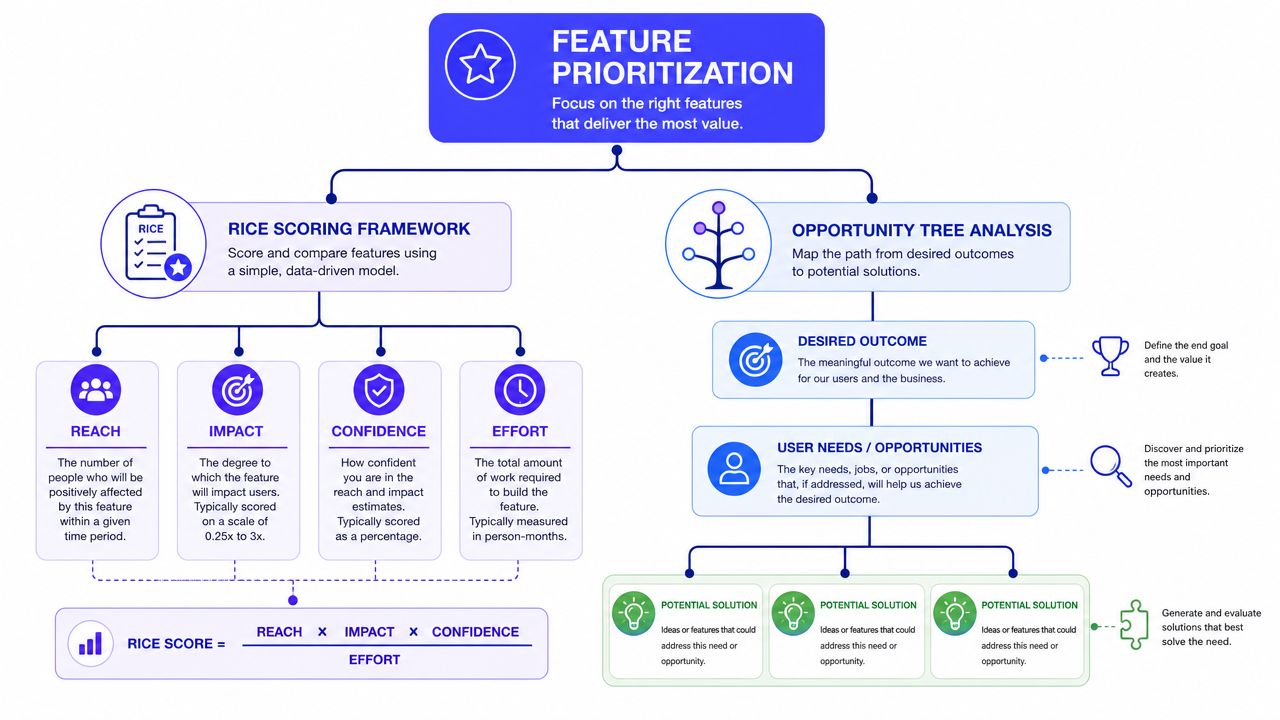
Choosing Your Prioritization Framework
| Criterion | RICE Score | Opportunity Solution Tree |
|---|---|---|
| Best for | Ranking known feature options | Exploring strategic problem areas |
| Starting point | Candidate backlog items | Desired outcome |
| Main question | Which item should we do first | Which opportunity is worth solving |
| Evidence used | Reach, impact, confidence, effort inputs | User needs, pain points, solution options |
| Good fit for | Tactical roadmap decisions | Discovery and problem framing |
Example one with RICE for an internal AI copilot
A company is building an internal copilot for account managers. The feature list includes call summaries, CRM note drafting, renewal risk flags, and email reply suggestions.
A simple scorecard might look like this:
| Feature | Reach | Impact | Confidence | Effort | Decision |
|---|---|---|---|---|---|
| CRM note drafting | High | High | High | Medium | Build first |
| Call summaries | High | Medium | Medium | Medium | Good candidate |
| Renewal risk flags | Medium | High | Low | High | Validate first |
| Email reply suggestions | Medium | Medium | Medium | Medium | Later |
The value of RICE isn't fake precision. The value is forcing the team to explain why one item deserves resources before another.
Here's a useful explainer if your team wants a more tactical resource to streamline feature prioritization in AI-heavy backlogs.
A short walkthrough helps:
Example two with an Opportunity Solution Tree in fintech
A fintech startup has a desired outcome: reduce onboarding friction for new users.
That outcome branches into opportunities such as:
- users don't understand verification steps
- users abandon when document upload fails
- users hesitate when trust signals are weak
- users don't see why completing setup is worth the effort
Potential AI solutions come later:
- guided document capture help
- personalized onboarding explanations
- support assist during verification
- adaptive content based on abandonment patterns
Start with the outcome, then the user struggle, then the solution. Teams that jump straight to “let's add AI chat” usually optimize the wrong layer.
RICE helps you choose among known bets. Opportunity trees help you avoid building polished answers to unimportant questions.
Assembling Your High-Impact AI Product Team
A weak team can ruin a good product development strategy. A well-structured team can rescue an imperfect one. That's especially true with AI because the handoffs are more fragile. Product decisions affect data requirements. Data quality affects model behavior. Model behavior affects UX. UX affects adoption. Operations affects trust.
That's why hiring isn't a downstream task. It's part of strategy.
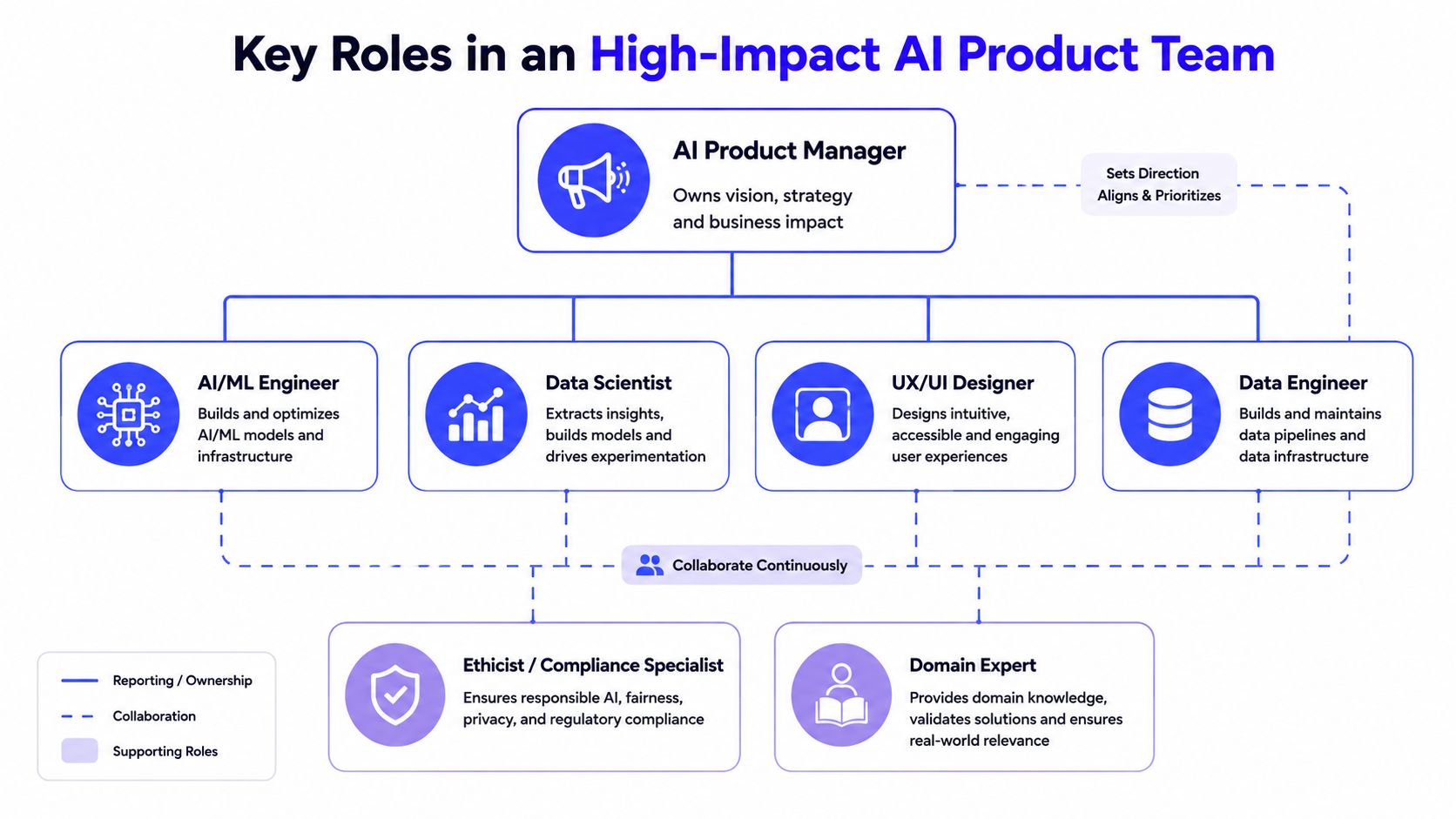
The core roles that matter
AI Product Manager
This person does more than manage backlog and delivery. They frame the problem, define evaluation criteria, translate uncertainty into experiments, and decide what evidence is enough to move forward. A traditional PM can struggle here if they treat model output as a black box.
ML Engineer
This role turns use cases into working systems. They handle model selection, prompt workflows, evaluation logic, and inference behavior. For early-stage teams, this is often the first specialist hire after a strong product lead.
MLOps Engineer
This person makes the system dependable. Deployment, monitoring, rollback paths, versioning, and production reliability sit here. If you skip this role for too long, the team can demo impressive work that never becomes maintainable.
AI-focused UX Designer
AI changes interaction design. Confidence signals, fallback behavior, editability, explanation, and error recovery all need deliberate UX. A generic designer may miss the moments where user trust is won or lost.
Mini case on a computer vision feature
A startup wants to launch a computer vision feature for quality checks in a warehouse workflow.
The team structure is lean but specific:
- AI PM owns the target workflow, acceptance criteria, and rollout scope
- ML Engineer handles model evaluation and inference pipeline behavior
- Data Engineer prepares image ingestion and labeling flows
- UX Designer creates the review screen where staff confirm or correct detections
- MLOps Engineer sets up deployment and monitoring once pilot accuracy is stable
That mix is why team design matters. If the startup only hired backend engineers, it would likely build the integration layer before resolving data quality and review UX.
Hiring in the right order
If you can't hire every role at once, sequence by bottleneck:
Need problem clarity
Add an AI PM or fractional product lead.Need working prototypes
Add an ML engineer.Need stable deployment and monitoring
Add MLOps.Need adoption and trust
Add AI-aware design capacity.
For founders building their first cross-discipline pod, this guide on cross-functional team building is useful because it maps ownership before hiring starts.
Building a Realistic AI Product Roadmap
Most roadmaps fail because they pretend certainty exists where it doesn't. AI work rarely moves in a clean line from spec to delivery. Data quality shifts. evaluation criteria evolve. Integration constraints appear late. User trust issues show up after the demo.
A realistic roadmap is a risk management tool. It should tell the team which assumptions must be answered first, what evidence enables the next phase, and where you're choosing depth over speed.
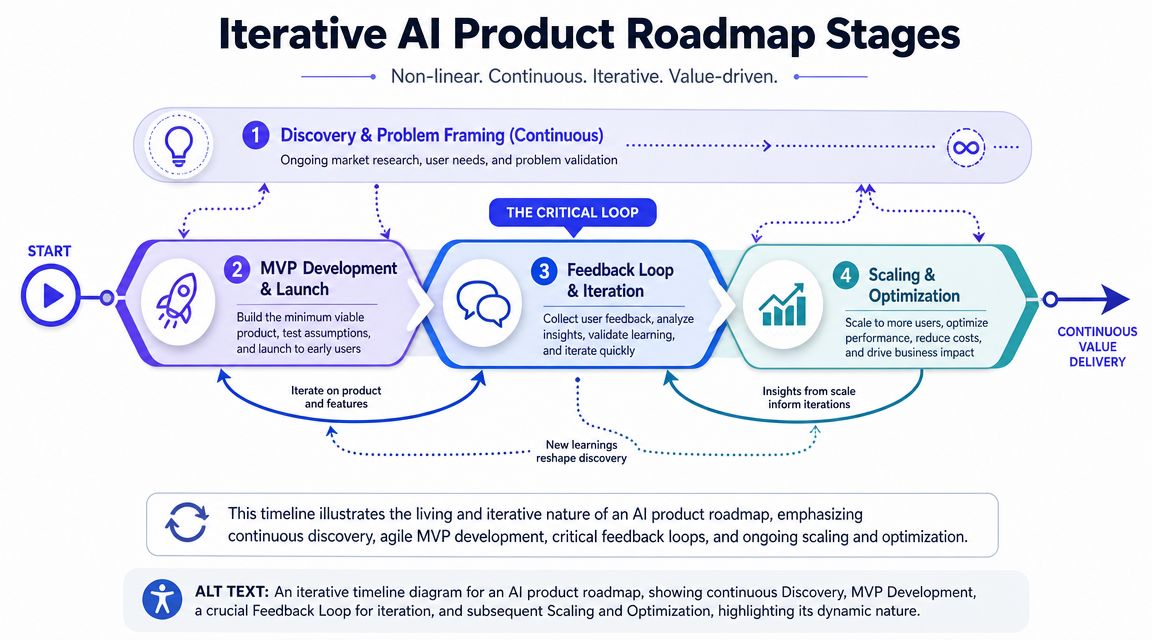
Roadmap by themes, not just features
A better AI roadmap uses themes such as:
- problem validation
- data readiness
- MVP workflow
- human review and fallback
- monitoring and optimization
That structure is more honest than a long feature list because it shows what the team is trying to learn, not just what it plans to ship.
A practical planning reference is this guide to an AI implementation roadmap, especially if you need to align technical milestones with executive expectations.
When slower is smarter
In regulated or high-friction markets, speed can be the wrong optimization. Product strategy needs to decide whether fast launch helps adoption or harms it.
Digital Leadership makes this tension explicit in its discussion of underserved needs and complex markets. It notes that in areas like fintech and enterprise AI, lean-launch playbooks can underperform when trust, security, and integration are bottlenecks, and that strong strategy should optimize for adoption friction, not just build velocity, in its analysis of underserved customer needs.
That matters in practice. A fintech onboarding assistant may need:
- auditability before broader rollout
- clear human escalation paths
- deeper integration with verification systems
- careful language and UX review for trust
Shipping faster without those pieces can create more resistance, not less.
A roadmap earns trust when it shows what won't be rushed.
AI roadmap risk checklist
Use this before you commit dates:
Data availability
Do you have enough representative data for the workflow you want to support?Evaluation clarity
Can the team tell good output from bad output in a repeatable way?Operational ownership
Who handles monitoring, alerts, rollback, and incident response?User safeguards
What happens when the model is uncertain or wrong?Scalability path
Will the MVP architecture survive broader adoption, or are you creating migration debt?
If your roadmap doesn't answer those questions, it's a wish list.
Your AI Product Strategy Template and Checklist
You don't need a giant strategy deck to start. You need a one-page working document that forces clarity.
A useful template should fit on a single page and include these fields:
One-page AI product strategy template
Product vision
What user problem are you solving, and why does it matter now?Target persona
Which user is the first design point?Desired business outcome
What business result should improve if this works?Core OKRs and KPIs
Which signals tell you the feature is useful, adopted, and commercially justified?Key assumptions to test
What must be true for this idea to succeed?Prioritization scorecard
Use RICE for candidate features or experiments.Risk assessment matrix
Cover data, trust, UX, compliance, integration, and operational support.
Pre-build checklist for founders
Run through this before you green-light work:
Problem clarity
Can a non-technical stakeholder explain the user problem in one sentence?Workflow fit
Does the feature sit inside an existing behavior, or are you asking users to form a new habit?Evidence plan
Do you know how you'll validate usefulness before scaling?Team ownership
Is there a named owner for product, ML, UX, and operations?Fallback design
If the AI output is weak, what does the user see and do next?
If you want a complementary operational resource, Cyndra's AI setup checklist is a practical reference for making sure early implementation details don't get ignored.
Next Steps to Execute Your Strategy
The biggest mistake now would be turning this into a reading project. Strategy only becomes real when it changes staffing, sequencing, and decision-making.
Aras emphasizes that strong strategy needs explicit governance, measurable milestones, and a staged roadmap tied to business KPIs such as revenue targets, customer adoption, and time-to-market in its guide to creating a successful product development strategy. That's a useful benchmark because it pushes you to connect concept, prioritization, and delivery before build work begins.
Do these three things next
Draft a one-page strategy for one AI feature
Don't plan an AI platform. Pick one workflow with a clear user and a clear business outcome.Identify the talent gap that will block execution first
If the challenge is problem framing, you need product leadership. If the challenge is prototyping, you need ML engineering. If the challenge is reliability, you need MLOps.Scope a small pilot around a single assumption
Define what you need to learn, what counts as success, and what decision the pilot will inform.
What good execution looks like
You know the strategy is healthy when:
- product and engineering use the same success criteria
- roadmap items are tied to evidence, not wishful thinking
- hiring plans reflect execution bottlenecks
- launch is treated as the start of learning, not the finish line
This is also where one external partner can help if your internal team is thin in AI product, ML engineering, or MLOps. Options range from fractional specialists to a scoped delivery pod. ThirstySprout is one example of a remote AI talent network that helps companies add senior AI engineers, MLOps, and AI product talent for pilots or longer-term builds.
A good first AI feature doesn't need to be ambitious in scope. It needs to be disciplined in strategy.
If you're scoping your first AI feature and need help with team design, validation, or a pilot build, ThirstySprout can help you line up the right AI product, ML, and MLOps talent. Start with a small, clearly owned pilot. Then scale what proves value.
Hire from the Top 1% Talent Network
Ready to accelerate your hiring or scale your company with our top-tier technical talent? Let's chat.