

Open source contribution is no longer a side path for curious engineers. GitHub reported 1.12 billion public and open source contributions in 2025, with 518.7 million merged pull requests and 395 million public repositories, which means open source has become a mainstream production channel that affects dependency choices, hiring signals, and platform strategy GitHub Octoverse 2025. If you lead AI, data, or platform teams, the question isn't whether open source matters, it's whether your contribution strategy is deliberate or accidental.
TL;DR
- Open source contribution is a business activity, not just a community gesture, because it shapes talent discovery, dependency health, and product velocity.
- Non-code work counts. Documentation, triage, testing, review, and governance can be more valuable than a small code patch in the right project.
- Measure the pipeline, not the commit count. Track intake, review latency, merge throughput, and retention so you can see the bottleneck.
- Contribution pays off when governance is healthy. Weak review norms, poor mentorship, and opaque decision-making can waste weeks of effort.
- Start with one upstream project and one measurable goal. Pick a project you already depend on, then define what a successful contribution looks like before you start.
The Scale of Modern Open Source Activity
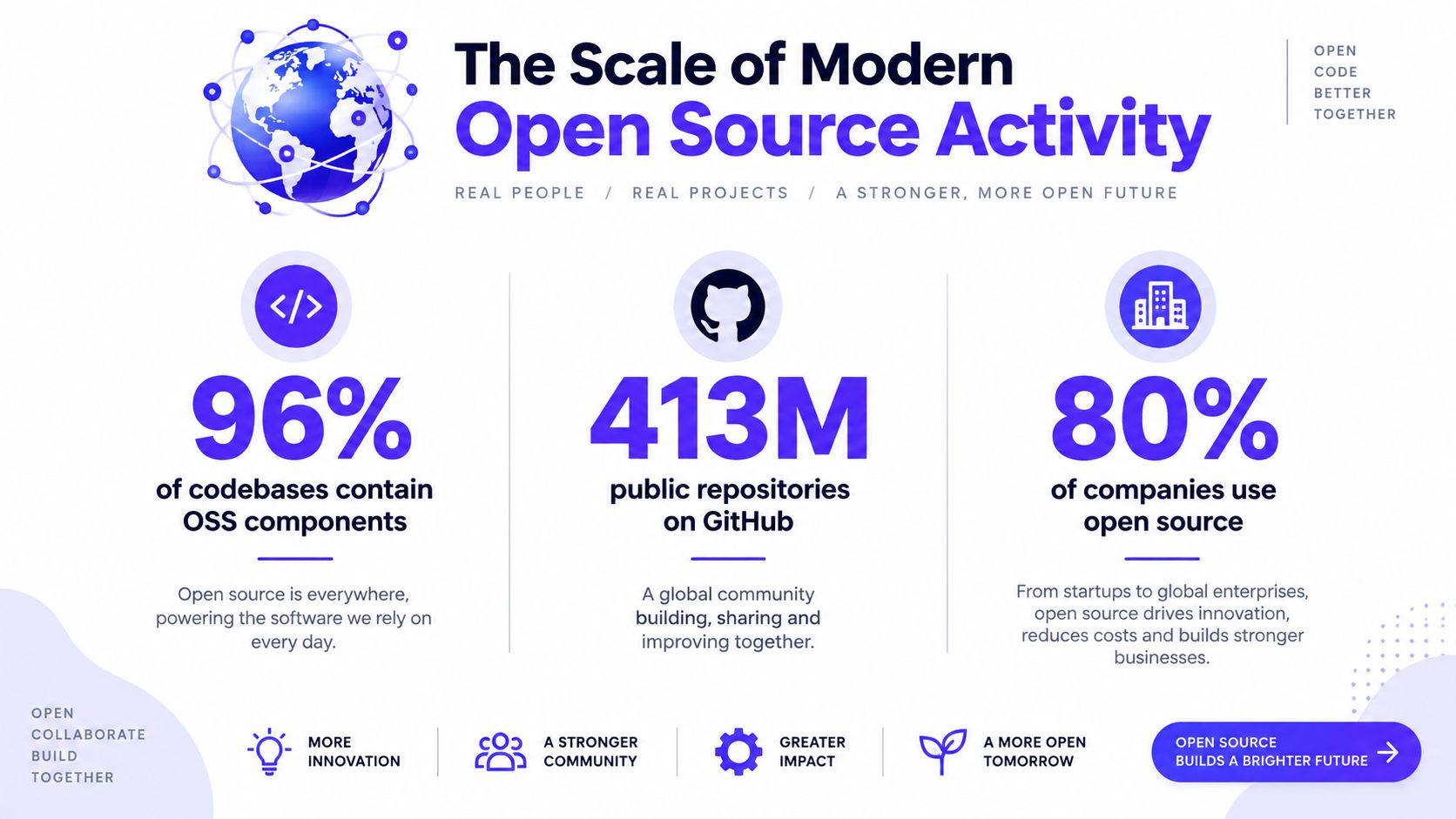
GitHub's 2025 numbers show open source at a scale that engineering leaders can no longer treat as background noise. The report lists 1.12 billion contributions, 518.7 million merged pull requests, and 395 million public repositories, with repository count up 19% from the prior year GitHub Octoverse 2025. It also says March 2025 was the largest single month of new open source contributors in GitHub history, with 255,000 first-timers.
That volume changes the operating model for AI and data teams. Dependencies are not frozen assets, they are live systems with review queues, maintainer capacity limits, and contributor churn, and GitHub's public activity numbers show how much work is flowing through those queues every month. If you own model tooling, orchestration libraries, or platform dependencies, this is part of your delivery surface whether or not your org has a formal open source program.
The hidden cost is governance. More activity means more reviews to wait on, more maintainers deciding what gets merged, and more chances that your internal roadmap gets tied to someone else's process. I have seen teams spend weeks waiting on a small upstream fix because nobody understood the project's decision path or who could approve changes, which is why contribution planning needs the same discipline as dependency risk management.
A practical way to judge scale is to connect it to developer experience. Contributor experience can be measured and improved, not left to chance, and the Creem developer experience guide is a useful reference for that kind of measurement. For AI and ML teams, the useful question is not just how many projects exist. It is whether the projects you rely on have review speed, maintainer clarity, and contribution paths that make upstream work worth the time you put into it.
Practical rule: if your team depends on open source, track contributor health the same way you track build reliability. If the project slows down, your roadmap will feel it later.
Types of Contributions Beyond Code Commits
Teams often overrate the code patch and underrate the work that makes a patch possible. Research on attribution shows recognition in open source is noisy, because projects use different conventions and datasets miss work that isn't a commit Attribution research. That means a good contributor profile can include documentation fixes, issue triage, testing, review comments, and community support, not just merged code.
Code is only one lane
The open source guide from Google makes the point plainly, writing code, reviewing code, Q&A, and testing are all major contribution activities Google Open Source survey summary. In AI and ML projects like PyTorch, Hugging Face, and LangChain, those non-code lanes matter because they reduce friction for everyone else. A useful documentation change can unblock dozens of users, while a strong bug report can save maintainers hours of reproduction work.
A portfolio built only on tiny bug fixes is often weaker than one built on visible, useful work. If you want practical signal, mix contribution types:
- Documentation: clarify install steps, examples, or edge cases.
- Issue triage: reproduce bugs, tag duplicates, or narrow scope.
- Testing: add failing tests that prove a defect exists.
- Community support: answer questions, summarize decisions, or guide new contributors.
- Governance work: participate in RFCs, review norms, or release notes.
How to show real expertise
If you want your work to stand out, tie each contribution to a project outcome. Fixing docs for an LLM evaluation library shows you understand onboarding. Writing tests for a model serving framework shows you understand reliability. Reviewing pull requests in a language tooling project shows you can reason about edge cases and maintainability.
A strong open source profile is a pattern, not a single heroic PR.
Benefits and Risks for Individuals and Organizations
Open source contribution looks different depending on whether you're the individual doing the work or the company paying the bill. The Linux Foundation's 2025 ROI survey says contribution delivers a 2 to 5x return on investment across engagement types, with 3.6x for code, 3.2x for community, 2.4x for financial, and 4.8x for foundation contributions Linux Foundation ROI Survey 2025. That makes contribution a resource allocation question, not a moral one.
| Open Source Contribution ROI by Engagement Type | Engagement Type | ROI Ratio | Primary Benefits | Key Risks |
|---|---|---|---|---|
| Open Source Contribution ROI by Engagement Type | Code | 3.6x | Better upstream fixes, product knowledge, dependency influence | Review delays, maintainer rejection, engineering distraction |
| Open Source Contribution ROI by Engagement Type | Community | 3.2x | Trust, visibility, faster issue resolution | Hard to measure, high coordination cost |
| Open Source Contribution ROI by Engagement Type | Financial | 2.4x | Sponsorship, ecosystem goodwill, sustained maintenance | Weak if unpaired with technical participation |
| Open Source Contribution ROI by Engagement Type | Foundation | 4.8x | Governance influence, long-term ecosystem stability | Requires patience, policy work, and alignment |
For individuals, the upside is skill growth, network access, and credibility inside the ecosystem. For organizations, the upside is more operational, better dependency outcomes, stronger recruiting signals, and more influence over the tools your teams use every day. The downside is also real. Maintainer burnout, review friction, legal review, and opportunity cost can turn a good intention into a hidden tax on senior engineers.
The value is also unevenly distributed. A Harvard Business School paper noted that 96% of demand-side value comes from only 5% of OSS developers, which explains why a small core can carry so much of the ecosystem's load Open Source Funding Survey 2024. That concentration is useful to remember when a company assumes “someone else will maintain it.” Often, that someone else is already overloaded.
Operational takeaway: contribute where you already consume. The closer the upstream project is to your product path, the easier it is to justify the time.
The Contribution Workflow From Fork to Merge
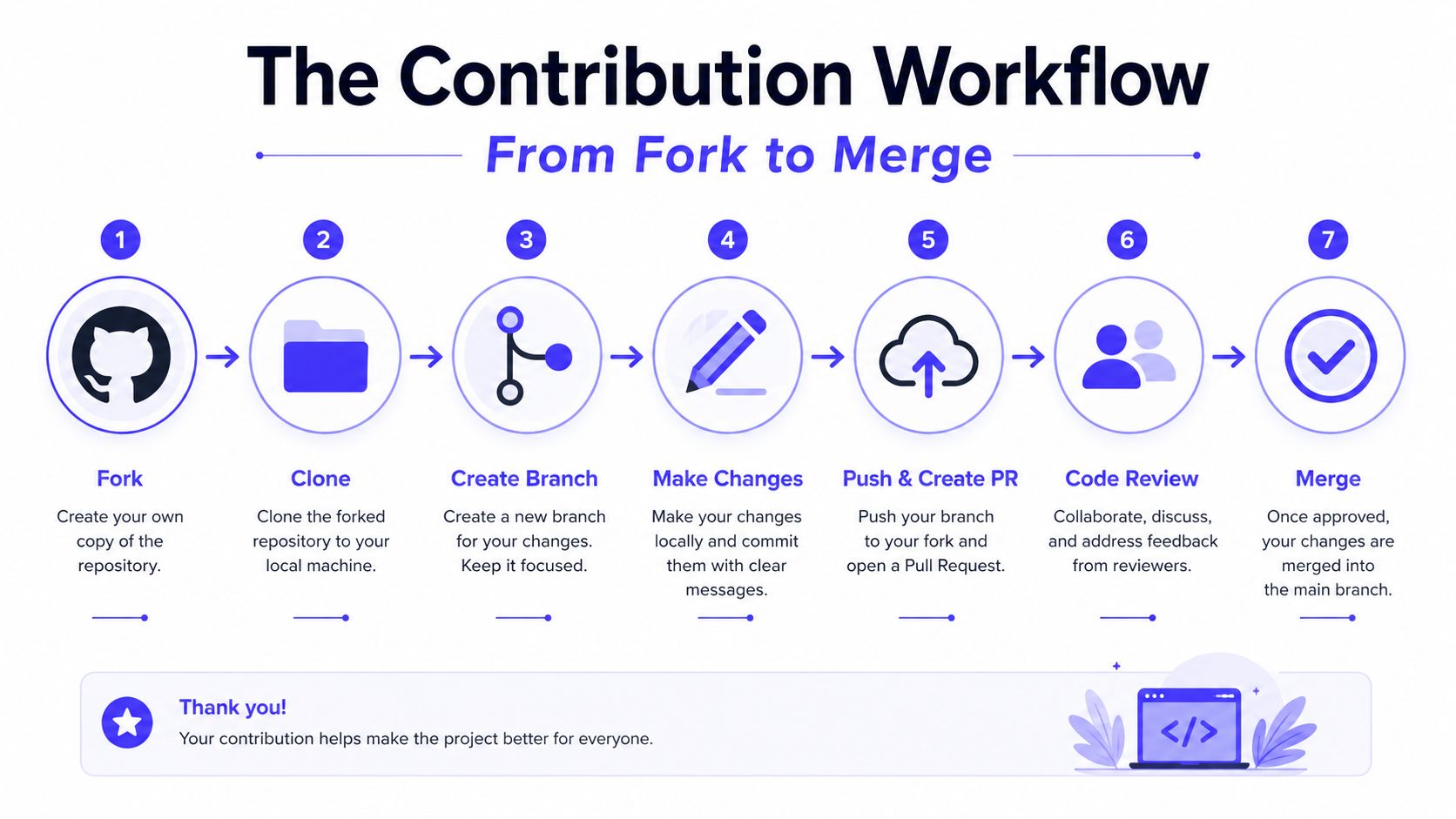
A contribution that looks straightforward in a diagram often breaks down in the details. GitHub's contribution guide recommends that you fork the repository, clone it locally, add the original project as an upstream remote, pull from upstream regularly to reduce merge conflicts, create a branch, reference relevant issues in the pull request, and test before submitting GitHub contribution guide. If your team uses AI code generation tools, the same discipline still applies. Verify the output, follow project conventions, and stay responsible for the final submission GitHub contribution guide.
For a machine learning library, the path is usually more disciplined than ambitious:
- Fork and clone the repo.
- Add upstream so you can sync with the project.
- Create a feature branch for one fix only.
- Make the smallest useful change.
- Run tests locally before you push.
- Open the PR with context, issue link, why it matters, and what you tested.
- Respond to review comments without mixing unrelated changes into the same branch.
That sequence is simple, but the hidden cost shows up fast. Every extra file in the branch adds review time, and every unclear commit message increases the chance that maintainers will ask for a rewrite instead of a merge. For AI or ML teams, the risk is even higher because a model-related patch can touch code, documentation, evaluation logic, and release notes at the same time. If you want a practical comparison of how contribution workflows differ across platforms, this GitLab and GitHub comparison is useful when deciding where the work should live.
Branch hygiene pays off because it reduces governance friction, not just technical friction. A messy branch forces reviewers to reconstruct intent, check whether the change is scoped correctly, and decide whether the contributor followed project rules. A clean branch keeps the review focused on the change itself, which matters when maintainers are already balancing triage, releases, and community support. In practice, that is the difference between a contribution that gets absorbed and one that sits in review.
Measuring Contribution Health as a Pipeline
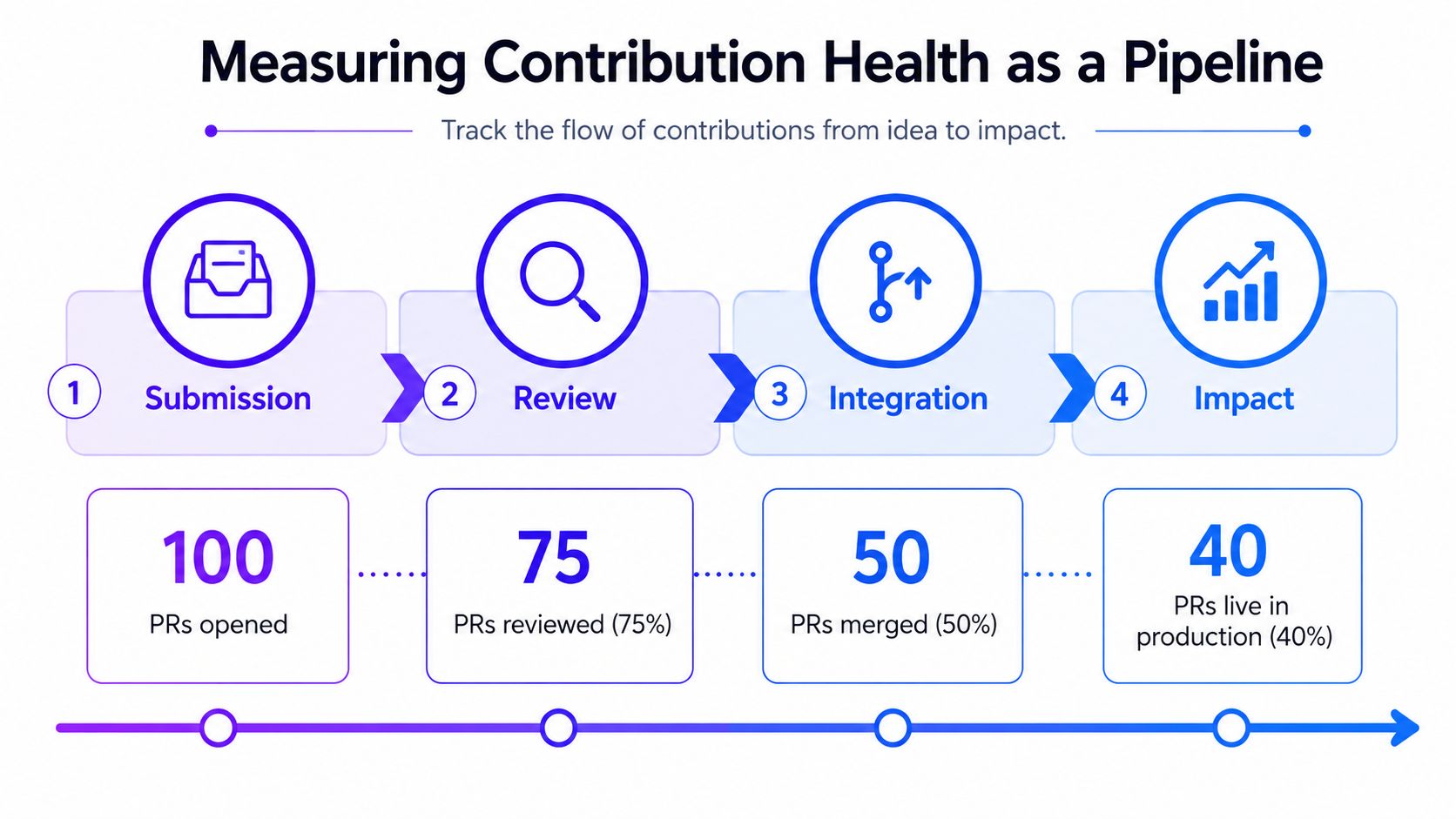
Commit totals don't tell you whether a contribution program is healthy. A pipeline view does. The Open Source metrics guide recommends tracking total contributors, commits per contributor, first-time vs. repeat contributors, open issues and pull requests, issue and PR age, whether issues are closed by PRs, and average time to merge. Those signals show where work is getting stuck, whether at intake, review, or merge.
Count stages, not just volume
High submission numbers can still hide a weak program. If reviews stall, the bottleneck is review capacity. If issues stay open and pull requests stack up, triage or maintainership is the problem. If first-time contributors never return, onboarding is failing even when raw activity looks healthy. A contribution dashboard should mirror the pipeline your maintainers work through.
As noted earlier, attribution is technically noisy, so commit counts alone miss documentation work, issue triage, reviews, and other non-code artifacts. Counting only code also pushes teams toward the wrong incentives, because the work that keeps projects usable often happens outside the commit log Attribution research. That risk is higher for AI and ML teams, where model behavior, docs, tests, and infrastructure all shape the user experience. For teams trying to measure that broader delivery chain, the DevOps for machine learning guide is a useful reference point.
A practical dashboard can stay simple and still be useful:
- Intake health: open issues, first response time, issue age.
- Review health: PR age, review turnaround, number of review cycles.
- Merge health: merge rate, merge latency, reopened PRs.
- Retention health: first-time contributor repeat rate, contributor mix, non-code contribution share.
A good dashboard does one more thing. It helps you see governance costs before they become program costs. When review queues grow, maintainers often absorb the delay as invisible labor. When attribution is narrow, leaders undercount the work that keeps the project healthy and overinvest in the easiest-to-measure activity. Measure the pipeline, not just the output, and you get a clearer view of where contribution is creating value and where the process is breaking down.
Building the Business Case for Contribution Investment
The business case starts with one question, what upstream dependency or ecosystem gap is costing your team time, risk, or opportunity right now? If the answer is “a lot,” contribution is cheaper than repeated workarounds. If the answer is fuzzy, you probably need a smaller pilot rather than a program.
The strongest rationale is usually a mix of three things. First, contribution reduces dependency risk because you can influence the upstream roadmap. Second, it shortens time-to-value because your team stops carrying private fixes forever. Third, it helps with hiring because engineers are more likely to join companies that visibly invest in the tools they use.
The funding survey data makes this easier to defend internally. Organizations worldwide contribute $7.7 billion USD to open source software each year, and 86% of that value comes from employee labor rather than direct payments Open Source Funding Survey 2024. That means most open source investment is already happening as salary time. The decision is whether that time is shaped intentionally or wasted reactively.
The simplest budget model is this:
- Identify one upstream dependency that matters to your roadmap.
- Assign one owner who can spend protected time on it.
- Pick one measurable outcome, such as fewer forked fixes, faster bug resolution, or better onboarding.
- Review the result after one quarter, then expand only if the project is healthy.
If your team is deciding between upstream contribution and maintaining a private fork, favor upstream when the project has clear governance and active maintainers. Keep the fork only when risk, compliance, or roadmap control makes upstream work impractical. The wrong answer is usually to do neither and hope the dependency stays stable.
Choosing Projects With Healthy Governance and Inclusive Norms
Not every project deserves your time. Some have strong code but weak governance, and that creates a hidden cost for contributors. A recent Linux Foundation guide on participating in open source communities calls out barriers faced by underrepresented groups, including discrimination, communication friction, and lower leadership representation, which can lead to worse retention and higher turnover in practice Linux Foundation community guide.
A quick project scorecard
Before you assign anyone to a contribution effort, check these signals:
- Governance clarity: Is there a code of conduct, CONTRIBUTING guide, and decision path?
- Review quality: Are PR comments constructive, specific, and timely?
- Mentorship capacity: Do maintainers answer questions, or do they disappear?
- Inclusion norms: Are newcomers treated like future contributors, or like interruptions?
- Sustainability: Is the core team active, or is one person carrying everything?
If the project looks opaque, your team will spend more time decoding social rules than improving software. That's a bad trade for a startup and a worse one for a large enterprise, because the opportunity cost scales with seniority. You want projects where contribution time compounds into knowledge, relationships, and influence.
For maintainers and contributors alike, the easiest signal is how disagreement is handled. If reviews are terse, defensive, or inconsistent, the project will likely burn people out. If the community explains why a change was rejected and points contributors toward a better path, that's a healthier place to invest.
The internal operating model matters too. Good source code management practices make contribution easier to track, review, and maintain across teams, which is why a clear branch and review discipline pays off long before a PR is opened source code management guide.
If you want a practical open source contribution strategy for your AI or engineering team, ThirstySprout can help you scope the work, identify the right upstream projects, and staff the people who can deliver it. Visit ThirstySprout to start a pilot, then use that time to turn contribution into a measurable part of your product, platform, or talent strategy.
Hire from the Top 1% Talent Network
Ready to accelerate your hiring or scale your company with our top-tier technical talent? Let's chat.