

Your board is reviewing an AI assistant that summarizes customer interactions, a fraud model that prioritizes alerts, and a vendor scoring engine used in underwriting. The uncomfortable question isn't whether each system has a model card. It's whether anyone can explain who owns the outcome when the system changes, fails, or produces a decision nobody expected.
Model risk management (MRM) provides that accountability. In 2026, however, a traditional inventory of statistical models isn't enough. You also need controls for generative artificial intelligence (GenAI), agentic systems, external application programming interfaces (APIs), and foundation models that your team can't inspect or retrain.
This guide focuses on the operating decisions that matter: what belongs in scope, how to validate and monitor it, how to challenge vendor claims, and how to build a defensible program without slowing every release.
Why Model Risk Management Matters in 2026
A credit scoring model can drift while approval rates remain normal. A fraud system can miss a new attack pattern. A recommendation engine can reinforce unfair outcomes. The warning may surface only after customers complain, losses appear, or a supervisor requests evidence.
Without model risk management, the organization must reconstruct basic facts under pressure:
- Ownership: Who approved the system, and who can stop it?
- Purpose: Which decision was it designed to support?
- Evidence: What testing shows that it performs within its limits?
- Change history: What changed since the last review?
- Response: What happens when results cross an agreed threshold?
A functioning MRM program turns the same failure into a controlled incident. The team identifies the affected system, isolates the change, reviews monitoring data, applies compensating controls, and escalates through a documented chain. MRM does not remove model risk. It keeps uncertainty from becoming the dominant risk.
Practical rule: A model failure is manageable when your organization can state what changed, who owns the response, and which decisions were affected.
MRM became a formal banking discipline on April 4, 2011, when the Federal Reserve and the Office of the Comptroller of the Currency issued SR 11-7, widely adopted supervisory guidance dedicated to model risk management. The Federal Deposit Insurance Corporation later adopted the same framework in June 2017. The agencies described the approach as risk-based, matched to a bank's model risk profile and the size and complexity of its operations. Federal Reserve SR 11-7
The 2026 operating environment creates three pressures. Organizations use more analytical systems, rely more heavily on third-party and foundation models, and deploy GenAI and agentic systems that may sit outside formal model definitions. Those systems still influence decisions, trigger actions, or shape customer outcomes. MRM must therefore provide accountability even when the underlying system is supplied externally or cannot be inspected.
GenAI and agentic systems do not always fit neatly inside formal model definitions, so MRM should operate alongside a broader AI risk management program. That broader control layer should cover system behavior, access, human oversight, and escalation, while MRM tests fitness for purpose, limits, monitoring, and remediation.
What Model Risk Management Really Means
Model risk management is the systematic process of identifying, assessing, validating, monitoring, and mitigating the risk that a quantitative model or analytical system produces harmful decisions or operates beyond its approved limits. MRM is a control function, not a document collection exercise. It tests whether a system remains fit for purpose throughout its lifecycle, with evidence that supports decisions about approval, restriction, remediation, or retirement.
Data risk asks whether inputs are accurate, complete, available, and traceable. MRM asks whether the system converts those inputs into reliable outputs for a defined decision. A clean dataset will not rescue a badly specified credit model, and a strong algorithm cannot compensate for a broken production pipeline.
AI ethics and MRM address different questions. Ethics examines fairness, transparency, human impact, and societal consequences, while MRM tests reliability, limitations, governance, effective challenge, and remediation. Govern both disciplines, especially when a GenAI or agentic system influences a decision without fitting neatly inside the organization's formal model inventory.
The banking origin of MRM
The framework has expanded beyond its original banking applications. Supervisory materials now sit alongside the OCC's model risk management handbook booklet and a 2021 statement on bank systems supporting Bank Secrecy Act and Anti-Money Laundering compliance. That progression matters because teams now need controls for statistical models, machine learning, foundation models, and systems that vendors update without exposing their underlying logic.
Treat “outside the model definition” as a governance question, not an exemption. If a GenAI assistant recommends an action, or an agentic system triggers one, assign an owner, define acceptable use, record evidence, and set escalation rules even when the system is classified as a tool rather than a model.
What MRM should deliver
Your MRM function should produce confidence that every in-scope system has:
- A named owner and approved purpose.
- Documentation of data, assumptions, methodology, limitations, and material dependencies.
- Independent validation or an equivalent effective challenge.
- Monitoring tied to meaningful performance and risk indicators.
- Change controls, issue escalation, and retirement evidence.
- A clear accountability record for third-party and foundation-model dependencies, including what your team can test and what it must control through contracts, usage limits, and monitoring.
The development team builds and operates the system. The control function challenges it. That separation does not require risk teams to remain detached from engineering, but it does require enough independence, expertise, and authority to reject weak evidence. A vendor's assurance report can inform your assessment. It cannot replace accountability for the decisions your organization makes.
A Practical Taxonomy of Model Risk
A useful taxonomy should help a team classify an incident quickly and choose a control response. Four categories cover most operational discussions: design, implementation, use, and third-party risk.
Design risk starts before code. A credit model might omit a relevant population characteristic, rely on an assumption that no longer holds, or optimize for a proxy that doesn't match the business decision. The control response is conceptual review, documented intended use, data and variable rationale, benchmarking, sensitivity analysis, and challenge from reviewers who understand both the method and the decision.
Implementation risk appears when a sound design becomes a faulty production system. A transformation can map values incorrectly. A pipeline can deliver stale data. A deployment can invert a score or load the wrong model version. Require code review, reproducible tests, deployment approvals, data-quality checks, version control, and post-deployment reconciliation.
Use risk occurs when people apply a model beyond its approved purpose. A treasury forecasting model may support liquidity planning but not be suitable for a different capital decision. The control is a clear use statement, access restrictions, user training, approval for extensions, and monitoring that detects out-of-scope behavior.
Third-party risk deserves its own category. A vendor may provide limited documentation, update a model without adequate notice, or restrict independent testing. Vendor assurance is evidence, not validation. Your response should include contractual change notification, audit rights, performance and incident data, independent onboarding tests, and an exit plan.
Model Risk Taxonomy at a Glance
| Category | Typical Failure Mode | Control Response |
|---|---|---|
| Design | Assumptions or variables don't fit the decision | Conceptual review, benchmarking, sensitivity testing |
| Implementation | Code, pipeline, or deployment error changes outputs | Reproducible testing, version control, release approval |
| Use | Users apply outputs outside approved limits | Use restrictions, training, access control, extension approval |
| Third-party | Opaque model, weak evidence, or undocumented update | Contract rights, independent validation, monitoring, exit plan |
The taxonomy prevents a common mistake: treating every incident as a “model performance” problem. Some failures come from the model's design. Others come from code, people, vendors, or governance. The remediation should match the cause.
The Model Lifecycle and the Controls at Each Stage
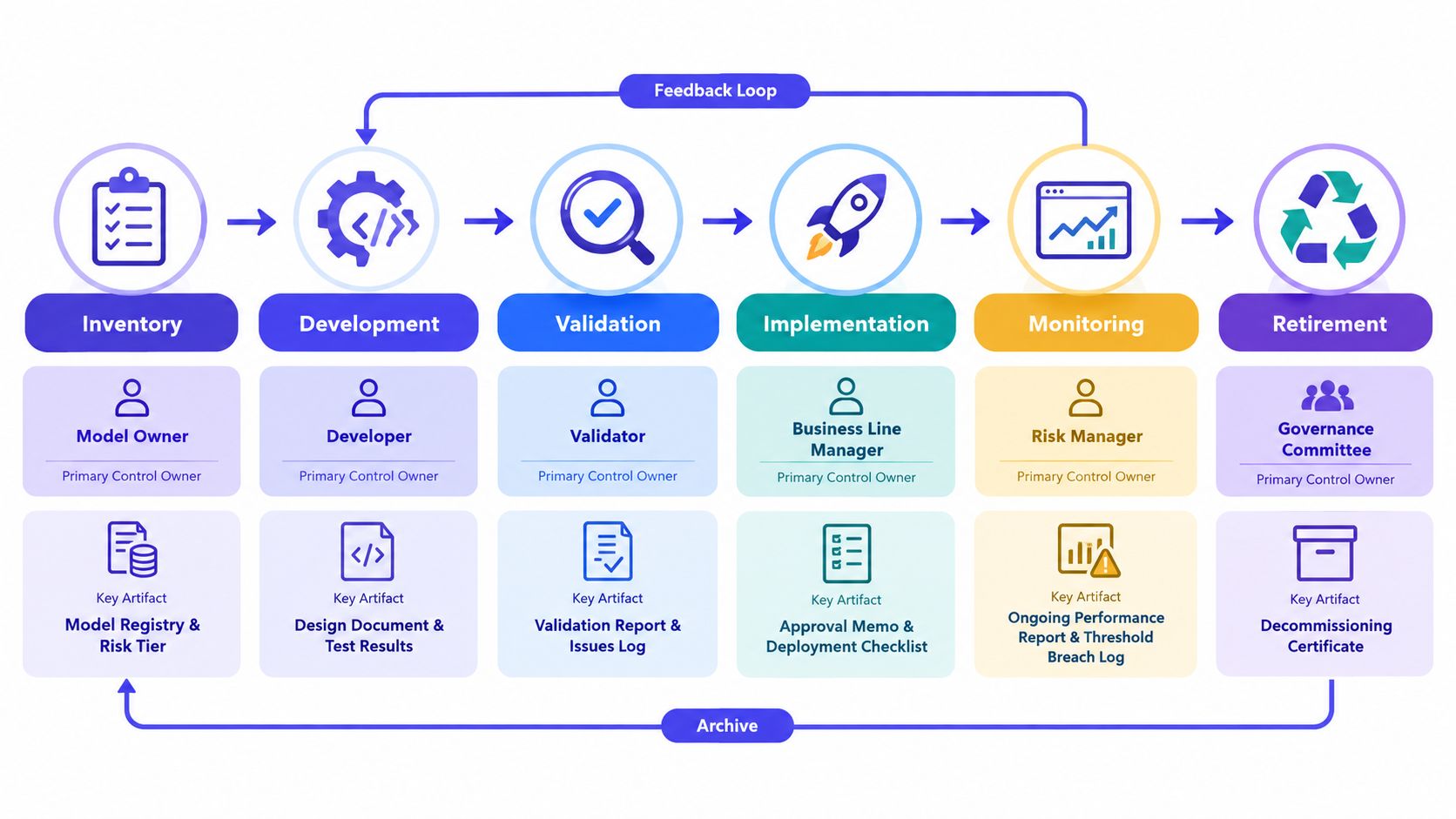
MRM works only when each lifecycle stage has an owner, an approval point, and an inspectable artifact. A policy statement without evidence is not a control.
Inventory
The model owner registers every model or governed analytical system, including systems still under development. Each entry should record its purpose, users, dependencies, risk tier, material decisions, data sources, vendor involvement, current version, and status.
The artifact is a model registry and risk tier. The registry must remain the program's source of truth. Banking inventories now span hundreds and, at some institutions, thousands of models. The survey also found that around one fifth of commercial-bank respondents manage more than 1,000 models.
Treat GenAI and agentic systems as governed systems when they influence decisions, recommendations, records, or workflows, even if a vendor says they fall outside the formal definition of a model. Record their prompts, tools, retrieval sources, permissions, human-approval points, and failure boundaries in the inventory.
Development
The developer produces the design document, data lineage, assumptions, intended-use statement, limitations, test results, and implementation details. For an AI system, include prompt or retrieval configuration, evaluation datasets, safety controls, tool permissions, and the conditions that require re-review.
The artifact is a model documentation pack. Do not approve a vendor system because its overview is polished. Require evidence connecting its behavior to your use case, and document what cannot be inspected in a foundation model or hosted service. That limitation must become a control requirement, not a footnote.
Validation
An independent validator reviews conceptual soundness, implementation, assumptions, limitations, monitoring design, and outcomes analysis. Back-testing compares predicted behavior with observed outcomes. The artifact is a validation report and issues log, not a sign-off email. FDIC validation expectations
Approval and implementation
A governance committee or delegated approver reviews validation findings, open issues, residual risk, usage limits, thresholds, and exit criteria. The artifact is a committee record, approval memo, and deployment checklist. Release approval should cover model changes, prompts, retrieval sources, connected tools, and permissions.
Monitoring
The first line monitors drift, outcome stability, population shifts, data quality, incidents, overrides, and activity outside approved boundaries. The artifact is an ongoing performance report and threshold breach log. Assign an owner for vendor updates and require review when the provider changes the model, controls, or service behavior.
Retirement
Retirement requires usage shutdown, dependency checks, archival, access removal, retention decisions, and notification to affected users. The artifact is a retirement memo or decommissioning certificate. Without this handoff, old models can remain active in reports, undocumented spreadsheets, or downstream services.
Validation, Monitoring, and Effective Challenge
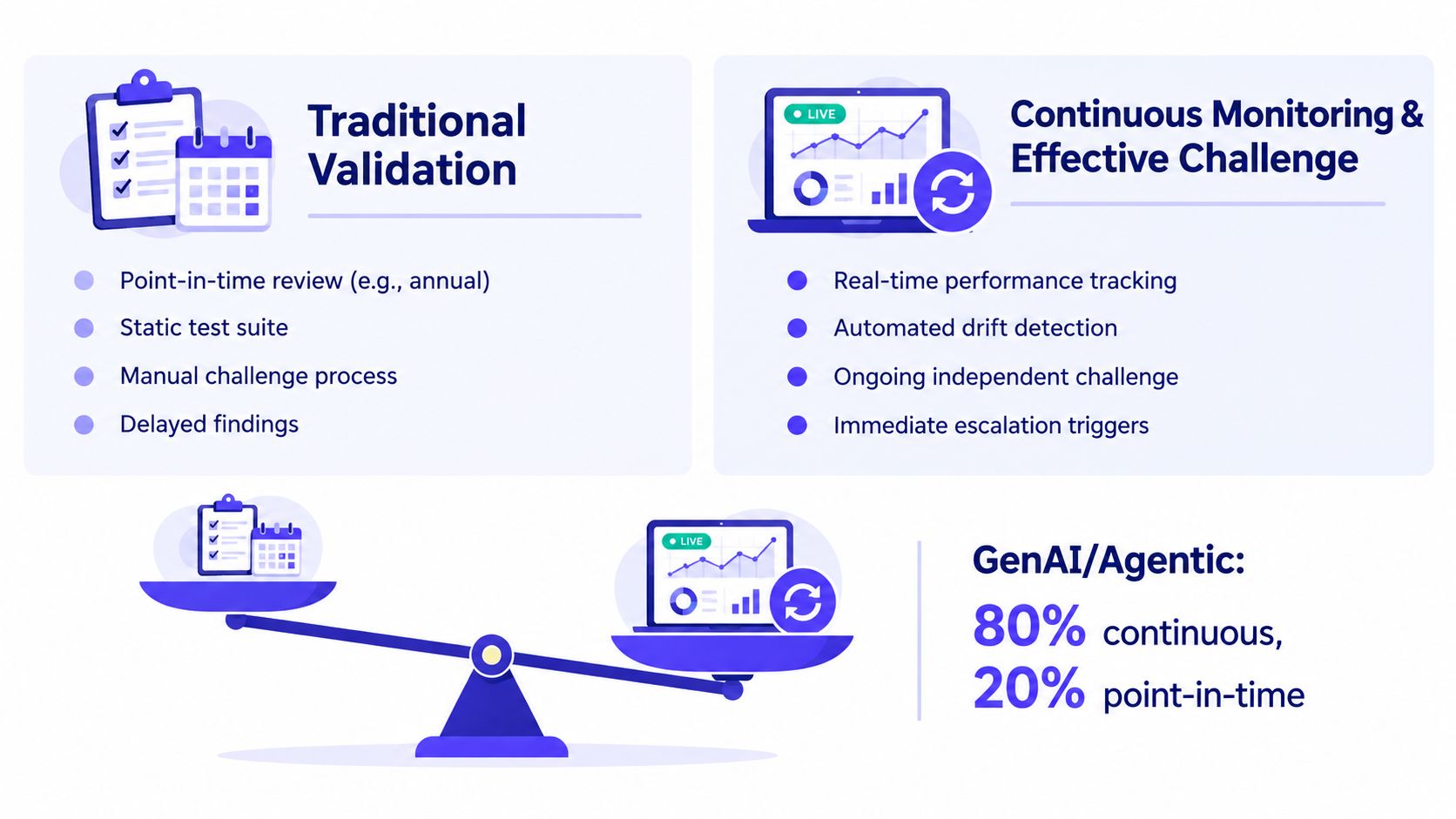
A model can pass validation and fail in production weeks later. Validation tests whether the design, implementation, assumptions, and intended use are defensible at a defined point in time. Monitoring tests whether that judgment still holds as data, users, markets, prompts, and operating conditions change.
Three controls that must work together
Validation creates entry assurance. The deliverable should record findings, limitations, severity, owners, target dates, compensating controls, and a clear recommendation. It should also create the issues log used after release.
Monitoring creates in-life assurance. Automate data-quality checks, drift detection, output sampling, threshold alerts, and incident routing where practical. A breach must trigger action, not sit in a dashboard. For example, if an approved error threshold is exceeded, route the alert to the named owner, open or update the corresponding validation issue, assess affected decisions, and document remediation or a temporary usage restriction.
Effective challenge keeps both controls credible. Qualified reviewers must be able to question methodology, reproduce important results, inspect implementation evidence, and force a decision when evidence is incomplete. Independence matters more than a polished vendor report.
GenAI and agentic systems require a different evidence trail. For foundation models, test boundaries, prompts, outputs, retrieval behavior, harmful-content risks, privacy, and use-case constraints when weights and training data are unavailable. For agents, inspect decision traces, tool calls, permissions, overrides, and human escalations. A response-quality dashboard alone cannot show whether an agent stayed within authority.
Teams can evaluate Verifai AI compliance engineering for organizing compliance evidence and engineering controls. Treat it as supporting infrastructure, not a substitute for independent challenge.
Production controls need an operating layer. An AI observability platform can collect traces, evaluation results, drift signals, and incident evidence, provided the monitoring thresholds and escalation owners are defined first.
Third-Party, GenAI, and Agentic Models
Buying access to a model doesn't transfer accountability. It often increases the MRM burden because you control the decision, customer communication, permissions, and response even when the vendor controls the underlying system.
Start with a vendor and model inventory tied to risk tier. Record the model's purpose, inputs, outputs, version, update process, dependencies, data handling, known limitations, service commitments, and approved use. Contract language should provide audit rights, access to relevant performance and incident information, change notification, support for testing, and exit and contingency arrangements.
The vendor's validation report is an input to your review. It isn't proof that the system works for your population, workflow, thresholds, or regulatory context.
Controls for GenAI and agents
For GenAI and foundation models, require:
- Data provenance: Identify the data sources used in retrieval, tuning, or configuration, and document restrictions.
- Output evaluation: Sample outputs against accuracy, relevance, harmful-content, privacy, and policy criteria.
- Change control: Treat model updates, prompt changes, retrieval changes, and policy changes as validation triggers.
- Human escalation: Define when a person must review, override, or block an output.
- Incident response: Route severe failures to a named owner with documented containment and remediation.
For agentic systems, add scoped permissions, action logs, kill switches, tool-call review, pre-deployment simulation, and explicit approval for irreversible actions. If your team needs background on how multi-step AI systems coordinate tools and tasks, review what is AI orchestration.
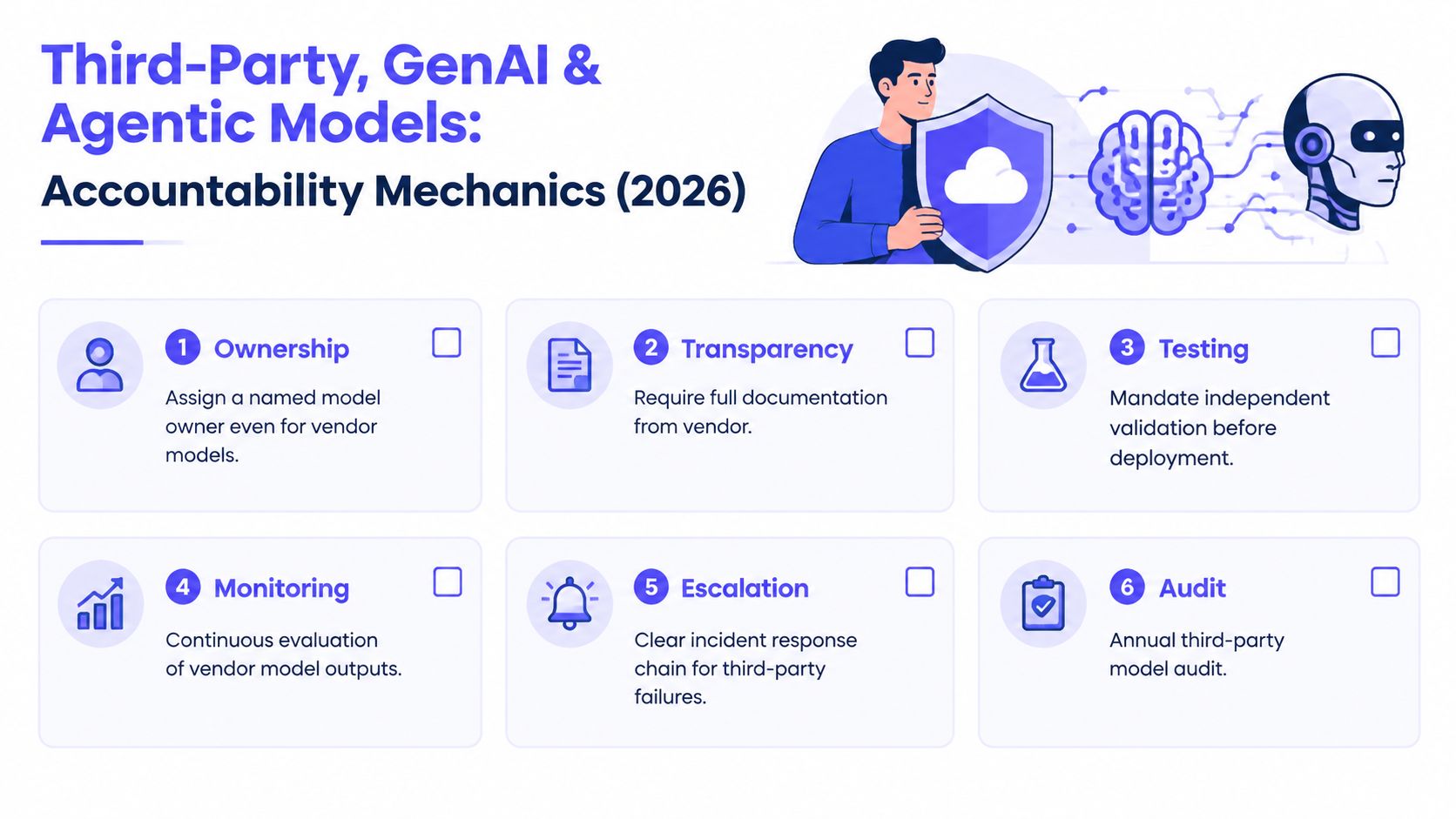
Adopt this risk committee checklist:
- Ownership: Assign a named internal owner.
- Transparency: Obtain documentation, limitations, and update information.
- Testing: Complete independent validation before deployment.
- Monitoring: Evaluate outputs continuously against approved criteria.
- Escalation: Define the incident chain and shutdown authority.
- Audit: Preserve evidence and exercise contractual review rights.
Teams assessing agents should also use an AI agent evaluation framework that tests actions and traces, not just final text.
The European Union AI Act provides concrete operational anchors for relevant systems. Article 55 requires providers of general-purpose AI models with systemic risk to perform standardized evaluations, document adversarial testing, assess and mitigate systemic risk, report serious incidents without undue delay, and maintain adequate cybersecurity protection. EU AI Act Article 55
A 90-Day Playbook to Stand Up MRM
A first MRM program shouldn't attempt to perfect every policy before controlling the systems that matter most. Build a working operating model, prove it on priority use cases, then expand.
Days 1 to 30, scope and inventory
The MRM lead works with engineering, product, compliance, procurement, and business owners to reconcile the existing registry with real usage. Include credit, fraud, Anti-Money Laundering, pricing, forecasting, customer decisioning, GenAI assistants, agents, vendor APIs, and foundation-model services.
Define “model” for your formal MRM scope, then create a connected bridge register for systems outside that definition but capable of causing material operational, compliance, customer, or safety risk. Assign initial tiers based on purpose, exposure, inherent risk, data sensitivity, autonomy, and reversibility.
Exit evidence: a complete inventory for the business lines in scope, named owners, initial tiers, and a documented list of unknown or unclassified systems.
Days 31 to 60, policy and governance
The risk lead drafts a tiered policy that explains which controls apply to each risk level. The charter should define committee membership, approval authority, escalation routes, issue aging, exceptions, and the relationship between MRM, AI governance, third-party risk, privacy, security, and operational resilience.
The validation standard should state who challenges whom, what evidence is required, how material changes trigger revalidation, and how monitoring results feed back into approval decisions.
Exit evidence: policy approval, a signed committee charter, a validation standard, and a remediation process with accountable owners.
Days 61 to 90, execute and test
Prioritize the highest-consequence models for full validation. Stand up monitoring dashboards for performance, data quality, drift, incidents, overrides, and vendor changes. Run one end-to-end challenge drill, from a detected threshold breach through committee escalation, containment, customer impact assessment, remediation, and closure.
Train developers, product owners, approvers, and users on their specific responsibilities. Don't deliver generic compliance training. Show them the artifacts they must create and the decisions they can and can't make.
Exit evidence: priority validation reports, live monitoring for critical systems, a completed challenge drill, and closed or actively controlled high-severity findings.
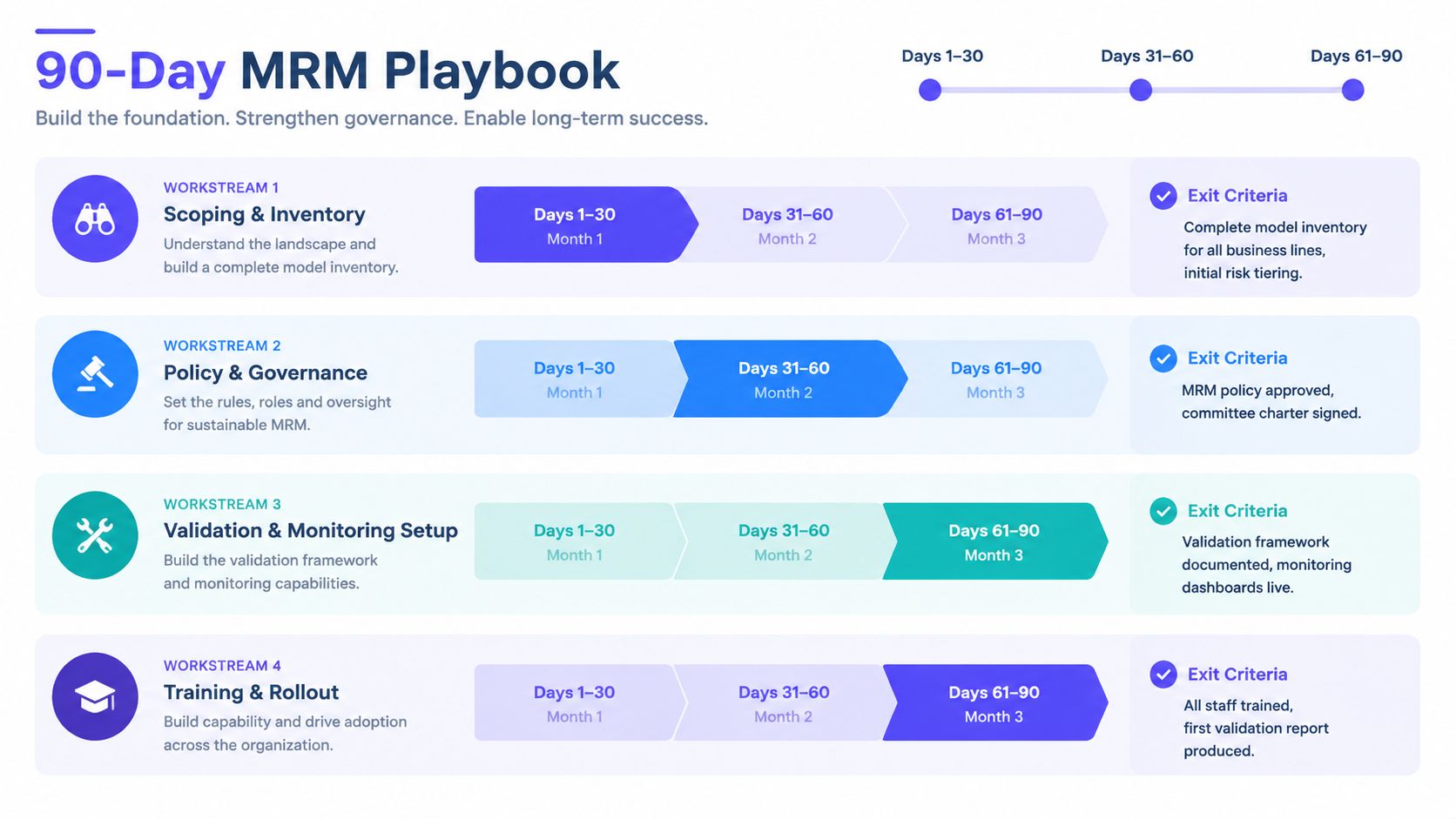
Use the following month-six roadmap to keep momentum:
- Expand coverage: Reconcile remaining inventory gaps and embedded model dependencies.
- Improve evidence: Automate registry updates, evaluation records, approvals, and issue tracking.
- Test resilience: Exercise vendor exit, model rollback, agent shutdown, and incident communication.
- Report aggregate risk: Show dependencies, shared data, common vendors, open findings, and concentration points.
Connecting MRM to Business Outcomes and Next Steps
Good MRM isn't a brake on AI delivery. It gives product and engineering teams a repeatable path to deploy systems with known limits, clear ownership, and evidence that reviewers can trust.
That discipline supports faster decisions, fewer surprises during audits, stronger regulator confidence, and safer use of third-party and GenAI systems. The competitive advantage comes from knowing which controls are necessary, which are excessive, and when a model should not ship.
ThirstySprout helps companies hire senior AI engineers, MLOps specialists, data engineers, and complete remote AI teams to build the registries, evaluation pipelines, observability, and governance workflows described here. Visit ThirstySprout to discuss your MRM scope, pressure-test GenAI and third-party controls, and start a focused pilot with the right technical talent.
Hire from the Top 1% Talent Network
Ready to accelerate your hiring or scale your company with our top-tier technical talent? Let's chat.