

Most AI risk advice starts with a policy, an inventory, and a committee. That order is backwards for production teams. A policy can't stop an employee from sending sensitive material to an unapproved assistant, and an inventory can't contain an agent that can call downstream services after its scope changes.
The practical definition of AI risk management is simpler: identify where AI operates, understand what can go wrong, install controls that limit the blast radius, and collect evidence that those controls work. NIST's AI Risk Management Framework, released on January 26, 2023, formalized that lifecycle around Govern, Map, Measure, and Manage. NIST's AI RMF timeline and implementation resources show how the discipline moved from advisory discussion toward structured governance.
This guide is for CTOs, engineering leaders, product teams, security owners, and procurement teams that need a workable program within weeks. It focuses on enforcement, runtime evidence, and decisions you can make with the team and systems you already have.
Why Most AI Risk Programs Fail in Production
A complete AI inventory can create false confidence. 86% of organizations say they have a complete AI inventory, while 59% still admit shadow AI exists and remains ungoverned. The State of AI Risk Management 2026 report exposes the enforcement gap: recording a system does not control its data, permissions, outputs, or ability to trigger actions.
Software delivery shows the same failure. 70% of organizations have seen AI-code vulnerabilities reach production, even though teams trust their detection tools and report that tool sprawl interferes with remediation. The International AI Safety Report 2026 notes that evidence for the effectiveness of resilience measures remains limited, while evaluation methods continue to develop.
Policy coverage isn't control coverage
A governance deck can define acceptable use, approval gates, and escalation. Production systems need mechanisms that enforce those decisions, including access restrictions, gateway policies, action allowlists, human approval points, rollback paths, and service-level monitoring.
A customer-support copilot makes the distinction clear. A policy may prohibit disclosure of confidential account data. A working control verifies retrieval scope, redacts sensitive fields, blocks unauthorized tool calls, records the decision, and routes uncertain actions to a person. If the model changes or a vendor endpoint behaves differently, the team needs a test and response path, not another paragraph in the policy.
Practical rule: Every material AI risk should map to an owner, a control, a signal, and an action.
Fragmented assurance creates a second blind spot. Cybersecurity may review identity and prompt injection, privacy may review data handling, legal may review intellectual property, and procurement may review the vendor. Each team can finish its own review while no one owns the combined failure mode.
Use a production readiness checklist for AI systems to connect those reviews to deployment evidence. The checklist should identify the approved system, the data it can access, the actions it can take, the method operators use to stop it, and the person who accepts residual risk.
Containment beats confidence
Inventories and policies still matter, but they should not consume the entire program budget. Assume discovery will remain incomplete and design containment around that limitation. Place unapproved tools behind controlled access, restrict sensitive data flows, and make high-impact actions fail closed when authorization cannot be established.
Generated code needs the same security gates as other code, plus AI-specific review for dependency changes, secrets exposure, insecure patterns, and tests that fail to cover intended behavior. Detection tools are useful signals. A trusted alert is not evidence that a vulnerability cannot ship.
The business trade-off is real. Strong controls can slow experimentation when every low-risk use case requires manual approval. Universal blocking is the wrong response. Create lighter paths for low-impact internal work, then reserve stronger gates for systems that affect customers, regulated decisions, sensitive data, or external actions.
The Six AI Risk Categories You Must Cover
AI risk isn't one category with one score. A customer-facing assistant, a hiring model, and an autonomous workflow can share infrastructure while creating very different harms. Start with the system's purpose, users, data, dependencies, and permitted actions, then map risks across six practical categories.
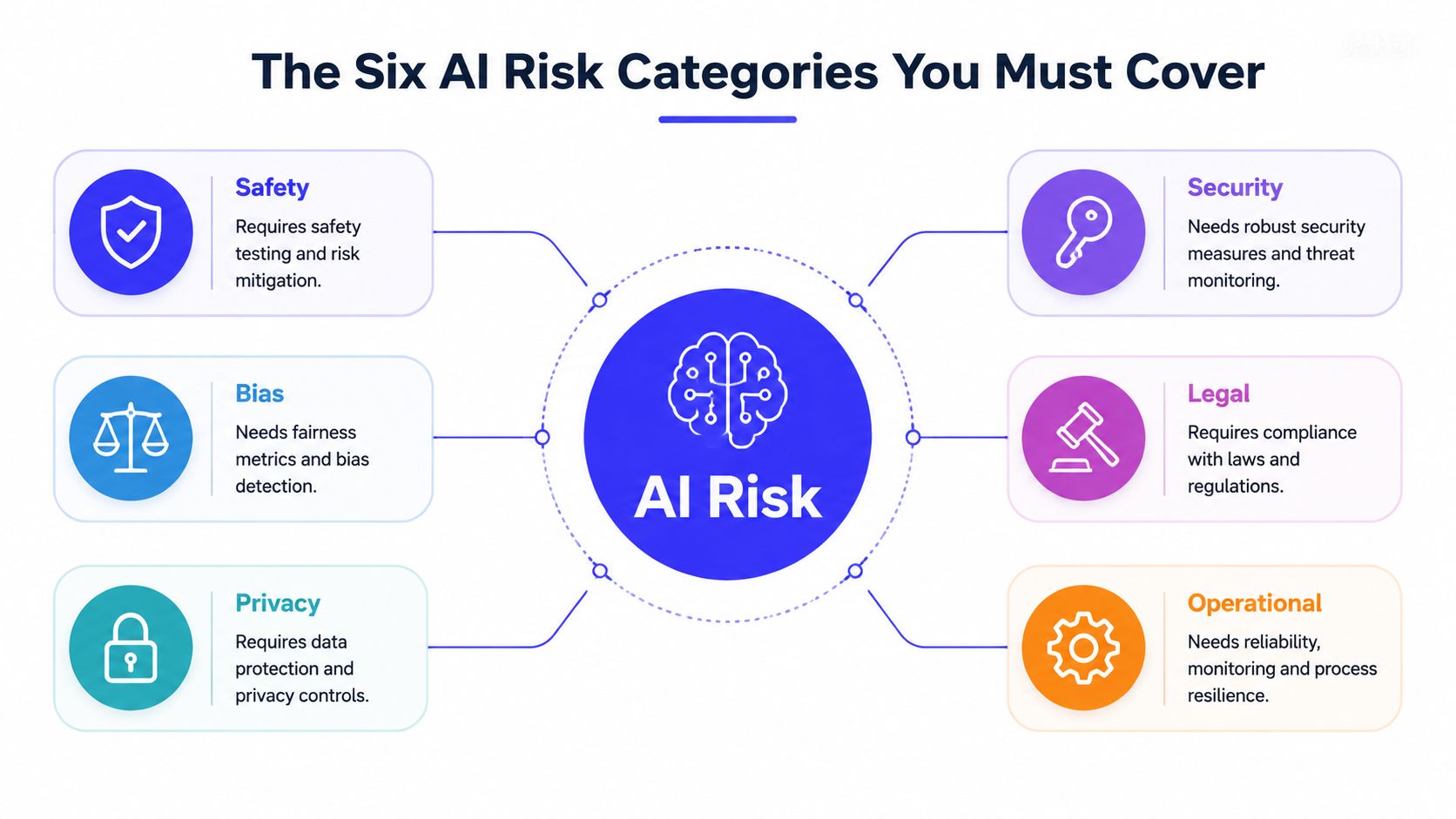
Safety
Safety concerns arise when an output or action can cause physical, financial, or material harm. A support copilot that confidently invents a refund policy creates a customer-impact risk. A system used in a clinical or industrial workflow needs stronger validation, human oversight, and a clearly defined safe state.
Measure safety against realistic tasks and failure modes. Test refusal behavior, uncertainty handling, escalation, and the consequences of an incorrect output. A generic benchmark won't tell you whether your workflow can safely handle its most consequential edge case.
Bias
Bias occurs when data, labels, model behavior, or workflow design produces unfair outcomes for relevant groups. Hiring and lending systems deserve particular attention because a seemingly small design choice, such as a proxy feature or uneven review process, can affect access to opportunity.
Your assessment should document the decision being supported, the populations affected, the available evaluation data, and the human review process. Use the AI bias mitigation guide to turn a broad fairness concern into testable assumptions, review criteria, and remediation ownership.
Privacy
Privacy risk covers collection, retention, retrieval, prompts, fine-tuning, logs, and vendor processing. A system can protect its model endpoint while still leaking sensitive information through conversation history or an overbroad retrieval index.
Limit data by purpose. Redact or tokenize sensitive fields, apply role-based access, define retention, and inspect logs for accidental exposure. Privacy review should include the full data path, not just the model provider's terms.
Security
Security controls address prompt injection, data exfiltration, unauthorized access, model extraction, insecure dependencies, and compromised tools. Treat model output as untrusted input when it reaches a parser, database, shell, or API.
A gateway can enforce authentication, rate limits, content checks, and tool permissions. The application still needs authorization at the action layer, because a safe-looking response can contain an unsafe instruction.
Watch the explainer below for a concise view of how these categories connect in practice.
Legal
Legal exposure may involve regulatory classification, disclosure, intellectual property, contractual commitments, and records needed to explain a decision. Legal review works best when engineers provide concrete system facts, including intended purpose, data sources, user groups, model dependencies, and deployment geography.
Avoid treating legal risk as a final sign-off. A model update, new data source, or newly enabled tool can change the original assessment.
Operational
Operational risk appears when models drift, vendors change behavior, dependencies fail, or teams can't reproduce a decision. Define service ownership, fallback behavior, model and prompt versioning, dependency health checks, and incident response before launch.
A useful risk register records the category, failure mode, affected asset, preventive control, detection signal, response owner, and review date. That structure helps teams prioritize material gaps instead of assigning one vague score to the entire AI system.
Choosing the Right Governance Framework
NIST AI RMF, ISO/IEC 42001, and the EU AI Act solve different enforcement problems. NIST provides a flexible operating model, ISO/IEC 42001 defines an auditable management system, and the EU AI Act creates legal duties for covered systems. Choosing one is less important than assigning each framework a job.
NIST organizes its AI RMF around Govern, Map, Measure, and Manage. NIST's official AI RMF core gives engineering teams a practical way to connect product decisions, ownership, evidence, and risk treatment without requiring certification. Use it to establish operating routines, not to produce a policy that nobody enforces.
ISO/IEC 42001:2023 specifies requirements for establishing, implementing, maintaining, and continually improving an AI Management System. ISO/IEC 42001's scope summary covers leadership, policy, risk management, data governance, transparency, performance monitoring, and continual improvement. Certification can provide repeatable evidence for customers and assurance teams, but it does not replace runtime testing, access controls, or release gates.
The EU AI Act is a legal framework rather than an internal operating playbook. Its official overview addresses risk assessment and mitigation, training data, logging, technical documentation, human oversight, resilience, cybersecurity, and accuracy for high-risk systems. Prohibited practices and AI literacy obligations began applying on 2 February 2025. The European Commission's AI Act overview provides the implementation context.
| Framework | Best For | Certification | Key Requirement | Timeline |
|---|---|---|---|---|
| NIST AI RMF | Teams building an internal risk program | No | Govern, Map, Measure, and Manage AI risks across the lifecycle | Use as an iterative operating model |
| ISO/IEC 42001:2023 | Organizations needing an auditable management system | Yes, through an appropriate conformity process | Establish, operate, monitor, and improve an AI Management System | Treat implementation as a managed program |
| EU AI Act | Providers and deployers covered by European Union obligations | Depends on system and applicable conformity route | Classify systems, apply controls, retain evidence, and meet obligations | Sequence work by system classification and obligation |
Apply the frameworks in layers
Start with NIST when teams lack a shared method for ownership, evidence, and risk decisions. Map its functions to security, privacy, software delivery, procurement, and vendor processes. That keeps governance close to the systems engineers already operate.
Add ISO/IEC 42001 when external assurance or internal audit requires documented, repeatable management-system activity. Set clear evidence owners and review points. Certification can strengthen accountability, while weak deployment controls still leave production exposure unchanged.
Use EU AI Act classification rules to determine applicable obligations. Article 6 of the EU AI Act describes high-risk treatment for certain product safety components and Annex III systems, including documentation for relying on the exception concerning significant risk or material influence. Framework selection should therefore follow enforcement needs, system classification, and the controls teams can verify in production.
Running an AI Risk Assessment in One Sprint
A useful assessment creates decisions, owners, and control work. It should not become a document nobody opens after launch. A focused sprint can establish a credible baseline if the team limits scope to one product area, workflow, or related system set.
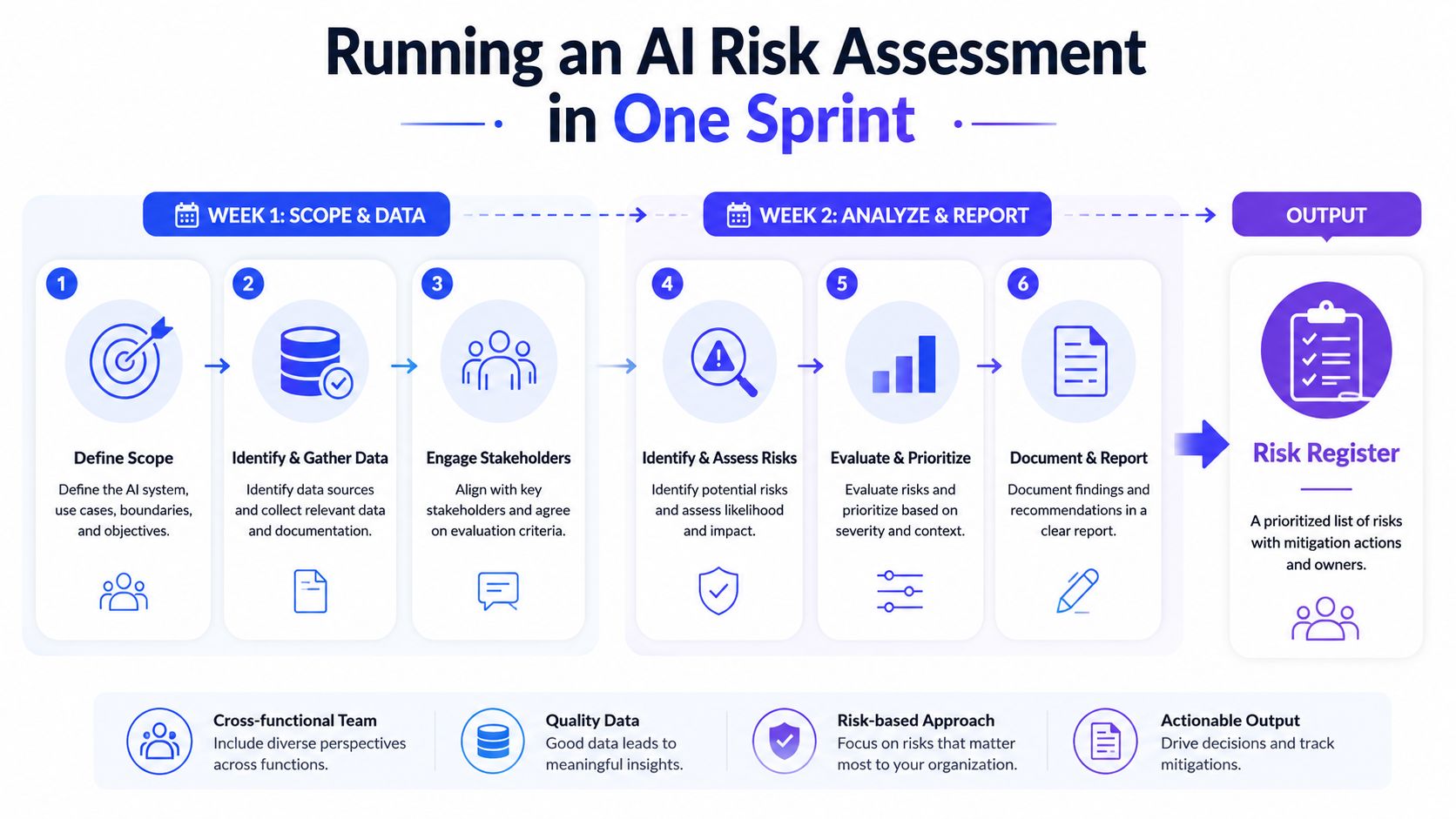
Week one focuses on scope and evidence
Day one, assign ownership. Name the engineering owner, business owner, security or privacy reviewer, and final risk approver. Define the system boundary, including model APIs, retrieval stores, data pipelines, prompts, tools, users, and downstream services. Clear ownership prevents risks from becoming shared, and therefore ignored.
Days two and three, discover usage. Combine repository searches, cloud and SaaS reviews, procurement records, identity logs, developer interviews, and expense data. Ask teams which assistants, model APIs, plug-ins, and automation tools they use, including tools that have not passed formal procurement. This step exposes the enforcement gap between a reported inventory and actual usage.
Days four and five, map material risks. Record intended and prohibited use, affected people, sensitive data, external actions, failure modes, dependencies, and fallback behavior. Classify the system qualitatively as low, medium, or high impact using consequence and exposure, not model novelty.
The week-one output is a system record, data-flow sketch, and initial risk register.
Week two turns gaps into control decisions
Days six and seven, test important paths. Run representative prompts, adversarial inputs, access checks, data-leakage tests, tool-authorization tests, and failure simulations. For generated code, check whether ordinary code review and security testing catch the defects that matter. A trusted detection tool is not evidence that vulnerabilities cannot reach production.
Days eight and nine, choose remediation. Prioritize controls that reduce blast radius quickly, such as removing unnecessary permissions, adding human approval for consequential actions, restricting retrieval scope, or creating a rollback path. Balance speed against coverage: a narrow control deployed now often reduces exposure more than a broad control still awaiting implementation.
Day ten, record acceptance and cadence. Every unresolved risk needs an owner, rationale, compensating control, target date, and review trigger. Record the evidence required to close it, then schedule reassessment after material changes, incidents, or new data access.
Use this template:
| NIST function | Evidence to collect | Decision |
|---|---|---|
| Govern | Owner, policy, escalation route, review cadence | Who can approve, pause, or reject use |
| Map | System boundary, data flow, users, harms, dependencies | What can go wrong and who is affected |
| Measure | Test results, monitoring signals, incident findings | Which controls work and where evidence is weak |
| Manage | Remediation plan, rollback, acceptance record | What changes now and who follows up |
Implementing Controls for Shadow AI and Agentic Systems
Shadow AI needs a containment strategy, not a reprimand campaign. Teams adopt unapproved tools when approved paths are slow, unavailable, or poorly suited to the task. Block everything and employees will often move the work to personal accounts or less visible channels.
Consider a fintech team that discovers 47 ungoverned AI tools during a usage review. The useful response isn't to publish a longer acceptable-use document. The team can group tools by data access and action capability, approve a small set of safe use cases, block sensitive data transmission at the gateway, route exceptions through procurement and privacy review, and give developers a supported internal alternative.
The key evidence is not the number of tools discovered. It's whether the team can show which tools remain active, what data they receive, which identities access them, and how exceptions expire or receive renewed approval.
A SaaS platform faces a different problem when an agent can read tickets, call internal APIs, and update records. After a production incident, the team can install a kill switch at the orchestrator, restrict tools with purpose-specific allowlists, require human approval before irreversible updates, cap action sequences, and automatically roll back when validation checks fail.
Design for bounded autonomy
Agentic systems need controls at several layers:
- Purpose limits: Give each agent a narrow job, defined inputs, permitted tools, and explicit prohibited actions.
- Action authorization: Check identity, resource, and business permission at execution time. Don't rely on the model's interpretation of policy.
- Human checkpoints: Require review before external communication, financial changes, account status changes, or destructive operations.
- Containment: Isolate credentials, data stores, queues, and network paths so one failure doesn't spread.
- Runtime signals: Monitor tool calls, denied actions, unusual volume, repeated retries, sensitive-data access, and divergence from expected workflows.
- Recovery: Keep a kill switch, rollback procedure, and manual fallback that operators have tested.
For financial-services teams evaluating autonomous decision making for banks, the important question is not whether an agent can complete a workflow. It is whether the institution can prove authorization, explain the decision path, stop execution, and recover when a dependency or model changes.
Use a focused AI agent evaluation framework before expanding autonomy. Measure task success alongside unauthorized action attempts, escalation quality, policy violations, and recovery behavior.
Building Your AI Risk Management Roadmap
A 90-day roadmap should scale controls beyond the first assessment. Each phase needs an operational artifact, a tested handoff, and evidence that the control works in production. The enforcement gap is the priority: organizations may report complete inventories while shadow AI remains ungoverned, and AI-code vulnerabilities can still reach production despite confidence in detection tools.
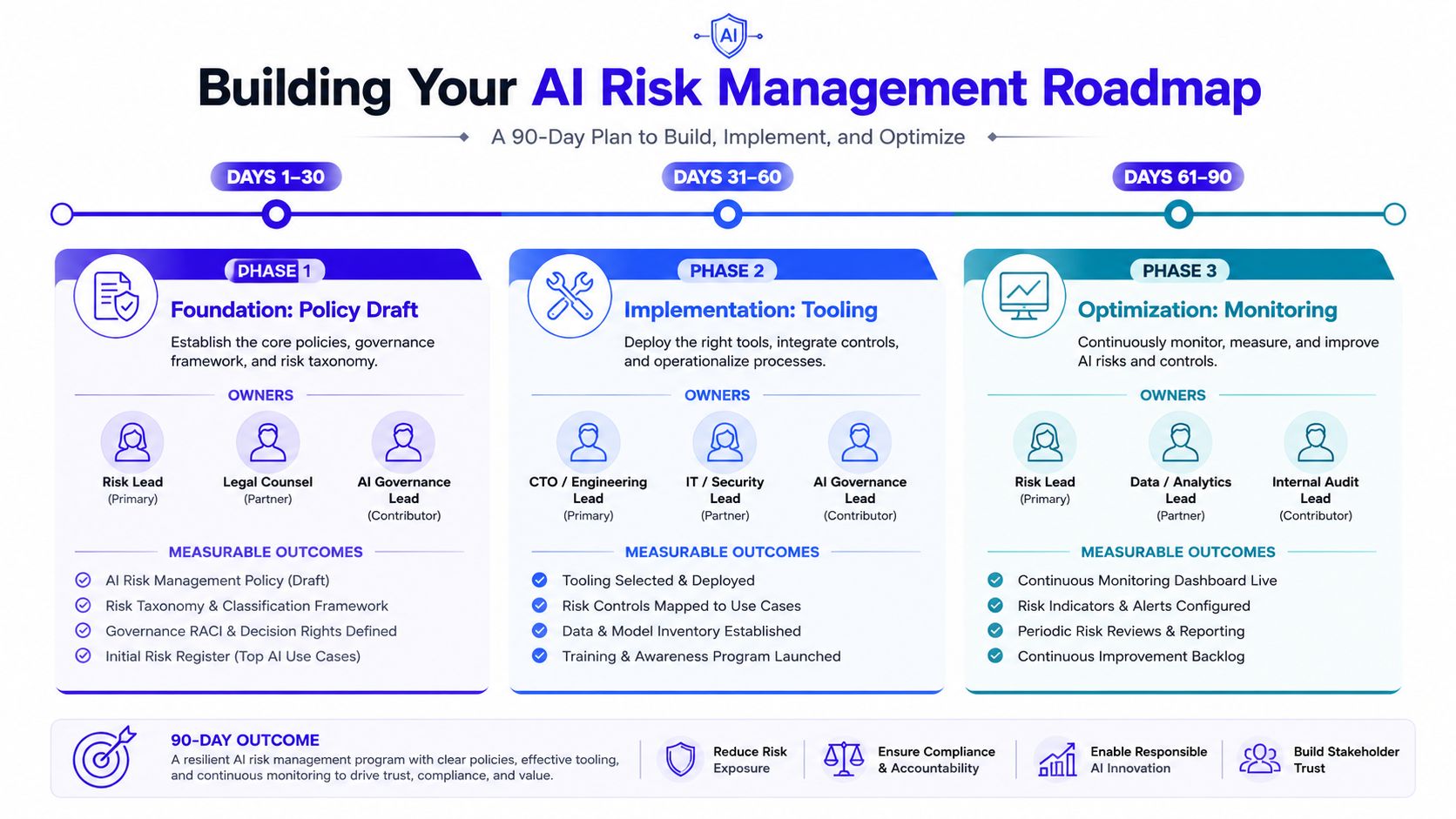
Phase one establishes the foundation
During weeks 1–4, turn the initial assessment into a repeatable operating model. Reconcile procurement records, cloud telemetry, code repositories, and access logs to expose unregistered use. Classify systems by impact, define prohibited data flows, publish acceptable-use rules, and select high-value systems for deeper control testing.
The output should be a usable inventory record, system boundaries, data-flow diagrams, approval criteria, and escalation paths. Standardize the fields and review process so new models, vendors, prompts, and workflows enter the same intake path instead of creating another spreadsheet.
Phase two puts controls into the path
During weeks 5–8, move controls from recommendations into shared platforms and development workflows. Add gateway enforcement, least-privilege access, retrieval filtering, tool allowlists, human checkpoints, logging, and rollback mechanisms where system risk justifies them. Add automated checks to code and deployment pipelines so vulnerable AI-generated code cannot bypass review simply because a scanner reports a clean result.
Monitoring should answer operational questions. Did the system access data outside its purpose? Did it attempt a denied tool call? Did review outcomes change after a model update? Can the team identify the version, prompt, data source, and user involved in an incident?
Phase three creates audit readiness
During weeks 9–12, test incident response, review exceptions, close high-priority gaps, and assemble evidence for customer due diligence or formal assurance. Align records to NIST's four functions, or to management-system requirements if the organization is implementing ISO/IEC 42001. Then set a release gate for material model, vendor, data, and workflow changes, so the roadmap continues after the initial rollout.
| Phase | Primary owner | Deliverables | Outcome |
|---|---|---|---|
| Foundation | AI risk owner and engineering lead | Inventory, classification, policy, intake process | Known scope and repeatable onboarding |
| Implementation | Platform, security, privacy, and product teams | Gateways, permissions, tests, monitoring, rollback | Enforced controls in production paths |
| Optimization | Risk owner and assurance stakeholders | Incident exercises, evidence pack, exception review | Scalable oversight and improvement |
Sequence expansion by blast radius. A low-impact internal summarization tool may need basic data handling and access controls. An agent connected to customer records needs containment and recovery before broader permissions.
Measuring What Matters and Next Steps
A policy count is not a safety outcome. Measure whether controls change production behavior: incidents, unauthorized action attempts, bypassed controls, remediation time, rollback readiness, unresolved exceptions, and the quality of reviewer escalations. Pair each metric with an owner and a threshold that triggers investigation or a release pause.
The enforcement gap deserves its own measure. Organizations may report complete inventories while shadow AI remains outside governance, and AI-code vulnerabilities can still reach production despite confidence in detection tools. Track inventory coverage against observed usage, the percentage of systems with enforced intake, and vulnerabilities found after release. These measures test whether governance operates in real delivery paths, not merely whether documentation exists.
Different stakeholders need different views. Engineers need actionable failures and owners. Legal and privacy teams need lineage, approvals, and retention evidence. Executives need material exposure, business impact, and investment decisions. Boards need accountability, trend direction, and confidence that the organization can stop and recover from a serious failure.
Use International AI Safety Report 2026 as context, not proof that an artifact makes a system safe. Set a next-step review date, record unresolved assumptions, and update controls when incidents or evaluations change the risk picture.
Start this week
- Name an owner: Assign one accountable AI risk owner for each production system.
- Set a cadence: Tie recurring reviews to model, prompt, data, vendor, and workflow changes.
- Document escalation: Define who can pause the system, investigate, and accept residual risk.
- Start a watch log: Track legal changes, vendor terms, incidents, and control exceptions.
- Test a kill switch: Demonstrate that operators can stop high-impact actions and restore a safe fallback.
ThirstySprout helps companies add senior remote AI engineers, MLOps specialists, data engineers, and AI product talent for governance and production-control work. Visit ThirstySprout to discuss a pilot.
Hire from the Top 1% Talent Network
Ready to accelerate your hiring or scale your company with our top-tier technical talent? Let's chat.