

You're probably staring at a model that looks good in aggregate, yet a few user segments keep getting worse outcomes, and nobody on the team can agree on whether it's a data problem, a threshold problem, or a product decision problem. This is the practical reality of AI bias mitigation in production, not a theoretical fairness debate, but an operating problem with customer, compliance, and revenue consequences.
The practical answer is to treat fairness like any other reliability domain. Define it up front, measure it continuously, mitigate with the least disruptive change that works, and govern it with documented review and monitoring. That approach lines up with the lifecycle view in the Berkeley Haas playbook, which emphasizes checking for and actively mitigating bias at every stage of development, along with documenting data sources and variables (Berkeley Haas AI Bias playbook).
Your End-to-End AI Bias Mitigation Framework
The cleanest way to run AI bias mitigation is as a loop, not a one-time cleanup task. Start by framing the problem, then detect disparities, mitigate the cause, and govern the system after launch. That sequence matters because fairness failures usually come from a mix of data selection, label quality, model design, and deployment choices, not one isolated mistake.
Frame the problem before you touch the model
Before training starts, define who can be harmed and what “fair” means for the use case. A credit model, a hiring screen, and a medical triage tool won't share the same fairness target, so the metric has to match the business decision. APEC's best-practices paper is clear that fairness should be defined in a way that allows quantitative measurement, and that teams should choose between metric-based, causal, and similarity-based approaches based on the problem (APEC best practices).
Practical rule: if the team can't name the protected groups, the decision point, and the harm being avoided, the model isn't ready for fairness work yet.
Detect bias with subgroup checks, not averages
Aggregate accuracy hides too much. The literature recommends subgroup-level measurement, including demographic parity, equal opportunity, equalized odds, and causal fairness, because a model can look healthy overall while failing specific populations (stage-wise pipeline review). IBM's open-source AI Fairness 360 toolkit gives teams a standard place to start, with 70+ fairness metrics and 10+ mitigation algorithms for development and evaluation (IBM AI Fairness 360 summary).
Mitigate with the smallest change that solves the gap
Use data-level fixes when representation is the main issue, then move to algorithmic or output-level changes when retraining isn't enough. Research-backed workflows recommend reweighing, suppression, massaging, or multiple imputation at the data layer, followed by threshold adjustment by sensitive feature when needed (stage-wise pipeline review). The key is to avoid treating “fairness” as a generic label, because method choice and use case determine whether the intervention helps.
Govern the system after deployment
Governance is where many teams fail. The Berkeley Haas playbook calls for human-in-the-loop review, internal and external audits, documentation of provenance, and attention to affected communities where possible (Berkeley Haas AI Bias playbook). NIST also says bias mitigation should be multifaceted and involve people with different backgrounds, perspectives, and expertise, because that broadens the view of the engineers who build the system (NIST SP 1270).
For a broader policy lens, the Global Governance Media piece on Global health AI policy insights is useful because it connects technical trust controls to real deployment expectations.
Detecting and Measuring AI Bias in Production
You can't fix what you don't measure, and in production that means fairness has to look like a scorecard, not a vague review note. The most useful bias checks are the ones that fit into release gates, alerting, and model registry metadata, so teams can compare versions over time instead of arguing from screenshots after a complaint.

Use the metric that matches the failure mode
Demographic parity asks whether positive outcomes are distributed similarly across groups. It's useful when access itself matters, such as approvals, invitations, or shortlist decisions. Equal opportunity checks whether true positive rates are similar across groups, which is helpful when missing qualified candidates is the bigger risk. Predictive equality focuses on false positive rates, which matters when incorrect approvals or flags create downstream cost or harm.
A good production setup doesn't try to force every metric into every model. It chooses one primary fairness objective, then tracks one or two secondary checks so the team can see whether a fix improves one dimension while hurting another. That trade-off is why the evidence base favors measurable governance over broad promises of fairness.
Build a bias scorecard before deployment
A simple scorecard gives reviewers a consistent gate. Use it in pull requests, pre-launch review, and incident analysis.
| Scorecard item | What to check | Pass or fail rule |
|---|---|---|
| Group coverage | Are key user groups represented in validation data? | Fail if a group is missing |
| Primary fairness metric | Does the selected metric stay within the agreed tolerance? | Fail if it crosses the threshold |
| Secondary fairness metric | Did the fix create a new gap elsewhere? | Fail if another group regresses |
| Utility check | Did accuracy or task quality stay acceptable? | Fail if business performance falls too far |
| Review status | Did a human reviewer sign off on the result? | Fail if no reviewer is logged |
Operational insight: if the team can't explain why a fairness threshold was chosen, the threshold is probably theater, not governance.
For a deeper measurement workflow, the internal guide on ai agent evaluation frameworks is a useful companion because evaluation discipline and fairness discipline usually need the same release machinery.
Set up tests as release gates
Bias tests should run the same way performance tests run. If a build changes the model, feature set, or thresholds, it should also re-run subgroup metrics on the validation slice. That makes fairness part of quality assurance instead of a post-launch escalation path.
The strongest signal from the systematic review is that mitigation works, but not uniformly. A review of 35 studies found 86% reported effectiveness, while only 3 studies (9%) reported ineffectiveness, which shows that method and context matter more than slogans about fairness (JAMIA Open review). In practice, that means you should treat a fairness metric like any other acceptance criterion, tied to a specific model version and decision use case.
Practical AI Bias Mitigation Techniques
Once the measurement is in place, the decision becomes mechanical. Start with data fixes when representation is the root cause, use in-processing methods when the model objective needs to change, and reserve post-processing for situations where you can't retrain or can only adjust outputs. That's the right order because each step adds complexity and can affect utility in different ways.
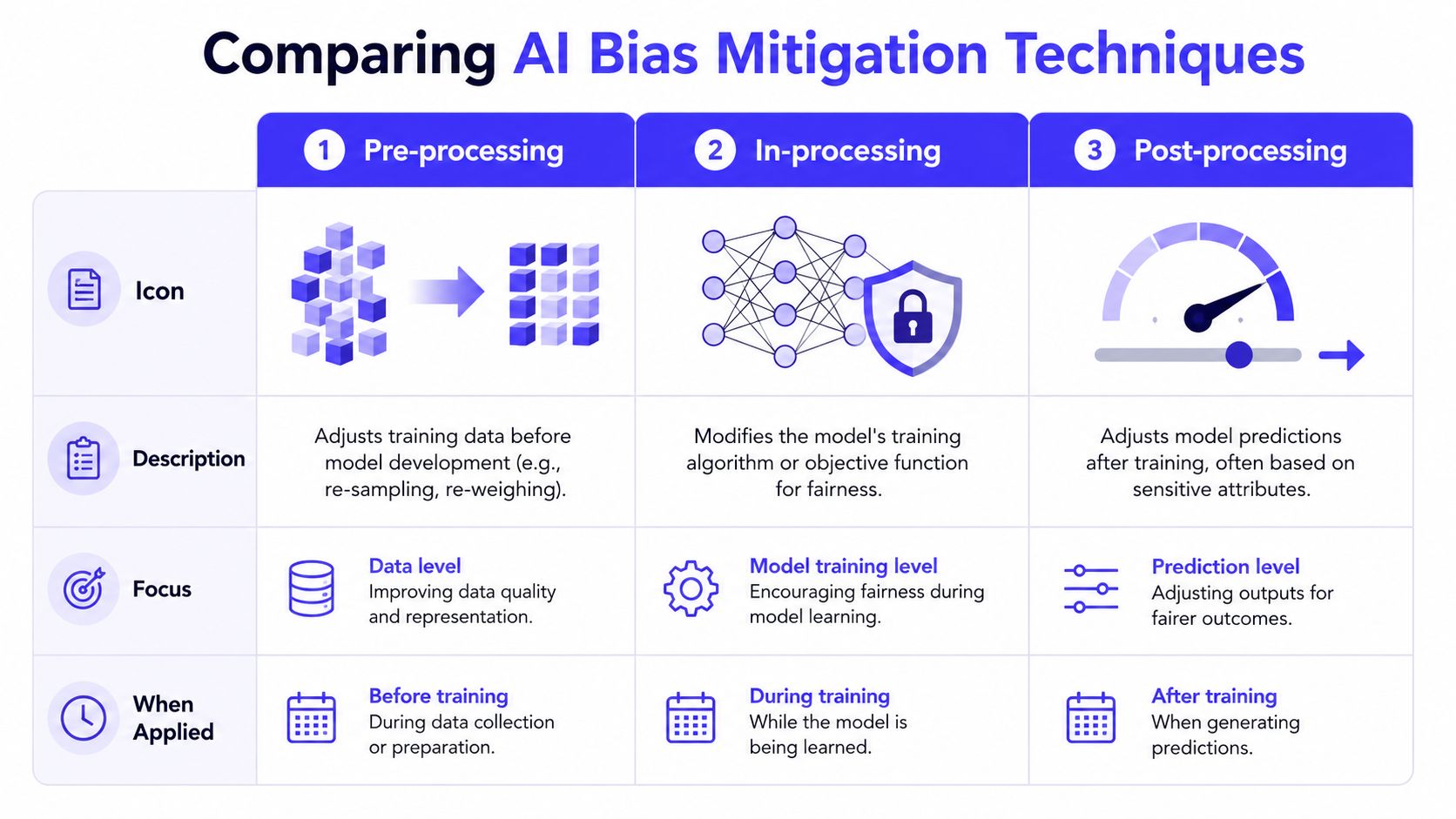
Pick the technique based on your constraint
| Technique | Best when | Trade-off to watch |
|---|---|---|
| Pre-processing | The data is skewed or incomplete | You can improve representation, but the fix may not survive drift |
| In-processing | You can retrain and change the objective | The training process gets more complex |
| Post-processing | The model is already deployed or retraining is expensive | Output tuning can help, but it may be brittle across groups |
Pre-processing is the most straightforward when the dataset itself is the source of bias. That includes re-sampling, re-weighing, or better label collection. The upside is that you're correcting the input signal, which often makes the rest of the pipeline easier to reason about.
In-processing is a better fit when the problem sits inside the learning objective. In such cases, fairness-aware losses or constraints belong. It's harder to implement, but it can produce a model that internalizes the fairness goal instead of patching it later.
Post-processing is useful when deployment constraints are real. If you can't retrain the model quickly, adjusting decision thresholds can still reduce disparity. The cost is that it often depends on sensitive attributes at inference or calibration time, so governance needs to be tighter.
A useful design rule is to avoid treating synthetic augmentation or oversampling as a free win. Recent work warns that mitigation can introduce new bias or degrade performance if the fix isn't validated across the full lifecycle (lifecycle trade-off review).
Mini example from a product review
A lending team sees stronger approval rates for one user segment and wants a quick fix. Rewriting the model immediately would delay launch, so they first test whether the training set is missing enough cases from the lower-performing group. If it is, they correct the data and re-run subgroup evaluation. If the gap remains, they test threshold adjustment and compare it against the business metric they prioritize, which is approved applications that later default. That order prevents them from “fixing” fairness by creating hidden portfolio risk.
The video below is a useful refresher for teams that want a compact walkthrough of fairness tooling and implementation patterns.
Integrating Bias Mitigation into Your MLOps Lifecycle
Bias mitigation only sticks when it's embedded in the system that already ships models. That means fairness checks in CI/CD, metric logging in the model registry, and monitoring in production dashboards alongside latency and error rates. If fairness lives in a slide deck, it will decay the moment the team gets busy.
Put fairness where the deployment workflow already is
The cleanest implementation is to treat fairness as a gate in the same pipeline that checks tests, security, and performance. Data validation should compare subgroup consistency before training starts. Training should log fairness metrics with the artifact. Release approval should require a reviewer to sign off on the fairness scorecard.
That workflow matches the Berkeley Haas playbook, which calls for policies that check for and actively mitigate bias at every stage of algorithm development and document provenance, including data sources and variables (Berkeley Haas AI Bias playbook). It also aligns with the operational reality that fairness issues often reappear when data changes, so monitoring has to keep running after launch.
Track fairness like any other model property
Model registries should record fairness metrics next to accuracy, calibration, and latency. Monitoring should compare the live population to the evaluation population so drift doesn't hide behind a stable headline metric. If the group distribution changes, the fairness baseline should be re-evaluated instead of copied forward.
For observability patterns that pair well with this setup, the guide on ai observability platforms is a practical reference. The important point is that fairness telemetry only helps when an engineer can act on it quickly.
A simple release sequence that works
- Validate data slices before training.
- Run subgroup metrics on the candidate model.
- Block deployment if a fairness threshold fails.
- Log the approval in the registry.
- Alert on drift after release.
Release rule: if the model needs a fairness exception, write down the business owner, the reason, and the expiry date. Exceptions without an expiry become permanent risk.
The operational payoff is real. Teams that put fairness into the same path as deployment avoid ad hoc escalations, duplicate reviews, and silent regressions. That saves engineering time and reduces the odds of shipping a model that creates avoidable reputational or regulatory exposure.
Building a Bias-Conscious AI Team and Culture
The best fairness tooling still fails if the team only sees bias as a compliance checkbox. NIST's position is strong here, bias mitigation should be multifaceted and involve people with different backgrounds, perspectives, and expertise because that broadens the views of the designers and engineers (NIST SP 1270). In practice, that means hiring for judgment, not just model-building speed.
Make hiring probes test real fairness judgment
A candidate can know the terminology and still miss the operational risk. Ask them how they'd choose between a data fix and a threshold fix, what they'd do if subgroup metrics improve while overall quality drops, or how they'd document a fairness exception for a launch review. Strong candidates will talk about trade-offs, not slogans.
Another useful interview question is, “What evidence would make you reject a model that looks strong on aggregate metrics?” That question forces the candidate to show how they think about subgroup performance, business constraints, and review discipline in the same answer.
Build a review board that can actually stop a launch
High-risk models need cross-functional signoff. Product should explain the use case, engineering should explain the evaluation, legal or risk should weigh the exposure, and a domain expert should challenge assumptions about the affected group. If one function is missing, the board usually defaults to the loudest voice in the room.
The point isn't to slow shipping. The point is to make sure the launch decision reflects technical reality, user impact, and organizational risk at the same time.
Use a fairness audit before launch
A pre-launch fairness audit should check four things. First, the problem framing matches the intended decision. Second, the data provenance is documented. Third, subgroup metrics have been reviewed. Fourth, someone has confirmed the mitigation didn't create a new operational problem.
That review culture matters because bias often comes from choices humans make long before the model runs. When the team includes different perspectives, it's more likely to catch proxy variables, missing populations, and weak assumptions before users feel the damage.
Your AI Bias Mitigation Audit Checklist and Next Steps
A usable audit checklist should fit into a release doc, not a presentation deck. Use it as a pre-deployment gate, a model refresh checklist, and a post-incident review form.
- Problem framing: confirm the decision, the affected group, and the fairness target are written down.
- Data provenance: document where the data came from, which variables matter, and what was excluded.
- Subgroup coverage: verify that the validation set includes the user segments the model will affect.
- Metric selection: choose the fairness metric that matches the use case, then define the pass rule.
- Mitigation choice: record whether the fix was pre-processing, in-processing, or post-processing, and why.
- Human review: log the reviewer, the date, and the signoff decision.
- Monitoring plan: define which fairness metrics will be watched in production and who gets alerted.
- Exception handling: note any approved trade-off and when it will be revisited.
For governance teams, the CloudCops write-up on cloud governance insights is a helpful parallel, because the same discipline used for cloud controls also applies to model controls, ownership, auditability, and review cadence.
Three next steps make the most difference right away. First, pick one high-stakes model and run a subgroup audit before the next release. Second, add fairness metrics to the model registry so they're visible during review. Third, assign a named owner for post-launch fairness monitoring so alerts don't get ignored.
Start there, then tighten the workflow with each release. If you need a vetted team to stand up the fairness checks, review the pipeline, or staff the MLOps work behind it, ThirstySprout can help you move from audit ideas to a production-ready pilot fast.
Hire from the Top 1% Talent Network
Ready to accelerate your hiring or scale your company with our top-tier technical talent? Let's chat.