

81% of respondents in Notion's 2026 AI Engineering Survey said they actively use multiple models together, and 94% of LLM-using teams in the 2025 AI Engineering Report use LLMs for at least two use cases. That's why ML engineer responsibilities now extend beyond training models, connecting data, deployment, operations, experiments, and business outcomes, with ownership changing by seniority and company stage.
The popular advice, “hire someone who can build a model,” is incomplete. A model that performs well in a notebook can still fail because the data pipeline breaks, inference costs too much, latency misses the product requirement, or nobody owns retraining after launch. The UK government's capability framework defines the machine learning engineer role across designing, training, deploying, scaling, assuring, and maintaining models throughout the full machine learning lifecycle. See the UK machine learning engineer capability framework.
This guide organizes 10 ML engineer responsibilities across that lifecycle. It's written for CTOs, engineering leaders, founders, product leads, and talent teams that need to define delivery expectations quickly. You'll find implementation details, interview signals, KPI guidance, reusable job-description language, practical scenarios, and a hiring framework that distinguishes startup ownership from enterprise specialization.
Business requirement↓Data sources and validation↓Features, prompts, or retrieval indexes↓Training and experiments↓Evaluation and release approval↓Serving infrastructure↓Monitoring, feedback, retraining, rollbackThe practical standard is end-to-end ownership. The engineer doesn't need to own every component alone, but the role must have clear accountability for how those components work together.
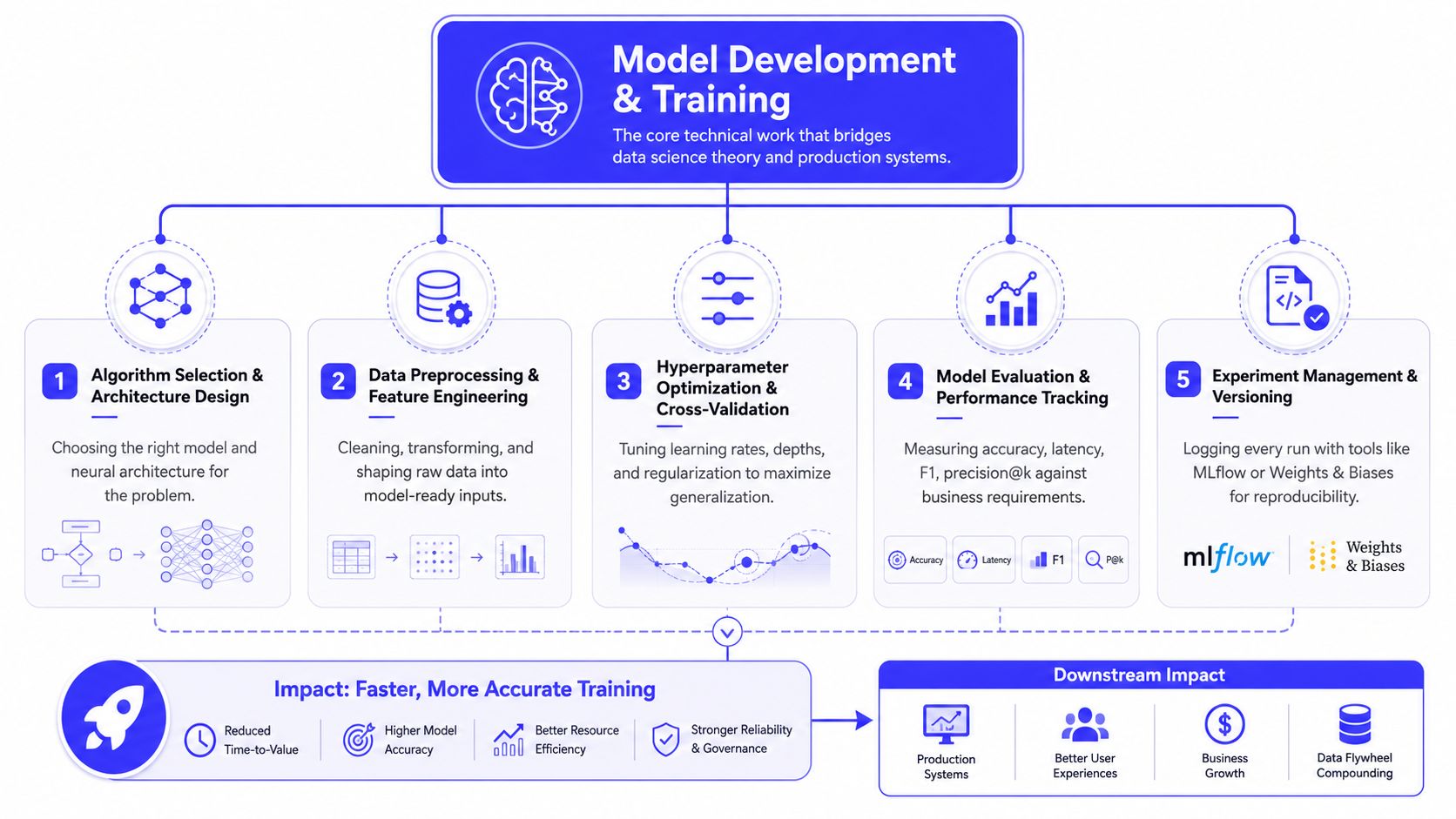
1. Model Development and Training
Model development remains a core responsibility, but strong ML engineers treat training as a repeatable engineering process rather than a one-off research exercise. They translate the business problem into a learning objective, select an appropriate model family, prepare representative datasets, tune the system, and validate results against both technical and product requirements.
The first move should usually be a simple baseline. Logistic regression, a decision tree, or a straightforward retrieval method can establish a performance floor and expose data problems before the team invests in a complex architecture. A baseline also makes trade-offs visible. If a more advanced model adds quality but creates unacceptable latency or maintenance work, the team has evidence for rejecting it.
What good implementation looks like
An engineer should version code, data transformations, configuration, and model artifacts. Experiment tracking tools such as MLflow or Weights & Biases can record parameters, evaluation results, and artifact lineage, making it easier to reproduce a promising run or explain why a candidate was rejected. MLOps guidance from KodeKloud connects this work to automated versioning, testing, training, deployment, and monitoring.
Useful requirements include:
- Define a baseline: Establish a simple reference model before tuning advanced architectures.
- Separate validation data: Keep test data isolated and representative of the intended use.
- Track business metrics: Use measures such as precision, recall, F1, ranking quality, or answer acceptance alongside loss.
- Automate training: Replace fragile notebook steps with a repeatable pipeline.
- Set an SLO: Document the required quality and response-time boundary before implementation.
Interview signal and job-description language
Ask, “Tell me about a time you rejected a more accurate model because it created a production problem.” A strong answer explains the measured trade-off, the baseline, the decision criteria, and how the engineer communicated the choice.
A useful job-description bullet is: “Design, train, and validate production-oriented machine learning models, maintaining reproducible experiments and evaluating candidates against quality, latency, reliability, and business requirements.”
2. Production Deployment and Model Serving
Deployment is where a model becomes a product capability. The ML engineer packages the artifact, exposes it through an appropriate interface, connects it to application systems, and makes sure the service behaves predictably under real traffic. That can involve containerization, APIs, orchestration, version control, request validation, capacity planning, and fallback behavior.
A production deployment should answer practical questions before launch. What happens when the model is unavailable? Can the previous version serve as a fallback? How will the team distinguish an application error from a model-quality problem? Which inputs must be rejected, logged, or redacted?
Machine learning model deployment tools can help teams compare serving approaches, but tool selection should follow the workload. A batch prediction job doesn't need the same architecture as a low-latency online endpoint.
Release controls that reduce risk
Containerizing the service improves development and production parity. A canary, shadow, or staged release lets the team compare a candidate with the current production model before exposing every user to it. Dashboards should exist before deployment, not after the first incident.
Track:
- Service behavior: Latency percentiles, throughput, timeouts, and error rates.
- Input health: Missing fields, unexpected values, and distribution changes.
- Release state: Model version, code version, feature version, and configuration.
- Fallback readiness: Previous model, rules-based path, or human review route.
- Capacity: Resource saturation and queue behavior under expected load.
Practical rule: A model isn't production-ready until the team can explain how it will fail, how it will recover, and who receives the alert.
A useful technical discussion can also include model context protocol integrations when an AI feature needs controlled access to external tools. This guide to MCP for web developers is relevant when the serving layer must manage tool context alongside model requests.
Interview question: “Walk me through your release plan for a new ranking model.” Look for shadow evaluation, rollback criteria, observability, and an explicit fallback.
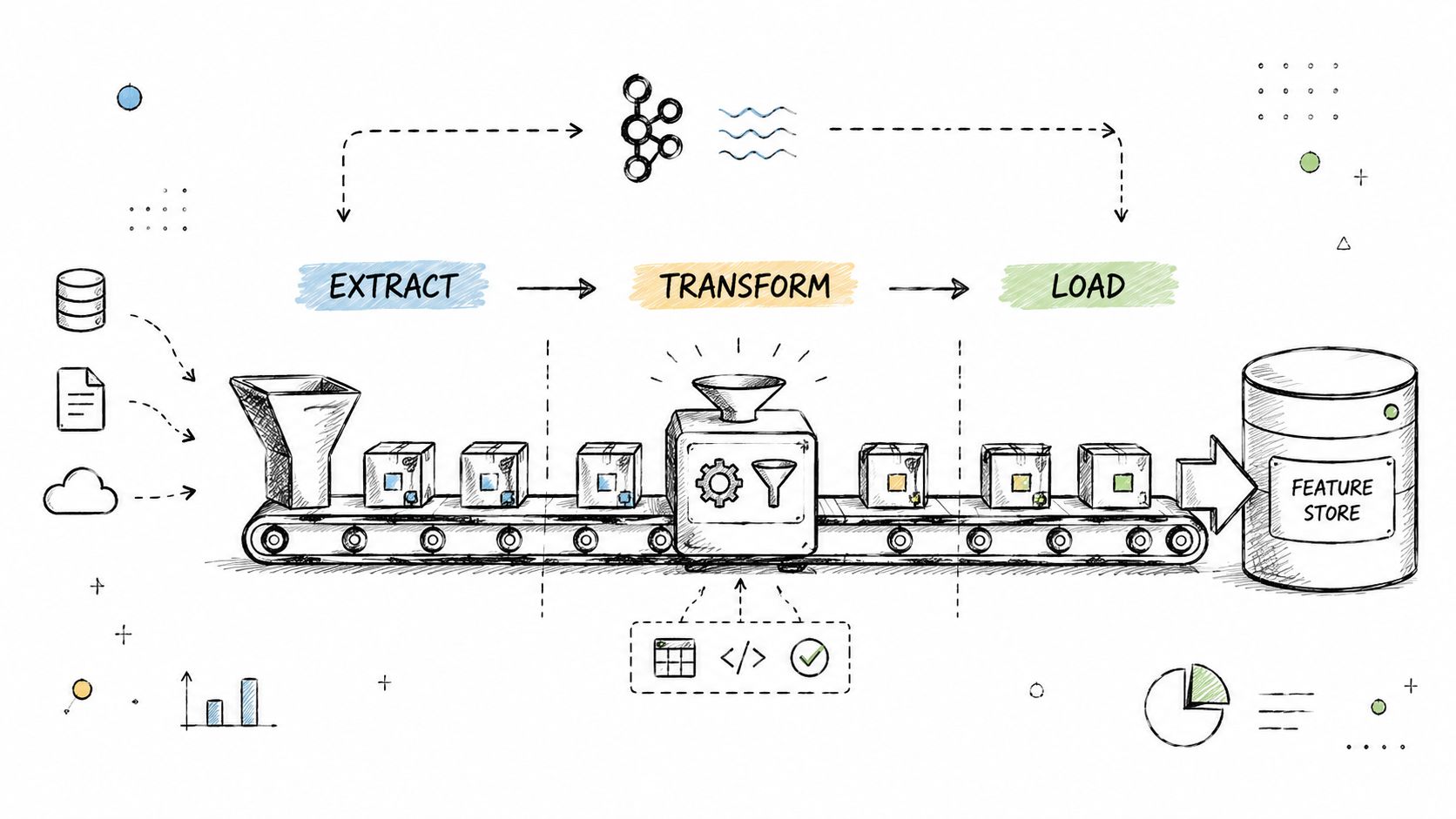
3. Data Pipeline Engineering and ETL
A model is only as dependable as the data entering training and inference. ML engineers build the extraction, transformation, and loading, or ETL, workflows that move data from operational systems into training environments, feature pipelines, retrieval indexes, and serving layers.
This responsibility includes schema design, missing-value handling, joins, time alignment, validation, lineage, and delivery guarantees. It also includes preventing training-serving skew, where a feature is computed one way during training and another way during live prediction.
Make data quality executable
A useful pipeline doesn't merely document expectations. It tests them. Assertions can check for null values, valid ranges, duplicate keys, timestamp consistency, and unexpected schema changes. Every feature should have an owner, a source, a transformation definition, and a freshness expectation.
An engineer might build a batch workflow for historical training data while maintaining a streaming path for online features. The right choice depends on how quickly the business signal changes. Batch is simpler and often easier to operate. Streaming can reduce staleness but adds infrastructure, failure modes, and debugging effort.
Data quality checks should stop unsafe training or serving changes, not just create a warning that nobody reviews.
For a hiring process, ask the candidate to design a pipeline that supports both daily retraining and online inference. Strong candidates will discuss idempotency, late-arriving events, backfills, schema evolution, feature consistency, and alert ownership.
A reusable job-description bullet is: “Build and maintain tested data and feature pipelines for training and inference, with clear lineage, freshness expectations, schema controls, and automated data-quality checks.”
The output isn't just a transformed table. It's a dependable contract between source systems and ML services. Google Cloud's MLOps architecture guidance describes related mechanics including data verification, metadata management, serving infrastructure, and monitoring.
4. Model Monitoring, Evaluation and Maintenance
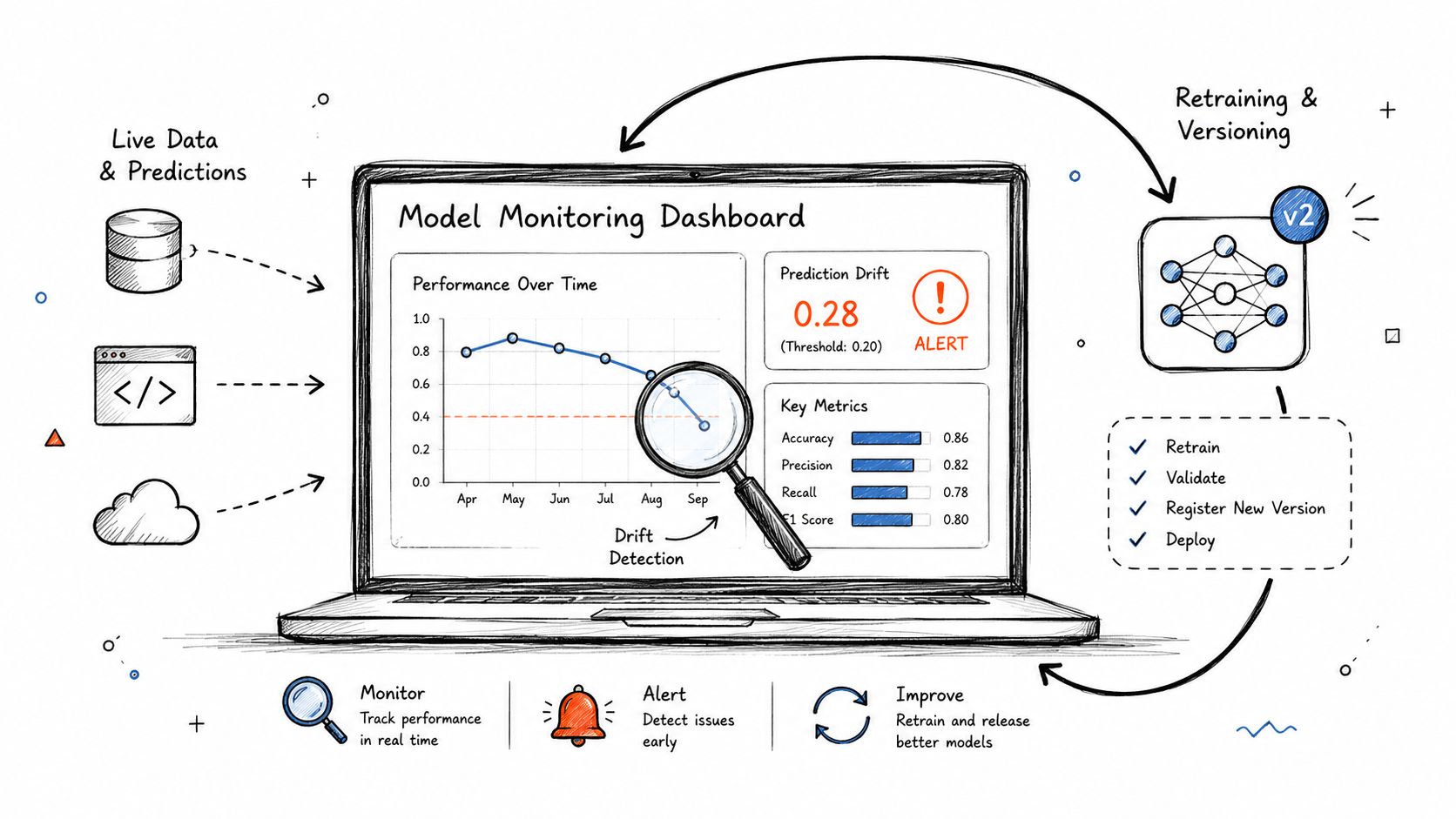
Launch day is the beginning of model ownership, not the end. Production data changes, user behavior shifts, upstream systems evolve, and model quality can decline without an obvious infrastructure failure. ML engineers create the observability and maintenance controls that reveal those changes and trigger an appropriate response.
Monitoring should cover more than endpoint health. A service can return successful responses while producing less useful predictions. The engineer needs a layered view of model health, including input distributions, output behavior, delayed labels, error categories, latency, cost, and business outcomes.
Build a response loop
A practical maintenance loop includes a current champion model, candidate models, comparable evaluation data, release gates, and rollback controls. Retraining can be scheduled, event-driven, or initiated by a quality threshold. The trigger must reflect the data velocity and the cost of a stale model, rather than follow a universal schedule.
AI observability platforms can support this work, especially for teams operating multiple model providers or retrieval components. For LLM applications, evaluation also needs to inspect groundedness, refusal behavior, retrieval quality, and unsafe outputs.
Track:
- Input drift: Changes in distributions, missing fields, and category coverage.
- Prediction behavior: Confidence, abstention, class balance, and output anomalies.
- Delayed quality: Human labels, conversion outcomes, defect rates, or review decisions.
- Operational health: Latency, errors, resource use, and queue depth.
- Recovery performance: Time to detect, decide, roll back, or retrain.
The interview signal is operational judgment. Ask, “What would make you roll back a model even if offline accuracy improved?” Good answers include guardrail failures, segment regressions, unacceptable latency, policy risk, or a business metric moving in the wrong direction.
A strong job-description bullet is: “Own production monitoring, evaluation, retraining triggers, incident response, rollback procedures, and ongoing model maintenance.”
5. Feature Engineering and Selection
Feature engineering turns raw records into signals a model can use. The work requires technical discipline and domain understanding. An engineer may derive recency, frequency, ratios, trends, or interaction features, then test whether they generalize beyond the training sample.
The best feature isn't always the most complicated one. A domain-informed transformation can outperform a larger model trained on poorly structured inputs. At the same time, every additional feature increases lineage, testing, serving, and privacy obligations.
Prefer reusable, explainable signals
Start with features that represent a clear hypothesis. For fraud, that might include deviation from a user's normal transaction behavior. For churn, it might involve recent activity and changes in product usage. The engineer should test each feature against a held-out dataset and inspect whether the signal remains stable across important segments.
Feature selection also affects operational performance. Removing weak or redundant inputs can simplify serving, improve interpretability, and reduce the chance of training-serving inconsistency. Tree-based importance, permutation importance, and SHAP can help investigate signal, but none replaces domain review or leakage checks.
Use this implementation checklist:
- Define provenance: Record the source field, transformation, timezone, and owner.
- Prevent leakage: Ensure the feature was available at prediction time.
- Test freshness: Alert when the feature arrives late or stops updating.
- Compare paths: Verify training and online computations produce consistent values.
- Review stability: Check performance across time periods and relevant user groups.
Ask candidates, “Describe a feature you removed from a model and why.” Strong candidates may discuss leakage, instability, privacy, serving cost, or weak generalization rather than treating feature count as a success metric.
Job-description language: “Create, validate, document, and maintain reusable features that improve model performance while preserving training-serving consistency, interpretability, and data lineage.”
6. Model Optimization and Inference Performance
A model can be accurate and still be unusable. Inference performance affects user experience, infrastructure requirements, concurrency, and operating cost. ML engineers profile the full request path, then optimize the actual bottleneck instead of applying compression techniques by habit.
The bottleneck may sit in preprocessing, model execution, serialization, database access, network calls, or queueing. Profiling should establish a baseline for latency, memory, throughput, and resource utilization before the team changes the model.
Choose the least risky optimization
Quantization, pruning, knowledge distillation, compilation, batching, caching, and hardware-specific runtimes each introduce trade-offs. Quantization can reduce resource demand but may affect quality. Batching improves throughput but can increase wait time. A smaller distilled model may be cheaper and faster, while a larger model remains useful for difficult cases.
A practical optimization sequence is:
- Measure the request path: Separate data loading, preprocessing, inference, and output handling.
- Set a quality floor: Define which evaluation results cannot regress.
- Test one change: Compare the candidate with the current champion.
- Evaluate under realistic load: Single-request benchmarks can hide queue behavior.
- Use routing when appropriate: Reserve expensive models for cases that need them.
AI inference optimization guidance is useful for teams comparing serving patterns and optimization priorities.
Interview question: “A model meets quality targets but misses the product latency requirement. What do you inspect first?” Look for profiling, request-shape analysis, batching and caching judgment, model simplification, and a clear quality guardrail.
A reusable bullet is: “Optimize inference latency, memory, throughput, and compute usage through profiling, serving configuration, model compression, and workload-aware architecture decisions.”
7. Experiment Design and A/B Testing
Offline evaluation can identify a promising model, but it doesn't prove that users or the business will benefit. ML engineers design controlled experiments with product and analytics partners, define success and guardrail metrics, instrument exposure, and interpret results without confusing statistical movement with practical value.
The first decision is the primary metric. A recommendation model might optimize engagement, while revenue, diversity, latency, or user complaints act as guardrails. Teams should agree on this before looking at results. Otherwise, people can select the most favorable metric after the fact.
Test the decision, not just the model
An experiment plan should specify the control, treatment, eligibility rules, exposure logging, duration, stopping criteria, and analysis method. It should also account for cold-start users, repeated exposure, seasonality, and interactions between segments.
A model-focused engineer may own the serving and logging system while a data scientist or analyst owns statistical analysis. In smaller teams, one ML engineer may carry both responsibilities. The job description should make that boundary explicit.
Useful interview prompts include:
- Metric design: Which metric is primary, and which metrics can block launch?
- Instrumentation: How will you verify that users received the intended model?
- Interpretation: What would you do if engagement improves but a quality guardrail declines?
- Segmentation: How will you inspect differences between new and returning users?
- Decision rules: What evidence is sufficient to ship, iterate, or roll back?
Job-description language: “Design and operate controlled ML experiments, ensuring reliable exposure logging, predefined success metrics, guardrails, and clear launch recommendations.”
The best teams don't treat A/B testing as a ceremonial final step. They use it to decide whether a technical improvement creates durable product value.
8. Model Interpretability and Explainability
Explainability turns a prediction into something stakeholders can inspect, challenge, and govern. It matters when users need reasons, when regulators or risk teams require evidence, and when engineers need to debug a model that behaves unexpectedly.
Different explanation methods answer different questions. Global feature importance can show what influences a model overall. Local methods such as SHAP can help explain an individual prediction. Attention visualizations may help inspect language-model behavior, but they shouldn't be treated as a complete explanation of causality.
Match the explanation to the decision
An explanation for a credit decision needs a different design from an explanation for an internal content-ranking tool. The first may require stable reason codes and user-facing language. The second may need internal diagnostics that help the product team identify unwanted patterns.
Engineers should test explanations against domain knowledge. If a model attributes a decision to a proxy that reflects geography, device type, or another questionable signal, the explanation can expose a deeper modeling problem. Documentation should state where explanations are reliable and where the model may fail, especially on out-of-distribution inputs.
Ask, “How would you explain a model decision to a user without overstating what the explanation proves?” Strong candidates distinguish correlation from causation, global from local explanations, and technical diagnostics from user communication.
A useful job-description bullet is: “Implement interpretable model diagnostics and user-appropriate explanations, document limitations, and partner with risk and product teams to investigate problematic signals.”
Explainability also creates a feedback channel. Users and reviewers can identify bad inputs, missing context, or unintended correlations that aggregate metrics may conceal.
9. Cross-functional Collaboration and Requirements Gathering
Many ML projects fail before training begins because the team has not defined the decision the model will support. ML engineers translate business goals into technical requirements, clarify constraints, and make trade-offs visible to product, risk, data science, platform, and operations teams.
A request such as “use AI to reduce fraud” isn't an implementable requirement. The engineer needs to establish which events require scoring, what action follows a prediction, how false positives are handled, what data is available at decision time, and which outcomes matter to the business.
Turn vague requests into an operating contract
A practical requirements brief should include:
- Decision: What action will the system influence?
- Users and workflow: Who sees or consumes the prediction?
- Quality: Which errors matter most?
- Latency: Is the decision real time, near real time, or batch?
- Reliability: What happens when the service or data is unavailable?
- Governance: Which privacy, security, fairness, or audit constraints apply?
- Success: Which product and business measures determine continuation?
An ML engineer should challenge impossible combinations early. The highest quality model may not fit the latency budget. A real-time architecture may create too much operational risk for a low-value workflow. A narrow metric may optimize one stakeholder's outcome while harming another's.
Interview question: “A product leader asks for 99% accuracy by the end of the quarter. What do you do?” Look for clarification of class balance, error costs, available labels, decision thresholds, time constraints, and a staged validation plan.
Job-description language: “Partner with product, domain, data, platform, and risk stakeholders to define ML requirements, success metrics, constraints, and launch decisions.”
Using RACI to end workplace confusion can help clarify who is responsible, accountable, consulted, and informed when multiple teams share the lifecycle.
10. Scalability and Infrastructure Decisions
Scalability is not a synonym for maximum complexity. It's the ability to meet the required workload, latency, reliability, and cost constraints without creating an architecture the team can't operate.
ML engineers choose between batch and streaming data, local and distributed processing, managed and self-hosted services, synchronous and asynchronous inference, and simple services versus orchestrated platforms. These decisions depend on demand and failure tolerance, not on whether a tool is fashionable.
Scale only where the constraint exists
A startup may begin with a scheduled pipeline and a single serving service. An enterprise may need stronger isolation, regional deployment, model governance, and platform standardization. The engineer's responsibility is to identify the current bottleneck, measure it, and add complexity only when the expected benefit justifies the operational burden.
A scalable design should address:
- Workload shape: Batch volume, request concurrency, data freshness, and traffic variability.
- Failure behavior: Timeouts, retries, circuit breakers, degraded modes, and recovery.
- Storage and compute: Where artifacts, features, logs, and evaluation data live.
- Deployment topology: Containers, orchestration, regions, queues, and service boundaries.
- Ownership: Which team operates each component and responds to its alerts.
Ask candidates to design a system that starts with a prototype and evolves under higher demand. Strong answers explain transition points rather than drawing an elaborate architecture immediately. They should also identify what they'd postpone.
Job-description language: “Design and evolve reliable ML infrastructure across data processing, training, serving, storage, and orchestration, balancing scalability, latency, availability, maintainability, and cost.”
10-Point Comparison: ML Engineer Responsibilities
| Item | Complexity 🔄 | Resources ⚡ | Expected outcomes ⭐📊 | Ideal use cases 💡 | Key advantages ⭐ |
|---|---|---|---|---|---|
| Model Development & Training | 🔄 High, iterative experiments, hyperparameter tuning | ⚡ Moderate–High, compute, labeled data, ML expertise | ⭐📊 High accuracy gains; measurable model metrics and business impact | 💡 New models, baseline → production, accuracy-driven features | ⭐ Directly improves model quality; foundation for downstream systems |
| Production Deployment & Model Serving | 🔄 High, containerization, APIs, rollout strategies | ⚡ High, infra, SRE/DevOps, monitoring | ⭐📊 Low-latency, high-availability serving; enables live revenue/UX | 💡 Real-time APIs, scale to users, multi-region inference | ⭐ Delivers business value in production; clear SLOs and reuse |
| Data Pipeline Engineering & ETL | 🔄 Moderate, orchestration, schema/versioning | ⚡ Moderate, storage, streaming systems, ops time | ⭐📊 Reliable, reproducible data for training/serving; fewer failures | 💡 Large-scale feature generation, streaming/real-time feeds | ⭐ Prevents garbage-in-garbage-out; multiplies model ROI |
| Model Monitoring, Evaluation & Maintenance | 🔄 Moderate–High, instrumentation, drift detection | ⚡ Moderate, monitoring tools, retrain compute | ⭐📊 Sustained performance; early detection of drift and regressions | 💡 Production models with live traffic; regulated or revenue-sensitive apps | ⭐ Proactive failure prevention; enables automated retraining/rollbacks |
| Feature Engineering & Selection | 🔄 Moderate, domain work and iterative design | ⚡ Low–Moderate, analyst/engineer time, feature store | ⭐📊 Large accuracy improvements; interpretable signals | 💡 Tabular models, interpretable/low-data domains | ⭐ High ROI on accuracy; features reusable across models |
| Model Optimization & Inference Performance | 🔄 Moderate–High, hardware-specific tuning & profiling | ⚡ Moderate, profiling, specialized runtimes, benchmarking | ⭐📊 Lower latency and cost; enables edge and real-time experiences | 💡 Mobile/edge deployment, strict latency SLOs, cost-sensitive serving | ⭐ Significant cost/latency reductions; enables new UX (sub-100ms) |
| Experiment Design & A/B Testing | 🔄 Moderate, stats, randomization, power calculations | ⚡ Low–Moderate, traffic volume, analytics tooling | ⭐📊 Validated business impact; reduces risk of harmful rollouts | 💡 Ranking, recommender, UI or model-change rollouts | ⭐ Quantifies value; prevents shipping models that hurt users |
| Model Interpretability & Explainability | 🔄 Low–Moderate, integrate SHAP/LIME, visualize attention | ⚡ Moderate, compute for explanations; communication effort | ⭐📊 Increased trust, compliance, and actionable debugging insights | 💡 Regulated industries, stakeholder-facing decisions | ⭐ Enables compliance and stakeholder trust; aids debugging |
| Cross-functional Collaboration & Requirements Gathering | 🔄 Low–Moderate, stakeholder alignment and scoping | ⚡ Low, time investment, meeting facilitation | ⭐📊 Better-aligned projects; fewer failed or mis-scoped initiatives | 💡 Project kickoff, prioritization, multi-team efforts | ⭐ Prevents building wrong solutions; improves adoption |
| Scalability & Infrastructure Decisions | 🔄 High, distributed systems, training/serving architecture | ⚡ High, cloud infra, ops expertise, cost management | ⭐📊 Elastic, cost-efficient systems supporting growth | 💡 High-traffic services, massive data volumes, global scale | ⭐ Enables 10x traffic growth; significant cost and latency optimization |
Turn Responsibilities Into a Hiring Scorecard
The 10 responsibilities become useful when they turn into observable ownership. Don't evaluate a candidate against every area with equal weight. Start with the risk that could most damage the product. A real-time decision system may prioritize serving reliability and monitoring. A research-heavy team may prioritize model development. A platform group may prioritize reproducible pipelines, release control, and infrastructure.
Match scope to seniority
A junior engineer can own a well-defined pipeline component, test suite, or serving integration with review. A mid-level engineer should take a model or service from development through production and handle routine incidents. A senior engineer should set system boundaries, define quality and reliability standards, mentor others, and make decisions that affect multiple teams.
Company stage changes the shape of the role. Startups often combine data engineering, model development, deployment, and monitoring in one person because the team needs a complete path to a shipped feature. Enterprises are more likely to distribute ownership among ML engineering, data engineering, platform engineering, MLOps, and site reliability engineering. The boundary can be different, but the responsibilities still need an accountable owner.
The formal emergence of MLOps as a distinct discipline by the late 2010s helps explain this division. A review of MLOps practices describes ML engineers as designing data, development, and deployment pipelines, while MLOps specialists focus on automation, versioning, governance, operational stability, and monitoring.
Use reusable job-description language
For a model-focused role, write:
- “Develop and validate machine learning models against product-defined quality metrics.”
- “Build reproducible training workflows and collaborate with data scientists on model selection and error analysis.”
- “Translate domain requirements into measurable evaluation criteria.”
For a production-focused role, write:
- “Deploy and operate ML services with defined latency, reliability, fallback, and rollback behavior.”
- “Own model serving integration, release controls, incident response, and production evaluation.”
- “Optimize inference performance without violating agreed quality guardrails.”
For an MLOps-focused role, write:
- “Automate model, data, and pipeline versioning across continuous integration and continuous delivery workflows.”
- “Implement experiment tracking, reproducible training, deployment approvals, monitoring, and governance.”
- “Create shared infrastructure that helps ML teams ship and maintain models safely.”
Decide what to do next
First, choose the highest-risk responsibility for the product you're building. Second, define measurable success criteria, including quality, speed, reliability, cost, and recovery expectations. Third, decide whether the capability belongs in your internal team now or whether a remote specialist or complete team can reduce delivery risk.
ThirstySprout supports that decision with a remote AI talent network covering ML engineering, MLOps, data engineering, LLM systems, and AI product roles. Start a Pilot when you need focused delivery against a defined scope, or See Sample Profiles when you're comparing senior specialists with broader team options. Before publication or hiring launch, schedule both technical review and editorial review so the scorecard remains accurate, clear, and aligned with the operating environment.
ThirstySprout helps startups and enterprises hire senior AI engineers and remote ML teams for model development, deployment, data pipelines, MLOps, and production operations. Visit ThirstySprout to explore vetted specialists, define a focused pilot, and match the right ownership model to your ML engineer responsibilities.
Hire from the Top 1% Talent Network
Ready to accelerate your hiring or scale your company with our top-tier technical talent? Let's chat.