

A lot of product teams hit the same wall. The model can predict demand, rank leads, estimate churn, or score fraud risk, but the business still can't decide what to do next.
You don't need another classifier when the problem is deciding which agent takes which shift, which jobs run on which cloud instances, or which warehouse should open under budget and service constraints. Those are decision problems. They live in the gap between prediction and action.
That's where mixed integer programming earns its keep. It gives you a way to encode business rules, optimize trade-offs, and produce a plan your software can execute.
Your Hardest Problems Are Not Machine Learning Problems
If you're a CTO at a startup, this probably feels familiar. Your team has good models. Demand forecasts are decent. Customer intent signals are flowing. Usage data is clean enough. But operations still run on spreadsheets, brittle scripts, and manual override logic because the final decision layer keeps breaking.
A support platform might predict ticket volume accurately and still fail to staff the right specialists across time zones. A vertical SaaS product might forecast job demand and still miss service windows because dispatch logic can't satisfy labor rules, travel limits, and skill constraints at the same time. A fintech team might score risk well and still struggle to allocate review capacity under strict SLA targets.
These aren't machine learning failures. They're optimization failures.
The practical gap is often underestimated. A Mixed Integer Programming Workshop study reported that 68% of industry questions focus on deploying MIP models in production systems with LLMs or MLOps stacks, yet only 12% of published tutorials address that integration. That's why so many engineering leaders know MIP exists but still don't know how to ship it in a product.
Practical rule: Use machine learning when you need to estimate the world. Use mixed integer programming when you need to choose under constraints.
That distinction matters for roadmap decisions. If your next feature involves scheduling, routing, packing, allocation, pricing bundles under hard limits, or selecting resources from a constrained pool, you're in optimization territory. The work starts to look less like model training and more like decision system design.
For teams mapping where this fits in their stack, an AI implementation roadmap should explicitly separate prediction services from optimization services. If you don't make that split early, the planning logic usually gets buried inside app code, where it becomes slow to change and hard to debug.
What Is Mixed Integer Programming in Practice
Think of mixed integer programming as business Tetris with rules. You're trying to place the right pieces into the right slots, but every move has consequences. Some choices are flexible, some are yes-or-no, and some must be whole numbers.
MILP is now used in the majority of operations research projects, largely because modern solvers have become efficient enough to make it practical. The reason teams keep coming back to it is simple. It can model continuous, discrete, and binary variables in the same problem, which maps well to real operations like facility location, scheduling, and resource allocation.
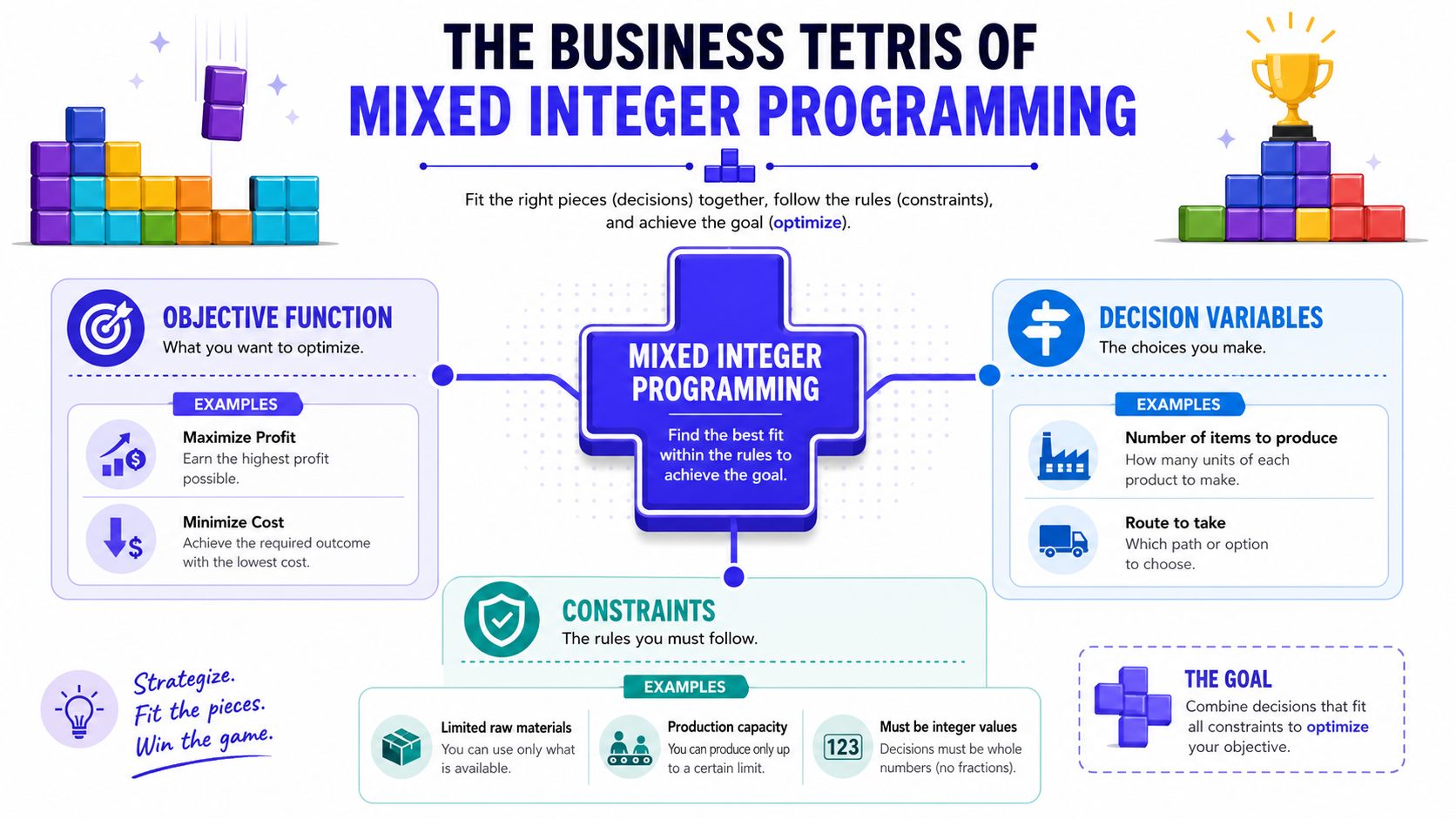
What it shows: The fundamental building blocks of any Mixed Integer Programming problem, illustrated through the relatable analogy of 'business Tetris'.
Three parts every MIP model needs
A usable model has three ingredients.
| Part | Plain English | Startup example |
|---|---|---|
| Objective function | What you want to optimize | Minimize cloud cost, maximize fulfilled orders |
| Decision variables | The choices the solver can make | Number of GPUs to reserve, whether to open a hub |
| Constraints | The rules you can't break | Budget cap, staffing minimums, delivery windows |
The objective is the business target. The variables are the knobs. The constraints are the reality of the business.
The variable types that matter
Mixed integer programming extends beyond linear programming.
- Continuous variables matter when fractional values are valid. Budget allocation across campaigns is a simple example. You can assign part of a spend amount to one channel and part to another.
- Integer variables matter when counts must be whole numbers. You can't assign 3.7 drivers or 2.4 support reps to a shift.
- Binary variables handle yes-or-no choices. Open a warehouse or don't. Accept a batch job or reject it. Route traffic through region A or region B.
A lot of AI product features use all three at once. Consider route planning. Travel time may be modeled continuously, the number of field reps assigned to territories must be integer, and territory activation can be binary. If you're working through route design in an operations setting, this guide to optimizing field sales routes gives a practical business view of the decision layer that often sits above forecasting.
A simple translation pattern
When a product manager brings a messy problem, convert it into this sequence:
- State the goal clearly. Reduce cost, reduce lateness, increase throughput, or maximize utilization.
- List the decisions the system can control. Headcount assignments, instance types, shipment choices, feature flags.
- Write down the hard rules. Budget, compliance, capacity, skill matching, latency thresholds.
- Separate hard rules from preferences. “Must cover every night shift” is hard. “Prefer fewer split shifts” is a soft penalty.
Most failed MIP projects don't fail because the math is wrong. They fail because the team never clarified which business rules are absolute and which ones are negotiable.
How MIP Solvers Find the Optimal Answer
A startup usually hits this moment after the first forecasting model ships. Demand predictions look good in a dashboard, but the product still has to choose a staffing plan, a routing plan, or a capacity plan that respects hard business rules. That is where the solver earns its keep. It searches for a deployable decision, then works to prove whether a better one exists.
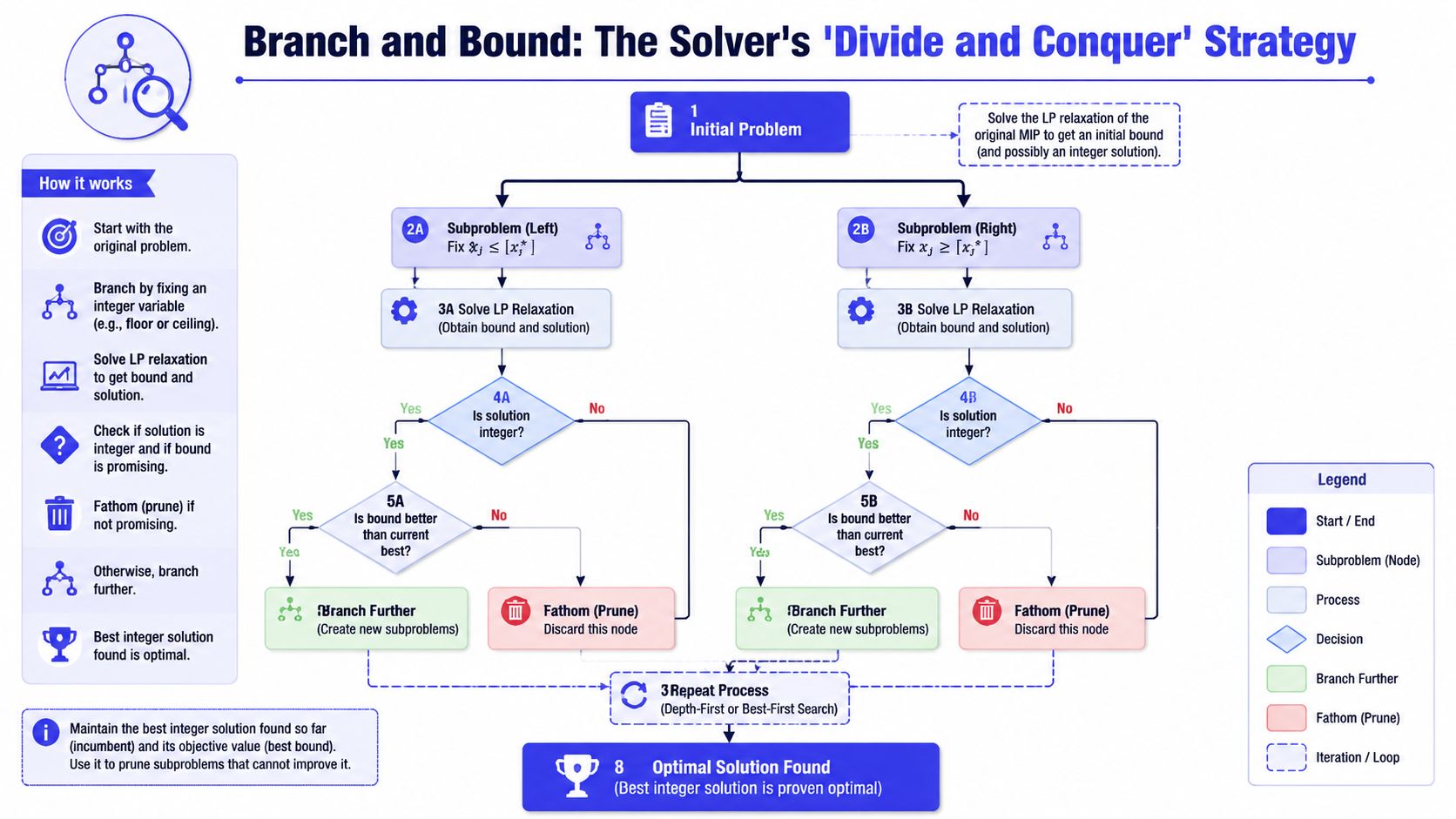
What it shows: The step-by-step 'divide and conquer' approach used by MIP solvers via the Branch and Bound algorithm to systematically search for the optimal integer solution.
It starts with a relaxed model
The first solve is usually a linear relaxation. The solver temporarily drops the integer restrictions and solves the easier LP version of the problem. That answer is often impossible to execute. You may get fractional server counts, half-assigned jobs, or partially activated facilities.
It is still useful.
The LP solution gives a bound on how good the integer solution could be. In production terms, that bound tells the service whether a branch of the search tree is worth more CPU time or whether it should be discarded early. For teams building optimization into allocation workflows, this is the same discipline used in a strong resource allocation strategy for constrained teams and systems. You want fast elimination of bad options before you spend engineering time polishing them.
Then the solver builds a search tree
When a variable that must be integer comes back fractional, the solver creates subproblems. One branch may force that variable to be less than or equal to a value. Another forces it to be greater than or equal to the next integer. Repeating that process creates a tree of candidate problems.
At each node, the solver asks a practical question. Is this branch promising enough to keep?
- If the bound is worse than the best feasible solution found so far, the branch is pruned.
- If the branch yields a valid integer solution, it becomes the incumbent.
- If the branch still has room to improve, the solver keeps exploring.
That is branch and bound in working terms. Real solvers add presolve reductions, cutting planes, primal heuristics, and branching rules to reduce the amount of tree they need to search.
Good models solve faster than verbose models
The biggest mistake I see in startup teams is assuming solver speed is mostly a hardware problem. It usually is not. Solve time is heavily shaped by formulation quality. A compact model with tight bounds and clean constraints often beats a more literal model that mirrors every business edge case directly.
This matters when MIP sits inside an AI/ML pipeline. The forecast service might run every hour. The optimization service then has a strict latency budget, has to consume changing inputs, and must return a plan that downstream systems can trust. If the model is loose, the solver spends time proving things that the product team could have encoded more carefully. If the model is tight, the system behaves like production software instead of a research demo.
A solver is doing two jobs at once. It searches for a good feasible plan quickly, and it tries to prove no better plan exists.
That distinction matters for product decisions. Sometimes the right feature ships with a time limit, a good incumbent, and a measured optimality gap. Sometimes you need a certified optimum because money, compliance, or contract terms depend on it. Several AI development platform uses follow this same pattern, where prediction generates candidates and optimization converts them into operational choices under hard constraints.
Two models can describe similar business problems and still have very different runtimes. The difference usually comes from structure: weak bounds, too many symmetric choices, oversized big-M constants, or unnecessary binary variables. That is why experienced MIP work looks as much like software and systems design as mathematics.
Practical MIP Use Cases for AI Startups
The cleanest way to use mixed integer programming in a startup is not to replace machine learning. It's to put MIP after machine learning.
The model predicts demand, risk, arrivals, or usage. The optimizer turns those predictions into an action plan.
Workforce scheduling for AI-enabled support operations
Consider a B2B SaaS company with multilingual support, premium SLA tiers, and specialists for billing, APIs, and enterprise onboarding. An ML model forecasts inbound ticket volume by hour and topic. That's useful, but not sufficient.
Operations still need a schedule that respects:
- Skill coverage
- Shift length rules
- Time-zone availability
- Employee preferences
- Overtime limits
- Escalation coverage
A MIP model can decide who works when, which queues get coverage, and how to minimize penalty costs when demand spikes hit. In practice, this often becomes a daily or intraday planning service.
A simple production pattern looks like this:
| Layer | Role |
|---|---|
| Forecast service | Predicts ticket volume by interval and skill |
| Feature store or warehouse | Provides staffing, contracts, skills, preferences |
| Python optimization service | Builds and solves the MIP |
| Operational database | Stores the recommended schedule |
| Agent app | Displays assignments and exceptions |
Here's a representative service boundary:
def build_schedule_plan(demand, agents, rules, solver):model = OptimizationModel()# binary: assign agent a to shift sx = model.add_binary_vars((a["id"], s["id"]) for a in agents for s in rules["shifts"])# hard constraintsadd_skill_coverage_constraints(model, x, demand, agents, rules)add_shift_length_constraints(model, x, agents, rules)add_rest_window_constraints(model, x, agents, rules)# soft penaltiesovertime_cost = build_overtime_penalty(model, x, agents, rules)preference_cost = build_preference_penalty(model, x, agents, rules)model.minimize(overtime_cost + preference_cost)return solver.solve(model)This isn't complex because the code is long. It's complex because every business rule becomes part of the contract between product, ops, and engineering.
Cloud cost optimization for AI workloads
A second example is infrastructure planning for training and inference. Teams often know expected workload demand from historical telemetry or forecast models, but they still overpay because placement logic is simplistic.
A MIP model can choose the least-cost mix of instances while respecting:
- Required compute capacity
- Region restrictions
- Reserved versus on-demand commitments
- Workload affinity
- GPU availability
- Latency or reliability rules
This gets especially useful when an AI product has multiple workload classes. Batch embedding jobs, nightly retraining, and low-latency inference shouldn't all compete for the same resources under naive autoscaling logic.
If your team is exploring adjacent AI product infrastructure patterns, these AI development platform uses are a helpful complement because they show where decision layers often sit alongside model-serving systems. For product planning, a separate resource allocation strategy should cover which constraints belong in code, which belong in policy, and which belong in the optimizer.
Treat the optimizer like a service, not a notebook artifact. Inputs should be versioned, outputs should be auditable, and failed solves should degrade gracefully.
What usually works
Teams get traction when they start with one bounded workflow. Daily scheduling is a better first target than global long-range planning. Nightly cloud allocation is a better first target than full autonomous FinOps.
What doesn't work is trying to encode every exception from day one. Start with the few constraints that drive cost or service quality, then expand.
The MIP Solver Landscape and Key Tradeoffs
A startup ships a pricing, routing, or capacity feature. The model works in staging. Then a large customer imports messy data at 4:55 p.m., the solve takes 20 minutes instead of 20 seconds, and the product team learns that “which solver are we using?” was never a minor implementation detail.
Solver choice affects runtime, failure handling, licensing cost, deployment options, and the kind of engineering support your team can expect when production behavior gets strange. Older commercial solvers earned trust over decades of use in planning, supply chain, and scheduling systems. That maturity shows up in better tooling, clearer diagnostics, and more predictable behavior under pressure.
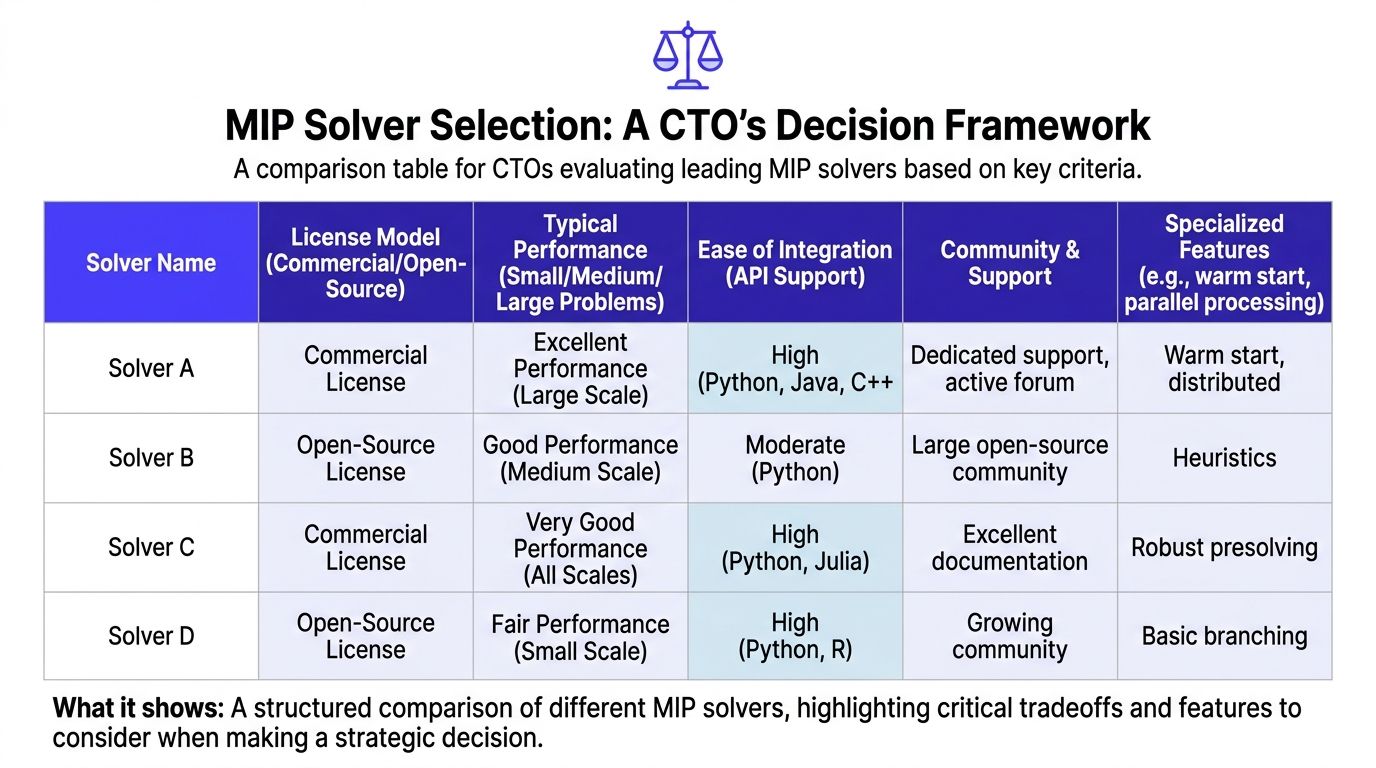
What it shows: A structured comparison of different MIP solvers, highlighting critical tradeoffs and features to consider when making a strategic decision.
Commercial versus open source
For startup teams, the central question is not ideology. It is where optimization sits in the product.
Commercial solvers usually make sense when the optimizer sits on a revenue path, controls SLA-sensitive decisions, or has to produce good answers fast across a wide range of ugly instances. You are paying for speed, yes, but also for presolve quality, tuning tools, API stability, documentation, and support from people who have seen your failure mode before.
Open-source solvers are often a good fit for prototypes, offline planning, internal tools, and early model development. They also work well when the optimization result is reviewed by a human and a slower solve does not hurt the business. The tradeoff is operational. Your team may spend more engineering time on performance tuning, workarounds, and debugging edge cases.
The decision criteria that matter
| Criterion | What to ask |
|---|---|
| Performance | Does solve time affect customer-facing latency, planner productivity, or batch deadlines? |
| Licensing | Can your budget, legal process, and deployment model support the solver license? |
| Support | Who helps when a production model becomes infeasible after a data or policy change? |
| Integration | Does the solver fit your Python services, Java stack, containers, and CI/CD workflow? |
| Advanced controls | Do you need warm starts, callbacks, tuning tools, conflict analysis, or parallel search? |
One more criterion deserves attention in AI startups. Observability.
If the optimizer is part of an ML pipeline, you need to trace inputs, feature-derived coefficients, constraint changes, solve status, and output quality over time. The same teams that invest in AI observability platforms for model behavior and production monitoring should apply similar discipline to optimization services. A solver that returns “optimal” is not enough if no one can explain why the recommendation changed after a feature pipeline update.
Commercial tools often win when optimization is embedded in dispatch, quoting, marketplace matching, or inventory decisions that run all day. Open source often wins when the model supports analysis, planning, or recommendation workflows with human review. There is no universal best solver. There is only the solver that fits your latency target, engineering capacity, and risk tolerance.
For teams in operations-heavy sectors, this guide to implementing AI in transport operations is a useful adjacent read because it shows how optimization creates value inside dispatch and logistics systems, even if your own use case is not freight.
Decision shortcut: If the optimizer affects a customer promise or a hard operational deadline, pay for reliability and support. If it supports internal planning, start with the option your team can ship and maintain fastest.
Scaling and Debugging Your MIP Model
Most production MIP pain falls into three buckets. The model is infeasible. The model is effectively unbounded because a business limit is missing. Or the model solves too slowly to be useful.
Each failure mode needs a different response.
Infeasible models usually mean your business rules conflict
Infeasibility is rarely a solver problem. It's usually a modeling truth the team didn't want to hear.
Common causes include overlapping staffing rules, contradictory capacity assumptions, and hidden data quality issues. The fix is to isolate constraints in groups and reintroduce them incrementally. If your solver supports conflict refinement or irreducible infeasible set analysis, use it early.
A practical debugging checklist:
- Validate input data first. Missing capacities, bad bounds, and duplicated entities create fake math problems.
- Turn hard preferences into soft penalties. If a rule can bend in real operations, encode it that way.
- Test on tiny instances. If a toy version fails, your large production version won't magically recover.
Slow models usually have structural causes
Some models are hard because of how they're built, not because the solver is weak. Research on solver configuration shows that state-of-the-art MIP solvers are highly parameterized, and automated algorithm configuration can deliver speedup factors of up to 52. That same work notes that structural properties such as the root LP gap are closely tied to problem hardness, which is why tuning matters so much in practice, as shown in this study on automated MIP configuration.
That has a direct engineering implication. Don't treat defaults as sacred once the model becomes important.
What to change before rewriting the whole model
You usually have more levers than you think.
- Strengthen the formulation. Tight bounds and cleaner constraints reduce wasted search.
- Tune solver parameters. Branching strategy, cut behavior, heuristics, and presolve settings can materially change runtime.
- Use warm starts when possible. Yesterday's solution is often a good starting point for today.
- Split planning horizons. A rolling short-horizon solve can outperform one giant monolith.
- Instrument solves like any other production component. Latency, gap at timeout, infeasibility rate, and fallback frequency belong in your dashboards.
The convergence of optimization and platform engineering occurs. If your team already tracks model drift and pipeline health, your AI observability platform should also monitor optimization quality, solve outcomes, and degraded-mode behavior.
Don't ask only, “Did the solver finish?” Ask, “Did it finish fast enough, with a plan good enough, for the business decision in front of us?”
When to Hire a Mixed Integer Programming Expert
You don't always need a dedicated optimization specialist. Some teams can get far by upskilling strong machine learning engineers, especially if the problem is narrow and the business can tolerate iteration.
But there's a clear line where specialist talent pays for itself. That line usually appears when the optimizer becomes part of a core workflow, when solve performance affects product quality, or when your team keeps shipping workarounds because the model behaves unpredictably.
A simple rubric helps.
Upskill when the first model is bounded and the stakes are manageable
If your problem has a standard structure, your engineers are mathematically comfortable, and the optimizer runs in a batch workflow with human review, upskilling can work. A strong ML engineer who already knows Python, data modeling, and production systems can learn a lot quickly with the right support.
Hire when the optimizer becomes a product dependency
Bring in a specialist if any of these are true:
- The problem has dense constraints and every new business rule makes runtime or feasibility worse.
- The result is customer-facing and bad plans affect service quality, compliance, or margin.
- Your team needs hybrid systems where forecasts from ML feed directly into optimization services.
- You need model redesign, not just implementation because the first formulation won't scale.
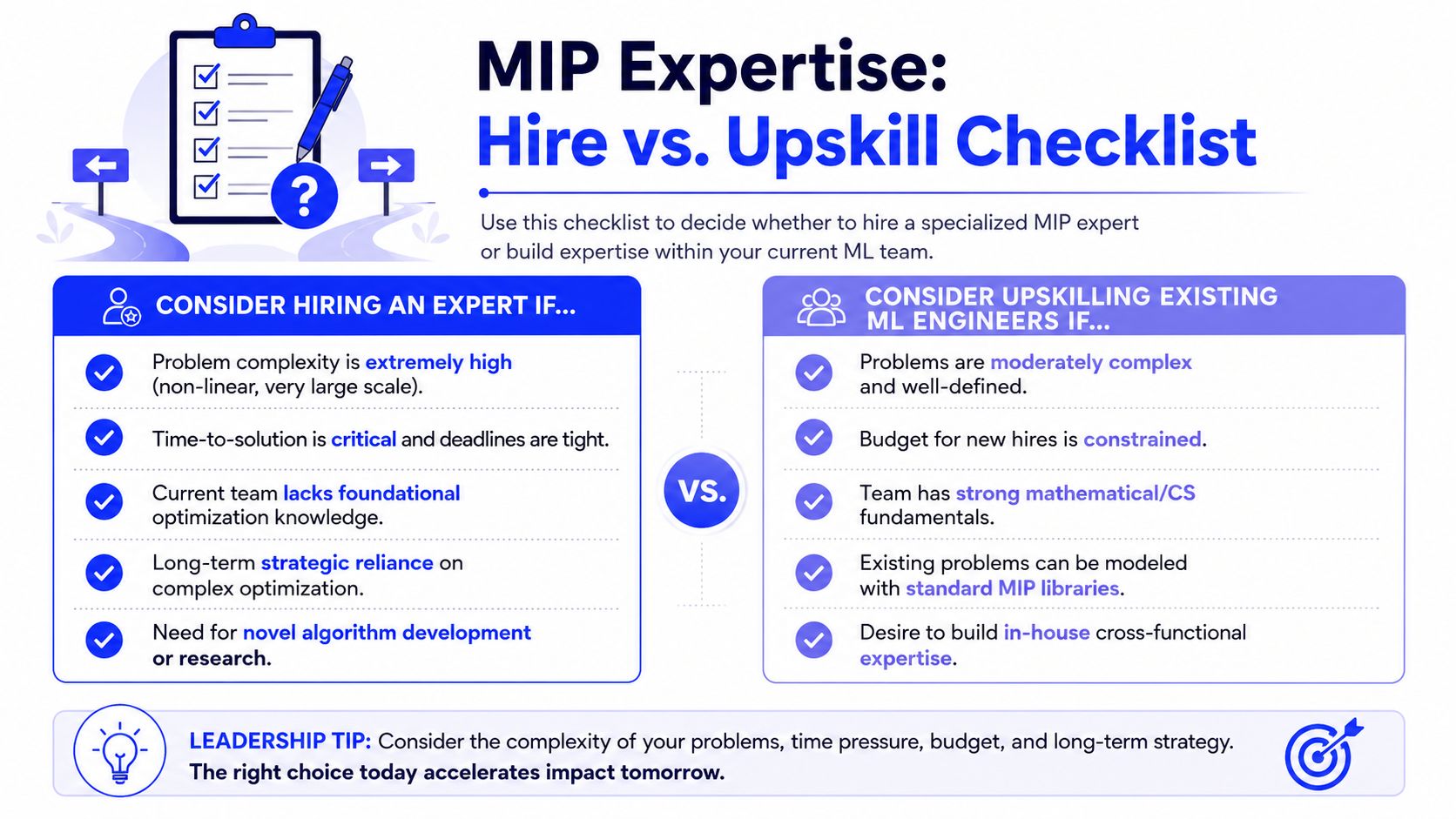
What it shows: A practical checklist to help leadership determine the optimal strategy for acquiring Mixed Integer Programming expertise, balancing hiring specialists versus upskilling the existing technical team.
A good mixed integer programming engineer doesn't just write constraints. They shape the business problem, choose the right abstractions, debug infeasibility, tune performance, and work with data and platform teams so the optimizer survives outside a notebook.
If your roadmap includes a scheduling engine, cost allocation service, network planner, or any decision layer that has to operate under real business constraints, this is often one of the highest-impact hires you can make.
If you need senior engineers who can build optimization-backed AI products in production, not just prototypes, ThirstySprout can help you Start a Pilot or See Sample Profiles for vetted AI, MLOps, and optimization talent.
Hire from the Top 1% Talent Network
Ready to accelerate your hiring or scale your company with our top-tier technical talent? Let's chat.