

You're probably in one of two situations right now. Either your team is starting a new AI or data product and someone asked, “Should we just use MATLAB because it's strong for numerical work?” Or you already have MATLAB in the building, and you're wondering whether it's slowing hiring, deployment, and productization.
My view is simple. For most new software products, choose Python. Choose MATLAB only when your problem is genuinely rooted in specialized engineering workflows, and when its domain tooling is part of the value, not just a familiar habit.
This isn't a syntax debate. It's a stack decision that affects who you can hire, how fast you can ship, how cleanly you can deploy, and whether your research code becomes a product or stays a prototype.
The Executive Summary for 2026
- Pick Python for most new AI, SaaS, and fintech builds. It gives you a broader hiring market, a cleaner path from notebook to API, and a general-purpose stack your engineers can extend beyond modeling.
- Pick MATLAB for specialized engineering programs. It's a strong fit when you need established workflows in simulation, control systems, signal processing, robotics, or embedded engineering.
- Judge the choice by production path, not benchmark theater. The right question isn't which language wins a toy test. It's which stack your team can hire for, maintain, and deploy without friction.
If you're a CTO, VP Engineering, founder, or head of AI, this decision usually shows up at an awkward moment. The prototype works. The roadmap is getting real. Hiring is starting. Product wants an API. Platform wants observability. Then the stack choice stops being academic.
My recommendation is blunt. If you're building software that needs to live in web services, data pipelines, cloud infrastructure, or modern machine learning workflows, default to Python. If you're building around engineering models where MATLAB and Simulink are already central to validation and domain workflows, keep MATLAB where it provides advantage.
For teams thinking about long-term platform direction, Python's trajectory in modern engineering teams is the more relevant lens than old classroom comparisons.
A Practical Decision Framework
The fastest way to make a bad MATLAB vs Python decision is to ask, “Which language is better?” The right question is, “Which one reduces execution risk for this product?”
Use this scorecard mentally before you commit.
| Decision criteria | MATLAB strength and fit | Python strength and fit | Key considerations |
|---|---|---|---|
| Primary use case | Strong for simulation, control, signal, robotics, engineering analysis | Strong for AI products, data apps, APIs, web services, automation | Match the language to the product's operating environment |
| Team background | Best when your core team already works in MATLAB or Simulink | Best when your team spans ML, backend, data, and platform engineering | Existing skill depth matters, but future hiring matters more |
| Production deployment | Can work well in specialized workflows, but often adds packaging or integration steps | Native fit for cloud services, containers, orchestration, and application backends | Ask how the code will run in production, not just in development |
| Talent availability | Narrower and more specialized talent pool | Broad talent pool across software, data, and ML | Hiring velocity affects roadmap velocity |
| Budget model | Proprietary ecosystem with license decisions tied to toolboxes | Open-source language with costs centered on infrastructure and people | Don't look only at license line items |
| Platform flexibility | Excellent within its intended domains | Better across mixed stacks and adjacent use cases | Future roadmap creep usually favors general-purpose tools |
Practical rule: If your model needs to become a product feature, Python usually wins. If your model is itself part of an engineering validation workflow, MATLAB often wins.
Mini case one
A SaaS company wants to launch a forecasting feature inside its customer dashboard. The likely next steps are predictable. Expose predictions through an API. Log inputs and outputs. Add retries. Put the service behind authentication. Maybe later, support batch jobs and customer-specific retraining.
That team should choose Python. Not because MATLAB can't forecast, but because the work doesn't stop at forecasting. It becomes backend engineering, MLOps, data contracts, and service ownership.
Mini case two
An aerospace team is building and validating control logic tied to simulation-heavy workflows. Engineers already rely on MATLAB and Simulink. The surrounding process includes domain-specific analysis, review, and handoff practices built around those tools.
That team should stay with MATLAB unless there's a compelling reason to uproot it. Replatforming just to chase mainstream popularity would be a mistake if the current workflow is aligned to safety, validation, and domain expertise.
The decision test I'd use
- Start with where the output lives. In a cloud API, internal platform, embedded system, or simulation environment?
- Map the people required after prototype. Data scientist, ML engineer, backend engineer, platform engineer, controls engineer.
- List the integration boundaries. Authentication, monitoring, model registry, scheduling, CI/CD, containerization, embedded export.
- Choose the stack with the fewest handoff points.
That last step matters most. Every handoff is delay, translation, and risk.
Ecosystem and Library Access
The sharpest difference in MATLAB vs Python isn't syntax. It's ecosystem shape.
Python gives you a massive open-source universe. MATLAB gives you a curated commercial environment. One offers breadth and flexibility. The other offers depth in tightly defined domains.
What the adoption gap really means
A July 2025 developer survey cited by Coursera found that 57.9% of software developers reported using Python, while only 3.9% reported using MATLAB, which highlights how much broader Python's mainstream adoption is in professional workflows, especially outside specialized engineering contexts (Coursera's MATLAB vs Python comparison).
That gap has practical consequences.
If you choose Python, you inherit a much larger base of developers, libraries, tutorials, community packages, deployment examples, and troubleshooting threads. If you choose MATLAB, you're buying into a more specialized ecosystem where the tooling is often polished, but the universe is smaller and more controlled.
Breadth versus curation
Here's the fundamental trade-off.
- Python gives you horizontal reach. You can move from data cleaning to model training to API deployment to automation without switching languages.
- MATLAB gives you vertical specialization. In control, signal processing, simulation, and related engineering work, its toolbox model can be extremely effective.
- Python lets teams mix concerns in one stack. Your ML engineer, backend engineer, and data engineer can often work in the same language.
- MATLAB makes more sense when the domain tooling is the point. If the toolbox workflow is core to the work, that specialization is an asset.
Curated ecosystems reduce variance. Open ecosystems increase optionality. You need to know which one your organization actually values.
A practical buyer's lens
Ask your team these questions:
- Are we buying a language or a product environment? MATLAB is often both.
- Will we need adjacent capabilities soon? Web services, automation, orchestration, dashboards, internal tooling.
- Do we want vendor-curated workflows or open-ended composability?
- How much roadmap control do we need? Proprietary environments can be stable, but they also narrow how you extend them.
If your roadmap includes product delivery, internal platform ownership, and multiple engineering disciplines, Python's ecosystem is the safer strategic bet. If the roadmap is anchored in technical computing inside a known engineering lane, MATLAB's curated approach can be worth the constraint.
Performance Benchmarks That Actually Matter
Most performance arguments in MATLAB vs Python are framed badly. People compare one toy script, then act like they've settled a platform decision.
That's not how engineering works.
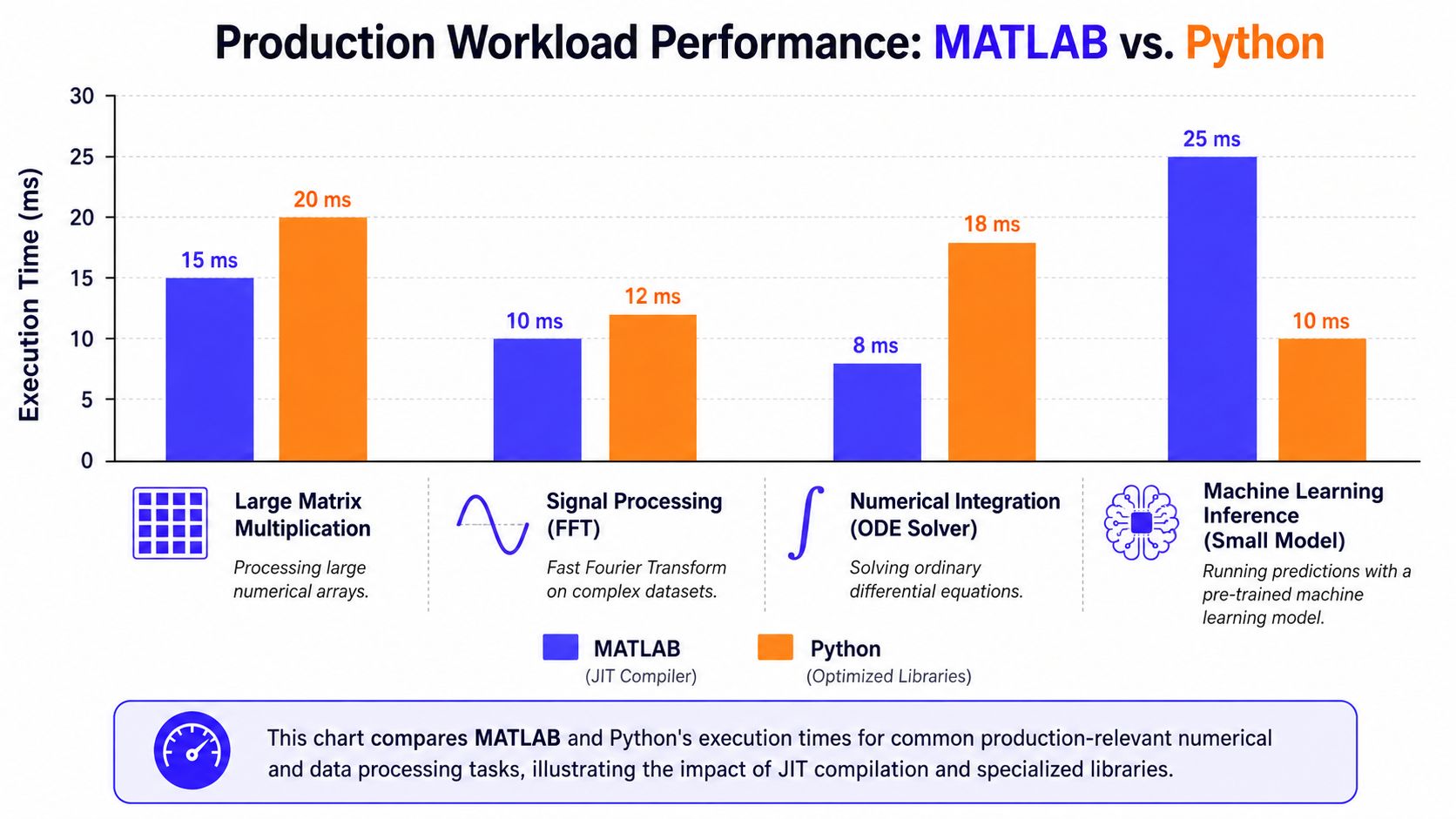
MATLAB has a real advantage in some cases
For non-vectorized, loop-heavy code, MATLAB can be materially faster than plain Python. One benchmark reported a loop-based test at about 0.7 seconds in MATLAB versus about 7.6 seconds in Python, and another 100-million-iteration loop at about 0.05 seconds in MATLAB versus about 0.8 seconds in Python (Codesolid's benchmark discussion).
That matters if your workload looks like that. Some academic algorithms and quick numerical implementations do.
But too many teams stop there and miss the actual question.
Performance for what workload
In production, you rarely want a language that wins only when code stays naïve. You want a stack that performs well when engineers use the right libraries and deployment patterns.
For Python, that usually means leaning on optimized numerical libraries and not writing performance-critical code as raw interpreter-heavy loops unless you have no choice. Once you do that, the simplistic “Python is slow” line gets much weaker.
A good CTO asks:
| Workload type | Better question |
|---|---|
| Research script | How fast is the first implementation? |
| Numeric kernel | Can optimized libraries handle the hot path? |
| API service | What's the end-to-end latency with serialization, I/O, and model load? |
| Batch pipeline | How well does it parallelize and recover? |
| ML inference | Which ecosystem gives better serving options and observability? |
The common mistake
Teams overvalue local benchmark speed and undervalue system throughput.
A model that runs fast in isolation but is painful to package, scale, and monitor can lose badly in practice. A slightly slower kernel in a much better production stack often wins the business outcome.
What matters in production isn't benchmark pride. It's whether the team can make performance repeatable, observable, and maintainable.
My recommendation on performance
Use MATLAB when your workload is dominated by specialized numeric computation and the rest of the delivery chain stays inside that environment.
Use Python when performance depends on full-system behavior. That includes APIs, batch jobs, model serving, pipelines, and distributed infrastructure. In those contexts, benchmark fragments matter less than architecture quality and library choice.
From Prototype to Production MLOps
Most MATLAB vs Python decisions become obvious at this point.
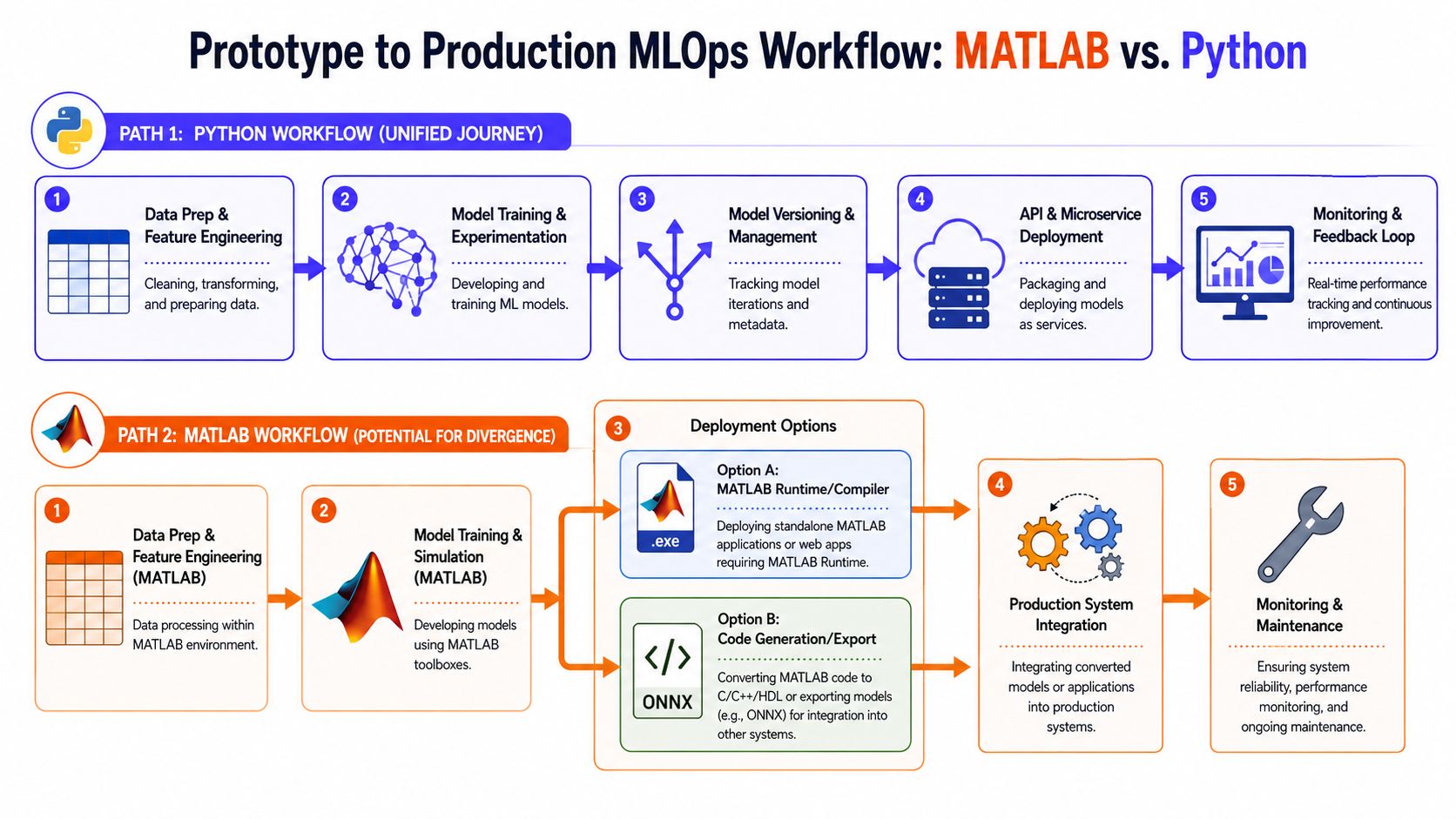
If your team wants a model in production, Python usually gives you a cleaner path from experiment to service. One language can carry the work from notebook to training pipeline to API deployment to monitoring.
Python keeps the handoffs low
A common Python workflow is straightforward:
- Explore and prepare data in notebooks or scripts.
- Train and evaluate models with standard ML libraries.
- Package the model into a service layer.
- Deploy into containers or managed infrastructure.
- Monitor predictions and retrain as needed.
That matters because every stage can stay close to the same ecosystem. Your data scientist, ML engineer, and platform engineer don't have to translate as much.
For teams tightening deployment practices, these MLOps best practices for production teams are much easier to apply when your modeling and deployment stack already align.
MATLAB often introduces a second language problem
MATLAB is excellent for modeling in the right domains. The trouble appears when the artifact needs to become part of a broader software system.
Then the team often faces one of two paths:
- Deploy around MATLAB runtime or compiler tooling
- Generate or export code for integration elsewhere
Both can work. But both add a boundary. And boundaries create friction.
The issue isn't that MATLAB can't reach production. It can. The issue is that many modern product teams don't want a special path for one part of the stack. They want the model, service, observability, and deployment workflows to fit together naturally.
Here's a useful outside reference if you're comparing operational tooling around model deployment and governance: this guide for evaluating MLOps tools is a solid checklist for what your stack will need after the prototype phase.
A short explainer is worth watching before you standardize the workflow:
Scaling changes the conversation
For econometric and bootstrap workloads, one benchmark found MATLAB was roughly 3x faster than Python in a native linear-algebra implementation, but Python's parallel execution scaled well across more than 12 cores and produced the largest percentage runtime improvements when work was distributed across processors (comparative benchmark analysis from William & Mary).
That's the production lesson. Single-core speed is only one dimension. In cloud systems and larger serving environments, parallel execution and ecosystem support often matter more.
Architecture example
A lean product team building a fraud scoring service will usually want this shape:
- Data ingestion through Python-based ETL and validation
- Feature computation in shared services or batch jobs
- Model serving behind an HTTP API
- Monitoring for latency, drift, and failures
- Retraining on scheduled pipelines
That architecture sits naturally in Python.
A hardware-adjacent engineering team validating control behavior may want a different shape:
- Simulation environment
- Model development in MATLAB
- Code generation or controlled deployment path
- Integration with downstream systems
- Domain-specific maintenance loop
That architecture can justify MATLAB. The key is honesty about which architecture you're building.
The True Cost Licensing and Hiring
Most MATLAB vs Python cost discussions are shallow. People say “Python is free” and move on. That misses the bigger financial issue.
The expensive part of a stack decision usually isn't the language. It's the operating model that comes with it.
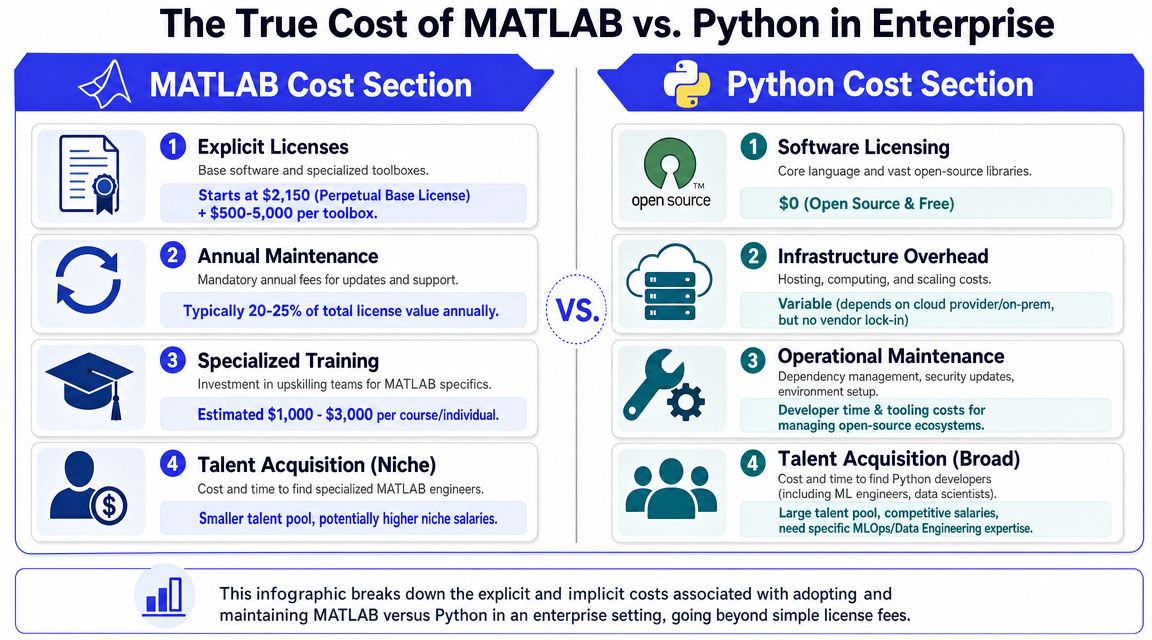
License cost is the obvious part
MATLAB is proprietary. Python is open source. That difference is real, but it's only the first line on the spreadsheet.
The harder costs show up later:
- Who can you hire
- How many roles can work in the same stack
- How much custom integration work is needed
- How much platform divergence you create
Hiring is where Python pulls away
Coursera's framing is directionally right. MATLAB remains strongest in specialized scientific and engineering work, while Python spans those areas plus automation, web development, and application development. A 2026 Boot.dev analysis cited by UpGrad also describes Python as the most popular language in the TIOBE index and estimates it is roughly 2x to 7x more hireable than MATLAB based on job listings (UpGrad's summary of MATLAB vs Python hiring and adoption).
That's the strategic difference.
If you choose Python, you can recruit from a broader market of backend engineers, data engineers, ML engineers, and automation-minded developers. If you choose MATLAB for a general-purpose product, you narrow the funnel immediately.
For teams planning hires, this guide to hiring Python coders reflects the practical advantage of building around a language with broad industry reach.
Total cost of ownership is about coordination
Consider two teams building the same customer-facing analytics feature.
Team A uses Python. The same stack can support data prep, model training, API delivery, and operational tooling. Fewer boundaries. More reusable hiring patterns.
Team B uses MATLAB for core logic and another stack for product delivery. That creates translation work. Someone has to bridge research code to production services. Someone owns integration. Someone debugs mismatches.
That second team may spend less time debating libraries and more time managing interfaces. That overhead is easy to ignore early and painful later.
Practical finance rule: The stack with the larger talent pool and fewer translation layers usually has the lower long-term cost, even if the short-term prototype feels similar.
When MATLAB is still worth the money
MATLAB is worth paying for when all three are true:
- Its specialized tooling is central to the work
- Your engineers already operate effectively in that environment
- The production path doesn't force awkward rewrites or fragmented ownership
If those conditions aren't true, MATLAB becomes an expensive comfort zone.
Quick TCO checklist
Use this in your planning doc:
License exposure
Are you buying one environment, or base software plus multiple specialized dependencies?Hiring depth
Can you fill roles from mainstream software and ML markets, or only from a narrow specialist pool?Platform sprawl
Will the stack unify data, modeling, services, and operations, or split them?Onboarding burden
Can new engineers contribute broadly, or only within a specialized lane?Roadmap flexibility
Can this stack support adjacent product requirements without major rework?
If your company builds AI, fintech, SaaS, or internal data products, Python usually wins this checklist. If you run a specialist engineering organization, MATLAB can still be the right answer.
Your Decision Checklist and Next Steps
The key buyer question isn't “Which language is nicer?” It's whether choosing MATLAB will narrow your talent pool and slow productization compared with Python. That's the issue many comparisons skip, even though it matters most for AI, fintech, and SaaS teams working toward standardization and scale, as discussed in the Journal of Data Science comparison context.
Use this simple weighted checklist with your leadership team. Score each item as higher fit for MATLAB or Python.
Scorecard template
Core product type
Customer-facing software product, internal platform, or engineering simulation environment?Deployment destination
Cloud API, data pipeline, embedded system, or lab workflow?Hiring plan
Will you hire generalist software and ML engineers, or domain specialists?Existing team skill
Are your strongest current operators already deep in MATLAB, or broader in Python?MLOps fit
Do you need a standard model lifecycle with deployment, monitoring, and retraining?Integration complexity
Will the model need to plug into services, data systems, and application logic?Vendor dependence
Are you comfortable tying roadmap decisions to a proprietary environment?Roadmap expansion
Will this project likely grow into adjacent product and platform work?
Three actions I'd take this week
- Run the scorecard with engineering, data, and product in one room. Don't let one specialist make a platform decision alone.
- Scope a short pilot with production intent. Build the deployment path, not just the model.
- Decide based on handoffs. The better stack is the one that reduces rewrites, staffing friction, and operational drag.
If your answer is still split, default to Python unless the MATLAB-specific workflow is plainly central to the business.
If you need senior engineers who can pressure-test this decision and turn it into a working pilot, ThirstySprout can help. We match companies with vetted AI, ML, data, and MLOps talent who've shipped real production systems. If you're ready to Start a Pilot, talk to the team. If you want to See Sample Profiles, ask for engineers with Python, ML platform, and production AI experience aligned to your roadmap.
Hire from the Top 1% Talent Network
Ready to accelerate your hiring or scale your company with our top-tier technical talent? Let's chat.