

You're probably here because you already learned the hard lesson. Hiring “a Python developer” didn't solve the problem. You got someone who could write scripts, maybe even ship a Flask app, but they couldn't stabilize a data pipeline, package a model service, or debug why inference broke after a dependency update.
That's the gap in most advice about Python coders for hire. Sourcing isn't the hard part anymore. Python is used by 57.9% of developers in 2025, up 7 points year over year, with roughly 22.9 million developers worldwide, and it appeared in 199,213 AI job postings in 2024 according to Python market data compiled here. The challenge is filtering for people who can ship production AI systems, not just write Python syntax.
My advice is simple. Define the workload precisely. Vet for production behavior, not buzzwords. Pay for capability. Then onboard with discipline.
Practical rule: If your team is building an AI feature, don't hire for “Python.” Hire for the exact failure mode you need to avoid.
Your Sourcing Strategy for Python Talent
Treating sourcing channels like a shopping list is a mistake. Each channel changes your execution speed, management load, and risk profile.
If you need Python coders for hire, start by deciding what kind of problem you're solving. Short burst of work? Specialist gap? Core team build-out? Those are different decisions.
Pick the channel that matches the work
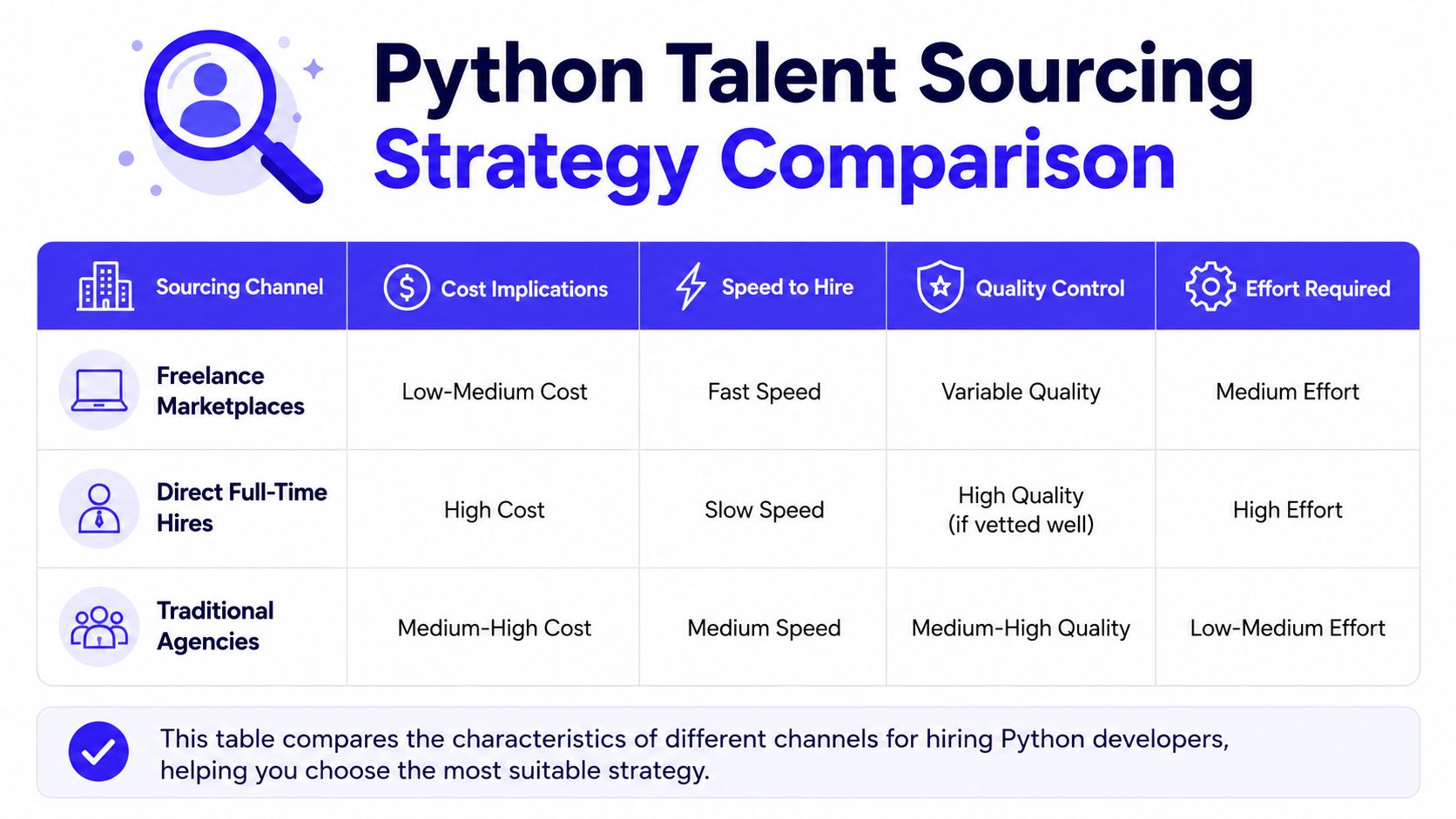
| Sourcing Channel | Cost Implications | Speed to Hire | Quality Control | Effort Required |
|---|---|---|---|---|
| Freelance Marketplaces | Low-Medium Cost | Fast Speed | Variable Quality | Medium Effort |
| Direct Full-Time Hires | High Cost | Slow Speed | High Quality (if vetted well) | High Effort |
| Traditional Agencies | Medium-High Cost | Medium Speed | Medium-High Quality | Low-Medium Effort |
Freelance marketplaces work when the task is bounded. Think migration scripts, API integrations, dashboard fixes, or a short data ingestion sprint. They fail when you need ownership, architecture judgment, or someone to work inside a messy production stack without daily hand-holding.
Direct full-time hiring makes sense when Python is becoming part of your core product capability. If your roadmap includes model serving, retrieval pipelines, backend services, or long-lived internal tooling, you want institutional memory and accountability inside your company.
Traditional agencies sit in the middle. They can reduce recruiting effort and give you delivery structure, but you still need to inspect the actual engineers who'll do the work. Agency logos don't review pull requests.
The real trade-off is coordination
The biggest mistake in global hiring is obsessing over hourly cost. Independent guidance on hiring Python developers outside the U.S. gets this right: the key trade-off isn't just cost, it's coordination. Freelancers give flexibility, but you need stronger vetting. Agencies can provide structure, but time-zone fit, communication reliability, and accountability still decide whether the engagement works.
That matters a lot for AI teams. A senior engineer working on FastAPI services, data pipelines, or model deployment needs to join your workflow, not operate as an isolated ticket taker.
A practical channel map
Here's how I'd decide:
- Use freelance marketplaces when you already have technical leadership in-house and need narrow execution.
- Use direct hiring when the engineer will own systems, influence architecture, or handle cross-functional trade-offs.
- Use agencies when you need managed throughput and can define interfaces clearly.
- Use curated talent networks when speed matters but you still need production-grade vetting. That's where services like ThirstySprout can fit, alongside options such as in-house sourcing stacks and recruiter-led search, because they focus on connecting companies with vetted remote AI and Python talent rather than raw applicant volume.
Mini-case one. A seed-stage SaaS team needs a Python contractor to clean up a brittle ETL job. Marketplace hire. Tight scope. Fixed deliverable. One internal reviewer.
Mini-case two. A Series A company is building an LLM-backed workflow product and needs someone to own model APIs, observability hooks, and deployment hygiene. That is not a gig task. That's either a full-time hire or a vetted senior contractor embedded with the team.
If you're building your own outbound pipeline, it's worth reviewing the LinkedIn Recruiter Lite benefits so your sourcing motion is based on targeted search instead of waiting for weak inbound. For teams evaluating the software stack around recruiting operations, this roundup of AI recruiting tools is also useful.
This table compares the characteristics of different channels for hiring Python developers, helping you choose the most suitable strategy.
Defining the Python Role You Actually Need
“Python developer” is a lazy job title. It conceals the precise requirement and guarantees noisy candidate pipelines.
Arc's hiring guidance puts it plainly in its advice on hiring Python developers: the label is too broad to be a meaningful hiring signal in 2026. The risk isn't hiring someone who lacks Python syntax. The risk is hiring someone who can't handle the workload you have, whether that's backend APIs, machine learning workflows, or data pipelines. The critical test is maintainable, Pythonic code and the ability to turn business needs into system requirements.
Start with the business problem
Don't open a req with tools. Open it with outcomes.
If the business asks for “an AI chatbot,” force specificity:
- Does the team need ingestion and retrieval?
- Does it need model experimentation?
- Does it need a production API with latency and auth constraints?
- Does it need offline evaluation and monitoring?
Those answers usually separate three very different roles.
| Business need | Real role | What matters most |
|---|---|---|
| Build and maintain APIs, auth, queues, services | Backend Python engineer | FastAPI, database design, testing, service reliability |
| Build ingestion, transforms, storage, batch or streaming flows | Data engineer | Pandas, orchestration, warehousing, pipeline resilience |
| Train, serve, and operate models in production | ML engineer or MLOps engineer | Model packaging, deployment, observability, versioning |
A role definition framework that works
Use this sequence before you publish a job:
Name the core deliverable
Example: “Ship a document ingestion and retrieval service used by our support product.”List the operating environment
Existing stack, cloud provider, CI/CD setup, data stores, model stack, review process.Specify production constraints
Reliability expectations, maintainability, deployment ownership, monitoring responsibility.Choose one primary role identity
Backend, data, ML, or MLOps. You can add adjacent skills, but only one should lead.Write outcome-based responsibilities
“Own the service that transforms raw documents into indexed chunks,” beats “must know Python, Docker, and APIs.”
Mini-case and template
Mini-case. A founder says, “We need a Python engineer for our recommendation engine.” After one follow-up, the actual problem turns out to be failed feature pipelines and unreliable batch jobs. That's a data engineering hire, not a generic Python role.
Use a job brief like this:
Mission
Own the Python services and pipelines that support our AI product in production.First outcomes
Ship one production change in the first month, improve one weak point in code quality or deployment flow, and take ownership of one service or pipeline by the end of onboarding.Must-have experience
Maintainable Python code, Git-based workflows, code review discipline, testing, and experience working inside an existing stack.Role-specific layer
Backend: FastAPI, async patterns, databases.
Data: transformation pipelines, workflow orchestration, storage systems.
ML/MLOps: model lifecycle handling, packaging, deployment, monitoring.
If you're hiring through freelance channels, this guide to mastering Upwork job descriptions is worth reading because it pushes you toward outcome-led specs instead of laundry lists. If you want a deeper view of where Python skill overlaps with product work, this piece on Python for web development adds useful context.
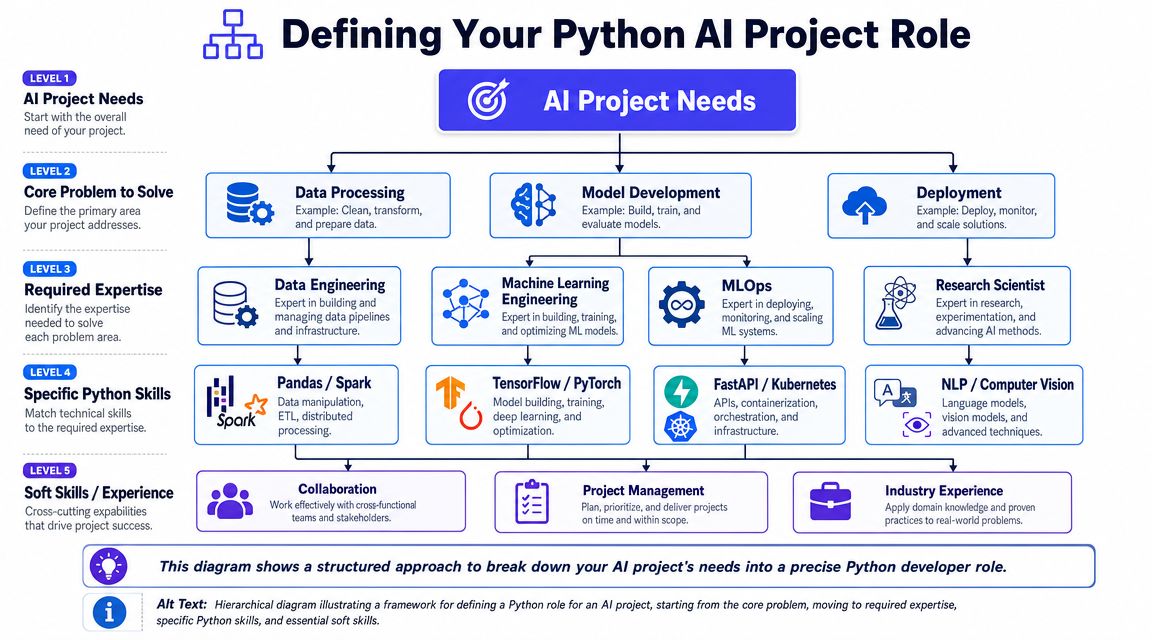
This diagram shows a structured approach to break down your AI project's needs into a precise Python developer role.
A Vetting Process That Filters for Excellence
A polished resume is easy to fake. Production judgment isn't.
The most effective hiring motion is a staged funnel. Hiring guidance from Lathire recommends a process built around a detailed role spec, screening for relevant work, and a small paid test project. It also notes that sourcing can take 1 to 7 days for freelancers, while in-house hiring can take 30 to 90 days before productive output appears, based on its Python developer hiring guide. That timing difference matters, but the deeper point is this: staged vetting filters for delivery, not résumé keywords.
Stage one screens for relevance, not prestige
I ignore brand-name employers unless the work is clearly relevant. I care about whether the candidate has operated in systems that resemble mine.
Look for:
- Project similarity with your environment, such as APIs, pipelines, model services, or internal platforms
- Ownership signals like leading a migration, stabilizing a service, or improving deployment workflow
- Artifacts such as GitHub work, technical writeups, architecture notes, or code samples when available
- Evidence of constraints because production work always involves trade-offs, incidents, and handoffs
Reject resumes that read like keyword stuffing. Ten libraries listed without shipped outcomes is noise.
Stage two tests engineering judgment
Your technical screen should feel like a design review, not a trivia contest.
Ask questions like:
- You inherit a Python inference service with inconsistent latency. How do you investigate?
- A data pipeline succeeds technically but produces bad downstream model behavior. Where do you look first?
- How would you structure versioning for code, models, and prompts in a team environment?
- When would you choose a batch job over an event-driven pipeline?
- What would you monitor after launching a new model-backed endpoint?
These questions reveal whether the person understands production systems or only tutorials.
Hire the person who can explain failure modes clearly, not the one who recites the most framework names.
Stage three uses a paid task that mirrors the job
This is the strongest filter. Keep it small. Keep it real. Pay for it.
Two good examples:
Example one. Backend AI task
Give the candidate a small FastAPI service with one weak endpoint, one failing test, and one data contract issue. Ask them to improve code quality, document decisions, and submit a pull request.
Example two. Data and ML task
Provide a messy dataset and a simple prediction or retrieval objective. Ask for a pipeline script, basic validation, and a short note on how they'd productionize it.
What you're scoring:
- Code quality and readability
- Testing instincts and edge case handling
- Change isolation so they don't break unrelated behavior
- Communication in commit messages, notes, or review responses
A scorecard you can use today
| Category | What good looks like | Red flag |
|---|---|---|
| Code quality | Clear structure, Pythonic style, maintainable choices | Clever but fragile code |
| System thinking | Understands dependencies, failure points, interfaces | Talks only about local code |
| Production readiness | Mentions testing, deployment, monitoring, rollback | Treats shipping as an afterthought |
| Communication | Explains trade-offs crisply | Vague, defensive, or overly abstract |
| Workflow fit | Comfortable with review, iteration, async teamwork | Operates like a solo hacker only |
One more practical note. Strong candidates are interviewing you too. This resource with expert interview tips for job seekers is aimed at candidates, but hiring managers should read it as well. It helps you understand how serious applicants present themselves and where weak interview loops create false negatives. For role-specific screening ideas, use these AI engineer interview questions as a starting point.
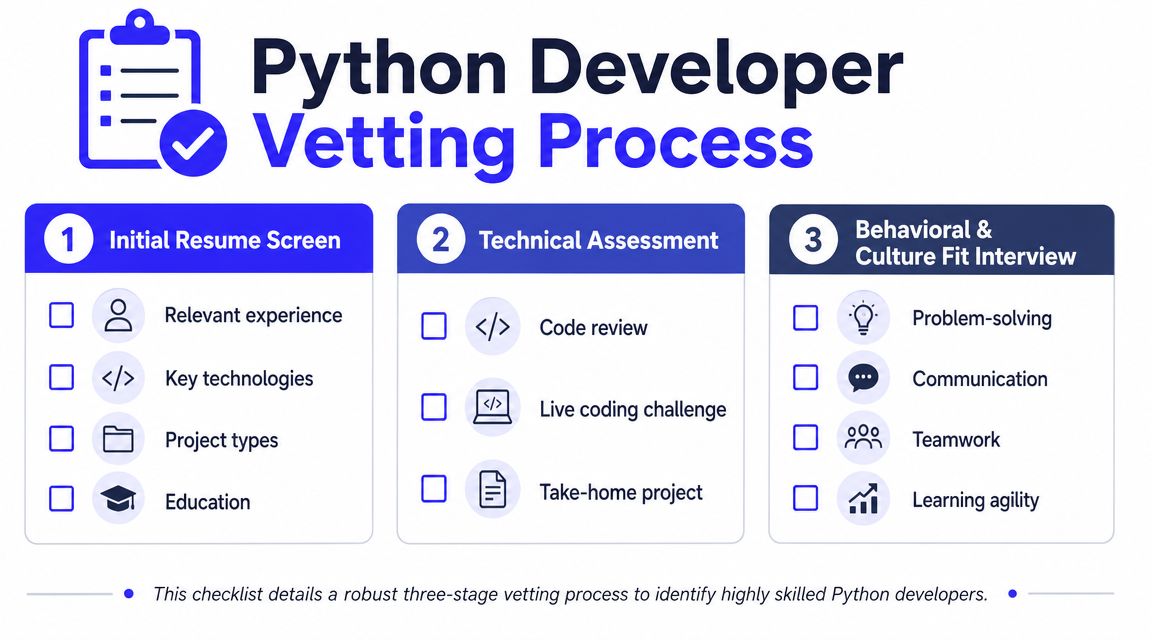
This checklist details a robust three-stage vetting process to identify highly skilled Python developers.
Crafting a Competitive Offer and Contract
If you want high-end Python talent, price the role appropriately. Trying to bargain-hunt for production AI capability usually costs more later in rewrites, delays, and team churn.
As of March 2026, the average U.S. Python developer salary was reported at $124,166, with senior AI and ML specialists commanding $100 to $150+ per hour, according to this breakdown of Python developer hiring costs. The same source notes 153% year-over-year growth in U.S. tech-sector demand for Python skills, which is why this market behaves like a premium technical labor segment.
Match the pricing model to the work
For bounded tasks, hourly or milestone-based contracts are fine. Use them when scope is narrow and acceptance criteria are clear.
For ambiguous product work, fixed-price contracts are usually a trap. You'll either over-spec the work and slow everything down, or under-spec it and fight over change requests. If the engineer is solving open-ended platform or AI delivery problems, use time-based pricing with explicit checkpoints.
For core team hires, salary is only one part of the offer. Strong candidates evaluate reporting line, technical ownership, code quality culture, and whether they'll inherit chaos.
Contract terms that matter
Don't overcomplicate the paperwork. Just cover the points that protect delivery.
- IP ownership so all code, artifacts, and related deliverables transfer cleanly
- Confidentiality covering data access, internal systems, prompts, models, and customer workflows
- Acceptance criteria tied to specific deliverables or operating expectations
- Payment schedule aligned to milestones or billing cycles
- Access and security rules so the engineer knows the boundaries from day one
If you want to attract senior people, write a contract that signals operational maturity. Good engineers notice when a company has thought through ownership, review flow, and delivery expectations.
The First 90 Days A Python Coder Onboarding Plan
Most hiring failures don't happen at offer stage. They happen after the hire, when nobody defines success, access arrives late, and the new engineer spends two weeks guessing how the team works.
A structured onboarding plan fixes that. It turns a promising hire into a productive operator.
Days 1 to 30 build context and one quick win
The first month is about orientation and trust. Give the engineer system access, local setup docs, architecture notes, service ownership maps, and one human point of contact who can answer questions quickly.
Then assign a contained deliverable. Not a toy task. A real one with low blast radius.
Good first-month tasks include:
- Fixing one production annoyance such as a flaky job, poor logging, or a brittle test path
- Improving one developer workflow like environment setup or deployment documentation
- Shipping one small feature inside an existing service or pipeline
Mini-case. A new ML platform engineer joins a remote team. Instead of asking for a broad audit, the manager assigns ownership of one scheduled data validation job and one alerting improvement. The engineer learns the stack and proves reliability fast.
Days 31 to 60 move from contributor to owner
This phase is where many teams go wrong. They either leave the engineer underloaded or throw them into architecture work before they understand the codebase.
Use the middle window for one meaningful project:
- extend a service,
- stabilize a pipeline,
- package a model interface,
- or take over a recurring operational burden.
Add regular pull request reviews and short design discussions. You want to see how the person reasons in your actual workflow.
A good onboarding plan doesn't just ask, “Can they code?” It asks, “Can they make our team better without creating new friction?”
Days 61 to 90 establish autonomy
By the end of the third month, the engineer should own a component, not just tasks. Ownership means they can estimate work, flag risks early, and improve part of the system without waiting for step-by-step instructions.
Use a 90-day review built around:
- Technical output against the initial outcomes
- Code quality behavior in reviews and implementation choices
- Operational reliability including handoff quality and incident awareness
- Team integration across product, design, data, and platform interactions
A simple onboarding checklist helps:
| Timeframe | Manager focus | Engineer deliverable |
|---|---|---|
| Week 1 | Access, context, introductions | Local setup and environment readiness |
| Days 15 to 30 | Narrow, real task | First shipped contribution |
| Days 31 to 60 | Guided ownership | One substantial feature or system improvement |
| Days 61 to 90 | Autonomy and feedback | Ownership of a service, pipeline, or subsystem |
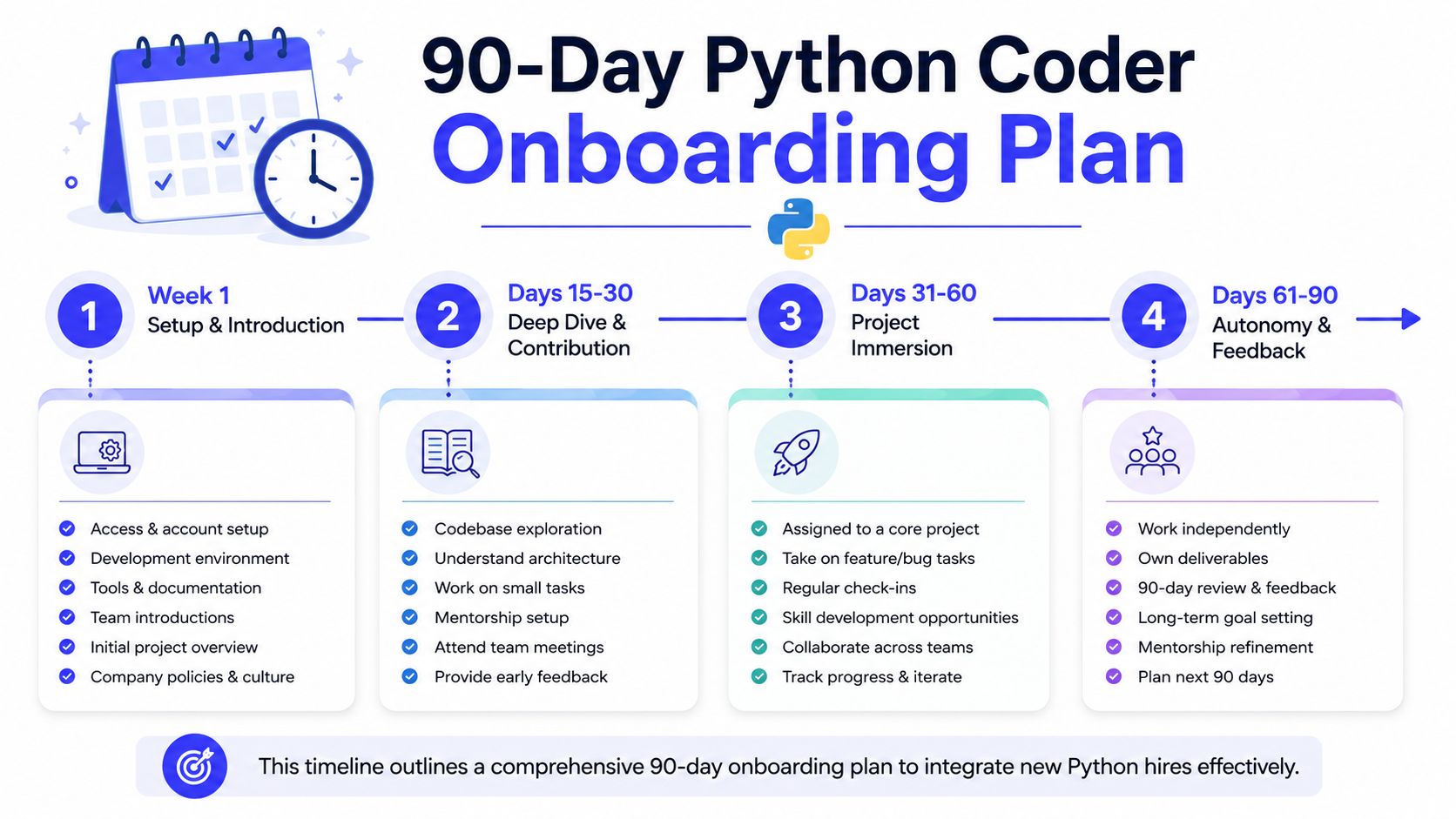
This timeline outlines a comprehensive 90-day onboarding plan to integrate new Python hires effectively.
Three Hiring Mistakes That Sink AI Projects
You hire a Python developer who looks strong on paper. Six weeks later, the model still runs only on a laptop, the pipeline breaks on messy inputs, and nobody trusts the deployment path. The problem usually is not Python skill. It is hiring the wrong kind of Python engineer for AI work that has to survive production.
Teams often get misled. They search for Python coders when they should be hiring for production AI ownership. That means screening for people who can handle model interfaces, data reliability, service boundaries, observability, and failure recovery. If your process does not test those areas, you are still hiring for prototypes.
Hiring a generalist for specialist work
“Python developer” is too broad to be useful. If the actual job is shipping inference services, maintaining ETL jobs around training data, or hardening LLM workflows, say that clearly and hire against it directly.
A backend generalist can write clean Python and still fail in an AI environment. Production AI work has different pressure points: changing data, unstable third party APIs, model latency, retry logic, prompt versioning, and evaluation drift. Write the scorecard around the system they will own, not the language they will use.
A good filter is simple. Ask, “What breaks at 2 a.m. in this role?” Then hire the person who has already dealt with those failures.
Treating AI work like standard app development
A lot of teams run interviews that reward clean syntax and fast whiteboard answers. That misses the actual job.
Production AI engineers need judgment. They need to know when to batch requests, how to log model outputs safely, how to set fallbacks, how to validate data before it poisons downstream steps, and how to package work so another engineer can operate it next month. If you do not test for those habits, you will hire someone who can demo well and hand off poorly.
Use a paid exercise that mirrors the work. Give the candidate a small inference endpoint, a flaky data input, or a simple pipeline with one intentional failure mode. Score the result on four things: correctness, reliability, clarity, and operational thinking. That is a better predictor than another generic coding round.
Running a slow, sloppy process
Good candidates read your process as a signal. If interviewers ask overlapping questions, feedback conflicts, and the team takes a week to respond, strong engineers assume your execution will be just as messy.
Assign one hiring owner. Use one scorecard. Decide what each interviewer is responsible for testing before the loop starts. Then make a decision fast.
For AI hiring, speed matters, but precision matters more. Fast and vague gets you an expensive miss. Fast and structured gets you someone who can ship.
The teams that avoid these three mistakes do one thing differently. They stop hiring “Python coders” as a generic category and start hiring for production AI outcomes.
If you need Python coders for hire who can work on production AI systems, not just prototypes, ThirstySprout can help you scope the role, evaluate senior candidates, and start with vetted remote talent aligned to your stack and time zone. Start with a pilot, or review sample profiles before you commit.
Hire from the Top 1% Talent Network
Ready to accelerate your hiring or scale your company with our top-tier technical talent? Let's chat.