

You're probably deciding between two kinds of risk.
The first is technical risk. Will Python hold up for a production API backend, support the product roadmap, and scale with the traffic pattern you expect?
The second is delivery risk. Can your team hire fast enough, integrate with data and AI services cleanly, and ship an MVP without turning the backend into a science project?
For modern SaaS and AI products, Python for web development is rarely a question of “can it build websites?” It can. The better question is whether Python is the right backend language for your specific product shape: API-heavy, data-intensive, integration-heavy, latency-sensitive, or compute-heavy. That's where most shallow guides stop. That's also where architecture and hiring decisions start to matter.
The Core Decision Framework for Using Python
It is Monday morning. The product team wants a customer-facing API in six weeks, the data team needs model inference in the same stack, and hiring has already ruled out building a niche backend team from scratch. In that situation, the Python decision is less about language preference and more about execution risk.
Python fits best when the backend is the coordination layer for a product, not the product's main performance bottleneck. That usually means production APIs that sit between users, databases, background jobs, third-party services, and AI workflows. It also means teams that value shipping features, integrations, and operational tooling quickly, even if they give up some runtime efficiency compared with Go, Rust, or Java.
According to the 2024 Python Developers Survey from the Python Software Foundation and JetBrains, web development remains one of the language's primary production use cases. For a CTO, the useful signal is not popularity by itself. It is that Python still offers a large hiring pool, mature libraries, and a broad base of engineers who can contribute across backend, data, and ML work.
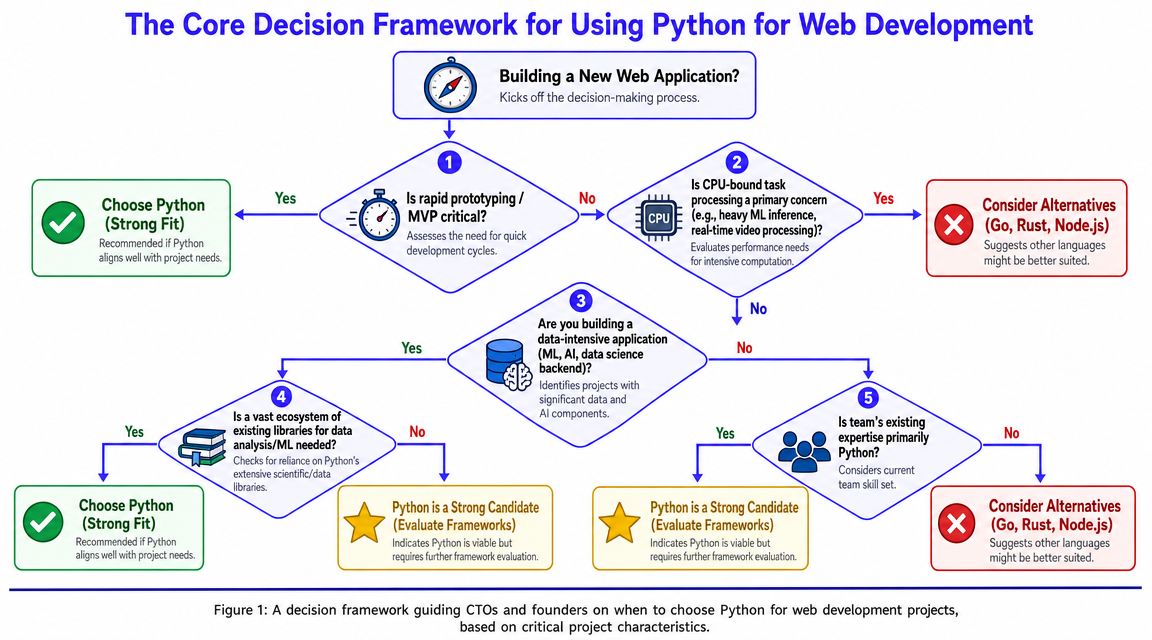
Choose Python when product speed and integration density matter most
Python is usually a strong call for SaaS and AI products with API-heavy backends. I recommend it most often when the roadmap depends on combining CRUD work, auth, async jobs, analytics, admin workflows, and model or data-service integrations in one system. Teams spend less time fighting the stack and more time shipping the product.
That pattern shows up in a few common cases:
- API-first SaaS products where web clients, mobile apps, customer automations, and partner integrations all depend on a stable backend contract
- AI-enabled applications where the backend has to orchestrate inference calls, vector search, data enrichment, evaluation pipelines, and usage tracking
- Operationally complex products where internal dashboards, background workers, billing logic, and support tooling matter almost as much as the public API
- Mixed-discipline teams where backend, data, and ML engineers need to collaborate in one language without heavy coordination overhead
That is why the more useful conversation is no longer “Can Python build a web app?” It can. The better question is whether it gives your company the fastest path to a maintainable production backend, and that is part of the broader future of Python in modern software teams.
Practical rule: Choose Python when your competitive advantage comes from delivering product logic, data workflows, and integrations quickly. Choose another language for the hot path if raw CPU efficiency or ultra-low latency defines the product.
Avoid Python by default if the request path is compute-heavy
Python has clear limits, and strong teams plan around them early.
If your core request path includes heavy video processing, high-frequency compute, strict tail-latency targets, or unusually tight memory budgets, Python should not be the only option on the table. A common production pattern is to keep the API and orchestration layer in Python, then isolate performance-critical services in Go, Rust, or a native extension. That split adds operational complexity, but it can be the right trade if product speed matters and only part of the system is performance-sensitive.
Hiring also changes the decision. A Python backend team is usually easier to build than a team around a narrower systems language, especially if the product touches data or AI. But easy hiring does not remove the need for senior engineering judgment. Flexible languages make it easy to move fast and easy to accumulate inconsistency if the team lacks strong standards around typing, testing, service boundaries, and observability.
A simple CTO scorecard helps:
| Decision factor | Python fit |
|---|---|
| MVP speed | Strong |
| AI and data integration | Strong |
| Internal tools and admin systems | Strong |
| Conventional CRUD apps | Strong |
| High-concurrency I/O APIs | Strong with async stack |
| CPU-bound request processing | Mixed |
| Ultra-minimal runtime overhead | Weaker |
| Team already strong in Python | Strong |
Figure 1: A decision framework guiding CTOs and founders on when to choose Python for web development projects, based on critical project characteristics.
Comparing Python Web Frameworks for 2026
A framework decision usually shows up six months later in places the prototype never exposed. Hiring gets easier or harder. Service boundaries stay clear or drift. Security and operational work either fit the framework's defaults or become a custom project.
For production Python teams, the shortlist is still Django, Flask, and FastAPI.
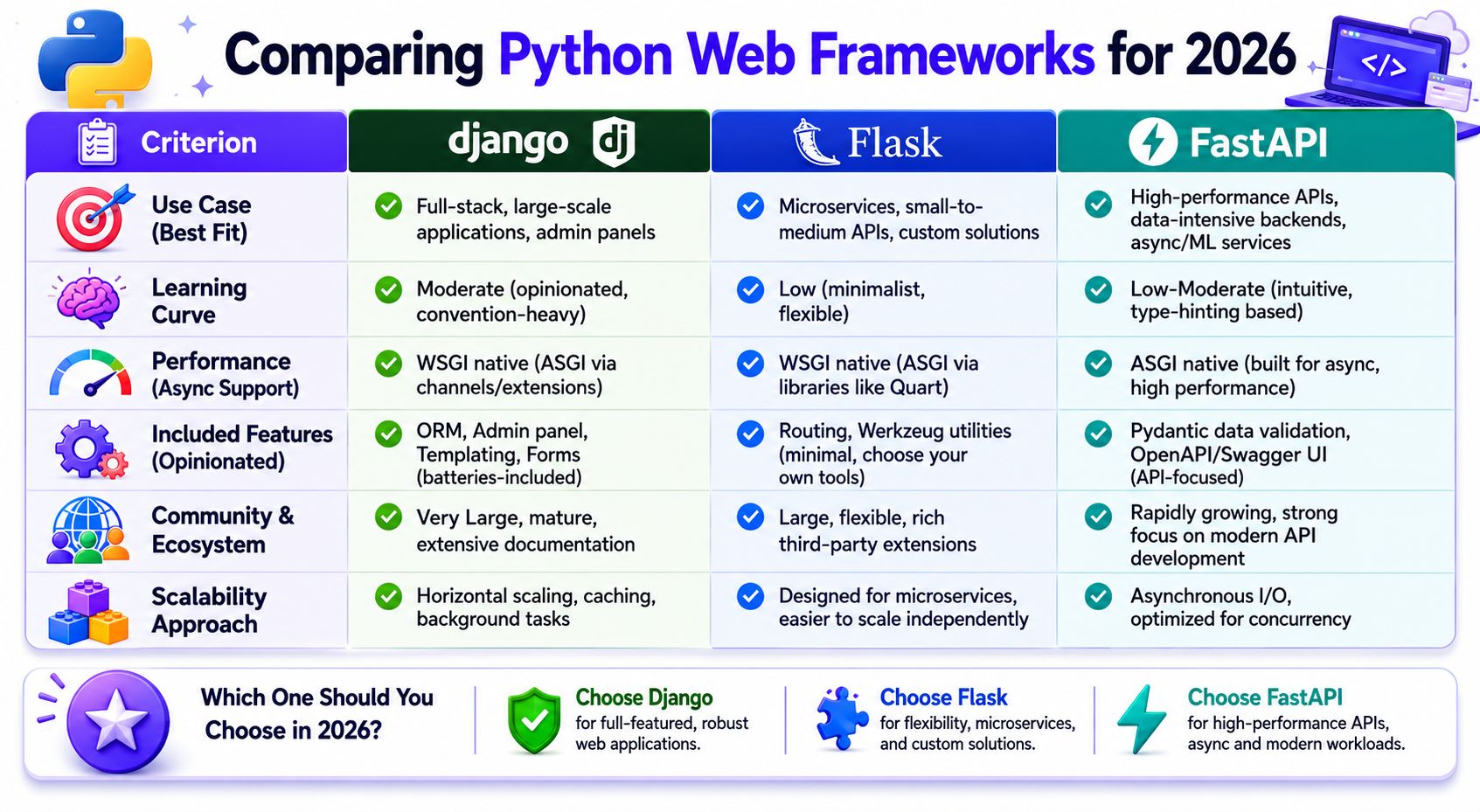
The practical scorecard
| Criterion | Django | Flask | FastAPI |
|---|---|---|---|
| Best fit | Full-stack apps, admin-heavy systems, mature monoliths | Lightweight services, custom backends, simple APIs | API-first products, async services, data-heavy backends |
| Team shape | Works well with structured product teams | Works well with experienced backend engineers who want flexibility | Works well with API and platform teams comfortable with type hints |
| Delivery pattern | Fast when you want batteries included | Fast at first, but architecture choices are yours | Fast for modern API work with strong defaults |
| Built-in features | Strong | Minimal | Focused on API ergonomics |
| Operational style | Convention-driven | Extension-driven | Contract-driven |
Table 1: A practical comparison of Python's leading web frameworks (Django, Flask, FastAPI) for making informed technology choices in 2026.
Django wins when the product needs structure
Django remains the safest choice when the backend has to support a real business operation, not just a public API. Teams shipping vertical SaaS products often need account management, permission models, admin workflows, reporting, and internal support tooling long before they need exotic architecture. Django handles that shape well because the framework pushes the team toward a consistent project layout, a standard ORM, and an admin interface that is useful in production.
That opinionation has a cost. Django is less attractive when every service boundary is custom, the API contract is the primary product surface, or the team wants to avoid framework-level conventions. But for a CTO trying to reduce decision load across a growing team, its structure is often an advantage.
Flask wins when you want a small, explicit core
Flask still makes sense for narrow services, migration layers, and backends that need very specific composition choices. It stays out of the way. Senior engineers often like that because they can choose their own validation, auth, ORM, and service layout instead of working around framework defaults.
The risk is governance. A Flask codebase can stay clean for years, or it can turn into a collection of loosely related modules with inconsistent patterns between teams. The difference is usually engineering discipline, not the framework itself. If you need a refresher on where Flask fits, this overview of what Flask is is a useful companion.
Here's a quick visual explainer before the final call:
FastAPI is often the first call for new API backends
FastAPI fits the way many modern SaaS and AI products are built. The backend is often an API contract sitting between frontend clients, third-party services, background jobs, and model-powered features. Typed request and response models, automatic OpenAPI generation, and a design that encourages explicit contracts all help teams move quickly without leaving API behavior implicit.
I would usually start with FastAPI for a greenfield product where the API is the product surface, especially if the roadmap includes partner integrations, AI features, or a platform model with multiple clients. It also tends to hire well with engineers coming from Python data work because the typing and schema model feel familiar.
The trade-off is operational maturity. FastAPI gives you a productive API layer, but it does not replace decisions about migrations, auth, permission boundaries, rate limits, background work, and service ownership. Teams still need clear production standards, including security review. This guide to AppSec for startups is a good reference when those decisions start moving from prototype to customer-facing system.
Pick Django when the company needs a structured business application. Pick Flask when the service is narrow and the team wants full control. Pick FastAPI when the API contract is central to the product and typed interfaces will improve delivery speed.
Architecting for Performance and Scale
The architectural choice that matters most in Python backends isn't “monolith versus microservices” at first. It's synchronous versus asynchronous request handling.
According to Coursera's Python learning roadmap, the major distinction is between WSGI-style synchronous frameworks and ASGI-style asynchronous frameworks, where ASGI enables concurrent handling of many I/O-bound requests and is better suited to real-time features, long-lived connections, and high-concurrency APIs in Coursera's Python roadmap.
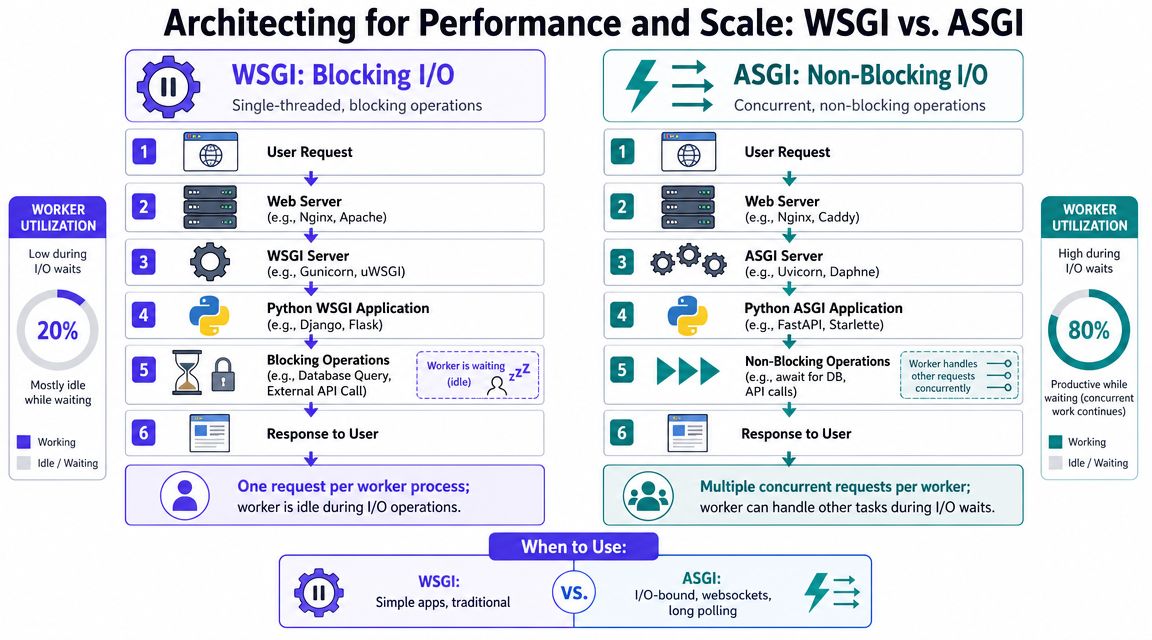
Think in waiting time versus working time
A simple mental model helps.
A synchronous service is like a cashier who starts one order and waits at the espresso machine until the drink is done. An asynchronous service is like a cashier who starts the order, hands the drink work to the machine, and serves the next customer while the machine runs.
That distinction matters when your request path spends a lot of time waiting on:
- Databases for reads and writes
- Caches such as Redis
- External APIs for payments, identity, email, or AI model access
- Realtime connections such as websockets or long polling
If that sounds like your product, async architecture deserves serious attention.
When a monolith is still the right answer
Many teams overcorrect and split too early.
A Django monolith is often the most responsible architecture for a new SaaS product. It gives one deployment unit, one domain model, one permission system, and one testing surface. That keeps debugging and onboarding simpler. If your current bottleneck is feature delivery, a clean monolith often beats a distributed system full of premature boundaries.
Use a monolith when:
| Situation | Better choice |
|---|---|
| Shared domain logic across most features | Monolith |
| Small backend team | Monolith |
| Need admin tooling immediately | Monolith |
| Distinct teams own separate workloads | Consider services |
| Heavy async I/O in a specific slice | Consider an async service |
When to split into services
A FastAPI service earns its keep when one part of the system has very different traffic or latency behavior from the rest. Good examples include an ingestion API, a document-processing backend, an ML inference gateway, or a websocket service.
That split should solve a real operational problem, not satisfy a style preference.
Security architecture should be part of the same conversation as performance architecture. If your backend will expose customer data or partner APIs, this guide to AppSec for startups is a practical reference for reviewing auth, secrets handling, and common web risks before launch.
Figure 2: A comparative architectural flow diagram illustrating the fundamental differences between synchronous WSGI and asynchronous ASGI for Python web application processing, highlighting their implications for performance and scalability.
Production-Ready Examples and Code
Python's practical value in web backends isn't only about frameworks. It's also about how easily it handles application logic that sits near data parsing, validation, enrichment, and downstream systems. Lucent Innovation's 2024 summary notes that Python is used by 1.4% of websites as a server-side language, and that an additional 20% of sites use it for scripts tied to data parsing and database management, according to Lucent Innovation's overview of Python for web development. That's one reason Python keeps showing up in admin systems, internal APIs, and integration layers.
Example one with a clean FastAPI endpoint
This is a representative pattern for a production API endpoint. It validates input, returns typed output, and keeps database access behind a dependency.
from fastapi import FastAPI, Depends, HTTPException, statusfrom pydantic import BaseModel, EmailStrfrom sqlalchemy.orm import Sessionapp = FastAPI(title="Accounts API")class UserCreate(BaseModel):email: EmailStrfull_name: strclass UserOut(BaseModel):id: intemail: EmailStrfull_name: strclass Config:from_attributes = Truedef get_db():db = Session()try:yield dbfinally:db.close()@app.post("/users", response_model=UserOut, status_code=status.HTTP_201_CREATED)def create_user(payload: UserCreate, db: Session = Depends(get_db)):existing_user = db.query(User).filter(User.email == payload.email).first()if existing_user:raise HTTPException(status_code=409, detail="Email already exists")user = User(email=payload.email, full_name=payload.full_name)db.add(user)db.commit()db.refresh(user)return userGood backend teams keep endpoints boring. Validation happens at the edge. ORM access is isolated. Status codes are explicit. The API contract is visible.
If your team is debugging payload shape issues across services, simple utilities matter too. For quick validation and troubleshooting, these Digital ToolPad tools for JSON are handy for checking malformed request or response bodies during development.
Example two with a realistic modernization path
A common production pattern looks like this:
- Legacy state with a server-rendered admin app, scattered business logic, and fragile partner integrations
- Transition move where the team keeps the database model but introduces a Python API layer for mobile, frontend, and partner traffic
- Target state with one stable admin surface and a separate API boundary that's easier to test and extend
A practical mini-case is a B2B platform whose operations team lives in an internal admin panel while customers and partners increasingly depend on APIs. In that setup, Python works well because one team can handle domain logic, integration jobs, and API delivery without fragmenting the stack.
The mistake is trying to rewrite everything in one pass. Keep the migration narrow. Move the API boundary first. Keep the admin stable. Split services only when one workload has clearly different operational needs.
How to Hire for a Python Backend Team
The hiring mistake I see most often is over-indexing on framework labels.
You don't need a “Django person” or a “FastAPI person” nearly as much as you need a backend engineer who understands HTTP, data modeling, testing, and production trade-offs. Framework experience matters, but it sits below software judgment.
Code Institute's guidance gets this right. A practical Python web skill set goes beyond syntax and includes HTTP methods, CRUD patterns, database relationships, ORM usage, and testable reusable code, as outlined in Code Institute's Python developer skills guide.
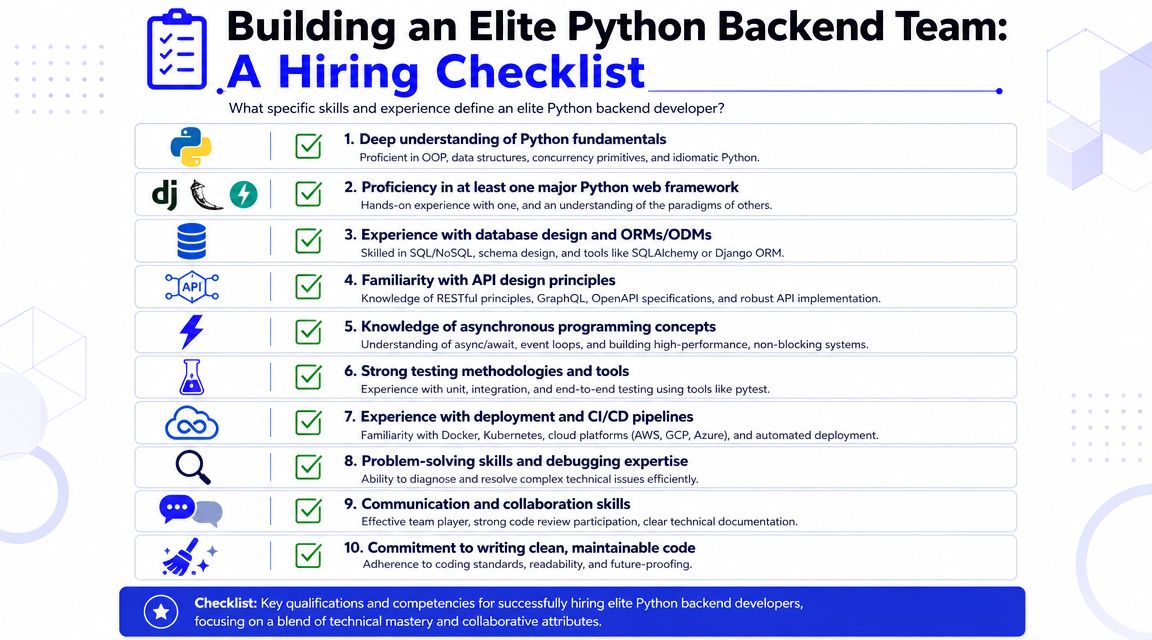
The skill matrix that actually predicts success
Use this rubric during sourcing and interviews:
| Skill area | What good looks like | Red flag |
|---|---|---|
| HTTP and API design | Explains idempotency, status codes, pagination, auth, versioning | Talks only about routes and JSON |
| Data modeling | Can design relationships and discuss trade-offs in schema design | Treats ORM models as just classes |
| Testing | Distinguishes unit, integration, and contract tests | Relies on manual testing |
| Async awareness | Knows when async helps and when it adds complexity | Assumes async fixes every performance issue |
| Operations | Understands logs, environments, migrations, CI/CD | Stops at local development |
| Communication | Can explain decisions to product and platform peers | Gives purely code-level answers |
Checklist: Key qualifications and competencies for successfully hiring elite Python backend developers, focusing on a blend of technical mastery and collaborative attributes.
Interview for reasoning, not trivia
A strong interview loop should test design judgment under realistic constraints.
Here are useful prompts:
- You're designing a partner API for order ingestion. How would you handle idempotency, validation failures, retries, and versioning?
- A service becomes slow under traffic, but CPU isn't maxed out. What would you inspect first?
- You inherit a Flask codebase with inconsistent schemas and no tests. What's your first month plan?
- A product team wants websocket updates for job progress. Would you keep this in the existing app or isolate it?
- A schema change affects billing records. How do you roll it out safely?
These questions reveal whether someone can own a production backend or just follow tutorials.
Hire for transferability. A strong backend engineer can learn framework conventions quickly. It's much harder to teach API judgment, data modeling, and operational discipline under delivery pressure.
If you're evaluating external support or augmenting the team, this guide to choosing a Python development firm is useful for pressure-testing capability beyond résumé keywords.
What to avoid in the hiring process
- Puzzle-heavy loops that never test API design
- Framework fetish where candidates are filtered out for not matching one library exactly
- No production discussion around migrations, auth, observability, or incidents
- No writing sample or system explanation, especially for remote teams
For Python backend roles, clean reasoning beats flashy syntax every time.
Your Python Web Stack Starter Checklist
Most backend delays don't come from Python itself. They come from missing setup decisions. Teams start coding before they've agreed on contracts, deployment paths, or ownership boundaries.
For founders and engineering leads, a starter checklist keeps the first sprint focused.
Setup decisions that reduce rework
- Pick the service shape early. Decide whether this is a Django monolith, a Flask utility service, or a FastAPI API-first backend. Why: this affects project layout, staffing, and deployment assumptions.
- Define your API contract before broad implementation. Use request and response schemas from day one. Why: frontend, mobile, and integrations move faster when the backend contract is stable.
- Choose one database access pattern. Standardize on the ORM and migration flow. Why: mixed patterns create debugging debt quickly.
- Set environment conventions. Local, staging, and production should differ by configuration, not by code behavior. Why: fewer launch surprises.
A lot of founders also benefit from a non-language-specific sanity check when comparing stack choices. These insights for SaaS founders on technology stacks are useful for framing Python as one business decision inside a broader platform plan.
Delivery controls to install in week one
- Create CI before feature volume grows. Run tests and linting on every change. Why: manual quality gates break as soon as more than one engineer is committing actively.
- Add structured logging immediately. Include request context, service name, and error metadata. Why: your first production incident will be easier to diagnose.
- Protect the edge. Set auth, input validation, and rate-aware thinking at the API boundary. Why: weak edges create security and support debt.
- Write one integration test for each critical flow. Focus on account creation, billing path, job submission, or partner sync. Why: these flows usually break first during releases.
Maintenance habits that keep the stack healthy
Use this as an operating checklist after launch:
| Phase | Task | Why it matters |
|---|---|---|
| Development | Keep endpoints typed and validated | Prevents drift in API behavior |
| Deployment | Use repeatable release steps | Reduces human error |
| Operations | Watch logs and failed jobs daily | Finds issues before customers do |
| Maintenance | Review slow queries and flaky tests | Preserves delivery speed |
The point isn't ceremony. It's reducing avoidable backend instability while the team is still moving fast.
Launch Your Python Project in Weeks Not Months
If your company is building an API-first SaaS product, an internal platform with heavy workflow logic, or an AI product that depends on data movement more than low-level systems tuning, Python is often the most pragmatic choice.
The strongest reason isn't ideology. It's alignment. Python lets product engineering, data work, and service development sit closer together. That usually improves delivery speed and lowers coordination overhead, especially early.
A three-step rollout plan
First, make the framework decision small. Don't debate every edge case. Use Django when you need strong built-in structure, Flask when the service is narrow and custom, and FastAPI when the API is the product surface.
Second, scope a pilot with one business outcome. Good pilot targets include partner ingestion, internal admin APIs, customer account workflows, or model-backed enrichment endpoints. Keep the boundary narrow enough that the team can learn from production behavior quickly.
Third, hire for backend judgment. The stack won't rescue weak API design, unclear ownership, or poor data modeling. A small team with strong fundamentals usually outperforms a larger team optimized around framework labels.
Start with the backend path that makes the next six months easier to ship, operate, and hire for. You can always isolate hot spots later. You can't easily recover time lost to the wrong foundation.
Python doesn't win because it's perfect. It wins when your product needs readable code, strong ecosystem support, fast iteration, and a clean path between application logic and data-rich workflows.
That's why it remains such a practical bet for modern web backends.
If you want to launch a Python backend without spending months assembling the team, ThirstySprout helps companies build with vetted senior AI and backend talent who've shipped production systems. You can Start a Pilot to scope a focused first build, or See Sample Profiles to evaluate engineers who can handle API architecture, data workflows, and production delivery from day one.
Hire from the Top 1% Talent Network
Ready to accelerate your hiring or scale your company with our top-tier technical talent? Let's chat.