

You're probably living this already. The team that used to ship cleanly at 5 engineers now spends more time in meetings, PRs sit idle, and every “quick hire” seems to create more coordination than output. That's not a culture problem, it's a management system problem.
Managing software teams at this stage is not about being nicer, hosting more rituals, or tracking more activity. It's about building a control system for delivery, quality, ownership, and feedback so the organization can grow without turning every decision into a bottleneck. Once you treat the team like an engineering system, the trade-offs get much clearer.
The Reality Most Engineering Leaders Hit at Scale
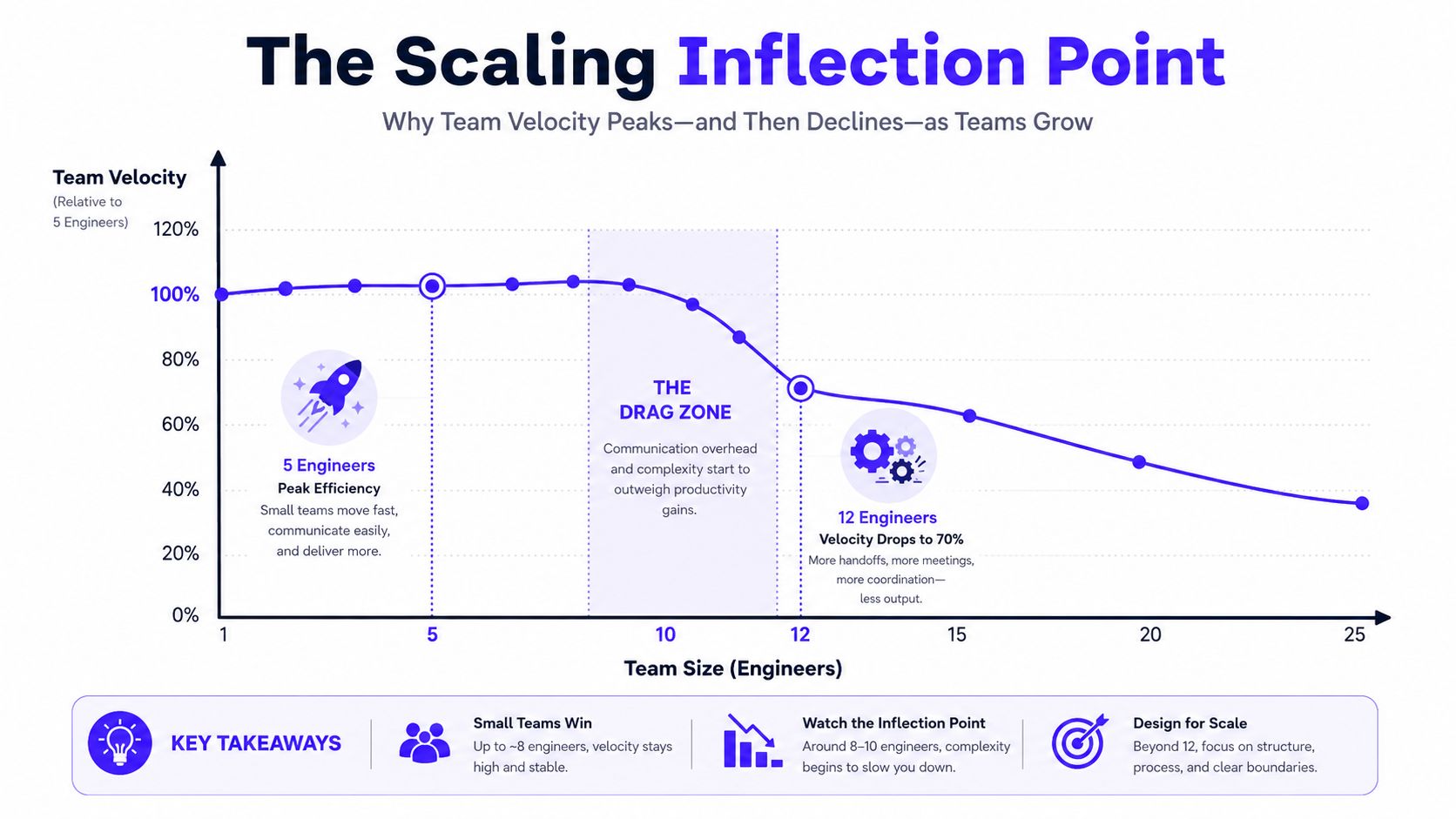
The break point usually shows up before anyone names it. A startup CTO looks up one quarter and realizes the team has doubled, but delivery hasn't. The original 4-person group could decide fast, review fast, and patch over unclear ownership with sheer proximity, but the 8-person version now needs meetings just to stay coordinated.
That's the moment the old advice starts failing. “Hire good people and get out of the way” stops working when coordination costs rise faster than throughput, especially once you get near the size where productivity drops for larger teams. An empirical review of software productivity literature cites ISBSG data showing that teams of nine or more are significantly less productive than smaller teams, which is exactly why size becomes a management decision, not just a hiring outcome (academic review).
The warning signs are blunt:
- PRs stall because nobody owns final review.
- Meetings multiply because scope is fuzzy.
- Blockers linger because “someone” is supposed to handle them.
- Developers ask for permission instead of making decisions inside clear boundaries.
Practical rule: if you need a meeting to answer who owns a piece of work, your org design is already leaking.
The shift from old-school phase-gated delivery to iterative coordination started after Agile emerged in 2001, but the label alone doesn't save you. In one industry summary, Agile adoption in software teams reportedly moved from 37% in 2020 to 86% in 2021, and a later survey found 71% use Agile in software development, 63% of team-level users run Scrum, only 13% say Agile is thoroughly embedded, and 74% use a blended, hybrid, or homegrown approach (Agile statistics summary). That gap matters because “we use Agile” often means very little about how the team plans and coordinates work.
One useful external reference for distributed leadership is manage distributed teams effectively. Read it with one question in mind, whether the team can still move when you're not in the room.
Designing Team Structure and Org Topology
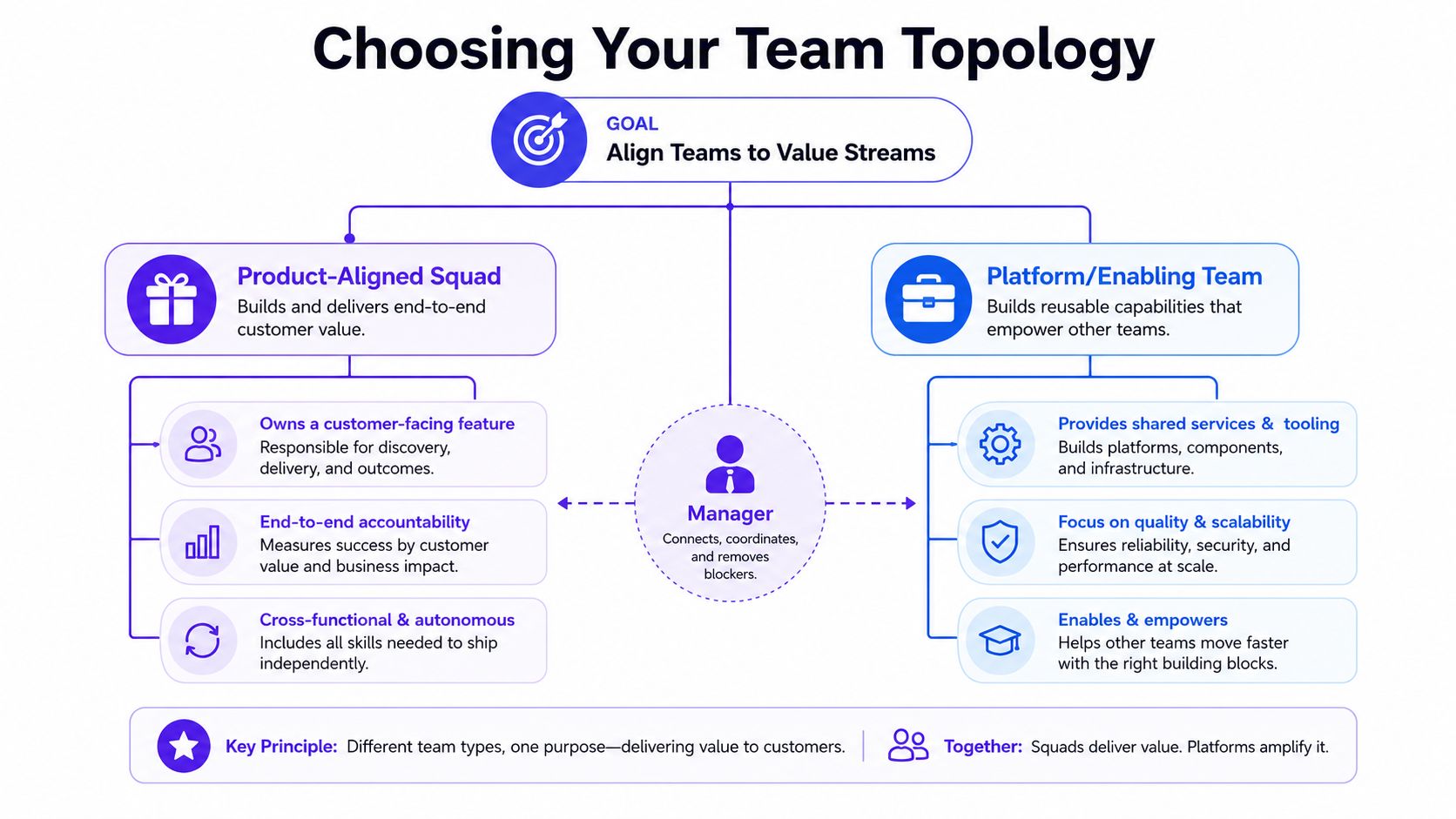
Start with value streams, not org charts. If one group owns customer-facing features, it should be shaped differently from a group that owns shared infrastructure, and the manager's job is to make those two shapes cooperate without turning either one into a queue. Decide early whether each team is a product-aligned squad or a platform/enabling team, because that choice determines how work flows, who makes decisions, and where bottlenecks show up.
Use one rule and apply it consistently. Once a team is getting too large for clear ownership and fast decisions, split the work before coordination starts to drag. The research tied to ISBSG data points in that direction as well, because larger groups tend to lose focus and slow down when too many people are sharing the same decisions. Keep that in mind when someone argues for “just one more engineer in the same room.”
A clean topology decision tree looks like this:
- Product-aligned squad if one group can own outcomes end to end.
- Platform/enabling team if the work is shared services, tooling, or reliability.
- Manager plus tech lead pairing if the problem is coordination, not headcount.
- Second manager only when the work has split into distinct streams with separate planning and feedback loops.
Blunt rule: don't add a manager because you're uncomfortable with ambiguity. Add one because the org has become too wide for one person to create clarity, coaching, and accountability.
A 15-person engineering org usually should not look like one oversized squad. A better split is two product squads with a shared platform cell, where each squad owns a customer-visible slice and the platform cell owns the internal systems both squads depend on. That keeps product teams close to users and keeps shared infrastructure from becoming a hidden bottleneck.
The operating model matters more than the label. Many companies say they use Agile, but the practice is thin, hybrid, and inconsistent, which is why a team can sound modern and still coordinate like a waterfall organization. A squad is not Agile because you named it that. It is Agile only if ownership, planning, and feedback are iterative and explicit.
Use an org-design canvas that fits on one page:
- Mission for each team.
- Primary customer or internal user.
- Owned systems or features.
- Interfaces and dependencies.
- Decision-maker.
- Escalation path.
If you are redrawing team boundaries and the hiring model has to match the structure, cross-functional team building is the right companion reference. It helps you check whether the shape of the team matches the kind of work you expect it to ship.
Hiring, Fractional Talent, and a 30-60-90 Onboarding Plan
Staff the structure you chose, not the org chart you wish you had. If the work needs durable ownership and repeated judgment calls, hire full-time. If the work is narrow, time-boxed, or tied to a single delivery burst, use contract talent. If you need senior execution across several streams without adding a permanent headcount slot, fractional talent can work, but only when the scope is tight and the handoff rules are written down.
The trade-off is simple. Full-time hires build institutional memory and carry long-term outcomes. Contract engineers can move faster on bounded work, but they rarely own the broader context that keeps systems healthy. Fractional talent is useful when you need leadership-grade judgment across multiple initiatives, but it fails fast if you expect full-time availability without giving full-time authority.
The hiring loop needs more than a scorecard and a polite interview. Build it around the work the person will do.
- Scorecard: list the exact systems, operating habits, and behaviors the role must cover. For a backend lead, that might mean incident handling, code review quality, and ability to reduce dependency risk.
- Structured interview: ask every candidate the same core questions. Use scenarios like, “A service is failing only under production load. What do you inspect first, and what do you change before you touch code?” or, “Two teams both claim ownership of the same API. How do you resolve it without turning it into a meeting spiral?”
- Take-home brief: make it a real design or debugging task. A good prompt is, “Here is a flaky deployment pipeline and a service with rising latency. Show the order you would investigate, what you would instrument, and what you would fix first.”
- Reference check: verify how they handle ambiguity, follow-through, and collaboration. Ask whether they finish hard problems without dragging the team into avoidable rework.
If you are hiring through a remote-first AI partner, the bar stays the same. The vendor presentation does not matter if the engineer cannot own delivery, communicate trade-offs, and ramp inside your stack. ThirstySprout is one option in that category, since it matches companies with pre-vetted remote engineers across AI, machine learning, MLOps, data, and product work, but the filter should still be blunt, who owns outcomes, how fast they become useful, and whether they can work inside your time zone and engineering process.
Onboarding should be run like a release plan. New hires do not become productive because they got a welcome doc. They become productive when the team gives them access, context, and a first win that is small enough to finish and real enough to matter. For a practical view of how teams shorten ramp time, use this time-to-productivity framework as a reference point.
30-60-90 onboarding plan
Days 1 to 30
- Buddy assigned for day-to-day questions.
- Environment ready before day one.
- One small ship by the end of week two or three.
- Decision log read so the new hire learns the team's operating history.
- System map reviewed so they know where ownership starts and stops.
Days 31 to 60
- Own a feature area or subsystem.
- Join design reviews and explain trade-offs.
- Handle one blocker without manager intervention.
- Write one document that improves team context.
- Shadow a production incident so they see how the team responds under pressure.
Days 61 to 90
- Own delivery for a meaningful slice.
- Participate in planning with realistic estimates.
- Lead one postmortem or retro action.
- Demonstrate predictable follow-through.
- Reduce one recurring handoff point so the team feels the ramp, not just the hire.
The internal productivity baseline is clear. A data-driven agile analysis recommends planning new projects at 60% utilization, leaving 20–30% buffer for discovered work, and expects velocity to stabilize over 3–4 sprints on a new project. That means onboarding should not be scheduled like a factory line. Build room for context loss, review cycles, and actual learning. If you load a new hire to full capacity on day one, you get slow ramp, shallow context, and more manager intervention.
For AI-focused roles, keep the role page open next to the scorecard. The same structure works for an AI engineer, MLOps engineer, or AI product manager role, because the bar is shipped ownership, not resume keywords. Use the job family to shape the questions, then force the candidate to prove they can operate in your codebase, your deployment path, and your decision model.
If the staffing decision still feels fuzzy, answer these questions in order:
- Is the work ongoing or temporary?
- Does the role need deep context or just execution capacity?
- Will this person own outcomes or only contribute tasks?
- Can the team absorb the ramp time?
- Do you need one specialist or a repeatable pod?
Operating Cadence, Sprint Mechanics, and CI/CD Discipline
A healthy team cadence is boring in the best way. Monday starts with sprint planning, Tuesday through Thursday are for building, Friday closes with a demo and retro. Every day includes a 15-minute stand-up focused on blockers, not status theater, because status reporting is a waste of engineering time and it doesn't move work forward (operating cadence guidance).
The sprint itself needs a clear outcome. “Finish tickets” is not an outcome. “Reduce checkout latency,” “stabilize onboarding flow,” or “ship the internal API migration” are outcomes. If you can't name the sprint result in one sentence, the team is probably just accumulating tasks.
A useful weekly template looks like this:
- Monday: define the sprint outcome and ownership.
- Tuesday to Thursday: build, review, test, and unblock quickly.
- Friday: demo working software, then run the retro.
- Daily: surface blockers, not progress reports.
Practical rule: the stand-up should answer one question, what is blocking delivery today.
The engineering side matters just as much. Set a Definition of Done, automate unit and integration checks in the pipeline, and make pull request reviews explicit. Independent best-practice guidance recommends CI/CD with automated testing, a unit-heavy test automation pyramid, and build times under 10 minutes so feedback arrives on every commit (best-practice guidance). If your build drags, your feedback loop is broken.
A lot of teams lose throughput because they keep these anti-patterns alive:
- Large pull requests with no size limit.
- Manual deployment steps that only one person knows.
- Batch testing that hides defects until late.
- Skipped design or QA feedback on complex work.
For a more systems-oriented DevOps reference, see DevOps Agile methodology. The useful takeaway is simple. Management becomes credible when the delivery pipeline gives you hard signals instead of opinions.
One thing to push hard on is review latency. A team that waits days for PR approval is not “moving carefully,” it's just slow. Set ownership rules, reduce PR size, and require explicit reviewers for each area. That's how you make the work visible without adding surveillance.
The point of cadence is not ritual. It is to make scope, ownership, and feedback latency visible enough that you can fix them before the quarter is gone.

Metrics, KPIs, and Capacity Planning Without Surveillance
Measure the system, not the people. If you want to know whether managing software teams is working, track delivery and reliability metrics, then use them to decide what to change. Start with activity tracking and you get compliance theater, bad incentives, and managers arguing about effort instead of throughput.
The most useful delivery measures come from the DORA framework. Track deployment frequency, lead time for change, change failure rate, and time to restore service. Those four metrics tell you whether your process changes improved flow and reliability, not whether people looked busy. See the DORA summary for the underlying framework.
| Metric | What it measures | Target (low maturity) | Target (high maturity) | Decision it triggers |
|---|---|---|---|---|
| Deployment frequency | How often the team ships | Infrequent, batch releases | Small, regular releases | Invest in CI/CD or release automation |
| Lead time for change | Time from commit to production | Long, unpredictable | Short and stable | Reduce handoff and review delays |
| Change failure rate | How often releases break things | Frequent incidents | Low defect escape | Raise testing and review quality |
| Time to restore service | How quickly you recover | Slow recovery | Fast recovery | Improve incident response and rollback |
Add flow metrics too. Cycle time, work in progress, and review latency tell you whether the team is stuck in hidden queues. If deployment frequency looks healthy but review latency is ugly, the bottleneck is usually review ownership, dependency churn, or too much work in flight. That is a management problem, not a developer problem.
Capacity planning needs the same discipline. Leave room for interrupts, production issues, support load, and planned discovery work. The mistake first-time CTOs make is filling every sprint with committed feature work and pretending unplanned work will stay small. It never does. Seasonal spikes, customer launches, security fixes, and incident response all show up, and if you do not reserve capacity for them, the sprint gets blown up and the team starts gaming estimates.
A data-driven agile analysis says average team utilization is closer to 60%, recommends planning at 60% utilization, and leaving 20–30% buffer for discovered work. That is the number executives usually resist, because they want to squeeze every hour. Do not let them. The buffer is what keeps the system stable when the unexpected lands, and it is what stops every interruption from turning into a schedule reset. See the agile utilization analysis for the underlying argument.
A one-page scorecard should map each metric to a decision:
- Deployment frequency falls. Increase automation or simplify release gates.
- Lead time grows. Cut review queues and reduce batch size.
- Change failure rate rises. Tighten testing and Definition of Done.
- Time to restore service increases. Add runbooks and incident ownership.
- Review latency spikes. Assign explicit reviewers and smaller pull requests.
- WIP rises too high. Split the team or reduce active work.
- Unexpected work keeps overrunning capacity. Hold a standing buffer and reforecast weekly instead of pretending the plan is still valid.
- A seasonal surge is coming. Freeze lower-priority work early, then reserve the best people for the spike instead of letting the team get whiplashed.
You should also tell executives why a slower week can be healthier. If the team is operating with the right buffer, it can absorb discovered work without collapsing the sprint. That usually looks worse in the short term and better over a quarter. The point is steady delivery, not maximum local efficiency.
A quick answer for the annoying middle case. If DORA numbers look good but the team still feels stuck, check whether dependency management, review ownership, or decision latency is the bottleneck. Strong output metrics with weak team sentiment usually mean the pain moved somewhere you are not measuring yet.
Async Communication, Performance, Career Ladders, and Tech Debt
If your team spans time zones, written communication is not optional. Default to async updates, use threaded discussions, and make decision logs part of the workflow so nobody has to reconstruct context from chat history. For practical tooling patterns, the async communication guidance recommended by SubmitMySaas is a useful reminder that the medium matters as much as the message.
Meetings should be sparse and intentional. Use time-zone-friendly slots, send pre-reads, and only invite people who need to make or unblock a decision. The goal is not fewer meetings for ego's sake. The goal is fewer meetings because the team can still move when the calendar is messy.
Performance management should stay outcome-based. Review what shipped, how the person worked with others, and whether they improved the team's effectiveness. Don't use stack ranking, and don't pretend activity tracking is a proxy for performance. A team that ships meaningful work with good judgment will beat a team that looks busy every time.
A simple engineering ladder helps remove annual-review chaos. Keep it in the wiki and calibrate against it.
- IC1. Executes well on well-defined tasks.
- IC2. Owns small features with guidance.
- IC3. Delivers independently across a clear subsystem.
- IC4. Influences design and leads across teams.
- IC5. Shapes strategy, mentors broadly, and raises the bar for others.
- EM track. Builds team capability through hiring, coaching, alignment, and delivery.
Use the ladder to separate skill from visibility. A strong IC3 should not be evaluated like a manager, and a great manager should not be judged on code volume. That distinction keeps performance conversations clean.
Technical debt needs a backlog, not a guilt trip. Keep a debt log, assign an owner to every item, and charge a quarterly tax in capacity so debt gets paid down. If a debt item has no owner, it doesn't get deferred. It gets ignored, which is worse.
Use this triage template:
- What is broken or fragile?
- Who owns the fix?
- What is the customer or engineering risk?
- What work will slip if we pay it down now?
- When will we revisit it?
That's the long game of managing software teams. Build a system where communication survives time zones, performance rewards outcomes, ladders reduce argument, and debt stays visible enough to be handled instead of inherited.
ThirstySprout helps companies staff remote engineering teams that can own delivery, not just fill seats. If you need senior AI, machine learning, MLOps, or product talent that can fit into your cadence and time zone, visit ThirstySprout to start a pilot and get a team shape that matches the way you want to ship.
Hire from the Top 1% Talent Network
Ready to accelerate your hiring or scale your company with our top-tier technical talent? Let's chat.