

TL;DR: Your Quick Guide to Combining DevOps and Agile
- For startups: The fastest win is to build a unified CI/CD pipeline. Use a tool like GitHub Actions to automate the path from code commit to deployment. This single step eliminates manual handoffs and dramatically cuts your lead time.
- For scale-ups: Your biggest lever is team structure. Embed operations or MLOps engineers directly into your Agile product squads. This creates a "you build it, you run it" culture, making reliability a shared responsibility from day one.
- Measure what matters: Track the four DORA metrics (Deployment Frequency, Lead Time for Changes, Change Failure Rate, MTTR). They are the gold standard for measuring the business impact of your DevOps and Agile integration.
- What to do now: Start a small pilot. Combine 2–3 developers with one ops-focused engineer on a single, high-impact project. Give them autonomy to build a unified backlog and a simple CI/CD pipeline.
Who This Guide Is For
This guide is for technical leaders who need to ship software faster without sacrificing quality.
- CTOs & VPs of Engineering: You need a practical framework to structure your teams and processes for high-velocity, reliable delivery, especially for complex AI/ML projects.
- Heads of Product & Founders: You need to understand how to connect Agile feature planning to the technical realities of deployment, ensuring the features you prioritize actually reach customers quickly and safely.
- Engineering Managers & Tech Leads: You need actionable patterns for integrating operations into your Agile sprints, breaking down silos, and fostering a culture of ownership.
If you are tasked with accelerating time-to-market and improving system stability within the next quarter, this guide provides the blueprint.
A Quick Framework for Unifying DevOps and Agile
Your first move depends on your company's stage.
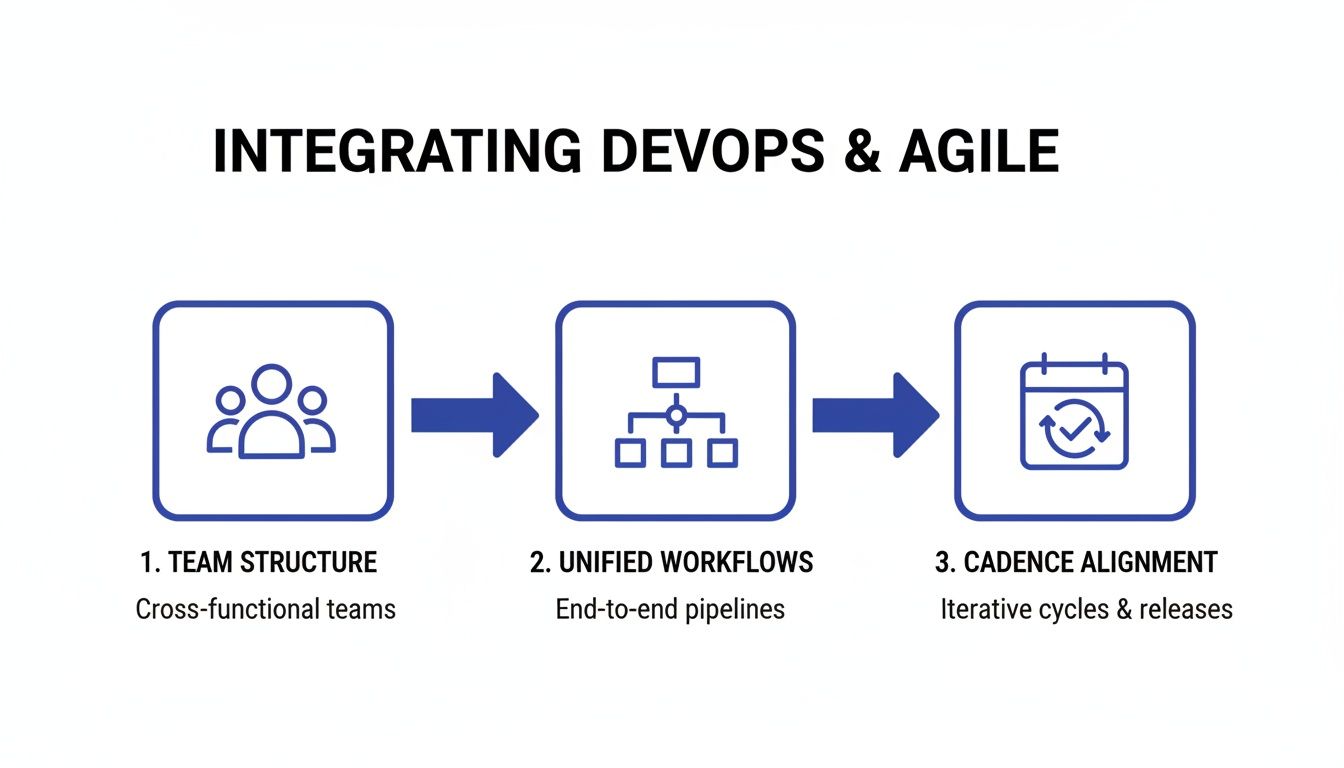
For a startup, the most impactful step is setting up a unified Continuous Integration/Continuous Deployment (CI/CD) pipeline. This automates the bridge between writing code and deploying it, delivering an immediate efficiency boost.
For a growing scale-up, the focus shifts to team structure. The goal is to break down the "us vs. them" mentality by embedding operations or MLOps engineers directly into your Agile squads. This creates a powerful sense of shared ownership and accountability.
This integrated approach ensures that the features your Agile sprints prioritize can be delivered reliably and quickly through solid DevOps practices. You’re aiming for a seamless feedback loop where development speed doesn't come at the cost of operational stability.
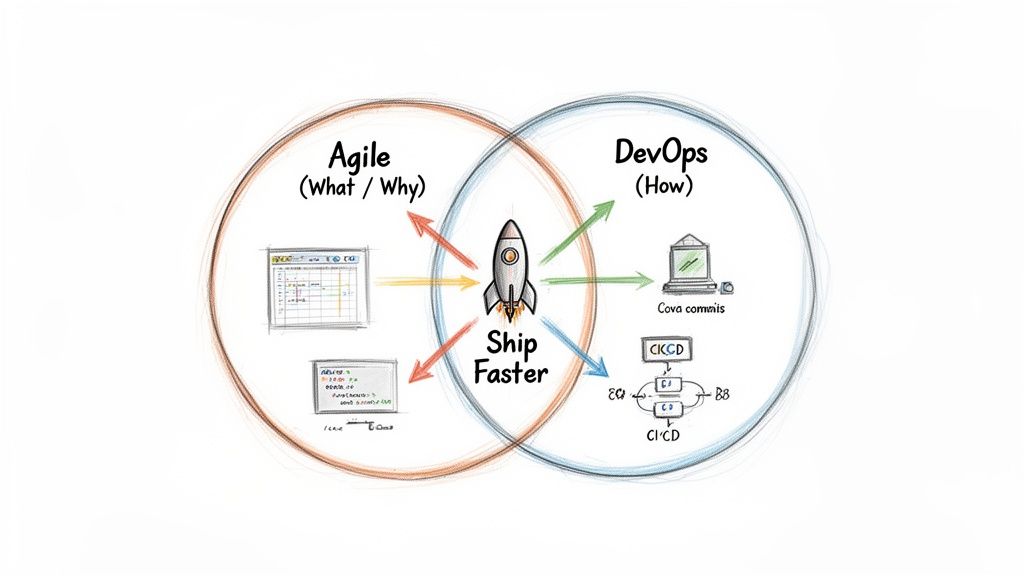
Clarifying Roles and Goals
To make this work, everyone needs to be clear on what each methodology brings to the table. They aren’t competing; they are two halves of a whole. Agile organizes the chaos of building software, while DevOps masters the art of delivering it.
When they work together, you get a significant acceleration in time-to-market, which is especially critical in complex areas like AI and machine learning. As your practices mature, you can take things further by developing in the cloud to unlock more advanced capabilities.
The table below breaks down their distinct responsibilities and shows how they align toward a common purpose.
Agile vs. DevOps at a Glance
This table clarifies the distinct focus areas and complementary goals of Agile and DevOps to help leaders understand how they work together.
Ultimately, bringing Agile and DevOps together creates a culture where a single team owns the entire lifecycle of a feature—from the initial idea all the way to running it in production and measuring its impact. This is the foundation for building elite engineering organizations.
Practical Examples of the DevOps Agile Methodology in Action
Theory is one thing, but seeing how a combined Agile and DevOps approach works on the ground is where it all clicks. Let’s look at two real-world scenarios showing how teams use this integrated model to ship better products, faster.
Top-performing organizations that master this synergy deploy code 30 times more frequently with lead times that are 200 times shorter. They also see 60 times fewer failures and recover from incidents 168 times faster. For an AI team, this is the difference between shipping a robust ML pipeline in weeks versus waiting months. The market adoption of these practices continues to grow because it delivers clear business results.
Example 1: Fintech Startup Cuts Time-to-Market by 50%
A Series A fintech startup needed to launch a new payment processing feature. The old way of working would have taken a full quarter. By integrating Agile and DevOps, they shipped it in just three two-week sprints, cutting their time-to-market in half.
Here’s how they did it:
- Unified Backlog: All work—coding payment logic, scripting infrastructure, and setting up monitoring dashboards—went into a single Jira backlog. There were no separate "dev" and "ops" queues.
- Simple CI/CD with Feature Flags: Using GitHub Actions, every code commit was automatically tested and packaged. They deployed the new code to production hidden behind a feature flag, allowing them to test internally before a public rollout.
Business Impact: The startup launched faster and with less risk. They gathered real-world performance feedback before the full public release, leading to higher customer satisfaction and a smoother launch.
Example 2: CI/CD Pipeline for an MLOps Team
For AI and machine learning, you're not just shipping code; you're shipping a package of code, models, and data. This requires a specialized MLOps pipeline that handles all three components.
The diagram below shows a CI/CD pipeline for an MLOps team building a Retrieval-Augmented Generation (RAG) application. It connects the team's sprint work directly to the automated deployment process.
Here is a simplified configuration snippet for a GitHub Actions workflow that could power part of this pipeline, focusing on model validation.
# .github/workflows/model-validation.ymlname: Validate Model on Pull Requeston:pull_request:paths:- 'models/**'- 'data/**'- 'src/evaluate.py'jobs:validate-model:runs-on: ubuntu-lateststeps:- name: Check out codeuses: actions/checkout@v3- name: Set up Pythonuses: actions/setup-python@v4with:python-version: '3.10'- name: Install dependenciesrun: pip install -r requirements.txt- name: Evaluate model performanceid: evaluaterun: |# This script compares the new model against the production baseline# It outputs a 'passed' variable if the new model meets the quality barpython src/evaluate.py --model-path ${{ github.sha }}This architecture creates a reliable path from an Agile sprint to a live AI product. It tightens the feedback loop, allowing the team to iterate with speed and confidence.
Deep Dive: Trade-offs, Pitfalls, and Alternatives
Adopting a devops agile methodology is a deep cultural shift, not just a technical upgrade. The path has common pitfalls that can undermine your efforts.
For any CTO or engineering leader, spotting these failure modes early is the first step to navigating around them.
Pitfall 1: The "Water-Scrum-Fall" Trap
This is the most common anti-pattern. A team adopts Agile ceremonies like daily stand-ups and sprints, but their workflow remains sequential. Development, testing, and deployment are still separate, siloed phases.
The result is all the meetings of Agile with none of the velocity. Work piles up until the end of the sprint, leading to a chaotic integration scramble.
How to Avoid It:
Start with value stream mapping. Get everyone to map every step from idea to production. This makes delays and handoffs painfully visible. Then, identify the biggest bottleneck and make it your team's mission to eliminate it.
Pitfall 2: Toolchain Tyranny
Many leaders mistakenly believe they can buy their way into a DevOps culture by investing in expensive CI/CD platforms and dashboards.
Tools are only amplifiers; they can't fix a broken process or a culture of blame. Without changing how people collaborate, you just end up with expensive shelfware.
How to Avoid It:
Focus on process and culture first, tools second. Define the workflow you want, then pick the simplest tool to automate it. A good starting point is automating tests on every commit to the main branch using GitHub Actions or GitLab CI.
The goal is not the most sophisticated toolchain, but the simplest process that lets a developer safely ship code to users.
Pitfall 3: Creating a New DevOps Team Silo
Creating a centralized "DevOps team" often becomes just another silo and a bottleneck. Developers end up filing tickets with the new team instead of learning to manage their own infrastructure.
This undermines the core principle of "you build it, you run it."
How to Avoid It:
Your goal is to embed DevOps skills, not centralize them. A better model is a platform engineering team whose mission is to build the tools and automation that enable product squads to be self-sufficient. Understanding the different roles in agile software development is key to structuring these teams for success.
Pitfall 4: Ignoring MLOps Nuances
Applying standard DevOps practices directly to machine learning systems is a recipe for failure. ML systems are a complex trio of code, data, and models.
If you don't version your training data or track experiment results, you can't reliably reproduce a model's performance.
How to Avoid It:
Adopt MLOps-specific practices from day one.
- Version Everything: Use tools like DVC (Data Version Control) to version datasets and models with the same rigor you use for code.
- Automate Validation: Build automated checks into your pipeline to validate data quality and evaluate model performance.
- Track Experiments: Use a platform like MLflow or Weights & Biases to log every training run.
By proactively addressing these common pitfalls, you can steer your team toward a truly effective and sustainable DevOps and Agile practice. If you want a deeper comparison of the two philosophies, you can learn more about the specific differences and synergies in our guide on Agile vs DevOps.
Checklist: DevOps & Agile Success Metrics Scorecard
You can't improve what you don't measure. The gold standard for measuring software delivery performance is the four DORA (DevOps Research and Assessment) metrics. They provide a balanced view of your team's speed and stability.
Combine them with key Agile metrics for a complete picture from idea to impact. Strong monitoring is essential to track these numbers accurately; concepts like AI Observability Monitoring provide the deep visibility required.
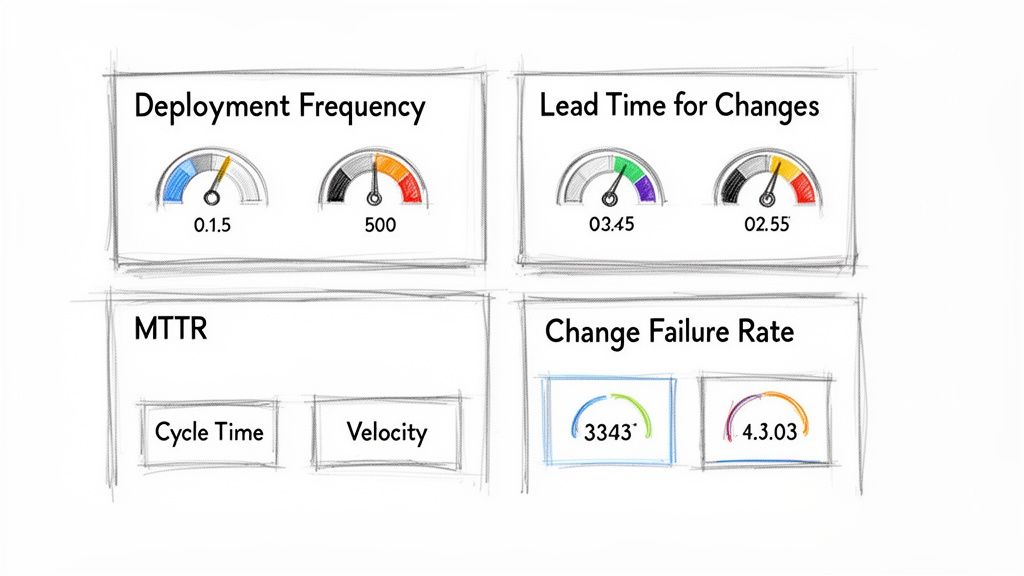
Use this scorecard to track the essential metrics that measure the business impact of your DevOps and Agile practices.
By regularly reviewing these metrics, you can celebrate real wins, tackle emerging problems, and lead your engineering organization with data-backed confidence.
What to Do Next: Your 3-Step Action Plan
- Run a Pilot Project: Don't try to boil the ocean. Select one high-impact project and form a blended team of developers and one ops-focused engineer. Task them with delivering the project in 2–4 weeks using a unified backlog and a simple, automated CI/CD pipeline.
- Establish a Metrics Baseline: Set up a dashboard to track the six metrics from the scorecard above for your pilot team. This data will become the proof point you need to justify a broader rollout across the organization.
- Scope Your Next Hire: If you lack in-house ops expertise, start defining the role for an MLOps or DevOps engineer who can build the "paved road" for your other teams. Focus on candidates who have experience with infrastructure as code and building developer-friendly automation.
Ready to build an elite AI team that truly understands the devops agile methodology? ThirstySprout connects you with the top 1% of remote AI and MLOps engineers who have already shipped production systems at scale. Start a pilot in under a week.
References
- Accelerate: The Science of Lean Software and DevOps by Nicole Forsgren, Jez Humble, and Gene Kim. (The source for DORA metrics).
- The Agile Manifesto.
- Official documentation for tools mentioned: Jira, GitHub Actions, GitLab CI, DVC, MLflow.
- Statista report on DevOps adoption: DevOps adoption worldwide by industry.
Hire from the Top 1% Talent Network
Ready to accelerate your hiring or scale your company with our top-tier technical talent? Let's chat.