

TL;DR
- Use Agile to build the right product. It focuses on customer feedback and iterative sprints to validate ideas, perfect for finding product-market fit.
- Use DevOps to build the product right and fast. It uses automation (CI/CD, IaC) to ensure stable, reliable, and frequent deployments, essential for scaling.
- They are not mutually exclusive; you need both. Agile guides what you build, while DevOps provides the automated engine for how you build and ship it.
- Your company stage determines your focus. Early-stage MVPs should prioritize Agile for learning. Mature platforms must prioritize DevOps for reliability and speed.
Who This Is For
This guide is for technical leaders responsible for building and scaling high-performing AI teams. You're under pressure to ship better products faster, and choosing the right operational framework is a strategic decision that defines your team's success.
This is for you if you are a:
- CTO, VP of Engineering, or Founder: You make the high-level decisions on team structure and methodology to hit the market faster while managing technical risk.
- Product Lead or AI PM: You need to understand how these frameworks impact delivery speed, feature prioritization, and the feedback loop for refining AI models.
- Talent Ops or Hiring Manager: You source talent and need to know the difference between hiring for a classic Agile squad versus a DevOps-minded MLOps team.
This is a guide for operators who must make decisions in weeks, not months. We skip the fluff and provide actionable frameworks and real-world examples you can use today.
Quick Answer: A Practical Decision Framework
The question isn't "Agile vs. DevOps" but "When do I prioritize one over the other?" The answer depends entirely on your primary goal: are you trying to validate an idea or scale a proven product?
Use this decision tree to guide your strategy:

- If your goal is to find product-market fit (left path): Prioritize Agile. Your biggest risk is building something nobody wants. Use short sprints and constant customer feedback to learn and pivot quickly.
- If your goal is to scale a mature product (right path): Prioritize DevOps. Your biggest risk is instability and slow delivery. Use automation, CI/CD, and Infrastructure as Code (IaC) to ship reliably and at speed.
A team great at Agile but weak on DevOps designs the perfect product but gets stuck in manual deployments. A team with a killer DevOps pipeline but no Agile discipline efficiently ships a product nobody wants. You need both, but your focus must match your stage.
Core Differences at a Glance
Practical Examples: How Real AI Teams Operate
Theory is one thing; real-world application is another. Let's examine two common scenarios we see with the AI teams we work with.
Example 1: The Agile Fintech Startup Building an MVP
Scenario: "LoanLogic AI," a Series A fintech startup, has a 6-month runway to build an MVP for an AI-powered loan risk assessment tool. Their biggest risk is not technical; it’s building a product that loan officers won't use.
Framework: They adopt a pure Scrum (Agile) approach.
- Team Structure: One lean, cross-functional squad: two AI engineers, one full-stack developer, a UX designer, and an AI Product Manager acting as Product Owner.
- Process: They work in tight, two-week sprints. Each sprint delivers a small, testable piece of the product. For instance, an early user story is: "As a loan officer, I want to upload a PDF application and see a preliminary risk score (low, medium, high)."
- Feedback Loop: At the end of each sprint, the team demos the working software to a small group of beta testers (actual loan officers). This direct feedback ("the UI is confusing," "the score needs more context") is immediately added to the product backlog for the next sprint.
- Business Impact: Agile allows LoanLogic AI to maximize its speed of learning. Instead of spending six months building the wrong product, they validate their core assumptions every two weeks. This de-risks their path to product-market fit and the next funding round.
Example 2: The DevOps-Focused HealthTech Scale-Up
Scenario: "CareScale," a Series C HealthTech company, has a live AI product that predicts patient readmission risks for hospitals. Their challenge is no longer finding customers; it's scaling reliably, maintaining compliance, and deploying model updates without any service disruption.
Framework: They implement a robust DevOps/MLOps culture.
- Team Structure: Multiple Agile product squads are supported by a central MLOps Platform Team. This team builds and maintains the automated infrastructure—the "paved road"—for deployments.
- CI/CD Pipeline for Models: When a data scientist commits a new model version to Git, an automated Continuous Integration (CI) pipeline triggers. This pipeline runs unit tests, data validation checks, and performance tests against a golden dataset.
- Infrastructure as Code (IaC): Here is a sample Terraform snippet they use to define a secure, version-controlled S3 bucket for model artifacts, ensuring consistency across environments.
This IaC approach using Terraform makes their infrastructure repeatable, auditable, and less prone to human error.# Manages a private S3 bucket for storing ML model artifactsresource "aws_s3_bucket" "model_artifacts" {bucket = "carescale-prod-ml-models"acl = "private"versioning {enabled = true # Keep history of model versions}server_side_encryption_configuration {rule {apply_server_side_encryption_by_default {sse_algorithm = "AES256"}}}tags = {Name = "Production Model Artifact Store"Environment = "Production"Team = "MLOps"}} - Monitoring & Alerting: Once deployed, models are monitored in real-time using tools like Prometheus and Grafana. If prediction accuracy drops or data drift is detected, an alert is automatically sent to the on-call MLOps engineer.
- Business Impact: DevOps enables CareScale to increase deployment frequency from monthly to weekly while reducing risk. Automation minimizes human error, IaC ensures stability, and proactive monitoring builds trust with enterprise clients who demand reliability. For more, see our guide on MLOps best practices.
Deep Dive: Agile vs DevOps Philosophies
Agile and DevOps aim to deliver better software faster, but they solve different problems. Agile was created to fix what was being built, closing the gap between developers and customer needs. DevOps emerged to fix how it was built, removing friction between development (Dev) and operations (Ops) teams.
Understanding the Agile product development process is key—it prioritizes flexibility over a rigid plan.
Guiding Principles
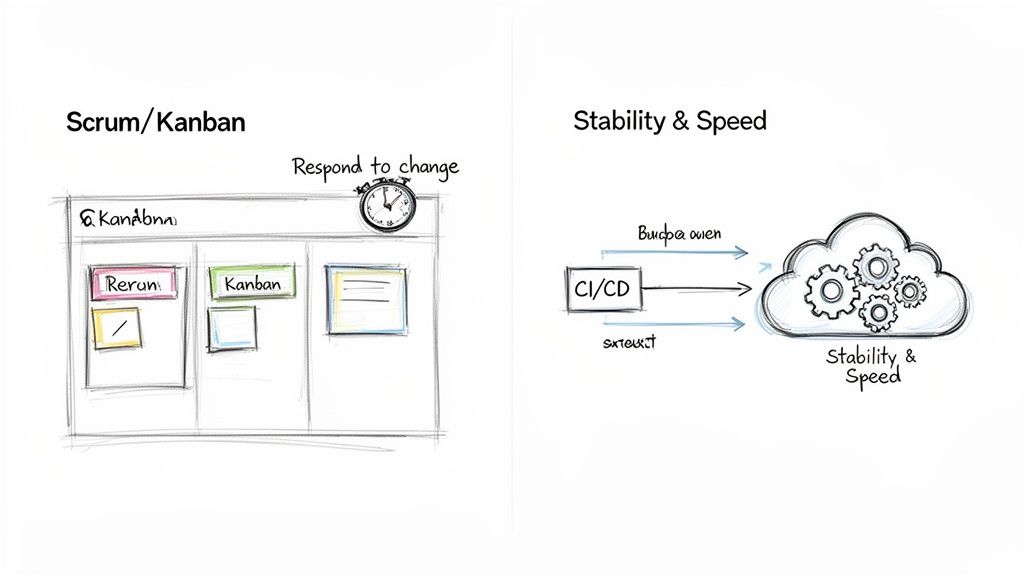
Agile is guided by the Agile Manifesto, which values individuals and interactions over processes and tools. Its primary function is to respond to change. If customer feedback invalidates a feature, an Agile team pivots immediately to avoid building something nobody wants.
DevOps principles focus on systems thinking, fast feedback loops, and a culture of continuous learning. It treats the entire delivery lifecycle—from code commit to production—as one integrated system to be optimized and automated.
Key Takeaway: Agile optimizes for learning and adaptability at the project level. DevOps optimizes for speed and stability at the system level.
Core Practices
An Agile team's daily work looks different from a DevOps-focused team's.
Agile teams practice:
- Sprints: Short work cycles (typically 1–4 weeks) to deliver a specific set of features.
- Daily Stand-ups: Quick 15-minute meetings to sync progress and remove blockers.
- Backlog Grooming: Continuously refining and prioritizing tasks based on customer value.
- Retrospectives: End-of-sprint meetings to improve team processes.
DevOps teams practice:
- Continuous Integration/Continuous Delivery (CI/CD): Automating the build, test, and deployment process to enable safe, frequent releases.
- Infrastructure as Code (IaC): Managing infrastructure with code using tools like Terraform for consistency and repeatability.
- Automated Testing: Creating a safety net of tests that run automatically with every code change.
- Monitoring and Observability: Using tools like Prometheus to get real-time insights into system health and performance.
These different practices lead to different team structures and roles in agile software development.
Checklist: Building Your Team and Tech Stack
Use this checklist to assess your current team's capabilities and identify where to invest next.
Team & Process Checklist
- (Agile) Do you run sprints shorter than 4 weeks? (Yes/No)
- (Agile) Do you get direct user feedback on working software every sprint? (Yes/No)
- (Agile) Is your product backlog prioritized by clear business value? (Yes/No)
- (DevOps) Is your deployment process automated (one-click or less)? (Yes/No)
- (DevOps) Is your production infrastructure defined as code (IaC)? (Yes/No)
- (DevOps) Do you have automated alerts for production performance issues? (Yes/No)
Tech Stack Checklist
- Project Management: Jira, Trello, Asana
- CI/CD Automation: Jenkins, GitLab CI, GitHub Actions
- Infrastructure as Code (IaC): Terraform, Ansible
- Containerization & Orchestration: Docker, Kubernetes
If you answered "No" to more than one question in either category, that's your starting point for improvement.
What to Do Next
You have the framework. Now, take action.
- Run the Checklist: Use the checklist above to perform an honest assessment of your team's current practices. Identify your top 1-2 weakest areas.
- Define Your Next Hire: Based on your gaps, decide who you need next. Is it an Agile-focused AI Product Manager to improve your roadmap, or a senior MLOps engineer to automate your deployments?
- Book a Scoping Call: When you're ready to fill those gaps, connect with us. We can help you Start a Pilot with pre-vetted AI and DevOps experts in 2–4 weeks. To see the caliber of talent, See Sample Profiles first.
References & Further Reading
For a deeper dive, explore these resources:
- Official Documentation: The Agile Manifesto, Terraform Docs, Kubernetes Docs
- Industry Data: Veritis report on production method adoption
- How to Hire AI Engineers
- MLOps Best Practices
- Roles in Agile Software Development
Ready to build a high-velocity AI team? At ThirstySprout, we connect you with pre-vetted AI, MLOps, and DevOps experts who can integrate with your team in days, not months. Start a Pilot and see the difference senior talent makes.
Hire from the Top 1% Talent Network
Ready to accelerate your hiring or scale your company with our top-tier technical talent? Let's chat.