

You can ship a model that looks excellent in a notebook and still have it fail in production. That's the trap many teams hit, and it's usually not because the model was bad. It's because the system around it was never treated like a product with owners, thresholds, rollback paths, and real operational discipline.
TL;DR
- Machine Learning Engineering for Production is the work of making models reliable after deployment, not just accurate during training.
- The hard parts are usually data freshness, serving reliability, drift detection, ownership, and safe release patterns.
- If you need a practical starting point, begin with one production model, one monitoring loop, and one clear owner for retraining and rollback.
- Use NIST AI RMF, AWS drift guidance, and Google Cloud MLOps to turn vague best practices into thresholds and response rules.
- Treat this like a distributed-systems problem. The model matters, but the surrounding infrastructure usually decides whether users ever feel the benefit.
Why Most Models Never Make It Past the Notebook
A fraud model can post a clean 0.94 AUC in Jupyter and still become useless three months later when a payments partner changes its transaction schema. The notebook score was real, but it only described a static slice of data. Production adds moving traffic, latency budgets, upstream schema changes, and the uncomfortable possibility that failures won't throw exceptions, they'll just erode trust.
That's why production ML work starts where offline evaluation ends. In practice, you're not only shipping a model, you're shipping a live service that has to survive bad inputs, stale features, delayed labels, and partial outages. The engineering burden sits around the model, and that burden is what turns a promising experiment into something the business can depend on.
The notebook measures a snapshot, production measures a system
Offline metrics tell you how a model behaved on one dataset. Production asks a different question, whether the model still behaves well when data changes, traffic spikes, or the calling service slows down. The 2022 State of MLOps report makes that gap hard to ignore, because only 21% of leaders said at least 80% of their models were operating reliably in production, the average time to production was 12 weeks, and the average organization shipped only 3 AI projects into production in the previous quarter (State of MLOps 2022).
Those numbers don't say models are impossible to deploy. They say production readiness is its own discipline, with delayed feedback, repeated release cycles, and reliability constraints that the notebook never shows you.
Practical rule: if a metric only improves in offline evaluation, it is not a production win until it survives live traffic, live labels, and rollback pressure.
The real failure is usually operational, not statistical
Teams don't lose because they picked the wrong algorithm. They lose because feature freshness drifts, retraining never triggers, or nobody owns the on-call path when performance slips. A live model also competes with product latency, platform cost, and incident response, so the job becomes one of reliability engineering, not just modeling.
That's the lens for the rest of this guide. The question isn't “Did the model score well?” It's “Can the system keep scoring well after reality changes?”
What Machine Learning Engineering for Production Actually Means
Machine learning engineering for production is the layer that makes a model deployable, observable, and recoverable. Data science finds a signal. Production engineering turns that signal into a service with versioned artifacts, reproducible training, runtime health checks, and an explicit owner when things drift.
The cleanest way to think about it is by separating responsibilities. Data science owns problem framing, feature ideas, and model selection. Production ML engineering owns the pipelines, artifacts, runtime, and post-deploy controls that let those ideas survive contact with users.
The four surfaces production work adds
First, there's the feature and training pipeline. Training data has to be built consistently, validated, and recreated later if an audit or rollback demands it. Second, there's the deployable artifact, which means pinned dependencies, a model registry entry, and a versioned feature set that can be traced back to the training run.
Third, there's runtime serving, including health checks, autoscaling, and graceful failure modes. Fourth, there's post-deploy monitoring plus ownership, because production models need someone to watch drift, respond to degradation, and decide whether to retrain or roll back.
The 2024–2025 Machine Learning & MLOps survey shows how far many teams still are from that operating model, with 38% not deploying models at all, 58% not monitoring models, 75% not using feature stores, 44% not retraining once deployed, 81% without a dedicated MLOps team, and only 7% describing their practice as advanced with automated CI/CD, retraining, and clear ownership (Datatalks.club MLOps survey). That doesn't mean the work is immature forever, it means it's still a specialty capability in many organizations.
The distinction between MLOps and the ML platform matters here. MLOps is the operating discipline. The platform is the shared substrate underneath it, the tools, storage, orchestration, and runtime environment that multiple teams use.
A good production ML setup makes ownership visible. If nobody can point to the model owner, the retraining trigger, and the rollback path, the system isn't production-ready yet.
For a broader software framing of what production systems are, this companion note on production systems is a useful cross-reference.
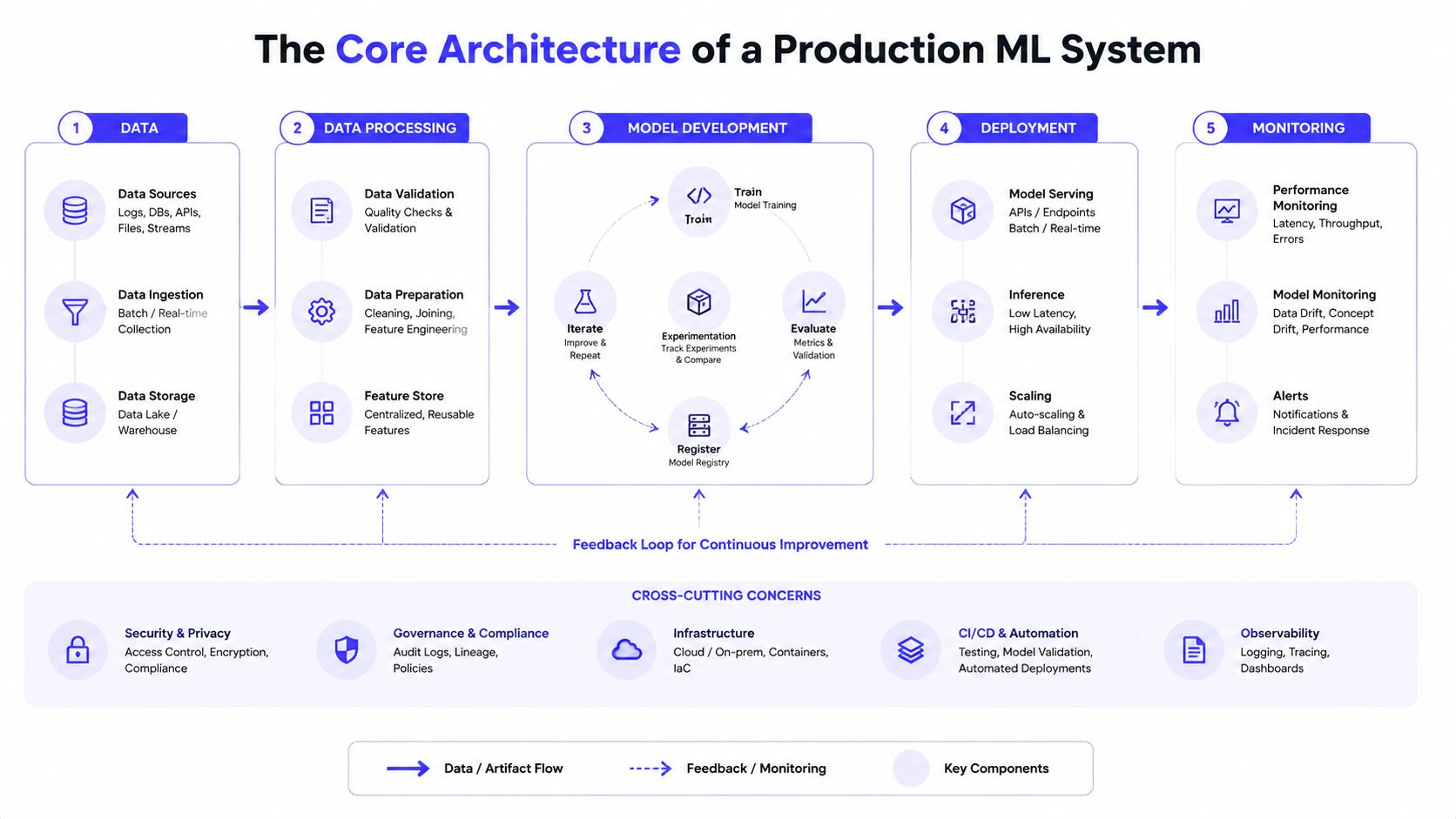
The Core Architecture of a Production ML System
The architecture that works in production is usually boring in the best possible way. It has clear boundaries, simple handoffs, and enough observability that each layer can fail without taking the whole service down. When teams blur those boundaries, debugging turns into guesswork.
Start with ingestion and feature parity
The first layer is data ingestion. In practice, that often means event streams from Kafka or Kinesis, plus batch sources for backfills and offline training. The point isn't just to collect data, it's to preserve the same semantic meaning of features in both training and serving.
That's where a feature store earns its keep. Online and offline parity prevents training-serving skew, one of the easiest ways to ship a model that looks strong in validation and wrong in production. If you don't control that parity, the model starts learning one reality and serving another.
Train, register, serve, observe
Training orchestration usually sits on something like Kubeflow or Vertex AI, because you need repeatable jobs, artifact tracking, and dependency control. Once trained, the model should be packaged as a container behind an autoscaling endpoint, with a registry entry that links the artifact to its data, code, and evaluation results.
Observability is the last layer, and it's the one teams skip at their own risk. You need prediction logs, request latency, feature distributions, and model outputs flowing into a metrics store so you can compare live behavior with baselines. The production-readiness rubric in the IEEE Big Data paper pushed this idea toward 28 concrete tests and monitoring needs, with explicit emphasis on measuring baselines and comparing changes against prior training or production windows (IEEE Big Data paper).
Map the stack to governance
The useful part of this architecture is that it also maps cleanly to NIST AI RMF functions, Govern, Map, Measure, and Manage (NIST AI RMF resources). Govern covers ownership and policy. Map covers use case context and dependencies. Measure covers drift, latency, and quality. Manage covers the actions you take when the system changes.
That makes the architecture more than a technical diagram. It becomes a compliance and operating model that engineering, product, and risk can all read the same way.
Deployment Patterns and How to Choose One
Deployment patterns matter because they define how risk enters the system. A batch model that enriches CRM records can tolerate delay. A fraud model or routing model often can't. The right choice depends less on fashion and more on latency budget, blast radius, and how quickly labels come back.
Batch, online, shadow, and canary do different jobs
Batch scoring fits offline enrichment, CRM scoring, and other jobs where the prediction can wait. The orchestration shape is usually cron or a scheduled pipeline, and rollback is simple because you can rerun the prior job or compare against the previous batch artifact.
Online prediction serves request-response traffic with sub-second expectations. The path is more complex because feature retrieval, inference, and logging all have to happen in the request window. If labels arrive late, you need a separate feedback pipeline to join predictions to outcomes later.
Shadow deployment sends production traffic to a new model without exposing the result to users. It's the safest way to compare behavior, but only when you have enough traffic to judge quickly. Canary releases expose a small slice of live traffic to the new version and ramp only if metrics stay healthy.
The deployment tooling space is broad, and a practical overview is available in this companion page on machine learning model deployment tools.
| Pattern | Latency | Freshness of Labels | Best Fit |
|---|---|---|---|
| Batch | Hours to days | Often delayed | CRM enrichment, reporting, overnight scoring |
| Online | Milliseconds to seconds | Can be late or immediate | Fraud, search, recommendations, routing |
| Shadow | Same as live traffic | Depends on downstream outcomes | Safe comparison before exposing users |
| Canary | Same as live traffic | Needs quick health signals | Controlled rollout with real traffic |
Choose based on business damage, not engineering taste
A startup pushing churn scores into a CRM can usually live with batch. An enterprise fraud system cannot tolerate a long stale window because the cost of one bad decision is too high. Shadow and canary are most valuable when production traffic is rich enough to reveal a meaningful signal in hours, not days.
Practical rule: if the business can wait for the score, use batch. If the business is making real-time decisions, pay the complexity cost for online serving and a rollback plan.
Monitoring, Drift Detection, and Ongoing Reliability
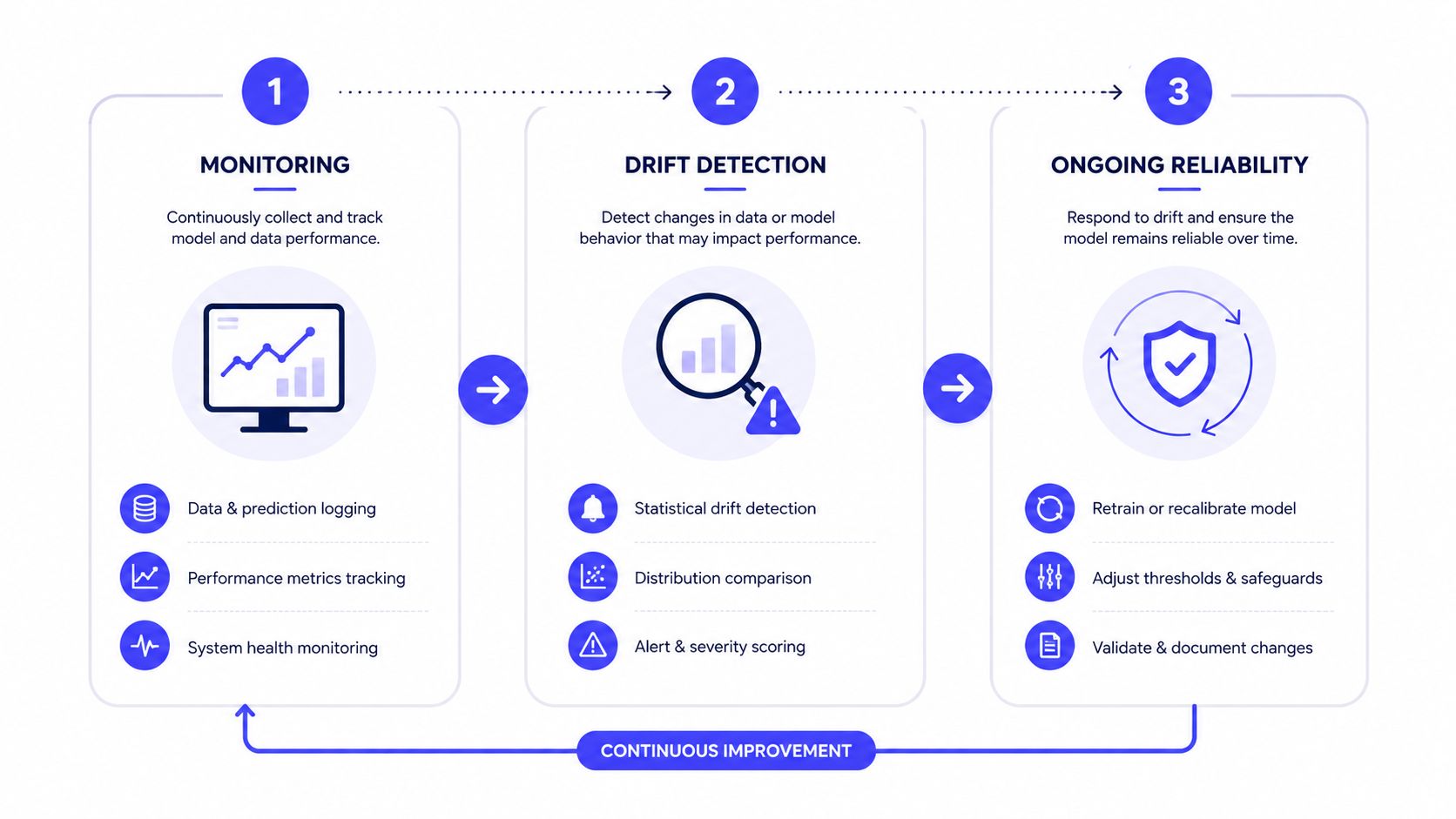
Monitoring is where production ML becomes dependable or slowly decays. CPU, memory, and error rate still matter, but they do not tell you when the model is making worse decisions on clean-looking traffic. Production monitoring has to combine service signals, data signals, and model signals, or you miss the failure modes that matter most.
Drift isn't one thing
Four drift types show up in production. Data drift means inputs changed. Concept drift means the relationship between inputs and target changed. Label drift means the target distribution shifted. System drift means the pipeline, latency, or feature path changed enough to alter model behavior.
For tabular systems, the monitoring loop should track prediction distribution shifts and compare current data with a stable baseline. LLM and embedding-based systems need different math. AWS Prescriptive Guidance recommends building a baseline from a stable period, monitoring production embeddings, comparing current and reference distributions with statistical tests, and alerting when thresholds are breached. It also notes that classic drift tests like Kolmogorov–Smirnov are less effective in embedding spaces, while Wasserstein distance fits better there (AWS drift monitoring guidance).
Tie metrics to ownership and action
Google Cloud's MLOps guidance says production monitoring should track accuracy, precision, and recall, detect drift, and trigger retraining when performance degrades or new data arrives (Google Cloud MLOps). NIST's AI RMF Playbook adds the operational guardrail that matters in practice, monitor performance, define how much shift from baseline is acceptable, and keep monitoring after deployment, including third-party components (NIST AI RMF Playbook).
A practical fraud setup makes the trade-offs obvious. Live precision on one merchant category starts slipping, but only for a specific slice. The monitoring job flags that slice, routes the issue to the model owner and the risk owner, and triggers a retraining check instead of waiting for the next scheduled run. If you also track a label-lag-corrected accuracy view, delayed ground truth does not hide the problem.
The best monitoring loops also include SLO-style service guards. If latency, error rate, or feature freshness breaches the threshold, the pipeline should fail loudly before users feel it. The production observability checklist is useful here because it recommends layered drift detection, shadow comparison between a pinned model and a current model, and small rolling evaluation samples of about 50-200 daily production interactions as an early warning signal before quality visibly degrades.
A useful companion overview is AI observability platforms, especially if you are deciding how much of this stack to build yourself versus buy.
MLOps Stacks, Tooling, and Build Versus Buy Decisions
Tooling choice gets too much attention because it feels concrete. The better question is which jobs you need to cover, and whether those jobs are differentiated enough to justify custom build work. Many teams don't need a bespoke platform on day one.
The six core jobs are straightforward. Experiment tracking is often handled by MLflow or Weights & Biases. Feature stores can be Feast or a managed cloud option. Training orchestration might use Kubeflow, Vertex AI Pipelines, or a cloud workflow service. Model registry usually starts with MLflow or a managed registry. Deployment and serving often uses FastAPI, KServe, or a managed endpoint. Monitoring can be Prometheus and Grafana, or a managed observability stack.
Buy the boring layers first
When the team is under five people, or the use case is not core to your product differentiation, buy the boring layers first. Registry and basic monitoring are usually the best place to start because they remove operational debt without forcing a platform project. Build only when the capability is central to your product, the vendor lock-in hurts roadmap flexibility, or compliance requires direct control of the data plane.
One practical caution. Don't buy four overlapping feature-store products because each team picked a favorite. Don't adopt an LLM platform before you've stabilized an eval set. Don't chase agent frameworks if a plain state machine would ship next week.
ThirstySprout is one option in this category, since it connects teams with senior AI and MLOps engineers for full-time, contract, or fractional work on production systems, product integration, and distributed collaboration. That matters when the issue isn't tooling access, it's getting the right operator in place quickly.
Five Production ML Pitfalls and Why They Keep Repeating
The same five mistakes keep showing up because teams treat them like model problems instead of reliability problems. The pattern is familiar, and it's expensive. The fix is usually simpler than the postmortem makes it sound.
The failure modes are repetitive for a reason
Fixed-schedule retraining without drift triggers keeps models fresh only on paper. Operators see a retrain job succeed while live quality still slips. The minimum fix is to tie retraining to measured drift or performance degradation instead of the calendar alone.
Shadow traffic without prediction comparison is just extra load. Teams route traffic to a new model, never compare outputs, and then assume safety because nothing exploded. The fix is to compare outputs, not just route requests.
Long-running agent memory treated as free state creates hidden fragility. Agentic systems fail when state gets incoherent across sessions, and the operational frontier is now durable memory architecture, replayable context, and graceful degradation, not just prompt polish (ZenML on LLMOps deployments).
Labels treated as ground truth when the upstream process changed leads to false confidence. If the business process that generates labels changed, the evaluation set no longer means what people think it means. The fix is to track label provenance and check whether the upstream process still matches the target definition.
Chasing offline accuracy on a stale test set rewards the wrong behavior. The model improves on paper while production data drifts away. A live eval loop with baselines, slice checks, and late-label correction is harder, but it's the only version that matters.
The more I've seen these failures, the more they look like distributed-systems bugs wearing a modeling costume. That's why the cure is to treat every model like a long-lived service with ownership, observability, and explicit recovery paths.
Team Shape, Ownership, and a 90-Day Rollout Plan
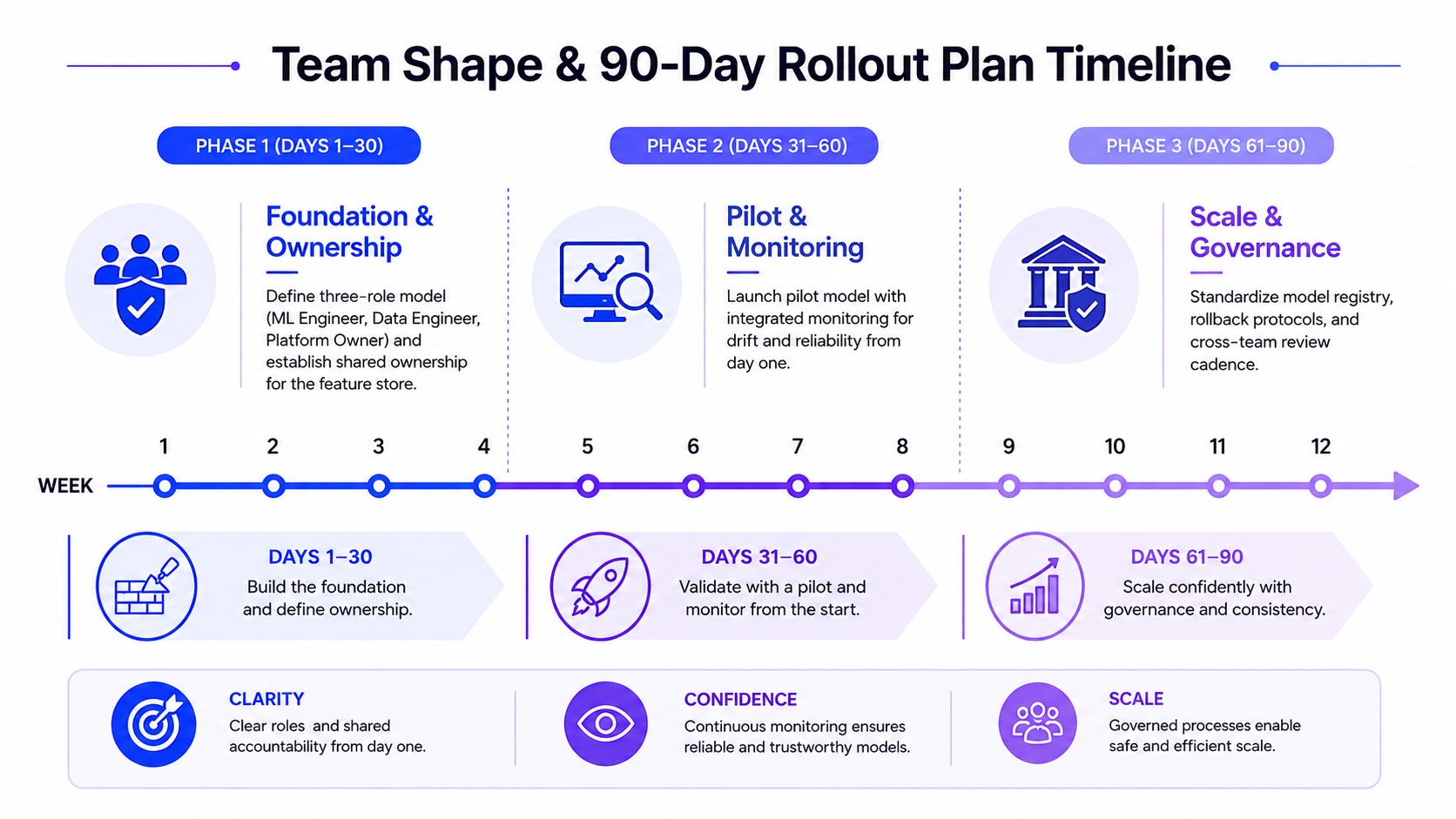
Tooling helps, but team topology usually decides whether production ML sticks. If ownership is fuzzy, every release turns into a coordination problem. If ownership is clear, even a modest stack can produce dependable systems.
A three-role model keeps the work legible
The first role is the ML platform engineer, who owns the training and serving substrate. The second is the applied ML engineer, who owns a specific model's lifecycle, from feature logic to deployment and monitoring. The third is the domain owner, who owns the business outcome and can say whether the model is helping or just looking good in dashboards.
In a startup, one person may wear two of those hats. In an enterprise, they should usually be distinct so platform work, model work, and business accountability don't blur together. That separation speeds decisions on retraining, rollback, and accepting change.
A realistic 90-day rollout
Weeks 1 to 3 should inventory the live models, identify who owns each one, and write down where features come from. Weeks 4 to 6 should add monitoring to the highest-revenue model first, because that's where you'll learn the most about failure modes and response paths.
Weeks 7 to 10 should add CI for training and pick one deployment pattern, batch, online, shadow, or canary, based on the business use case. Weeks 11 to 13 should run the first end-to-end retraining cycle, document the handoffs, and verify rollback works before the next change reaches users.
The rollout works best when the dashboard stays simple. Put model health, retraining status, drift alerts, latency, and ownership in one place so the CTO can see whether the system is becoming more reliable or just more complicated.
What to watch: if nobody can answer who owns the model, what threshold triggers retraining, and how rollback happens, the rollout isn't done yet.
Start by booking a scope call and choosing one production model to stabilize. If you need senior ML, MLOps, or AI engineers who've shipped live systems before, ThirstySprout can help you staff the work with remote specialists and move from planning to pilot without waiting months.
Hire from the Top 1% Talent Network
Ready to accelerate your hiring or scale your company with our top-tier technical talent? Let's chat.