

A production system can mean manufacturing, software engineering, or rule-based AI, and those meanings are not interchangeable. In the software and ML sense, it's the live system serving real users, not the notebook you tested yesterday.
You're probably here because someone on your team said “production” and the room went quiet. That's the right moment to slow down, define the term, and make sure you're talking about the same architecture, failure modes, and ownership model.
What the Phrase Actually Means
A launch meeting goes sideways fast when everyone uses production system to mean something different. In manufacturing, it refers to an organized way to turn raw materials into goods through batch, continuous, or project systems, with the factory system and assembly line as the classic reference points. In software engineering, it usually means the live environment that real users depend on. In rule-based AI, it means an if-then system that fires rules through a recognize-act cycle Wikipedia).
For this article, the software and ML meaning is the one that matters most. That is the version founders, CTOs, and platform leads need when they are deciding how to ship safely, how to monitor risk, and what to hire before launch.
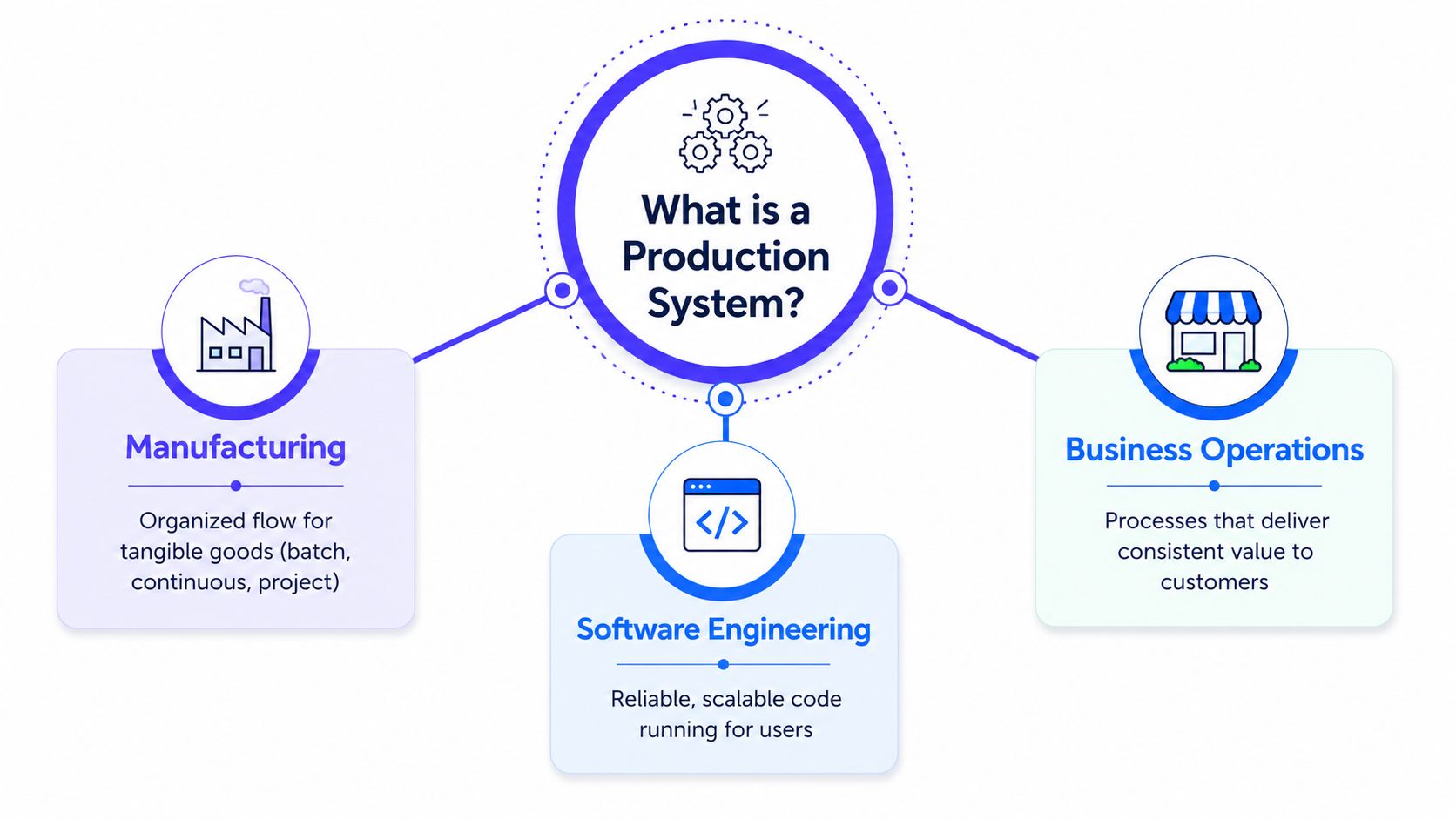
Why the distinction matters
A manufacturing production system is constrained by physical flow, equipment, and labor. A software production system is constrained by release discipline, data quality, security, and runtime reliability. A rule-based AI production system is constrained by rule maintenance, inference paths, and the cost of keeping logic coherent as conditions expand.
The same word also shows up in vendor conversations in ways that cause confusion. A scraping vendor might talk about production APIs in the software sense, which is a useful lens if you are dealing with live data ingestion, as Scrapeway explains web scraping APIs. A factory manager is usually thinking about line balance, throughput, and queueing. A platform engineer is thinking about deployment safety, rollback paths, and whether a bad release can be contained before users feel it.
Practical rule: if the word “production” appears in a document, ask what is being transformed, what the control layer is, and what failure looks like.
A useful working definition is straightforward. A production system is the set of people, tools, rules, and flows that reliably turn inputs into outputs at scale. That definition is broad enough to cover manufacturing, software, and rule-based AI without pretending they fail in the same way.
Where the Concept Came From
A production system started as an operations term long before software teams borrowed it. In factory settings, it referred to the way people, machines, materials, and rules were arranged to turn inputs into outputs in a controlled way. Standard operations texts still divide production systems into batch, continuous, and project types, and the factory system that emerged in the 18th century gave that idea a practical base in standardized work, division of labor, and higher-output facilities Britannica. That history still matters because it explains why engineers still talk about flow, queue time, and bottlenecks instead of only adding capacity.
What each milestone added
The conveyor belt changed how work moved through a plant. The European Route of Industrial Heritage traces its connection to the stockyards of Chicago and Cincinnati, where moving partially finished goods through the process cut down on wasted handling the European Route of Industrial Heritage's history page. In 1901, Ransom E. Olds patented the assembly line, and Henry Ford later scaled that logic into mass automotive manufacturing. Those shifts turned output into a coordination problem as much as a labor problem.
Toyota then formalized Lean Manufacturing in 1948, with an emphasis on flow, quality, flexibility, and waste reduction instead of increasing batch size the European Route of Industrial Heritage's history page. Software teams still borrow that lesson because local efficiency does not save a system when one stage slows down. A queue at one handoff affects everything that follows.
Rule of thumb: flow beats raw capacity when queues are growing faster than the system can clear them.
The same shift shows up in software and ML operations. You still have inputs, transformation, control, and outputs, and you still have variability, waiting, and bottlenecks. Teams that treat production like a release problem instead of a flow problem usually miss the primary constraint, which is why data engineering practices such as the ones in this data pipeline best-practices guide matter so much in live systems. If you need a practical way to spot trouble early, use tools that help you detect pipeline anomalies before they spread through the rest of the system.
The Architecture Every Production System Shares
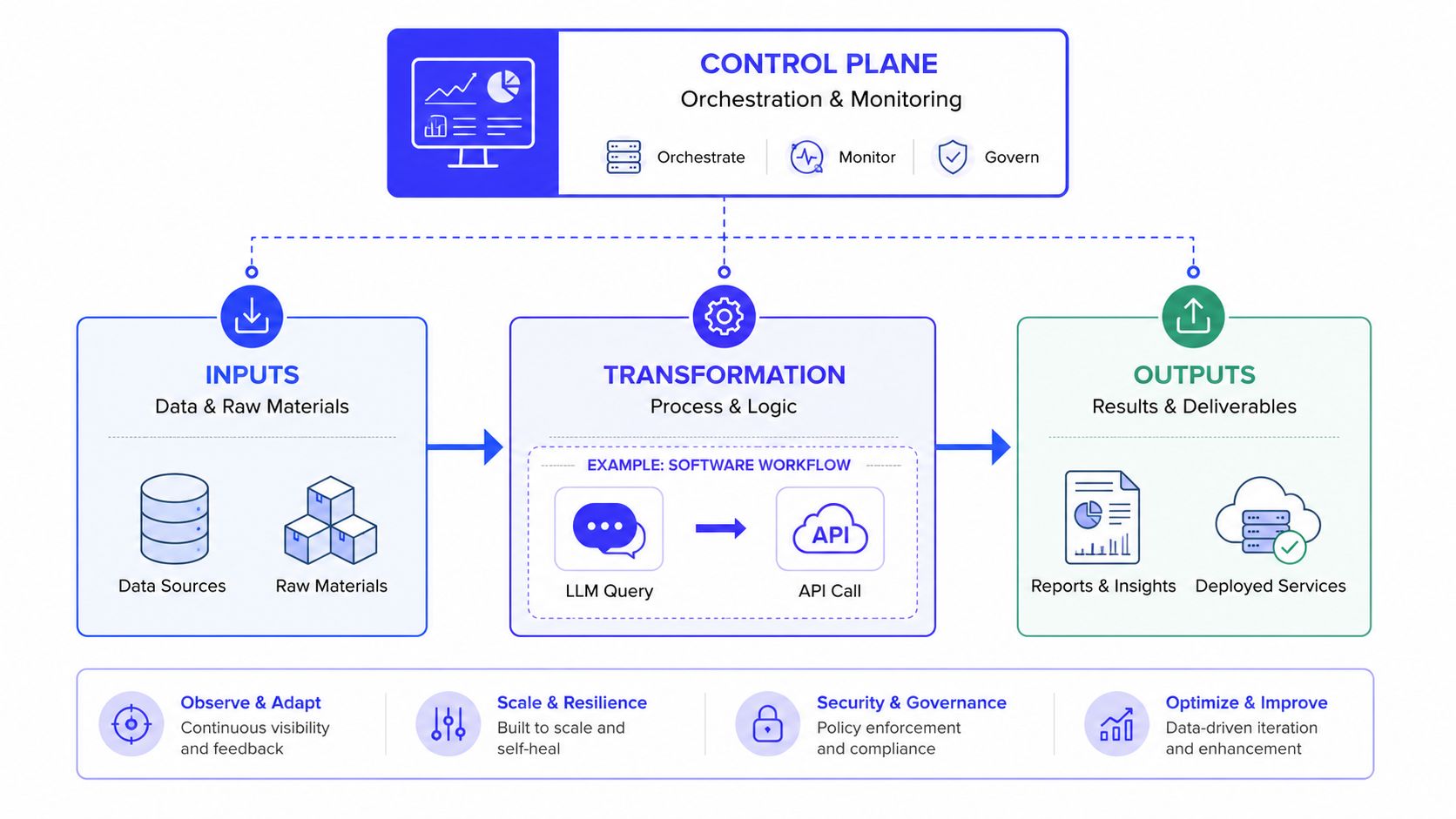
At the core, every production system is an integrated combination of equipment, people, materials, information flows, and control logic IEEE. That holds whether the system is a factory line, a SaaS backend, or an LLM-powered search API. The parts matter, but the system is really the flow between them, governed by rules that shape what gets processed, what waits, and what gets blocked.
Inputs, transformation, outputs
The basic model is transformation. You take inputs such as data, labor, machines, tools, or materials, run them through a defined process, and produce outputs ScienceDirect. For a search API, the inputs might be the user query, retrieval index, model weights, feature flags, and auth context. The transformation is retrieval, ranking, generation, and policy checks. The output is an answer, a citation set, or a refusal.
The control plane matters as much as the model. Layout and scheduling determine throughput, cost, quality, and responsiveness to demand shifts. If you do not control release timing, routing, or retries, the system will still behave, just not in the way you want. In production ML and backend systems, that control layer often decides whether the service is predictable or constantly fighting its own queues.
Why queueing breaks good systems
Production-science research is direct about the failure mode. Work-in-process accumulates between steps, and queue time can dominate lead time PPI Journal PDF. If a downstream stage slows down, upstream work piles up even when the upstream jobs themselves are healthy. That is why a team can have good individual services and still deliver a poor user experience.
The metrics that matter are cycle time, throughput, and work-in-process. In a SaaS backend, cycle time is how long a request takes. Throughput is how many requests you can complete. WIP is the queue depth across services, jobs, or GPU batches. The same pattern shows up in data pipelines, where healthy components still fail as a system if one stage stays backed up. Good data engineering practice focuses on the handoffs, the retries, and the monitoring around them, which is why a practical data engineering best practices guide belongs in the same conversation. If you need a concrete debugging habit, use tools that help you detect pipeline anomalies before they spread through the rest of the system.
Which stage creates the waiting, and what happens to the queue when demand rises?
That question maps cleanly onto a SaaS backend and an ML inference stack. In both cases, the path from input to output is only as strong as the slowest handoff.
Prototype vs Production in Practice
A prototype can be useful and still be unsafe to ship. The gap usually isn't the model, it's the layers around it. The easiest way to see that gap is to compare the notebook version with the version that has to survive real traffic.
| Dimension | Prototype | Production |
|---|---|---|
| Data | Sampled, cleaned by hand, often static | Streaming or batch-fed, messy, changing, access-controlled |
| Reliability | Best effort | Defined SLOs, alerting, on-call response |
| Observability | Logs or ad hoc prints | Logs, metrics, traces, dashboards |
| Security | Open internal access, weak secrets discipline | Least privilege, audit logs, secret rotation |
| Cost | Untracked or ignored | Budgeted, reviewed, and capped |
| Rollback | Re-run the notebook | Versioned deploys and tested rollback paths |
Fast litmus tests
- Data freshness: can you say when the last trusted input arrived?
- Reliability: do you know your service-level objective, or are you guessing?
- Observability: can one engineer trace a bad request end to end in minutes?
- Security: are access rules explicit, or is everyone effectively an admin?
- Cost: can you explain unit cost per request without opening a bill shock spreadsheet?
- Rollback: can you revert a broken release without rebuilding from scratch?
Most production incidents aren't model failures. They're gaps in one of those layers. If your prototype works but your release process, access model, or rollback path is vague, the system isn't production-ready yet.
Operating a Production System Day to Day
The day-to-day work is about keeping the control loop tight. Each layer needs to produce a clear signal, keep the blast radius bounded, and give you a clean way to recover when the system drifts.
Delivery, data, and runtime layers
Start with CI/CD, using something like GitHub Actions or GitLab CI to build, test, and promote changes through gates. Config validation, integration tests, and deploy approvals belong there. If prompts or model endpoints change without a gated pipeline, you are shipping blind.
For MLOps, use a model registry, feature store, and experiment tracking with tools such as MLflow or Weights & Biases. Training and serving parity matters because mismatched transforms create bugs that only show up after launch. Data pipelines need their own discipline too. Use batch orchestration with Airflow and streaming with Kafka or Kinesis when freshness matters more than a daily refresh. For a deeper look at these workflows, see our guide on machine learning operations.
Observability, security, and cost control
For runtime monitoring, track latency, error rate, saturation, and traffic with the RED method. Pair that with structured logs, distributed tracing through OpenTelemetry, and metrics in Prometheus. If you cannot connect the traces to the request path, launch week turns into guesswork.
Infrastructure should be reproducible. Use containers, Terraform, autoscaling, and multi-AZ or multi-region deployment patterns when the business needs resilience. Security needs secrets management, IAM least privilege, audit logs, and model access controls. Cost control should be treated as an engineering problem, not a finance surprise. Watch per-request budgets, spot versus on-demand trade-offs, and the relationship between model size and accuracy.
For teams building live ML or LLM systems, recent operational guidance also pushes versioning, governance, rollout controls, and end-to-end observability as first-class requirements, not afterthoughts Resolve AI Gogloby. If you want a practical reference point for data-team hygiene, the review on data engineering best practices is a useful internal baseline.
Practical rule: if a change can affect users, it needs a promotion gate, a rollback path, and an owner before it goes live.
That is the operating model. The stack can vary, but the control discipline cannot.
Two Real Systems and What They Teach
A Series A SaaS team I've seen work with did what many founders do. They demoed a churn-prediction model in a notebook, got excited, and then discovered the actual project was not the model. It was the plumbing. They had to retrofit pipelines, access controls, monitoring, and deployment discipline before launch, and the biggest surprise was that data freshness, not model quality, became the limiting factor.
What that team learned
Their first mistake was assuming the notebook path represented the business path. It didn't. Once real customer data started arriving late or inconsistently, the model's outputs became stale faster than the team expected. The lesson was simple, and painful.
Lesson: if freshness is part of the product promise, treat the data feed as a core runtime dependency, not a background task.
A fintech team took the opposite approach with a RAG support assistant. They shipped production-first. Prompts were versioned, an eval suite ran in CI, canary deploys were in place, per-tenant rate limits were set, and a rollback runbook existed on day one. The team didn't wait for a crisis to create the control plane.
What that team did right
They treated the assistant like a live service, not a demo artifact. That made it easier to separate tenant risk, catch regressions early, and roll back quickly when outputs changed. It also meant support could trust the system sooner, because the failure boundaries were explicit.
One useful interview question for teams building systems like this is:
- If the model starts producing plausible but wrong answers, what signal catches it first, and who owns the rollback?
That question surfaces whether a team has a real production mindset or just a strong prototype.
Metrics and Team Roles That Keep It Healthy
A production system can look fine on the surface and still be drifting toward failure. The metrics that matter are the ones that tell you whether the service is safe to trust in real use. Start with availability, usually framed at 99.9% or higher when uptime matters, then watch latency percentiles like p50, p95, and p99, along with error rate and throughput. For ML systems, add data drift, prediction drift, and a business metric that shows whether the model is still helping the product.
These numbers only work if someone owns them. A dashboard with no owner becomes decoration fast, and the team usually notices only after users do.
Who owns what
- SRE or platform engineering: latency, uptime, saturation, and incident response.
- MLOps: drift, model health, deployment safety, and training-serving parity.
- Data engineering: pipeline freshness and upstream data quality.
- Security: access control, auditability, and secrets.
- Product: business metrics and user impact.
- Finance or platform: unit cost and spend discipline.
The clean handoff rarely exists at startup scale. One senior MLOps or platform engineer often carries several of these responsibilities, because release safety, data flow, and runtime reliability are tied together in the early days. As traffic grows and the failure surface gets wider, the work has to split across dedicated teams so no single person is guessing across too many systems.
The first hires for a new AI product often follow the same pattern, even if the titles differ. A senior ML or MLOps engineer handles deployment safety and model operations, a data engineer keeps the inputs reliable, and a platform or SRE-minded engineer keeps the service observable and stable. If you are using ThirstySprout as a hiring route, the question is whether the person can own release safety, data flow, and runtime reliability from day one.
A good way to check readiness is to compare your team against a production readiness checklist. If the checklist is missing basic ownership, monitoring, or rollback discipline, the system may already be more fragile than the team thinks.
Launch Checklist and Common Pitfalls
A production launch should feel boring, and the checklist is how you get there. Before go-live, verify that config is versioned, the runbook exists, rollback has been tested, SLOs are defined, alerts are wired, dashboards are live, secrets are rotated, access has been reviewed, cost alerts are set, and on-call is assigned. If even one of those is missing, the blast radius is bigger than it should be.
A practical launch sequence starts with the parts that are hardest to fix under pressure. Version the config and prompt assets, then confirm that deployment can roll back cleanly, because that is what keeps a bad release from becoming a long outage. After that, check that the team can see the system, alerts point to the right owner, and the runbook gives a real next step instead of generic advice.
Common failure modes
- Skipping canary deploys: a full rollout turns one bad change into a broad outage.
- Ignoring data drift: the system degrades while the dashboard still looks green.
- Treating prompts as code, but not as versioned artifacts: nobody can reproduce what shipped.
- No eval suite in CI: regressions escape because nothing checks behavior before deploy.
- Underestimating inference cost: the architecture works, then margins disappear.
A launch can also fail on the boring controls that teams rush past. Secrets rotation, access review, and cost alarms are easy to postpone, but they matter once the system is live and more people can touch it. If those controls are loose, debugging gets slower and a small mistake can reach too many users before anyone notices.
A good reference for readiness is the production readiness checklist, but your team still has to adapt it to your stack and risk profile.
The next move is straightforward. Score your current system against the checklist, identify the two highest-risk gaps, then hire or contract the role that closes those gaps before you scale traffic or add new use cases.
If you're ready to tighten the launch plan, Start a Pilot with ThirstySprout and bring in the right senior AI or platform talent for the first production pass. If you'd rather benchmark the profile mix first, compare the roles against your current architecture before you commit.
Hire from the Top 1% Talent Network
Ready to accelerate your hiring or scale your company with our top-tier technical talent? Let's chat.