

Your chatbot passed the smoke tests. The team shipped another prompt change. Then weekly quality review found regressions nobody could explain. Support flagged answers that sounded confident but used the wrong policy, while the benchmark dashboard still looked healthy.
That's the hiring signal. An LLM evaluation engineer isn't a person you hire to run leaderboards. You hire this role to define production quality, turn failures into repeatable tests, and give engineering a defensible release decision.
Why This Role Exists and What It Actually Owns
Generative systems change across several layers at once. A model update can alter tone, retrieval behavior, tool selection, refusal patterns, latency, and cost. A prompt edit can improve one workflow while breaking another. Without a clear owner, teams ship on intuition, retrofit tests after incidents, and treat every regression as an isolated bug.
The LLM evaluation engineer owns the reliability discipline around those changes. The role starts by defining what “good” means for the product, not by selecting a fashionable benchmark. For a support assistant, that may mean grounded answers, correct escalation, policy compliance, and useful citations. For a coding agent, it may mean successful task completion, safe file edits, and correct tool use.
The person then turns those requirements into an evaluation system:
- Specify quality: Write rubrics, pass and fail criteria, and risk-based release thresholds.
- Build repeatable tests: Create datasets, graders, schemas, and pipelines that run against model and prompt variants.
- Gate releases: Decide which failures block deployment and which become tracked debt.
- Close the loop: Convert customer complaints, production traces, and incident findings into new test cases.
- Explain trade-offs: Show leadership whether a change improved the target behavior while damaging another requirement.
A useful overview of the surrounding operating model is what LLMOps covers, but evaluation ownership deserves its own accountability. LLM operations can provide observability and deployment workflows. The evaluator decides whether the system remains fit for purpose.
Hiring principle: If the candidate talks only about benchmark rankings and never asks what users are trying to accomplish, you're interviewing a benchmark operator, not a production evaluator.
How Evaluation Engineering Grew Into a Discipline
A model can top a public leaderboard and still fail a production release. Early NLP evaluation relied on reference-based measures such as BLEU, introduced in 2002, and ROUGE, introduced in 2004. Those metrics remain useful for constrained comparisons, but open-ended systems exposed their limits. A correct answer may use different wording from its reference, while a fluent answer may match surface language and miss the user's intent. This review of evaluation progress traces the field's shift toward broader evaluation suites.
GLUE, introduced in 2018, combined 9 English natural language understanding tasks. SuperGLUE followed in 2019 after GLUE was largely surpassed, increasing the difficulty. MMLU expanded testing in 2021 across 57 subjects, and BIG-bench covered 200+ diverse tasks in 2022. These milestones made a single accuracy score less useful. They also increased the value of test design, reproducible protocols, and careful interpretation.
Benchmark saturation then exposed the operational risk. SQuAD, TriviaQA, ARC, GLUE, and SQuAD 2.0 were described as saturated from 2018 to 2023. HumanEval, launched in 2021 for code generation, reached saturation by 2024. MMLU was described as saturated by 2023, and MATH by 2024. Static public tests can lose signal as models improve, a turnover documented by the LLM benchmark timeline.
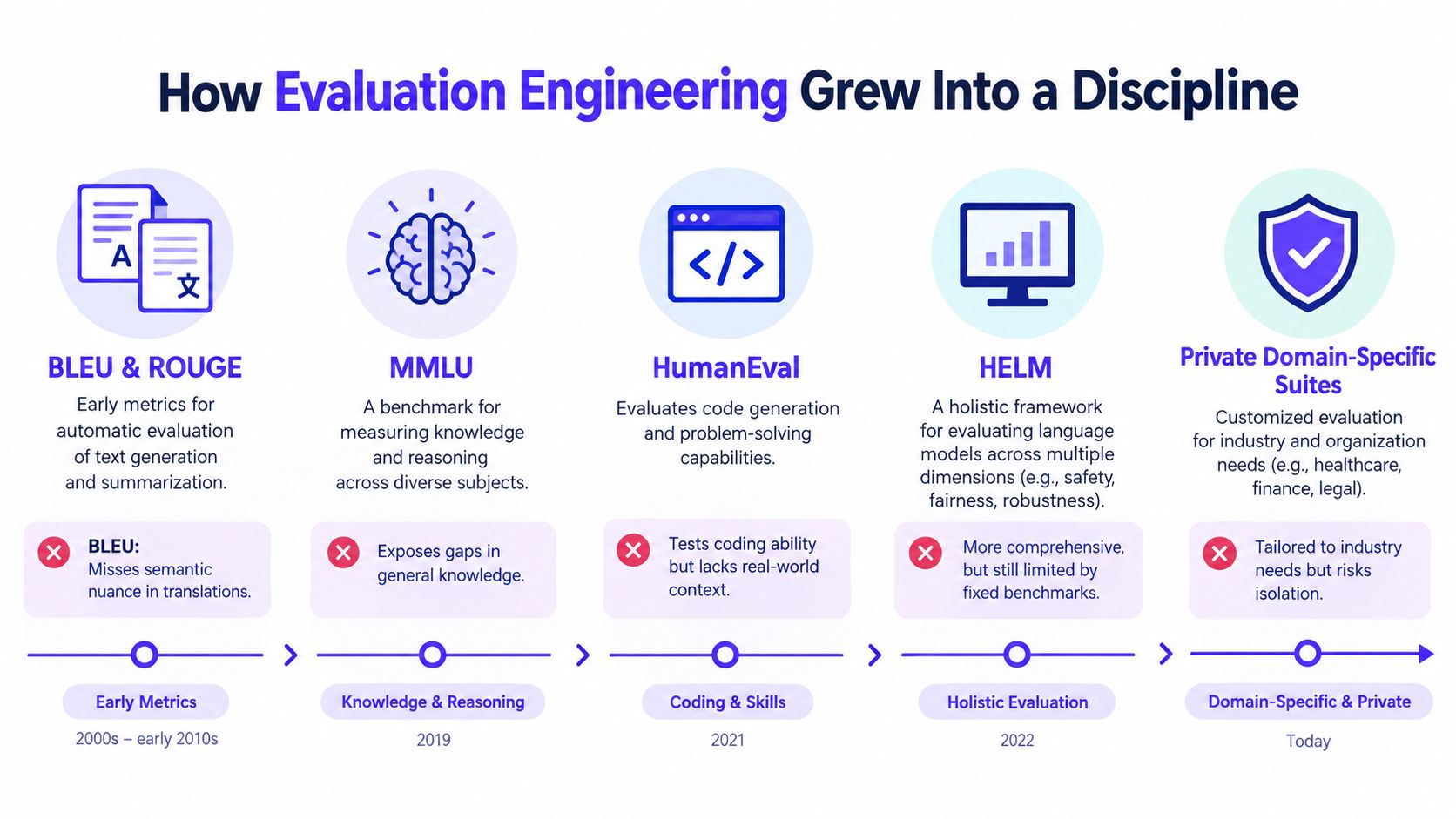
Production evaluation therefore combines public benchmarks with private, domain-specific suites. Coding and agent systems require end-to-end checks alongside next-token measures. HumanEval uses 164 hand-written Python problems for functional correctness, SWE-Bench Verified uses real GitHub issues, and MLE-Bench uses 75 real-world machine learning tasks covering data handling, training, and analysis.
The discipline grew because benchmark scores alone cannot define release quality. Teams need graders, schema validation, reproducible runs, regression dashboards, and controlled datasets. An evaluation engineer also decides which failures block deployment, which remain tracked debt, and when a benchmark no longer represents the product's real risks.
Core Responsibilities of an LLM Evaluation Engineer
A strong candidate should produce artifacts, not just describe concepts. Ask for evidence that could run in your environment and survive review by product, engineering, and safety stakeholders.
| Responsibility Area | Evidence Artifact | What Strong Looks Like |
|---|---|---|
| Metric specification | A written rubric for an open-ended task | Defines observable pass and fail conditions, separates factuality from style, and ties thresholds to product risk |
| Evaluation dataset curation | A versioned test set with labeling rules | Documents sampling, inclusion criteria, edge cases, ownership, and change history |
| Pipeline engineering | A CI-runnable evaluation suite | Runs against prompt and model changes, stores outputs, compares baselines, and exposes failure cases |
| Human-in-the-loop calibration | Agreement analysis on a labeled sample | Surfaces disagreements, clarifies the rubric, and records expert adjudication |
| Regression and safety gating | A release checklist with pass/fail thresholds | Names release blockers, exceptions, rollback conditions, and accountable approvers |
| Production feedback loops | Traced failures re-entering the evaluation set | Links incidents and user feedback to new cases, categories, and regression coverage |
The first artifact separates an evaluator from a generalist who has only read about benchmarks. A metric specification should answer a hard question: what observable behavior counts as failure? “Helpful” isn't enough. “Answers using only retrieved policy content, refuses unsupported requests, and routes unresolved cases correctly” is testable.
Dataset work demands equal rigor. A versioned set should identify the source of each case, its expected behavior, the label owner, and the reason it exists. If a customer complaint becomes a test without a documented rule, the team may preserve the symptom while missing the underlying failure mode.
Pipeline ownership turns evaluation into engineering. The suite should run when prompts, models, retrieval settings, tool definitions, or application code change. It should retain the candidate result and the previous baseline so the reviewer can inspect the regression rather than trust a summary score.
Human review still matters where correctness depends on context. The candidate should know how to calibrate reviewers, investigate disagreement, and revise a rubric without moving the goalposts.
The final test is operational judgment. A real practitioner can say, “This release improves answer relevance but fails the unsupported-claim gate, so it doesn't ship.” That sentence is more valuable than a polished leaderboard chart.
Metrics, Benchmarks, and When Each One Stops Working
No metric works across every deployment. An evaluation engineer selects measures for the product surface, then defines the point at which each measure becomes misleading.
| Metric Family | Examples | Best Deployment Surface | Where It Stops Working |
|---|---|---|---|
| Reference-based automatic metrics | BLEU, ROUGE, METEOR | Constrained generation, summarization comparisons, and outputs with stable references | Open-ended chat where valid answers can use different wording |
| Embedding and LLM-as-judge scorers | BERTScore, G-Eval, Prometheus | Semantic similarity and rubric-based review when human labels validate the grader | Nuanced domains where the judge misses key evidence or inherits vague criteria |
| Domain benchmarks | MMLU, HellaSwag, HumanEval, MT-Bench, Chatbot Arena | Candidate model screening and broad capability comparison | Domain copilots, private workflows, safety-sensitive decisions, and agent tasks |
| Production-side online metrics | Task success, deflection, hallucination rate, cost per resolved ticket | Real user workflows and business outcomes | Sparse feedback, shifting traffic, weak instrumentation, or metrics that reward speed over correctness |
Reference-based metrics provide useful evidence when the reference defines the task. They weaken when an assistant reasons over changing documents or supports several valid answers. A high similarity score can still conceal a policy violation, missing condition, or unsupported claim.
Embedding and judge-based methods can assess meaning and rubric criteria, but expert labels must validate them. Treat the judge as another model in the system. Track its calibration, drift, and recurring blind spots instead of treating its score as ground truth.
Public benchmarks are screening tools. HumanEval can help compare code-generation capability, while an agent that edits repositories, calls tools, and recovers from errors requires task-specific tests. MMLU can indicate broad knowledge but says little about whether a finance copilot cites the correct internal policy.
Specialized suites provide a closer view of coding and agent behavior. Zemith's AI model comparison guide offers a practical reference for comparing models across evaluation dimensions. Public benchmark context can also help teams interpret results for HumanEval, SWE-Bench Verified, and MLE-Bench.
Use public scores to narrow candidates. Use private product tests to approve releases. The AI agent evaluation framework applies when success depends on tool sequences, state changes, and final outcomes rather than one response.
Set release blockers before reviewing scores. A benchmark gain cannot override failures in policy adherence, tool safety, citation accuracy, or task completion. A leaderboard result can justify investigation. It cannot, by itself, justify deployment.
A Weekly Workflow Built Around a Three-Step Eval Loop
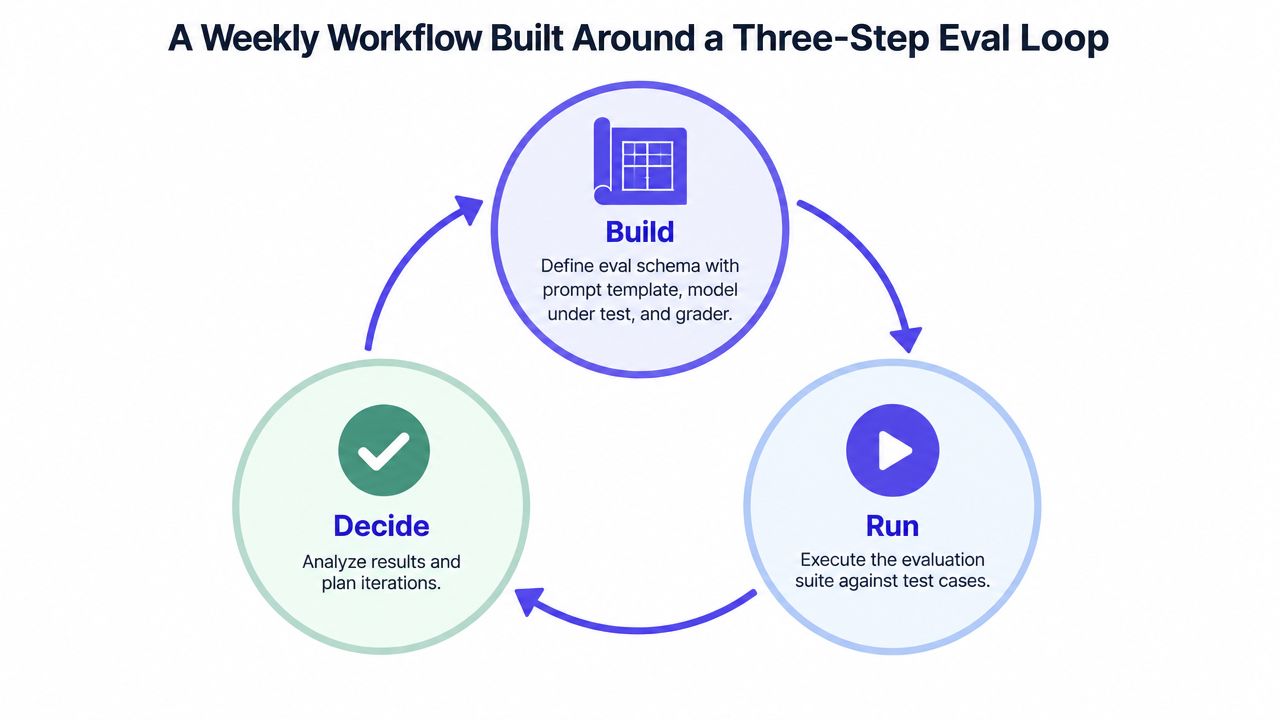
OpenAI's documented workflow is simple: define the task as an eval, run it with test inputs, then analyze results and iterate on the prompt or system. The value comes from making that loop part of the team's weekly operating rhythm.
Build the evaluation artifact
Define the schema before running the suite. Include the prompt template, model under test, relevant parameters, grader type, expected behavior, and pass or fail thresholds tied to product risk. OpenAI describes evals as reusable configurations containing testing criteria and a data-source schema, which makes the artifact suitable for comparing models and parameters.
Start with a small set for a single skill. OpenAI's agent guidance recommends 10–20 prompts to surface early regressions, then expanding the set as real failures appear. Don't build a grand test platform before you understand the failure modes.
Run the candidate and baseline
Run the current production candidate against the curated suite and sampled production traces. Compare it with the previous baseline under the same protocol. Keep deterministic settings where possible, record the run configuration, and set a cost budget so an evaluation cannot become an uncontrolled production workload.
Decide with failure-level evidence
Hold a short triage meeting. Every failure should receive a disposition:
- Prompt or application fix: The system violates a known requirement.
- Model rollback: The candidate loses a critical capability.
- Dataset gap: The case reveals missing coverage or a weak label.
- Accepted failure: The team documents the risk and chooses not to block.
The Friday repository update should include the schema, dataset version, grader configuration, baseline comparison, failure samples, decisions, and follow-up cases. OpenAI's eval design guidance supports this continuous-evaluation approach across synthetic, domain-specific, human-curated, production, and historical data.
The following video can help teams visualize how an evaluation loop fits into iterative system improvement.
Dataset Stewardship and Defending Ground Truth
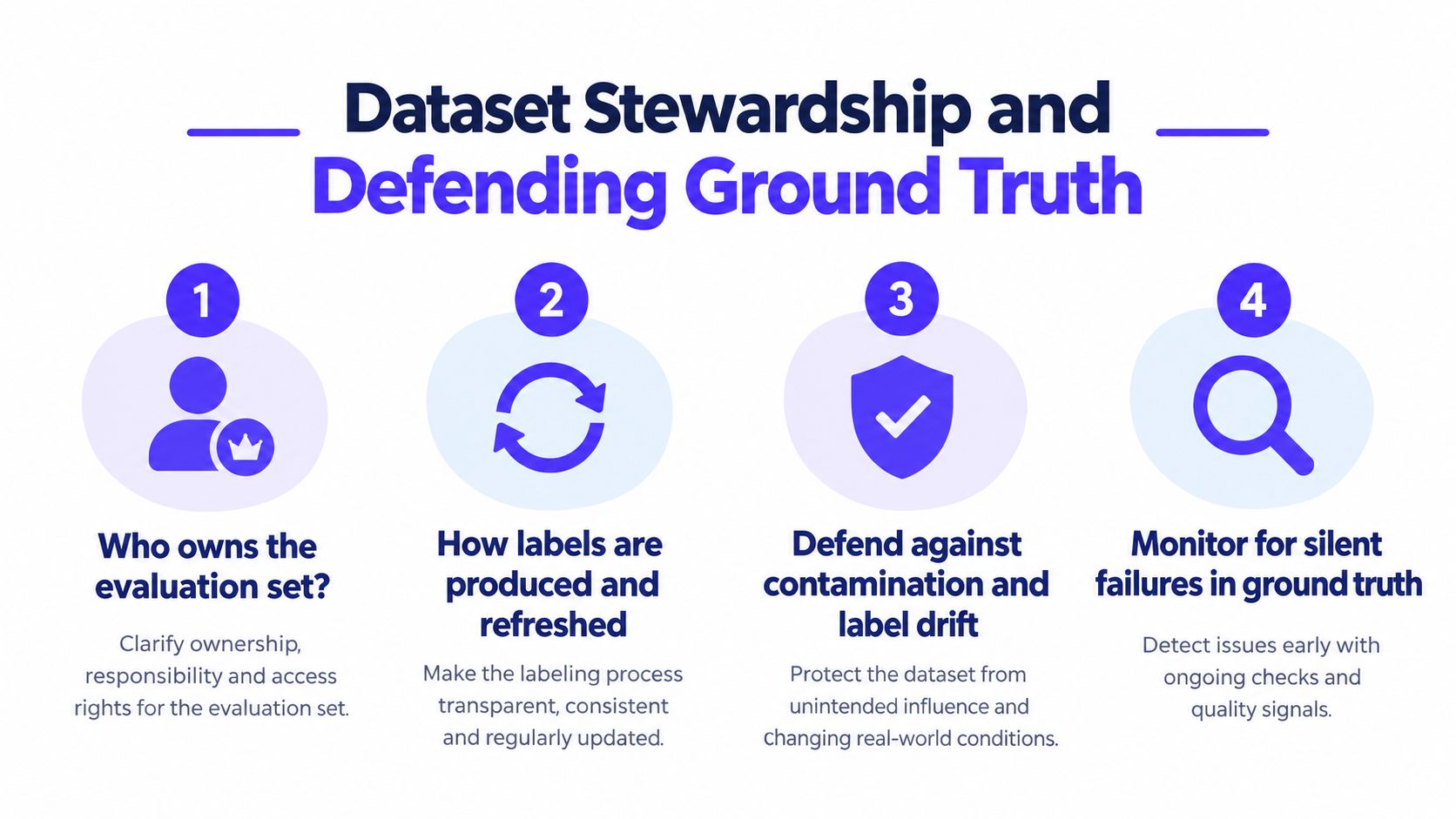
A benchmark is only as credible as the dataset behind it. Someone must own the evaluation set, define how labels are produced, decide when labels need review, and defend the ground truth when a model, product policy, or reviewer disagrees.
The operational practices are straightforward but easy to neglect:
- Version the golden set: Record every addition, removal, label change, and reason for the change.
- Separate public and private data: Keep internal evaluation cases distinct from public benchmarks and training material.
- Probe for contamination: Add adversarial checks for memorization and investigate suspiciously easy results.
- Refresh labels: Revisit cases when product policies, source documents, or user expectations change.
- Retire compromised cases: Document when a case may have leaked into training data or become too familiar to provide useful signal.
Each practice prevents a different failure. A contaminated MMLU slice can make a model appear stronger than it is. A support rubric can become wrong when the company changes its refund policy. A coding benchmark can lose value when solutions have appeared in pre-training data.
Dataset stewardship also requires ownership of disagreement. If product says an answer is acceptable but safety says it creates unacceptable risk, the evaluator shouldn't resolve the conflict without documentation. The team needs a named decision-maker, a recorded rationale, and a policy for revisiting the case.
Prophetic's role description emphasizes the need to produce, maintain, and defend evaluation datasets. Akkodis highlights versioned test cases, ground-truth references, and reproducible baselines. Those job-market signals point to a broader responsibility: the evaluator is a data steward, not merely a metrics operator.
Ask candidates one governance question: Who can approve a ground-truth change, and what evidence must they record? A strong answer includes domain ownership, version control, adjudication, and a clear audit trail.
Hiring Kit, Skill Matrix, and Interview Questions
Hire for engineering judgment first. A candidate who knows Python, can design datasets, understands statistical uncertainty, and maintains disciplined experiments will learn another evaluation tool. Someone who only knows a vendor dashboard won't necessarily recognize a broken rubric.
Use this skill matrix as a starting point:
| Skill or Signal | Weight | 1, Below Bar | 2, Meets Bar | 3, Strong | 4, Exceptional |
|---|---|---|---|---|---|
| Python and pipeline engineering | High | Can't build a repeatable run | Writes basic scripts | Builds CI-ready suites and result storage | Designs maintainable evaluation infrastructure |
| Statistical literacy | High | Treats every score as definitive | Understands basic comparisons | Investigates variance and sampling | Explains uncertainty and decision risk clearly |
| Dataset design | High | Collects convenient examples | Builds a usable set | Documents coverage and labels | Defends ground truth against drift and contamination |
| Experiment discipline | High | Changes several variables at once | Runs controlled comparisons | Preserves baselines and configurations | Connects results to release decisions |
| Product reasoning | High | Optimizes generic scores | Understands stated requirements | Finds workflow-specific failures | Converts business risk into testable criteria |
| Human review calibration | Medium | Relies on intuition | Uses a basic rubric | Investigates disagreement | Builds durable reviewer alignment |
| Reinforcement learning from human feedback exposure | Medium | Has no relevant context | Understands the concept | Connects it to evaluation limits | Can separate preference signals from task correctness |
| Annotation vendor management | Low | Has no process | Can coordinate labeling | Tracks quality and escalation | Designs governance around external labeling |
| Front-end prototyping | Low | Avoids review tooling | Can inspect outputs | Builds a usable review surface | Prototypes tools that improve reviewer throughput |
Three interview questions
Metric regression: “Your retrieval-augmented assistant's answer-relevance score improves, but unsupported claims increase. What do you inspect first?”
A strong answer separates graders, reviews failed traces, checks retrieval context, compares the baseline, and refuses to collapse both behaviors into one weighted score. An exceptional answer proposes a release gate for unsupported claims and identifies whether the judge itself changed.
Harness design: “You inherit a vague request to evaluate an internal assistant. What do you do during the first working session?”
Look for clarifying questions about user tasks, failure costs, data access, and expected behavior. The candidate should propose trace review before metric selection, then a small schema, a versioned dataset, deterministic checks where possible, and a plan for expanding coverage.
Ground-truth drift: “The product policy changed, but the old test set still passes. How do you respond?”
A strong candidate identifies affected cases, updates ownership and labels, preserves the old version for historical context, adds new policy examples, and records the approval. They won't overwrite the dataset and claim improvement.
For a practical take-home, ask candidates to build an offline evaluation set for a retrieval-augmented assistant using 100 queries. Require a four-column scorecard, trace examples, labeling rules, a baseline comparison, and a short release recommendation. Use the candidate vetting process to keep review consistent across interviewers.
When to Hire and How to Onboard in 30 Days
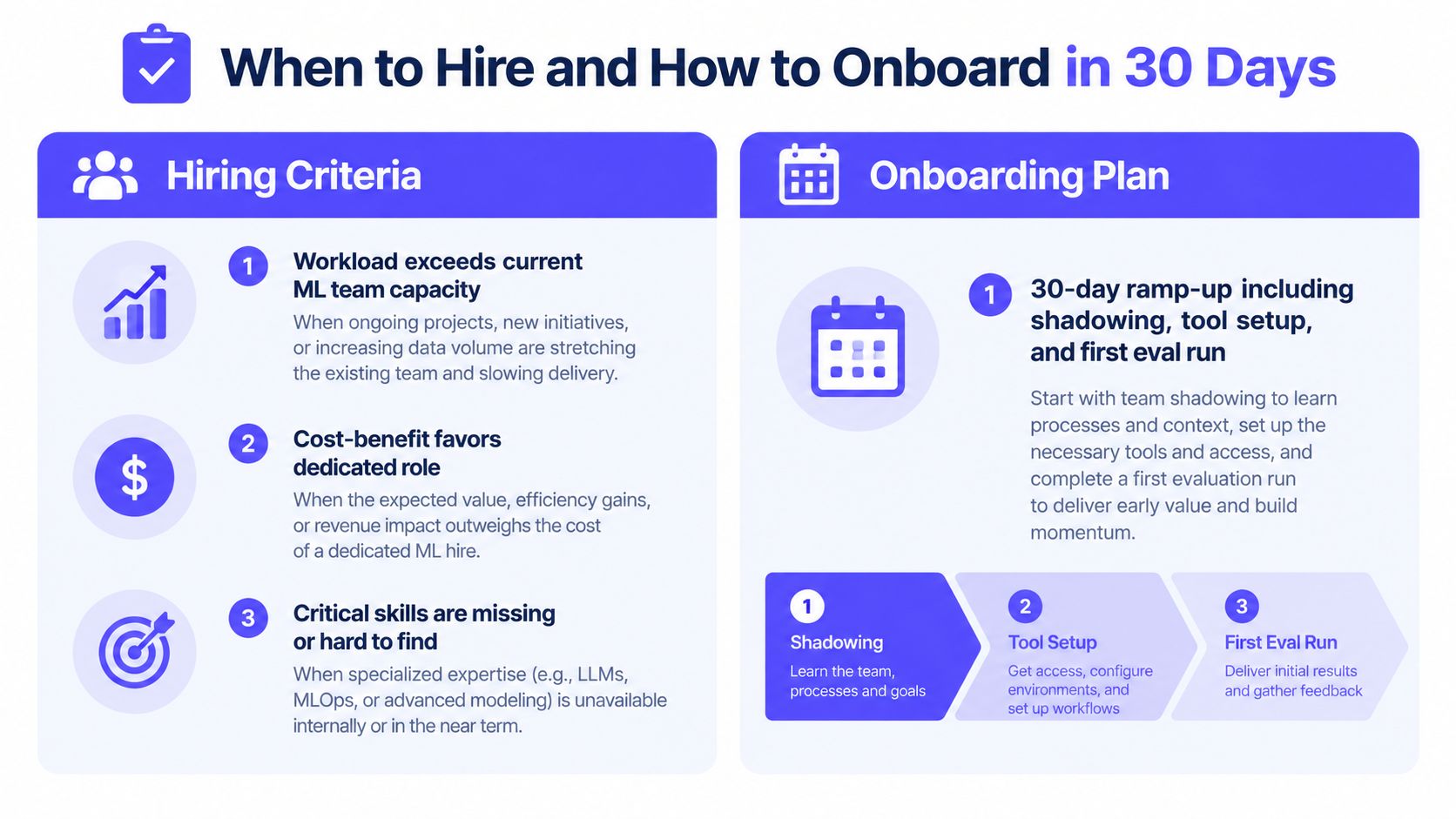
Hire a dedicated LLM evaluation engineer when your team changes models, prompts, retrieval, or agent workflows frequently enough that regressions compete with feature work. If you launch a model-powered feature once or twice a year, an ML or MLOps engineer can usually own a lightweight evaluation program. If you ship changes weekly, dedicated ownership is usually justified.
The role pays for itself through better decisions, not through a prettier dashboard. Your evaluator should make quality visible, reduce repeated investigation, and stop risky releases before customers discover the failure. Those benefits disappear if leadership treats every threshold as advisory.
Use a focused first month:
- Week 1, audit and baseline: Inventory current benchmarks, production traces, prompts, graders, and release checks. Ship a baseline dashboard with known gaps and a versioned starting dataset.
- Week 2, own one blocker: Select one high-risk behavior, such as unsupported claims, incorrect tool calls, or unsafe escalation. Define the rubric, validate the grader, and make the threshold visible to the release team.
- Week 3, calibrate across functions: Run a review with product, engineering, support, and safety. Resolve disagreements about what counts as failure and assign ground-truth ownership.
- Week 4, make the first gated decision: Run the suite against a real candidate release, compare it with the baseline, document failures, and issue a ship, fix, or rollback recommendation.
Leadership requirement: Don't hire this person and then override every release decision. Their sign-off must carry operational authority, or the company is paying for measurement without reliability control.
ThirstySprout provides vetted remote AI engineers and ML teams for LLM application development, retrieval, evaluation, MLOps, and platform work. If you need an evaluator who can establish release gates or a broader team to build the surrounding system, visit ThirstySprout to discuss a focused pilot.
Hire from the Top 1% Talent Network
Ready to accelerate your hiring or scale your company with our top-tier technical talent? Let's chat.