

Most hiring advice treats candidate vetting as a sequence of recruiter screens, a generic coding test, and a background check at the end. That process can work for low-risk roles. It breaks down for senior AI engineers who may touch customer data, model weights, production infrastructure, and proprietary research.
A strong candidate vetting process turns hiring into an evidence chain. You verify what the candidate claims, test the technical decisions the role requires, confirm how they behaved in production, and establish that the person being assessed is the person who will do the work. The result isn't certainty. It's a disciplined reduction of hiring risk.
Rethinking Technical Screening as Risk Management
A polished resume is a useful source of leads, not proof of seniority. Keyword matching can identify candidates who have written “LLM,” “Kubernetes,” or “MLOps,” but it can't tell you whether they designed the system, operated it under pressure, or inherited it after someone else made the important decisions.
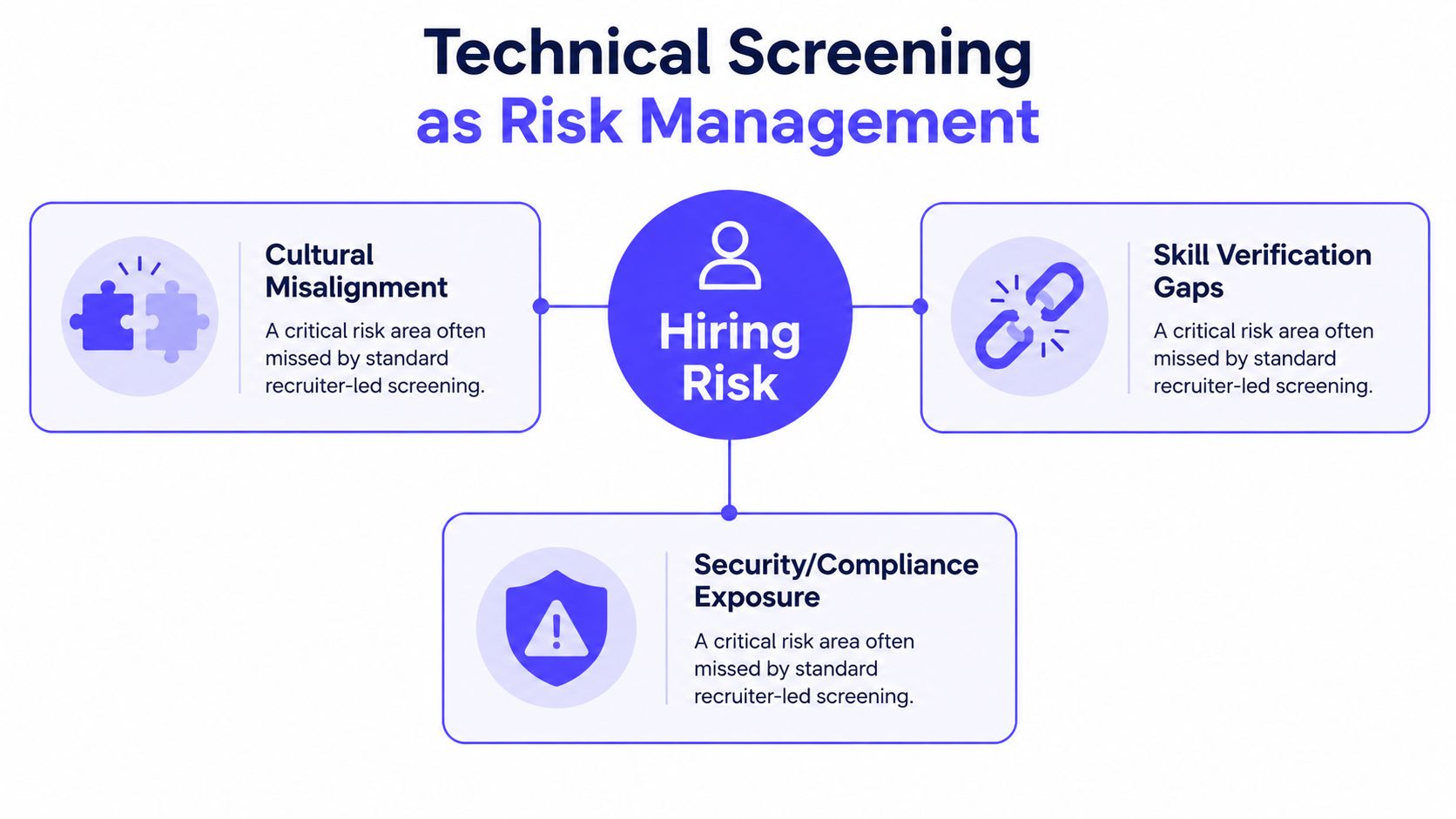
For senior AI roles, the common recruiter-led model creates three blind spots:
- Cultural misalignment: The candidate may struggle with written decisions, ownership, or disagreement in a distributed team.
- Skill verification gaps: The resume may describe team output rather than the candidate's own technical contribution.
- Security and compliance exposure: The process may confirm employment history while failing to establish identity, access discipline, or responsible handling of sensitive data.
The useful historical reference point isn't modern recruiting software. It's the formal definition used in U.S. suitability and clearance systems. Vetting involves investigation, evaluation, adjudication, decision, and notification, as described in this RAND report on personnel vetting. That structure matters because it treats screening as a multi-stage risk-control workflow, not a single conversation.
You don't need to copy a government clearance process for a startup hire. You should copy its discipline. Each stage should answer a different question, produce an explicit record, and have a defined owner.
A practical decision workflow
Use this sequence for a senior AI or machine learning hire:
- Application review: Does the claimed experience match the role's actual constraints?
- Low-cost assessment: Can the candidate reason about the systems and data they'll work with?
- Live technical evaluation: Can they explain trade-offs and produce sound code or architecture?
- Reference verification: Do former colleagues describe the same ownership and operating habits?
- Identity and access review: Is the candidate who they claim to be, and can you safely grant access?
- Adjudication: Do the signals collectively clear the role's risk threshold?
- Decision and notification: Can you explain the decision using job-related evidence?
The funnel is narrower than most hiring teams expect. One hiring benchmark reports that recruiters may spend about 7.4 seconds on an initial resume scan, applicant tracking systems can reject roughly 75% of candidates before a human interview, and only about 3% of applicants may reach interviews. The same source cites a benchmark in which roughly 180 applicants produce one hire, an applicant-to-hire conversion of about 0.56%. Those figures come from Lathire's candidate vetting overview.
The lesson isn't to add more filters. It's to make every filter answer a useful question. A bad automated screen removes unconventional candidates because they lack familiar credentials. A good one removes unsupported claims and preserves candidates who can demonstrate practical judgment.
Practical rule: Treat every hiring stage as a control against a specific failure mode. If a stage has no clear question, remove it.
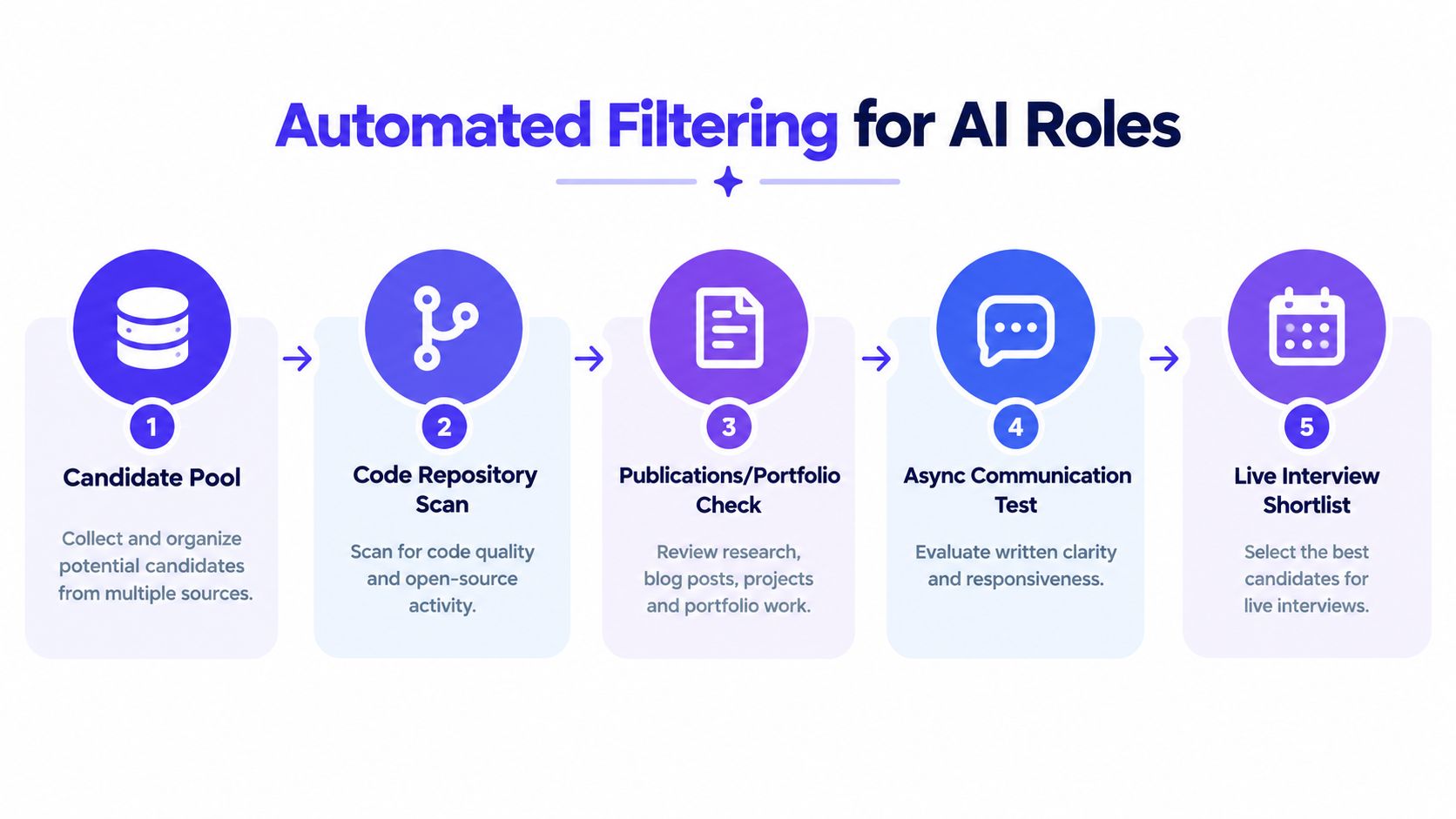
Designing High-Signal Automated Filters
Before engineers spend time in live interviews, create a low-cost hurdle that tests relevant technical judgment. The U.S. Department of Health and Human Services describes an initial assessment hurdle as an automated self-report questionnaire or an inexpensive online test, which supports placing cheaper screens before more expensive interviews in a multi-stage process. See the HHS hiring assessment strategies for the underlying framework.
Start with the failure you need to prevent
Don't begin with a generic quiz. Begin with the role's most expensive mistake.
For a retrieval-augmented generation engineer, that mistake might be shipping a system that retrieves plausible but unauthorized documents. For an MLOps engineer, it might be deploying a model without rollback, lineage, or observable failure states. For an AI platform engineer, it might be creating an abstraction that hides cost and latency from product teams.
Write the screen around that failure. A strong short assessment might ask the candidate to:
- Review a repository: Identify a data leakage risk, brittle deployment step, or missing test boundary.
- Explain a design choice: Compare batch inference with online inference for a stated product requirement.
- Write a small change: Add validation, improve an evaluation harness, or make a pipeline failure observable.
- Respond asynchronously: Produce a concise design note with assumptions, risks, and open questions.
The assessment should be difficult enough to reveal judgment but narrow enough that candidates can complete it without reproducing an entire production system. Avoid timed algorithm puzzles unless the job requires them. They often measure familiarity with that interview format more than the ability to operate AI systems.
Score evidence, not pedigree
Use a scorecard before applications arrive. Separate required signals from helpful signals, and don't let brand-name employers or academic credentials substitute for evidence.
A practical scorecard can include:
| Area | Evidence to request | Weak signal |
|---|---|---|
| Production ownership | Candidate explains an incident, decision, and measurable operational constraint | Lists tools without describing decisions |
| Data judgment | Identifies leakage, drift, labeling, or access risks | Treats data as clean and static |
| System design | States assumptions and compares alternatives | Draws components without failure paths |
| Code quality | Produces readable, testable changes | Optimizes prematurely or skips validation |
| Written communication | Documents trade-offs clearly | Uses dense prose with no decision record |
Keep an exception path for candidates who fail a conventional screen but show strong practical evidence elsewhere. A nontraditional background shouldn't be an automatic rejection. The reviewer should record why the candidate moves forward and which risk the next stage will test.
For tooling, compare products against your workflow rather than buying an opaque filter. This guide on best AI recruiting tools can help you map automation to sourcing, screening, and coordination needs. Automation should organize evidence and apply consistent criteria. A human should make the final decision.
Evaluating Architecture and Code in Live Interviews
Senior AI candidates reveal their level when requirements are incomplete. They ask what matters, identify constraints, and make trade-offs visible before they draw architecture.
A useful live exercise might ask the candidate to design an internal knowledge assistant. Don't grade the diagram for the number of boxes. Ask how they would handle document permissions, stale content, retrieval failures, evaluation data, prompt changes, latency, and rollback. A candidate who starts by choosing a vector database without clarifying access control is showing a risk in prioritization.
What strong technical signal looks like
During architecture discussions, listen for the following:
- Assumption control: The candidate asks about users, data sensitivity, traffic shape, latency expectations, and failure tolerance.
- Evaluation design: They define how the team will detect retrieval errors, hallucinations, regressions, and unsafe responses.
- Operational ownership: They discuss observability, alerting, rollback, model versions, data lineage, and incident response.
- Economic reasoning: They compare model quality with inference cost, storage, latency, and engineering complexity.
- Boundary awareness: They know what belongs in application code, orchestration, data systems, and model infrastructure.
For coding, use a small repository or representative service rather than a blank editor. Give the candidate an imperfect pipeline and ask them to make one meaningful improvement. Watch how they read unfamiliar code, test assumptions, and explain what they'd defer.
A take-home project can reveal deeper work habits, especially written communication and repository hygiene. It also introduces candidate burden, inconsistent environments, and the risk that someone else completes the work. Live pair programming offers stronger identity confidence and lets you probe decisions, but it can disadvantage candidates who need time to process or who are unfamiliar with the tooling.
Use both formats selectively. A short, bounded take-home should test the work product. A live review should test authorship, reasoning, and adaptability.
| Interview Stage | Key Signal to Evaluate | Red Flag to Avoid |
|---|---|---|
| Technical screen | Problem framing and relevant fundamentals | Memorized answers with no assumptions |
| Architecture interview | Failure handling and trade-offs | Tool-first design with no requirements |
| Code review | Testing, readability, and debugging method | Large rewrite without understanding context |
| Incident discussion | Ownership and learning behavior | Blaming other teams or hiding uncertainty |
| Final debrief | Consistency across evidence | One charismatic interviewer overriding the scorecard |
A candidate may not know every library you use. That's rarely the critical signal. A stronger indicator is whether they can learn the unfamiliar component, locate its risks, and choose a safe integration boundary.
Use a consistent question set, then add targeted probes based on the candidate's answers. The technical interview questions for engineers resource can support question design, but interviewers still need to tie each question to the role's actual production environment.
Turning Reference Checks into a Verification Gate
Reference checks should verify the story you've already heard. They shouldn't serve as a friendly call that happens because the hiring process says it must.
The U.S. Office of Personnel Management describes reference checking as a way to verify candidate-provided information, predict on-the-job success, and uncover information that resumes and interviews may miss. Its guidance recommends asking the candidate for permission, deciding who will conduct the check, preparing role-specific questions, and contacting additional references when needed. Review the OPM reference checking guidance before you design your own process.
Select references for evidence quality
Ask for a former manager, a close peer, and, where appropriate, someone the candidate mentored or led. Canada's public service guidance describes a structured reference check as a conversation with people who worked with the applicant, while OPM frames it as an objective evaluation based on supervisors, peers, or subordinates who knew the person at work. The OPM structured reference checking guide provides useful grounding for that approach.
Don't ask, “Was this person good?” That invites politeness and produces little evidence. Ask questions connected to the work:
- Ownership: “What did this person personally own, and what did the broader team own?”
- Technical judgment: “Tell me about a decision they made when accuracy, latency, and delivery speed conflicted.”
- Operational behavior: “How did they respond when a production model or pipeline failed?”
- Collaboration: “How did they communicate a technical risk to product or leadership?”
- Growth edge: “What type of support helped this person perform at their best?”
- Rehire signal: “Would you hire this person into a similar role again, and why?”
Reconcile claims with observations
Prepare a claim ledger before the call. Record the candidate's major assertions, such as leading a migration, owning a model launch, or reducing operational burden. Ask references to describe the same work without feeding them the candidate's preferred conclusion.
A mismatch doesn't automatically disqualify someone. Team structures differ, titles vary, and people remember projects differently. It does mean you should investigate. Ask the candidate for clarification and record the final interpretation in the hiring file.
Reference checks also surface management style. A technically brilliant engineer who hoards context, dismisses operational concerns, or leaves teams with unmaintainable systems creates a different risk profile from someone who communicates constraints and builds durable practices.
A reference check is most useful when it tests a claim that matters to the role, not when it collects a general impression.
Keep the process consistent across candidates for the same role. Obtain appropriate permission, limit questions to job-related matters, protect the information, and involve counsel or local experts where employment rules require it.
Assessing Async Fit and Identity Assurance
Remote AI teams don't get to resolve every ambiguity in a hallway conversation. A senior engineer needs to write a design proposal, explain model behavior, document an incident, and make a decision that another time zone can understand without a live meeting.
Evaluate that capability directly. Give the candidate a short technical scenario and ask for a written response. Look for clear assumptions, a decision, alternatives considered, risks, and the next action. Ask them to revise the document after receiving new information. That second pass reveals whether they can update a decision without losing the thread.
Identity deserves the same early attention. Background checks often happen after trust and access have already been granted, while impersonators can exploit the gap between screening and identity confirmation. Industry analysis identifies AI-generated profiles, synthetic identities, deepfakes, and proxy candidates as parts of this emerging identity attack surface. One cited projection from Gartner says 1 in 4 candidate profiles worldwide could be fake by 2028, and the same industry summary reports that 41% of staffing buyers already report candidate-fraud challenges. These figures are presented in NHIMG's analysis of candidate fraud and hiring pipelines, with the 2028 figure clearly treated as a projection.

Add proportionate identity controls
Use several lightweight signals instead of one theatrical verification step:
- Early consistency check: Compare the application, professional profile, portfolio, and interview history for contradictions.
- Live presence: Include a live technical discussion where the candidate explains work they submitted.
- Authorship review: Ask for an unscripted change to a prior exercise or a walkthrough of implementation choices.
- Secure access sequencing: Delay sensitive credentials until identity, authorization, and onboarding checks are complete.
- Account verification: If the candidate came through a platform where account authenticity matters, a resource such as verify Indeed account can support the verification workflow.
Don't treat AI assistance as proof of fraud. Engineers may use coding assistants, search tools, and transcription software. Set the policy in advance, ask candidates to disclose permitted assistance, and evaluate whether they can explain and maintain the resulting work.
Implementing Continuous Post-Hire Monitoring
The offer letter isn't the end of the candidate vetting process. It marks the point where the person receives broader access and begins producing evidence in the actual environment.
A benchmark cited by Veremark says 81% of employers run no post-hire screening at all, according to its discussion of ongoing background-screening risk. The same analysis describes a government oversight case in which hiring proceeded despite incomplete or unfavorable background checks, showing how weak controls can turn a supposedly complete process into an unresolved risk. Read the Veremark analysis of post-hire screening gaps for that benchmark and case context.
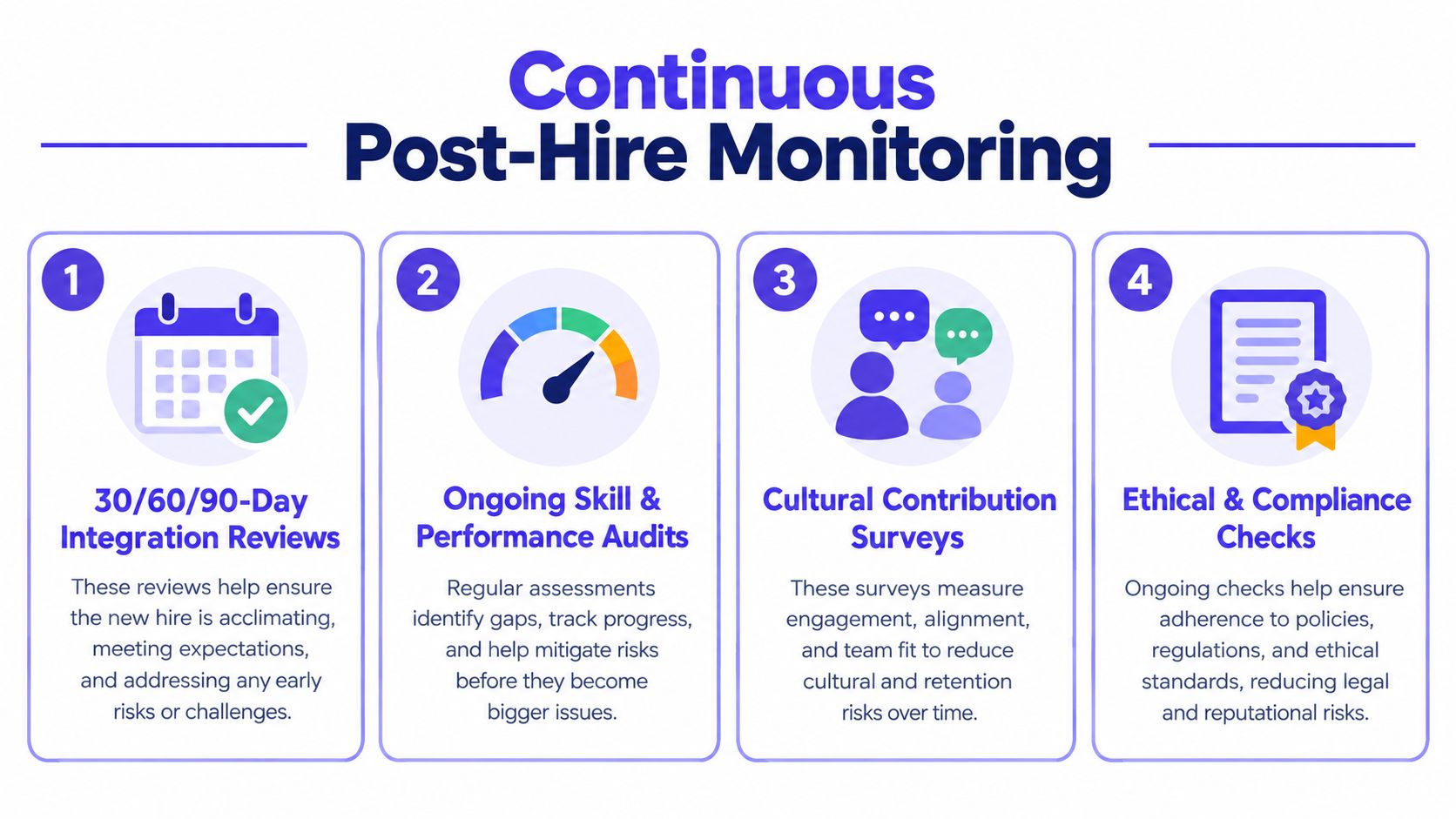
Continuous monitoring shouldn't mean invasive surveillance. It means reviewing whether access, performance, and conduct still match the role's requirements. Use role-based access, audit logs, incident reviews, periodic skills conversations, and documented probation checkpoints. Reverify only when the role, jurisdiction, contract, or risk profile justifies it.
Run a simple operating checklist
- Before access: Confirm identity, authorization, required agreements, and least-privilege permissions.
- During onboarding: Review the first technical deliverable, documentation quality, and incident escalation habits.
- At integration reviews: Assess delivery, collaboration, security behavior, and unresolved concerns at planned checkpoints.
- During role changes: Reassess access when the engineer moves into customer data, production infrastructure, or sensitive model work.
- After incidents: Separate honest mistakes from concealment, negligence, or repeated disregard for controls.
- At review time: Track quality and risk indicators with a consistent framework such as quality-of-hire metrics.
A clear record protects the company and the employee. It gives managers a way to correct problems early instead of relying on vague impressions after a serious failure.
Use the full process as a reusable checklist: define role risks, verify claims, filter for practical ability, test architecture and code, conduct structured references, confirm identity, sequence access, and review evidence after hiring. That approach takes more design than a resume screen, but it gives CTOs and founders a defensible decision process for roles where technical quality and trust are inseparable.
ThirstySprout helps companies hire vetted senior AI engineers and remote ML teams through role-specific screening, technical interviews, and practical assessments. Visit ThirstySprout to start a pilot, discuss your role's risk profile, or review sample profiles for a specialist or complete AI team.
Hire from the Top 1% Talent Network
Ready to accelerate your hiring or scale your company with our top-tier technical talent? Let's chat.