

LLMOps is already a multibillion-dollar category, with independent estimates putting the global market at about $5.88 billion in 2025, $7.14 billion in 2026, and $15.59 billion by 2030 with a projected 21.6% CAGR over 2026 to 2030 according to Research and Markets. LLMOps is the operational discipline for running LLM-powered applications in production, covering prompt management, evaluation, deployment, monitoring, cost control, guardrails, and incident response.
If you're a CTO reading this, you're probably in the awkward middle. The prototype worked. Product wants to launch it. Finance wants to know why token spend keeps moving. Security wants a review. Your engineers want to know whether this belongs in platform, ML, or just “whoever owns the feature.”
My opinion is simple. If you're shipping customer-facing or workflow-critical AI, you need LLMOps. The only real question is whether you need a dedicated function now, or whether you can extend your current engineering team with a lighter operating model.
What Is LLMOps and Why It Matters Now
LLMOps exists because production LLM systems don't behave like normal software and don't behave like classical machine learning either. IBM defines it as the discipline for managing LLM systems continuously in production, including prompt management, evaluation, deployment, monitoring, cost control, guardrails, and incident response in IBM's LLMOps overview.
Why classical MLOps isn't enough
Traditional machine learning operations usually center on training pipelines, model artifacts, and retraining. LLM applications often center on something else entirely:
- Prompts as artifacts: Your biggest behavior change may come from a prompt edit, not a new model.
- Retrieval as runtime logic: A bad chunking choice or stale corpus can break output quality fast.
- Provider volatility: You may swap APIs, model versions, or routing rules without retraining anything.
That changes how you operate. You need versioning for prompts, retrieval pipelines, eval suites, and safety rules. If you don't track those as seriously as code, you lose the ability to explain regressions.
Why this became its own category
This isn't a niche discipline anymore. Market reports now treat LLMOps software as its own category, with 2020 to 2025 described as the historical growth period and 2025 often used as the base year for forecasts in The Business Research Company's market report. That's a useful signal. It means teams stopped treating LLM operations as an experiment and started standardizing it.
Practical rule: If a prompt change can create a customer support issue, a compliance issue, or a cost spike, you're already doing LLMOps. You're just doing it informally.
The CTO question that matters
Don't ask, “Should we buy an LLMOps platform?” Ask this instead:
- What production risks do we already have
- Which controls can our current team own
- Where do we need tools versus hiring
That's the frame for the rest of this article. This is an operating model decision first. Tooling comes second.
The Six Core Components of an LLMOps Stack
LLMOps is often underestimated because teams only see the model call. The stack is bigger. Google's definition is directionally right here. LLMOps is an operational layer around the application, not just model hosting, as outlined in Google Cloud's explainer on what LLMOps covers.
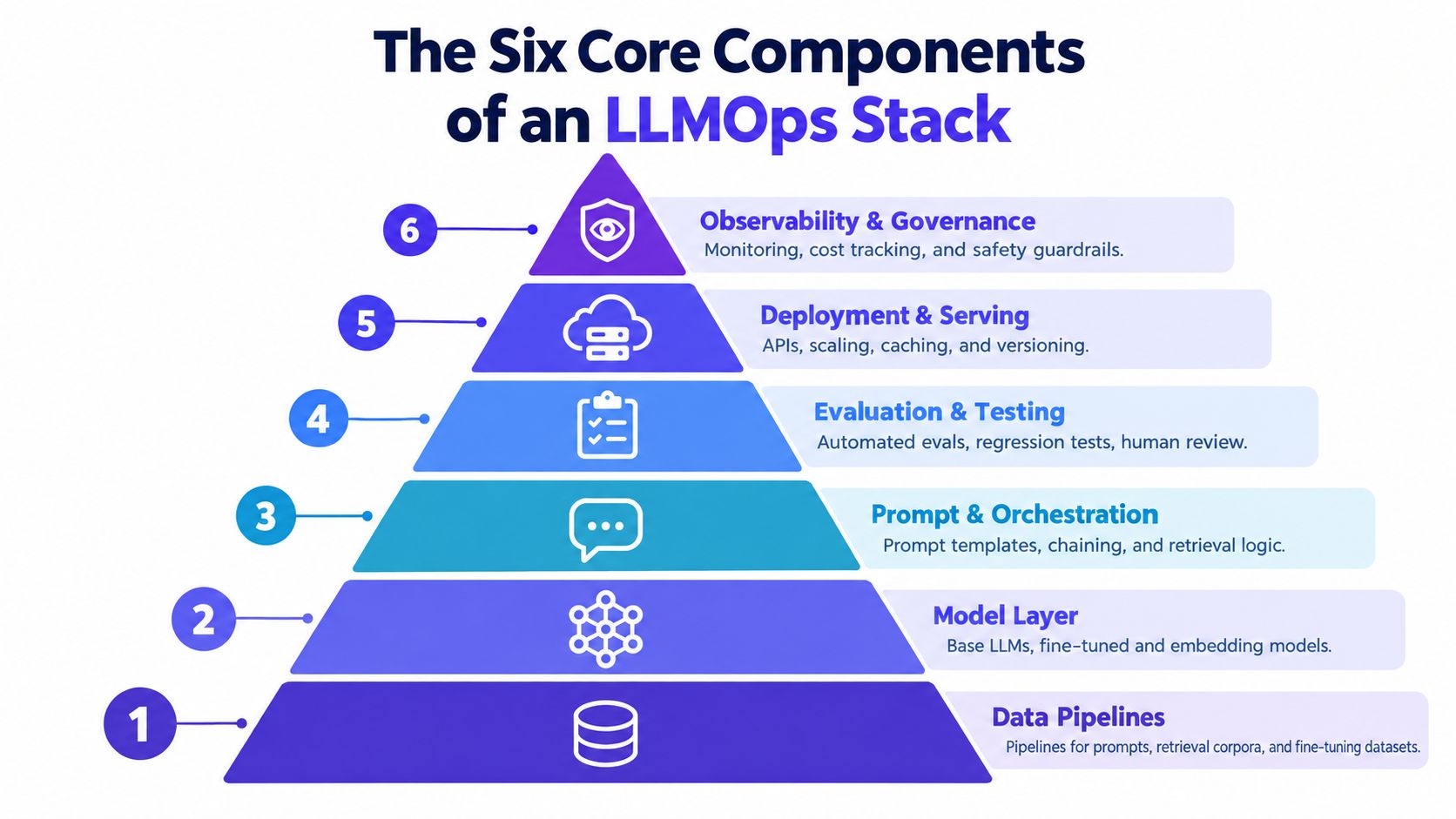
The six layers
Data pipelines
Prompts, retrieval corpora, and eval datasets need version control. Treat them like code, not content.Model lifecycle management
This includes provider choice, model version pinning, fallback strategy, and any fine-tuning you need.Deployment and serving
You need gateways, retries, timeouts, streaming behavior, routing logic, and safe rollback patterns.Evaluation pipelines
Release gates should include deterministic checks, model-based evaluation where useful, and human review for high-risk flows.Observability
Track latency, token use, retrieval quality, quality regressions, and spend at request level.Safety, governance, and guardrails
Runtime filters, policy checks, audit trails, and incident response belong here.
A lot of teams also need prompt and orchestration tooling sitting across the middle layers. That's why LLM engineering teams often end up bridging product, platform, and ML.
Here's a compact architecture view you can use in planning:
| Layer | What ships | Build or buy default |
|---|---|---|
| Data pipelines | Corpora, eval sets, prompt versions | Build light |
| Model lifecycle | Routing, fallback, model registry | Mixed |
| Serving | Gateway, auth, cache, rate control | Buy or extend platform |
| Evaluation | Test harness, regression suite | Build first |
| Observability | Traces, logs, cost metrics | Buy if velocity matters |
| Governance | Guardrails, audit, approval flow | Start simple, harden later |
A short walkthrough helps if your team is still aligning on terminology:
The decision hidden inside the stack
The stack isn't just technical scope. It's staffing scope.
If you have one feature and one engineering squad, don't hire a “Head of LLMOps.” If you have multiple prompts in production, customer-facing generation, and active cost pressure, don't pretend platform can absorb this forever without explicit ownership.
A 90-Day Path to Your First Production LLM Feature
Most startups make the same mistake. They build the happy path demo first, then scramble to add testing and controls after the feature is visible. Reverse that sequence.
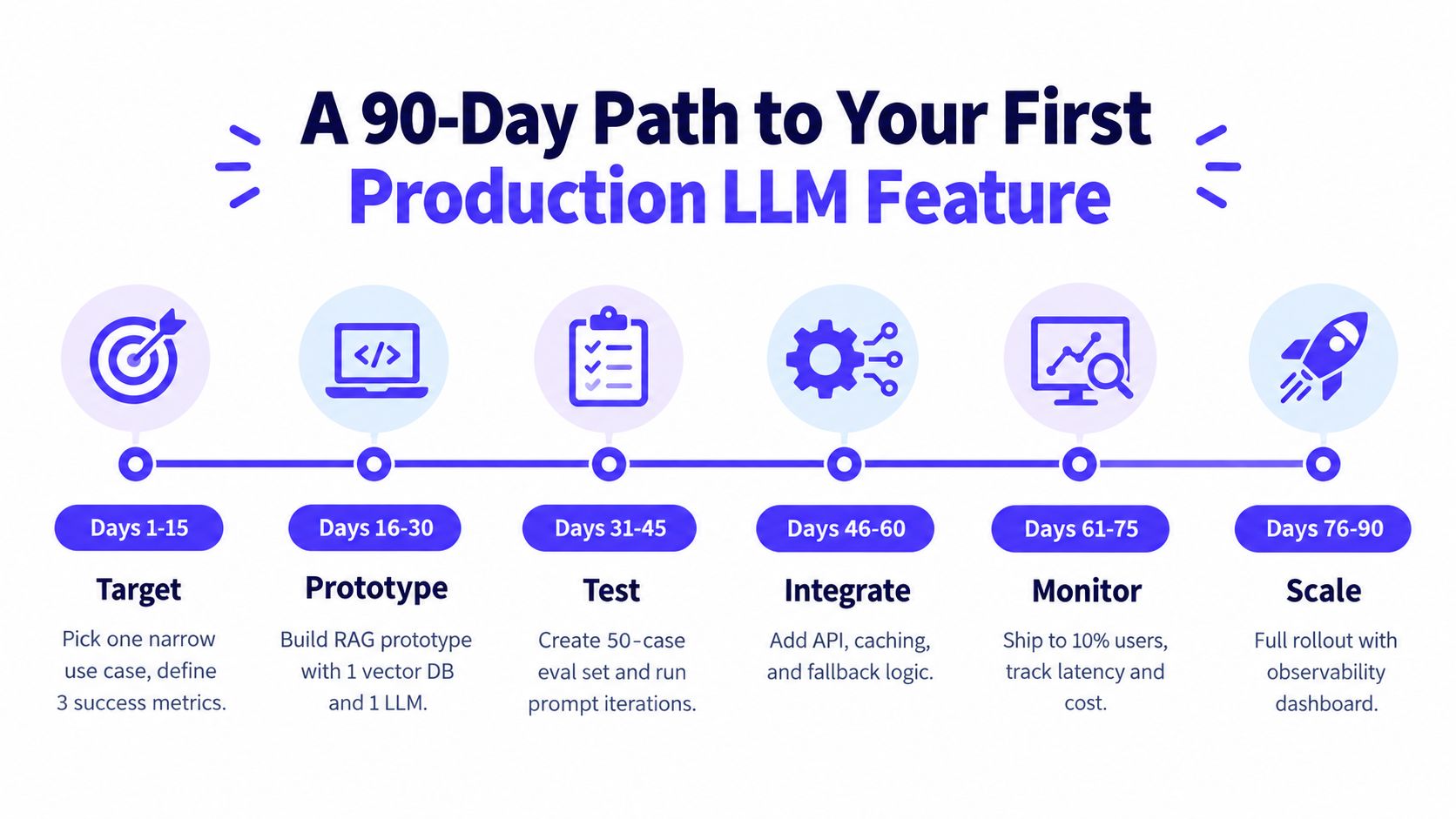
Days 1 to 15
Pick one narrow use case. Not “AI assistant.” Pick something like ticket summarization, internal search answers, or sales call recap.
Define three success metrics before you ship anything:
- Quality: What good output looks like for this use case
- Latency: What response time your product can tolerate
- Cost: What spend ceiling is acceptable per request or workflow
Wrap one model provider behind a thin internal interface. That makes replacement possible later. If you need a reference pattern for shipping user-facing features, this guide to LLM application development is the right adjacent read.
Days 16 to 45
Build the eval harness first. Not last.
Use a golden set of representative examples from your use case. Include expected behaviors, refusal cases, edge cases, and known bad inputs. Then build scoring with a mix of deterministic assertions and human review. If you choose to add model-based scoring, keep it behind the harness, not in the product path.
Ship the first version behind a feature flag to internal users only. Internal rollout catches workflow failures that demos never expose.
Days 46 to 75
Now add the operational plumbing:
- Trace every request
- Log prompt and response versions
- Track token usage and latency
- Measure retrieval quality if you're using RAG
- Capture thumbs-up, thumbs-down, or equivalent user feedback
Add a cache layer for repeat requests. Add fallback behavior for provider or model failure. Set a clear budget threshold that triggers review.
Days 76 to 90
Roll out in stages. Start with a small slice of traffic, then expand only if quality and spend remain within bounds.
A basic release scorecard should answer:
| Gate | Pass condition |
|---|---|
| Quality | Eval set remains stable or improves |
| Latency | User experience stays acceptable |
| Cost | Spend doesn't spike unexpectedly |
| Safety | Known risky prompts are handled correctly |
| Recovery | Rollback path has been tested |
The shortcuts that burn teams
- Skipping evals: You won't know whether changes helped or hurt.
- Ignoring cache behavior: You'll pay for repeat traffic you should have avoided.
- Relying on one provider: You'll discover concentration risk at the worst time.
- Shipping without a runbook: On-call engineers need known recovery steps.
LLMOps vs MLOps and When You Need Both
LLMOps grew out of MLOps, but they're not interchangeable. Oracle's overview is useful on the runtime side. It emphasizes that LLMOps includes token-cost control, output-quality monitoring, and retrieval-pipeline management, which are very different operational concerns from a typical predictive model pipeline in Oracle's LLMOps guide.
LLMOps vs MLOps Where the Disciplines Diverge
| Dimension | MLOps Practice | LLMOps Practice |
|---|---|---|
| Data and versioning | Version datasets, features, model binaries | Version prompts, retrieval corpora, eval sets, routing rules |
| Evaluation | Offline metrics on labeled sets | Behavioral evaluation, open-ended output review, release gating |
| Runtime observability | Drift, latency, infrastructure health | Prompt traces, retrieval context, token use, output quality, hidden tool decisions |
| Cost structure | Training often dominates | Inference and token usage dominate |
Where MLOps still helps
Don't throw away your MLOps foundation if you already have one. Several primitives carry over cleanly:
- CI/CD discipline
- Artifact versioning
- Release approvals
- Monitoring pipelines
- Incident response habits
Those are still useful. The problem is forcing LLM workflows through old abstractions and losing prompt lineage, retrieval lineage, and behavior history in the process.
When you need both
You need both when your product combines structured prediction and generated output. A fraud model may score risk with classical ML, while an LLM explains the decision to analysts. A recommendation model may rank options, while an LLM turns that into natural language.
If your system predicts with one model and explains, summarizes, or chats with another, separate the ownership of predictive models from the ownership of generative behavior.
A practical ownership split looks like this:
- MLOps owns: training pipelines, feature lineage, model registry, retraining cadence
- LLMOps owns: prompt versions, eval harnesses, model routing, guardrails, generation traces
If your generative surface area is small, extend your existing platform team. If generative behavior is customer-facing and changes weekly, give it explicit ownership.
LLMOps Tools and How to Choose Them
Don't buy an “LLMOps platform” because the category sounds mature. Buy tools for specific jobs. The wrong tool stack creates more process than control.
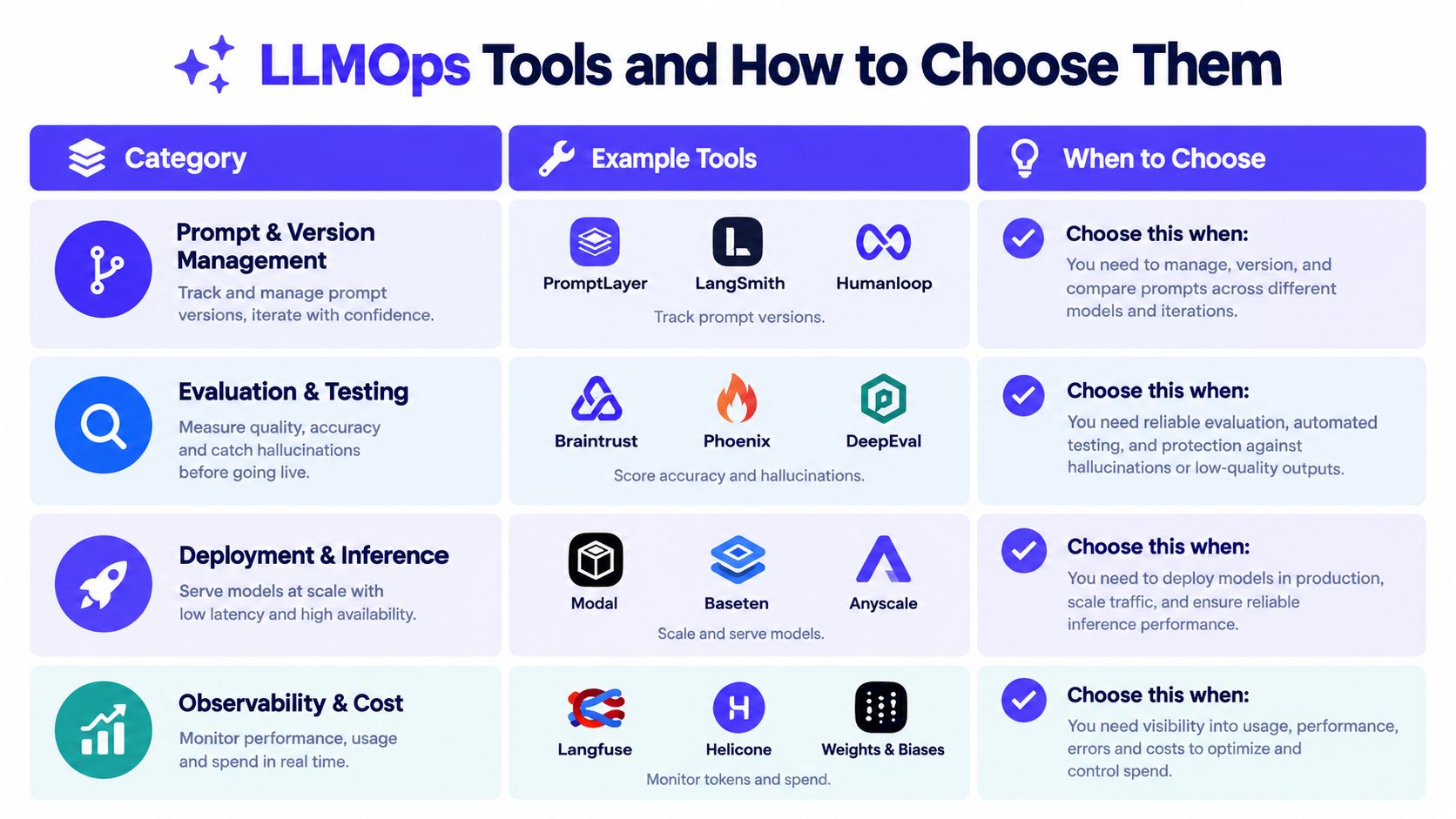
Choose by job to be done
Here's the simplest breakdown.
| Category | Examples | What to ask |
|---|---|---|
| Prompt and version management | PromptLayer, LangSmith, Humanloop | Can we diff versions, review changes, and access it by API? |
| Evaluation and experiment tracking | Braintrust, DeepEval, custom harnesses | Does it support our own datasets and release gates? |
| Vector and retrieval | Pinecone, Weaviate, pgvector | What are the data residency and retrieval debugging options? |
| Orchestration | LangChain, LlamaIndex, in-house | Does it help or just hide complexity? |
| Inference and gateway | LiteLLM, OpenRouter, Portkey | Can we route, fail over, and audit requests cleanly? |
What startups should skip
Skip heavyweight platforms if you have one feature, one team, and no compliance burden yet. You probably don't need a giant control plane. You need a clean proxy, a test harness, logging, and some discipline.
A sane startup-default stack is often:
- Gateway: LiteLLM or a thin in-house proxy
- Retrieval: pgvector if Postgres already exists in your stack
- Evaluation: custom harness plus a lightweight experiment layer
- Observability: request tracing and structured logs first
If you're embedding LLM features in a mobile or hybrid app, a practical implementation reference is the Capacitor LLM plugin by Capgo. It's useful because it shows how the model integration layer should stay modular instead of being hardwired deep into app logic.
Build, buy, or staff
Org design matters. A tool won't fix weak ownership. If your issue is missing platform capacity, staff it. If your issue is slow evaluation cycles, buy tooling there first. If your issue is temporary execution bandwidth, providers like ThirstySprout can supply senior remote AI and platform engineers for LLM application, retrieval, evaluation, and production operations work.
Observability and Cost Control in Practice
This is the part where underinvestment happens. They monitor latency and call it done. That's not observability. That's uptime theater.
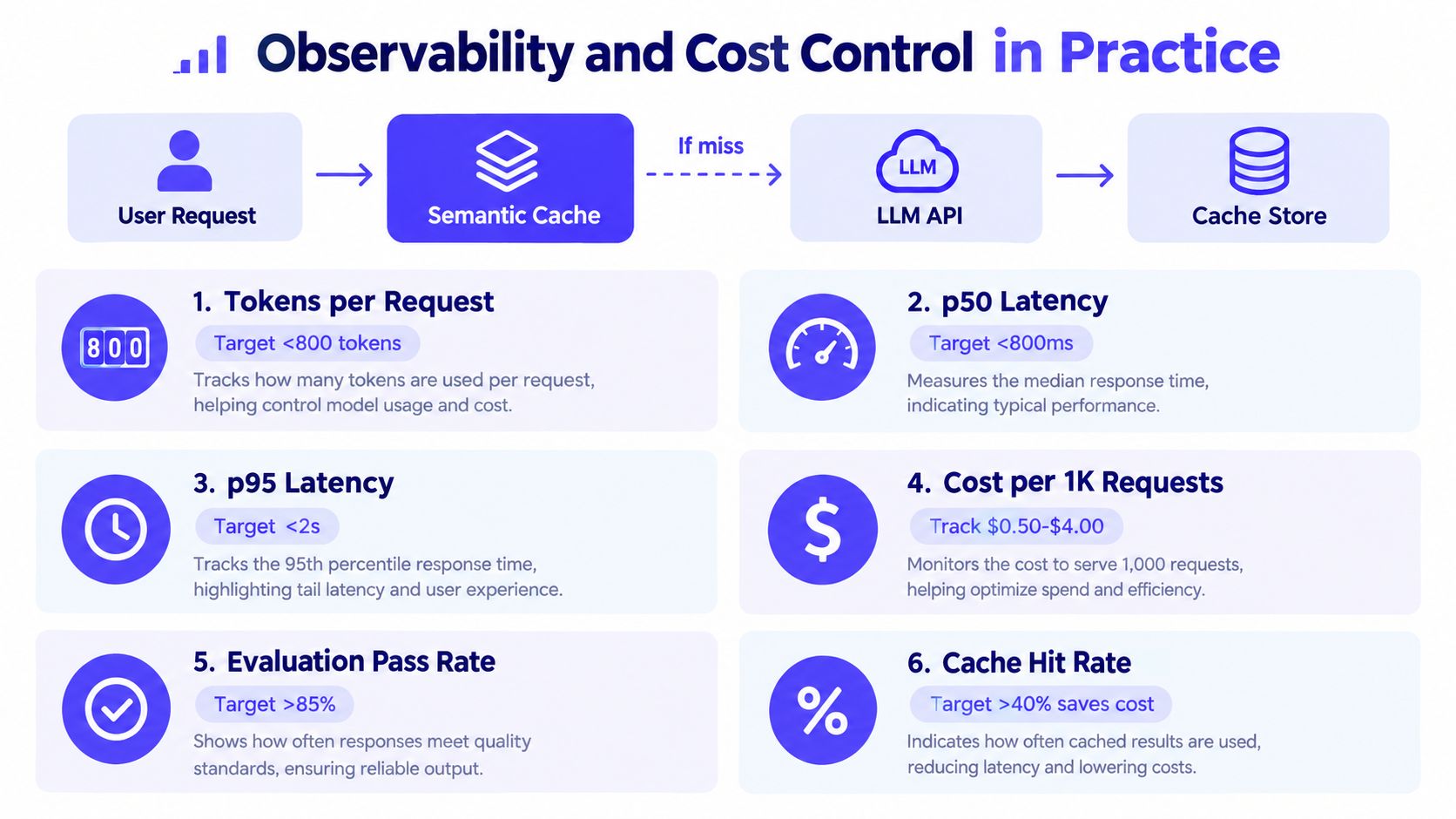
The baseline should include traces, metrics, and logs. A practical metric set from the LLM observability chapter in the LLM Stack book includes time-to-first-token, tokens per output token, total latency, prompt token counts, completion token counts, and estimated cost per request.
The minimum viable dashboard
Your dashboard should answer six questions fast:
- How many tokens did this request consume
- How long until first token appeared
- How long did the full response take
- What did the request cost
- Did the output pass evaluation
- Did a guardrail or refusal trigger
Logs should keep verbatim prompts and responses for debugging. Traces should show the chain across retrieval, tools, model calls, and filters. Metrics should aggregate cost and latency trends.
Cost control that actually works
Caching is one of the few cost controls that pays off quickly. Recent production guidance from Redis specifically recommends exact-match caching for repeated queries so identical prompts can be served without another model call in Redis's LLMOps guide.
A simple request path looks like this:
- Check cache first
- On miss, call the model
- Store the result with version-aware keys
- Reuse on identical repeat requests
You should also route easier requests to cheaper models and reserve larger models for the cases that need them. Start with rules, not a giant router project.
Track cost anomalies and evaluation regressions together. A cheaper answer that fails quality checks isn't optimization. It's debt.
Mini-case for a support assistant
A support bot using retrieval often fails for one of three reasons: stale knowledge, bloated prompts, or unnecessary repeated calls. Logging each request with retrieval context and request cost lets the team see which one happened. Once that data exists, engineers can trim prompts, improve corpus hygiene, and raise cache reuse without guessing.
Governance, Safety, and Risk Management
The cleanest way to understand LLMOps is as change control for probabilistic systems. TechTarget gets this right. Production concerns include reproducibility across changing components, evaluating open-ended outputs, observing hidden context and tool decisions, controlling costs, and protecting sensitive data in TechTarget's LLMOps definition.
What governance is actually for
Prompt edits, retrieval changes, and model swaps are behavior changes. Users experience them as product changes whether engineering treats them that way or not.
That's why governance needs to focus on real control points:
- Prompt versioning: Every released prompt should be attributable and reversible.
- Model records: Keep a clear record of provider, model version, and intended use.
- PII handling: Know what enters prompts, what gets logged, and where data resides.
- Adversarial testing: Test jailbreaks, prompt injection, and misuse cases before release.
- Incident runbooks: Define rollback and response actions before the feature is under pressure.
NIST's Generative AI Profile says organizations should identify unique generative AI risks and define actions aligned with business goals, and it also states that pre-trained models used for development must be monitored as part of regular AI-system monitoring in the NIST AI Risk Management Framework resources.
Which controls deserve money first
Invest first in controls that stop common production failures:
- Prompt and model version history
- Runtime logging and audit trails
- Release-gated evals
- Input and output filtering
- A tested incident response path
If your team needs a concrete starting point on one major attack surface, this guide on how to prevent prompt injection is worth using in design reviews.
NIST AI RMF 600-1 goes further for high-risk capabilities. It recommends a test plan and response policy before development and periodic evaluation for misuse involving CBRN information or offensive cyber capabilities in NIST AI 600-1. That's not enterprise theater. That's what serious pre-release control looks like.
Hiring and Building Your LLMOps Team
Most startups shouldn't start with a dedicated LLMOps team. They should start with explicit ownership across product engineering, platform, and security, then consolidate later if usage grows.
LLMOps Roles and Hiring Order for Startups
| Stack Component | Primary Owner | Key Skills | Hiring Order |
|---|---|---|---|
| Prompt and eval workflows | Applied ML engineer or strong product engineer | Prompt design, test harnesses, qualitative evaluation | First |
| Inference and routing | Backend or platform engineer | API design, provider abstraction, retries, caching | First |
| Retrieval and data pipelines | Data engineer or backend engineer | Corpus prep, chunking, indexing, data quality | Second |
| Observability and incident response | SRE or platform engineer | Tracing, structured logs, alerting, runbooks | Second |
| Governance and safety | Security lead with engineering support | Policy controls, audit, data handling, abuse review | Third |
A startup-friendly team shape
For one production feature, a practical shape is usually:
- One product engineer who owns the user workflow
- One platform or backend engineer who owns proxying, routing, and cost controls
- One applied ML engineer who owns evaluation, prompts, and retrieval quality
- Fractional security support for data handling and guardrails
That isn't a full platform org. It's enough to ship responsibly.
A short pilot before you hire hard
Use a 2 to 4 week pilot to expose gaps before you open headcount. ThirstySprout's audience and delivery model are built around that kind of rapid staffing window, and the broader blog guidance here assumes operators need to act within weeks, not months.
A good pilot does four things:
- Picks one feature
- Ships behind a proxy with eval gates
- Instruments latency, quality, and spend
- Documents which problems are tooling issues and which are staffing issues
Don't hire an LLMOps specialist because the title sounds modern. Hire when prompt quality, routing, observability, and governance no longer fit comfortably inside existing roles.
When to form a dedicated function
Create a dedicated LLMOps function when at least two conditions are true:
- You have multiple production LLM features
- You have cross-team demand for shared evals, routing, and observability
- You have customer-facing generation with real risk exposure
- You are spending meaningful engineering time on provider swaps, incidents, or governance reviews
Until then, keep ownership distributed but explicit. Ambiguous ownership is what breaks these systems.
If you're building AI features and need people who can ship them, ThirstySprout helps companies add senior remote AI engineers, MLOps specialists, and platform talent for LLM application development, evaluation, retrieval, and production operations. Start with a focused pilot, map the gaps in your current stack, and then decide whether you need tools, fractional expertise, or a dedicated LLMOps hire.
Hire from the Top 1% Talent Network
Ready to accelerate your hiring or scale your company with our top-tier technical talent? Let's chat.