

A 12-person product team launches a customer-facing assistant on the largest available model. Six weeks later, the quarterly inference budget is gone. Latency varies by prompt length, answers change after a provider updates model weights, and nobody can explain whether a cheaper model would preserve quality.
That gap separates calling an API from practicing LLM engineering. A reliable system needs deliberate model selection, retrieval and context design, targeted adaptation, and operational discipline. The model is only one component.
The practical priority in 2026 is no longer raw capability alone. It's cost architecture, evaluation rigor, and multi-model orchestration. The framework below helps you choose a defensible architecture before an over-budget prototype becomes a production dependency.
Why LLM Engineering Matters Now
The modern LLM stack grew out of a rapid shift in model architecture and training economics. The Transformer architecture introduced in 2017 replaced recurrent approaches with attention-based sequence modeling, making large-scale training more practical. BERT followed in 2018, GPT-2 in 2019 demonstrated coherent long-form generation, and GPT-3 reached 175 billion parameters in 2020, helping establish the foundation-model era. This history is summarized in IBM's overview of large language models.
Scaling laws also changed how engineers plan infrastructure. A 2020 result found that model loss improves predictably as model size, dataset size, and compute increase across more than seven orders of magnitude, giving teams a mathematical basis for training and infrastructure decisions. Capability still matters, but the operational question is broader: how much quality do you need, at what latency, and for which request types?
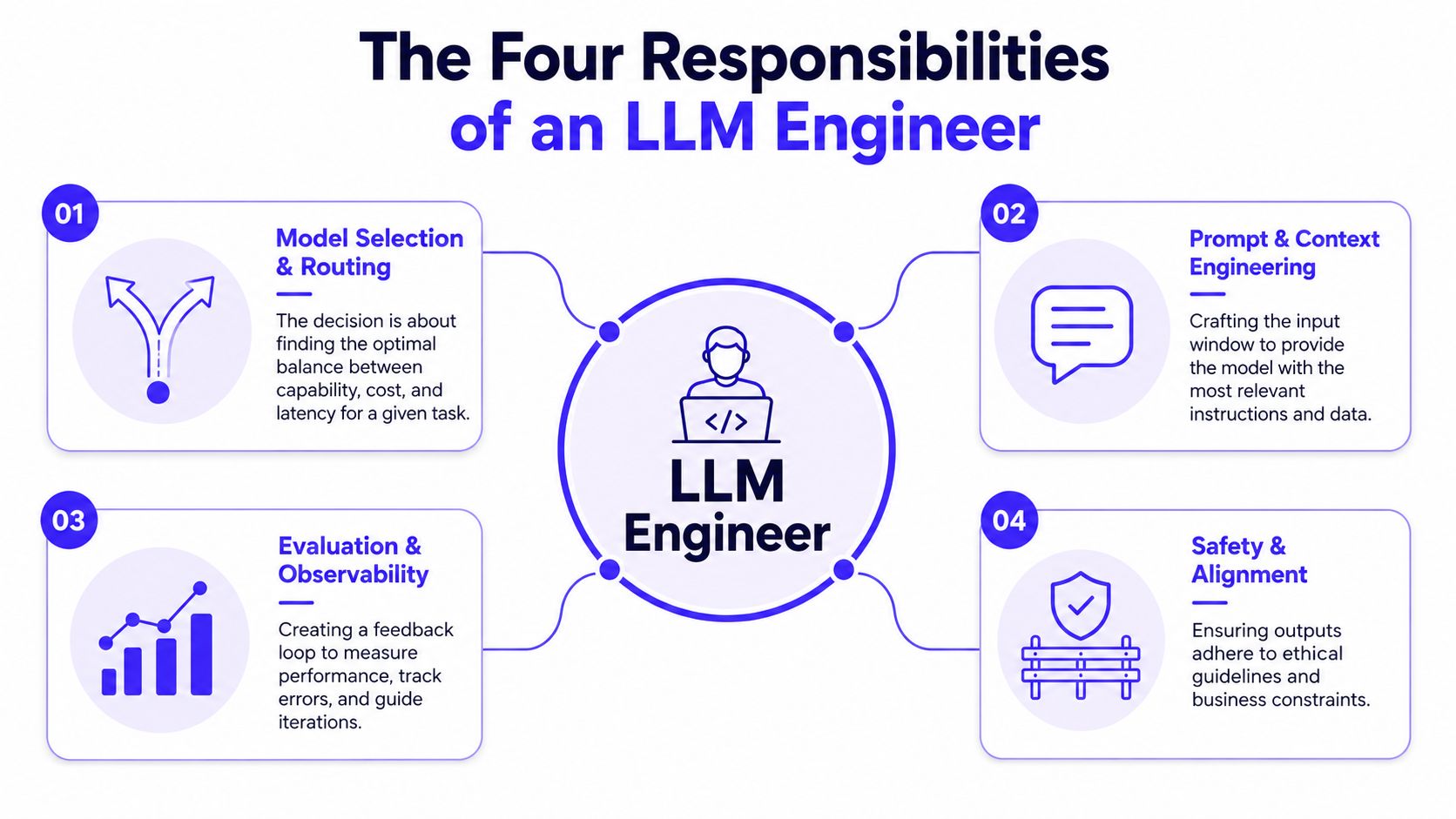
A useful LLM engineering plan starts with four responsibilities:
- Model selection and routing: Choose the least expensive model that clears the task's quality bar, then reserve stronger models for cases that need them.
- Retrieval and context: Control what the model sees, especially when answers depend on private, changing, or cited information.
- Fine-tuning decisions: Adapt behavior only after prompting and retrieval have failed against a measured requirement.
- LLMOps discipline: Version prompts, datasets, adapters, and routing rules. Evaluate before release and monitor after deployment.
Practical rule: Treat every model call as a production dependency with a budget, a quality contract, and a rollback path.
The goal isn't to avoid capable models. It's to stop using the most expensive option for every task by default.
What LLM Engineering Actually Means
LLM engineering is the discipline of designing, building, evaluating, and operating software systems whose core behavior comes from large language models. It includes application code, data pipelines, inference, evaluation, security, and cost controls.
The field's history explains why the work has moved beyond architecture research. The Transformer made attention-based scaling practical, while compute-optimal training research later showed that model size and token volume must be balanced. DeepMind's study analyzed more than 400 models, ranging from 70 million to over 16 billion parameters, trained on 5 to 500 billion tokens, and found that the largest model is not automatically the best use of a fixed compute budget. Its practical rule of thumb is to scale training tokens alongside model size, with roughly one doubling of tokens for every doubling of model size. See the compute-optimal training study.
That shift makes retrieval pipelines, evaluation harnesses, serving infrastructure, and spend controls central engineering concerns. For a broader foundation, readers can review this large language model explainer, while teams planning content workflows may also benefit from WebinOne's 2026 guide to AI content.
How the role differs
| Role | Primary output | Owns production? | Model weights? | Eval harness? |
|---|---|---|---|---|
| LLM engineer | Reliable model-powered system | Yes | Sometimes | Yes |
| Machine learning engineer | Trained models and ML services | Usually | Often | Usually |
| Prompt engineer | Prompt and instruction improvements | Rarely | No | Sometimes |
| Applied scientist | Research prototypes and experiments | Sometimes | Sometimes | Usually |
| Backend engineer | Services, APIs, and data flows | Yes | No | Sometimes |
An LLM engineer isn't primarily a research scientist chasing state-of-the-art benchmarks. The role also isn't a UX position, although product feedback matters, and it isn't a backend role that treats the model as a stateless function.
The simplest test is this: if swapping the model would break your product, you're doing LLM engineering. Your team must understand why the system depends on that model, which surrounding layers compensate for its weaknesses, and how to replace it safely.
The Four Responsibilities of an LLM Engineer
The job becomes clearer when you map it to four production responsibilities. They overlap, but each has a distinct decision cue.
Model selection and routing
Start with the task, not the vendor. Define the quality bar, latency boundary, privacy requirements, and expected request pattern. Then test multiple candidates on representative examples.
The decision cue is: can a smaller model with retrieval beat a larger model on this task? A routing layer can send classification, extraction, and routine support questions to a compact model while reserving a frontier model for ambiguous reasoning.
Retrieval and context architecture
Retrieval augmented generation, or RAG, gives a model access to information outside its weights. The engineer owns document ingestion, chunking, embeddings, filtering, reranking, context assembly, and citation behavior.
The decision cue is: what does the model see before it answers? Raw logs often create noise. A structured intermediate representation, such as a current case state or normalized account record, can be more useful than placing every tool result in the prompt.
Targeted adaptation
Fine-tuning has a place, but it shouldn't be the first response to weak answers. Test prompting and retrieval first. If the remaining problem is consistent style, format, classification behavior, or domain adaptation, compare an adapter method against the baseline using a held-out evaluation set.
The decision cue is: have you proved that prompting and retrieval can't reach the bar? LoRA-based methods can approach full fine-tuning quality while training far fewer parameters. One financial-dataset benchmark reported a 36% average accuracy gain over baseline models after applying LoRA-family methods, as described in the benchmark analysis.
LLMOps and evaluation
Prompts, retrieval configurations, datasets, adapters, and routing rules are deployable artifacts. Version them, test them, monitor them, and roll them back like code.
The decision cue is: can you detect a silent regression after a provider model swap? If the answer is no, the system isn't production-ready. These responsibilities commonly spread across 2 to 5 people, depending on whether the team also owns platform, data, and product integration.
Choosing the Right Approach for Each Problem
Use the cheapest method that meets the quality requirement. The right choice depends less on what a technique can do in theory than on freshness, determinism, data availability, latency, and operational risk.
| Method | Knowledge freshness | Latency | Data needed | Cost per request | Best fit |
|---|---|---|---|---|---|
| Prompting | Limited to supplied context | Usually low overhead | Few examples or instructions | Low to moderate | Stable tasks and behavior changes |
| RAG | Strong for indexed, changing knowledge | Retrieval adds overhead | Curated documents and index | Moderate | Private or frequently updated facts |
| Fine-tuning | Encodes learned behavior at training time | Inference depends on model | High-quality task examples | Training cost plus serving cost | Style, format, and specialized behavior |
| Agents | Depends on tools and sources | Variable, often higher | Tool definitions and policies | Variable and potentially high | Multi-step work with side effects |
Prompting is the sensible starting point for a stable task with clear instructions. Add retrieval when the answer must use current or proprietary information, or when citations matter. Fine-tune for repeatable behavior that context and instructions haven't fixed, not as a substitute for an incomplete knowledge pipeline.
Agents deserve stricter scrutiny. They're useful when a workflow needs tools, side effects, or multi-step planning. They're a poor fit when a deterministic function, a single retrieval step, or structured extraction solves the problem more safely.
When smaller models win
A smaller open model plus retrieval can beat a frontier model when the domain is narrow, the output format is structured, latency is tight, and request volume is high. The system's quality then comes from focused context and constrained behavior rather than general reasoning breadth.
A hybrid-strategy report states that routing simpler requests to 7–8B models while reserving frontier models for harder reasoning can reduce spend by 5–10x without measurable quality loss. That claim appears in Turing's coverage of LLM trends. Treat it as a hypothesis to validate on your own workload, not as a universal guarantee.
A practical decision sequence is straightforward:
- Prompt first when the task is stable and the failure is instructional.
- Add retrieval when knowledge changes, must remain private, or needs citations.
- Fine-tune selectively when the remaining gap concerns style, format, or specialized behavior.
- Use agents only when tools, side effects, or multi-step planning justify the added failure surface.
Production Architecture and Serving Decisions
A production LLM application is a layered service, not a model call hidden behind an endpoint. Each layer should have an owner, a measurable responsibility, and a failure policy.
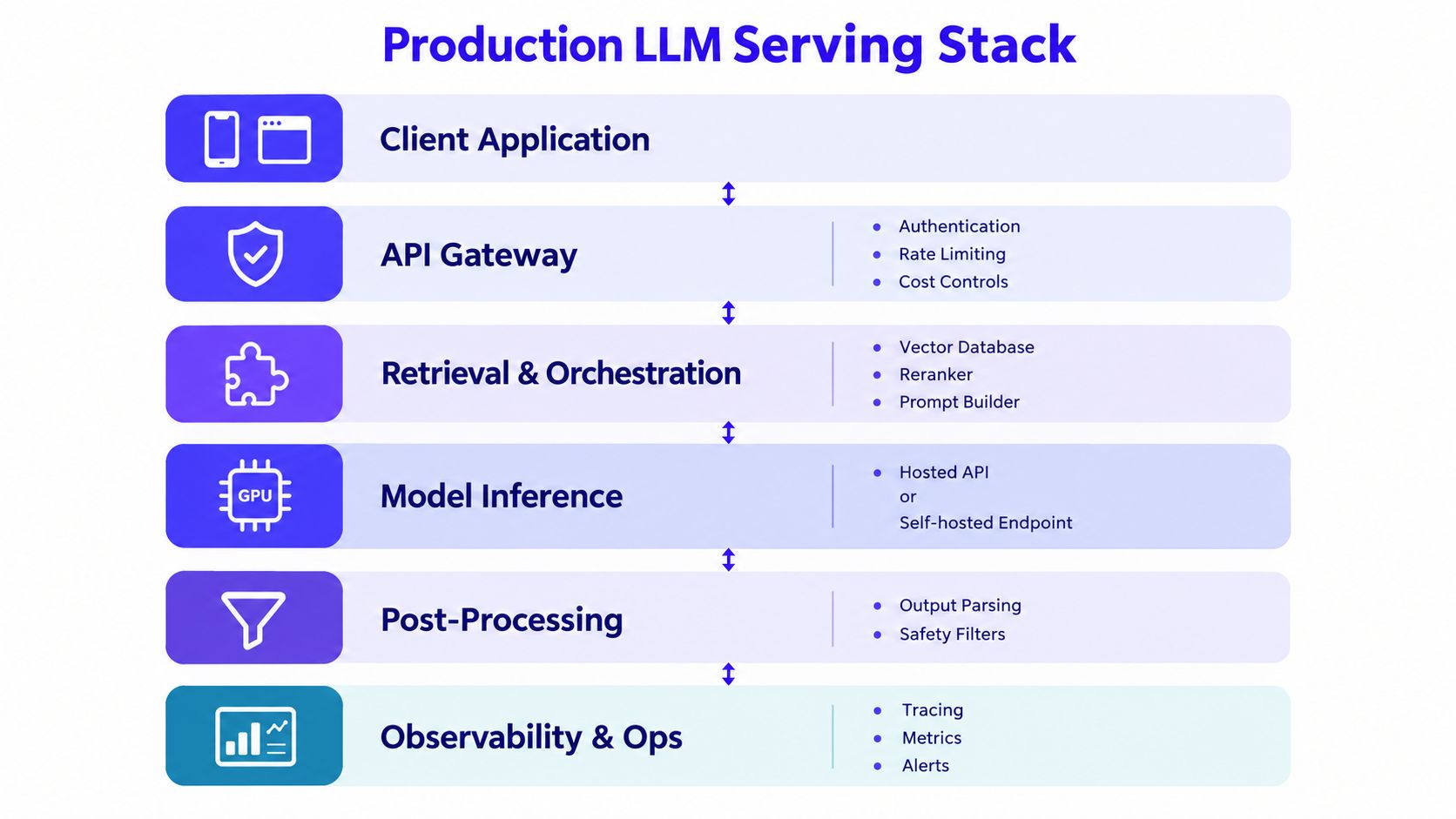
The request path typically looks like this:
- Gateway: Authenticate requests, apply rate limits, enforce spend caps, and attach tenant context. OpenAI's limits operate at the organization and project levels, and its dashboard exposes rate and usage limits for managing throughput and spend. See the OpenAI rate limits documentation.
- Retrieval and orchestration: Query the index, rerank results, remove irrelevant passages, and assemble a bounded context.
- Model router: Dispatch by capability, risk, latency, privacy, and current provider health.
- Cache: Reuse exact prefixes, repeated instructions, and stable project context. Anthropic documents minimum cached-entry lifetimes of 5 minutes in standard mode and 1 hour in extended mode, with automatic or explicit cache control available in its prompt caching documentation.
- Post-processing: Parse structured output, apply safety checks, and handle invalid responses.
- Evaluation and observability: Record traces, token usage, tool calls, refusals, latency, and outcome labels.
Context length changes serving economics. A 500B-parameter model at batch size 512 and sequence length 2048 can require roughly 3 TB of key-value cache, about 3 times the model's weights, according to this KV-cache engineering discussion. The broader lesson matters even when your model is smaller: concurrency and prompt length can exhaust memory before raw compute becomes the limiting factor.
For a practical explanation of context-window behavior, consult this guide to LLM context windows. Then apply the principle in your own traces. A 70B model with a 2k context can be cheaper per useful answer than a 7B model with a 64k context if the long prompt dominates time to first token and cache pressure.
Paged attention, prefix caching, and speculative decoding can change the serving curve without retraining weights. For application design patterns, the LLM application development guide provides useful adjacent context.
LLMOps, Evaluation, and Observability in Practice
Treat prompts, retrieval settings, fine-tuned adapters, and evaluation datasets as release artifacts. A useful loop starts before deployment and continues through live traffic.
Build an eval-first release loop
- Version inputs: Store prompts, datasets, retrieval configurations, model identifiers, and adapter versions together.
- Block regressions: Run task-specific evaluations in continuous integration. A regression in a protected metric should block the merge.
- Sample production traces: Review representative requests, not only curated examples.
- Track operational signals: Monitor latency, token usage, refusal rates, tool errors, and cost by workflow.
- Calibrate judges: Compare model-as-judge scores with human review, and inspect disagreements.
No single metric works for every LLM application. Use exact match for deterministic extraction, rubric-based scoring for open-ended answers, human spot-checks for nuanced quality, and production sampling for behavior that offline data misses. Datadog's LLM evaluation guidance emphasizes dynamic, representative datasets and explicit handling for non-determinism, prompt sensitivity, and hallucinations.
Operators should actively test for silent regressions after a model swap, prompt injection hidden in retrieved documents, distribution shifts caused by new user language, and agent loops that retry tools indefinitely. Guardrails and red-team suites are ongoing signals, not one-time approval gates.
For broader service-level tracing and operational patterns, this production systems guide from CloudCops GmbH offers useful observability context. Teams building a dedicated monitoring layer can also review AI observability platforms.
Hiring Checklist and Team Structures That Work
Avoid hiring a “prompt whisperer” as the core production owner. Strong LLM engineers have shipped systems, can inspect a failed trace, understand retrieval quality, and connect model behavior to business outcomes.
Look for two complementary profiles:
- Model-aware backend engineer: Can tune indexes, inspect reranking, reason about inference, and read evaluation reports.
- Product-oriented AI engineer: Owns prompt and context design, guardrails, structured output, and feedback from real users.
Choose the team shape
| Dimension | 2-person pod | 5-person squad |
|---|---|---|
| Best fit | One focused use case | Multi-model orchestration |
| Core roles | Generalist LLM engineer and backend or data owner | Tech lead, 2 LLM engineers, eval-focused ML engineer, platform engineer |
| Main strength | Fast ownership and short feedback loops | Clear specialization and operational depth |
| Main risk | Limited redundancy and platform capacity | Coordination overhead |
| Hiring signal | End-to-end shipping ability | Deep ownership across retrieval, serving, evaluation, and cost |
Interview candidates with a concrete failed trace. Ask them to identify whether the error came from retrieval, context assembly, model behavior, parsing, or a tool response. Then ask how they'd lower cost per resolved task before optimizing latency.
A strong candidate should also describe a rollback path for a model swap. Look for versioned prompts, pinned model identifiers where available, traffic controls, evaluation gates, and a documented fallback. Notebook demos don't provide that evidence.
A 90-Day Starter Plan and Risk Checklist
Pick one high-volume workflow and make it measurable.
- Days 1–30: Define the quality bar, select a baseline and a smaller candidate model, and build the evaluation harness before extensive prompt work.
- Days 31–60: Add retrieval, instrument traces, set a cost-per-resolved-task target, and run a shadow comparison against the stronger model.
- Days 61–90: Route 10–30% of traffic through the cheaper path behind a kill switch, document rollback, and formalize on-call procedures. This rollout pattern is an operating recommendation, not a measured industry statistic.
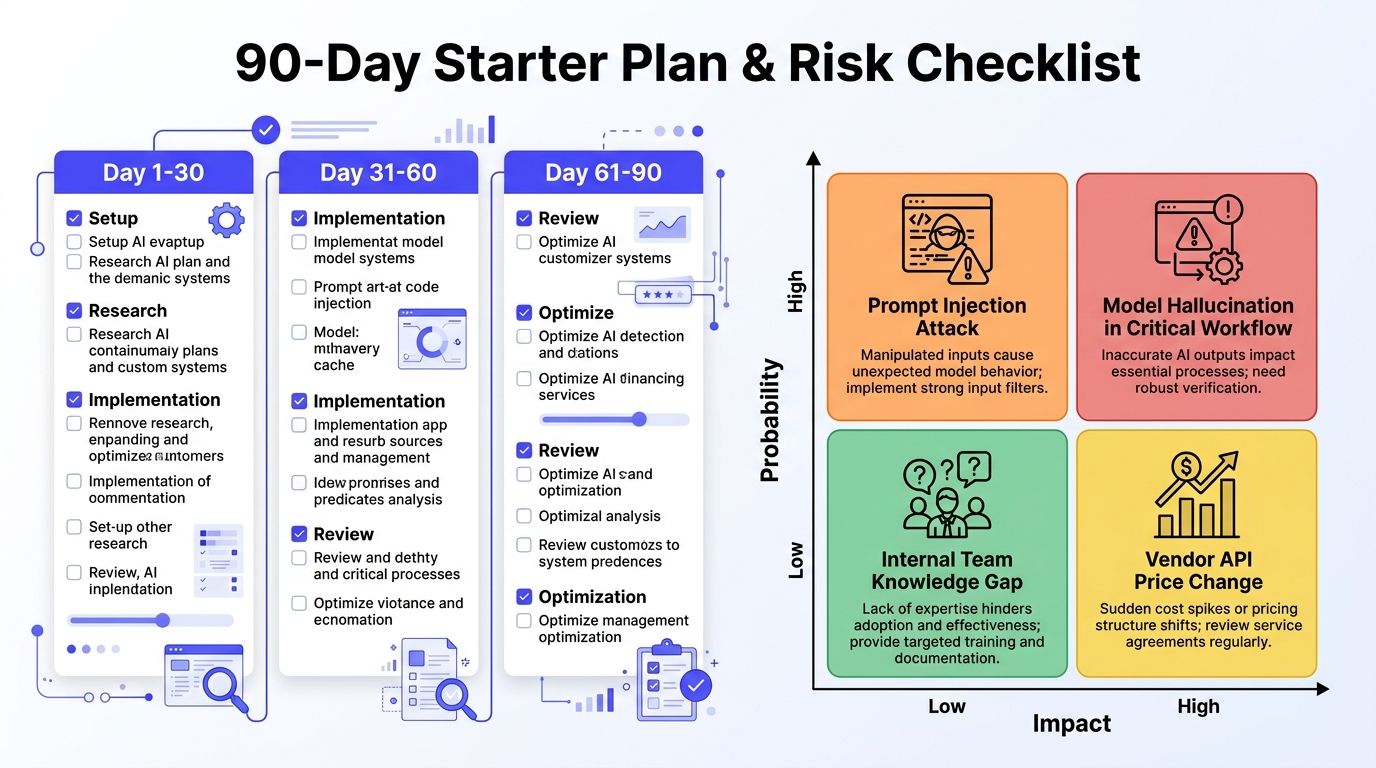
Use NIST's voluntary AI Risk Management Framework to organize the risk review:
- Govern: Set policy, access, ownership, and escalation rules.
- Map: Document data provenance, users, tools, and affected workflows.
- Measure: Combine offline tests, online monitoring, human review, and cost tracking.
- Manage: Define incident response, spend ceilings, fallbacks, and release controls.
NIST also released a Generative AI Profile on July 26, 2024, providing guidance for risks specific to generative systems in its AI Risk Management Framework.
Start by scoping a 6-week pilot around one workflow, one quality bar, and one cost target. ThirstySprout can provide vetted remote AI engineers and ML teams for LLM application development, retrieval, evaluation, MLOps, and platform work. Visit ThirstySprout to start a pilot or discuss the right specialist or pod for your production roadmap.
Hire from the Top 1% Talent Network
Ready to accelerate your hiring or scale your company with our top-tier technical talent? Let's chat.