

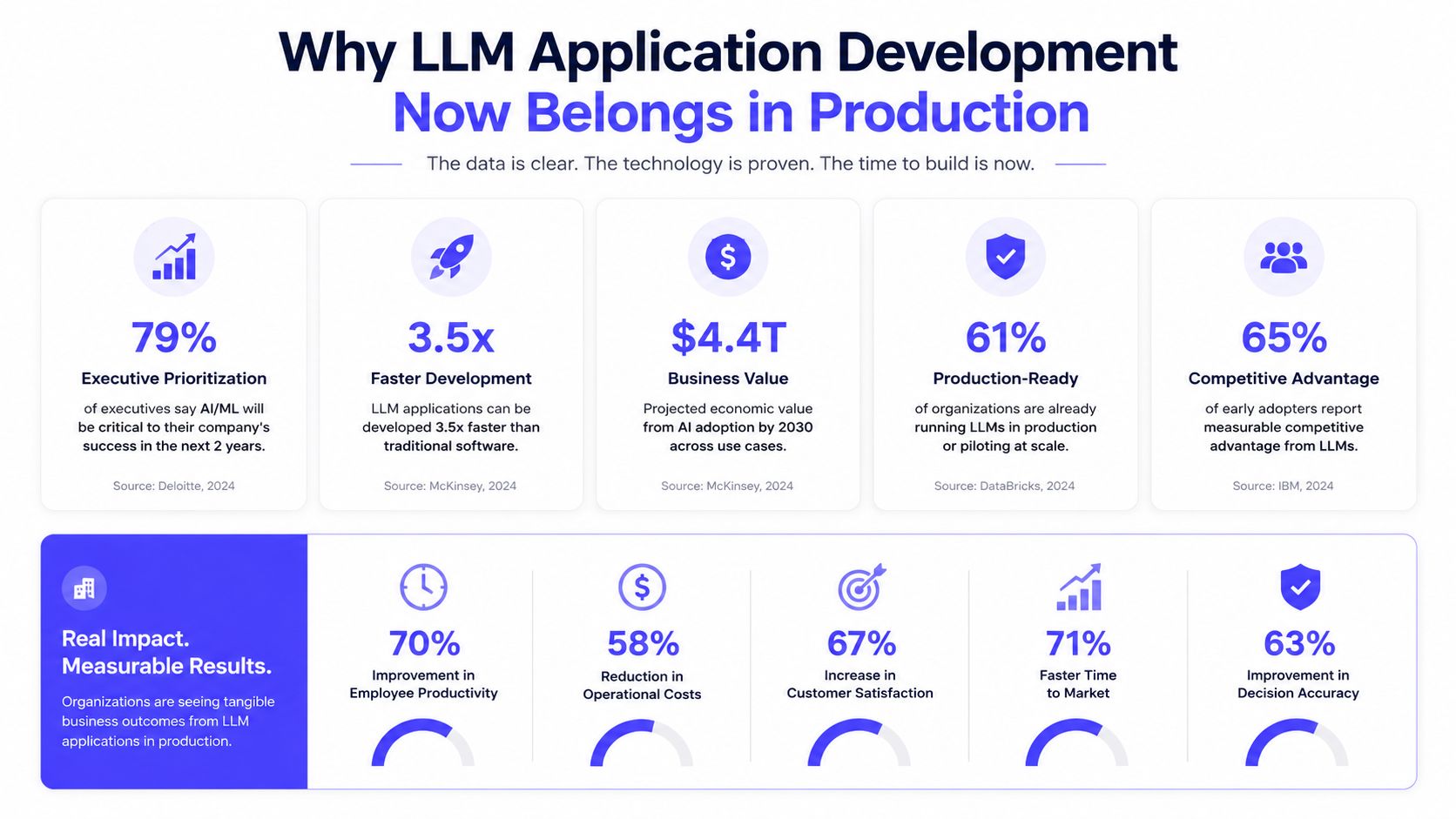
By mid-2026, approximately 85–90% of large enterprises reported at least one production large language model deployment, compared with about 65% a year earlier. Roughly 55–65% were running multiple frontier models concurrently, while enterprise spending on frontier model application programming interfaces exceeded $15 billion in the first half of 2026 and was projected to surpass $35 billion for the full year, according to enterprise LLM adoption research.
That changes the engineering question. LLM application development isn't mainly about proving that a model can produce an impressive demo. It's about selecting a narrow business problem, grounding outputs in trustworthy data, measuring failure modes, controlling operating costs, and giving a team a safe path from pilot to production.
Why LLM Application Development Now Belongs in Production
The market has moved from isolated experiments to multi-model production programs. Large organizations aren't choosing just one provider and building around it. Many are operating several frontier models at the same time, which creates practical requirements for routing, fallback behavior, prompt compatibility, evaluation, and vendor risk management. The application layer now matters as much as the model.
Developer behavior shifted quickly after public products such as ChatGPT made LLM capabilities accessible. A 2024 empirical study of LLM application developers describes the sharp increase in attention after major public launches and identifies late 2022 as a milestone in software development practice. The same source reports that 61.7% of developers and machine learning teams either had or planned to have an LLM application in production within a year, while 14.7% were already in production.
For a chief technology officer, product lead, or platform engineering lead, “production” means more than a deployed endpoint. A production LLM application has:
- A defined business job, such as resolving support questions, extracting structured records, or assisting an internal workflow.
- A controlled knowledge boundary, so the model knows which sources it may use and when it must decline.
- An evaluation system, with separate checks for retrieval, generation, attribution, safety, latency, and cost.
- Operational ownership, including dashboards, alerts, rollback procedures, and incident response.
- A release process for prompts and workflows, not just application code.
- Governance controls, covering privacy, security, intellectual property, bias, misuse, and model behavior.
Practical rule: Treat a prompt, retriever, tool schema, model setting, and preprocessing step as release inputs. If a user-facing answer can change because one of them changed, each belongs in the audit trail.
The business outcome should determine the build. A support copilot might optimize for grounded answers and agent productivity. A document extraction system might prioritize schema validity and review queues. An autonomous workflow may need strict authorization boundaries before it can call external tools.
By the end of a serious planning cycle, you should be able to decide which architecture to use, which roles you need, what must be measured, and what belongs in the first pilot. The fastest teams don't skip those decisions. They narrow them.
Planning Your LLM Application Architecture and Use Case
Start with the task, not the model. Write one sentence that names the user, the input, the permitted action, and the unacceptable failure. “Help support agents answer policy questions from approved documents” is a better starting point than “build an enterprise chatbot.”
Choose the simplest pattern that can work
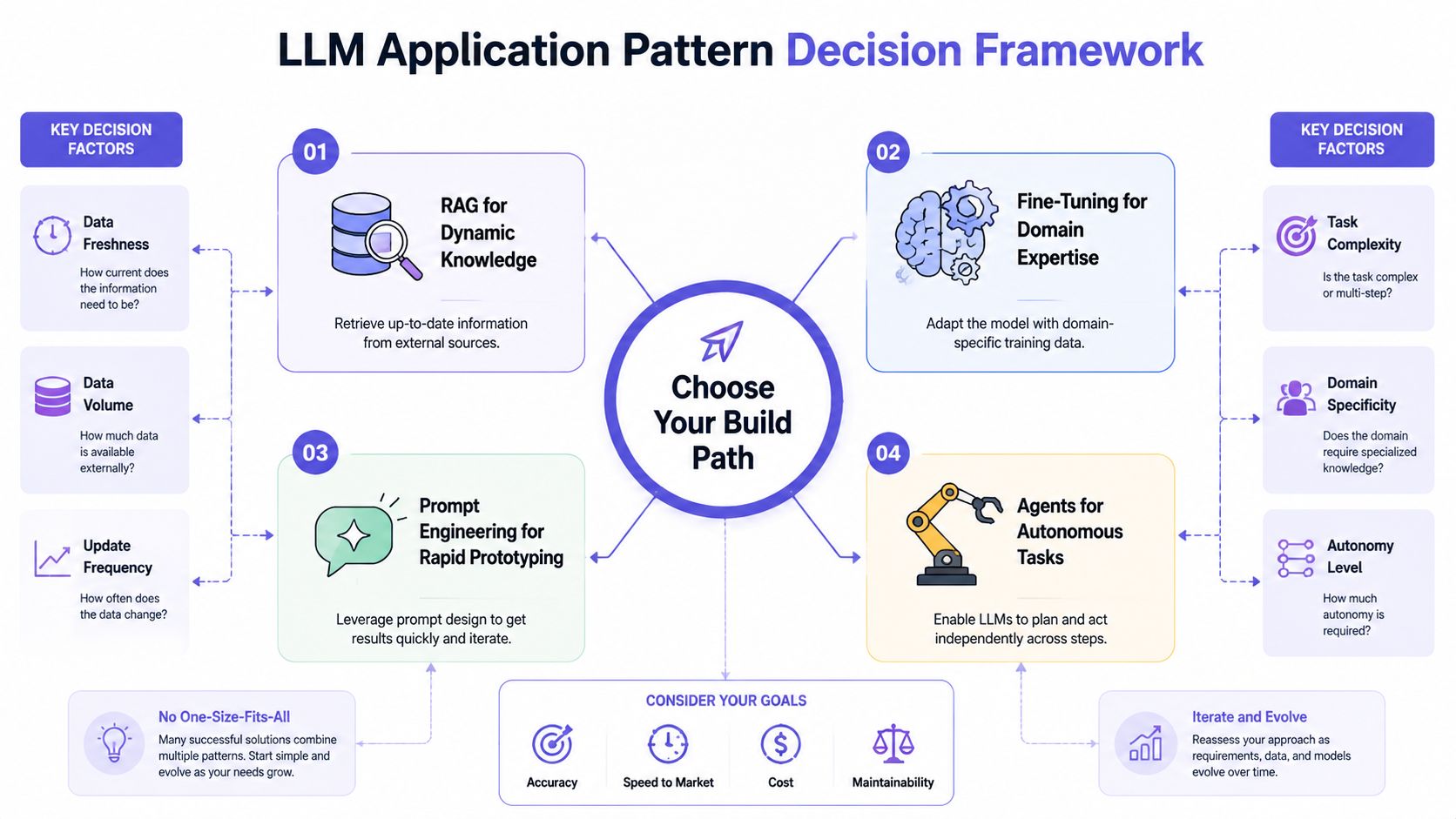
Use this decision framework:
| Need | First pattern to test | Why | Main trade-off |
|---|---|---|---|
| Current, private, or frequently changing knowledge | Retrieval-augmented generation, or RAG | Supplies relevant source material at request time | Retrieval quality becomes a first-class failure point |
| Stable behavior or a specialized response style | Fine-tuning | Changes model behavior through examples | Requires suitable training data and a careful regression process |
| A constrained task with limited context | Prompt engineering | Fastest way to test product value | Prompt-only systems can become brittle as requirements grow |
| Multi-step actions across systems | Agent or explicit tool workflow | Connects reasoning with authorized actions | More state, security, testing, and observability complexity |
RAG is usually the sensible first test for knowledge applications because it keeps changing information outside the model weights. Fine-tuning is more appropriate when you need repeatable behavior, formatting, or domain adaptation that retrieval alone can't provide. Agents deserve a higher bar. If a deterministic workflow can execute the same steps, use the deterministic workflow first.
Scope the data and service boundaries
Inventory every source the application might touch. Record ownership, freshness, access permissions, format, language, retention requirements, and whether the source contains personal or confidential information. Don't send data to a model provider until procurement, privacy, and security owners understand that flow.
A practical architecture looks like this:
Source systems → ingestion and cleaning → chunking and indexing → retrieval and reranking → prompt assembly → model → validator or tool layer → response and telemetry
Keep retrieval separate from generation in both code and telemetry. That separation lets you determine whether a bad answer came from missing evidence, poor ranking, prompt assembly, or model reasoning.
Define success with business and technical measures. A support team may care about answer acceptance and escalation quality. A search product may care about relevant evidence and source attribution. A workflow assistant may care about valid tool arguments, authorization, and human approval.
Consider two contrasting knowledge bases:
- A focused document collection: Start with a small RAG pipeline, clear metadata, source citations, and a modest gold set. Avoid building an autonomous agent when users only need grounded answers.
- A broad enterprise repository: Invest earlier in ingestion ownership, document versioning, access-aware retrieval, reranking, conflict handling, and observability. A larger corpus increases the number of ways retrieval can fail, so the indexing pipeline becomes product infrastructure.
Your one-page scoping brief should answer:
- Who uses the application and what decision does it support?
- Which sources are authoritative?
- What must the system refuse or escalate?
- What response format does downstream software require?
- What latency and cost boundaries matter to the business?
- Which languages and cultural contexts must the first release support?
- Who reviews failures and approves releases?
That document prevents the common mistake of funding a general chatbot before proving a specific workflow.
Building with Data Prompting and Model Selection
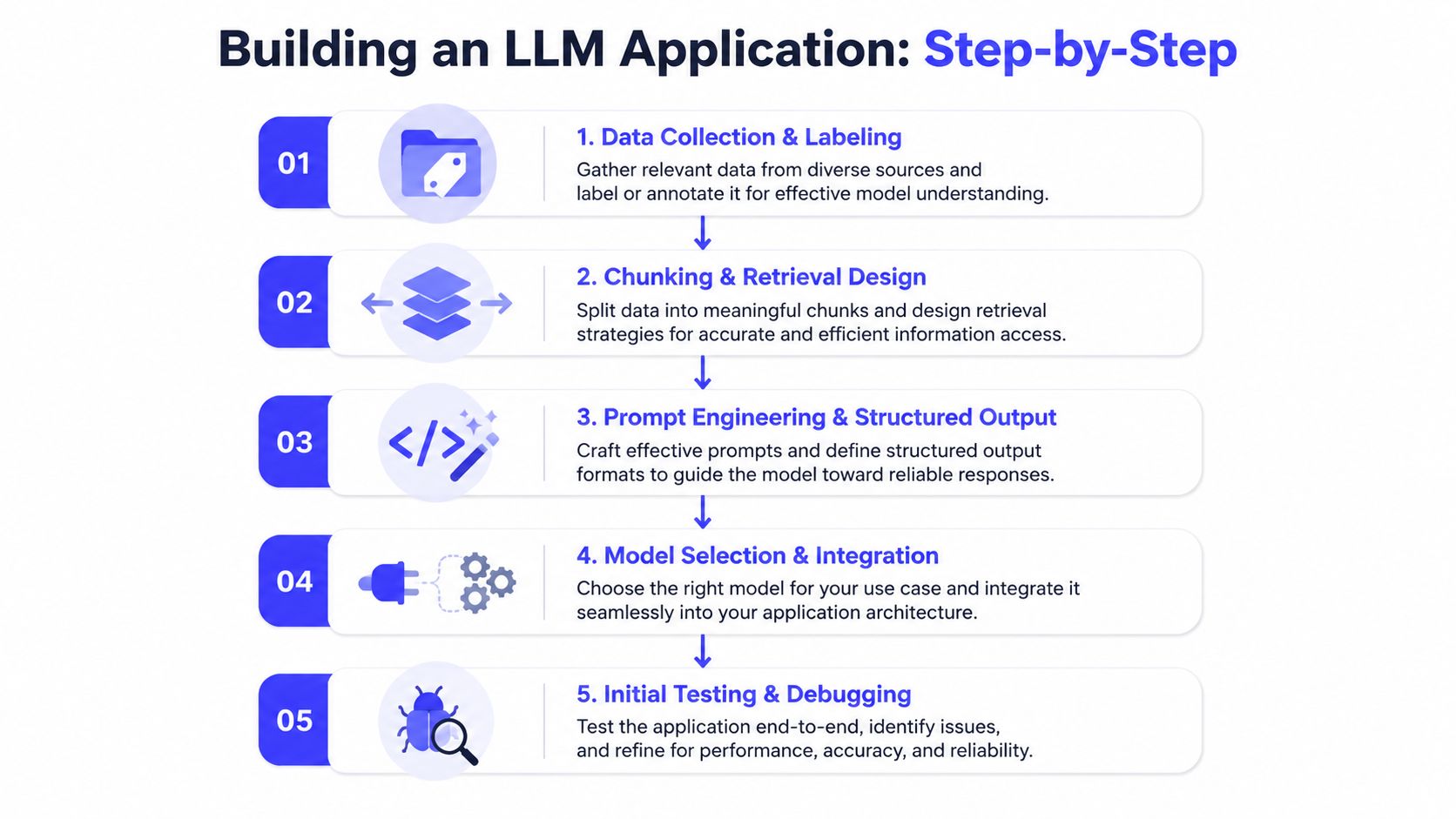
The build loop should connect data preparation, prompting, model choice, and testing. Treating those as separate activities makes diagnosis harder because a change in one layer can alter the behavior of the others.
Build the data path first
Collect representative inputs, not just polished examples. Label the expected answer, acceptable evidence, refusal conditions, sensitive fields, and escalation path. For RAG, preserve document identifiers, section titles, timestamps, permissions, and source links through the entire pipeline.
Chunking is a retrieval decision, not a cosmetic preprocessing step. Keep related statements together, preserve headings, and test whether the retriever returns complete evidence rather than isolated sentences. Compare lexical retrieval with embedding retrieval when terminology, identifiers, or exact policy language matters.
A useful record for each test case includes:
- User request
- Relevant source identifiers
- Expected evidence
- Expected answer properties
- Disallowed claims
- Language and locale
- Model and prompt version
- Retrieval and generation outputs
Make prompts and outputs versioned artifacts
A prompt should live beside the workflow that uses it. Store the template, system instructions, model settings, tool definitions, preprocessing code, and post-processing logic as one versioned unit. An empirical repository study found that only 21.9% of prompt changes were documented in commit messages, and it also found that prompt edits could create logical inconsistencies or misalignment between prompts and outputs. The finding is documented in this study of prompt change documentation.
Use structured output whenever another program consumes the result. OpenAI's Structured Outputs function-calling documentation explains that strict: true forces generated arguments to match the declared JSON Schema. The first request using a new schema adds preprocessing latency, while later requests don't incur that overhead.
A representative tool definition might look like this:
{"type": "function","function": {"name": "create_support_ticket","strict": true,"parameters": {"type": "object","properties": {"category": { "type": "string" },"summary": { "type": "string" },"priority": { "type": "string" }},"required": ["category", "summary", "priority"],"additionalProperties": false}}}Schema validity doesn't prove that the action is safe or correct. Validate authorization, allowed values, business rules, and whether the model had enough evidence before executing the function.
For a practical introduction to designing clear instructions and reusable templates, see what prompt engineering involves.
Select models by measured workload fit
Compare models on the actual task. Measure answer quality, evidence use, structured-output validity, latency, context handling, safety behavior, and provider constraints. A smaller model may work well for classification, routing, extraction, or straightforward summarization. A more capable model may earn its cost on ambiguous reasoning, complex synthesis, or difficult tool selection.
Fine-tune only after prompt, retrieval, and workflow errors are understood. Fine-tuning can't repair missing source data or an authorization flaw. It can also make behavior harder to explain if the training examples don't represent the production distribution.
For a lean team, the repeatable loop is simple:
- Add representative examples.
- Change one layer.
- Run the regression set.
- Inspect failures by category.
- Record the decision and version.
- Release behind a controlled rollout.
The engineer screening this work should ask: “A RAG answer is wrong. How would you determine whether retrieval, prompt assembly, generation, or source data caused the failure?” A strong answer names separate traces and tests rather than reaching immediately for a larger model.
Evaluation That Catches Real Failures Before Users Do
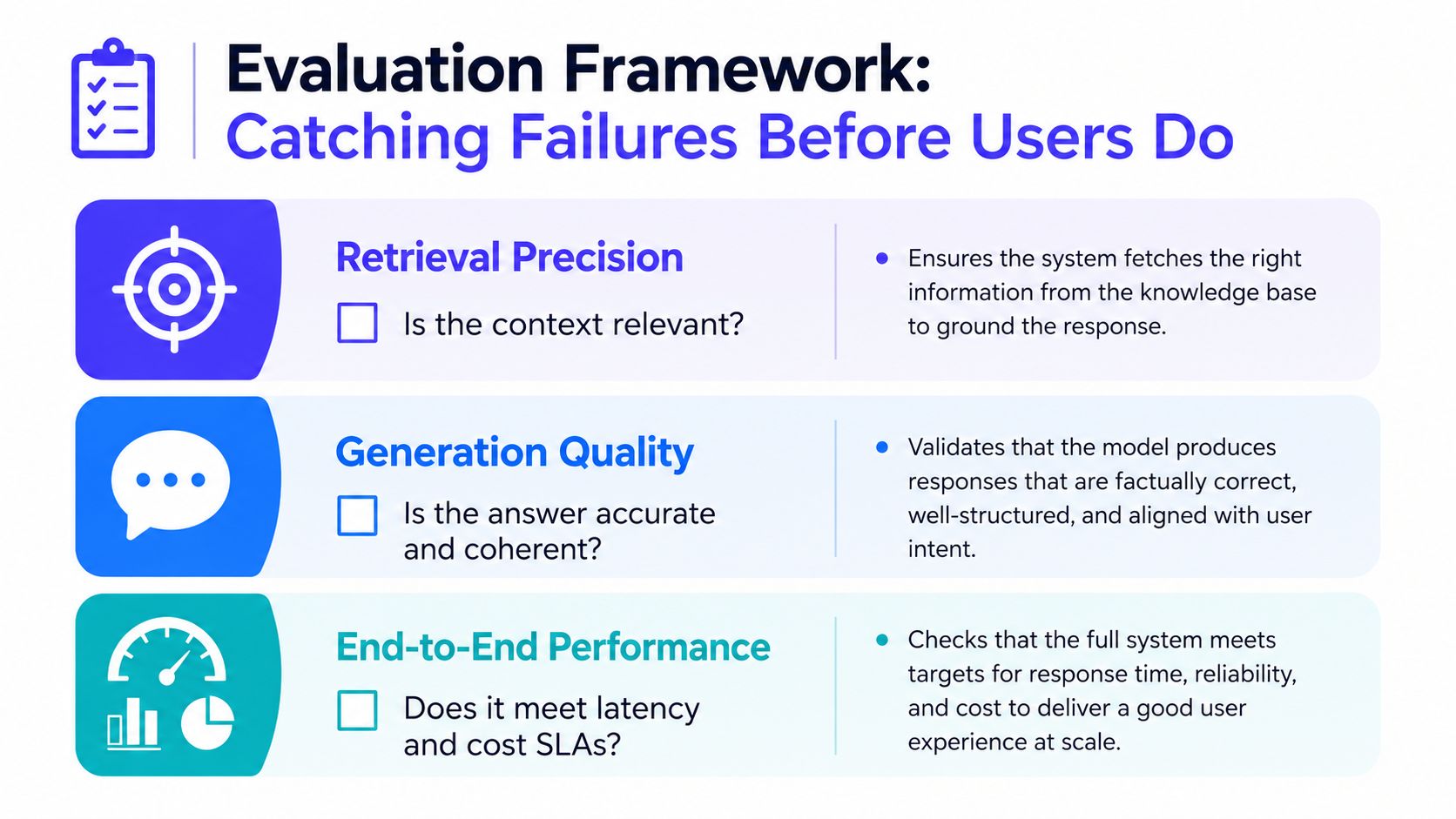
A single end-to-end score can hide the exact failure you need to fix. A system may produce fluent answers while retrieving irrelevant passages, omitting citations, mishandling contradictory documents, or failing when the embedding model changes.
Separate the pipeline into measurable layers
For every test request, log the query, retrieved documents, ranking information, assembled context, prompt version, model, output, citations, tool calls, latency, and token usage. Then score the layers independently.
| Evaluation layer | Question | Example release signal |
|---|---|---|
| Retrieval precision | Did the system find the right evidence? | Required source appears in the retrieved context |
| Evidence coverage | Did the context contain enough information? | All answer-critical facts are represented |
| Generation faithfulness | Does the answer stay within the evidence? | Unsupported claims are rejected or escalated |
| Attribution | Can a reviewer trace claims to sources? | Citations point to the relevant passage |
| Workflow correctness | Did tools receive valid and authorized arguments? | Schema and business-rule checks pass |
| Operations | Does the application meet service expectations? | Latency, cost, and error alerts remain within policy |
A 2026 taxonomy of RAG failure modes highlights why single-stage metrics miss diverse real-world failures. Independent evaluation guidance also emphasizes separating retrieval from generation because answer-level scores can conceal whether the retriever found the correct evidence.
Put hallucination testing on the release path
Hallucination rates remain measurable even in strong models. Vectara's HEM benchmark reported rates ranging from 3.0% for GPT-4 and 3.5% for GPT-3.5 to 27.2% for Google PaLM-Chat, as reported in the benchmark discussion on hallucination evaluation. These figures aren't a promise about your application, but they are a clear reason to test faithfulness before launch.
Build a gold set from real queries and known failures. Include incomplete questions, conflicting sources, stale documents, permission boundaries, adversarial instructions, and requests in each supported language. Mark expected evidence and acceptable refusal behavior, not just the preferred prose answer.
A better model isn't always the fix. If the retriever returns the wrong policy section, upgrading generation may produce a more confident wrong answer. Inspect the trace first, then improve indexing, metadata, ranking, source freshness, or conflict handling.
Release gate: Block deployment when the application cannot explain where an answer came from, when unsupported claims pass unnoticed, or when a prompt change hasn't been tested against known failures.
For systems with tool use or autonomous behavior, apply the same instrumentation discipline to planning, tool selection, arguments, permissions, and final state changes. The AI agent evaluation framework provides a useful companion for that broader workflow.
Deploying Operating and Securing LLM Applications at Scale
Deployment changes the problem. In development, engineers inspect examples manually. In production, users create new inputs, traffic varies, source data changes, providers behave differently, and an unnoticed prompt edit can affect thousands of responses.
Start with a small operating runbook:
- Record every request path. Capture model, prompt version, retrieved source identifiers, tool calls, validation results, latency, errors, and spend metadata. Redact personal or confidential content before logs leave the approved boundary.
- Set controls before traffic arrives. Add rate limits, timeouts, retries with care, provider fallbacks, maximum tool-call depth, response-size limits, and human approval for consequential actions.
- Create alerts that map to owners. Alert on error rates, latency shifts, structured-output failures, retrieval failures, unsupported-answer rates, safety events, and unexpected spend. Each alert should name the team responsible for investigation.
- Keep rollback simple. You should be able to revert a prompt, model route, retriever, index, or tool schema independently. Releasing all layers together makes incidents difficult to isolate.
- Review live samples. Automated metrics won't catch every change in tone, cultural fit, attribution quality, or refusal behavior. Domain reviewers should inspect samples from important user segments.
NIST's Generative AI Profile, published on July 26, 2024, identifies risks including confabulation, privacy, harmful bias, misuse, information security, and intellectual property. Use its risk categories to build a register that names the owner, control, evidence, and review date for each risk.
NIST's broader AI Risk Management Framework organizes governance around Govern, Map, Measure, and Manage. It also treats computational costs and environmental impacts as relevant risk considerations, so your architecture review should include model routing, caching, context size, preprocessing work, and workload scheduling.
Security needs its own test plan. Treat retrieved documents and user inputs as untrusted content. Keep instructions separate from data, constrain tools with allowlists and authorization checks, and test prompt injection at ingestion, retrieval, and generation boundaries. The guide to preventing prompt injection offers practical controls for this threat.
Global rollout requires more than translating the interface. Stanford's research on the language gap in LLM development describes weaker performance in non-English and especially low-resource languages, limited cultural attunement, and data scarcity or poor representativeness. Build language-specific test sets, review local terminology, and involve native speakers who understand the market context.
Your Next Moves Team Roles and Launch Checklist
A lean production team usually needs clear ownership across five capabilities:
- AI engineer: Designs prompts, workflows, retrieval, tool use, and model integration.
- MLOps or platform engineer: Owns deployment, observability, reliability, provider routing, and rollback.
- Data engineer: Maintains ingestion, permissions, metadata, freshness, and evaluation data.
- AI product manager: Defines the user problem, acceptance criteria, escalation rules, and business outcome.
- Evaluator or domain reviewer: Labels failures, reviews evidence, and protects quality during iteration.
Use fractional specialists when the architecture is uncertain or the pilot has a narrow scope. Hire full-time ownership when the application becomes a core product surface, requires continuous data operations, or carries material compliance and reliability obligations.
A practical pilot sequence is:
- Scope the workflow. Choose one user, one job, one authoritative data boundary, and explicit failure handling.
- Build and instrument. Ship the smallest viable path, version every change, and create a gold set before broad access.
- Run a controlled launch. Review live traces, fix the highest-risk failure categories, and decide whether to expand, pause, or change the architecture.
Use this article as a launch checklist, then turn the controls into tickets with owners and dates. ThirstySprout can help you source remote AI engineers, MLOps specialists, data engineers, AI product managers, or a fractional team for an LLM application pilot. Visit ThirstySprout to start a pilot and discuss the team shape needed for a focused production launch.
Hire from the Top 1% Talent Network
Ready to accelerate your hiring or scale your company with our top-tier technical talent? Let's chat.