

You need a Java developer because the backlog is growing, the current team is overloaded, and the systems in question aren't toy apps. They touch payments, customer data, internal workflows, or the API layer that other teams depend on. In that situation, hiring for generic Java knowledge is where most searches go wrong.
A useful Java developer for hire in 2026 isn't just someone who knows syntax, collections, and object-oriented design. You need someone who can work inside a real production stack, understand service boundaries, ship safely, and get productive without spending weeks learning your delivery process from scratch.
TL;DR
- Define the role around production ownership, not just Java. Ask for Spring, APIs, Git, Linux, cloud familiarity, and container awareness if that's your actual environment.
- Choose the hiring model based on the work. Full-time is better for long-lived ownership. Contract works for migrations, deadlines, and temporary capacity.
- Use job-relevant coding simulations early. SHL analyzed 1.9 million responses from 655,000+ candidates worldwide and found simulation-based assessment can measure technical capability at scale in a more reliable way than resumes alone, especially for technical hiring (SHL report).
- Run interviews around debugging, architecture, and communication. Java trivia rarely predicts who can keep a service stable in production.
- Have an onboarding plan ready before the offer goes out. Enterprise Java environments are often mature and complex, so ramp-up doesn't happen by accident.
Defining the Modern Java Developer Role
A team opens a Java req because delivery is slipping. Two weeks later, it becomes clear the problem is not raw coding capacity. The service needs someone who can read a mature Spring codebase, trace an API failure through logs, fix a container build, and ship into a cloud environment without creating new operational risk.
That is the modern Java role.
Java still sits inside a large share of enterprise systems, which means many hires step into existing services, shared libraries, compliance constraints, and release processes instead of clean greenfield builds. A good hire is not just fluent in the language. A good hire can become useful inside your production setup fast.
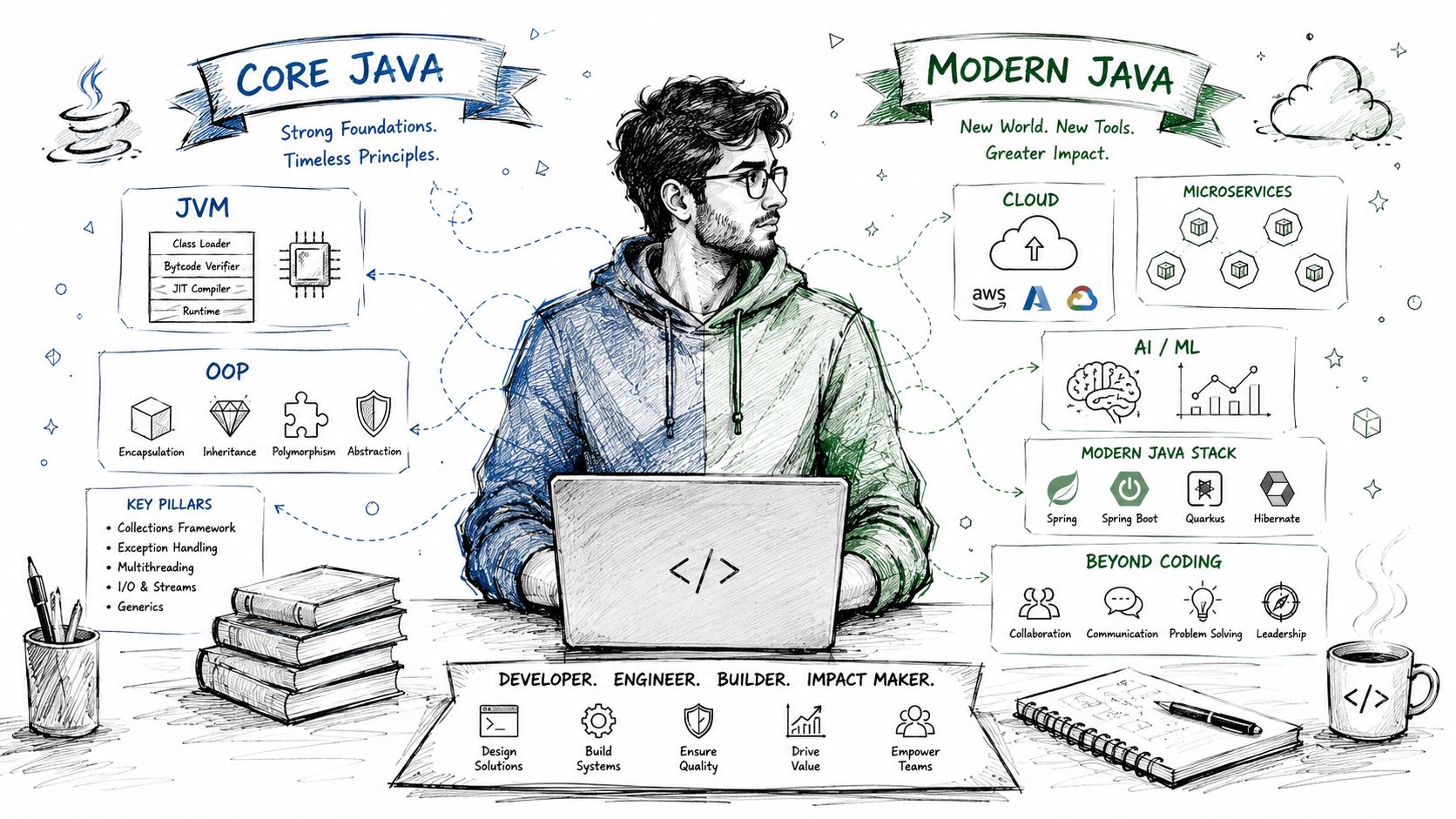
Core Java is necessary but not enough
I have seen strong Java interviewers miss this point. They spend an hour on collections, concurrency trivia, and inheritance patterns, then hire someone who struggles with Dockerfiles, API contracts, or basic cloud debugging.
Production readiness should define the role. Current job listings commonly ask for Java plus Spring, Git, Linux, and familiarity with cloud or containerized delivery environments, which reflects what teams need in day-to-day work (Indeed Java listings in New York).
A weak job description sounds like this:
- Java developer
- 5+ years of experience
- Problem-solving skills
- Team player
That description attracts volume, not fit.
A stronger version ties the role to the environment and expected outcomes:
- Application stack: Java, Spring Boot, REST APIs, Maven or Gradle, Git, Linux
- Runtime environment: AWS, GCP, or Azure
- Delivery expectations: CI/CD, code review, testing discipline, incident response
- Deployment model: Docker, Kubernetes, or another container platform
- Business ownership: billing service, partner integration, internal platform module, migration stream
If your stack is Spring Boot on AWS with container-based deployments, ask for that directly. "8 years of Java" is weak screening criteria if the person has never owned a service after merge.
Write the role around the work
Useful Java hires usually map to one of three operating modes.
Service owner
Maintains backend services, APIs, data flows, and production health over time.Modernization engineer
Handles framework upgrades, dependency cleanup, monolith extraction, and cloud migration work.Platform-aware backend engineer
Writes application code and understands what happens in CI, in containers, and in production telemetry.
Titles should reflect that scope.
| Hiring need | Weak title | Better title |
|---|---|---|
| API development | Java Developer | Java Spring Boot API Engineer |
| Legacy modernization | Senior Java Developer | Senior Java Modernization Engineer |
| Cloud deployment ownership | Java Programmer | Java Backend Engineer for AWS and Containers |
This saves time later. Better titles produce better applicants, cleaner recruiter outreach, and fewer interviews with candidates who only match the word "Java."
Past work matters more when it shows applied engineering in context. A candidate who has built utilities, integrations, or data-processing tools in Java often gives you a clearer signal than someone who only lists frameworks on a resume. Even a practical example like a tutorial on how to scrape age and gender with Java can reveal how a developer structures code, handles libraries, and works through real implementation details.
What day-one usefulness looks like
The best hires do not need weeks to understand how work moves through your system.
Look for candidates who can:
- Read an unfamiliar codebase and trace request flow across controllers, services, queues, and data layers
- Discuss API design trade-offs such as versioning, retries, idempotency, pagination, and error contracts
- Work with build and delivery tooling including Maven, Gradle, CI pipelines, and container images
- Debug in the target environment using logs, metrics, configs, and deployment context instead of relying only on local IDE runs
- Connect technical choices to delivery outcomes such as release speed, failure rate, operational load, and maintainability
That last point matters. A developer who can explain why a health-check design reduces noisy alerts or why a contract test prevents downstream breakage is usually much closer to production ownership than someone who only answers syntax questions well.
Some teams also need Java developers who can integrate with ML services, internal automation, or AI-backed workflows. In those cases, it helps to review how backend Java systems fit into that architecture. This practical guide to Java and AI integration patterns gives useful context for hiring managers defining that kind of role.
Sourcing Java Talent Contract vs Full-Time
Hiring strategy gets better when you stop treating every Java need as a standard full-time requisition. Some seats need durable ownership. Others need focused execution for a narrow window.
The labor market also pushes you toward flexibility. The U.S. Bureau of Labor Statistics projects 129,200 openings per year on average for software developers, QA analysts, and testers from 2024 to 2034, with overall employment growth of 15% over the decade (BLS software developers outlook). In practice, that means competition for experienced developers stays real, and a slow search often costs more than a slightly different engagement model.
When full-time is the right move
Full-time works best when the engineer will own systems that matter for a long time.
Use it when the role includes:
- Long-lived service ownership
- On-call participation
- Cross-team planning
- Architecture continuity
- Internal knowledge accumulation
A Java developer maintaining a core billing API, internal workflow engine, or customer event pipeline should usually be an employee. You want incentives aligned with maintainability and long-term code health.
When contract is the smarter option
Contract talent fits better when the work is bounded.
Common examples:
- Migration work: moving from older framework versions to a newer Spring stack
- Capacity spikes: a product launch creates a temporary delivery gap
- Specialist need: debugging performance issues, stabilizing a deployment path, or clearing a legacy backlog
A practical way to think about it is simple. If the work has a visible finish line, contract usually deserves a close look.
Many teams wait too long to use contractors. They assume every engineering problem needs a permanent headcount decision, when the real problem is often a six-month delivery gap.
A simple decision table
| Situation | Better fit | Why |
|---|---|---|
| Core product backend with ongoing ownership | Full-time | Preserves knowledge and accountability |
| Framework upgrade or migration | Contract | Focused work with clear completion criteria |
| Fast hiring need but uncertain long-term scope | Contract-to-hire | Reduces commitment risk |
| New product area with unknown staffing shape | Flexible network or augmentation | Lets you start before final org design is settled |
If you're comparing sourcing models more broadly, this managed services vs staff augmentation guide is useful for thinking through ownership, control, and delivery expectations.
Where teams waste time
Teams lose weeks in three predictable ways:
- Broad role specs: "Senior Java engineer" attracts too many mismatched profiles.
- Mismatched channel: posting everywhere when the role needs a narrow senior profile.
- Slow decision loops: strong candidates won't wait through a bloated interview process.
For procurement or operations teams weighing staffing approaches across professional roles, this professional services staffing guide gives a practical overview of how staffing models differ operationally.
One more point. ThirstySprout is one option if you want access to pre-vetted technical talent across contract, full-time, or fractional models and need a sourcing process that already screens for production readiness rather than just resume keywords.
A Practical Vetting and Assessment Framework
A bad Java hire rarely fails because they forgot syntax. The failure shows up three weeks in. The service runs locally but falls apart in a container, the API contract is vague, health checks are missing, and nobody can explain how the code behaves under production traffic.
That is why the vetting process should answer one question early: can this person ship and support a Java service in a modern production environment?
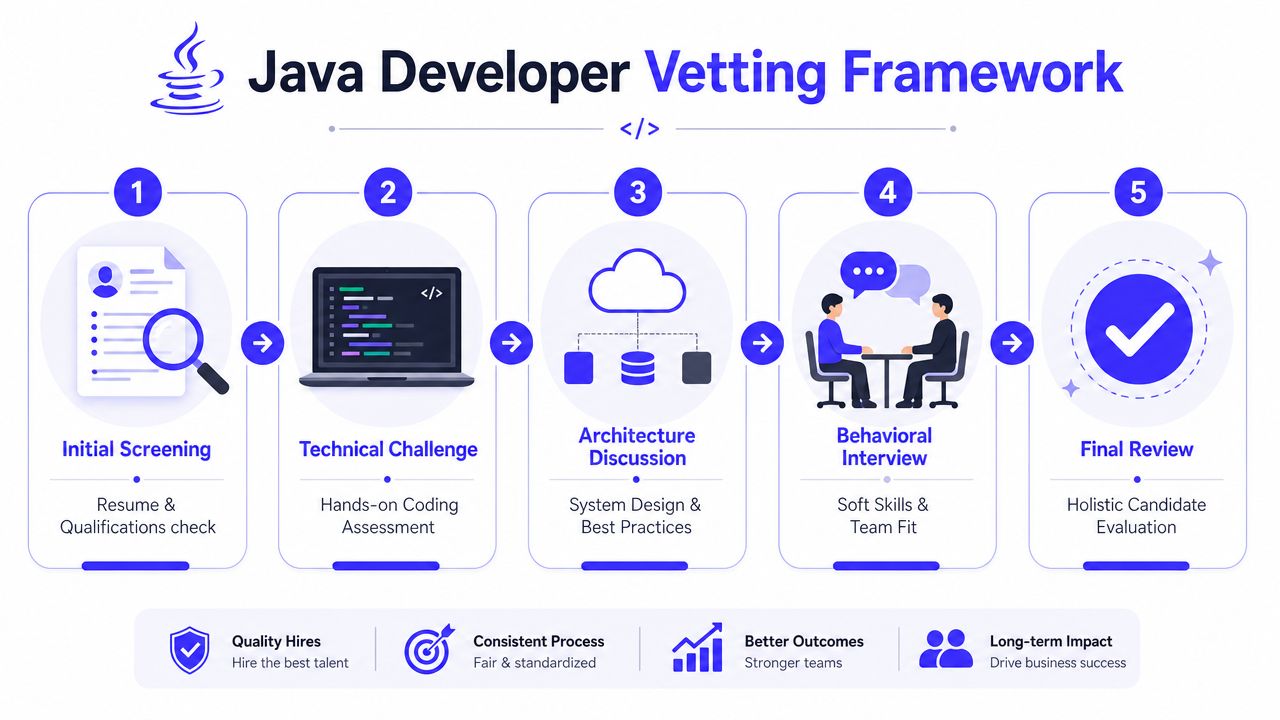
The five-stage filter that works
1. Resume screen for shipped systems and operating context
Use the resume to confirm relevance, not to infer skill. I look for evidence that the candidate has owned code after deployment, not just contributed features before handoff.
Strong signals include:
- Production scope: ownership of a payments flow, internal platform service, event-driven workflow, or migration with clear outcomes
- Modern runtime tools: Spring Boot, Docker, Kubernetes, AWS, GCP, CI/CD pipelines, logging and metrics tooling
- API and operations exposure: REST design, versioning, incident response, performance tuning, database query work, rollout or rollback decisions
Weak signals are easy to spot. Generic bullets, inflated architecture titles, and long tool lists with no description of what changed, broke, improved, or scaled.
2. Short coding exercise tied to actual work
Skip trivia and generic algorithm screens unless the role depends on them. A small debugging or refactoring task gives better signal for a Java hire who needs to contribute fast.
What to watch:
- how quickly they understand an unfamiliar codebase
- whether they make safe, contained changes
- whether they test edge cases
- how they talk through trade-offs under time pressure
A realistic assessment example
Give the candidate a small Spring Boot service with one endpoint that intermittently returns duplicate records and slows down under moderate load. Include a controller, service layer, repository query, and one failing test.
Ask them to:
- identify the likely cause
- fix it
- add one test
- explain what they would monitor after release
This mirrors real work. It also exposes whether the candidate can connect code changes to production risk.
The strongest candidates usually mention logging, rollback planning, query behavior, and how they would verify the fix in staging or production. That is more useful than a fast answer with no operating judgment.
If your team needs a stronger prompt set before building the full loop, this bank of Java interview questions and answers for practical hiring is a good starting point.
Before the deeper rounds, it can help to calibrate your interviewers with a short external perspective. This video is a useful prompt for what technical evaluation should and shouldn't over-index on.
System design and debugging over trivia
3. Architecture discussion mapped to your stack
Ask the candidate to design something close to the job. If your team runs containerized services behind APIs, the exercise should include those constraints. A whiteboard prompt with no runtime context tells you very little.
Useful prompts:
- design a notification service with retries, dead-letter handling, and delivery visibility
- design an internal reporting API with role-based access and pagination
- add a third-party integration without hurting service reliability or deployment speed
Good answers cover failure modes, API boundaries, data flow, observability, and where they would put safeguards such as timeouts, idempotency, and rate limits.
4. Behavioral interview focused on delivery under production conditions
Behavioral rounds should test how the person works when requirements are messy and systems are already live.
Ask about:
- a production issue they handled directly
- a design disagreement that changed the implementation
- a code review conflict they resolved
- a release where they had to cut scope to protect quality or timing
Listen for ownership, prioritization, and how they worked with product, QA, DevOps, or platform teams. Senior Java developers should show judgment across the delivery path, not just inside the IDE.
5. Final review with written evidence
Hiring teams waste time when feedback stays vague. Require each interviewer to write a recommendation tied to observed behavior from the exercise or discussion.
A simple rubric works:
- Java and framework depth
- debugging and root-cause skill
- API and system design judgment
- production readiness across cloud, containers, and monitoring
- communication and likely ramp speed
This framework shortens time-to-hire because it filters for day-one usefulness. It also reduces the expensive mistake of hiring someone who knows Java syntax but cannot ship reliable services in production.
The Java Developer Interview Kit and Scorecard
Most interview kits fail because they test for familiarity, not readiness. A candidate can answer trivia about the Java memory model and still struggle to debug a slow endpoint, explain an API decision, or work through an ugly code path with another engineer.
A better interview loop uses three distinct lenses. How they think in code. How they reason about systems. How they communicate under normal engineering pressure.
Question bank you can use today
Behavioral prompts
- Tell me about a production issue you personally helped resolve. What was the first signal, what did you check, and what changed after the fix?
- Describe a time you disagreed with a design or implementation choice. How did you handle it?
- What's one change you made that improved maintainability, even if it didn't ship visible product value?
System design prompts
- Design a document upload API for internal users. Walk through validation, storage, retries, and failure handling.
- Design a service that publishes events to downstream systems without duplicating side effects.
- You need to add rate limiting to a public endpoint. Where would you enforce it, and what trade-offs would you expect?
Debugging exercise
Give the candidate a small Java service with:
- one performance smell,
- one error-handling flaw,
- and one test gap.
Ask them to talk through what they see before they type. That short pause is revealing. Good engineers form a model of the problem first.
If you want a broader bank of role-specific prompts, this collection of Java interview questions and answers is a useful supplement.
The best interview question is often a messy one. Real work is rarely clean, and neither is production code.
Java Developer Interview Scorecard
| Competency | 1 (Below Expectations) | 3 (Meets Expectations) | 5 (Exceeds Expectations) |
|---|---|---|---|
| Java fundamentals | Misses basic language or runtime concepts needed for role | Solid command of core Java used in everyday work | Explains trade-offs clearly and applies them correctly in context |
| Spring and API design | Gives generic answers, weak understanding of service patterns | Can design and discuss common Spring Boot API workflows | Shows strong judgment on contracts, validation, failure modes, and maintainability |
| Debugging ability | Jumps randomly, struggles to isolate issues | Follows a reasonable process and finds likely root cause | Systematically narrows issues, explains evidence, and proposes safe fixes |
| Production readiness | Limited awareness of deployment or runtime concerns | Understands logging, testing, CI/CD, and environment basics | Connects code changes to rollout risk, monitoring, and operational impact |
| Communication | Unclear, hard to follow, defensive under pressure | Explains decisions well and collaborates effectively | Makes complex technical decisions easy to understand for mixed audiences |
| Ownership | Waits for direction on obvious next steps | Shows initiative within scope | Anticipates risks, proposes next actions, and thinks beyond assigned ticket |
How to use the scorecard
Don't average scores mechanically. Use the table to force consistency, then review outliers.
A practical rule set:
- No hire if debugging or communication is weak for a senior role
- Proceed with caution if Java is strong but production readiness is unproven
- Strong yes if the candidate is consistently solid across code, systems, and collaboration
This also helps de-bias the process. Interviewers can disagree, but they have to disagree on evidence.
Setting Compensation and Making the Offer
Compensation for Java talent is usually where teams either lose momentum or lose the candidate. The common mistake is treating salary as the only variable. Strong candidates evaluate the whole package and the speed and clarity of your process.
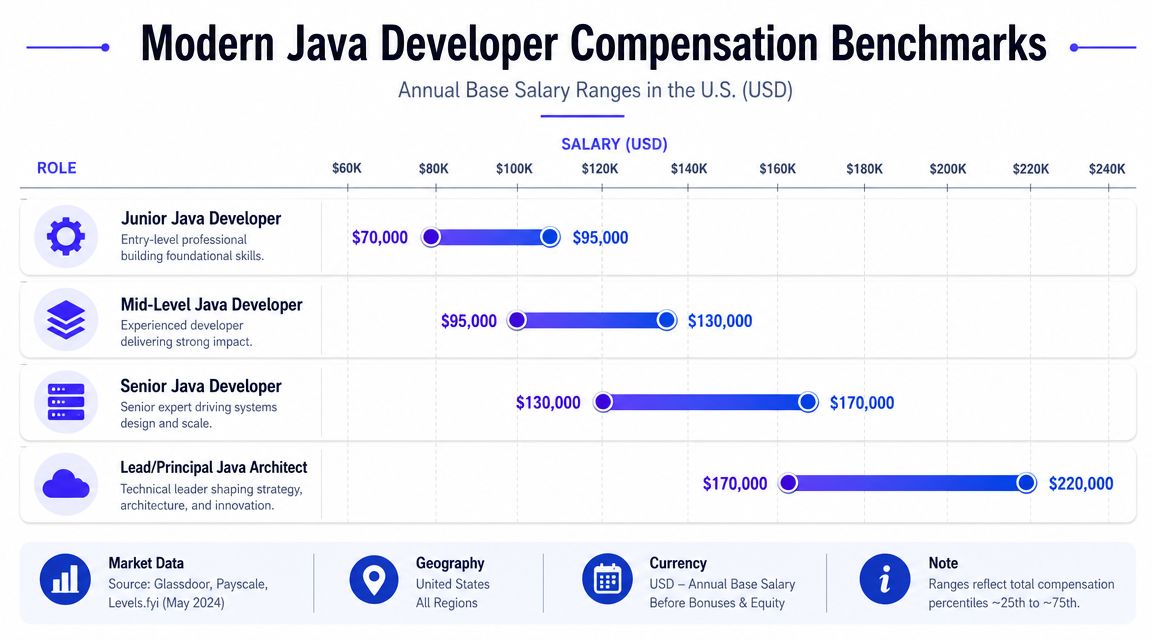
Current 2026 market guidance for U.S. Java developers places mid-level compensation at about $113,924 to $141,344 and senior-level compensation at about $140,607 to $169,766. In high-cost hubs, senior Java developers can earn up to about $203,000, and a senior Java architect can reach roughly $188,000 (Arc Java hiring guide).
Build the offer around the actual seat
A reliable offer starts with role clarity.
Use these questions first:
- Is this a mid-level delivery role or a senior ownership role?
- Will this person be expected to handle production incidents?
- Do they need cloud and container fluency on day one?
- Are you buying coding capacity or architectural judgment?
A team hiring a Java developer to close tickets under supervision shouldn't benchmark that role like a senior service owner. On the other hand, if the person is expected to own a revenue-critical API and guide design decisions, a budget anchored too low will just waste time.
What candidates actually compare
Candidates usually weigh more than base pay:
| Offer element | Why it matters |
|---|---|
| Base salary or rate | Sets the floor for the decision |
| Equity or bonus | Signals upside and company confidence |
| Scope of ownership | Strong candidates care about impact |
| Team quality | They want competent peers and sane review culture |
| Manager clarity | Vague reporting lines create risk |
| Hiring speed | Long pauses imply internal friction |
A practical offer process
Move quickly after final round
If your team has enough evidence, don't wait for a perfect debrief calendar.
Be explicit about the role
Spell out what they will own in the first few months. Good candidates want to know how they'll contribute.
Handle counters calmly
A counteroffer doesn't automatically mean the candidate is unreliable. It usually means the market validated their value.
Strong offers are clear, not clever. If a candidate has to decode your package, you already made the decision harder than it needs to be.
If you're hiring a contractor, the same logic applies. Be specific about expected output, team overlap, communication norms, and whether extension is possible. Ambiguity kills acceptance rates just as fast as a weak number.
Your Java Developer's First 90 Days Onboarding Plan
A Java hire can clear interviews, accept the offer, and still fail by week three. The usual cause is not raw coding ability. It is a messy production environment, unclear ownership, missing access, and no path from local setup to a safe deploy.
That risk is higher in Java teams because new hires often step into mature systems with real operational weight. They need more than language familiarity on day one. They need to understand services, containers, APIs, CI pipelines, cloud access, logging, and how the team handles incidents.
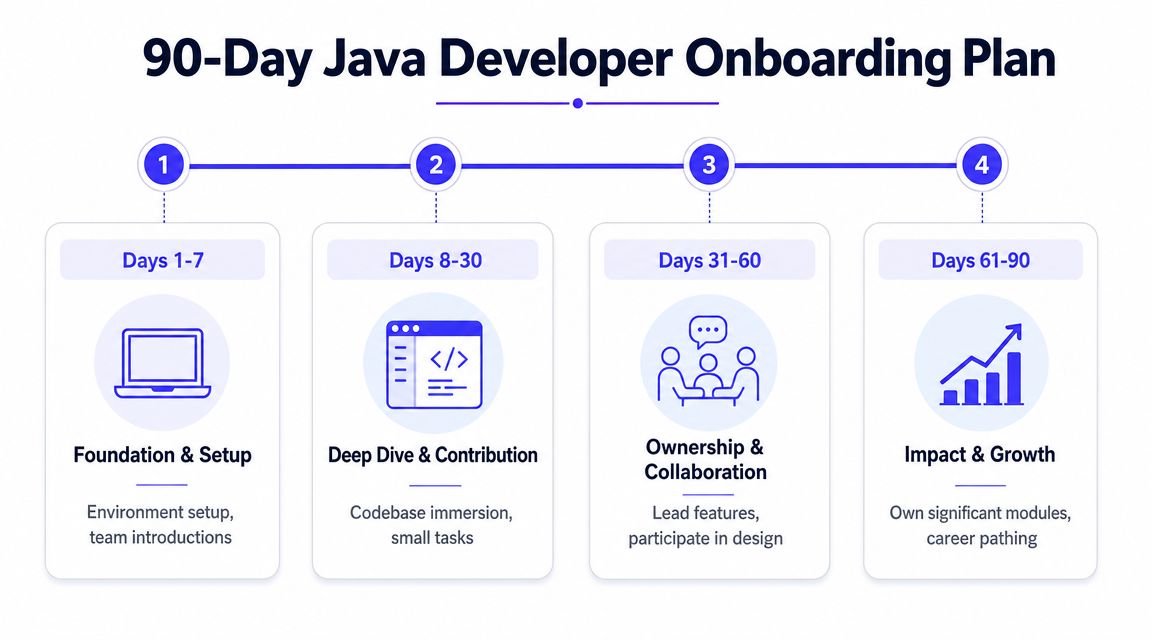
Days 1 through 7
The first week should answer a simple question. Can this developer get the app running, understand the delivery path, and make a low-risk change with support?
Start with the operating environment, not a history lesson about the codebase.
Manager checklist:
- Environment access: repos, cloud accounts, CI visibility, ticketing tools, secrets workflow
- Architecture orientation: one live walkthrough of the main services, data stores, queues, and external APIs
- Runtime context: how containers are built, where services run, how configs differ by environment
- People map: who owns what, who reviews code, who handles incidents
- First task selection: small, real, safe
The best first task is production-adjacent and contained. Fix a flaky test tied to a real service. Add structured logging to an endpoint. Update a minor API validation rule and ship it with a reviewer. That sequence shows whether the developer can work inside your actual stack instead of solving toy problems.
Days 8 through 30
By the end of the first month, the developer should move through the normal delivery flow without constant help.
Expected milestones:
- ships a small production change,
- understands local setup, container workflow, and deployment flow,
- can trace a request across the main application layers and dependent services,
- joins code review with useful comments,
- understands team norms for testing, observability, rollback, and incident escalation.
I have seen onboarding go off track when managers assign broad discovery work like "learn the platform." That usually produces notes, not momentum. A better approach is three concrete assignments: one bug fix, one small endpoint or integration change, and one shadow incident review. That gives the developer exposure to code paths, deployment mechanics, and team communication under real conditions.
Days 31 through 60
At this stage, orientation turns into ownership.
Ask the developer to:
- Own a small feature end-to-end
- Write or improve tests around an existing module
- Participate in a design discussion
- Document one part of the system they found confusing
- Handle one service change that touches config, monitoring, and deployment
That last point matters because production readiness is broader than writing Java code. A developer who can change an API but cannot reason about container config, health checks, dashboards, or rollback steps is still not fully effective in a modern delivery team.
For managers who want a reusable framework, this practical guide to 30-60-90 day plans is a useful reference for structuring milestones without turning onboarding into bureaucracy.
Early onboarding should answer one question fast: can this person contribute safely in your production environment?
Days 61 through 90
At this stage, the hire should need normal support, not daily rescue.
A solid 90-day target looks like this:
| Timeframe | Expected outcome |
|---|---|
| First week | Setup complete, team context clear, first scoped task assigned |
| First month | Small production contribution shipped |
| Second month | Owns a feature or module slice with normal review support |
| Third month | Contributes independently, handles routine changes safely, and joins design and planning with context |
The manager's job here is to tighten feedback loops. Review code quickly. Correct gaps early. Check whether the developer understands operational expectations, not just implementation details. If the role includes cloud infrastructure, Kubernetes, or external API ownership, those responsibilities should show up in the 90-day plan instead of getting deferred to "later."
When onboarding is done well, the new Java developer becomes useful faster and creates less delivery risk. That is the point of the hiring process.
If you need a Java developer who can operate in a real production stack, not just pass a language screen, ThirstySprout can help you scope the role, evaluate production readiness, and start a pilot with vetted technical talent.
Hire from the Top 1% Talent Network
Ready to accelerate your hiring or scale your company with our top-tier technical talent? Let's chat.