

TL;DR: Your Quick Guide to Java in AI
- When to Use Java: Use Java for deploying AI models into high-traffic, enterprise-grade production systems where performance, security, and integration with existing infrastructure are critical.
- Java vs. Python: Use Python for rapid model training and experimentation. Use Java for low-latency, high-concurrency model inference and seamless integration with big data tools like Spark and Kafka.
- Key Libraries: For core ML, use Deeplearning4j (DL4J), Oracle Tribuo, or the ONNX Runtime for Java. For LLM applications, use Spring AI or LangChain4j.
- Recommended Action: Start with a 2-week pilot project. Choose an internal tool or process automation task. Use the hybrid architecture: train in Python, export to ONNX, and serve the model from a Java microservice.
Who This Guide Is For
This guide is for technical leaders who need to make sound architectural decisions and build high-performing AI teams.
- CTO / Head of Engineering: You need to decide whether Java is the right choice for deploying your company’s AI features and how to integrate them into your existing stack.
- Founder / Product Lead: You're scoping the budget, timeline, and team composition needed to build and launch a reliable AI-powered product.
- Staff Engineer / Architect: You are responsible for designing the system architecture for serving ML models and need to understand the trade-offs between Java-native and hybrid approaches.
This is not a theoretical debate. It's a practical playbook for operators who need to ship production-ready AI within the next quarter.
Framework: The Python-to-Java Production Path
The most effective way to leverage Java and AI is to use a hybrid approach that plays to the strengths of both ecosystems. This framework minimizes risk and maximizes both development speed and production performance.
- Activity: Your data science team uses Python libraries like PyTorch or TensorFlow to rapidly train, test, and iterate on ML models.
- Goal: Find the best-performing model architecture quickly, without being constrained by production requirements.
- Activity: The final, trained model is exported to the Open Neural Network Exchange (ONNX) format. This creates a standardized, framework-agnostic asset.
- Goal: Decouple the model training environment from the production deployment environment. The ONNX file is the official handoff.
- Activity: Your backend engineering team loads the ONNX model into a Java microservice using the ONNX Runtime for Java. The model is served via a REST or gRPC API.
- Goal: Run the model in a high-performance, scalable, and secure environment that integrates seamlessly with your existing enterprise infrastructure.
- Architecture: The model is exported to ONNX format. A Java Spring Boot microservice loads the model at startup using the ONNX Runtime. The service exposes a single REST endpoint that accepts transaction data.
- Why Java? The Java Virtual Machine (JVM) is optimized for this kind of long-running, high-throughput workload. Its superior multi-threading and Just-In-Time (JIT) compilation ensure consistent, low-latency responses under heavy load, directly reducing financial risk by catching fraud faster.
- Business Impact: Reduced financial losses from fraud, improved customer trust, and a scalable system that can handle peak transaction volumes without performance degradation.
- Architecture: Use Spring AI to orchestrate calls to an embedding model and an LLM like GPT-4. The Java application handles document chunking, vector storage (e.g., in PostgreSQL with pgvector), and constructing the final prompt with the retrieved context.
- Why Java? The chatbot is part of a larger internal developer portal built on Spring Boot. Integrating the AI feature directly in Java avoids the operational complexity of managing a separate Python service. Spring AI provides clean abstractions, making the code simple and maintainable.
- Code Snippet (Spring AI): This shows how easily you can create a chat endpoint. The framework handles the complex interactions with the AI model provider.
@RestControllerpublic class DocChatController {private final OpenAiChatClient chatClient;// Constructor injection for the AI clientpublic DocChatController(OpenAiChatClient chatClient) {this.chatClient = chatClient;}@GetMapping("/ai/docs/ask")public String askDocs(@RequestParam String question) {// In a real app, you would first retrieve relevant docs here (RAG)String prompt = "Using our internal docs as context, answer the following question: " + question;return chatClient.call(prompt);}} - Business Impact: Increased developer productivity, improved consistency in answers, and a reduction in repeat questions to senior engineers, leading to faster project delivery.
- Using Java for Initial Model Training: While possible with libraries like Deeplearning4j (DL4J), the Python ecosystem is vastly larger and more productive for research and experimentation. Don't fight the current; let your data scientists work where they are most effective.
- Ignoring the Hybrid Model: Forcing your Java team to learn the entire Python data science stack or your data science team to productionize services in Java can lead to frustration and slow delivery. The hybrid model with an ONNX handoff is a proven pattern that respects team specializations.
- Neglecting JVM Tuning: Simply running your AI service on the JVM isn't enough. For high-performance applications, you must invest time in tuning garbage collection, heap size, and thread pools. The default settings are rarely optimal for low-latency AI inference.
- Define Business Goal: A clear, measurable outcome is defined (e.g., "reduce support ticket response time by 20%").
- Confirm Production Need: The project requires high throughput, low latency, or deep integration with existing Java systems.
- Select Pilot Project: A small-scale, high-impact pilot (2–4 week scope) has been identified.
- Choose Architecture: The Python-Java hybrid model (via ONNX) has been agreed upon as the starting point.
- Identify Java AI Lead: An engineer with experience in both Java performance tuning and ML concepts is on the project.
- Assess Skill Gaps: Your team has hands-on experience with the chosen Java AI library (e.g., ONNX Runtime, Spring AI).
- Define Roles: Clear separation of responsibilities between the Python (training) and Java (deployment) teams.
- Set Up CI/CD Pipeline: A process exists for automatically building, testing, and deploying the Java service with the ML model.
- Establish Monitoring: You have tools (e.g., Prometheus, Grafana) to monitor API latency, throughput, and error rates.
- Define Model Versioning Strategy: A clear plan for how new model versions will be deployed without downtime (e.g., blue-green deployment).
- Scope a 2-Week Pilot: Identify a small, high-impact project. Focus on automating an internal process or enhancing a feature where a 10% improvement is a clear win.
- Assess Your Team: Use the checklist above to conduct an honest skills gap analysis. Determine if you need to train your existing team or bring in an experienced Java AI engineer.
- Book a Scoping Call: The fastest way to de-risk your first project is to partner with an expert. We connect you with senior, vetted Java AI engineers who can help you define your pilot and start delivering value from day one.
- Official Libraries: ONNX Runtime for Java, Deeplearning4j (DL4J), Oracle Tribuo, TensorFlow Java.
- LLM Frameworks: Spring AI, LangChain4j.
- Industry Trends: Java's Resilience in the AI Era.
- ThirstySprout Resources: How to Hire AI Engineers, MLOps Best Practices.
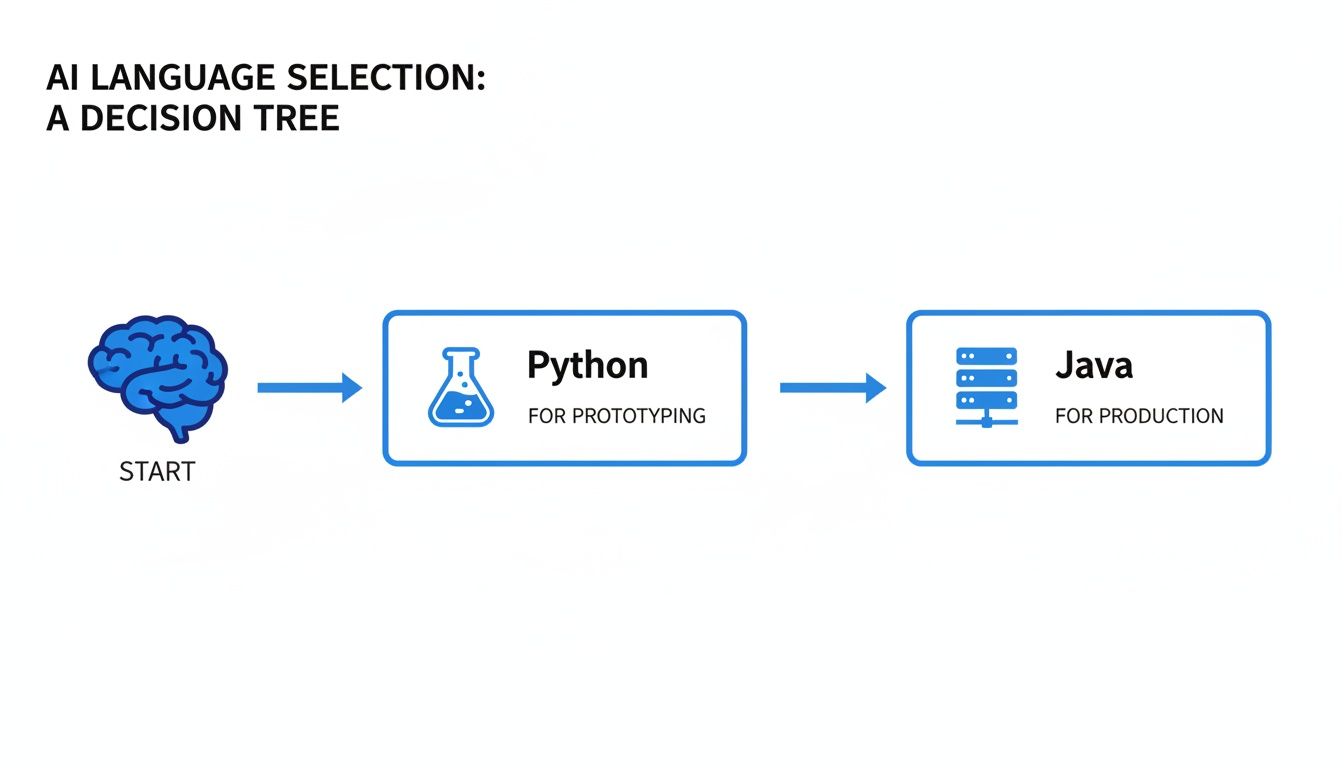
This workflow is common because it works. It lets data scientists innovate freely in Python while your engineers build a rock-solid deployment path in Java.
Practical Examples of Java in AI Systems
Theory is good, but real-world examples are better. Here are two common scenarios where using Java for AI deployment delivers significant business impact.
Example 1: Real-Time Fraud Detection API
A financial services company needs to check transactions for fraud in under 50 milliseconds. Their data science team has built a powerful gradient-boosting model in Python's scikit-learn.
Example 2: Code Snippet for a RAG Chat Service
You need to build a "ask our documentation" chatbot for your internal engineering teams. The goal is to reduce the time developers spend searching for information.
Deep Dive: Trade-Offs, Alternatives, and Pitfalls
While Java is a powerhouse for production AI, it's not the only option. The choice between Java and Python involves real trade-offs between development speed, long-term operational costs, and team skills.
Java vs. Python: The Decision Matrix
Use this matrix to guide your architectural decision. The best choice depends on the specific phase of the AI lifecycle.
The most successful teams don't see this as an "either/or" choice. They build a bridge between these two ecosystems, using each for what it does best. For a deeper analysis of backend performance, our Go vs Java comparison provides valuable insights.
Common Pitfalls to Avoid
Ultimately, Java's core strengths—performance, scalability, and enterprise integration—make it a strategic choice for AI deployment. It excels at connecting AI capabilities to the big data ecosystems (Apache Hadoop, Spark) that already power your business. You can explore more about Java's role in data analysis on dev.to to see these connections in action.
Checklist: Java AI Project Readiness
Use this checklist to assess if your team and project are ready for a Java-based AI deployment.
Phase 1: Scoping & Strategy
Phase 2: Team & Skills
Phase 3: Technical Readiness
If you have gaps in this checklist, particularly in team skills or technical readiness, bringing in external expertise can accelerate your timeline and reduce project risk.
What to Do Next
References and Further Reading
Hire from the Top 1% Talent Network
Ready to accelerate your hiring or scale your company with our top-tier technical talent? Let's chat.