

TL;DR: Go vs Java
- Choose Go for cloud-native microservices, CLI tools, and high-concurrency APIs where fast startup, low memory usage, and simple deployments are critical. It's built for speed and operational simplicity.
- Choose Java for large-scale enterprise systems, big data processing, and complex applications that require a massive, mature ecosystem of libraries and frameworks. Its strength is stability and comprehensive tooling.
- Performance: Go's lightweight goroutines excel at I/O-bound tasks. Java's JVM is a powerhouse for long-running, CPU-bound work, and Project Loom's virtual threads are closing the concurrency gap.
- Hiring: Java has a massive global talent pool with deep enterprise experience. Go's talent pool is smaller but growing fast, composed of engineers often skilled in modern cloud infrastructure.
- Action: Scope a 2-week pilot project on your chosen language to validate performance and developer productivity before committing to a full-scale build.
Who This Is For
This guide is for technical leaders making strategic decisions that impact hiring, budget, and time-to-market. We wrote this for:
- CTOs, Heads of Engineering, and Staff Engineers who need to decide on a backend stack that balances performance, scalability, and long-term maintenance costs.
- Founders and Product Leads scoping new AI, fintech, or SaaS platforms where choosing the right technology directly influences hiring velocity and operational overhead.
This is a practical guide focused on business impact—how your choice affects time-to-value, total cost of ownership, and your ability to build a high-performing team.
Go vs Java: A Quick Decision Framework
Choosing between Go and Java is a strategic decision. Use this framework to map your project requirements to the right language. The best choice depends on your business goals, team skills, and architectural needs.
At a Glance: Go vs Java for Technical Leaders
This table summarizes the core trade-offs to help you make a fast, informed decision.
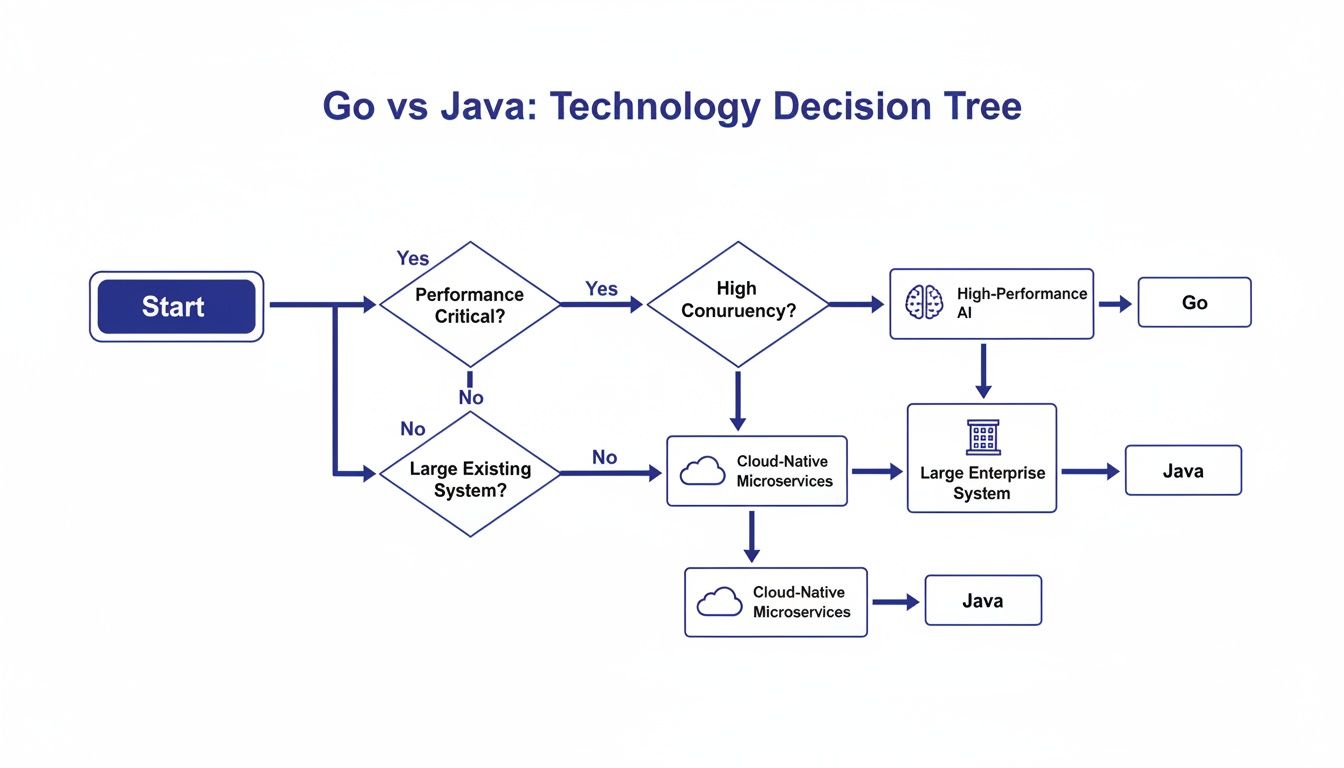
The decision tree clarifies the primary split: Go excels in modern, cloud-native architectures where efficiency and speed are paramount. Java remains the champion for complex, feature-rich enterprise systems that demand stability and extensive library support.
Practical Examples: Go and Java in the Real World
Theory is useful, but seeing how these languages solve real business problems is what matters. Here are two practical examples illustrating where each language shines.
Example 1: Go for a High-Throughput API Gateway
A fintech startup needs to build an API gateway to handle hundreds of thousands of concurrent requests for real-time stock price data. Latency must be minimal, and the service must be highly resilient to traffic spikes.
Why Go is the right choice:
- Concurrency: Go's goroutines are perfect for this I/O-bound task. The gateway can spawn a goroutine for each incoming connection with negligible overhead, allowing it to scale massively.
- Performance: A low-latency garbage collector and fast startup times mean the service responds quickly without unpredictable pauses.
- Deployment: The gateway compiles to a single static binary, which is placed in a minimal Docker container. This simplifies CI/CD pipelines and reduces the attack surface.
Here's a simplified snippet showing how a Go HTTP server would handle concurrent requests:
// A simple Go HTTP server demonstrating concurrent handlingpackage mainimport ("fmt""net/http""time")func priceHandler(w http.ResponseWriter, r *http.Request) {// In a real app, this would fetch data from a fast data source.// We simulate work with a sleep.time.Sleep(50 * time.Millisecond)fmt.Fprintf(w, "{\"symbol\": \"TSPT\", \"price\": 123.45}")}func main() {http.HandleFunc("/price", priceHandler)// The http server automatically handles each request in a new goroutine.http.ListenAndServe(":8080", nil)}This code shows how Go’s standard library handles concurrency out of the box, making it easy to build high-performance network services.
Example 2: Java for a Core Banking Transaction Platform
A large bank is modernizing its core transaction processing platform. The system must process millions of financial transactions daily, ensuring strict data consistency (ACID compliance) and integrating with dozens of legacy and third-party systems.
Why Java is the right choice:
- Ecosystem: The Spring Framework and Jakarta EE provide battle-tested libraries for transaction management (JTA), security, and database connectivity (JDBC). There's no need to reinvent the wheel for complex enterprise needs.
- Maturity & Reliability: Java has been the backbone of the financial industry for decades. Its stability, robust memory management, and extensive tooling are non-negotiable for a mission-critical system.
- Talent Pool: The bank can easily hire experienced Java developers with deep domain knowledge in finance and enterprise integration patterns.
A configuration snippet for managing transactions in a Java Spring application might look like this:
// Spring configuration for declarative transaction managementimport org.springframework.context.annotation.Configuration;import org.springframework.transaction.annotation.EnableTransactionManagement;@Configuration@EnableTransactionManagement // Enables Spring's annotation-driven transaction managementpublic class TransactionConfig {// Defines a transaction manager bean that Spring will use to control// database transactions for methods annotated with @Transactional.// ... bean definitions for DataSource and JpaTransactionManager ...}// Usage in a service class@Servicepublic class PaymentService {@Transactional // This annotation ensures the method runs within a database transaction.public void processPayment(PaymentDetails payment) {// 1. Debit account A// 2. Credit account B// If any step fails, the entire transaction is rolled back automatically.}}This example demonstrates how frameworks like Spring abstract away complex transaction logic, allowing developers to focus on business rules while ensuring data integrity.
Deep Dive: Key Trade-Offs
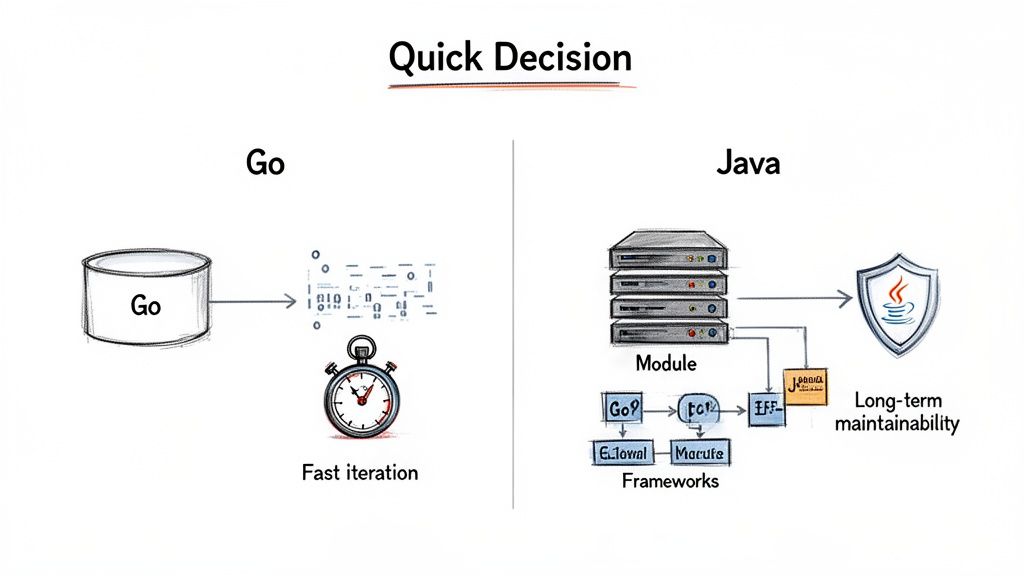
Beyond high-level use cases, the languages have fundamental differences in performance models, ecosystem philosophy, and their impact on your team.
Performance and Concurrency
Your application's ability to handle simultaneous operations directly impacts scalability, user experience, and your cloud infrastructure bill.
Go was built for concurrency with goroutines and channels. A goroutine is an extremely lightweight thread managed by the Go runtime, not the operating system (OS). You can run hundreds of thousands concurrently. This makes Go a powerhouse for I/O-bound workloads, like handling API requests or database connections. This approach, known as Communicating Sequential Processes (CSP), avoids many common concurrency bugs related to shared memory.
Java has traditionally relied on heavy OS threads. This model is effective for CPU-intensive jobs but struggles to scale to tens of thousands of connections. However, Project Loom's introduction of virtual threads in Java 21 is a game-changer. Like goroutines, virtual threads are managed by the JVM, bringing Java's scalability for I/O-bound tasks much closer to Go's.
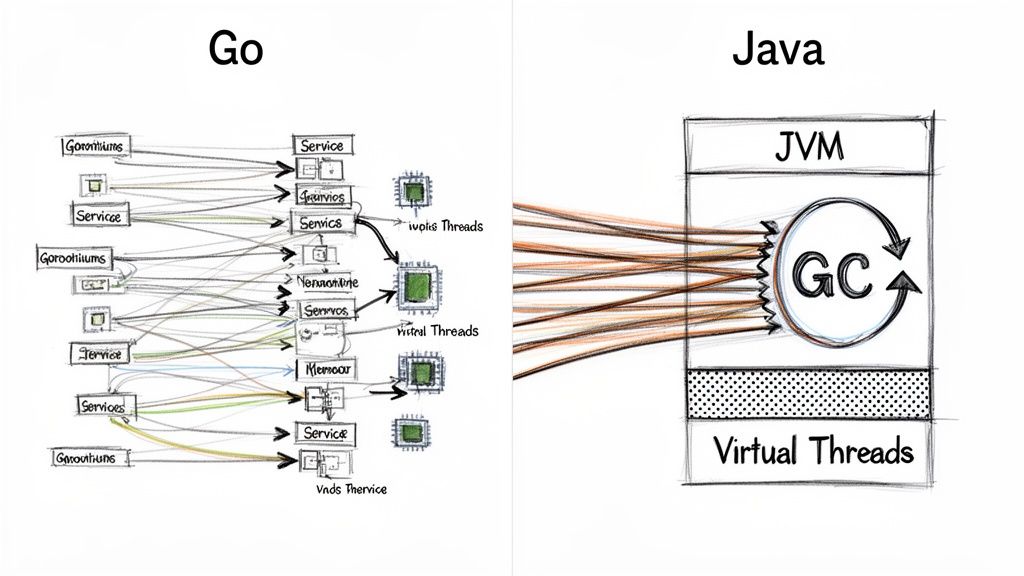
For teams already invested in the Java ecosystem, mastering virtual threads is essential for building modern, scalable applications. Learn more about optimizing your stack in our guide to developing in the cloud.
Ecosystem and Tooling
When you choose a language, you adopt its entire ecosystem of libraries, frameworks, and tools.
Go's ecosystem is lean, modern, and purpose-built for the cloud-native world. The foundational tools of modern infrastructure—like Docker, Kubernetes, and Prometheus—are written in Go. Its built-in tooling for formatting, testing, and dependency management simplifies the developer experience. Data confirms its growth; developer surveys show Go's adoption has risen steadily, especially for infrastructure roles. You can read more about Golang's rising popularity on Netguru.
Java's ecosystem is a massive, mature universe of tools that can solve nearly any business problem. It is anchored by powerful frameworks like Spring and a vast collection of open-source libraries like the Apache Commons. This depth is invaluable for complex enterprise applications, from big data processing to secure financial transactions. This maturity is why many organizations still choose paths like migrating from COBOL to Java for modernizing critical systems.
Hiring and Developer Productivity
Your language choice directly impacts who you can hire and how quickly they become productive.
Go was designed for productivity. Its minimal syntax (only 25 keywords) and standardized tooling mean a new developer can become effective in weeks. The fast compile times create a tight feedback loop, enabling rapid iteration. The talent pool is smaller but consists of engineers often skilled in modern, cloud-native practices.
Java has a steeper learning curve due to its verbose syntax and complex ecosystem. However, its global talent pool is enormous. Finding senior engineers with deep experience in enterprise patterns is straightforward. For complex systems requiring specialized domain knowledge, this large talent pool is a significant business advantage.
To make an informed decision, it's crucial to understand how to measure developer productivity within your organization's context.
Decision Checklist: Go or Java?
Use this checklist during your architectural review to make a data-driven decision aligned with your business goals.
1. Project & Performance Needs
- High Concurrency (I/O-Bound): Will the app handle >10k concurrent connections (e.g., APIs, chat servers)? → Lean Go
- CPU-Bound Tasks: Is the core logic computationally intensive (e.g., big data processing, scientific computing)? → Lean Java
- Low Latency Critical: Is sub-millisecond latency a hard requirement (e.g., ad tech, real-time trading)? → Lean Go
- Fast Startup / Serverless: Does the application need to cold-start in under a second? → Lean Go
- Complex Business Logic: Does the project require extensive, mature libraries for domains like finance, security, or enterprise integration? → Lean Java
2. Team & Hiring
- Existing Team Skills: Is your team already proficient with the JVM ecosystem? → Lean Java
- Hiring Velocity: Do you need to hire a large team of senior enterprise developers quickly? → Lean Java
- Cloud-Native Talent: Are you building a team focused on microservices, Kubernetes, and modern infrastructure? → Lean Go
- Onboarding Speed: Is it critical for new hires to become productive within their first month? → Lean Go
3. Operations & Ecosystem
- Deployment Simplicity: Is a simple, single-binary deployment a top priority? → Lean Go
- Mature Frameworks: Does the project benefit from a comprehensive, all-in-one framework like Spring Boot? → Lean Java
- Infrastructure Tooling: Is the project primarily for building infrastructure, CLIs, or networking tools? → Lean Go
- Operational Expertise: Does your Ops team have deep experience in JVM tuning and monitoring? → Lean Java
For a deeper dive into talent strategy, our guide on hiring software developers provides actionable frameworks.
What to Do Next
You’ve analyzed the trade-offs and used the checklist to make a decision. Now, it’s time to validate that choice and execute effectively.
Step 1: Scope a Pilot Project (2 Weeks)
Before committing your entire roadmap, de-risk the decision with a small, focused pilot project. Choose a single, self-contained microservice or feature. The goal is to get real-world data on:
- Performance: Does it meet latency and throughput goals under realistic load?
- Developer Experience: How quickly can a developer build, test, and deploy a meaningful change?
- Operational Cost: What is the actual memory footprint and CPU usage in your cloud environment?
This short pilot will provide more clarity than weeks of theoretical debate.
Step 2: Define Your Ideal Candidate Profile
Use your decision to build a precise job description. Don't just ask for "Go experience"; specify the need for expertise in channels and concurrency patterns. Don't just ask for a "Java developer"; target someone who has deployed applications using Spring Boot and virtual threads in a production environment. Focus on hiring engineers who have solved the specific problems you anticipate facing.
Step 3: Accelerate with Vetted Talent
Finding, vetting, and hiring senior engineers with specific production experience can take months, stalling your project before it starts. Instead of a slow, traditional hiring process, you can engage pre-vetted experts who can join your team and start contributing immediately.
This approach significantly reduces hiring risk and shortens your time-to-value. See how we help companies build expert teams through outsourced development and staff augmentation.
Ready to build your team with elite Go or Java talent? ThirstySprout connects you with the top 3% of pre-vetted engineers who can start in days, not months.
Hire from the Top 1% Talent Network
Ready to accelerate your hiring or scale your company with our top-tier technical talent? Let's chat.