

TL;DR:
- Define with a Scorecard: Ditch generic job descriptions. Create a role scorecard detailing the mission and key 90-day outcomes. Focus on business impact (e.g., "cut model inference latency by 15%").
- Source Beyond LinkedIn: Find the best engineers in niche communities (Discord, Slack) and by reviewing open-source contributions on GitHub.
- Use Practical Interviews: Replace whiteboard algorithm quizzes with a practical take-home challenge (e.g., build a small RAG API) and a collaborative system design session relevant to your business.
- Measure Your Funnel: Track metrics like time-to-hire (aim for <45 days) and offer acceptance rate (>80%) to find and fix bottlenecks.
- Actionable Next Step: Use our Role Scorecard Template below to define your next hire.
Who this is for
This guide is for CTOs, engineering managers, and founders who need to hire high-impact software developers—especially for AI, ML, and data roles—within weeks, not months. You need a repeatable process that identifies true problem-solvers and connects their work directly to business goals.
The 5-Stage Developer Hiring Framework
To succeed, you need a clear, five-stage process: define the role's business impact, source talent where they live, screen for core skills, interview for real-world abilities, and make a compelling offer. A flawed process hires the best interviewees, not the best engineers.
This framework creates a repeatable system that consistently attracts, vets, and closes top-tier developers.
For companies needing to ramp up faster, software development team augmentation can offer immediate access to pre-vetted engineers.
1. Define the Role with a Scorecard, Not a Job Description
Most hiring processes fail before a single candidate applies. Why? Because the job description is a generic laundry list of technologies, not a clear picture of the business problem the new hire must solve. To attract top-tier engineers, start with the mission.
This means creating a role scorecard. A scorecard ties the position directly to your company's objectives and spells out what success looks like in the first 90 days. This shifts the conversation from "Do you know Python?" to "Can you help us cut model inference latency by 15% this quarter?"
This filter attracts candidates driven by impact, not just a paycheck.
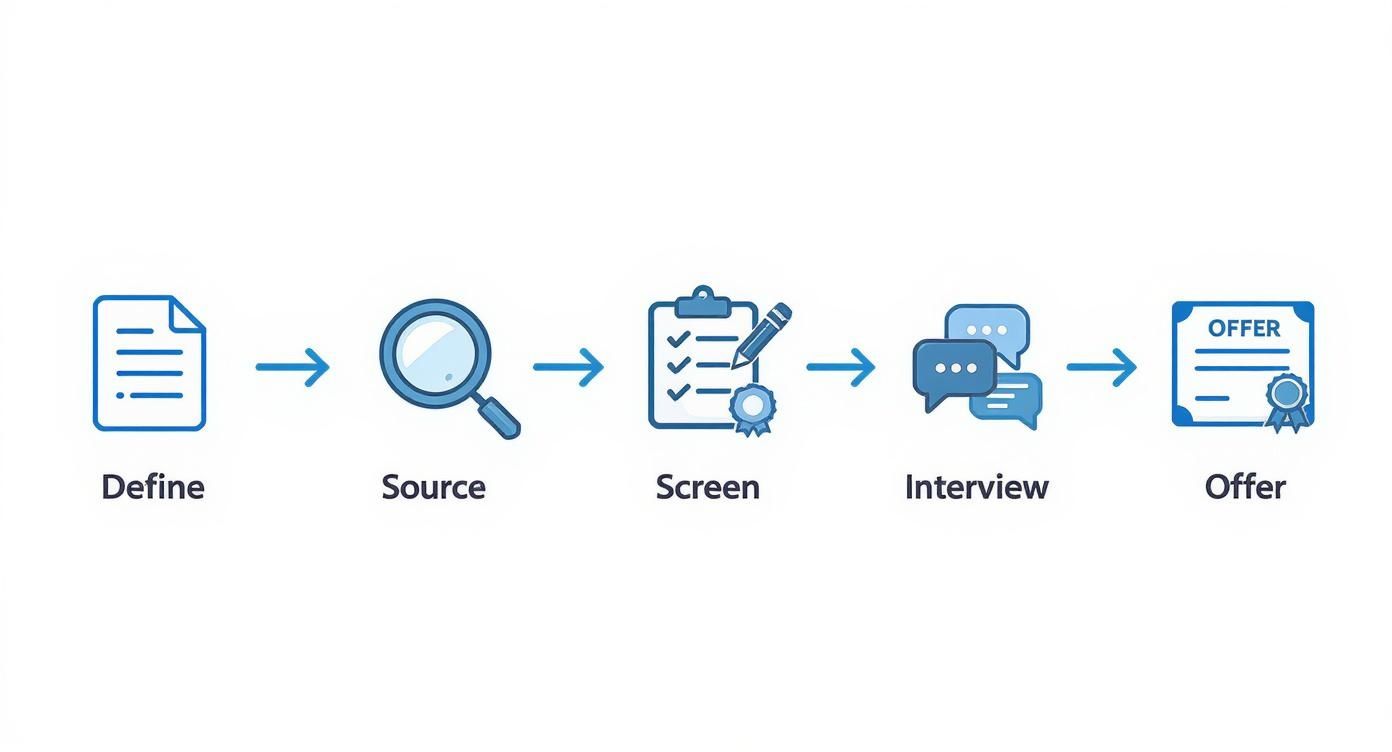
This five-stage flow—Define, Source, Screen, Interview, and Offer—makes it clear: a successful hire depends completely on a well-defined beginning.
Example 1: Differentiating Key AI and Data Roles
A common pitfall is conflating related but different roles. Hiring an "AI Engineer" when you need a "Data Engineer" can torpedo your product roadmap.
- Data Engineer: Builds and maintains reliable, scalable data pipelines. Hire when your core problem is getting access to quality data.
- ML Engineer: Deploys, monitors, and retrains models in production. Hire when your goal is to reliably get a proven model into users' hands.
- AI Engineer: Builds user-facing features with LLMs and generative AI (e.g., copilots, RAG). Hire when you need to build new AI-powered product features.
Focus on the problem, and the correct job title becomes obvious. If your data is a disaster, you need a Data Engineer. If your prototype model can't handle live traffic, you need an ML Engineer.
Example 2: The High Cost of Role Misalignment
A Series A startup hired a brilliant AI Engineer to build a recommendation engine. The problem? Their user data was a siloed, inconsistent mess.
The new hire spent three months trying to build a sophisticated feature on a foundation of quicksand. The project went nowhere. They really needed a Data Engineer to build foundational data pipelines first. That mistake cost them an entire quarter and thousands in recruiting fees.
Actionable Template: The Role Scorecard
Your role scorecard is a one-page internal document. It is your source of truth for aligning the entire hiring team.
A solid scorecard has three parts:
- Mission (1 Sentence): Why does this role exist? Example: "To build and scale the data infrastructure that powers our real-time fraud detection models."
- Key Outcomes (First 90 Days): List 3-5 specific, measurable goals. Example: "Deploy a CI/CD pipeline for our main recommendation model" or "Reduce data processing time by 20%."
- Core Competencies: The non-negotiable skills needed to hit those outcomes. Focus on fundamentals like "distributed systems design" or "statistical rigor," not a long list of languages.
This clarity ensures everyone evaluates candidates against the same high-impact criteria.
2. Source and Engage Top Engineering Talent
You have a killer role scorecard. Now, you need to find people who fit it. The best software engineers are not scrolling job boards; you must actively source talent that isn't looking yet.
This means building relationships and showing genuine interest in their work long before mentioning a job.
*A multi-channel sourcing strategy is essential for building a robust candidate pipeline.*
Go Where the Talent Lives
Relying solely on LinkedIn or referrals limits your access to diverse talent. Instead, be active where great engineers spend their time.
- Open-Source Contributions: Platforms like GitHub are a goldmine. You can see a developer's code quality, how they handle feedback, and the problems they enjoy solving.
- Niche Communities: Experts hang out in specialized Discord or Slack servers for tools like LangChain or the dbt Community. Participate, answer questions, and you'll spot the problem-solvers.
- Curated Talent Platforms: To move faster, services that pre-vet candidates are a lifesaver. We use AI-powered recruiting and sourcing to find passive candidates and craft personalized messages that break through the noise.
Crafting Outreach That Actually Works
A generic, copy-pasted outreach message will be ignored. Your goal is to show you’ve done your homework and have a legitimate reason for contacting them specifically. Your first message is a conversation starter, not a job pitch.
Practical Example: A LinkedIn Message That Converts
This template connects to a specific contribution.
Subject: Question about your PR on the vector-db-utils library
Hi [Candidate Name],
I saw your recent pull request on the
vector-db-utilsrepo that refactored the indexing logic—great work simplifying the API. My team at [Your Company] is tackling a similar challenge with our RAG system, and your approach gave us a new idea.We're currently looking for a Senior AI Engineer who loves diving deep into these kinds of performance and architecture problems. Given your expertise, I thought you might be interested in an informal chat. No pressure if the timing isn't right.
Best,
[Your Name]
This message is specific, shows respect for their work, and connects their skills to a real problem your team is solving.
3. Design an Interview Process That Predicts Performance
A bad interview process attracts great interviewees, not great engineers. To find real builders, you need a structured process that assesses how they solve real-world problems—not how well they remember algorithms on a whiteboard.
The best interviews feel like collaborative work sessions. They give both you and the candidate a genuine feel for what it would be like to work together.
Your interview loop is a product. A bad candidate experience gets around fast and will cost you top talent.
Practical Example 1: Take-Home Challenge for an AI Engineer
For a mid-level AI Engineer building RAG systems, a take-home project provides a strong signal on practical skills.
Assignment Brief:
- Objective: Build a simple question-answering API using a RAG approach.
- Dataset: A small set of 50–100 documents (e.g., your company's blog posts).
- Task: Create a FastAPI endpoint that takes a question and returns the best answer, citing the source.
- Constraints: Use a pre-trained sentence-transformer model and a vector database like FAISS or Chroma. Containerize the solution with Docker.
- Time Limit: We suggest a 3–4 hour time box to respect their time.
This project assesses data prep, embeddings, vector search, and API building. Use a rubric to evaluate submissions objectively.
Scoring Rubric:
This turns a subjective code review into a structured evaluation. For more on this, see our guide on the skills required for a software engineer.
Practical Example 2: System Design for a Senior Developer
For senior hires, a system design interview is a must. Give them a problem relevant to your business.
Interview Prompt:
"We want to build a real-time analytics dashboard for our e-commerce platform. It needs to track page views, add-to-cart events, and purchases, showing total counts for the last hour. Walk me through how you’d design this system."
A great candidate won't jump into technologies. They'll start by asking clarifying questions about constraints like event volume and data freshness.
What a Good Answer Looks Like:
- High-Level Architecture: They’ll sketch a flow from event capture (client beacon) to a message queue (Kafka or Kinesis), through a stream processor (Flink or Spark Streaming), and into a fast read store (Redis) for the dashboard.
- Trade-offs: The best candidates will explicitly discuss trade-offs, like at-least-once vs. exactly-once processing or cost vs. performance.
Red Flags:
- They immediately rattle off tools without explaining why.
- They don't consider scale, reliability, or monitoring.
- The conversation feels like a lecture, not a collaboration.
This approach surfaces engineers who know how to build, ship, and scale products in the real world.
4. Make the Offer and Onboard for Retention
Getting a candidate to say “yes” is just the starting line. A strong offer and a structured onboarding experience are your first real opportunities to retain the talent you worked so hard to find.
Crafting an Offer That Gets Accepted
Your offer is a complete package, not just a base salary.
- Benchmark with Real-Time Data: Use sources like Levels.fyi to ensure your salary and equity bands are competitive for the role, seniority, and location.
- Show Them the Whole Picture: Schedule a call to walk the candidate through the entire offer, including salary, equity, benefits, and professional development budgets.
- Be Transparent: A respectful negotiation builds trust from day one. Explain the details and listen to their questions.
Your Onboarding Checklist for the First 30 Days
A new hire’s first 90 days are critical. A structured onboarding process boosts both productivity and long-term retention. A checklist turns onboarding from a chaotic scramble into a repeatable system.
Week 1 Goal: Get Set Up and Oriented
- Access granted to all systems: GitHub, Jira, Slack, AWS, etc.
- Local development environment is fully built and running.
- Merged their first small PR (a bug fix or documentation update) for a quick win.
- 1:1 meetings scheduled with their manager and every team member.
- Assigned an "onboarding buddy" for informal questions.
Weeks 2–4 Goal: Make a Real Contribution
- Paired with a senior engineer on a small, clearly-defined feature.
- Fully understands the team’s sprint process and key meetings.
- Has presented their work during a team code review session.
- 30-day check-in with their manager to review progress and set goals for the next phase.
For engineers looking to build a career, consider implementing high-impact mentoring programs as part of your retention strategy.
5. Measure and Optimize Your Hiring Funnel
You cannot fix a process you don't measure. Treating recruitment like a product funnel moves you from guesswork to data-backed decisions.
Start with these essential metrics to find bottlenecks:
- Time-to-Hire: Track the days from first contact to a signed offer. If this exceeds 45 days, you are losing the best candidates to faster companies.
- Offer Acceptance Rate: If this drops below 80%, it's a red flag. Your compensation may be off-market, or your interview experience is poor.
- Cost-per-Hire: Total recruiting costs divided by the number of hires. This is crucial for understanding the ROI of your sourcing channels.
The hiring market is volatile. Lead-to-hire conversion rates for developers fell from 1.49% in 2022 to just 0.31% in 2024, showing why a data-driven strategy is essential. To dive deeper, explore recent software development statistics.
Your hiring data tells a story. If 50% of candidates drop off after your technical screen, you must ask why. Is the assessment too difficult? Is your sourcing pulling in the wrong candidates? Data points you to the right questions.
Common Questions About Hiring Software Developers
How long should a good hiring process take?
Aim for 30 to 45 days from first contact to a signed offer. Any longer, and you risk losing top candidates to competitors who move faster. A tight process signals that you respect their time and know how to make decisions.
Will AI replace the need to hire developers?
No. AI is a powerful assistant, not a replacement. Tools like GitHub Copilot need a sharp engineer to guide them, refine their output, and integrate it into a complex system. AI gives a great engineer superpowers; it does not turn a novice into a senior architect.
How do we compete for talent against big tech?
You cannot win on salary alone, so compete on what makes your startup a better place to work.
- Impact: Give engineers ownership over a major piece of the product.
- Equity: Offer a real stake in the company's success.
- Flexibility: Lean into a remote-first culture and genuine work-life balance.
The best engineers are driven by tough challenges and the freedom to ship work that matters. That’s where a startup can always win.
What to do next
- Define Your Role: Use the Role Scorecard framework to clarify the mission and outcomes for your next hire.
- Scope Your Needs: Book a 20-minute call with our team to discuss your technical requirements and team dynamics.
- Meet Vetted Candidates: We connect you with pre-vetted AI and software engineers in days.
Ready to build your high-impact engineering team without the friction? Start a Pilot.
Hire from the Top 1% Talent Network
Ready to accelerate your hiring or scale your company with our top-tier technical talent? Let's chat.