

You've got a board asking for an LLM roadmap, a product team promising an AI feature, and a budget decision due before the next planning cycle. At the same time, your engineering team may already have paid for AI seats without seeing a clear change in output. The question isn't “is an LLM worth it?” The useful question is whether the value survives the full cost of ownership, operational risk, and staffing required to run it.
For a seed-to-Series-B company, that answer depends on the workload, not the novelty of the model. The guide below gives you a decision framework, cost scenarios, staffing requirements, risk gates, and a practical pilot plan.
The Real Question Founders Should Ask About LLMs
A seed-stage CEO walks into a board meeting with a difficult request: commit $400,000 to an LLM roadmap next quarter. The product team has several promising demos, but no agreed baseline, no production evaluation set, and no firm estimate of ongoing operating costs.
Across town, a Series-B CTO is facing the opposite problem. The company has carried Copilot seats for six months, yet the productivity curve remains flat. Developers use the tool sporadically, code review still catches the same classes of defects, and nobody can say whether the investment improved delivery speed or merely changed how work feels.
Both leaders are asking the wrong first question. “Is an LLM worth it?” is too broad to approve a budget. Use four filters instead.

Filter one, identify the bottleneck
Find a specific, high-volume workflow where language understanding or generation is the constraint. Support triage, document extraction, internal search, proposal drafting, and repetitive code work are plausible candidates. “Add AI to the product” isn't a workflow.
Ask who performs the work, how often it happens, what inputs they handle, and what quality standard applies. If you can't name the user and the baseline process, you're not ready to fund an LLM initiative. A useful primer on model capabilities is what a large language model is.
Filter two, establish a non-LLM baseline
Can your team ship a credible baseline in under 30 days without an LLM? A rules engine, keyword search, structured form, workflow automation, or conventional classifier may solve the actual problem more reliably.
The baseline gives you something concrete to beat. Without it, a polished demo can look valuable because nobody measured the manual process.
Filter three, stress the economics
Model costs can move, traffic can grow, and prompts can become longer as teams add context. Recalculate the business case under a 10x token price increase. If the use case collapses immediately, redesign the workflow, use a smaller model, add caching, or pause.
Filter four, test ownership
An LLM project requires more than prompt writing. Someone must own retrieval quality, evaluation, tracing, privacy controls, regression testing, and rollback. Commit budget only when you can answer yes to at least three of these four filters. If you only have one or two, fund discovery rather than production.
Where LLMs Actually Deliver Value Today
LLMs tend to pay off when the workflow contains lots of language, repeats frequently, and includes a human who can verify the result without recreating the entire task. U.S. workplace adoption reached 39.4% among adults aged 18–64 by September 2024, while 28% of employed respondents reported using generative AI for work, according to an NBER working paper on generative AI adoption. That adoption is a signal of usefulness, but not proof that every deployment creates financial value.
The strongest applications sit in three groups:
- High-volume unstructured text: Support teams can classify incoming requests, retrieve relevant policy, draft responses, and route exceptions. Operations teams can summarize documents or prepare first drafts of requests for proposals.
- Boilerplate-heavy development: Coding assistants can help with repetitive implementation, test scaffolding, documentation, and straightforward transformations. They're less dependable when the developer must supply missing architecture or validate unfamiliar business rules.
- Personalized communication at scale: Marketing and sales teams can create account-specific drafts, summarize interactions, and adapt approved messaging. Human review remains essential where brand, legal, or commercial accuracy matters.
The weak cases are just as important. Long-horizon reasoning over private data often fails when retrieval is incomplete or the context is poorly grounded. Regulated financial advice creates a high review burden. A customer-facing workflow isn't attractive if correcting hallucinations costs more than completing the task manually.
| Use Case | Adoption Rate | Reported Productivity Lift | Maturity | Risk Profile |
|---|---|---|---|---|
| Support triage and drafting | Qualitatively established | Time savings reported in workplace research | High for bounded workflows | Medium |
| Document summarization | Qualitatively established | Varies by review burden | Medium to high | Medium |
| Code assistance | Qualitatively established | Depends on task and developer experience | Medium | Medium |
| Private-data reasoning | Selective | Unreliable without strong retrieval and evaluation | Medium | High |
| Regulated advice | Limited | Often offset by review requirements | Low to medium | High |
A retrieval-augmented generation system improves the odds when the answer depends on current or proprietary information. The relevant evaluation dimensions include retrieval relevance, generation faithfulness, and grounding quality, not just answer accuracy, as described in a clinical benchmark and RAG evaluation discussion.
Practical rule: Measure quality and rework, not only the time needed to produce a first draft.
Security belongs in the same workflow. Before connecting an LLM to source repositories, ticket systems, or cloud accounts, consider an automated security reconnaissance tool as part of a broader application security review. Productivity evidence can measure speed while missing leaked data, incorrect decisions, or review overhead.
Build vs Buy with 2026 Pricing and Infra Realities
The default recommendation for most startups is simple: buy access first, then earn the right to build deeper infrastructure. An API pilot gives you a fast way to test workflow fit, quality, and user behavior. Building too early locks capital into serving, evaluation, and operations before you know whether customers value the output.
The build decision becomes more reasonable when you need strict data residency, unusual customization, predictable high-volume traffic, or control over model behavior. Fine-tuning can sit between those extremes, but it still requires clean training data, evaluation discipline, and a plan for model updates.
| Path | First-Year Cost Band | Time to Pilot | Token Pricing, Input and Output per 1M | Best Fit | Key Risk |
|---|---|---|---|---|---|
| API only | Variable usage plus engineering overhead | Fast | Frontier APIs can vary widely by provider and model | Rapid validation and changing workloads | Vendor dependence and price changes |
| Fine-tune hosted model | $25,000–$80,000 project cost | Moderate | Base model pricing plus training and inference | Repeated format or behavior requirements | Weak data or limited quality gain |
| Self-host open-weight model | $180,000–$450,000 first-year infrastructure and MLOps | Slowest | Infrastructure-dependent | Residency, control, and sustained volume | Underused GPUs and operational burden |
Current pricing snapshots show efficient models near $0.10–$0.25 per million input tokens, while frontier output tokens can reach $25–$180 per million in 2026 market comparisons. Review LLM API pricing comparisons before approving a forecast, and model input and output separately. Output-heavy workflows can cost far more than a simple request estimate suggests.
Hosted open-weight inference through providers such as Groq or Fireworks can reduce unit cost without forcing you to operate the entire serving stack. That option works when you need more control than a frontier API provides but don't yet need to own GPUs, deployment automation, and capacity planning.
For a broader decision on engineering ownership and vendor dependency, use this build-versus-buy software framework. My recommendation is to start with an API unless you already have evidence that volume, residency, or customization makes the API path structurally unsuitable. Build only when the savings or control will remain material after MLOps, monitoring, evaluation, security, and maintenance.
Cost and Time-to-Value Scenarios Founders Can Model
A model invoice rarely represents the complete LLM budget. Your forecast should include inference, retrieval, observability, evaluation, prompt maintenance, integration, human review, and the latency cost of a poor user experience.
Use this formula:
Net monthly value = labor or revenue value created − inference − infrastructure − evaluation − observability − review − maintenance
Then calculate:
Payback period = one-time implementation cost ÷ net monthly value
If the result depends on optimistic usage, remove the optimism and rerun it.
Scenario one, an API-first SaaS workflow
Suppose a Series-A SaaS product processes 2 million LLM calls per month. The team chooses an API path with pricing around $3 per million input tokens and $15 per million output tokens, using a frontier model class. The actual invoice depends on tokens per call, so the team must measure prompt and completion volume rather than multiply calls by a headline rate.
The pilot should log token counts, model response time, retrieval volume, retry frequency, and human edits. A thin retrieval-augmented generation layer may improve grounding, but it adds storage, indexing, retrieval, and evaluation work. Observability also becomes a recurring cost, especially when each tenant needs usage attribution.
Scenario two, self-hosted inference
A company with sustained traffic may compare the API against open-weight inference on H100-class GPUs priced around $2–$3 per GPU-hour. That calculation still excludes redundancy, idle capacity, deployment work, model upgrades, on-call coverage, and an engineer who keeps the serving system healthy.
Self-hosting can win when utilization stays high and the model meets quality requirements. It can lose when traffic is uneven, quality requires a larger model, or the team spends its time tuning infrastructure instead of improving the customer workflow.
| Workload | API Path Monthly Cost | Self-Hosted Monthly Cost | Estimated Payback | Hidden Costs |
|---|---|---|---|---|
| Variable traffic and early pilot | Usage-based, measure actual tokens | Capacity-based and operationally heavier | Usually faster to test | Evaluation, tracing, prompt iteration |
| Sustained, predictable volume | Driven by input-output mix | Driven by GPU utilization and staffing | Depends on utilization | Idle capacity, upgrades, on-call |
| Retrieval-heavy support workflow | Model usage plus retrieval layer | GPU serving plus retrieval layer | Depends on deflection value | Source freshness, review, latency |
| Sensitive proprietary workload | Higher control and contract requirements | More direct residency control | Depends on compliance value | Security, MLOps, audits |
Don't forget peak queueing latency, vendor price changes, failed calls, prompt experiments, and regression testing. The business case is sound only when the workflow produces enough measurable value after those costs.
Staffing and Infra Requirements for an LLM Initiative
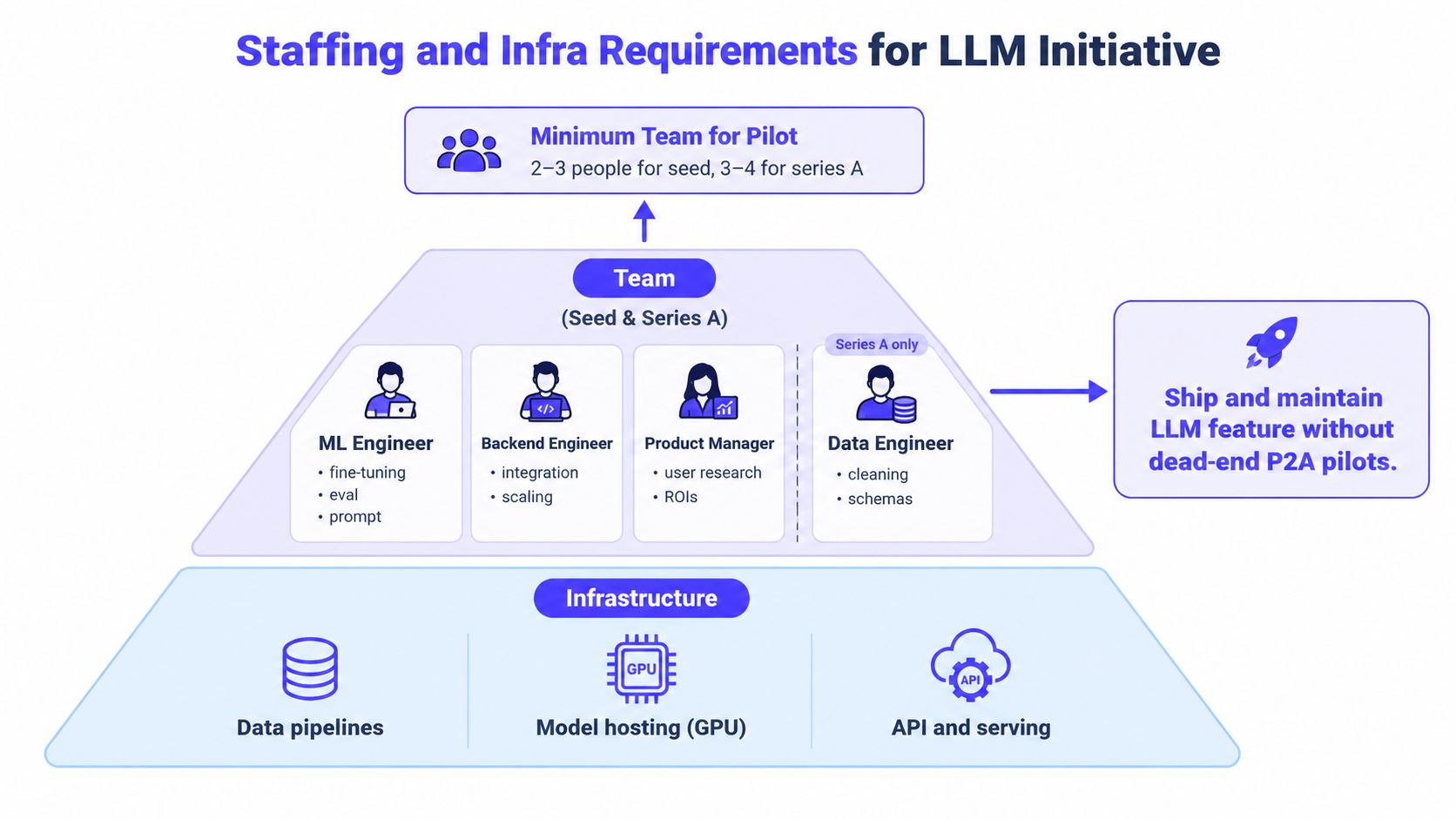
A pilot doesn't need a large AI department. It does need clear ownership. For seed and Series-A teams, a lean shape usually includes 2–3 people: an ML engineer who understands retrieval and evaluation, a backend engineer who owns integration, latency, and cost, and a product manager or fractional AI advisor who keeps the use case tied to user value.
The ML engineer shouldn't become the only person who understands the system. The backend engineer needs access to usage telemetry and rate controls from the start. Product must define what a good answer means and when the system should defer to a human.
The minimum production foundation
You need a retrieval store when answers depend on changing internal knowledge. You need an orchestration layer to manage prompts, tools, retries, and fallbacks. Secrets handling, tracing, an evaluation harness, and per-tenant budgets prevent a demo from becoming an unowned production dependency.
Use a simple ownership map:
- ML engineer: Retrieval, model selection, prompt behavior, evaluation, and fine-tuning decisions.
- Backend engineer: API integration, authentication, latency, retries, queues, and usage limits.
- Product manager: Workflow selection, user research, baseline measurement, and value definition.
- Data engineer: Schemas, source cleanup, refresh jobs, and data lineage when retrieval becomes central.
Hire full-time before scaling traffic if nobody can maintain evaluation, incident response, or data quality. Keep advisory strategy, specialist model review, or an initial red-team assessment fractional when the workload is still narrow.
Ownership test: If the model produces a bad answer on a Friday evening, someone must know whether to fix the prompt, retrieval, model, source data, or product guardrail.
This embedded video offers additional context on operating an LLM initiative:
Risk, Compliance, and the ROI Reality Check
An LLM can be technically impressive and financially wrong. NIST's Generative AI Profile identifies 12 distinct risk categories, including confidentiality, data privacy, intellectual property, environmental risks, and harmful outputs in its Generative AI risk profile. Treat that list as a launch requirement, not a governance document to read after deployment.
Customer-facing hallucinations create support and reputational costs. Prompt injection can cause a model to follow instructions embedded in untrusted documents. Private data can leak through logs, retrieval systems, connectors, or provider configurations. Summarization and scoring can reproduce bias, especially when the model turns incomplete records into apparently authoritative judgments.
Your legal and security review should answer concrete questions:
- Data residency: Where may customer data be processed, stored, and retrieved?
- Logging: Which prompts, outputs, and tool calls must your SOC 2 evidence retain?
- Regulation: Does the use case trigger higher obligations under applicable GDPR or EU AI Act requirements?
- Contracts: Which provider tier governs whether prompts and outputs are used for service improvement?
- Security: What happens when retrieved content contains malicious instructions?
The ROI gap deserves equal attention. One 2025 study reported executives expected 171% ROI on agentic AI, while other 2025 research found only 15% of generative-AI users already had significant measurable ROI and 38% expected it within a year, summarized in an enterprise AI statistics analysis. Those figures point to a measurement problem as much as a model problem. Usage, seat activation, and demo quality aren't financial outcomes.

Before launch, require a red-team pass, an evaluation threshold, a rollback path, human review for high-impact actions, and a quarterly ROI review tied to revenue or cost avoided. Teams that need a practical operating reference can use this guide to manage AI risk in business.
Decision Scorecard and 90-Day Pilot Checklist
Use a weighted scorecard before committing production budget. Score each criterion from 1 to 5, where 1 means weak fit and 5 means strong fit. Weight the criteria that matter most to your business, then record the evidence behind every score.
| Criterion | Score, 1–5 | Evidence to Record |
|---|---|---|
| Workflow volume | Tasks, requests, or documents processed | |
| Language bottleneck | Why rules or conventional software fall short | |
| Baseline clarity | Current time, cost, quality, and rework | |
| Time to impact | Earliest credible user value | |
| Build-versus-buy fit | API, open-weight, or conventional alternative | |
| Staffing readiness | Named owners for model, backend, data, and product | |
| Data sensitivity | Residency, privacy, and access requirements | |
| Compliance exposure | Review obligations and audit evidence | |
| Payback potential | Revenue created or cost avoided | |
| Evaluation maturity | Test set, thresholds, and rollback procedure |
Set your own threshold before scoring. A high score should support a pilot or greenlight. A middle score should trigger a narrower pilot with explicit constraints. A low score means no-go, or a return to process redesign. Don't let the team adjust the threshold after seeing the result.
The 30-60-90 day rollout
Days 1–14: Pick one workflow, document the current baseline, define the success metric, classify data, and write kill criteria. Select an API unless residency or customization makes that impossible.
Days 15–60: Ship a narrow pilot with retrieval where needed. Add token telemetry, rate limits, tracing, human review, and an evaluation set of 100–200 real prompts. Compare model output against the baseline, including correction time and failure severity.
Days 61–90: Measure the workflow against the baseline, then choose one path: scale, fine-tune, redesign, or kill. Prepare a memo that the founder or accountable executive signs, committing budget, scope, owner, and the go, pivot, or kill date.
For additional implementation safeguards, review this resource on avoiding AI pitfalls in business.
Your checklist for next week is straightforward:
- Choose one workflow: It must have a measurable manual baseline.
- Set the economic floor: Define the maximum acceptable cost per completed task.
- Instrument usage: Capture tokens, latency, retries, review time, and tenant-level spend.
- Build evaluation: Use representative real prompts and document failure classes.
- Define human control: Specify which actions require approval.
- Set kill criteria: Decide in advance what result ends the pilot.
- Assign ownership: Name the ML, backend, product, data, and risk owners.
- Book the decision: Put the scale, pivot, or kill review on the calendar now.
ThirstySprout helps startups source senior remote AI engineers, MLOps specialists, data engineers, AI product managers, and fractional teams for focused LLM pilots. Visit ThirstySprout to start a pilot with clear scope, technical ownership, and a decision date.
Hire from the Top 1% Talent Network
Ready to accelerate your hiring or scale your company with our top-tier technical talent? Let's chat.