

You've connected a language model to your company's documents. The demo answers a few questions, cites useful passages, and looks ready to ship. Then real users ask about an outdated policy, an exact product code, a document they're not allowed to see, or a question that requires evidence from several sources. The confident answer is wrong, slow, or unsafe.
That gap is what production RAG must close. Retrieval-augmented generation is not a prompt pattern. It's an engineered pipeline covering data ingestion, retrieval, reranking, generation, evaluation, security, and operations.
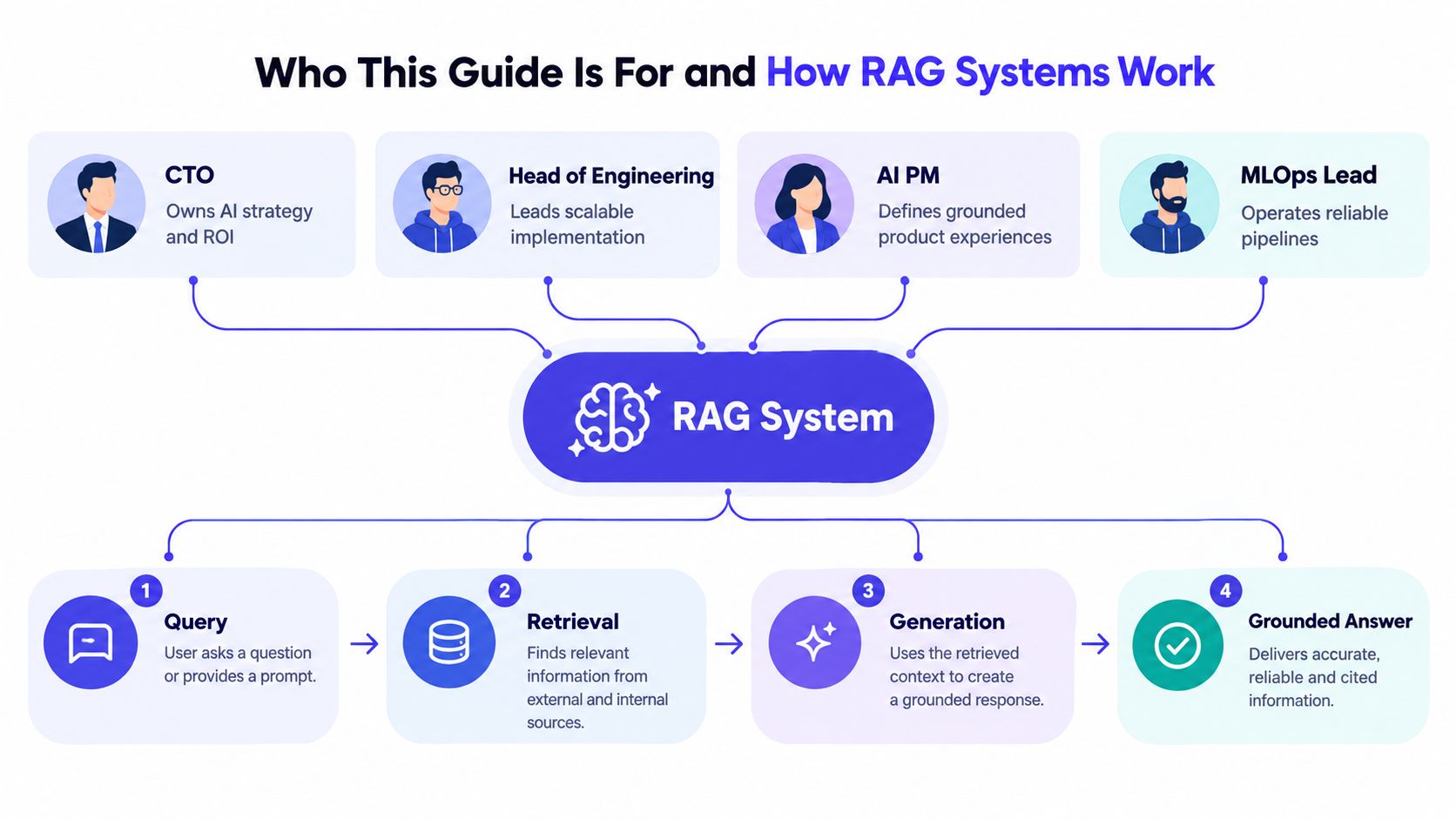
Who This Guide Is For and How RAG Systems Work
This guide is for CTOs, Heads of Engineering, AI product managers, and MLOps leads who need to move from a working prototype to a dependable system in weeks. It's also useful when you're deciding whether to hire one senior AI engineer, add an MLOps specialist, or assemble a remote team that can own ingestion, evaluation, and production operations.
RAG fits when your answers must use changing or private information. A plain large language model prompt can reason over text you provide, but it won't reliably search a large knowledge base or enforce document permissions. Fine-tuning can change behavior and style, but it's a poor substitute for a frequently changing source of truth. RAG keeps knowledge in retrievable sources and gives the model selected evidence at query time.
| Use case | Start with | Why |
|---|---|---|
| Frequently changing policies, product docs, tickets, or internal knowledge | RAG | Refresh the index without retraining the generator |
| Stable response style, formatting, or domain behavior | Fine-tuning, usually alongside RAG | Change how the model responds, while retrieval supplies current facts |
| Small, stable context with no access-control requirements | Direct prompting | Avoid retrieval complexity when the full context is already manageable |
| Answers requiring several sources or business actions | RAG with routing, validation, and escalation | Retrieval alone isn't enough for workflow safety |
The end-to-end flow is straightforward:
- Query: Normalize the user's question and determine filters or routing requirements.
- Retrieval: Search lexical and semantic indexes for candidate passages.
- Reranking: Reorder candidates using the query and passage together.
- Generation: Give the language model a compact evidence set and strict grounding rules.
- Grounded answer: Return the response with traceable citations, refusal behavior, and telemetry.
A useful rule is to start with the simplest retriever that can answer your evaluation set, then add complexity only when a measured failure justifies it. For many business systems, that means clean ingestion, metadata filters, hybrid retrieval, a reranker, and separate retrieval and generation evaluation.
If you're designing a support experience, the practical application is similar to the architecture described in guides on how to build RAG-powered support agents. The important distinction is that a production support agent needs more than a chat interface. It needs evidence quality checks, permissions, escalation, and an audit trail.
Expect the first useful version to require a focused engineering effort rather than a single prompt experiment. A small team can validate the core path quickly, but production ownership still needs clear responsibility for data pipelines, model behavior, observability, and security.
Ingesting and Preparing Data for Retrieval
Most RAG failures begin before the first user query. If your ingestion pipeline drops headings, mixes document versions, strips table context, or discards access-control metadata, a stronger model won't repair the evidence later.
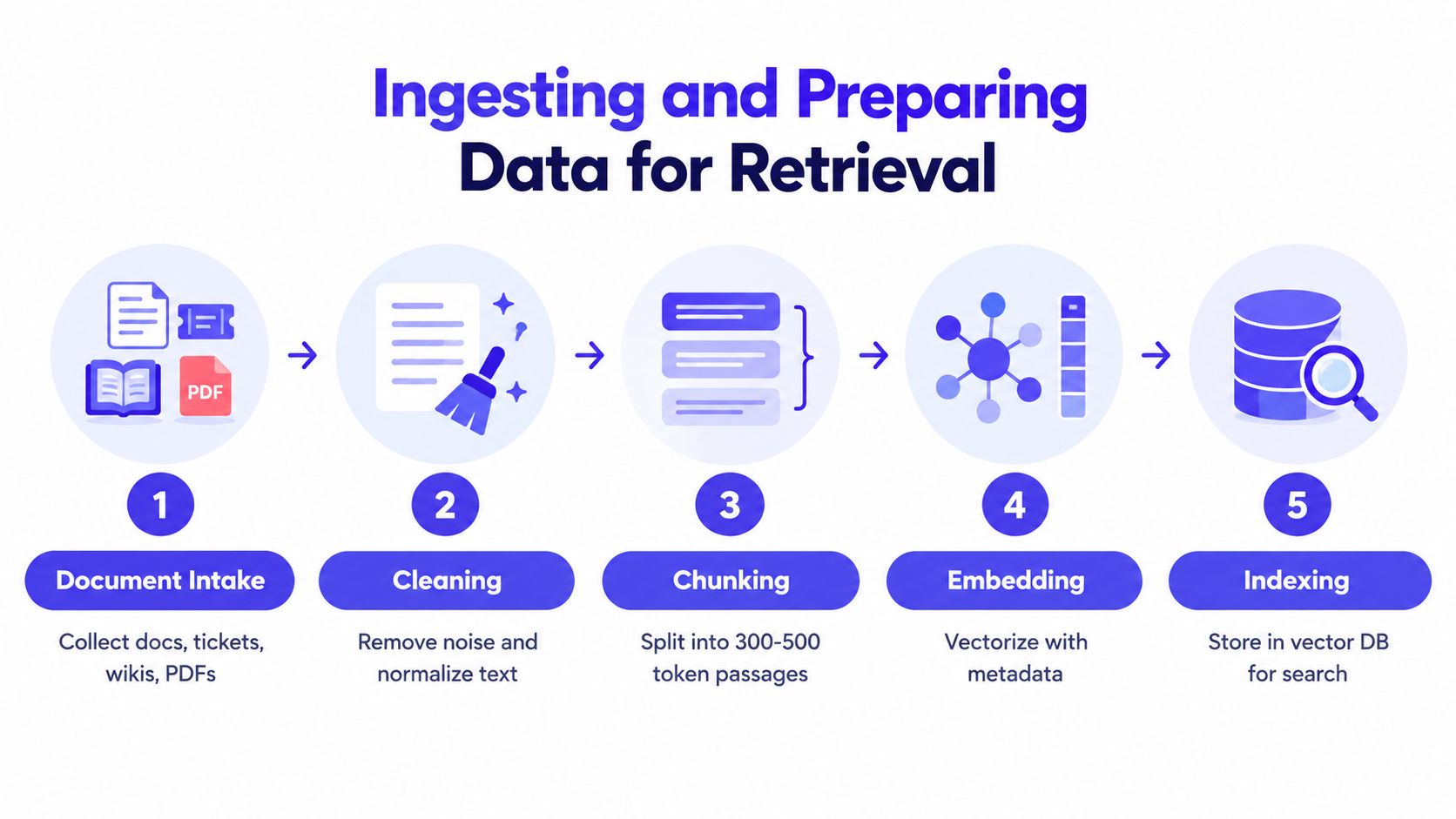
Treat ingestion as a repeatable data product:
- Collect: Pull documents, tickets, wikis, PDFs, and structured records from authoritative systems.
- Normalize: Remove navigation noise, duplicated footers, broken encoding, and irrelevant boilerplate.
- Structure: Preserve titles, sections, page references, document identifiers, timestamps, versions, and ownership.
- Chunk: Split content into passages that retain enough meaning to answer the intended question.
- Embed and index: Store vectors with the original text and filterable metadata.
- Validate: Sample chunks and test whether a human can identify the source and context.
Chunking needs a measured starting point, not a universal default. A 2024 study found that 512-token and 1024-token chunks consistently outperformed other tested sizes across three document types, with the strongest similarity results appearing when retrieved chunks used about 40–50% of the context window for 512-token chunks and 60–70% for 1024-token chunks. See the chunk-size study for the reported results and test setup.
Task type matters too. A 2025 preprint reported that 64–128-token chunks suited short factual answers, while 512–1024-token chunks worked better for broader technical or contextual questions. On TechQA, the reported Recall@1 rose from 16.5% at 128 tokens to 61.3% at 512 tokens in that study, so test against your own query mix rather than copying a setting from a tutorial. The document-aware chunking research provides the comparison.
A representative ingestion configuration
Use semantic boundaries first, then apply a token budget. Overlap can help preserve answers that cross boundaries, but excessive overlap increases index size and can cause near-duplicate retrieval.
ingestion:sources:- type: support_docsauthority: current- type: ticketsauthority: operational- type: wikiauthority: internalcleaning:remove_navigation: truepreserve_tables: truenormalize_whitespace: truechunking:strategy: heading_then_token_limittarget_tokens: 512max_tokens: 1024overlap_tokens: 64preserve:- title- section- page- source_id- version- acl- sensitivityembeddings:model: production_embedding_modelbatch_size: 32cache_by_content_hash: trueindexing:lexical: truevector: truemetadata_filters: trueThe exact embedding model is less important than testing it on representative queries. Cache embeddings by content hash, process updates incrementally, and retain enough lineage to remove or replace old versions safely.
A support knowledge base with roughly 20k documents can usually begin with one clear ingestion path, heading-aware chunks, hybrid indexes, and a manually reviewed query set. A much larger enterprise corpus needs stronger partitioning, incremental updates, source ownership, deletion workflows, and query-time permissions from the start. The scale changes the operational design, not the basic evidence contract.
For adjacent pipeline practices, see data engineering best practices. The same principles apply here: explicit ownership, reproducible transformations, validation, and observable changes.
This short walkthrough can help teams visualize the ingestion flow before they implement it:
Choosing Your Retrieval Strategy and Vector Database
Retrieval choices should follow query behavior. Dense retrieval captures semantic similarity, lexical retrieval handles exact terms, hybrid retrieval combines both, and reranking spends more computation on the candidates most likely to answer the question.
Recall@k and MRR@k are core lexical retrieval metrics, because the generator can't use evidence the retriever never returns. The 2024 benchmarking work on retrieval metrics in RAG explains why these measures belong in the first evaluation loop.
| Strategy | Best for | Latency impact | Accuracy lift |
|---|---|---|---|
| Dense embeddings | Natural-language questions and paraphrases | Moderate, depending on index and filters | Strong semantic matching, but can miss exact identifiers |
| BM25 lexical search | Product codes, names, acronyms, and exact policy language | Usually lower operational complexity | Strong lexical precision, weaker synonym handling |
| Hybrid retrieval | Mixed support, technical, and enterprise queries | More search work and score fusion | Broader candidate coverage |
| Hybrid plus reranking | High-value answers where top-result quality matters | Adds a model inference stage | Better evidence ordering, measured against your test set |
If users ask about exact error codes, release names, or contract terms, pure dense retrieval often leaves quality on the table. If they ask broad natural-language questions, pure BM25 can miss relevant passages that use different wording. Hybrid retrieval is a practical default when both query types matter.
A reranker examines the query and candidate passage together, which lets it correct weak ordering from the first-stage search. One benchmark summary reported top-1 accuracy rising from 62.67% to 83.00%, an improvement of 20.33 percentage points, after adding a reranker. Treat that as evidence for testing the stage, not as a guarantee for your corpus. The benchmark summary is available in this RAG retrieval analysis.
Run the smallest useful ablation
Create a fixed query set with expected evidence. Compare:
- Dense retrieval with a small candidate set.
- BM25 with the same evaluation questions.
- Hybrid retrieval with score fusion.
- Hybrid retrieval followed by a reranker.
- Each configuration across several top-k values.
Measure retrieval quality and latency together. A reranker that improves evidence ordering but violates your response-time target may belong only on high-risk routes, not every request.
Your vector database should support the operational features your index needs, including metadata filtering, updates, deletion, backups, namespaces or tenant isolation, and observable query latency. Don't choose based only on vector similarity speed. A smaller system with dependable filtering and simple operations can beat a more elaborate platform that your team can't maintain.
The vector search guide is a useful primer on the underlying search pattern. For a production decision, add your own requirements for data residency, access control, index rebuilds, and failure recovery.
Prompt Engineering and Generation That Stays Grounded
A strong retriever can still produce an unfaithful answer. The generation layer must make the evidence boundary explicit, preserve source identity, and give the model a safe response when the retrieved context doesn't support the question.
Use structured evidence blocks rather than pasting an undifferentiated text wall. Each block should include a stable source identifier, title or section, version information, and the passage itself. Keep only the passages selected after filtering and reranking.
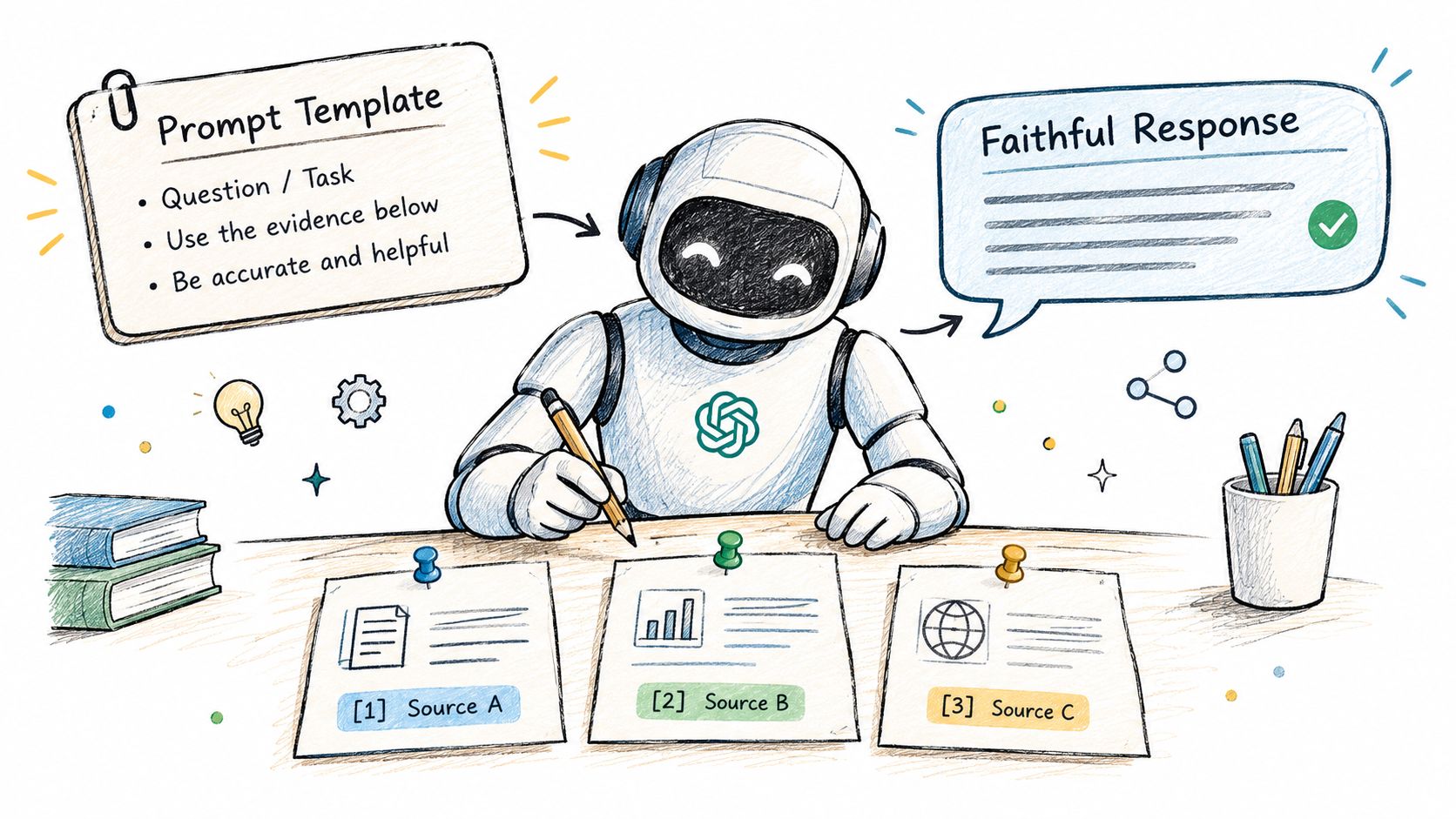
A representative prompt contract looks like this:
System:You answer using only the evidence blocks supplied below.Rules:- If the evidence does not support the answer, say that the available sources are insufficient.- Do not add facts from model memory.- Distinguish confirmed statements from unresolved conflicts.- Cite the source_id after each material claim.- Do not expose content the access-control layer has excluded.Evidence:[Source ID: DOC-123][Title: Refund policy][Version: current][Passage: ...][Source ID: DOC-456][Title: Regional exception][Version: current][Passage: ...]Question:{user_question}Response:Give a concise answer, then list the supporting source IDs.The model should not decide whether a user is allowed to see a passage. The retrieval layer should enforce that boundary before prompt assembly. The prompt can still instruct the model not to mention excluded content, but that instruction is a secondary safeguard, not authorization.
Handle contradictions as data
Suppose one policy says refunds are available under a general rule, while a regional document states an exception. Don't ask the model to reconcile them. Pass both passages with their metadata, instruct it to identify the conflict, and route the answer for clarification when the source hierarchy doesn't resolve it.
Multi-hop questions need the same discipline. Break the request into sub-questions, retrieve evidence for each, record which passage supports each step, and generate only after the chain has coverage. A fluent synthesis without evidence linkage is still an unsupported answer.
Large context windows don't remove the need for selection. More context can raise cost and latency while giving the model more opportunities to blend unrelated or conflicting passages. The best prompt is usually the smallest evidence set that covers the answer with traceable support.
Evaluating Retrieval and Generation Separately
A single “answer quality” score hides the cause of failure. If the answer is wrong, you need to know whether ingestion created a bad chunk, retrieval missed the evidence, reranking ordered it poorly, or generation invented a conclusion.
Evaluate the pipeline in two layers:
| Layer | Questions | Useful measures |
|---|---|---|
| Retrieval | Did the system return the right evidence, and did it rank that evidence early? | Recall@k, MRR@k, precision, context relevance |
| Generation | Did the answer use the evidence accurately and completely? | Faithfulness, correctness, answer relevance, citation quality |
Build a gold set from real user questions, expected evidence, acceptable answers, and known refusal cases. Include exact-term questions, ambiguous questions, outdated-document traps, permission-sensitive questions, contradictory sources, and multi-hop tasks. Keep the set versioned so changes to chunking, embedding models, filters, or prompts can be compared fairly.
Use benchmarks to expose blind spots
RAGBench introduced a 100,000-example benchmark spanning five industry-specific domains and multiple RAG task types, while CRAG added 4,409 question-answer pairs and mock APIs for testing web and knowledge-graph retrieval behavior. These resources show how evaluation has moved beyond informal demos toward measurable pipeline behavior. The benchmark discussion is covered in the RAG evaluation survey.
MIRAGE uses 7,560 curated instances mapped to a 37,800-item retrieval pool, offering another way to test retrieval and generation across broader coverage. A separate failure-mode taxonomy identifies 33 failure modes across seven stages, including ingestion, representation, retrieval, generation, evaluation, deployment, and orchestration. Use these taxonomies to organize incident reviews instead of labeling every bad answer as “hallucination.” The methodology is described in this RAG evaluation paper.
For unsupported claims, RAGTruth is especially relevant. The ACL paper describes it as a corpus designed to analyze word-level hallucinations in standard RAG frameworks, which makes it useful for auditing whether generated language is supported by retrieved evidence. See the RAGTruth corpus paper.
A practical scorecard
| Check | Pass condition | Diagnostic action |
|---|---|---|
| Evidence recall | Expected passage appears in retrieved candidates | Review parsing, chunking, embedding, and filters |
| Rank quality | Best evidence appears near the top | Compare hybrid fusion and reranking |
| Context relevance | Supplied passages address the question | Reduce candidate noise or adjust routing |
| Faithfulness | Claims are entailed by evidence | Tighten prompt, add validation, or refuse |
| Citation accuracy | Each citation supports the nearby claim | Preserve source lineage and test attribution |
| Operational behavior | Latency, resource use, and failures stay within target | Profile each stage and add fallbacks |
Run ablations for chunk size, overlap, top-k, reranker choice, and prompt context limits. Record quality and operational cost together. A system that improves benchmark scores while consuming excessive context or creating unacceptable latency isn't ready for the product.
Deploying Secure and Cost Efficient RAG in Production
Production readiness comes from treating every stage as an independently observable service. Capture retrieval latency, reranking latency, generation latency, context size, model usage, error paths, and answer validation outcomes. Monitor throughput, memory footprint, CPU or GPU utilization, context recall, query accuracy, and factual consistency together, because optimizing one can damage another.
Security must be enforced before restricted evidence enters the generation path. An enterprise guide on enterprise RAG access control argues that permissions belong at query time in the index layer, not as a post-retrieval filter. Preserve ACLs, owner, source, sensitivity label, and last-modified date through ingestion, indexing, retrieval, citations, and audit logs.
Use a staged production path
- Pilot: Keep the scope narrow, use a representative evaluation set, and make human review available for uncertain answers.
- Controlled release: Add monitoring, rate limits, deletion workflows, source freshness checks, and fallback behavior.
- Scale: Tune indexes, cache safe repeat queries, route simple questions differently from multi-hop tasks, and review resource usage under realistic load.
Workflow-facing systems need more than answer accuracy. A JMIR analysis of RAG evaluation recommends safety monitoring, contradiction handling, escalation paths, and governance for systems that influence operational workflows. That's the right standard for support automation, internal decision tools, and agents that can take actions.
Keep a runbook for stale indexes, unavailable vector stores, embedding-model changes, prompt regressions, permission mismatches, and unsafe answers. The production readiness checklist can help structure that review.
Your next steps are simple:
- Select one narrow use case and collect real questions with expected evidence.
- Build ingestion, hybrid retrieval, reranking, grounded generation, and separate evaluation in a controlled pilot.
- Add query-time access control and observability before expanding the corpus or enabling workflow actions.
ThirstySprout helps companies add vetted remote AI engineers, MLOps specialists, data engineers, and AI product talent for RAG projects, from a focused specialist to a complete team. Visit ThirstySprout to start a pilot or review sample profiles, then book a scope call for your production roadmap.
Hire from the Top 1% Talent Network
Ready to accelerate your hiring or scale your company with our top-tier technical talent? Let's chat.