

You're a Series A founder hiring a staff machine learning engineer. The roadmap is ambitious, the data platform is still changing, and a poor full-time hire could consume 18 months and roughly $400K, based on the scenario defined for this guide. You need evidence from real work, not another polished interview performance.
Contract-to-hire gives both sides a structured trial before a permanent employment decision. The worker joins through a staffing agency or employer of record, delivers against an agreed scope, and may later convert to the client's payroll. It can reduce uncertainty, but it doesn't guarantee a job offer. For senior AI hires, the model only works when you engineer the trial as a decision process rather than treating it as an indefinite audition.
What Contract to Hire Actually Means for Senior AI Hires
Contract-to-hire is a fixed-term engagement with a possible permanent conversion. The staffing partner employs and pays the worker during the trial. Your company directs the work, evaluates performance, and decides whether to make a permanent offer under the agreed conversion terms.
That differs from ordinary freelancing. A freelancer usually owns a defined project or deliverable and may not integrate into your engineering rituals. It also differs from direct contracting, where the client typically places the worker on its own payroll or engages the person under its own contracting structure. In contract-to-hire, the staffing partner remains the employer during the trial.
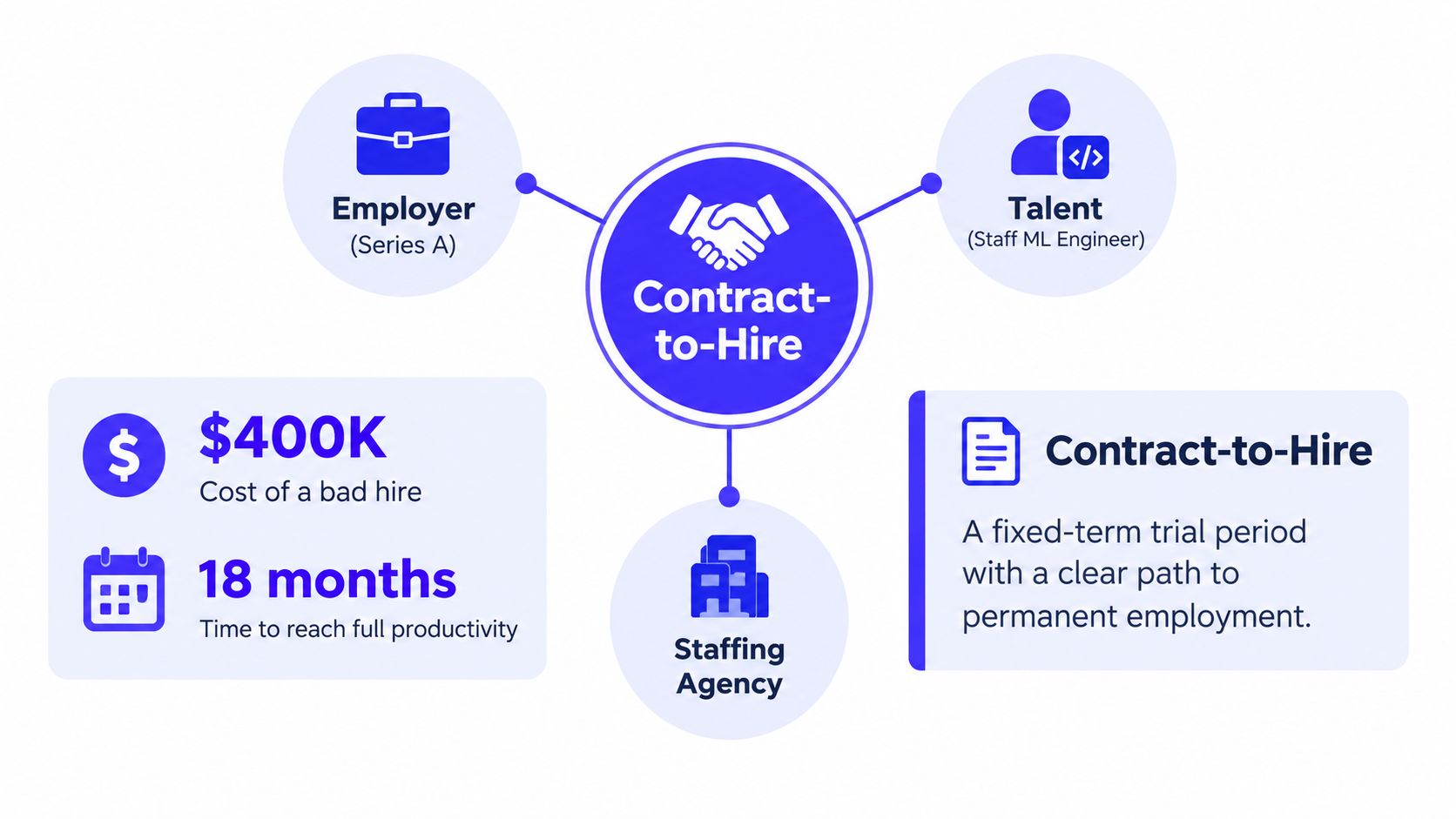
For senior AI roles, a trial has real value. An ML engineer needs time to understand your data quality, deployment controls, model evaluation, infrastructure, and team habits. A candidate also needs to inspect your stack, leadership, product direction, and operating standards before leaving a stable role. A résumé and system-design interview can't reveal how someone handles an unreliable feature store or pushes back on an unsafe launch.
What changes during the trial
The agency or employer of record generally handles payroll and employment administration. Benefits may be supplied by that intermediary rather than your company, and the candidate's compensation, paid time off, termination terms, and conversion mechanics can differ from those of a permanent employee.
Before you start, write down:
- Trial scope: The production problem the engineer will own.
- Decision criteria: The technical and behavioral evidence required for conversion.
- Decision date: The date for a go, no-go, or extension decision.
- Conversion terms: Expected role, compensation structure, start window, and any fee trigger.
- Management model: Who gives feedback and who makes the final call.
A senior hire shouldn't enter a vague “tryout.” Use a structured candidate vetting process, then let the trial answer the questions interviews couldn't.
The Trial to Conversion Timeline and Stages
A strong answer to “how does contract to hire work” is a staged operating plan. Each stage should produce a decision artifact, not just another meeting.
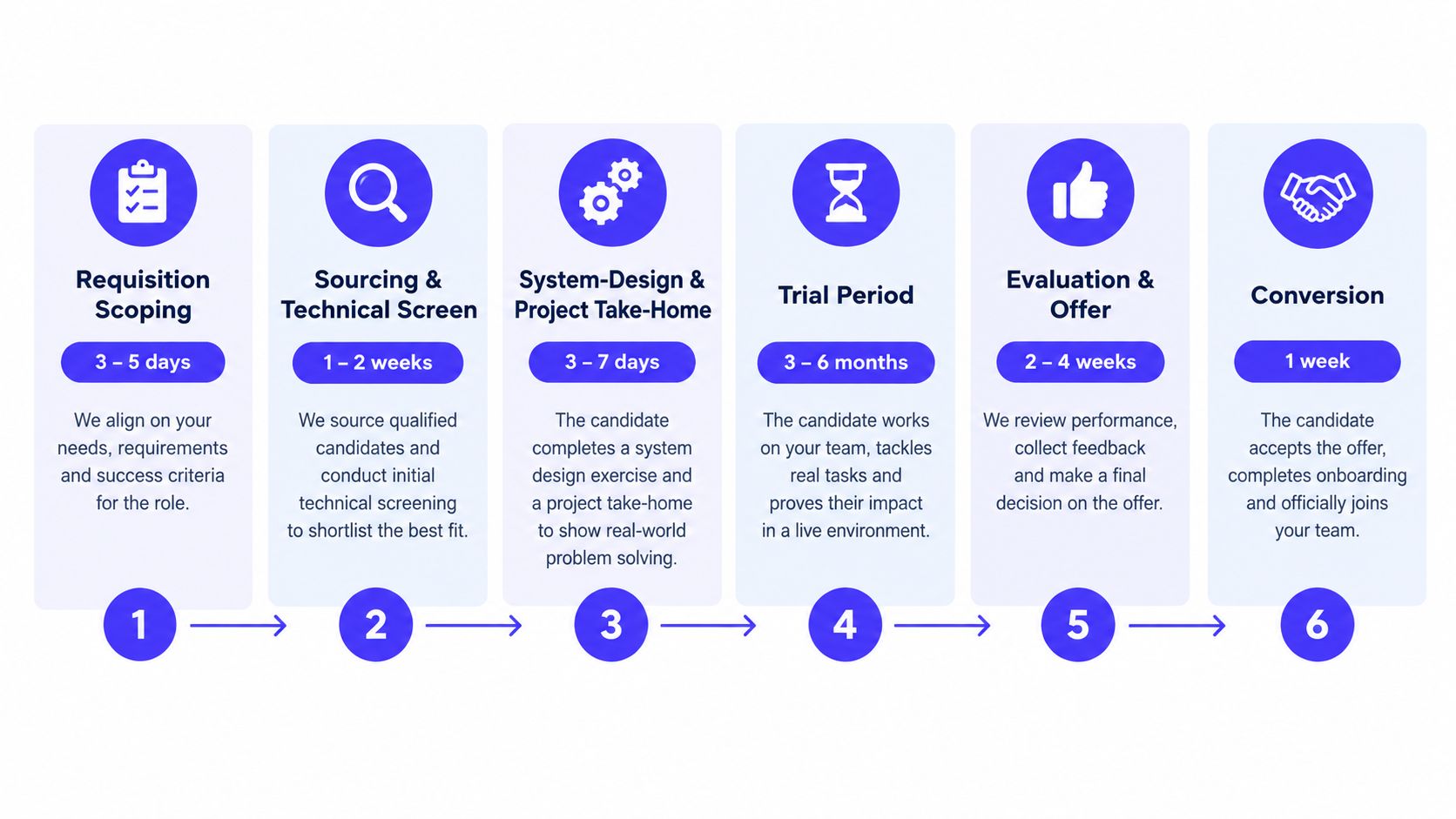
Six stages from scope to offer
Requisition scoping, 3–5 days. Define the business outcome, technical boundaries, reporting line, and reason the role may convert. For an AI engineer, specify whether success means improving retrieval quality, stabilizing model serving, or shipping an internal capability.
Sourcing and technical screening, 1–2 weeks. Assess production experience, system ownership, communication, and relevant stack knowledge. Don't over-index on algorithm puzzles when the role requires judgment across data, infrastructure, and product constraints.
System design and project evaluation, 3–7 days. Use a realistic exercise. Ask the candidate to explain failure handling, observability, evaluation data, security, and rollout strategy. A take-home should reveal decisions, not reward unpaid labor.
Trial kickoff. Give the engineer a Day 1 onboarding plan and milestones for the first 30, 60, and 90 days. Provide repository access, data documentation, architecture context, and a named technical partner.
Active trial. The engineer works inside the team while you track output, collaboration, ownership, and learning speed. The six-month point is a useful structural anchor for reviewing the arrangement, but it isn't a magic legal boundary. The relationship, including who controls the work, remains important.
Conversion decision, often within Days 150–180. Make a written decision before the engagement drifts. If the answer is yes, prepare the payroll transition and permanent offer. If it's no, communicate the reason and close access cleanly. If it's extend, document the remaining evidence required and the new decision date.
At conversion, payroll generally moves from the agency to the client. Benefits may change, equity usually requires a new grant, and notice provisions may reset under the permanent employment agreement. Review these details before the candidate starts, not after the person has committed emotionally and operationally to the role.
Practical rule: Never let a trial pass its planned decision date without a written go, no-go, or extend decision.
Cost, Payroll Setup, and Who Carries the Risk
The bill rate isn't the candidate's full economic picture. During the trial, the agency or employer of record may handle payroll taxes, benefits administration, unemployment coverage, and other employment obligations. Your company pays for access to the worker and carries the cost of onboarding, management time, tooling, and delayed productivity.
The candidate may also experience a different package from the one offered after conversion. Benefits can be limited or supplied by the intermediary, and the permanent employment offer may introduce different equity, paid time off, and termination terms. Put every material difference in writing.
A practical allocation table
| Cost or Risk Category | Client Pays / Carries | Agency / EOR Carries | Candidate Bears |
|---|---|---|---|
| Trial compensation | Agency bill rate and agreed expenses | Payroll administration and payment processing | Possible differences in benefits or permanent compensation |
| Employment administration | Vendor fee and operational coordination | Payroll tax handling and employment records | Need to verify payslips, deductions, and benefits |
| Day-to-day integration | Onboarding, access, management, and review time | Support with employment logistics | Ramp effort and uncertainty about permanence |
| Intellectual property | Clear assignment terms and secure systems | Contractual cooperation with the client arrangement | Need to understand ownership obligations |
| Failed trial | Lost onboarding time, delayed roadmap progress, and replacement effort | Contract closeout and payroll termination process | Lost opportunity and possible income disruption |
| Conversion | Permanent payroll, benefits, equity, and any agreed conversion fee | Transfer coordination and release terms | New employment terms and possible reset of benefits |
Payroll responsibility doesn't remove client risk. Your managers still control access, work priorities, code review, and production decisions. If the engineer spends too long learning undocumented systems, the business absorbs the opportunity cost even when the agency handles the paycheck.
Review the engagement alongside your broader staff augmentation services strategy. Contract-to-hire is appropriate when you need a genuine evaluation period. It isn't a way to disguise a permanent role, avoid basic employment planning, or postpone an unpopular decision.
Startups vs Enterprises Using Contract to Hire for AI Talent
A seed-stage startup and a regulated enterprise may use the same hiring label for completely different reasons. The startup needs proof that a senior engineer can create production velocity with incomplete systems. The enterprise may need time to manage headcount controls, procurement, security review, and multiple leadership approvals.
| Dimension | Startup, Seed–Series B | Enterprise, 1,000+ employees |
|---|---|---|
| Primary reason | Validate execution, product judgment, and team fit | Manage headcount constraints and evaluate performance in context |
| Trial owner | CTO, founder, or staff engineer | Engineering manager with Talent, HR, procurement, and legal support |
| Evidence that matters | A shipped AI capability, sensible trade-offs, fast learning | Architecture quality, code review, reliability, documentation, and cross-team influence |
| Equity discussion | Often deferred until conversion and tied to the permanent offer | Usually governed by a formal compensation and equity process |
| Main risk | Runway changes before the decision | Slow approvals outlast candidate patience |
| Best operating style | Tight scope, direct feedback, visible roadmap | Written gates, stakeholder map, approval calendar, and documented controls |
A startup may want to use the trial as a culture filter before discussing meaningful equity. That can be reasonable, but withholding the basic conversion logic creates distrust. Tell the candidate who decides, what evidence matters, and what happens if the roadmap or funding position changes.
Enterprises need the opposite discipline. A manager may see strong performance while a headcount committee delays the offer. Schedule the approval work at kickoff, not after the engineer has completed the trial. The candidate should know whether conversion depends on performance alone or also on an unapproved requisition.
Match the scorecard to the environment
For a startup, score production velocity, ownership, customer impact, and the ability to simplify. For an enterprise, score architecture judgment, review quality, operational discipline, and communication across teams. Don't use a startup scorecard in a regulated environment, and don't force a large-enterprise process onto a small team that needs an engineer shipping this quarter.
The model is worth considering only when your organization can make a timely decision. Compare the alternatives in contract-to-hire versus direct hire before presenting the role. A direct hire is often more attractive to a senior candidate when your conversion authority is uncertain.
Conversion Odds and How to Engineer a Better Outcome
A three-to-six-month trial does not guarantee permanent employment. One independent guide reports a median conversion share of 10% in North America, 8% in APAC, and 5% in Europe across an employer's temporary workforce, while purpose-built contract-to-hire programs report 60% to 75% conversion. Those populations aren't comparable, which is precisely why you need to define your own conversion pool before using any benchmark. (Kore1's contract-to-hire conversion guidance)
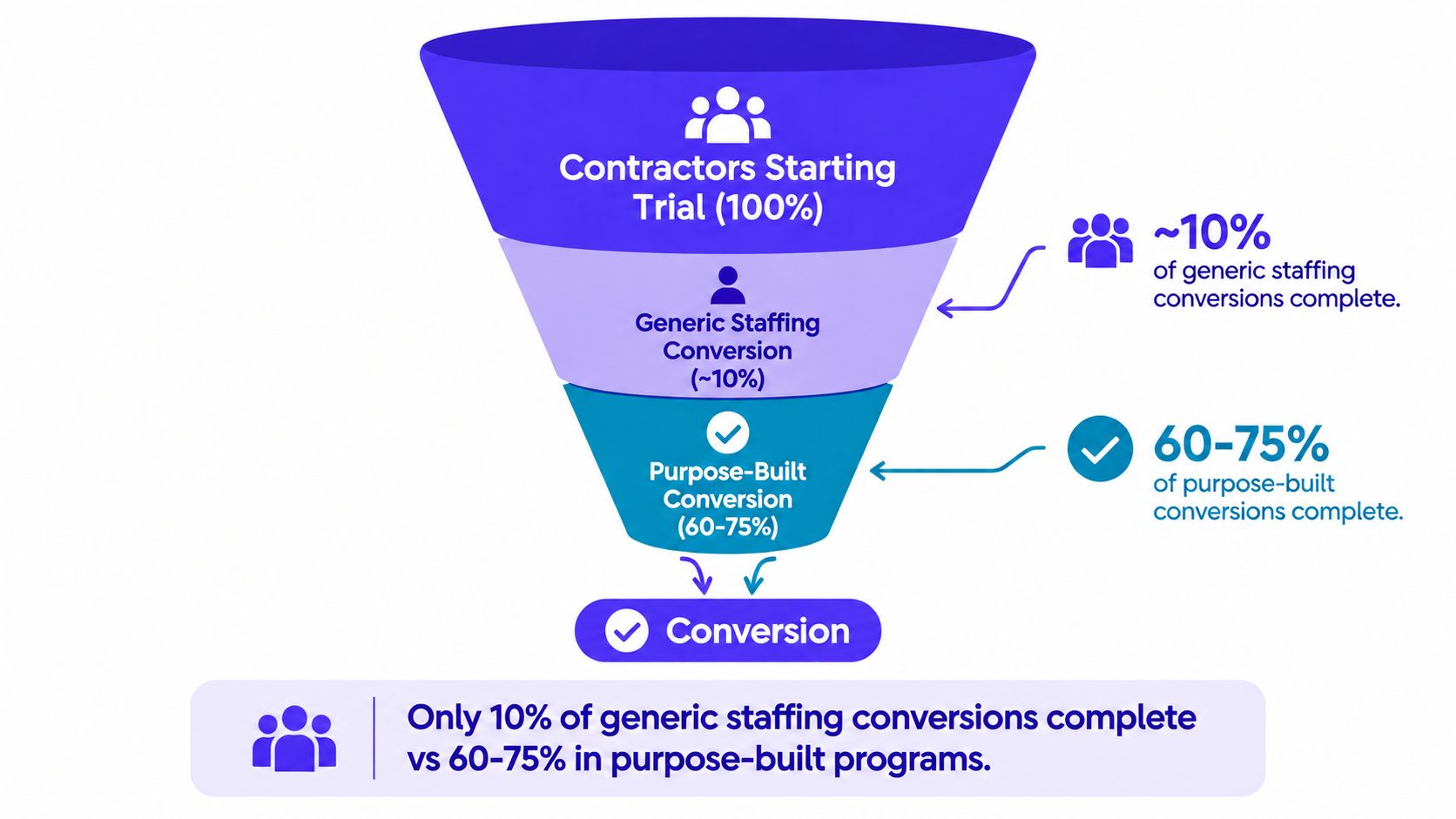
The gap comes from intent and management. Generic staffing includes temporary workers who never expected to convert. A purpose-built program starts with a role, candidate, budget path, and decision owner aligned around a permanent possibility.
Engineer the trial before Day 1
Write one scorecard with four evidence categories:
- Technical output: Did the engineer ship the agreed deliverable with sound evaluation and operational controls?
- Collaboration: Did they communicate trade-offs, respond to review, and work effectively with product and platform partners?
- Ownership trajectory: Did they identify risks, improve the system, and take responsibility beyond assigned tickets?
- Mission alignment: Do they understand the business problem and make decisions that support it?
Run weekly check-ins, especially at the beginning. One industry guide reports a 27% baseline conversion rate, with weekly check-ins during the first three weeks associated with conversion toward 65% and candidate drop-off reduction of 41%. Treat those figures as a benchmark from that guide, not a promise for your program. (80Twenty's contract-to-hire guidance)
At Days 30, 60, and 90, make the evidence visible. Use one decision-maker, record feedback, and tell the candidate what must change. Pre-agree the salary, conversion fee, offer timing, and communication path with the agency.
Senior AI candidates often have competing offers and strong alternatives. Keep them engaged by giving meaningful system access, scheduling technical conversations with future peers, sharing roadmap context, and resolving approval questions early. Don't ask someone to prove commitment while your company withholds the information they need to assess the role.
Use a direct hire instead when you already know the role, have approved headcount, and can evaluate the candidate through a rigorous selection process. Contract-to-hire is the wrong tool when nobody owns the conversion decision or when the client only wants temporary delivery.
Worker Classification, Contracts, and Paperwork to Get Right
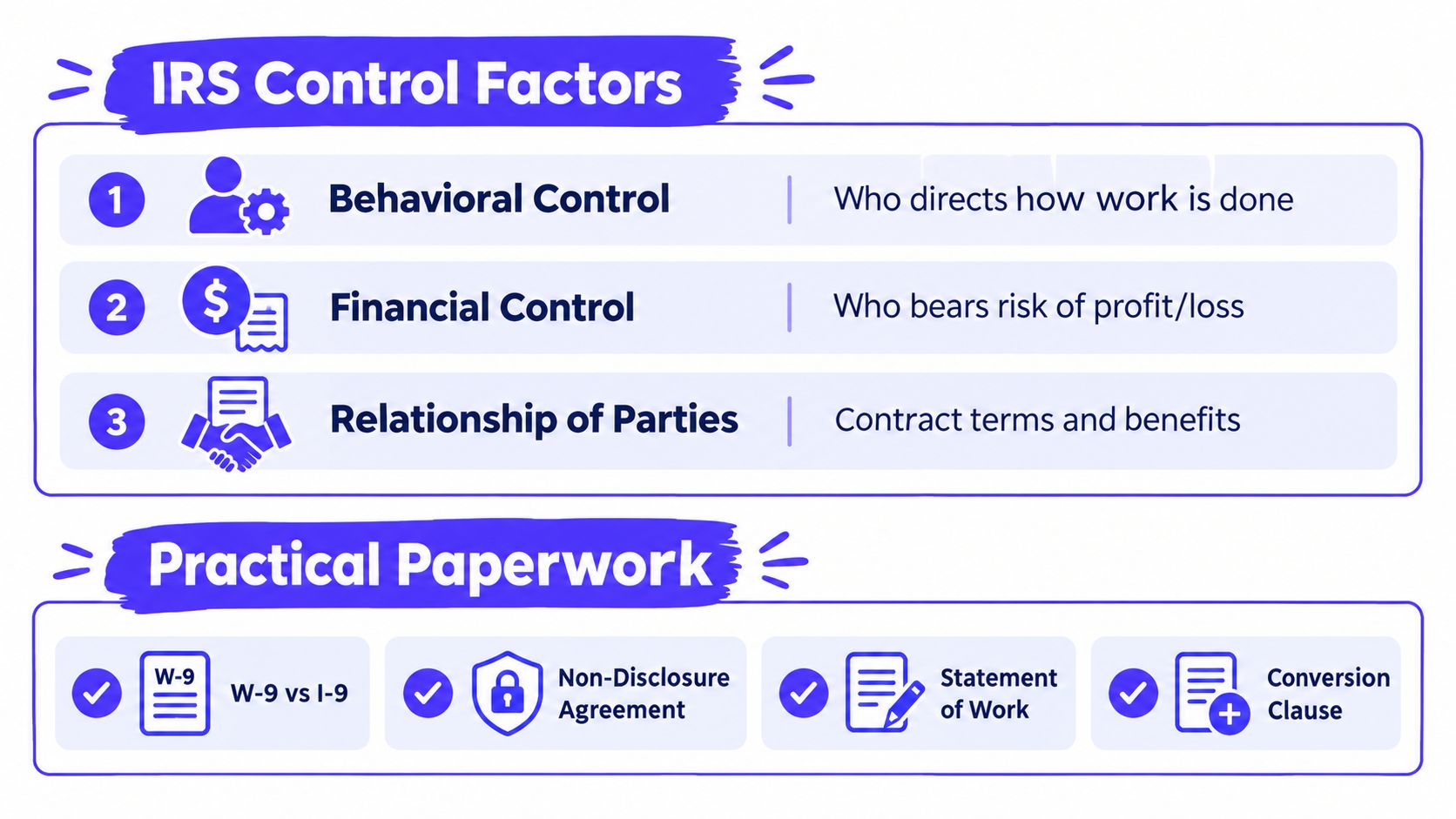
The Internal Revenue Service evaluates worker status through the actual relationship, not the label on a document. Its framework considers behavioral control, financial control, and the relationship of the parties, including written contracts, benefits, expense reimbursement, tools, and whether the work is a key part of the business. (IRS worker classification guidance)
That matters when a company calls someone an independent contractor but manages them like an employee. Who directs the method of work? Who sets hours? Who supplies tools? Who pays expenses? Who controls the result and the means used to achieve it? The IRS says a written independent-contractor clause alone doesn't settle the question, and businesses can use Form SS-8 when they need a federal determination. (IRS relationship guidance)
Paperwork should follow the employment model
At the start, the parties should identify the scope, duration, deliverables, confidentiality obligations, security requirements, and ownership of work product. A statement of work and a master services agreement should align with the actual operating relationship.
Before signing, review:
- Engagement documents: Statement of work, master services agreement, pay terms, duration, and termination language.
- Control boundaries: Who directs outcomes, who manages daily work, and whether the arrangement matches the stated classification.
- Confidentiality and IP: Non-disclosure obligations, code ownership, data handling, and assignment language.
- Conversion terms: Fee trigger, offer timing, release process, benefits transition, and equity treatment.
- Permanent hire documents: Offer letter, employment eligibility paperwork, benefits enrollment, equity grant, and updated IP assignment.
The IRS also describes common-law analysis around control over both the result and the means of accomplishing the work, with some analyses using 20 factors. Use that lens before kickoff and again before conversion, because supervision can change as the role becomes integrated. (IRS Topic 762)
For a practical legal starting point, review this independent contractor agreement template guide from Coto & Waddington, Attorneys at Law. Have counsel adapt it to your jurisdiction, staffing structure, and actual control model.
Checklist, Decision Criteria, and Next Steps
Run this checklist before the first day, then repeat the relevant items before the conversion decision. The purpose is to remove ambiguity while the engineer is still deciding whether your company deserves a permanent commitment.
The 10-item pre-conversion checklist
- Confirm the trial scope. Name one primary AI deliverable and define what “done” means.
- Instrument milestones. Record evidence at the agreed 30, 60, and 90-day points.
- Review control factors. Confirm that supervision, tools, expenses, and work methods match the employment model. Ask counsel about jurisdiction-specific rules.
- Audit dual payroll. Map the agency payroll during the trial to the client payroll after conversion, including deductions, benefits, and eligibility dates.
- Verify conversion-fee triggers. Confirm when a fee applies, how the amount is calculated, and what happens if the candidate converts after an extension.
- Clarify notice periods. Put trial termination, agency release, permanent start date, and post-conversion notice terms in writing.
- Document equity mechanics. State whether equity begins only after conversion, what approval is required, and when the grant paperwork arrives.
- Re-check references. Validate the candidate's recent scope, production ownership, and collaboration with former peers or managers.
- Re-check immigration status. Confirm work authorization and whether the payroll transition changes sponsorship or documentation requirements.
- Set the decision date. Name the decision-maker and record a written go, no-go, or extend date before the trial begins.
Use a weighted matrix rather than relying on the loudest stakeholder. Score each category from 1 to 5, then multiply by the weight your role needs.
| Decision category | Suggested weight | Go evidence |
|---|---|---|
| Technical output | 40 | Ships the agreed AI deliverable, tests it, and handles failure modes |
| Collaboration | 25 | Gives and receives review, communicates clearly, and earns trust |
| Ownership trajectory | 20 | Finds risks, improves systems, and operates beyond assigned tasks |
| Mission alignment | 15 | Connects technical choices to customer and business outcomes |
Set a 14-day decision window after the trial ends. A go decision should include the final role, compensation, start date, equity process, and benefits transition. A no-go decision needs a written rationale. An extension needs a narrow evidence gap, a short new scope, and a new decision date. “We're still discussing it” isn't an operating model.
Candidates also benefit from understanding how evaluation works before they enter the process. This overview of how employers screen applicants can help hiring teams identify which parts of their own process need clearer communication.
A Monday-ready pilot template
- Business outcome: One production AI capability tied to a named product or operational need.
- Technical owner: One manager accountable for scope and feedback.
- Success measures: Output quality, reliability, documentation, collaboration, and adoption evidence.
- Review cadence: Weekly check-in, plus formal milestone reviews.
- Conversion terms: Written before kickoff, including fee mechanics and offer timing.
- Risk review: Classification, confidentiality, access, immigration, and payroll transition.
- Decision: Go, no-go, or extend, recorded within the agreed window.
A focused 90-day pilot works best when the deliverable is valuable even if conversion doesn't happen. If the engineer leaves, you should retain usable documentation, tests, deployment knowledge, and a clean handoff. That protects the business without turning the candidate into disposable labor.
ThirstySprout helps startups and enterprises engage senior AI engineers through contract, fractional, direct-hire, and contract-to-hire models, with scope and conversion criteria defined before the work starts. Visit ThirstySprout to discuss a 90-day pilot, name the decision owner, and turn an uncertain AI hire into a controlled evaluation.
Hire from the Top 1% Talent Network
Ready to accelerate your hiring or scale your company with our top-tier technical talent? Let's chat.