

A Series A founder has lost a senior machine learning engineer three weeks before a board demo. The team has 60 days of runway pressure, the inference stack still needs an owner, and a recruiter is pitching a six-month contract-to-hire arrangement as the low-risk answer.
That framing is incomplete. The core question isn't just whether to pay a contractor or hire an employee. It's how long you need the person, how difficult the role is to evaluate before onboarding, and what happens if you make the wrong call.
Contract-to-hire can protect you from a fast mis-hire. Direct hire can protect you from paying a premium for an option you never use. For AI and machine learning roles, the choice matters even more because ramping into proprietary data, model pipelines, evaluation systems, and production constraints takes real context.
This guide gives you the operator's calculation. If you're also building the wider hiring system around funding, headcount planning, and recruiting execution, master startup hiring with Credit for Startups is a useful companion resource.
The Hiring Decision Most Founders Get Wrong
The founder in this situation has two tempting answers. Hire directly and hope the interview process identified the right person, or use contract-to-hire and call the temporary arrangement a cheap trial.
Both answers can be wrong.
The relevant comparison is the total cost over the expected tenure, not the first invoice. A contract-to-hire arrangement can look inexpensive during the first assignment period while accumulating agency markup, a conversion fee, duplicated onboarding, and delayed ownership. A direct hire can look expensive on day one while becoming the better financial decision if the engineer remains with the company.
AI hiring magnifies this blind spot. A senior engineer may need to understand your feature store, deployment process, model monitoring, evaluation harness, and product constraints before becoming fully effective. If you keep someone in a temporary structure while they build that context, you may pay contractor pricing during the very period when you're trying to create long-term institutional knowledge.
Operator rule: Choose contract-to-hire to manage uncertainty about the person or the role. Choose direct hire when the work is clearly permanent and the cost of delayed ownership is high.
The opposite risk also matters. A direct hire who fails after joining can create replacement work, team disruption, and an ownership gap. Contract-to-hire gives you a structured evaluation window, but only if you define the work and the conversion decision before the assignment starts.
Temporary and contract work remains a meaningful route into permanent employment. A global industry claim reported that 23% of temporary agency workers were offered permanent contracts in 2024, while the same context cited approximately 1.5 million temporary employees in the UK, representing 5.3% of all employees. The World Employment Confederation context on temporary work and conversion shows why this isn't a niche hiring mechanism, but it also shows that conversion isn't automatic.
Your decision should start with duration. If you expect a core AI role to last beyond the evaluation window, model the cost of keeping that person temporary. If you only need a defined deliverable, don't pretend you need a permanent employee.
How Contract to Hire and Direct Hire Actually Work
Contract-to-hire starts with a temporary engagement. The worker may sit on an agency's payroll or be employed through an employer of record, while your company directs the day-to-day work under the terms of the assignment. The agreement should state the assignment period, responsibilities, conversion option, fee schedule, intellectual property terms, confidentiality obligations, and what happens if either side ends the engagement.
Direct hire puts the employee on your payroll from day one, or on the payroll of the relevant employing entity in a cross-border arrangement. The employee receives the benefits, equity treatment, reporting structure, and employment protections defined by the applicable agreement and law.
The difference isn't merely temporary versus permanent. It determines who carries payroll and statutory exposure, who must maintain the employment relationship, and when your company receives the complete long-term commitment of the person.
A staffing partner can support either model, but the contract language and operating process should change with the model. For a broader view of how staffing providers structure technical services, see the Faberwork LLC services overview.
Contract-to-Hire vs Direct Hire at a Glance
| Dimension | Contract to Hire | Direct Hire |
|---|---|---|
| Start timing | Often faster because the worker begins through an agency or employing partner | Usually requires a completed employment process before the start date |
| Upfront cost structure | Temporary bill-rate markup during the assignment, followed by a possible conversion fee | Salary, benefits, payroll obligations, and any recruiting fee begin with employment |
| Conversion mechanics | Conversion normally requires a defined option, timing, and fee schedule | No conversion event. The employee joins directly |
| Compliance exposure | The staffing partner may carry payroll, tax, insurance, and statutory duties during the contract phase, but classification still needs review | Your company carries employment duties from the start, subject to the governing jurisdiction |
| Intellectual property | The agreement must preserve a clean assignment chain from worker to agency or employing partner and then to your company | The employment agreement and company policies should assign relevant work product directly |
| Evaluation value | Real work can reveal technical execution, collaboration, and ownership | Evaluation happens before hiring, with any post-start probation governed by the agreement and law |
| AI and ML fit | Scoped builds, integration work, evaluation systems, and uncertain role definitions | Production ownership, proprietary pipelines, research continuity, and long-term team leadership |
Contract-to-hire agreements often use a 3 to 6 month conversion window, with buyout fees that may decline and can reach zero after roughly 520 to 1,000 or more assignment hours, depending on the agreement. Midwest Staffing's discussion of temp-to-perm rates and conversion mechanics also reinforces the more important point: large-workforce conversion rates can be modest, so you shouldn't treat every temporary placement as a likely permanent hire.
The Real Cost Comparison Including Break-Even
Cost analysis needs two inputs that recruiters often separate: the contractor's bill rate and the conversion fee. Independent staffing analysis places temporary bill-rate markup commonly at 25% to 60% over the pay rate, while conversion fees commonly run 10% to 25% of first-year salary. KORE1's contract-to-hire guide explains why the temporary period can eventually cost more than a direct hire if the person stays on assignment long enough.
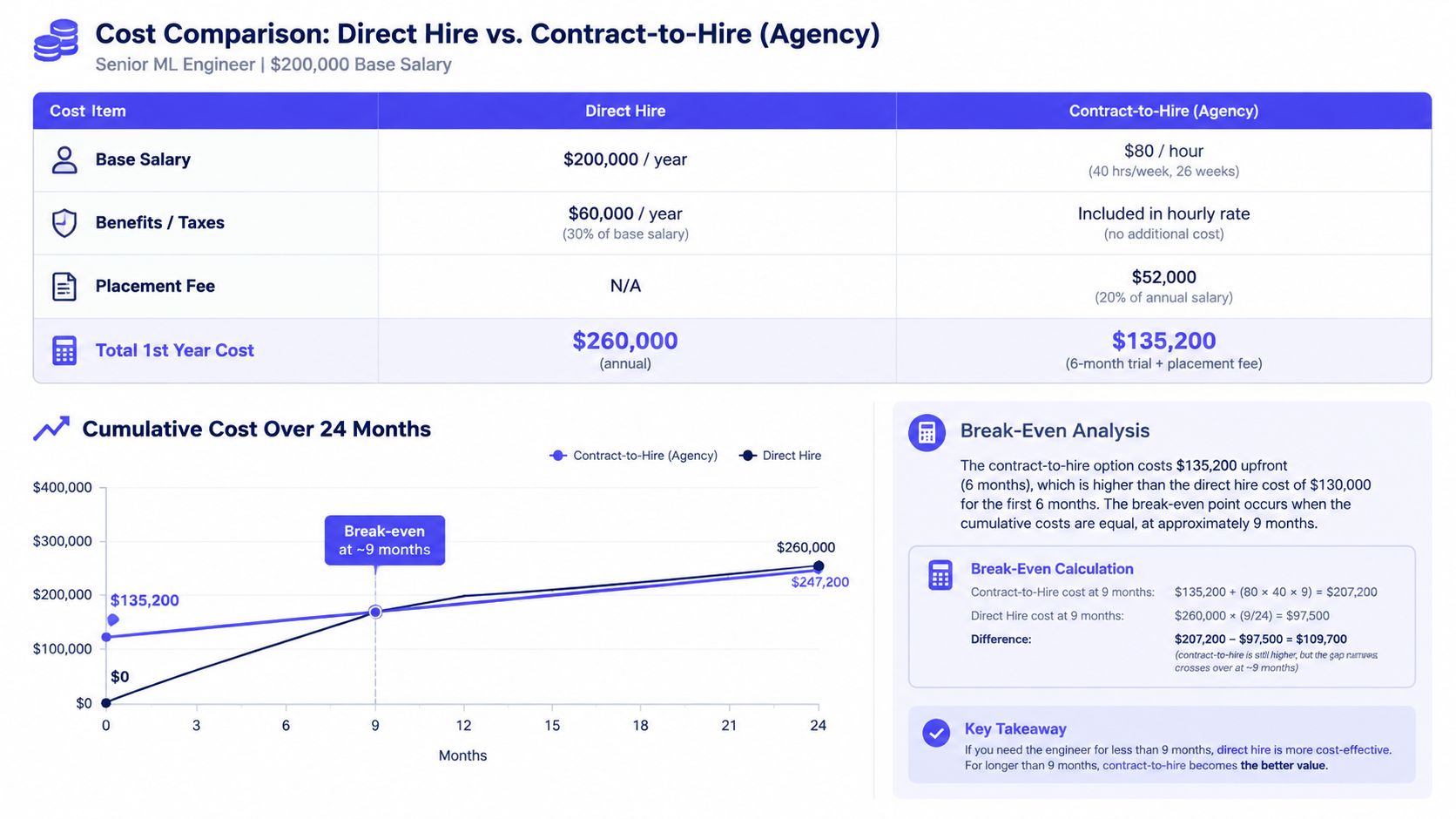
The supplied illustration below uses the requested $200,000 base salary and an agency rate of $80 per hour. The six-month assignment cost is calculated as $80 multiplied by 40 hours per week and 26 weeks, or $83,200. A 20% placement fee equals $40,000 on a $200,000 salary, not $52,000. That distinction matters because the chart asset supplied for this article contains a different fee calculation and must be treated as a visualization, not as a reliable arithmetic source.
What the break-even means
Verified staffing analysis places the break-even window broadly around 6 to 14 months, depending on the direct-hire fee, contractor markup, and conversion timing. Another analysis says direct hire is usually cheaper when the person stays 18 or more months, while contract-to-hire wins when the conversion happens relatively quickly. KORE1's break-even analysis supports the duration-based approach.
For the illustration, a direct hire with a 30% benefits and payroll assumption would cost $260,000 annually. That benefits assumption is part of the supplied visualization context, not a universal employment cost. The contract-to-hire path costs $83,200 for the six-month assignment, then adds the negotiated conversion fee and any ongoing markup if you delay conversion.
The hidden tax appears when you reach month seven and keep the worker temporary because nobody set a decision gate. You may continue paying the higher bill rate while the company still carries the same onboarding and ramp burden. If the person converts later, you also pay the conversion fee after already funding months of temporary work.
Use IT staff augmentation when you need temporary capacity without implying that every assignment should become employment. For contract-to-hire, set the conversion date and the decision owner before the first invoice.
Legal and Compliance Implications You Cannot Skip
Cross-border contract-to-hire isn't a compliance-free middle ground. During the contract phase, a staffing partner may handle payroll, tax, insurance, and statutory obligations, while direct hire places those obligations on the employer from the start. Worker classification, intellectual property ownership, benefits, termination rules, and local employment requirements still require a jurisdiction-specific review.
Legal and Compliance Implications by Hiring Model
| Compliance Area | Direct Hire | Contract to Hire |
|---|---|---|
| Employment status | The company or employing entity hires the worker directly | The worker may be employed by an agency or employer of record during the assignment |
| Written terms | Employment terms should be documented before the start date | Services, assignment, conversion, and fee terms should be documented before work begins |
| Intellectual property | Use a direct assignment and confidentiality framework | Verify the assignment chain from worker to intermediary to your company |
| Benefits and equity | Governed by the employment offer and applicable policies | Usually attach to the direct employment stage, subject to the agreement |
| Performance management | The employer manages feedback, support, and any probation process | The company and staffing partner must coordinate performance and conversion decisions |
| Cross-border exposure | The employing entity must follow local requirements | The intermediary may reduce administrative burden, but doesn't remove classification and contract review |
In the UK, an employment contract is legally binding and sets out the employee's conditions, rights, responsibilities, and duties. UK government guidance on employment contracts and conditions recommends verifying written terms, notice rules, and any changes in status. When a contractor becomes an employee, document the new relationship with a fresh agreement or formal amendment.
New Zealand guidance requires every employee to have a written employment agreement, and the offer should include an accurate job description. Employees must also be told they can seek independent advice and given reasonable time to do so. Employment New Zealand's hiring process guidance provides the practical sequence.
A probationary period doesn't remove employer duties. Employers still need to explain expected performance, provide feedback, warn when employment may not continue, and offer support or training. Employment New Zealand's probationary-period guidance makes that obligation clear.
For a practical documentation workflow, use compliance documentation for remote teams as a starting point, then have counsel or a qualified local adviser review the final agreements.
AI and ML Roles Where Each Model Fits
AI hiring is unusually sensitive to continuity. A senior engineer may own production inference, model monitoring, deployment safeguards, data access, or an evaluation framework that another person can't immediately reconstruct.
Use direct hire when the role owns a system that must remain stable after the initial project. That includes production system owners, proprietary model custodians, and core research scientists. Direct employment also makes the long-term relationship explicit, which helps when the person must make decisions across product, platform, security, and research.
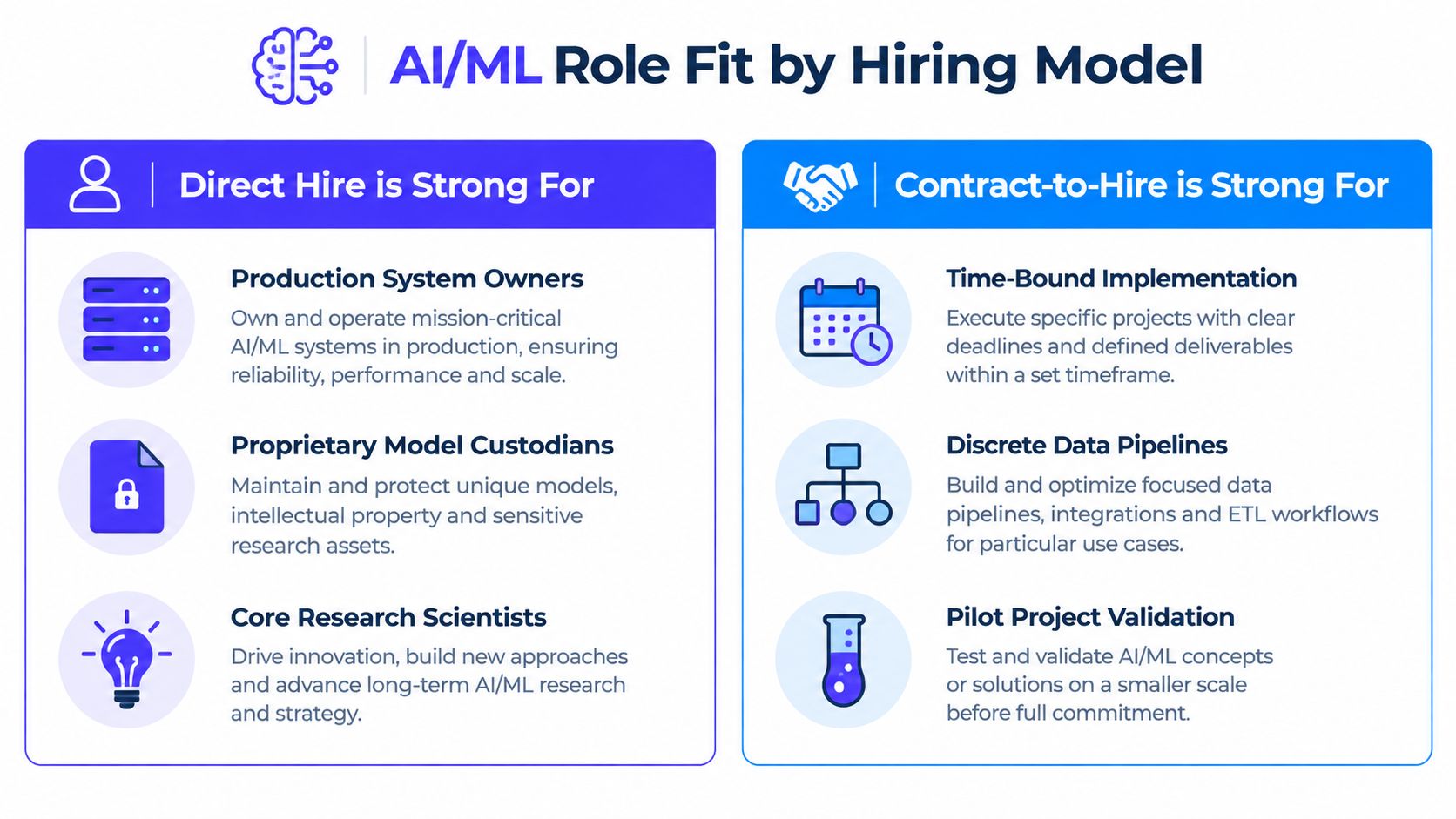
Contract-to-hire fits better when the output has a clear boundary and the evaluation question is substantial. Examples include an evaluation harness, a reinforcement learning from human feedback data pipeline, a model integration, or a defined MLOps implementation.
Match the model to the ownership pattern
| Role pattern | Recommended model | Why |
|---|---|---|
| Production inference owner | Direct hire | The company needs durable ownership and operational continuity |
| Proprietary model or training-pipeline custodian | Direct hire | The role touches valuable systems and long-lived internal knowledge |
| Core research scientist | Direct hire | Research direction and institutional context compound over time |
| Evaluation harness builder | Contract-to-hire | The deliverable can be inspected against defined technical criteria |
| Discrete data-pipeline implementation | Contract-to-hire | The work has a bounded output and a clear acceptance test |
| Pilot validation project | Contract-to-hire | The company is testing both the approach and the working relationship |
A hybrid can work well. Contract the first 60 to 90 days around a production milestone, then convert the person with vesting treatment tied to the agreed engagement start, if your counsel and compensation plan support that structure. Don't use a temporary agreement to postpone defining who owns the system.
Two Real Scenarios for Startups and Scale-Ups
Scenario one, the first senior ML hire
A Series A platform startup plans 2 hires in 6 months and has 14 months of runway. The founder needs a production owner for the inference stack within 30 days, so the hiring team has little room for a vague trial.
The company chooses direct hire with a 60-day probation and defines concrete gates: production access, serving-layer ownership, incident participation, and a documented handoff standard. The engineer starts in week 4, takes ownership of the serving layer by week 10, and receives equity under the company's standard vesting schedule.
That choice makes sense because the role is permanent, the ownership gap is urgent, and the company can't afford to delay institutional commitment while paying temporary rates.
Scenario two, the production language-model expansion
A Series B scale-up is expanding a production large language model team with 4 engineers. The immediate scope is an evaluation and safety harness deliverable in 12 weeks, followed by a planned team expansion.
The company hires 2 engineers through contract-to-hire and 2 core owners directly. The temporary pair ships the harness, 1 converts at week 12, and the other declines the permanent offer. The direct hires carry system ownership into the next sprint, so the company doesn't need to rebuild responsibility after the project ends.
The pattern is simple. Match the hiring model to the deliverable horizon, not to a blanket preference for flexibility or permanence.
A Decision Framework You Can Use This Week
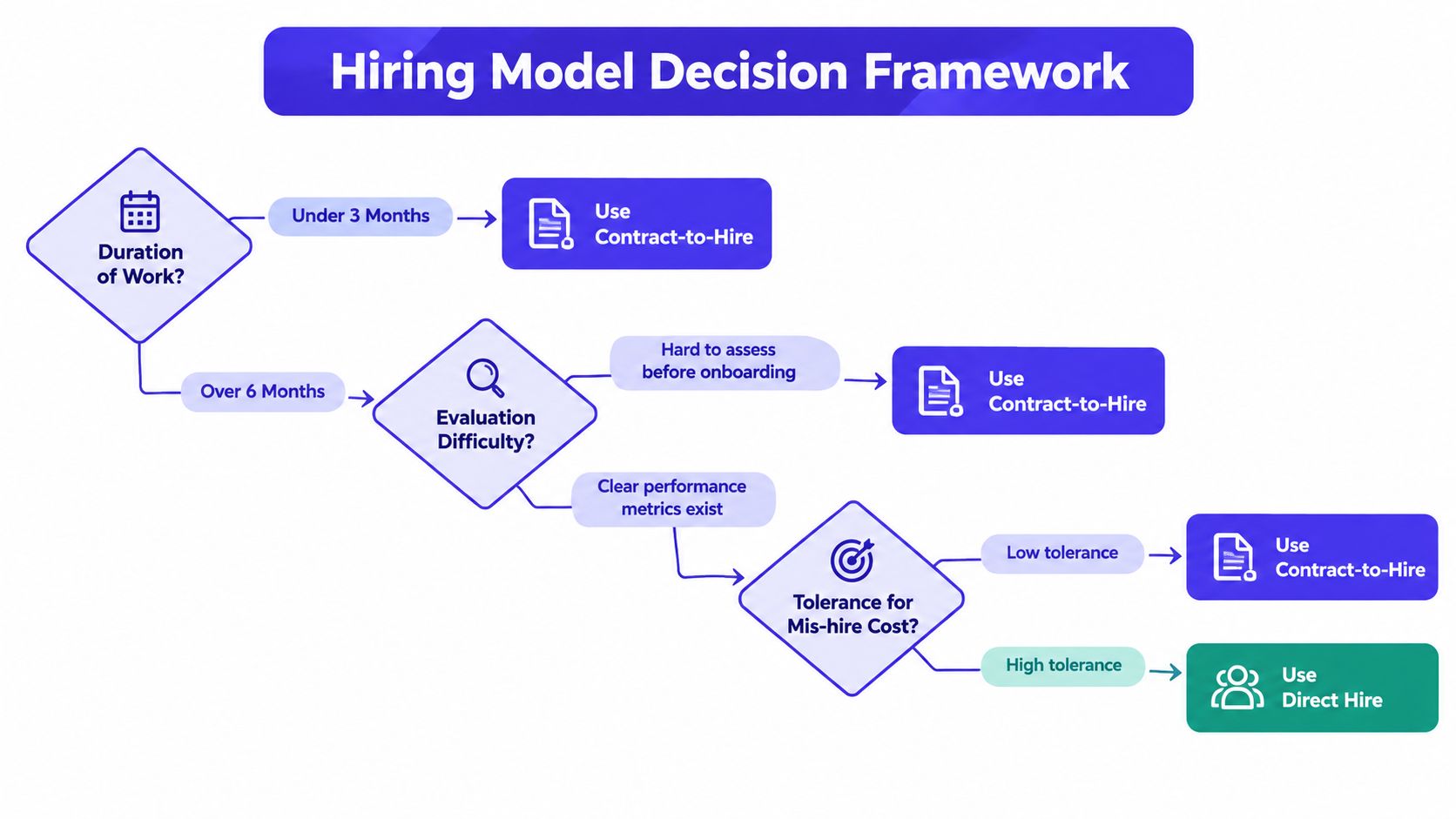
Start with three questions:
- How long will the work exist?
- How difficult is performance to evaluate before onboarding?
- How much damage can a mis-hire create?
If the work is sharply defined and lasts under 3 months, use a direct contract with no assumed conversion. If the work will run beyond 6 months, assess whether the role owns durable systems or whether the company is still testing the scope.
Choose direct hire when these signals are present
- The role is permanent: The position owns a long-lived product, platform, or research direction.
- The candidate pool is narrow: You need to secure the person rather than ask them to wait through an uncertain conversion process.
- The work touches proprietary systems: Model weights, training pipelines, evaluation data, and production credentials require a clean ownership structure.
- You need team-level leadership: The person will set standards, mentor engineers, and make decisions outside a single project.
- The cost of delayed ownership is high: A temporary arrangement would leave a critical system without durable accountability.
For a role that exceeds 12 months, touches proprietary pipelines, or carries major mis-hire consequences, I usually recommend direct hire with milestone-based performance management. Set a 60 to 90 day gate, define success in writing, and avoid using contract status as a substitute for a strong interview process.
Choose contract-to-hire when these signals are present
- The evaluation problem is hard: You need to see how the person works inside your stack.
- The scope is still moving: The company is deciding whether it needs an ML platform engineer, applied scientist, or product-focused AI engineer.
- You need a 3 to 6 month evaluation window: The assignment has a defined conversion date and decision owner.
- The candidate values flexibility: The worker understands the conversion terms and wants a trial relationship.
- You aren't ready to establish a local employing setup: An agency or employer of record may handle the contract phase while you validate the role.
Use the time-to-hire metrics framework to separate speed from quality. A fast start isn't a successful hire if nobody has defined the conversion criteria.
Checklist and Next Steps to Move Forward
Run the decision as a 2 to 4 week pilot, not as an open-ended recruiting exercise. The pilot should create evidence about the role, the candidate, the employment structure, and the cost path.
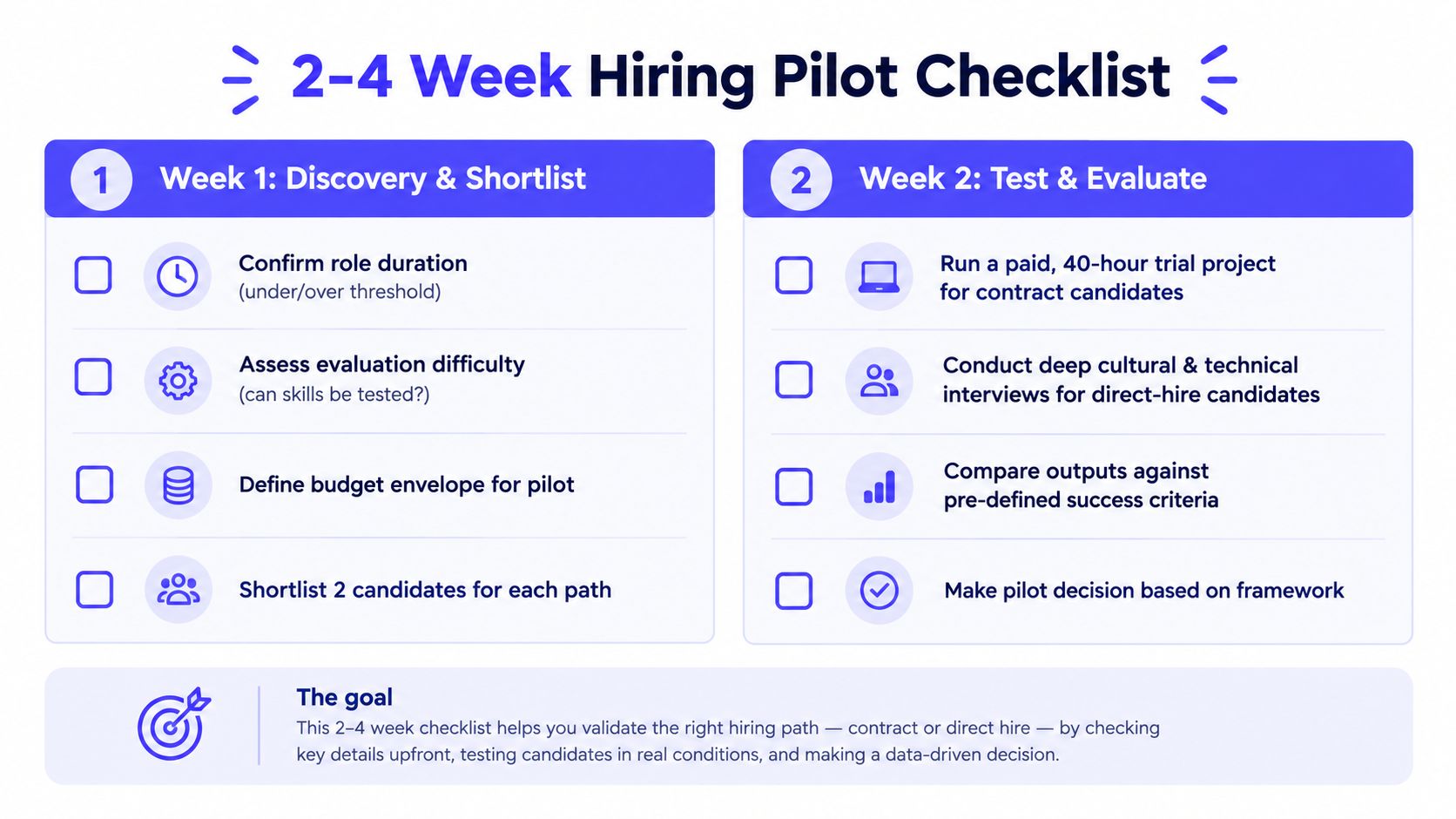
Week one, define the decision
- Confirm the role duration: Decide whether the work is a bounded project, a long-term ownership role, or an uncertain scope that needs testing.
- Assess evaluation difficulty: Write down which skills you can test before onboarding and which require access to your systems.
- Set the budget envelope: Include bill-rate markup, conversion fees, recruiting fees, benefits, payroll costs, and any duplicated onboarding.
- Shortlist both paths: Identify 2 candidates for each path, rather than asking one model to solve every hiring problem.
Week two, test the evidence
Run a paid, structured trial for candidates who are being considered for contract work. The supplied checklist asset calls for a 40-hour trial project, while the broader principle is more important than the exact format: define a paid output, acceptance criteria, access boundaries, and a reviewer before work starts.
A useful AI engineering trial might ask for an evaluation harness, a model card, or a code review against a small representative service. Don't ask for unpaid production work. The test should reveal reasoning, communication, testing discipline, and ability to operate within constraints.
For direct-hire candidates, use deep technical and collaboration interviews focused on the actual role. Ask questions such as: “A model's offline evaluation improves, but production user feedback declines. What would you inspect first, and how would you decide whether to roll back?” Score the answer against a written rubric instead of relying on interviewer instinct.
Weeks three and four, make the decision
- Check references for ownership: Ask how the candidate handled incidents, ambiguity, feedback, and cross-functional disagreement.
- Compare outputs with the rubric: Review technical quality, documentation, communication, and follow-through.
- Choose the employment path: Make the direct-hire or contract-to-hire decision using the trial evidence and the duration calculation.
- Paper the relationship before day one: Complete the written agreement, classification review, IP assignment, confidentiality terms, benefits, paid time off, conversion mechanics, and termination terms.
- Set the re-evaluation date: Put the conversion or continuation decision on the calendar at month 6, even if you expect to decide earlier.
Take three actions this week. Lock the evaluation criteria, pre-approve the conversion-fee budget, and assign an owner for the month-six review. If you need senior AI engineers, MLOps specialists, or a complete remote ML team, ThirstySprout can support contract, contract-to-hire, direct-hire, and fractional staffing options. Start with the role duration and ownership requirements, then choose the model that fits the work.
Hire from the Top 1% Talent Network
Ready to accelerate your hiring or scale your company with our top-tier technical talent? Let's chat.