

TL;DR
- What it is: A model to embed skilled tech professionals directly into your team for specific projects, filling skill gaps fast without the overhead of full-time hires. You manage them directly.
- When to use it: To accelerate a critical launch, bridge a temporary but deep skill gap (e.g., needing a RAG expert for 3 months), or scale your team for a temporary surge in workload.
- How to start: First, define the exact skill and project duration. Then, vet partners on their talent screening process, not just their rates. Use a scorecard to compare them objectively.
- Key action: Insist on a practical take-home test for candidates that mirrors a real task they'll face in their first two weeks.
- Next step: Start with a 2-week pilot to validate a candidate's fit before committing to a longer engagement.
Who this guide is for
- CTO / Head of Engineering: You have an urgent project deadline but a hiring freeze or a 3-month lead time for full-time hires. You need to deliver results this quarter.
- Founder / Product Lead: You need to build a new AI feature (like an internal copilot) but lack the specialized in-house talent. You need to prove the concept quickly to secure budget or meet roadmap goals.
- Talent Ops / Procurement: You're evaluating vendors and need a framework to assess risk, quality, and the total cost of engagement beyond just the hourly rate.
Quick Answer: The Staff Augmentation Decision Framework
IT staff augmentation is a strategic tool, not just a hiring tactic. Use this step-by-step framework to decide if it's the right move and how to execute it effectively.
- Define the Gap: Is your need skill-based (e.g., "we lack production MLOps expertise") or capacity-based ("we need two more senior Python engineers to hit our deadline")? Is it temporary (3–6 months) or permanent? If permanent, a full-time hire is better.
- Calculate the Business Impact: What is the cost of delay? A missed launch could mean a $500k revenue hit or losing market share. Quantifying this makes the case for augmentation clear.
- Choose the Model (Nearshore vs. Onshore): For most AI/ML roles requiring collaboration, nearshore offers the best balance of cost savings (30-50% vs. onshore) and time-zone alignment for agile workflows.
- Vet the Partner, Not Just the Person: Scrutinize the vendor's technical vetting process. Ask for sample interview scorecards and their process for handling a mismatch. A good partner is a talent filter.
- Run a Practical Interview: Ditch brain teasers. Give candidates a small, real-world take-home assignment. For an AI engineer, this could be building a mini RAG pipeline with a small dataset.
- Launch a Pilot: Start with a 2-week paid pilot project. This is the ultimate test of technical skill, communication, and team integration. If it's not a fit, you can part ways with minimal disruption.
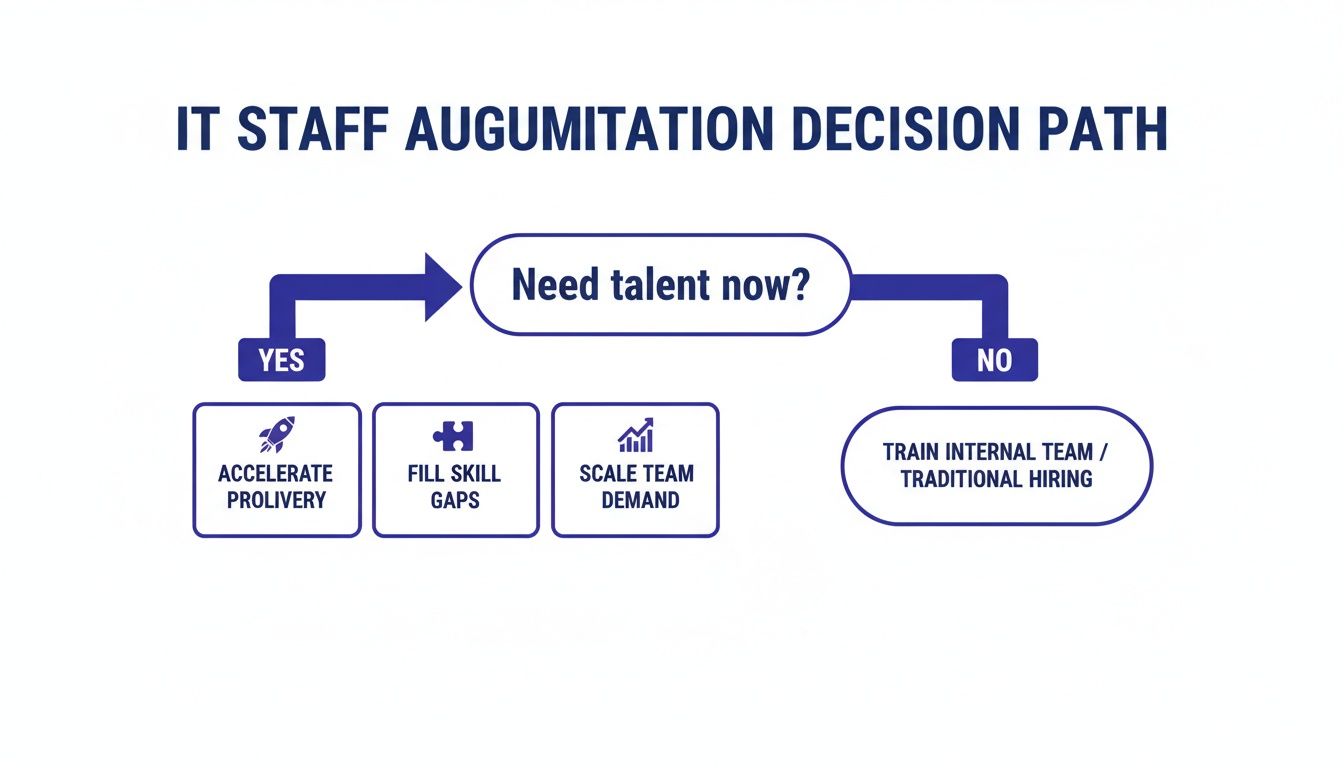
What this shows: The decision to use IT staff augmentation typically starts with an immediate need for talent. Your project timeline and skill requirements will determine the best path forward.
Practical Examples of IT Staff Augmentation
Here are two common scenarios where IT staff augmentation provides a clear business advantage.
Example 1: Accelerating an AI Product Launch
- Situation: A fintech startup needs to launch an AI-powered fraud detection feature in 4 months. Their core team is strong in data science but lacks production-level Machine Learning Operations (MLOps) experience to build a scalable deployment pipeline. The launch date is non-negotiable.
- Business Impact of Delay: Missing the launch means losing a first-mover advantage and a projected $500k in quarterly revenue.
- Team Composition: 2 Senior MLOps Engineers.
- Key Skills: Deep expertise in Kubernetes, AWS SageMaker, and Terraform.
- Integration: The engineers join the core team’s Slack, daily stand-ups, and use the same Jira board.
Example 2: Bridging a Niche Skill Gap for an RAG Prototype
- Situation: An e-commerce company wants to build a Q&A chatbot using Retrieval-Augmented Generation (RAG) to reduce customer support tickets. Their in-house team understands Natural Language Processing (NLP) but has no hands-on experience with vector databases or frameworks like LangChain.
- Business Impact of Delay: Every month without the chatbot costs an estimated $30k in manual support agent hours. They need a working prototype in one quarter to secure funding for a full rollout.
- Team Composition: 1 Principal AI Engineer (RAG Specialist).
- Key Skills: Proven experience with LangChain, Pinecone, and hybrid search methods.
- Integration: The specialist acts as a tech lead and mentor, pair-programming with the in-house team to architect the system.
Deep Dive: Onshore vs. Nearshore vs. Offshore Trade-offs
Choosing the right geographic model is a critical decision that impacts budget, collaboration, and talent access.
For most tech companies, particularly those running agile development for complex products like AI, nearshore hits the sweet spot. It provides the cost benefits of a global model without sacrificing the critical workday overlap needed for stand-ups, pair programming, and quick problem-solving. For a deeper analysis, see our guide on nearshore vs. offshore outsourcing.
A Step-By-Step Checklist for Vetting Partners and Talent
Your success hinges on the quality of your partner and their talent. A weak partner means mismatched skills and project delays. Use this checklist to ensure you select a high-quality firm and the right engineer.
Vendor Vetting Scorecard
Use a simple scorecard to objectively compare potential partners. Rate each vendor on a scale of 1-5 for each criterion.
A data-driven approach removes bias and makes it easy to justify your decision internally. A great partner should be transparent about their screening methods, like our candidate vetting engine.
Talent Vetting Checklist
Once you have a partner, apply this framework to vet individual candidates.
- Example (AI Engineer): Python (expert), LangChain/LlamaIndex (hands-on), Vector DBs (e.g., Pinecone), Cloud Deployment (e.g., AWS SageMaker).
- Example: "Given a small dataset of 100 text docs, build a simple RAG pipeline using LangChain. Push the code to a GitHub repo with a README explaining your choices."
- Why it works: It tests real-world problem-solving, code quality, and communication skills far better than a whiteboard interview.
- Sample Question: "Walk me through a complex technical problem you solved on a recent project. What was your process, and what were the trade-offs you made?"
Onboarding and Integration Template
A structured onboarding process ensures new team members contribute value within the first month. An unstructured one leads to frustration and wasted time.
What this shows: A successful integration follows a clear path from providing basic access to full immersion in team rituals, enabling productivity.
Your 30-Day Onboarding Plan:
- Grant access to Git, Jira, Slack, and development environments.
- Schedule 1-on-1s with the direct manager, product manager, and key engineering peers.
- Assign an in-house "onboarding buddy."
- Walk them through the system architecture and current sprint goals.
- Assign a small, low-risk bug fix or task. The goal is to get a first pull request merged.
- Ensure active participation in stand-ups, sprint planning, and retrospectives.
- Encourage them to ask questions and challenge assumptions. A fresh perspective is valuable.
- Assign a well-defined feature or user story that aligns with their core skills.
- Set clear acceptance criteria and check in daily.
For a more comprehensive plan, refer to our guide on how to manage a remote team.
What to Do Next
- Identify Your Most Critical Skill Gap: Pinpoint the one role that, if filled tomorrow, would most significantly accelerate your roadmap.
- Book a Scoping Call: Spend 20 minutes with our team to define the role requirements, project timeline, and success metrics. We’ll confirm if we have pre-vetted candidates in our network who fit your needs.
- Launch a Pilot: Interview 2-3 of our best-fit candidates and select one for a 2-week paid pilot. You'll see their work firsthand before making a longer-term commitment.
Ready to fill critical AI and engineering roles without the friction of traditional hiring? ThirstySprout delivers vetted, senior talent who can start contributing in days, not months.
References
- Your Ultimate Remote Employee Onboarding Checklist - RemoteWeek
- IT staff augmentation trends - Squareboat.com
- What is cloud cost optimization? - ServerScheduler.com
Hire from the Top 1% Talent Network
Ready to accelerate your hiring or scale your company with our top-tier technical talent? Let's chat.