

The popular advice is to “get your policies in place and store the PDFs in a shared folder.” That approach may create the appearance of readiness, but it doesn't prove that your controls operate in production. Auditors need to trace requirements to actions, approvals, system records, and conclusions.
For a startup preparing for System and Organization Controls 2 (SOC 2), ISO 27001, or an assessment involving artificial intelligence, compliance documentation should function as a living evidence system. It should show what changed, who approved it, which system version was involved, and whether the control ran. This guide focuses on the artifacts, ownership model, technical safeguards, and automation patterns that make audit preparation defensible without turning engineering into an administrative queue.
Why Compliance Documentation Is More Than a Policy Folder
A policy describes intent. Compliance documentation must demonstrate operation.
That distinction matters because a folder can contain a polished access-control policy while production still has stale accounts, undocumented exceptions, or approvals that happened outside the stated workflow. The policy may be accurate as written, yet insufficient as evidence. The PCAOB audit evidence standard defines audit evidence as information used to reach an audit opinion, and its documentation requirements call for enough detail for an experienced auditor to understand the work performed, evidence obtained, and conclusions reached.
The practical test is simple. For every control, can you answer:
- What requirement does it support?
- What action occurred?
- Who performed, approved, or verified it?
- When did it happen?
- Which system or record proves it?
- Was the evidence protected from later alteration?
The Federal Register offers a useful model for this way of thinking. In U.S. administrative law, agencies publish regulatory histories through notices of proposed and final rulemaking. Those citations are embedded in the Code of Federal Regulations, while later amendments add further references. The result is a dated documentary trail that allows researchers to follow how a rule evolved, as described in this overview of audit results and regulatory traceability. Compliance documentation creates the same value inside a company when it connects the requirement, control, evidence, and revision history.
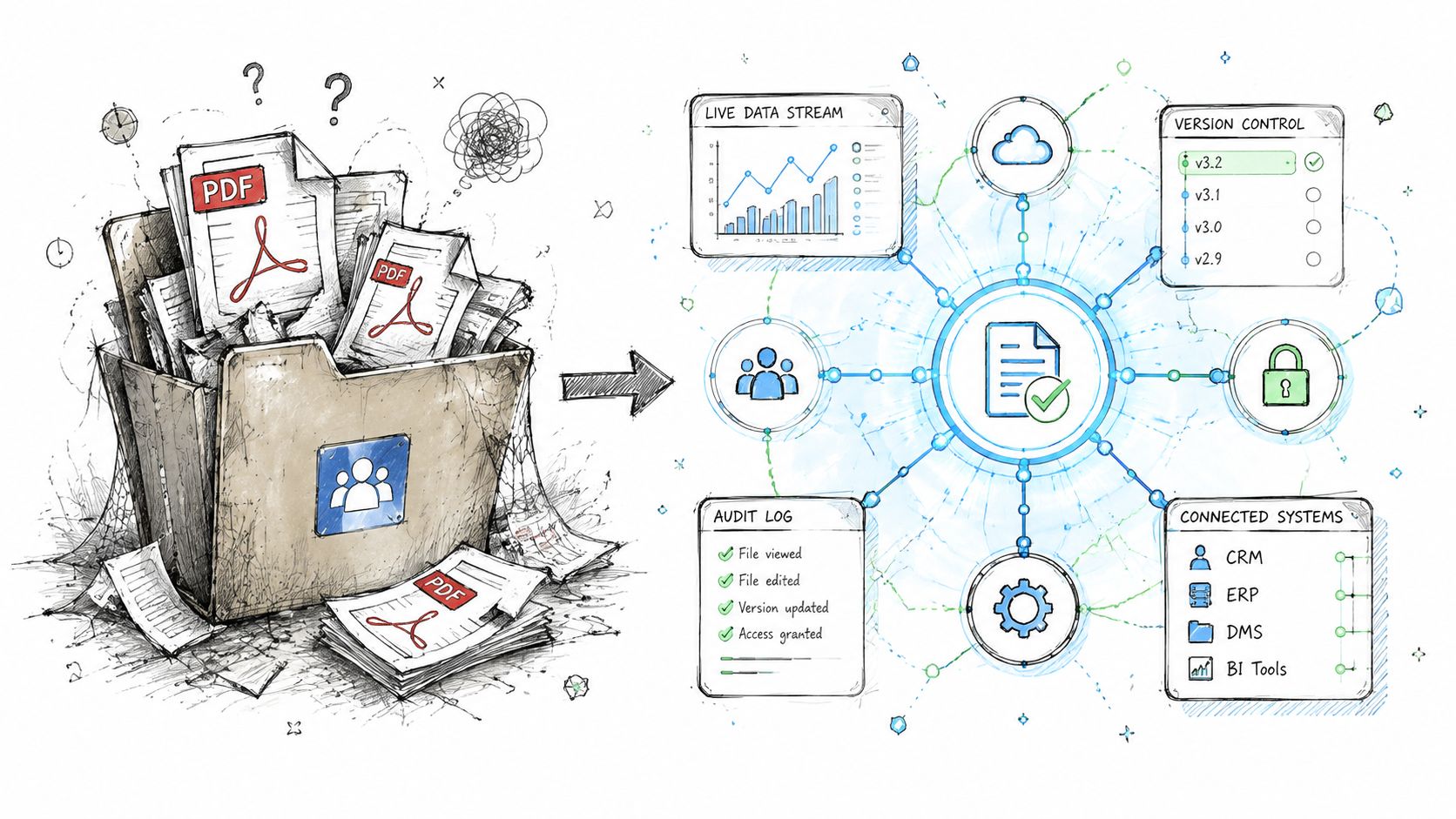
The gap between intent and behavior
The gap widens as software changes faster than governance processes. An engineer can deploy a new model, alter a retrieval workflow, change a permission boundary, or add a vendor integration before anyone updates the related narrative. For artificial intelligence systems, the regulated object may be a model, workflow, or automated decision path, not a static application.
Recent guidance on authorization maturity describes a widening difference between compliance records and what runs, while audit-evidence guidance emphasizes that auditors want policies alongside records and demonstrated practice. That means a model card without deployment evidence, a human-oversight policy without review logs, or a risk assessment without a current decision path leaves a material gap.
A useful AI governance best-practices guide can help teams define model ownership, impact assessments, and audit trails. For enterprise AI, a security policy for enterprise AI is also a useful reference when translating broad security expectations into operational rules for model access, data handling, and oversight.
Practical rule: Treat every compliance artifact as a pointer to operational evidence, not as a substitute for it.
This reframing changes the work. Instead of asking whether a document exists, ask whether its claims remain true against current production behavior. That shift reduces audit surprises, makes engineering changes easier to review, and gives leadership a clearer view of operational risk.
Required Artifacts for Software and AI Compliance
Start with an inventory, not a writing sprint. List the systems, data flows, models, vendors, controls, and regulatory obligations in scope. Then assign an owner for each artifact and define the evidence that will keep it current.
The table below provides a practical baseline for software and AI teams. Framework relevance depends on your business, customer commitments, jurisdictions, and audit scope, so treat it as a working map rather than a universal obligation.
| Artifact Type | Purpose | Typical Owner | Relevant Frameworks |
|---|---|---|---|
| Security and privacy policies | Define expected behavior, responsibilities, and escalation paths | Security or compliance lead | SOC 2, ISO 27001, GDPR |
| Control and requirement mapping | Connect requirements to controls, owners, and evidence | GRC or compliance lead | SOC 2, ISO 27001, sector frameworks |
| System architecture and data-flow diagrams | Show where data enters, moves, transforms, and exits | Engineering or platform lead | SOC 2, ISO 27001, privacy reviews |
| Asset and data inventory | Identify systems, data classes, processors, and owners | Security, data, or privacy lead | ISO 27001, GDPR, AI governance |
| Risk assessments | Record threats, impacts, mitigations, and residual risk | Risk owner with technical contributors | ISO 27001, AI governance |
| Model cards | Describe model purpose, data use, limitations, evaluation, and intended context | ML or AI product owner | AI governance, EU AI Act readiness |
| Pre-deployment decision records | Explain why a model or automated workflow was approved | Product, legal, and engineering owners | EU AI Act readiness |
| Human-oversight logs | Prove that required review or intervention occurred | Operations or product owner | AI governance, EU AI Act readiness |
| Disclosure records | Show how users were informed about automated or AI-supported interactions | Product and legal owners | AI governance, consumer-facing requirements |
| Access reviews | Demonstrate that permissions were reviewed and exceptions resolved | Identity or IT owner | SOC 2, ISO 27001 |
| Change-management records | Link approved changes to testing, deployment, and rollback decisions | Engineering or DevOps owner | SOC 2, ISO 27001 |
| Incident records | Preserve detection, response, communication, and lessons learned | Security or incident commander | SOC 2, ISO 27001 |
| Training logs | Show that relevant personnel completed required training | People operations or compliance | SOC 2, ISO 27001 |
What auditors actually look for
Auditors don't need every artifact to be beautiful. They need it to be specific, current, attributable, and verifiable.
The ISO 9001 Auditing Practices Group describes audit evidence as statements of fact or other information relevant to audit criteria and verifiable. A change-management record should therefore identify the approved ticket, deployed version, validation result, and verification path. A narrative saying “the release was tested” doesn't provide that path.
For AI systems, document the decision path before deployment, not just the model's intended purpose. Capture the data sources, evaluation approach, approval decision, human-oversight design, known limitations, and user disclosures. Keep interaction-level or workflow-level records where the risk depends on individual decisions.
Ownership needs two layers
The person who writes an artifact isn't always the person who generates its evidence. Security may own the access-control policy, while the identity team produces access reviews and the engineering team supplies deployment records. Assign both a document owner and an evidence owner. Without that split, policies become detached from the teams that operate the controls.
Building a Defensible Documentation System
A defensible system protects evidence and makes it simple to access. A shared drive may still play a role, but it shouldn't be the only control surface.
At minimum, the system needs version control, role-based access, immutable logging, centralized evidence storage, and tamper-evident retention. Every artifact should carry metadata for its control, owner, system, timestamp, approval state, and retention class. Store the evidence in a way that lets an auditor follow the chain from requirement to control execution.
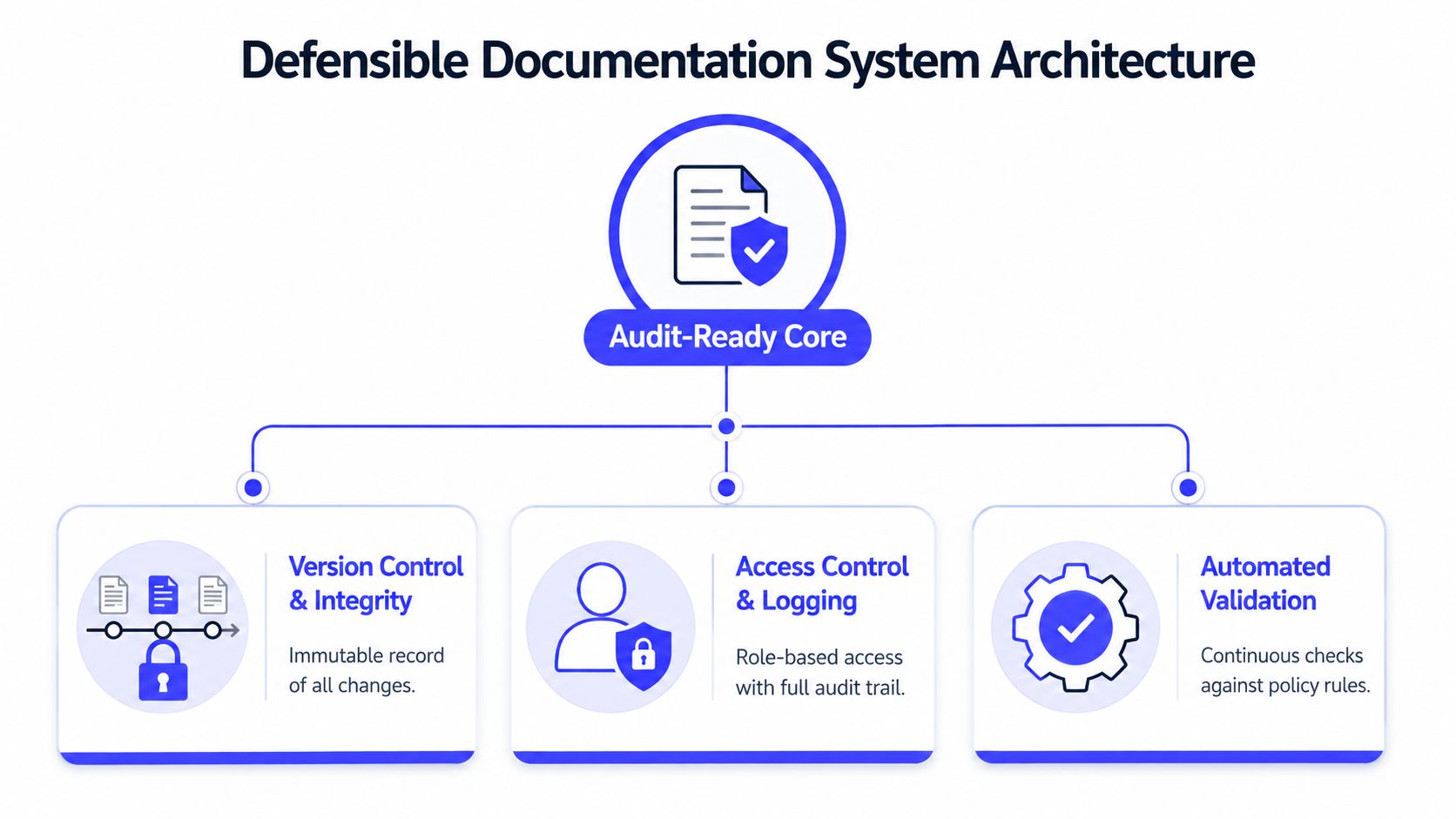
Design for integrity and retrieval
Version control answers how an artifact changed. Role-based access answers who could change it. Immutable logs answer whether the system recorded those changes in a way that prevents silent rewriting. Centralized evidence storage answers where the auditor should look.
These controls work together. A version history without restricted permissions may not be trustworthy. A locked storage bucket without useful metadata may be technically secure but operationally painful. An evidence platform that preserves records but can't connect them to a control forces your team to reconstruct the audit manually.
Retention must also follow the record, not a company-wide default. The audit-trail guidance from DiliTrust identifies different retention examples across major frameworks, including SOX at 7 years, HIPAA at 6 years, PCI DSS v4.0 at 12 months with at least 3 months immediately accessible, the GDPR processing duration plus applicable statute of limitations, the EU AI Act at a minimum of 6 months for deployers of high-risk systems, and DORA ICT third-party risk logs at 5 years for critical ICT providers.
Those requirements aren't interchangeable. Add litigation holds, contractual obligations, and business needs before setting a deletion trigger.
Use a record class table
A record class table turns retention into an implementable control.
| Record Class | Retention Period | Owner | Storage Location | Deletion Trigger |
|---|---|---|---|---|
| Access review evidence | Applicable framework or contractual period | Identity owner | Central evidence store | Approved retention expiry, unless held |
| Deployment and change records | Applicable control requirement | Engineering owner | CI/CD evidence store | System retirement plus retention period |
| Model decision records | Applicable AI and legal requirement | AI product owner | Model governance repository | Retention expiry, unless dispute or hold exists |
| Audit workpapers | 7 years under PCAOB AS 3 | Audit or compliance owner | Restricted archive | Seven-year expiry, subject to legal hold |
| Loan application register data | 3 years | Lending operations | Regulated records store | Three-year expiry, subject to applicable hold |
| Error-related documentation | 2 years | Compliance operations | Regulated records store | Two-year expiry, subject to applicable hold |
The PCAOB Auditing Standard No. 3 provides the seven-year audit documentation retention rule. The Federal Reserve's Consumer Compliance Outlook 2025 record-retention reference guide shows why regulated records need their own classes, including three-year retention for loan application register data and two-year retention for error-related documentation.
Tiered storage is usually the right compromise. Keep frequently requested evidence immediately available, move older records to controlled archival storage, and define a retrieval service-level agreement for each class. Teams should test retrieval before an audit, not discover an archive problem during fieldwork. For migration projects, migration risk register templates can help structure ownership, dependencies, and evidence risks before records move between systems.
Authoring and Versioning Compliance Artifacts at Scale
Fast-moving teams shouldn't ask engineers to rewrite policy prose after every deployment. They should define stable control objectives and connect those objectives to changing system records.
Begin each artifact with a compact header:
- Control objective: What risk does this control address?
- Scope: Which systems, environments, data, and teams are included?
- Owner: Who operates the control?
- Approver: Who accepts the design and exceptions?
- Frequency: When does the control run?
- Evidence: Which primary artifacts prove operation?
- Dependencies: Which services, vendors, or reports must remain reliable?
- Review trigger: What event requires an update?
The review trigger matters more than a calendar reminder. A change to the identity provider, model provider, data source, approval workflow, or production architecture should open a documentation review automatically.
Connect document versions to system versions
A document version tells you when the text changed. It doesn't necessarily tell you which software version it described. Add system identifiers to the evidence record, such as a deployment reference, infrastructure change reference, model release identifier, or configuration revision. The auditor should be able to move from a control statement to the exact operational state under review.
The source code management practices for engineering teams provide a useful foundation for linking approvals, commits, reviews, and releases. The compliance layer should use those existing relationships instead of creating a second, disconnected workflow.
Mini-case for an access review
An access-control review becomes defensible when the evidence pack follows the control end to end:
- The identity owner exports the in-scope users and privileged groups.
- The reviewer checks each account against the role and employment record.
- Exceptions receive a ticket with an owner, due date, and remediation status.
- The reviewer records the scope, review date, exceptions, and conclusion.
- A manager signs off on the completed review.
- The system stores the export, review worksheet, remediation tickets, and sign-off together.
The PCAOB evidence guidance supports pairing each control with substantive primary artifacts such as screenshots, exports, approvals, test results, or ticket history. A screenshot alone may show a state, but it won't always prove scope, completeness, reviewer judgment, or remediation.
Evidence standard: If an experienced reviewer can't understand what happened without interviewing the person who performed the control, the record needs more context.
Automating Evidence Collection in CI/CD Pipelines
Automation works best when it captures events at the moment they occur. A deployment system already knows which commit was built, which tests ran, who approved the release, and where the artifact was deployed. A compliance workflow should preserve that information instead of asking someone to recreate it in a spreadsheet later.
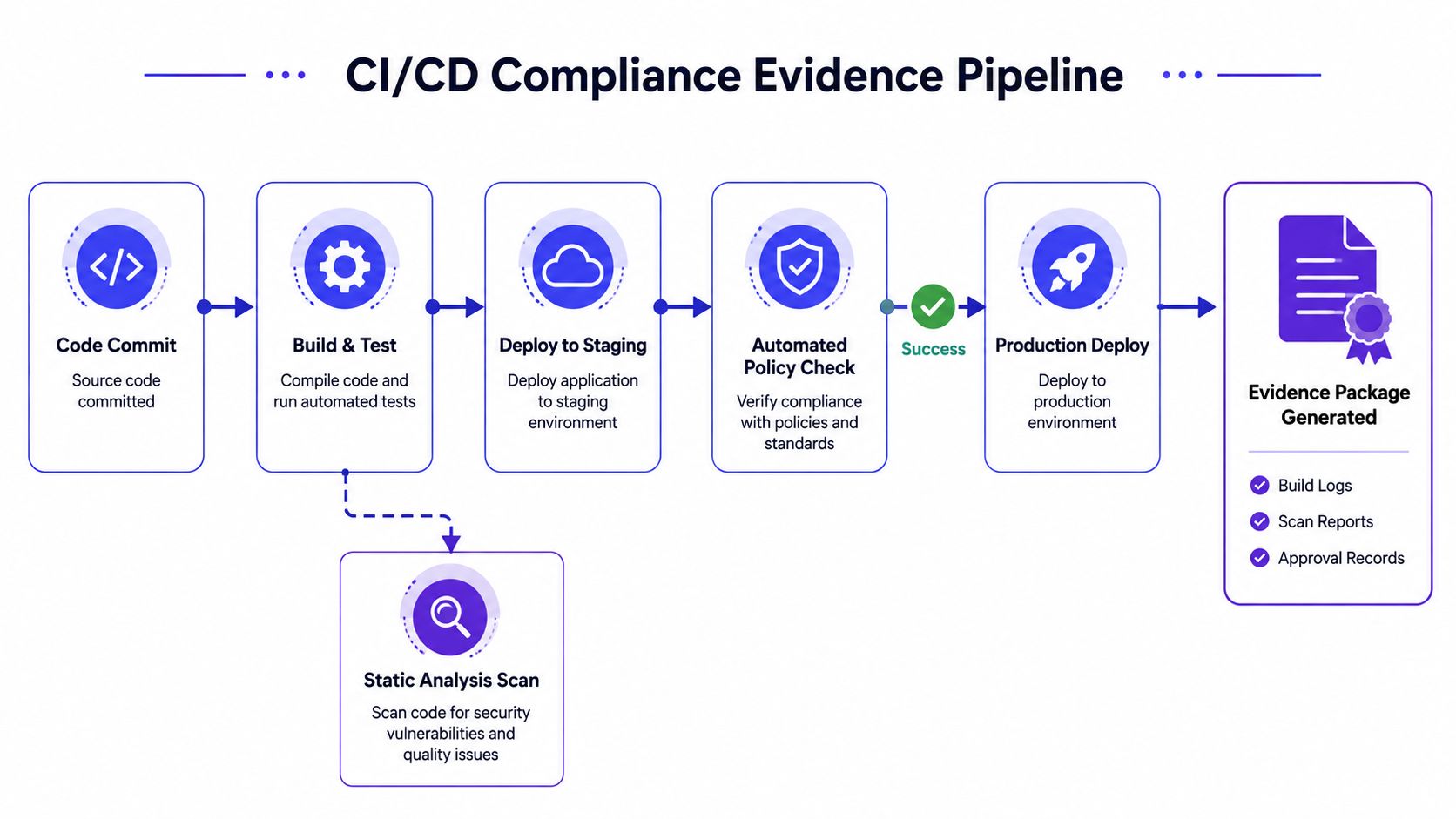
A useful evidence package can include:
- Build identity: Commit, build result, artifact reference, and actor.
- Test evidence: Test results, failed checks, and accepted exceptions.
- Security scans: Static analysis output, dependency findings, and disposition.
- Approval records: Reviewer identity, approval time, and change scope.
- Deployment facts: Environment, release reference, rollback status, and monitoring result.
- Policy checks: The rules evaluated, result, and reason for any override.
Send those records to a centralized evidence store with consistent metadata. Use append-only or immutable storage where appropriate, and restrict access so the people who operate a control can't alter its history.
Automate the valuable evidence first
Automate records that are frequent, objective, and already generated by a system. Deployment logs, code-review approvals, access exports, backup results, vulnerability scans, and test outputs are strong candidates.
Keep judgment-heavy activities manual or human-supervised. Risk acceptance, model limitations, ambiguous policy interpretation, and exception approval need accountable owners. Automation can prepare the evidence, but it shouldn't make responsibility disappear.
The common mistake is automating document formatting while leaving operational logs scattered across GitHub, Jira, cloud consoles, identity systems, and monitoring tools. That produces attractive reports with weak traceability. Start with the operational event and generate the compliance record from it.
For teams operating machine-learning delivery workflows, DevOps for machine learning provides relevant context for connecting model changes, testing, deployment, and monitoring.
A representative evidence object might contain:
| Field | Example Content |
|---|---|
| Control ID | Access review control |
| Event Type | Production deployment |
| System Version | Release or model identifier |
| Actor | Approver or service identity |
| Timestamp | System-generated event time |
| Result | Passed, failed, or exception |
| Source Artifacts | Logs, tickets, test output |
| Integrity Metadata | Immutable record reference |
Automation reduces rework only when the resulting record answers the auditor's questions. Otherwise, it adds another system for your team to maintain.
Preparing for Your First Compliance Audit
A Series A software startup preparing for a SOC 2 Type II audit usually has enough tooling to produce evidence, but not enough ownership discipline to produce it consistently. The failure isn't normally a missing policy. It's a mismatch between the policy, the system configuration, and the records generated by daily work.
Start with a pre-audit evidence review. Build a control register, assign one evidence owner per control, and test whether a reviewer can retrieve a complete evidence trail without asking the original operator for help.
A practical preparation sequence
First, freeze the scope. Confirm the systems, environments, vendors, data flows, and controls that the audit covers. If the product changed materially, update the architecture diagram and risk assessment before collecting evidence.
Next, sample your own records. Pick representative access reviews, deployments, incidents, backup checks, and vendor reviews. Check the date, actor, approval, result, exception handling, and connection to the control objective.
Then, prepare evidence packages. Group artifacts by control, not by department. A package should contain the control description, population or scope, primary records, exception tickets, reviewer conclusion, and links to related system evidence.
Finally, run an auditor-style walkthrough. Ask an engineer or operations lead to explain how the control works while another person retrieves the evidence. If the walkthrough depends on memory or a private spreadsheet, fix the workflow before fieldwork begins.
Handling gaps without creating fiction
Missing evidence should be recorded as a gap. Don't backfill a signature, alter a timestamp, or write a narrative that implies a check happened when it didn't. Document the cause, assess the affected period and systems, identify compensating evidence where it exists, and assign remediation.
Auditors usually ask follow-up questions because the first record lacks scope or context. A centralized evidence index lets you answer those questions with related logs, tickets, approvals, and system exports instead of reconstructing the event from chat history.
Audit preparation test: Give a teammate the control ID and ask them to retrieve the evidence. If they need the operator's memory, the process isn't ready.
Use findings as engineering input. A repeated missing approval may indicate a workflow design problem, not an individual failure. A stale model card may indicate that model release processes don't include governance checks. Fix the trigger, ownership, or integration that allowed the gap to recur.
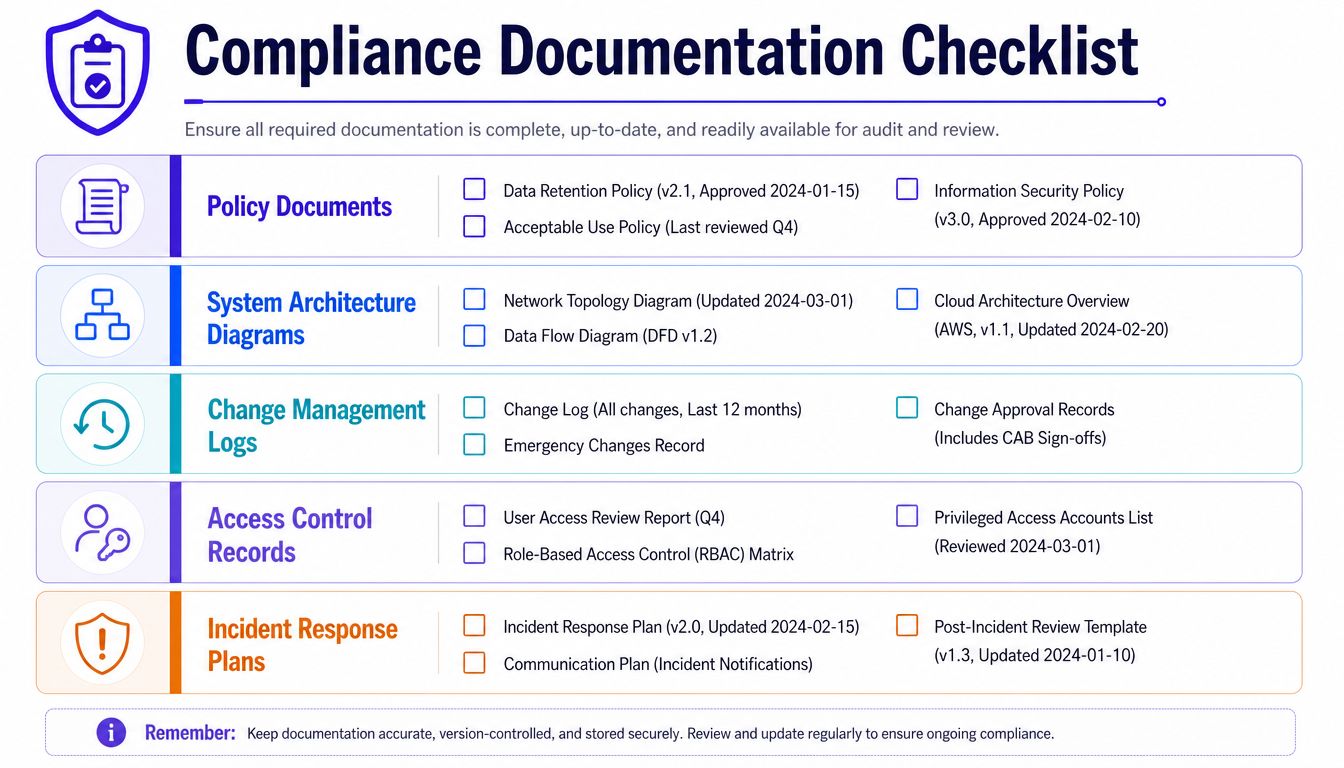
Compliance Documentation Checklist and Templates
Use this checklist as a working control, not a one-time project plan. Mark each item with an owner, status, last verification date, and linked evidence.
- Inventory scope: List systems, models, data stores, vendors, environments, and regulated workflows.
- Map obligations: Connect each requirement to a control objective and responsible owner.
- Assign ownership: Name both the document owner and the evidence owner.
- Define evidence: Identify the primary artifact that proves each control operated.
- Version artifacts: Record document versions alongside system, model, configuration, or deployment versions.
- Protect records: Apply role-based access, immutable logging, and tamper-evident storage.
- Schedule retention: Use record classes with retention periods, legal-hold handling, and deletion triggers.
- Automate collection: Capture deployments, approvals, tests, scans, access reviews, and operational logs from source systems.
- Review AI controls: Maintain model purpose, data use, limitations, risk decisions, human oversight, and disclosure records.
- Run walkthroughs: Test whether a person unfamiliar with the control can retrieve and interpret the evidence.
- Log exceptions: Record the issue, affected scope, owner, remediation, approval, and closure evidence.
- Refresh after change: Trigger review when architecture, vendors, models, data, or workflows change.
Template for a control-to-evidence map
| Control ID | Requirement | Control Objective | Owner | Primary Evidence | System Version | Review Trigger | Status |
|---|---|---|---|---|---|---|---|
| AC-01 | Access management | Remove inappropriate access | Identity owner | Access export and signed review | Directory revision | Role or identity workflow change | Open or verified |
| CH-01 | Change management | Approve and validate production changes | Engineering owner | Ticket, review, tests, deployment log | Release identifier | Pipeline or release process change | Open or verified |
| AI-01 | Model governance | Document purpose, limits, and approval | AI product owner | Model card and decision record | Model release identifier | Model, data, or prompt change | Open or verified |
Template for a pre-audit review
- Confirm the control description matches the current workflow.
- Retrieve the evidence without contacting the operator.
- Verify dates, scope, actor, approval, result, and exception handling.
- Trace the record to the relevant system or model version.
- Check retention and access protections.
- Record gaps without rewriting history.
- Assign remediation and retest after the fix.
The foundational elements are traceability, ownership, integrity, and truthful records. The storage platform, document format, dashboard design, and automation vendor can vary. A small startup may begin with a controlled repository, ticketing system, CI/CD exports, and an evidence index. A scale-up may need a governance platform that connects these sources automatically.
Begin this week by selecting one high-risk control, mapping its evidence, and running a retrieval test. Then connect the result to the workflow that generates the record. That small loop is more valuable than adding another policy to an unmanaged folder.
ThirstySprout helps companies staff senior AI engineers, MLOps specialists, data engineers, and AI product talent who can build production systems with compliance documentation embedded in the delivery workflow. Visit ThirstySprout to discuss a focused pilot, find the right specialist or remote AI team, and turn audit evidence from a recurring scramble into an operating capability.
Hire from the Top 1% Talent Network
Ready to accelerate your hiring or scale your company with our top-tier technical talent? Let's chat.