

You need to hire a senior Java engineer fast. A service is creaking under load, a modernization project is blocked, or a team lead just left. The pressure pushes a lot of teams into the same mistake. They start sourcing before they define the problem, then they interview for trivia, then they choose the candidate who sounded smartest in a meeting.
That's how expensive hiring mistakes happen.
When you hire Java developers well, you're not filling a seat. You're reducing delivery risk. You're deciding who will touch core services, own production trade-offs, and make choices that affect reliability, maintainability, and team velocity long after the interview loop ends.
The Senior Java Hiring Playbook Framework
TL;DR
- Start with role clarity. “Senior Java developer” is too vague to hire against.
- Screen for evidence, not keywords. Resumes alone are weak signals.
- Use practical assessments. Real problems from your stack beat language trivia.
- Score candidates consistently. Gut feel creates avoidable bias.
- Close on role quality, not salary alone. Good candidates evaluate scope, architecture, and leadership room.
This playbook is for CTOs, founders, hiring managers, and engineering leaders who need to hire Java developers without gambling on a polished resume. It works especially well when the role is senior, the system is business-critical, and the cost of a weak hire will show up in delivery slips or production incidents.
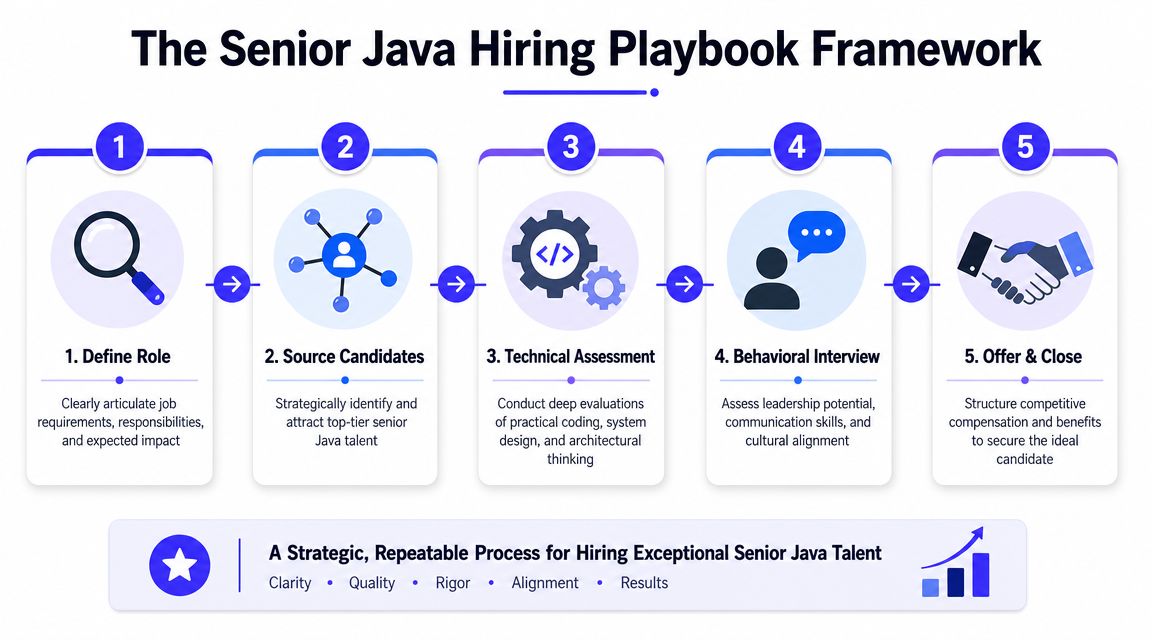
The five-stage flow that reduces hiring risk
I use a simple sequence:
- Define role
- Source candidates
- Technical assessment
- Behavioral interview
- Offer and close
That order matters. Teams often swap the first two steps, then wonder why the pipeline is noisy. If you don't know whether you need a modernization engineer, a Spring Boot service owner, or a platform-minded Java lead, sourcing gets flooded with the wrong profiles.
Practical rule: Treat hiring like architecture. Ambiguous inputs produce unstable outputs.
A useful parallel exists outside Java. If you've seen the 2026 playbook for hiring Angular, the same pattern shows up there too. Strong hiring starts with capability definition, not channel selection. The language changes. The operating principle doesn't.
Who should use this approach
This approach fits teams that are dealing with one of these realities:
- A product deadline is close. You need someone who can contribute without weeks of hand-holding.
- The stack is messy. There's old middleware, enterprise integration, or production constraints beyond plain Java coding.
- The hire must influence others. You need someone senior enough to shape decisions, not just implement tickets.
If that's your situation, broad sourcing alone won't save you. You need a disciplined funnel. For a deeper look at building that funnel across engineering roles, this guide on recruiting software developers effectively is a useful companion.
Define the Role Before You Search
Most failed Java searches start with a lazy brief. The hiring manager says they need a “senior Java developer,” recruiting posts the title, and then everyone spends two weeks sorting through candidates for three different jobs hidden inside one label.
A strong search starts with the business problem.
Start from the system, not the title
Ask what this person must own in the first six months. That answer usually puts the role into one of three buckets:
| Role shape | What they actually own | Typical signals to look for |
|---|---|---|
| Microservices builder | Spring Boot services, APIs, performance, testing, deployment | Service boundaries, REST design, testing depth, production incident judgment |
| Enterprise maintainer | Legacy Java estate, middleware, integrations, stability | JBoss, WebSphere MQ, Oracle or PostgreSQL, careful change management |
| Platform-oriented engineer | Java services plus deployment, observability, automation | CI/CD judgment, cloud comfort, scripting, operational ownership |
That distinction matters because current job listings often ask for more than Java alone. They include adjacent requirements such as JBoss, WebSphere MQ, Oracle/PostgreSQL, configuration management tools like Chef or Puppet, and scripting. In practice, teams searching to hire Java developers may need someone who can operate in legacy, secure, or DevOps-heavy environments, not just write classes and controllers, as reflected in current Java direct-hire job listings.
Write a skills matrix before you write a job post
Use a simple matrix with four bands:
- Must have
- Strong plus
- Nice to have
- Not needed
A sample for a senior backend role might look like this:
- Must have Java fundamentals, concurrency judgment, Spring Boot, SQL, testing strategy, Git, production debugging
- Strong plus message queues, caching, containerized deployment, system design, mentoring
- Nice to have cloud services, infrastructure automation, scripting in Python or Ruby
- Not needed front-end frameworks if the role won't touch UI
This forces trade-offs early. Without it, interviewers improvise. One interviewer screens for framework depth, another screens for algorithms, and a third screens for “culture fit.” That inconsistency makes the process noisy.
Good hiring briefs are specific enough to exclude the wrong people without excluding adjacent talent that can do the job.
Mini example of a better brief
Bad brief:
- Senior Java developer
- 5+ years
- Good communication
- Spring experience
Better brief:
- Own two customer-facing Java services with Spring Boot
- Maintain integrations with PostgreSQL and a message queue
- Improve test coverage discipline and release safety
- Lead design reviews for service boundaries and failure handling
- Work comfortably with CI/CD and production debugging
- Explain trade-offs to product and platform peers
That second version tells candidates what success looks like. It also gives your interview panel a shared definition of seniority. That alone cuts a lot of hiring waste.
Build a High-Signal Sourcing and Screening Strategy
Once the role is clear, speed matters. The Java labor pool is broad, with over 170,000 Java developers in the U.S., but mobility is high, and 60% stay in a job for 1–2 years according to this Java developer demographics analysis. That means good candidates don't stay available for long, and average candidate experience matters more than many teams admit.
Choose the right channel for the role
Different sourcing channels solve different problems.
| Channel | Works best when | Main upside | Main risk |
|---|---|---|---|
| In-house recruiting | Brand is strong and role is straightforward | Good process control | Slower on niche senior roles |
| Traditional agencies | You need volume quickly | Broader outbound reach | Incentive can favor speed over fit |
| Specialized talent networks | Role is senior, remote, or operationally complex | Better pre-filtering on stack and seniority | Smaller pool than open-market sourcing |
If you're hiring a plain CRUD role into a familiar stack, in-house can work well. If you need someone who can own a migration, evaluate trade-offs, and function remotely with little supervision, a specialized network can save internal bandwidth. For example, ThirstySprout is one option teams use when they want access to pre-vetted remote engineering talent rather than building the entire top of funnel from scratch.
Run a first-pass evidence review
The first screen shouldn't be a vibe check. It should answer one question: does this profile contain proof of doing the kind of work you need?
Here's a practical rubric.
| Signal Source | Low Signal (Red Flag) | Medium Signal (Investigate) | High Signal (Prioritize) |
|---|---|---|---|
| Resume | Long stack list, little ownership detail | Good employers, unclear personal impact | Specific systems owned, trade-offs explained |
| Generic bullets, inflated titles | Relevant background, vague achievements | Clear progression, credible scope, consistent story | |
| GitHub or portfolio | Empty or unrelated activity | Some code, weak context | Clear code ownership, thoughtful commits, architecture notes |
| Project discussion | Can't explain decisions | Explains implementation only | Explains constraints, failures, and production choices |
| Tenure pattern | Repeated short stays with no story | Mixed tenure, unclear reasons | Movement with plausible progression and increasing responsibility |
What I screen for in the first ten minutes
- Ownership language. Do they say “worked on,” or can they explain what they owned?
- Context depth. Do they mention reliability, testing, migration, incident handling?
- Tooling realism. Does the profile reflect actual production work, or just framework shopping?
- Consistency. Do the resume, profile, and conversation line up?
One practical sourcing trick is targeted outreach by company and role rather than broad keyword search. If your recruiters need help narrowing target accounts and finding the right people inside them, these strategies for finding key contacts are useful.
A weak pipeline wastes interviewer time. A strong pipeline is smaller, faster, and easier to close.
The Technical Assessment That Predicts Performance
The biggest technical hiring mistake is simple. Teams test what's easy to administer instead of what predicts job performance.

Generic take-homes and language trivia often miss what you need to know. Can this person solve business-relevant problems under constraints? Better practice is to use a real problem from your stack, and that matters even more in a market where U.S. labor data projects about 129,200 software developer openings per year, as noted in this discussion of best practices for hiring software developers.
Stop asking questions that reward memorization
Senior Java engineers rarely fail because they forgot syntax. They fail because they make poor production decisions, can't reason through trade-offs, or can't explain their own code.
Weak assessments usually look like this:
- LeetCode-only loops that reveal little about service design or maintainability
- Generic take-homes that could apply to any language and any company
- Rapid-fire trivia about annotations, JVM flags, or collection internals with no business context
These methods create false positives. You end up rewarding people who interview well, not people who ship well.
The interview should resemble the work closely enough that the candidate can demonstrate judgment, not just recall.
Use a paired practical exercise
My preferred format is a short, collaborative coding session built around a simplified version of a real problem.
Example prompt:
Build or extend a small Java service that accepts notification requests, validates payloads, persists state, and publishes an event for downstream delivery. Talk through error handling, idempotency, and test choices as you go.
This reveals a lot fast:
- how they structure code
- whether they can reason about failure paths
- what they test first
- how they communicate when requirements are incomplete
You don't need a giant exercise. You need enough surface area to observe habits.
A solid interview kit also includes role-specific prompts. If you need them, this list of Java interview questions and answers for practical hiring can help structure the conversation.
Add a system design discussion
For senior hires, coding alone isn't enough. You also need to understand architectural thinking.
Use prompts tied to your environment. For example:
- Design a scalable notification service for an e-commerce platform using a message queue.
- Design a migration path from a monolith to service boundaries without breaking reporting workflows.
- Design a partner integration service where retries, observability, and auditability matter.
Look for these behaviors:
- Clarifies constraints first
- Chooses sensible boundaries
- Explains trade-offs
- Thinks about operations
- Adapts when challenged
A good candidate doesn't chase the fanciest design. They make reasonable choices under stated constraints.
This short talk is a good companion if your team wants to calibrate how candidates explain design and implementation trade-offs in interviews:
Mini example of a high-signal debrief
After the interview, don't ask “Did you like them?”
Ask:
- What production risk did they notice on their own?
- Where did they show judgment rather than memorization?
- Could they explain testing and failure handling clearly?
- What level of support would they need in month one?
That kind of debrief predicts onboarding reality much better than general impressions.
Using Scorecards and Compensation to Close the Right Candidate
By the time you reach final interviews, the main risk changes. It's no longer “Can we find someone?” It becomes “Can we make a disciplined decision and close them before the process drifts?”
That's where scorecards matter.
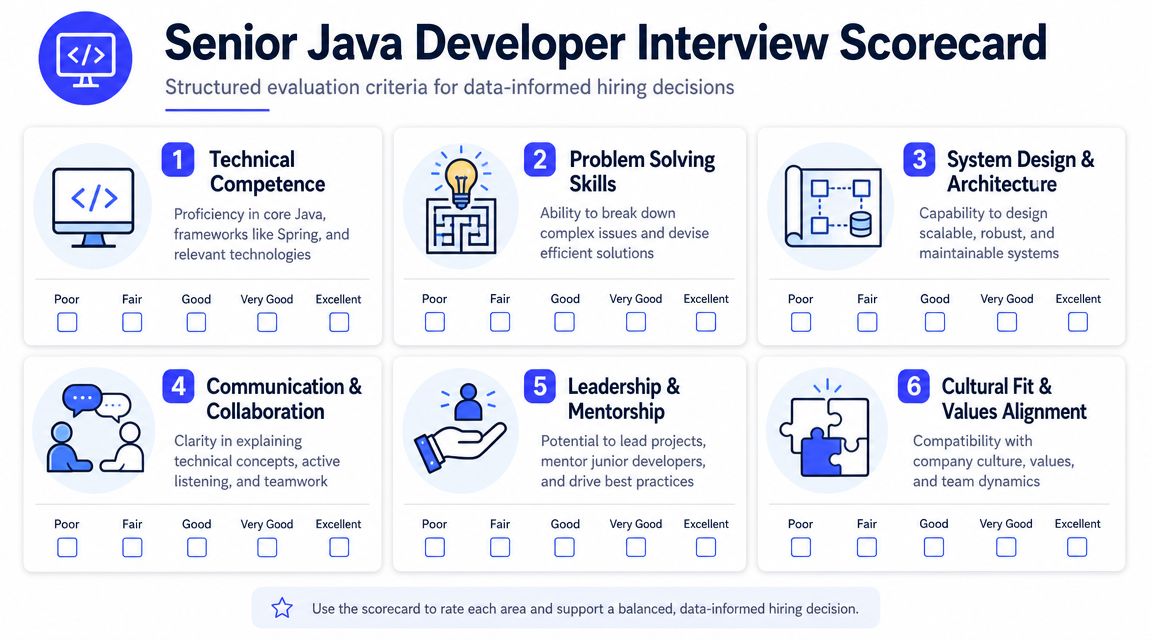
Use one scorecard across the whole panel
A scorecard prevents the common failure mode where each interviewer uses a different mental model. One person rewards confidence. Another rewards framework knowledge. A third rewards likability. None of that is reliable unless you normalize what “good” looks like.
A simple scorecard template:
| Dimension | What good looks like | Interview owner |
|---|---|---|
| Technical depth | Solid Java fundamentals, framework judgment, testing realism | Senior engineer |
| System design | Sensible architecture, trade-off awareness, scalability thinking | Staff or principal engineer |
| Execution | Can turn vague requirements into clear implementation steps | Hiring manager |
| Communication | Explains decisions clearly, handles challenge constructively | Cross-functional partner |
| Leadership | Mentors others, improves standards, raises risk early | Engineering leader |
Use written evidence, not just scores. “Strong on system design” is weak feedback. “Identified retry storms as a risk and proposed idempotent consumers plus dead-letter handling” is usable feedback.
Hiring heuristic: If the panel can't describe why the candidate is strong in concrete terms, the signal probably isn't strong.
Example scorecard prompts
Give every interviewer prompts before the loop:
- What did the candidate simplify well?
- Where did they show production awareness?
- Did they improve the problem framing, or just answer the question asked?
- Would you trust this person to review a critical service change?
That last question is especially useful for senior Java hires.
Compensation needs to match the market reality
Closing strong Java talent isn't just about process quality. Compensation still matters. One hiring-focused market source reports an average annual salary of $104,837 for Java developers in the U.S., with averages of $133,327 in New York and $147,316 in Massachusetts, as summarized in this report on hiring Java developers for in-demand roles.
The practical takeaway isn't that every senior hire must target those numbers. It's that compensation needs to be grounded in market competition and role difficulty. If your role asks for Java plus architecture ownership plus operational maturity, your offer should reflect that level of responsibility.
Make the offer about the work
Candidates at this level don't only compare money. They compare role quality.
Your close package should answer:
- What will I own?
- How much architectural influence will I have?
- What kind of mess am I inheriting?
- Will this team move fast enough to let me succeed?
- Is there room to mentor or grow?
A weaker offer says, “We're excited to have you.” A stronger one says, “You'll own service modernization, lead design reviews, and shape how this team releases Java systems safely.” Good candidates can tell the difference immediately.
Remote Onboarding, Retention, and Pitfalls to Avoid
A signed offer doesn't remove hiring risk. It moves the risk into onboarding.
Senior remote engineers fail early for predictable reasons. Access is slow. Ownership is fuzzy. The first project is either too trivial to matter or too chaotic to succeed. Then everyone starts second-guessing the hire when the underlying issue was setup.
Use a 30-60-90 day onboarding plan
For remote teams, structure matters more because casual hallway recovery doesn't exist.
A practical first 90 days can look like this:
First 30 days
- Access and environment. Repo access, service docs, local setup, incident tooling, communication channels.
- Architecture orientation. Walk through major services, data flows, integration points, and known pain points.
- First useful task. Assign a bounded task with real business value, not a fake onboarding ticket.
Days 31 to 60
- Own a service area. Put the engineer in charge of one component, support path, or workflow.
- Review and feedback rhythm. Weekly manager check-ins, design review participation, code review expectations.
- Production exposure. Let them observe incident response, release process, and operational dashboards.
Days 61 to 90
- Lead a scoped improvement. Reliability fix, migration step, performance cleanup, or developer-experience improvement.
- Document decisions. Ask them to write down trade-offs and system assumptions.
- Calibrate growth path. Clarify what senior ownership means on your team.
If your People team wants a simple administrative baseline, LeaveWizard's onboarding checklist is a useful starting point. Engineering should then layer role-specific technical onboarding on top.
Verify early, support early
A high-signal process includes scoping, portfolio review, technical interview, and reference checks. That matters because some industry hiring guides warn that up to 70% of applicants may lie on their resumes, which is why verification and evidence of hands-on competence matter in the final stages, as discussed in this guide on what to look for in a Java candidate.
That same principle carries into onboarding. Verify assumptions quickly:
- Can they understand the codebase?
- Can they explain the service they now own?
- Do they ask sharp questions about business context?
- Can they close a small task cleanly without hidden support?
The retention side most teams miss
Retention starts with role design. Senior engineers stay when they can see impact, autonomy, and technical credibility in the environment around them.
The teams that struggle usually make one of these mistakes:
- Vague ownership. Nobody knows what the new hire truly owns.
- Process drag. Slow approvals and unclear priorities kill momentum.
- No growth surface. Senior people don't want to remain ticket closers forever.
- Weak management cadence. Remote hires need intentional communication, not constant meetings.
If your broader plan includes distributed engineering teams, this guide on how to hire remote developers is worth reading alongside your onboarding plan.
A strong hiring process reduces bad-hire risk. A strong onboarding process reduces false negatives on good hires.
The pattern across this whole playbook is consistent. Bad Java hiring usually comes from preventable process flaws. The role is fuzzy. The sourcing is noisy. The assessment is generic. The final decision is unstructured. The onboarding is improvised. Fix those five things, and your odds improve sharply.
If you need help hiring senior engineers for complex remote roles, ThirstySprout can be one practical option to explore. Start with a clear role brief, ask for sample profiles, and run the same scorecard and assessment discipline described above so you can compare candidates on evidence, not hype.
Hire from the Top 1% Talent Network
Ready to accelerate your hiring or scale your company with our top-tier technical talent? Let's chat.