

TL;DR
- Choose the right channel: For urgent, short-term tasks, use a talent marketplace. For critical, long-term roles where quality is non-negotiable, a vetted network like ThirstySprout is the fastest path to production-ready talent. Build in-house recruiting only when hiring 10+ engineers per year.
- Define the role, not just the title: Create an Ideal Candidate Profile (ICP) focused on the business outcomes you need in the first 90 days. Translate this into a practical scorecard to eliminate bias and ensure consistent evaluation.
- Vet for real-world skills: Use a concise (3-4 hour) take-home assignment that mimics a real task, followed by a collaborative pair programming session. This combination is the best predictor of on-the-job performance.
- Onboard for day-one impact: A structured 90-day plan is non-negotiable. Day 1 should include full system access, an onboarding buddy, and a small, scoped first project to build momentum.
Who This Is For
- CTOs & Heads of Engineering who need to hire specialized remote developers for core product teams and must ensure quality and speed.
- Founders & Product Leads who are scoping new roles, setting budgets, and need to de-risk their hiring process to hit product milestones.
- Talent Ops & Procurement Managers who are evaluating different hiring channels and need a reliable, repeatable framework for sourcing and vetting global talent.
This playbook is for operators who need to make a hiring decision and get a new engineer productive within weeks, not months.
Your Remote Hiring Framework: A Step-by-Step Guide
Finding and hiring elite remote developers isn’t a game of chance. It’s a disciplined process that hinges on three pillars: clear role definition, rigorous skills vetting, and structured onboarding. This framework replaces guesswork with a system designed to find engineers who can ship production-ready code and drive business impact.
It starts with deciding how you'll find them. This choice directly shapes the speed, cost, and quality of your candidate pipeline.
Step 1: Choose Your Hiring Path
You have three primary paths for sourcing remote developers, each with clear trade-offs.
- Talent Marketplaces (Upwork): Best for speed and short-term projects. The vetting burden is entirely on you.
- Vetted Networks (ThirstySprout): Ideal for critical, long-term roles where technical excellence is non-negotiable. They handle the initial sourcing and screening.
- In-House Recruiting: The long-term play. It makes sense when you're hiring 10-15+ engineers annually and can invest in a dedicated talent team.
This decision tree helps you match the channel to your immediate needs.
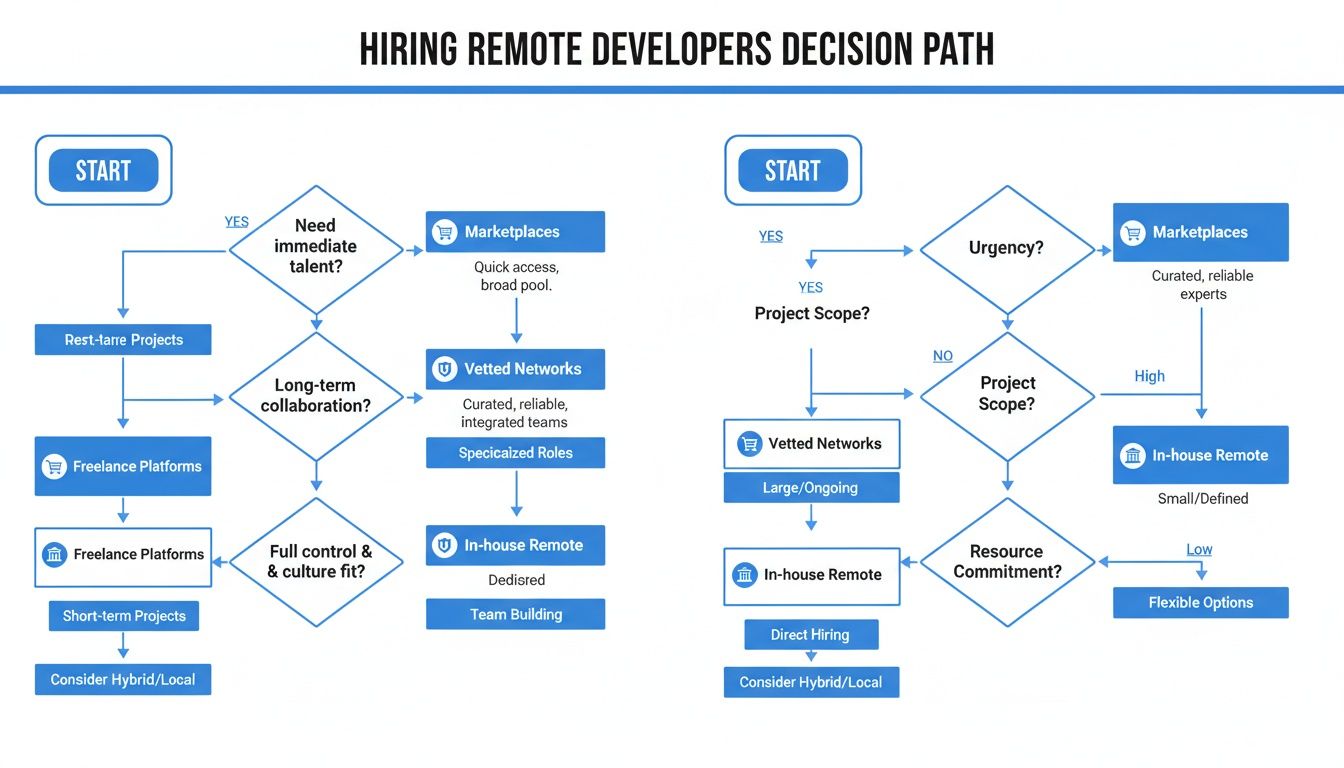
This flowchart shows two main paths: one for urgent, short-term needs leading to talent marketplaces, and another for critical, long-term roles leading to vetted networks or in-house recruiting.
Use this table to quickly compare your options.
Match your sourcing strategy to the role's importance. For a core engineer who will own part of your codebase, a vetted network provides a quality guarantee you won't find on a public marketplace.
Practical Examples: Scorecards and Take-Home Briefs
Vague requirements lead to costly mis-hires. Here are two practical examples you can adapt to bring clarity and objectivity to your hiring process.
Example 1: The Candidate Scorecard
A candidate scorecard translates your Ideal Candidate Profile (ICP) into a measurable rubric. It ensures every interviewer evaluates candidates against the same criteria, removing "gut feel" from the equation.
Here’s a scorecard for a Senior Backend Engineer role focused on API development.
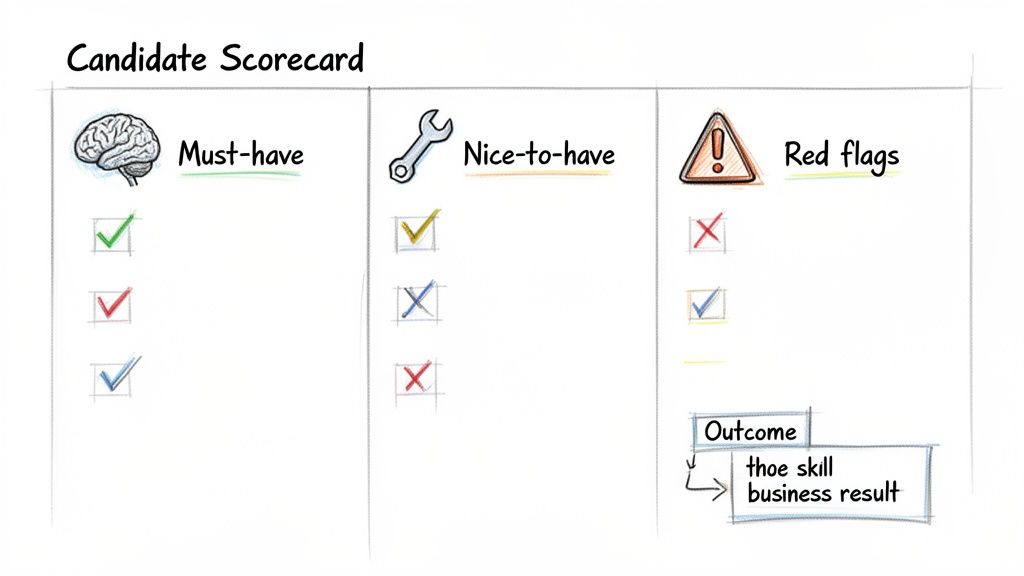
This scorecard example breaks down evaluation criteria into Must-Haves, Nice-to-Haves, and Red Flags for a technical role.
A well-defined ICP is your best defense against bias. It provides a consistent framework to measure every candidate against the same high bar, which is a cornerstone of improving your quality of hire metrics.
Example 2: The Concise Take-Home Assignment
A short, relevant take-home assignment is the single best predictor of an engineer’s ability to deliver production-ready code. It must respect their time—keep it to 3–4 hours.
Example Take-Home Brief: Senior AI Engineer
- Objective: Build a simple REST API using FastAPI that takes a block of text and returns its sentiment using a pre-trained model from Hugging Face.
- Requirements: Containerize the application using Docker, include a basic README with setup instructions, and write a few unit tests for the API endpoint.
- What We're Looking For: Clean, production-ready code; proper use of containerization; and clear, concise documentation. We value correctness and simplicity over overly complex solutions.
This one task reveals practical skills in API design, testing, and modern deployment workflows.
Deep Dive: Sourcing, Vetting, and Onboarding
With a clear role definition and evaluation tools, you can move on to finding and integrating your new hire.
How to Source and Vet Top Remote Talent
The best engineers are rarely scrolling public job boards. You need a proactive sourcing strategy and a vetting process that tests for production-level skills.
Choosing Your Sourcing Channels
- Talent Marketplaces: Platforms like Upwork are built for speed on short-term projects. The entire vetting burden falls on you.
- Direct Outreach: Building your own sourcing function via LinkedIn or GitHub gives you control but is slow and resource-intensive.
- Specialized Vetted Networks: Networks like ThirstySprout focus on a niche (e.g., AI engineering) and handle initial screening for you. Our candidate vetting engine filters for engineers with a proven track record of shipping production software.
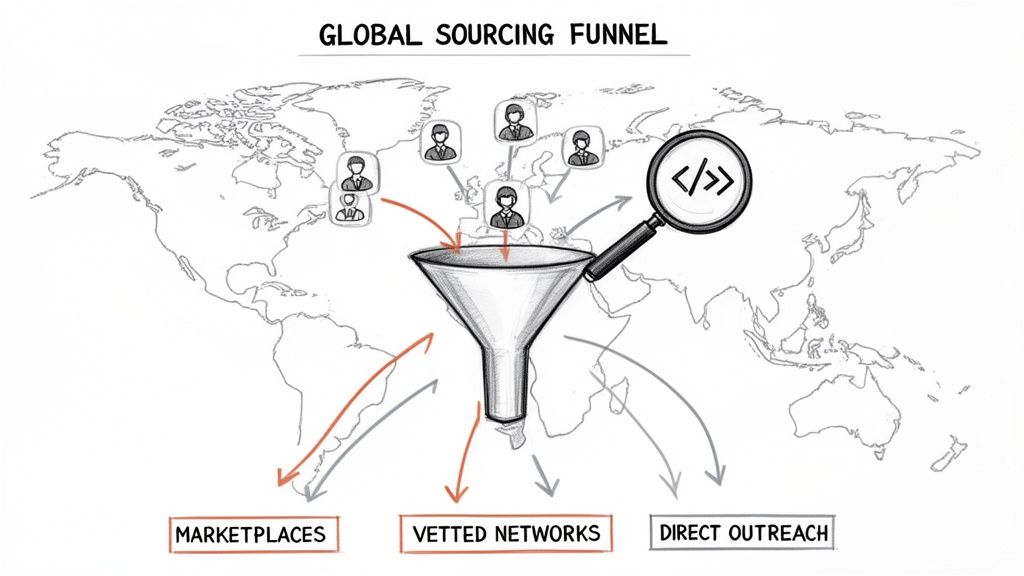
This diagram illustrates a sourcing funnel, starting with a wide pool from global sources and narrowing down through vetting stages to the final hire.
The Structured Pair Programming Session
After the take-home, a live coding session reveals how candidates solve problems and communicate in real-time. This is not a whiteboard algorithm test; it should be a practical, collaborative task.
Example Pair Programming Scenario: MLOps Engineer
- Objective: Review a provided Terraform script that deploys a simple S3 bucket and an IAM role.
- Task: Identify potential security issues, suggest improvements for production readiness (like state locking), and discuss how to integrate it into a CI/CD pipeline.
- What We're Looking For: Their thought process, clear communication, and ability to identify real-world infrastructure trade-offs.
This combination of a take-home and a collaborative session provides a complete picture of a candidate's technical depth and remote-readiness. For more on this, check out how to conduct effective interviews.
Sorting Out Global Pay and Compliance
Making a global offer involves more than just salary. You must handle compensation and compliance correctly to avoid legal risks.
Contractor vs. Employee of Record (EOR)
- Independent Contractor: Best for short-term projects or fractional roles. It offers minimal paperwork but carries misclassification risk if the role resembles full-time employment.
- Employer of Record (EOR): An EOR acts as your legal entity in the developer's country, managing payroll, taxes, and benefits. It’s the safest option for long-term, core team members.
A location-based compensation approach is most sustainable. Use data from tools like Pave or Levels.fyi to determine competitive salary ranges in the developer’s specific region. According to top global hiring trends for startups on riseworks.io, tapping into global talent can reduce costs while accessing specialized skills.
Onboard for Long-Term Success
The first 90 days determine whether a new hire becomes a long-term asset or a churn statistic. A structured onboarding plan is essential.
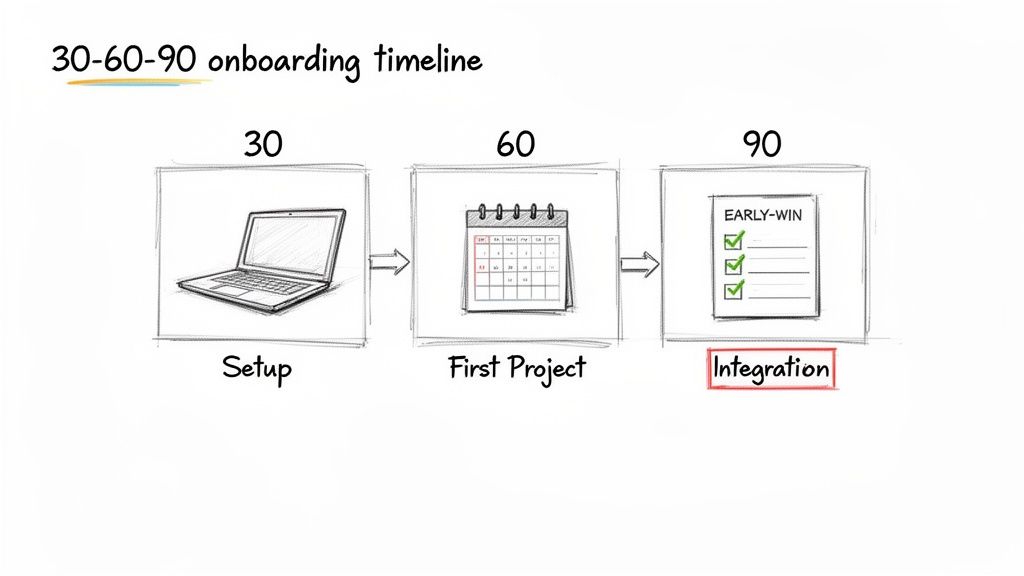
This 30-60-90 day timeline outlines key onboarding stages, from initial setup and first project to full integration and ownership.
- First 30 Days: Focus on setup and a first win. Ensure Day 1 access to all systems, assign an onboarding buddy, and scope a small, low-risk first project.
- Days 30-90: Shift to integration and impact. The developer should take on more complex tasks, contribute to sprint planning, and begin owning features.
A structured process is key to successfully integrating new hires. For more strategies, see our guide on how to manage remote teams. Data from global workforce trends on remote.com confirms that companies hiring internationally report higher talent quality and better retention. For more tips, explore these best practices for managing remote teams.
Remote Hiring Checklist
Use this checklist to ensure your process is repeatable and effective.
- Define the Role: Create an Ideal Candidate Profile (ICP) focused on 90-day business outcomes.
- Build a Scorecard: Translate the ICP into a rubric with must-haves, nice-to-haves, and red flags.
- Select a Sourcing Channel: Match the channel (marketplace, network, in-house) to the role's urgency and importance.
- Design a Take-Home: Create a 3–4 hour practical assignment that mirrors a real work task.
- Plan the Interview Loop: Structure a 3-stage process (screen, technical deep-dive, pair programming/system design).
- Handle Compliance: Decide between contractor and EOR models and benchmark compensation locally.
- Structure Onboarding: Prepare a 90-day plan with an onboarding buddy and a small first win.
- Set Up Tooling: Ensure async-first tools like Notion, Jira, and Slack are ready.
What to Do Next
- Define your immediate need: Is it a short-term project or a critical, long-term role? This answer dictates your hiring channel.
- Draft your ICP and Scorecard: Spend one hour defining the business outcomes and skills required for success in the first 90 days.
- Book a scoping call: If you're hiring for a critical AI or software engineering role, we can help you refine your spec and match you with pre-vetted candidates in days.
Ready to hire remote developers who have been vetted for technical excellence and remote readiness? ThirstySprout connects you with top-tier talent who can integrate seamlessly and start delivering value from day one.
References
- ThirstySprout - Quality of Hire Metrics
- ThirstySprout - How to Manage Remote Teams
- Rise - Top Global Hiring Trends for Startups
- Remote.com - Global Workforce Trends
- Callsky - Best Practices for Managing Remote Teams
- HypeScribe - How to Conduct Effective Interviews
Hire from the Top 1% Talent Network
Ready to accelerate your hiring or scale your company with our top-tier technical talent? Let's chat.