

TL;DR
- Define Impact First: Don't write a job description. Start with a Skill Matrix that maps every technical skill (e.g., PyTorch, RAG) to a specific business outcome (e.g., "reduce model hallucinations").
- Go Where Talent Lives: The best developers aren't on job boards. Find them through their open-source contributions (GitHub), in niche communities (Discord/Slack), or via specialized talent networks.
- Run a Structured Process: Use a multi-stage interview funnel (Recruiter Screen -> Tech Deep-Dive -> Take-Home Project -> Team Fit) to systematically evaluate skills and save your team's time.
- Make a Compelling Offer: Benchmark compensation with real-time data, but also sell the mission, project autonomy, and a clear growth path. Share a 90-day onboarding plan before they start.
- Need Speed & Expertise? For urgent or niche AI/ML roles, a standard in-house search takes 60-120 days. A specialized network like ThirstySprout connects you with vetted engineers in 2–4 weeks.
Who This Is For
- CTOs / Heads of Engineering: You need to hire senior AI or MLOps engineers to deliver on your product roadmap, but your current pipeline is slow and filled with unqualified candidates.
- Founders / Product Leads: You're scoping a new AI feature and need to understand the talent required, the budget, and a realistic timeline to get a team in place.
- Talent Ops / Hiring Managers: You're tasked with finding specialized developers and need a practical framework that gets results faster than posting on LinkedIn.
This playbook is for operators who need to hire critical talent and see business impact within weeks, not quarters.
Your Tactical Playbook for Hiring Developers in 2026
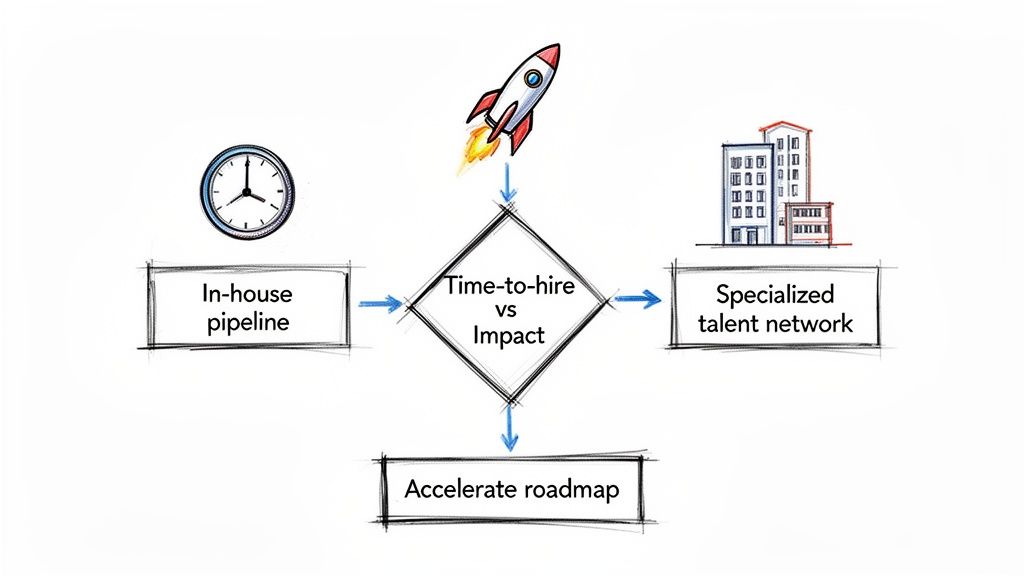
Alt text: Flowchart comparing the trade-offs between hiring in-house vs. using a specialized talent network, showing that specialized networks offer faster time-to-hire for high-impact roles.
The market to recruit software developers isn't about finding people. It's about attracting the right people who can ship production-ready code. Throwing a generic job description onto a massive platform gets you a flood of applicants but burns out your team screening candidates who lack the right skills. Success requires a surgical approach.
For most tech leaders, it boils down to one crucial decision: build a slow, expensive in-house hiring machine, or partner with a specialized network to get results fast? The right answer depends on your immediate roadmap, how niche the role is, and how quickly you need someone delivering code.
The metric that matters isn't cost-per-hire. It's the opportunity cost of an empty role. A six-month delay hiring that key AI engineer could mean a competitor launches first and grabs market share you'll never get back.
The Decision Framework: In-House vs. Specialized Network
Your recruiting approach must reflect your product goals. Here is the framework we use to advise clients.
- Urgent Project Need (e.g., ship new AI feature next quarter): An in-house search is too slow. A specialized talent network can introduce vetted, ready-to-work engineers in 2–4 weeks. This path prioritizes speed and immediate business impact.
- Building a Core Team (e.g., first 5 engineers): For foundational roles where deep cultural integration is paramount, investing in your own in-house strategy makes sense. This means dedicating real resources to your employer brand and talent acquisition function. This path prioritizes long-term cultural embedding.
- Highly Specialized Expertise (e.g., RAG, MLOps for LLMs): Finding someone with production experience in a niche field like vector databases is a different challenge. These experts are not browsing job boards. You find them through open-source work, curated communities, or deep industry connections—the core competency of a specialized network.
A common mistake is a one-size-fits-all approach. The playbook for hiring a generalist frontend developer is completely different from landing a senior MLOps engineer. This guide gives you the tactical frameworks for both paths.
1. Define The Role With a Skill-to-Impact Matrix
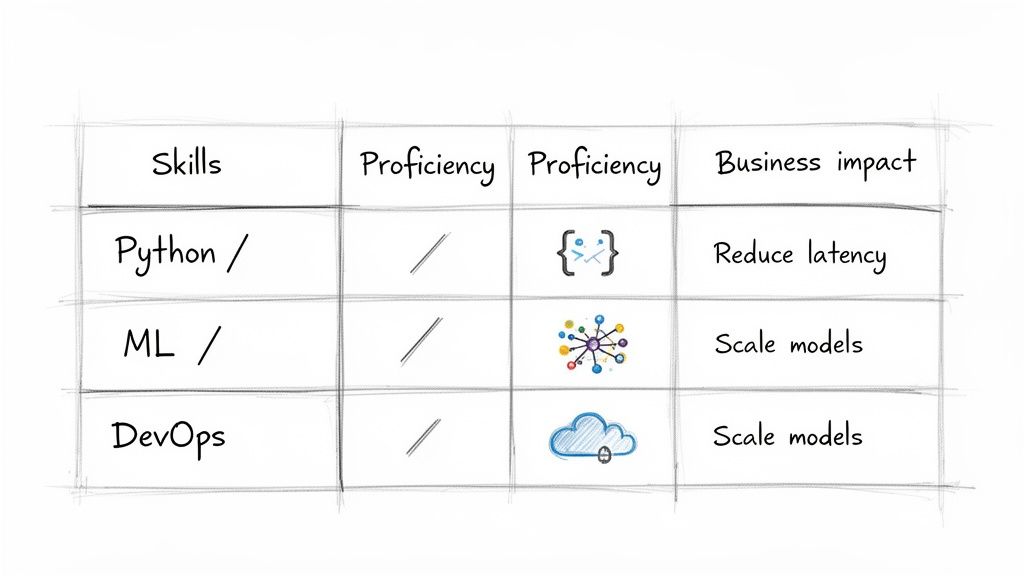
Alt text: A sample skill matrix table for a developer role, with columns for Skill/Technology, Required Proficiency, and Business Impact, showing how to connect technical needs to business outcomes.
Most job descriptions are a laundry list of technologies that fail to attract the right people. To recruit software developers who move the needle, you must stop thinking about a role and start thinking about the problems you need solved.
The best tool for this is a Skill Matrix. Before writing a job spec, map every technical skill to a specific business outcome. This forces clarity and ensures you’re hiring for impact, not just checking boxes.
The goal isn't finding someone who knows PyTorch. The goal is to find someone who can use PyTorch to reduce model inference latency by 30%, improving user experience and cutting cloud spend. That’s the mindset shift.
Practical Example 1: Skill Matrix for a Senior AI Engineer
This matrix becomes the foundation for your job description, interview questions, and the new hire’s 90-day plan. It forces you to distinguish between "must-haves" and inflated "nice-to-haves."
| Skill/Technology | Required Proficiency | Business Impact |
|---|---|---|
| Python & PyTorch/TensorFlow | Expert | Build, fine-tune, and deploy custom large language models (LLMs) for our new AI co-pilot feature. |
| RAG & Vector Databases | Advanced | Implement a scalable retrieval system to ground model responses in our proprietary knowledge base, reducing hallucinations by 40%. |
| API Development (FastAPI) | Proficient | Expose model endpoints for consumption by our frontend applications, ensuring <100ms latency and high availability. |
| Prompt Engineering | Advanced | Develop and test sophisticated prompt chains to improve the accuracy and relevance of AI-generated content for key user workflows. |
Practical Example 2: Skill Matrix for a Remote MLOps Engineer
| Skill/Technology | Required Proficiency | Business Impact |
|---|---|---|
| CI/CD (GitHub Actions) | Advanced | Automate the testing and deployment pipeline for models and prompts, reducing time-to-production from weeks to 2-3 days. |
| IaC (Terraform) | Advanced | Manage and scale cloud infrastructure (AWS/GCP) to support model training and serving, optimizing for a 20% cost reduction. |
| Containerization (Docker, Kubernetes) | Expert | Ensure consistent and reproducible model environments from local development to production deployment, eliminating "it works on my machine" issues. |
| Monitoring (Prometheus, Grafana) | Proficient | Implement robust monitoring to track model performance, data drift, and system health, enabling proactive issue resolution. |
With your skill matrix, you can now write a job description that tells a story about the impact the role will have. For a deeper dive, see our guide on crafting a compelling AI engineer job description.
2. Source and Engage Talent Where They Are
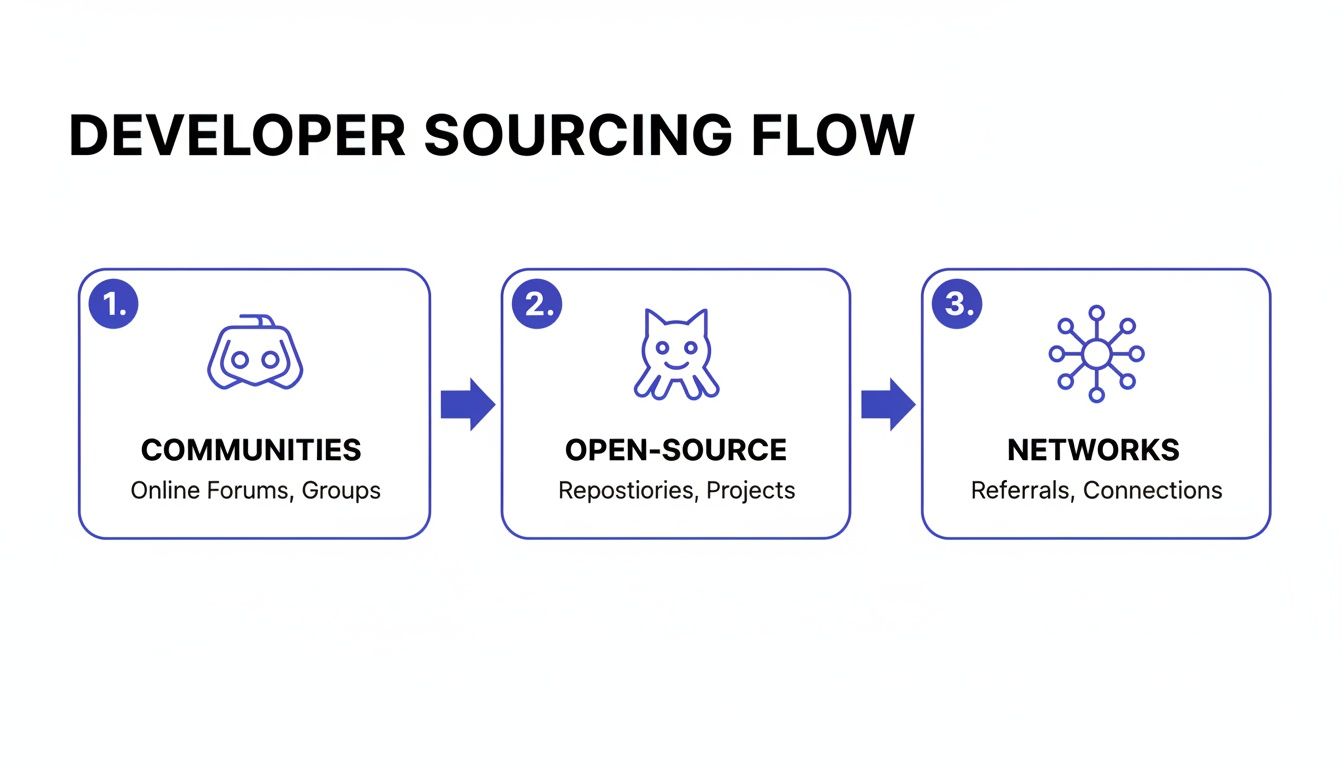
Alt text: Flowchart showing three primary channels for sourcing developers: niche online communities, open-source project contributions, and specialized talent networks.
The best software developers aren't looking for a job. They’re busy building things. To hire them, you have to go where they are. This means you must stop casting a wide net and start fishing with a spear.
Knowing how to search for employees on LinkedIn is a start, but it’s not enough for specialized roles. You have to dig into the communities where your ideal candidates are contributing and learning. The global developer population is an estimated 28.7 million, with talent hotbeds for AI/ML emerging in India, Argentina (3.2% of hires in 2026), and Germany (2.4%).
Go Beyond LinkedIn: A 3-Channel Sourcing Strategy
If you want to find elite developers, become part of their world. This isn’t just sourcing; it’s building a warm pipeline.
- Open-Source Contributions (GitHub/GitLab): A developer’s code is their truest resume. Building a RAG system? Look at who is contributing to LangChain or LlamaIndex. Their public commits reveal their skills.
- Niche Communities (Discord/Slack): Specialized Discord servers for AI research or specific frameworks are goldmines. Don't just drop job links. Participate authentically. Answer questions, share your team's work, and become a trusted member.
- Specialized Talent Networks: For speed and quality, platforms that pre-vet senior engineers are invaluable. This can slash your time-to-hire for critical roles from months to weeks.
Real-World Example: A fintech startup needing a data engineering team spent time on GitHub identifying key contributors to an open-source pipeline tool they used. They started by asking smart questions about the contributors' work, built rapport, and hired three senior engineers who were already world-class experts in their exact tech stack.
Craft Outreach That Gets a Response
Your first message is everything. A generic template is the fastest way to be ignored. Show you've done your homework.
A great first message has three ingredients:
- A Specific, Genuine Compliment: "I was really impressed by your recent contribution to the
XYZlibrary..." proves you're not spamming. - A Clear Link to Your Challenge: "We're building a real-time fraud detection model, and your experience with streaming data processing is exactly what we’re looking for."
- A Low-Friction Ask: "Would you be open to a 15-minute call next week to talk more about the engineering challenges we're tackling?" Don't ask for a resume.
This personalized approach dramatically increases your reply rate. As you scale, consider the best AI recruiting tools to help track and personalize communication.
3. Design An Efficient and Respectful Interview Process
A great interview process does more than just weed out wrong candidates—it actively sells your company to the right ones. You need a structured, efficient experience. Lead-to-hire conversions for developers have dropped to just 0.31% as of late 2025. Competition for specialized talent is fierce. Your process must be a well-oiled machine.
Using specialized job application form software can help collect the right information upfront and save time for everyone.
A 4-Stage Interview Funnel That Works
A multi-stage funnel protects your senior engineers’ time. Each stage needs a clear purpose.
| Stage | Goal | Format | Key Focus/Question Example |
|---|---|---|---|
| 1. Recruiter Screen | Verify baseline fit & sell the vision | 30-min Video Call | "What are your salary expectations, and what kind of work environment helps you do your best work?" |
| 2. Technical Deep-Dive | Assess technical depth & decision-making | 60-min Video Call with Hiring Manager | "Walk me through a complex project you led. What were the biggest technical trade-offs you had to make?" |
| 3. Technical Assessment | Validate hands-on skills | Varies (Paid Take-Home is best for senior roles) | For a take-home: "Build a simple API with these two endpoints and include tests. Document your architectural choices." |
| 4. Final "Bar Raiser" | Evaluate collaboration & cultural alignment | 45-min Panel Interview with a peer | "Tell me about a time you had a strong disagreement with a colleague. How did you handle it?" |
Choose The Right Technical Assessment (With Trade-offs)
There's no single "best" assessment. Match the test to the skills you need.
- Live Coding (60-90 mins): Good for assessing algorithmic thinking and communication under pressure. Best for: Junior to mid-level roles. Trade-off: High-stress and doesn't reflect real-world coding.
- Take-Home Project (3-5 hours): The best way to evaluate code quality, project structure, and independent work. Best for: Senior roles (AI, MLOps). Trade-off: Requires a significant time commitment. You must pay them for their time or keep the scope incredibly tight.
- System Design Interview (60 mins): A collaborative whiteboarding session to test architectural thinking and handling ambiguity. Best for: Senior, Staff, and Principal roles. Trade-off: Can become too abstract if not well-moderated.
Our Approach at ThirstySprout: For senior AI/ML roles, we heavily favor a paid, scoped take-home assignment. It provides a real signal on production-quality work and respects the candidate's expertise by compensating them for their time.
Remember to assess non-technical skills as well. Our guide on behavioral interview questions for software engineers can help.
4. Close the Deal with a Compelling Offer and Onboarding
You’ve found the perfect developer. Don’t lose them now. A lukewarm offer or a disorganized start can make a candidate walk away.
Employment for software developers is set to jump by 15% in the coming decade, with median salaries at $133,080 annually, and much higher for AI roles (Source: U.S. Bureau of Labor Statistics website). Your offer must be competitive.
Developer Compensation Benchmarks (Annual Salary, 2026)
Use these real-time, market-driven ranges to anchor your budget.
| Role | Experience Level | US (High-Cost Area) | US (Low-Cost Area) | Western Europe | LATAM |
|---|---|---|---|---|---|
| Backend Engineer | Mid-Level (3-5 yrs) | $140k - $175k | $110k - $135k | $80k - $110k | $55k - $80k |
| AI/ML Engineer | Senior (5+ yrs) | $180k - $240k | $150k - $190k | $110k - $150k | $80k - $115k |
| MLOps Engineer | Lead (8+ yrs) | $210k - $270k+ | $180k - $220k | $130k - $170k | $95k - $130k |
Beyond salary, top talent cares about:
- Meaningful Equity: Walk them through the strike price, vesting schedule, and potential upside.
- Project Autonomy: Emphasize the ownership they’ll have and the direct line between their work and business success.
- Growth Opportunities: A clear career path and a budget for conferences and courses prove you’re invested in them.
A great offer isn't just a number; it's a story. It tells the candidate, "We understand what you're worth, we have challenges worthy of your skills, and we are committed to helping you grow."
The 90-Day Onboarding Checklist for Fast Impact
Share this plan before day one. It shows you’re prepared and combats "buyer's remorse."
- Schedule 1-on-1s with every key team member.
- Grant access to all tools and documentation.
- Assign a small, low-risk "first win" project (e.g., a documented bug fix).
- Integrate into the first major sprint.
- Participate in code reviews.
- Schedule first formal check-in with manager to review progress and goals.
- Take ownership of a feature or component.
- Proactively suggest solutions and improvements.
- Contribute ideas to the team's technical roadmap.
A structured onboarding process dramatically shortens time-to-value and is one of the most powerful drivers of long-term retention.
What to Do Next
- Build Your Skill Matrix: Before you post any job, use our matrix template to define the business impact you need for your next hire.
- Audit Your Sourcing: Are you only on LinkedIn? Dedicate time this week to explore two niche communities or open-source projects relevant to your stack.
- Talk to an Expert: If your search is taking too long, let's talk. We can show you profiles of vetted AI and ML engineers who match your needs.
Ready to accelerate your hiring and connect with pre-vetted, senior AI talent? At ThirstySprout, we match you with elite engineers who can start in days, not months.
Start a Pilot and build your team faster.
References & Further Reading
- ThirstySprout: AI Engineer Job Description Template
- ThirstySprout: Best AI Recruiting Tools for 2026
- U.S. Bureau of Labor Statistics: Software Developers Outlook
Hire from the Top 1% Talent Network
Ready to accelerate your hiring or scale your company with our top-tier technical talent? Let's chat.