

You're hiring for an AI platform, not a toy service. The Go engineer who looks solid in a generic backend interview can still struggle when the system starts handling concurrent inference requests, long-running data jobs, cancellation chains, and hard-to-reproduce race conditions in production.
That's why generic Golang interview questions usually miss the mark. They over-index on syntax and under-index on correctness under load. For senior hiring, especially in AI and ML environments, the signal comes from how a candidate reasons about ownership, concurrency, failure handling, and system boundaries.
Go is still a niche interview language compared with the mainstream options, but it's very much present in senior screening. Interviewing.io says it has hosted over 100,000 interviews, with Go as the language of choice in 1% of them, or roughly 1,000 Go interviews in that dataset, which is useful context if you're hiring in backend and infrastructure-heavy markets where Go is common for services and cloud tooling (Interviewing.io's Go interview guide).
If I were building a hiring loop for a high-stakes AI team, I wouldn't just ask for definitions. I'd ask candidates to explain trade-offs, debug flawed code, and connect technical decisions to reliability, latency, and team maintainability. That's the difference between someone who has used Go and someone who can safely own a production service that fronts a model, coordinates workers, or runs a feature pipeline.
Use the list below as a practical playbook. Each question includes what a strong answer sounds like, where weaker candidates usually stumble, and how to tie the topic back to business impact. That last part matters. A senior Go hire isn't there to win language trivia. They're there to help your AI systems stay correct, operable, and fast enough for real users.
1. Explain Goroutines and Concurrency in Go
A lot of candidates can define a goroutine. Fewer can explain when adding more concurrency makes a service better, and when it just creates harder failure modes.
A strong answer starts with the basics. Goroutines are lightweight concurrent functions managed by the Go runtime, not raw operating system threads. But for senior roles, don't stop there. Ask how they'd use goroutines in an inference service that needs to handle multiple upstream calls, feature fetches, and result aggregation without leaking work after the request is canceled.
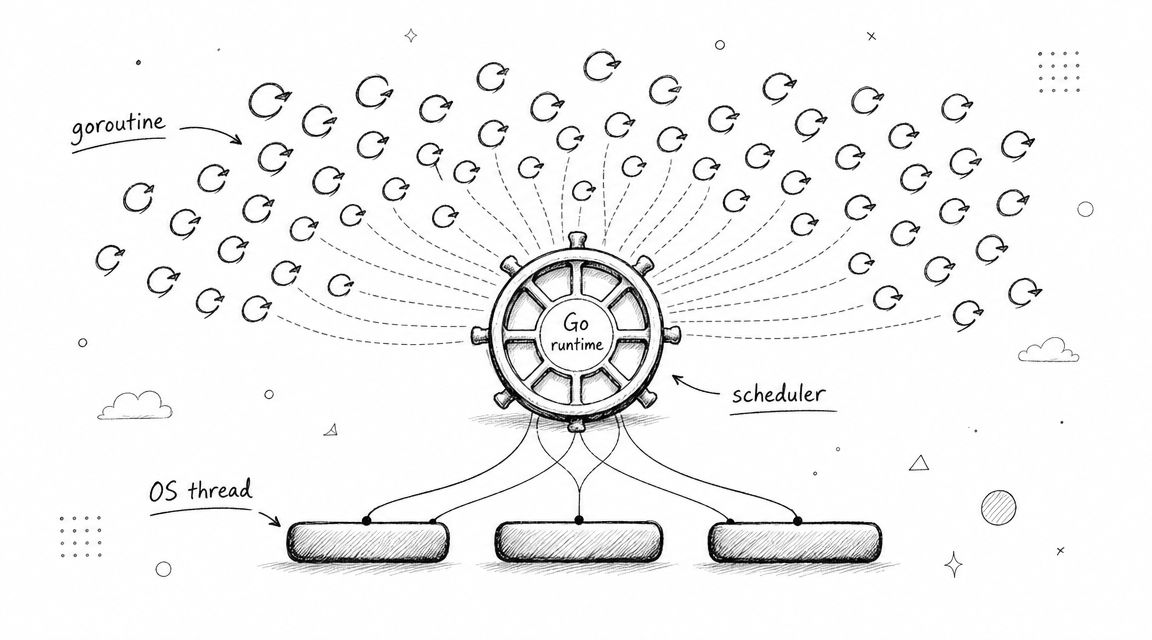
What a strong answer sounds like
The best candidates talk about bounded concurrency, lifecycle management, and cleanup. They'll usually mention that goroutines are cheap, but not free. They should also recognize that AI workloads often combine network I/O, preprocessing, model orchestration, and post-processing, so a worker-pool design is often safer than spawning unbounded goroutines per task.
A practical scenario is batch inference. A senior engineer might fan work out to a fixed pool, collect results through channels, and stop early if the request context is canceled. That answer shows system judgment, not just language knowledge.
Practical rule: If a candidate talks about launching goroutines freely but never mentions cancellation, leaks, or backpressure, they're not thinking like an owner.
Go's use in scalable application engineering is one reason interviewers keep returning to concurrency-heavy topics for backend and platform roles, especially in companies that care about reliable services under load (MindMajix on Go interview demand and adoption).
For teams comparing language choices at the architecture level, this is often where Go vs Java becomes a real staffing discussion rather than a theoretical one.
Follow-up prompts for senior candidates
- Worker pool design: How would you limit concurrency when requests spike?
- Leak detection: How do you investigate goroutines that never terminate?
- Shutdown behavior: What happens to in-flight work during deploys or autoscaling events?
Weak candidates usually stay at “goroutines are lightweight threads.” Strong ones talk about ownership, cancellation boundaries, and operational safety.
2. What Are Interfaces and How Do You Use Them?
This question sounds basic, but it exposes whether a candidate writes Go that stays simple under product pressure.
In AI systems, you'll often want to swap model backends, feature sources, embedding providers, or cache layers without rewriting orchestration code. Interfaces help, but only when they're small and purposeful. Senior engineers know that overusing interfaces makes a Go codebase harder to follow.
What you want to hear
A good candidate will say that interfaces describe behavior through method sets, and that Go uses implicit satisfaction. They'll also explain where interfaces belong. In strong Go code, the consumer package usually defines the interface, not the implementation package.
Give them a concrete scenario. Say you run an inference gateway with multiple model backends:
- Prediction layer:
Predict(ctx, input) (Output, error) - Feature source:
LoadFeatures(ctx, entityID) (Features, error) - Cache layer:
GetandSetaround a response cache
The right answer isn't “abstract everything.” It's “define the seam where you need substitution, testing, or multiple implementations.”
What weak answers miss
Less experienced candidates often create large “god interfaces” because they came from object-heavy ecosystems. That's usually a maintenance smell in Go. It couples unrelated behaviors and makes mocking easy in the short term but design worse in the long term.
A better answer mentions small interfaces, narrow contracts, and explicit behavior. In an ML platform, that might mean a ModelPredictor interface for orchestration code, while the actual TensorRT, ONNX, or remote model client stays concrete behind that edge.
Good Go interface design isn't about future-proofing every possibility. It's about reducing coupling where you already know multiple behaviors exist.
You can press further by asking for a refactor example. If the candidate can explain how they replaced a broad interface with two smaller ones to make testing or ownership clearer, that's strong evidence of maturity.
3. Explain Channels and Select Statements
A senior Go hire will eventually own code where one inference request fans out across multiple systems, then has to stop the losing work fast enough to protect latency and cost. Channels and select are where that judgment shows up.
For hiring managers, this topic is less about syntax and more about operational thinking. You are testing whether the candidate can coordinate concurrent work without leaks, blocked goroutines, stale writes, or wasted model calls. In AI services, those mistakes show up as p95 latency spikes, higher backend spend, and hard-to-reproduce correctness bugs.
A useful interview scenario
Ask this: “You query two model backends in parallel and return the first acceptable result. How would you structure that in Go?”
Strong candidates usually start with the mechanics. Channels move typed values between goroutines. select waits on multiple channel operations. The better signal comes from what they do after that baseline explanation. They should bring up context.Context, cancellation of the losing branch, ownership of result channels, and how to prevent workers from blocking forever when the caller exits early.
A good answer often includes one of two patterns. The first is fan-out and fan-in for redundant model calls or parallel feature retrieval. The second is a bounded worker pool for batch preprocessing or embedding jobs, where a buffered job channel helps throughput but still respects ctx.Done().
What to listen for
- Clear channel ownership: The goroutine that sends the final values should usually be the one that closes the channel.
- Cancellation discipline: They should include
selectonctx.Done()and explain how abandoned work stops. - Buffered versus unbuffered trade-offs: Buffered channels absorb short bursts. They also hide backpressure if used carelessly.
- No accidental busy loops: If they add a
defaultcase, ask what behavior they want. In many cases it creates polling, not responsiveness. - Awareness of goroutine leaks: A senior candidate should spot the risk when a sender blocks because no receiver is left.
That last point matters more than many interviewers realize. In production AI systems, a leaked goroutine is rarely just a minor cleanup issue. It can hold memory, keep network calls alive, and continue expensive inference work after the request is already gone.
Senior follow-up
Push past the happy path. Ask: “The pipeline passes tests, but under load you get intermittent corrupt responses and occasional latency blowups. What do you inspect first?”
Strong candidates usually work through three classes of failure. Shared mutable state crossing goroutine boundaries. Channel misuse, such as closing from the wrong side or leaving senders blocked. Missing cancellation, which lets background work continue after a winner has already been chosen. If they also mention slice aliasing or reuse of buffers passed between workers, that is a strong sign they have debugged real Go concurrency bugs before.
Practical scoring guidance
For a mid-level engineer, a correct explanation of channels, select, and timeout handling is enough.
For a senior hire on an AI platform team, raise the bar. Look for answers that connect concurrency design to user-visible latency, GPU or model-serving cost, and failure isolation. The people you want can explain not just how channels work, but when channels are the right tool, when a mutex is simpler, and how to structure cancellation so parallelism improves throughput without hurting control.
4. Describe Defer, Panic, and Recover
You separate people who've built production services from people who've mostly written happy-path code.
A senior Go engineer should understand defer as a cleanup mechanism, panic as a signal for programmer error or unrecoverable state, and recover as a boundary tool, not a normal control-flow technique. In AI-serving code, that distinction matters because one bad handler, malformed input path, or unsafe assumption inside a wrapper shouldn't take down the whole process.
A practical production example
Imagine an HTTP inference handler that acquires a lock, opens a file-backed artifact, and allocates temporary resources for preprocessing. A strong candidate should instinctively say defer is the right way to release those resources, especially where functions have multiple returns.
Another good example is panic containment. If your service integrates with a third-party library or experimental model wrapper, putting recover at the request boundary can stop a single request from crashing the server. But a senior candidate should also say that recovering without logging and diagnosis just buries the problem.
recoverbelongs at the boundary of a process or request. It doesn't belong in ordinary business logic.
What strong candidates usually say
They'll often mention a few practical rules:
- Use
deferfor cleanup: files, locks, transactions, and temporary resources - Reserve
panicfor broken invariants: not normal validation or network errors - Recover high in the stack: typically middleware, RPC boundary, or worker supervisor
- Be mindful in hot paths:
deferis clean and correct, but they may note overhead in tight loops
Weak candidates often say “panic is like exceptions.” That's not enough. A mature answer explains where panic is appropriate and where explicit errors are still the correct path.
If you're hiring for model-serving infrastructure, ask how they'd stop a malformed payload from cascading into a full service crash. The candidate who discusses middleware recovery, structured logs, and request-scoped context is likely much closer to production-ready.
5. What Is the Difference Between Pointers and Values?
A model-serving incident often starts with a small design choice. One handler passes a struct by pointer for convenience. Another goroutine mutates shared state. A few deployments later, you are debugging request contamination, cache corruption, or a race that only appears under production load.
That is why this question matters in a senior Go interview. Pointer versus value semantics affect API design, mutation control, allocation behavior, and how safely a team can scale concurrent code. In AI systems, those choices show up in feature payloads, model metadata, in-memory caches, and request-scoped configuration.
What strong candidates should explain
The baseline is straightforward. Passing a value copies it. Passing a pointer shares access to the same object.
Senior candidates go further. They should explain when copying is cheap and clarifying, when sharing is necessary, and what each choice means for correctness. I look for a default bias toward values for small data with clear ownership, and toward pointers when a type is large, mutable, or has identity that must remain shared across calls.
They should also catch the trap hidden inside the question. Some Go types look like values but still share underlying storage. Slices, maps, and channels already carry reference-like behavior. A candidate who says "everything passed by value is isolated" is missing how bugs happen in production.
A practical interview setup
Use two examples that mirror real backend and AI workloads:
Config, small and treated as immutable after startupModel, large and stateful, with caches, metrics, and loaded artifacts
Ask which should use value receivers and which should use pointer receivers. A strong answer usually lands here:
Configcan often stay value-oriented because copying is cheap and mutation is easier to preventModelshould usually use pointer receivers because copying it is expensive and methods operate on shared state- Receiver choice should stay consistent across the type so method sets remain predictable
The follow-up is where seniority shows. Ask what happens if Config contains a slice or map. Better candidates will immediately point out that copying the struct does not deep-copy that backing data. They will talk about defensive copying at boundaries where isolation matters.
What to listen for in senior-level answers
- Ownership clarity: who is allowed to mutate the data
- Method-set discipline: avoid mixing pointer and value receivers without a clear reason
- Alias awareness: slices and maps can still create shared-state bugs even inside copied structs
- Performance judgment: copying a small struct may be cheaper than the coordination cost of shared mutable state
- Concurrency safety: pointers increase the chance of accidental cross-goroutine mutation
This question is useful because it exposes engineering judgment, not memorization.
In AI infrastructure, one bad answer has business impact. If a team shares mutable request state across workers, you get hard-to-reproduce inference bugs. If they copy large structs blindly, latency and memory pressure rise under batch load. The right trade-off depends on data size, mutation patterns, and contention. For teams comparing Go against other backend options for latency-sensitive services, this often ties into broader discussions about which languages perform best in production systems.
A simple rubric for hiring managers
Junior signal: knows that values copy and pointers share access.
Mid-level signal: discusses receiver choice, mutation, and basic performance trade-offs.
Senior signal: explains aliasing with slices and maps, defends ownership boundaries, and connects pointer use to race risk, memory behavior, and service reliability.
A weak candidate treats pointers as a speed shortcut. A strong one treats them as a tool with a cost. That is the answer you want on a team building high-stakes AI systems.
6. Explain Error Handling in Go
If a candidate answers this with “Go returns errors instead of throwing exceptions,” keep digging.
The core question is whether they can design failure paths that stay understandable during incidents. AI and ML systems fail in layered ways. A request can time out in feature retrieval, fail model validation, hit a dependency limit, or return partial work. Senior engineers don't just “handle the error.” They preserve meaning.
What good error handling looks like
Strong candidates usually talk about returning errors early, wrapping them with context, and inspecting them with errors.Is() or errors.As() when the caller needs structured behavior. They'll also distinguish between operational errors and programmer errors.
A realistic example is model loading. open model.bin: no such file or directory is technically informative, but not operationally sufficient. The better answer is to wrap it with service context so the log and caller know which artifact path, model version, or startup phase failed.
A useful rubric for evaluation
- Junior signal: checks
if err != nilreliably - Mid-level signal: wraps errors with context and avoids swallowing root causes
- Senior signal: designs domain errors, maps them to API responses, and preserves causality across layers
One thing I look for is where they log. Strong candidates usually avoid logging the same error at every layer. They return rich errors upward and log with full context at the system boundary, such as the handler, worker supervisor, or RPC server.
The best error handling makes the first on-call read enough to form a theory, not start a scavenger hunt.
Ask this follow-up: “A model request failed. What should the caller receive, and what should the logs capture?” The strongest answers balance user-safe messages, operator-useful context, and stable error categories.
7. What Are Maps and When Should You Use Them?
Maps show up constantly in AI and platform code. Feature lookups, deduplication, request caches, token counts, metadata joins, and configuration overlays all depend on them.
That makes this a useful interview question, but only if you push past “maps are key-value stores.” The deeper issue is whether the candidate understands when maps are convenient, when they're dangerous, and how concurrency changes the answer.
A concrete scenario
Ask the candidate how they'd model a feature lookup path for online inference. Many will propose something like a nested map keyed by entity ID and feature name. That's reasonable. Then ask what changes when multiple goroutines read and write the structure under load.
A senior engineer should immediately flag that ordinary Go maps are not safe for concurrent writes. From there, the conversation gets useful. They may suggest ownership by a single goroutine, protection with a mutex, or sync.Map for a specific access pattern. What matters is whether they can explain why they chose one.
What a strong answer sounds like
Good candidates usually mention a few practical details:
- Check presence explicitly: use the
value, okidiom - Pre-allocate when size is known: helps avoid repeated growth
- Never rely on iteration order: map iteration is intentionally not ordered
- Be careful with mixed concerns: flexible maps can become type-safety debt fast
A practical mini-case is token counting in an LLM preprocessing step. A map is perfect for counting frequencies in a local pass. It's much less appropriate as a casually shared mutable structure across concurrent workers without ownership rules.
How to evaluate trade-off thinking
Weak candidates talk as if maps are always the obvious answer. Strong candidates mention alternatives. Sometimes a struct is clearer. Sometimes a sorted slice is enough. Sometimes the business requirement is predictability or memory discipline, not convenience.
If they can explain why they'd use a map for fast lookup in one path and avoid it in another because of concurrency or schema clarity, they're thinking like a senior engineer.
8. How Do You Structure Large Go Projects?
Project structure reveals whether someone has built software that more than one team can live with.
This matters a lot for AI platforms because systems grow sideways. You start with one inference service, then add evaluation jobs, feature pipelines, offline scoring, model registry integrations, and internal tooling. If the package structure is muddy early, velocity slows later.
What good answers tend to emphasize
Strong candidates usually organize by domain or capability, not by abstract technical layers. In practice, that often means packages around inference, models, features, cache, evaluation, or serving boundaries. The cmd/ packages stay thin. Shared internals live behind clear package edges.
That style fits the way Go is commonly used in backend systems, cloud-native services, APIs, and DevOps tooling, which is a useful framing if you're hiring for platform-heavy work in AI environments (what Golang is used for in CTO contexts).
A practical codebase might look something like this:
cmd/inference-apifor the service entry pointcmd/batch-processorfor offline jobsinternal/inferencefor orchestration logicinternal/featuresfor feature retrieval and transformsinternal/modelsfor model wrapperspkg/configonly if config logic is intentionally reusable
What weak structure looks like
You'll often hear answers like “I separate controllers, services, repositories, and utilities.” That can work in some ecosystems, but in Go it often creates generic package names and vague ownership. “utils” is usually where maintainability goes to die.
For teams packaging services consistently, patterns around building Golang apps with Docker also become part of the operational structure, not just the repo layout.
Organize code so a new engineer can find the business capability first, then the implementation detail.
Good follow-up questions
Ask how they prevent circular dependencies. Ask where they define interfaces. Ask what belongs in internal/ versus pkg/. If they've lived through a codebase that got too abstract too early, their answer will usually be concrete and opinionated in the right way.
9. Explain Context and Its Usage in Go
If you're hiring for production Go and the candidate is shaky on context, that's a serious concern.
Modern AI systems depend on deadlines and cancellation. Inference requests time out. Feature stores stall. Upstream clients disconnect. Batch jobs get terminated. Without proper context propagation, your service keeps doing expensive work nobody needs anymore.
What strong candidates say right away
They'll usually mention three things. context carries cancellation, deadlines, and request-scoped values across API boundaries. It should be passed as the first parameter. It should not be stored in structs.
That's the foundation. The senior signal comes next. Ask where timeouts should be set. Good candidates often say close to the boundary of external work, such as a database call, remote model invocation, or request handler that owns the user deadline.
A production-grade example
Suppose an API handler fans out to a feature service and a model-serving backend. If the client disconnects or the deadline expires, both downstream operations should stop. A strong candidate will mention propagating the same context and selecting on ctx.Done() in long-running work.
This topic also lines up with a significant gap in existing Golang interview questions. Many question sets cover goroutines, channels, and mutexes, but don't probe how candidates would diagnose production issues like goroutine leaks, deadlocks, contention, starvation, or latency spikes. More recent Go discussions increasingly point to tooling such as go test, go tool pprof, and Delve as part of the key interview signal for production-grade debugging (DistantJob on Golang interview gaps and debugging focus).
How to make this question harder
Ask these follow-ups:
- Cancellation path: What happens if one downstream call returns early?
- Timeout ownership: Should the model layer create its own timeout unconditionally?
- Values misuse: When is
context.WithValue()the wrong tool?
Candidates who've only used context mechanically often stumble here. Candidates with production experience usually answer in terms of boundaries, ownership, and waste reduction. That's exactly what you want in systems touching expensive AI compute.
10. What Are Slices and How Do They Work?
Slices are one of the most important Go topics to test well because they look simple and cause real bugs.
In AI and ML systems, slices often hold batched inputs, embeddings, scores, feature vectors, or intermediate payloads. If a candidate doesn't understand slice headers, shared backing arrays, append, and copy semantics, they can create correctness bugs that only show up under concurrency or high throughput.

What to ask beyond the definition
A candidate should know that a slice references an underlying array and carries length and capacity. But that's only the starting point. Ask what happens when one function takes a subslice and another appends to the original. Ask when two slices still share memory. Ask when they'd use copy().
A practical AI example is request batching. You build a buffer of records, split it into chunks, and process them concurrently. A weak candidate may say that passing each chunk is fine. A stronger one will pause and ask whether those chunks still share the same backing array and whether later writes could corrupt sibling work.
What strong candidates usually mention
- Sub-slices share memory: mutations can bleed across boundaries
appendmay reuse or reallocate: behavior depends on capacity- Three-index slicing can cap exposure: useful when you need stricter boundaries
- Copying is often the safety move: especially across goroutines
This topic ties directly to one of the most useful real-world interview signals in Go. Concurrency bugs often come from shared slice backing arrays, and experienced candidates should be able to explain why copying a slice before handing it to another goroutine is sometimes the correct design choice, even if it adds allocation cost.
In Go, “cheap” sharing is often where expensive debugging starts.
A good final follow-up is, “When would you intentionally copy instead of sharing?” If they can answer in terms of race avoidance, ownership clarity, and stable API boundaries, they understand slices at the level senior teams need.
Top 10 Go Interview Topics Comparison
| Topic | Implementation Complexity 🔄 | Resource Requirements & Performance ⚡ | Expected Outcomes ⭐ / 📊 | Ideal Use Cases |
|---|---|---|---|---|
| Explain Goroutines and Concurrency in Go | Moderate 🔄 (easy spawn, requires lifecycle design) | Low per-goroutine memory; can tax CPU for CPU-bound work ⚡ | High concurrency & throughput ⭐⭐⭐ / strong scalability 📊 | I/O-bound inference servers, concurrent API handlers, pipelines |
| What Are Interfaces and How Do You Use Them? | Low–Moderate 🔄 (simple rules, needs design discipline) | Minimal; design impacts test/mocking overhead ⚡ | Improved modularity & testability ⭐⭐ / clearer abstractions 📊 | Pluggable model implementations, dependency injection, mocks |
| Explain Channels and Select Statements | High 🔄🔄 (advanced concurrency patterns) | Moderate (buffering affects memory/latency) ⚡ | Safe communication, elegant multiplexing ⭐⭐ / reliable pipelines 📊 | Fan‑out/fan‑in, worker pools, timeouts, event-driven flows |
| Describe Defer, Panic, and Recover | Low–Moderate 🔄 (straightforward APIs, careful use) | Minimal runtime cost; avoid in hot loops ⚡ | Robust cleanup & graceful failure handling ⭐⭐ / higher availability 📊 | Resource cleanup, HTTP handlers, GPU/memory release |
| What is the Difference Between Pointers and Values? | Moderate 🔄 (semantic reasoning & consistency) | Significant impact on copies, heap/GC pressure ⚡ | Memory/performance trade-offs; safer or faster code ⭐⭐ / optimized allocations 📊 | Large tensors/models (pointers); small configs (values) |
| Explain Error Handling in Go | Low 🔄 (explicit but verbose) | Minimal; logging/wrapping adds some overhead ⚡ | Clear failure semantics & debuggability ⭐⭐ / better observability 📊 | Model loading, inference pipelines, API error mapping |
| What Are Maps and When Should You Use Them? | Low 🔄 (simple API; concurrency caveats) | Moderate (allocations, GC; sync for concurrency) ⚡ | Fast lookups & caches ⭐⭐ / high lookup throughput 📊 | Feature stores, inference caches, token counting |
| How Do You Structure Large Go Projects? | High 🔄🔄 (architectural planning required) | Organizational cost; enables reuse and CI/CD ⚡ | Improved maintainability & team scaling ⭐⭐⭐ / lower coupling 📊 | Large ML systems, multi-service repos, reusable libs |
| Explain Context and Its Usage in Go | Moderate 🔄 (conventions to follow) | Minimal runtime cost; avoids leaked resources ⚡ | Coordinated timeouts/cancellation ⭐⭐ / graceful shutdowns 📊 | Request deadlines, DB/API calls, distributed training control |
| What Are Slices and How Do They Work? | Low–Moderate 🔄 (need to understand internals) | Allocation/GC-sensitive; prealloc reduces cost ⚡ | Flexible, efficient batch handling when used correctly ⭐⭐ / low-allocation patterns 📊 | Mini-batches, feature matrices, streaming data buffers |
| Key Advantages 💡 | Brief summary of main benefit(s) | , | , | , |
| 💡 Concurrency primitives for scale | , | , | ⭐⭐⭐ / Enables massive concurrent request handling | Goroutines + channels for responsive inference |
| 💡 Interface-driven design | , | , | ⭐⭐ / Swapable implementations & testability | Interfaces for models, loaders, transformers |
| 💡 Safe inter-goroutine comms | , | , | ⭐⭐ / Prevents shared-memory races | Channels & select for producers/consumers |
| 💡 Guaranteed cleanup & controlled failures | , | , | ⭐⭐ / Resource safety and resilience | Defer + recover in handlers |
| 💡 Control copies & memory usage | , | , | ⭐⭐ / Lower GC and better perf | Pointers for large data structures |
| 💡 Explicit, contextual errors | , | , | ⭐⭐ / Better observability & debugging | Wrapped errors with context |
| 💡 Fast key-value lookups | , | , | ⭐⭐ / O(1) average lookups | Maps for caches and feature stores |
| 💡 Scalable code organization | , | , | ⭐⭐⭐ / Team productivity & reuse | Package/domain organization |
| 💡 Coordinated cancellation | , | , | ⭐⭐ / Prevents leaked work | Context for timeouts and shutdown |
| 💡 Flexible dynamic arrays | , | , | ⭐⭐ / Efficient batch operations | Slices for data batching and views |
Next Steps Build Your Elite Golang AI Team
The best Golang interview questions don't just test whether a candidate knows the language. They test whether the person can keep a real system correct when concurrency, cancellations, state sharing, and operational failures all show up at once.
That's why I'd treat these 10 questions as a structured hiring kit, not a grab bag. Start broad, then go deeper where the role demands it. For an inference-platform engineer, spend more time on goroutines, channels, context, slices, and debugging. For a tooling or platform role, press harder on project structure, interfaces, error handling, and ownership boundaries across packages. The point isn't to ask everything with equal weight. The point is to match the interview loop to the failure modes the hire will own.
A simple way to use this in practice is to score each answer on four dimensions:
- Conceptual clarity: Can they explain the language feature accurately?
- Production judgment: Do they understand failure modes and trade-offs?
- Debugging depth: Can they reason through broken or ambiguous behavior?
- Business relevance: Can they connect technical choices to latency, reliability, operability, or team speed?
That last category matters more than many interviewers admit. In high-stakes AI systems, a poor Go hire doesn't just write clumsy code. They can increase incident risk, make model-serving behavior harder to reason about, and slow everyone else down with avoidable complexity. A strong one does the opposite. They create boundaries that are easier to operate, debug, and extend.
I'd also recommend changing how you run follow-ups. Don't ask, “What is a channel?” and move on once they answer. Ask, “Where does this break in a model-serving pipeline?” Don't stop at “What is a slice?” Ask, “How would this create a race in a batch inference worker?” The strongest candidates reveal themselves when the conversation shifts from recall to judgment.
If you're building a hiring process from scratch, keep the loop grounded in practical scenarios. One debugging round. One architecture discussion. One coding exercise that includes cancellation or ownership concerns. One conversation about how they've made trade-offs in a service that had to run under load. That will usually tell you far more than an interview full of isolated definitions.
For readers thinking about career alignment from the candidate side, this also maps well to the broader senior software developer career path where systems thinking matters as much as coding fluency.
If you need help hiring against this bar, ThirstySprout is one option to consider. The company focuses on remote AI talent and works with teams hiring senior engineers for production AI, ML, data, and platform work. The practical value isn't just speed. It's reducing the amount of interview noise before your team spends time with a candidate.
If you're hiring Go engineers for AI infrastructure, model serving, or data-intensive backend systems, ThirstySprout can help you meet vetted senior talent faster and shape an interview loop that actually tests production-ready judgment.
Hire from the Top 1% Talent Network
Ready to accelerate your hiring or scale your company with our top-tier technical talent? Let's chat.