

TL;DR
- What is Go used for? Building high-performance backend systems, especially cloud-native microservices, APIs, and DevOps tooling. Its key strengths are speed, concurrency, and simple deployments.
- When should you use it? When you need to handle thousands of concurrent connections (e.g., APIs, data streams), require top performance for I/O-bound tasks, and prioritize simple, low-cost deployments with Docker/Kubernetes.
- When should you NOT use it? For ML model prototyping (use Python) or when you need absolute low-level memory control (use Rust).
- What's the business impact? Lower infrastructure costs due to a small memory footprint, faster time-to-market via simple CI/CD, and improved reliability for high-traffic applications.
- What's the next step? Use our decision framework below to validate if Go fits your project, then scope a 2-week pilot to measure performance and developer productivity.
Who This Guide is For
- CTOs / Heads of Engineering: Deciding on the right tech stack for a new backend service or platform.
- Staff Engineers / Architects: Evaluating languages for performance, scalability, and maintainability.
- Founders / Product Leads: Scoping the budget, timeline, and team needed to build scalable backend features.
This guide is for technical leaders who need to make a pragmatic decision in the next few weeks, not months. We skip the hype and focus on the trade-offs, real-world examples, and business impact.
The Quick Answer: A 4-Point Golang Decision Framework
To decide if Golang is right for your project, answer these four questions. If you answer "yes" to at least two, Go should be a top contender.
Is high concurrency a core requirement?
- Examples: Real-time chat apps, API gateways handling thousands of requests, or IoT data ingestion pipelines.
- Why Go fits: Its built-in goroutines are extremely lightweight, making it easy to handle massive parallelism without the complexity of traditional threading models.
Do you need top-tier performance for I/O-bound tasks?
- Examples: Services that constantly read/write from databases, call other APIs, or interact with a file system.
- Why Go fits: Go's runtime is optimized for network and disk I/O, delivering near C-level speed for these common backend workloads.
Is simple, fast deployment a business priority?
- Examples: You're building a cloud-native platform on Kubernetes and need to iterate quickly with a lean DevOps process.
- Why Go fits: It compiles to a single, dependency-free binary file. This makes building minimal Docker containers and managing CI/CD pipelines trivially simple, accelerating your time-to-market.
Are you building microservices, APIs, or infrastructure tools?
- Examples: Creating a fleet of small, independent services; building a custom CLI for your team; developing internal platform tools.
- Why Go fits: This is its natural habitat. A small memory footprint, fast startup, and a powerful standard library are perfect for server-side applications that must be scalable and easy to maintain.
- Efficient Concurrency: Each incoming API request is handled in its own lightweight goroutine, eliminating the memory bloat and complexity of their old threading model.
- Raw Performance: Go's compiled nature and optimized networking stack delivered the sub-50ms latency required for real-time payment authorizations.
- Simple Deployments: The entire service is packaged into a single binary, making their CI/CD pipeline with Kubernetes fast and reliable.
- 40% reduction in infrastructure costs due to Go’s lower memory and CPU usage.
- Zero downtime during peak traffic events.
- Faster feature deployment cycles, from weeks to days.
- Parallel I/O: When a request comes in, the Go service uses goroutines to fetch user history from a database and vector embeddings from a vector store simultaneously.
- High-Performance Glue: It acts as the fast, efficient layer between the user-facing API and the slower, more resource-intensive Python model service.
- 60% reduction in end-to-end P95 latency, making the AI assistant feel instantaneous.
- Decoupled data preparation from model inference, allowing the MLOps team and data science team to iterate independently.
- Blazing-Fast Performance: Go compiles directly to machine code. Its garbage collector is optimized for low latency, ensuring your services remain responsive under heavy load. For most backend work, its performance is in the same league as Java and C++.
- Concurrency That Just Works: This is Go's superpower. Goroutines are incredibly cheap, lightweight threads, and channels provide a safe, simple way for them to communicate. This makes it shockingly easy to build systems that handle thousands of concurrent operations.
- Dead-Simple Operations: Go compiles your app into a single, statically-linked binary. No external runtimes or dependencies needed. This simplifies Docker images, shrinks your security attack surface, and makes CI/CD pipelines faster.
- Verbose Error Handling: The
if err != nilpattern is everywhere. While it forces developers to handle errors explicitly, it can feel repetitive compared to languages withtry/catchblocks. - Simpler Type System: Compared to Rust, Go's type system is less expressive. It lacks the powerful compile-time guarantees of Rust's ownership model, which can mean writing slightly more verbose code to ensure type safety.
- Not for ML Prototyping: For data science and model training, stick with Python. Its ecosystem of libraries (Pandas, Scikit-learn, PyTorch) is unmatched for experimentation and analysis. Use Go for the operational plumbing around the model.
- [ ] Concurrency Mastery: Can they explain the difference between a mutex and a channel? Can they design a concurrent worker pool and identify potential deadlocks or race conditions? This is the #1 skill to test.
- [ ] Standard Library Proficiency: Do they default to using standard packages like
net/http,io, andsyncbefore reaching for a third-party framework? - [ ] Robust Testing Habits: Are they comfortable with Go's built-in testing framework, including table-driven tests, benchmarking, and mocking interfaces?
- [ ] Pragmatic Systems Design: Can they whiteboard a scalable, resilient API? They should be able to defend their choices (e.g., REST vs. gRPC, SQL vs. NoSQL) and articulate the trade-offs.
- [ ] Cloud-Native Tooling Fluency: Proficiency with
go modis a given. For most roles, hands-on experience with Docker, Kubernetes, and a major cloud provider (AWS, GCP, Azure) is essential. - Technical Screen (30 min): Focus on concurrency concepts and standard library knowledge.
- Practical Coding Challenge (Take-Home): A small, well-defined task. Example: "Build a simple API endpoint that concurrently fetches data from two external APIs and aggregates the result." This tests real-world skills.
- Systems Design Interview (60 min): A collaborative whiteboarding session on a relevant problem, like designing a scalable URL shortener.
- Validate the Fit: Use the 4-Point Decision Framework one last time. Confirm that Go's strengths directly address your project's primary technical and business needs.
- Define Your Ideal Developer: Use the Core Skill Checklist to create a precise job description. Knowing exactly who you're looking for is half the battle.
- Scope a 2-Week Pilot: The fastest way to de-risk a new technology is to build something small and real. A pilot project proves the architecture, validates performance assumptions, and builds team momentum.
- Start a Pilot: Launch your Go-based MVP with our vetted experts in as little as two weeks.
- See Sample Golang Developer Profiles: Get a clear picture of the senior talent available to build and scale your most critical systems.

As the diagram shows, the sweet spot for Go is at the intersection of performance, concurrency, and cloud-native architecture.
Practical Examples of Golang in Production
Theory is good, but real-world proof is better. Here are two common scenarios where engineering teams use Go to solve high-stakes problems and drive business value.
Example 1: Fintech Payment Gateway Architecture
The Problem: A fintech startup needed to process over 10,000 concurrent API requests during peak shopping events. Their previous system struggled with high memory usage and complex scaling, leading to risk of downtime and lost revenue.
The Go Solution: They re-architected their payment service using Go microservices.
The Architecture:
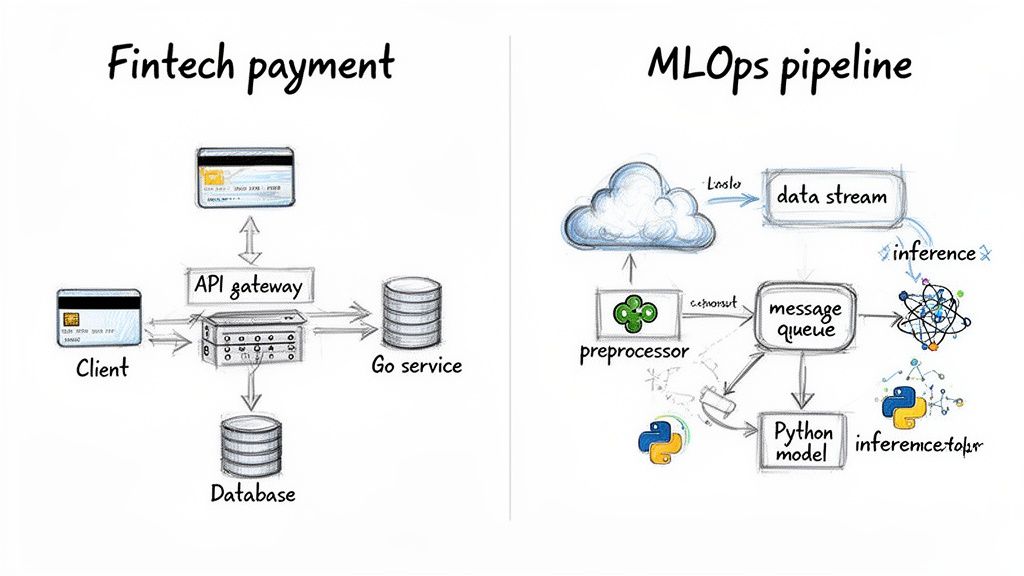
The Business Impact:
Example 2: MLOps Data Preprocessing Pipeline
The Problem: An AI-powered customer support tool needed to gather user data from multiple sources and feed it to a Python-based Large Language Model (LLM) with minimal latency. Slow data aggregation was making the user experience feel sluggish.
The Go Solution: A Go service was built to act as a high-performance "data orchestrator" that sits in front of the ML model.
Example Code Snippet: This shows how Go uses channels to concurrently fetch data from two different sources and wait for both to finish.
// Simplified example of concurrent data fetching in Gopackage mainimport ("fmt""time")// fetchUserData simulates a database callfunc fetchUserData(userID string, ch chan<- string) {time.Sleep(50 * time.Millisecond) // Simulate network latencych <- "User data for " + userID}// fetchEmbeddings simulates a vector store callfunc fetchEmbeddings(query string, ch chan<- string) {time.Sleep(75 * time.Millisecond) // Simulate network latencych <- "Embeddings for '" + query + "'"}func main() {userDataChan := make(chan string)embeddingsChan := make(chan string)// Start both operations concurrentlygo fetchUserData("user123", userDataChan)go fetchEmbeddings("How do I reset my password?", embeddingsChan)// Wait for both concurrent operations to completeuserData := <-userDataChanembeddings := <-embeddingsChanfmt.Println("Data ready for ML model:")fmt.Println("-", userData)fmt.Println("-", embeddings)}The Business Impact:
Deep Dive: Golang Trade-Offs, Alternatives, and Pitfalls
No language is a silver bullet. Go was created at Google with a strong opinion: prioritize simplicity, performance, and operational ease over feature richness. Understanding this philosophy is key to avoiding frustration.

Core Strengths Driving Adoption
Go’s popularity in cloud and backend development is driven by three pragmatic benefits.
Common Pitfalls and When to Use an Alternative
Go's intentional simplicity comes with trade-offs. Be aware of these before committing.
For a more detailed look at how Go stacks up, see our guide on Go vs. Java for modern backend development.
Golang Decision Matrix: When to Use It vs. Alternatives
This table helps you choose the right tool for the job based on your primary project requirements.
| Criteria | Golang | Python | Rust |
|---|---|---|---|
| Primary Strength | Concurrency & Simplicity | Rapid Development & Data Science | Performance & Memory Safety |
| Performance | Excellent (Compiled) | Good (Interpreted) | Exceptional (Compiled) |
| Concurrency Model | Built-in (Goroutines) | Library-based (Asyncio) | Built-in (Async/Await) |
| Learning Curve | Gentle | Very Gentle | Steep |
| Best For | Microservices, APIs, Cloud Tools | Web Apps, Scripts, ML Prototyping | Systems, Embedded, Game Engines |
Checklist: How to Hire an Elite Golang Developer
Hiring a great Go developer means finding an engineer who thinks in terms of concurrency, simplicity, and performance—not just someone who knows the syntax.
Core Golang Skill Checklist
Use this checklist to define the role and vet candidates. A top-tier Go developer must have these skills.
Vetting Candidates: Interview Questions & Take-Home
The market for skilled Go developers is competitive. According to research on in-demand programming language trends, Go consistently commands premium salaries.
Our Recommendation: The best Go interview questions are practical and focused on concurrency. Ask them to design a concurrent web scraper or a rate limiter. Their approach will reveal far more than any abstract algorithm puzzle.
A good vetting process includes:
For a complete hiring framework, check out our guide on how to hire software developers.
What To Do Next: Your 3-Step Plan
Ready to build with confidence?
References
Hire from the Top 1% Talent Network
Ready to accelerate your hiring or scale your company with our top-tier technical talent? Let's chat.