

AI job postings grew 21.3% in the second quarter of 2026, reaching 69,539 active roles, with new demand concentrated in AI enablement, governance, and agentic AI, not only model development, according to enterprise hiring trends and AI adoption data. That changes the enterprise AI hiring problem. You aren't just competing for more machine learning engineers. You're building a portfolio of specialists who can move systems from prototype to governed, observable production.
The constraint is durable. Bain reports that AI-related job postings have grown 21% annually since 2019, compensation for those roles has risen 11% annually, and the talent shortage is likely to persist through 2027. The same analysis is available through Deloitte's State of AI in the Enterprise report. Treat enterprise AI hiring as a capability investment, not a quarterly headcount exercise.
The 2026 Enterprise AI Skills Gap
72% of employers reported difficulty filling roles in 2026, and AI capabilities were the hardest skills to find worldwide, ahead of traditional engineering and information technology skills, according to enterprise AI skills-gap analysis. The shortage now reaches deployment, integration, evaluation, and operational ownership.
Generic requisitions create noise. An “AI/ML engineer” might build models, run inference infrastructure, or translate a business workflow into an AI product. Those profiles are not interchangeable once a production system faces poor data quality, latency limits, approval requirements, or unclear ownership.
Applied capability now commands attention. DataCamp-reported 2026 market data cited in enterprise hiring trends and AI adoption research says AI and data job postings rose 80% year over year, while AI engineer postings increased 255% and generative AI engineer postings grew 197%. The figures support specialization, not indiscriminate hiring. Enterprises should define roles around the failures that block deployment.
Hire by deployment maturity
Use this framework to decide which specialist comes first:
| Deployment maturity | First specialized hire | Ownership |
|---|---|---|
| Validating a first use case | AI application engineer or data engineer | Workflow fit, data readiness, and a usable pilot |
| Scaling retrieval and generation | RAG systems architect or retrieval engineer | Grounded answers, retrieval quality, and source traceability |
| Operating multiple models | MLOps engineer or AI platform engineer | Deployment, monitoring, recovery, and cost control |
| Automating decisions and actions | Agentic workflow developer | Tool use, orchestration, permissions, and human controls |
| Establishing production quality | Evaluation engineer or AI quality engineer | Task-level reliability, regression testing, and release gates |
| Managing enterprise risk | AI governance specialist or model risk lead | Policies, auditability, transparency, and operational guardrails |
This sequence prevents a common failure: adding model-building capacity while production lacks observability, evaluation, or ownership. Hire against the current bottleneck. A team validating its first workflow needs product and data execution. A team running several models needs platform reliability, quality controls, cost management, and governance before expanding experimentation.
The adoption gap makes role order matter. Independent reporting on a 2026 enterprise hiring report found that 81.6% of surveyed organizations were using, piloting, or scaling AI in recruitment, while only 6.6% had fully integrated AI across the hiring process. The same report says 89% considered governance, transparency, and ethical AI frameworks important when implementing AI in recruitment, as reported by enterprise hiring research. Adoption without operational maturity creates demand for controls, not just more builders.
Map available skills and role demand with this talent intelligence platform guide 2026. For compensation planning, use ThirstySprout's AI engineering salary guide.
Practical rule: If a requisition does not name the production failure the hire will own, it is not specific enough.
Choosing Your AI Team Organizational Model
Centralized AI labs and embedded AI teams solve different problems. A centralized group creates shared standards, concentrates scarce expertise, and gives governance leaders one place to establish approved infrastructure. An embedded team sits closer to users, product managers, data owners, and operational constraints, so it usually moves faster on a defined business workflow.
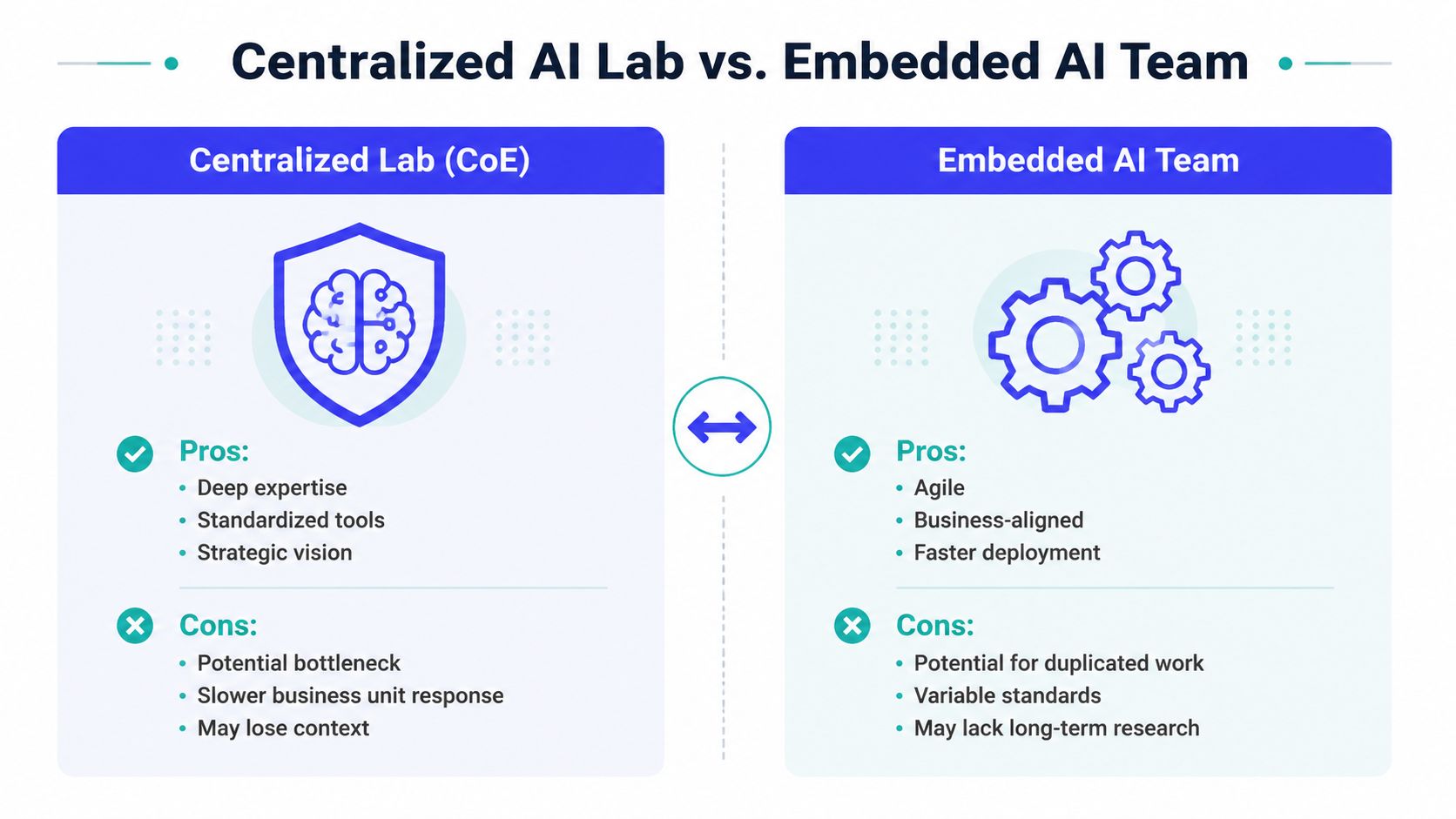
A centralized model works well when regulatory exposure is high, infrastructure is immature, or many business units would otherwise build duplicate tooling. The failure mode is predictable. The lab becomes an approval queue, and domain teams wait for a platform group that doesn't feel the urgency of a customer workflow.
Embedded teams reverse the tradeoff. They can iterate directly with business stakeholders and learn the operational context quickly. They can also produce fragmented pipelines, inconsistent evaluation methods, duplicated retrieval systems, and governance blind spots when every unit makes its own rules.
The model I recommend
For most enterprises, use a platform-plus-embedded model. The central team should own:
- Shared infrastructure: Model gateways, deployment patterns, secrets management, observability, and approved cloud components.
- Evaluation standards: Test-set design, regression checks, human review workflows, and release gates.
- Governance guardrails: Access controls, documentation, risk classification, audit evidence, and approval paths.
- Career architecture: Leveling, technical communities, mobility, and staff-level expectations across business units.
Embedded teams should own domain-specific model behavior, workflow integration, data contracts, user feedback, and business outcomes. This division keeps platform decisions coherent without forcing every use case through a central delivery queue.
Choose the operating model with four questions:
| Decision Factor | Centralized Lab | Embedded Teams | Platform Plus Embedded |
|---|---|---|---|
| Company scale | Smaller or highly coordinated | Large, autonomous business units | Large, distributed enterprise |
| Regulatory exposure | High and uniform | Lower or locally managed | High with varied workflows |
| Active AI use cases | Few shared experiments | Many domain-specific products | Many products on shared foundations |
| Engineering culture | Platform-oriented | Product-led and autonomous | Mature enough to support both |
Retention matters as much as delivery. Centralized labs attract research-oriented people, but production engineers may leave if they spend too long on prototypes that never reach users. Embedded teams retain builders through visible ownership, but they need a common career ladder or senior specialists can feel isolated.
A dedicated AI center of excellence can provide the governance and enablement layer without turning every business unit into a separate platform organization.
Designing Specialized AI Role Requisitions
A production-ready requisition begins with the deployment problem, not a library list. Identify the missing capability in the delivery chain, then hire for the system's current maturity. Early teams usually need application and data builders. Once systems reach production, prioritize specialized ownership for RAG quality, MLOps, agentic AI controls, or governance.
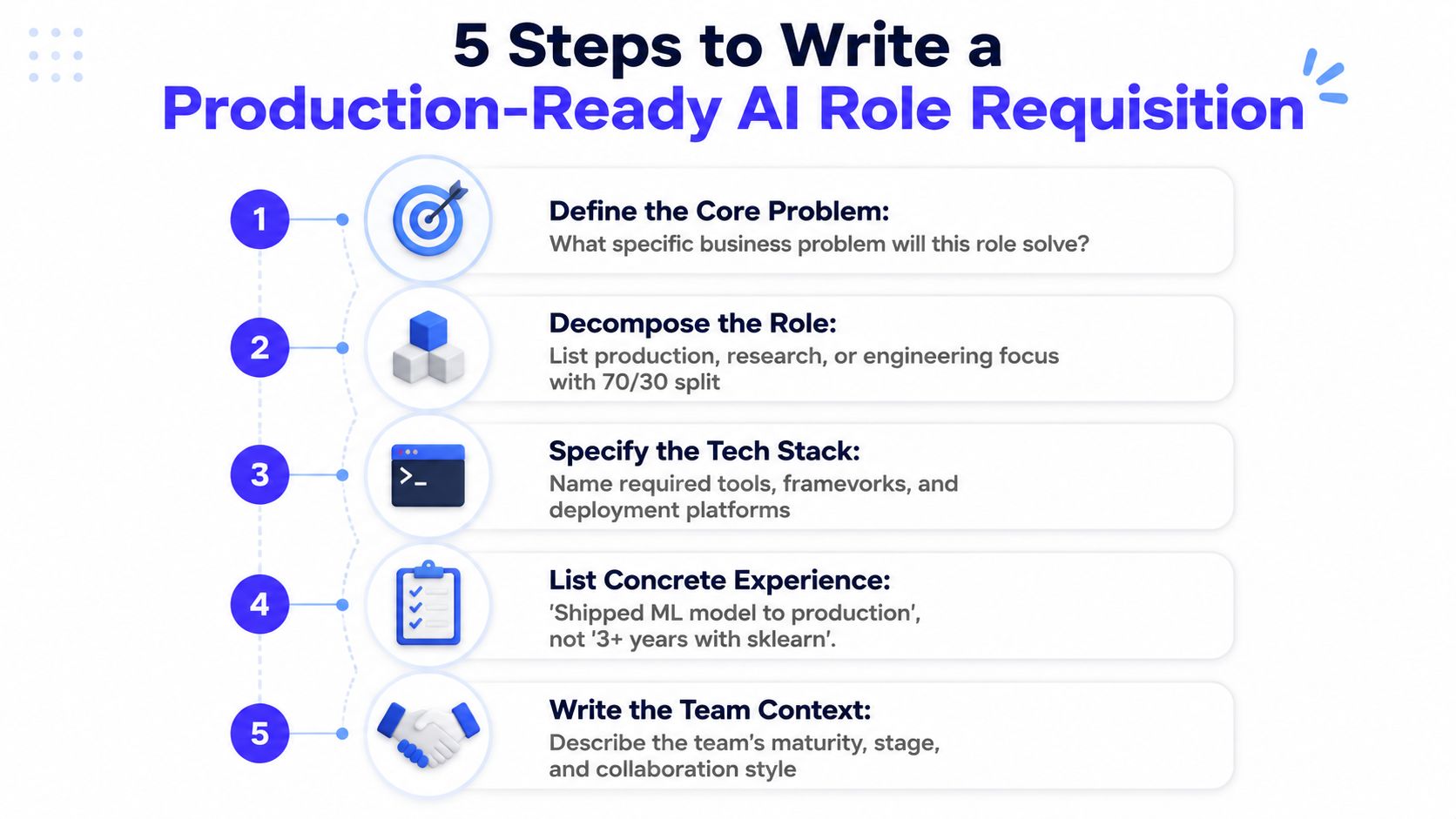
Build the requisition in five steps
Define the business outcome. Name the workflow, user, decision, and operational owner. “Build an enterprise chatbot” is weak. “Improve internal policy-search answers while preserving document permissions” gives candidates a concrete problem to reason through.
Separate skill clusters. Distinguish model development, MLOps and infrastructure, data engineering, evaluation and quality assurance, agentic AI, and governance and compliance. One person may cover adjacent areas, but the requisition must identify primary ownership.
Describe production constraints. Specify the deployment environment, reliability and latency expectations, data sensitivity, integration points, rollback requirements, and on-call duties. These details attract candidates who have operated real systems and expose prototype-only experience.
Write evidence-based requirements. Request demonstrated work, such as shipping a retrieval-augmented generation system, building an evaluation harness, operating model releases, or enforcing policy controls. Framework familiarity is not evidence of production competence.
Preserve technical language through approval. The hiring manager, a staff engineer, and the recruiter should approve the final version together. Human resources can improve clarity and inclusiveness, but should retain the details that show qualified candidates what they will own.
Use evidence that matches the role. This skills-based hiring explanation provides context for replacing credential filters with observable capability.
Use a scorecard, not a wish list
A practical scorecard should test the work the hire will perform:
| Competency | Evidence to request | Failure signal |
|---|---|---|
| Production delivery | A system the candidate shipped and maintained | Discusses only experiments |
| Retrieval and LLM integration | RAG design, chunking, retrieval, grounding, and evaluation decisions | Treats prompting as the whole solution |
| Agentic AI | Tool permissions, task boundaries, tracing, and failure handling | Assumes agents can act without controls |
| MLOps | Deployment, monitoring, rollback, and incident response | Cannot explain recovery after regression |
| Data engineering | Data contracts, quality checks, lineage, and access controls | Assumes clean, static data |
| Governance | Risk classification, approvals, auditability, and policy enforcement | Treats governance as paperwork |
Do not impose a fixed seniority ratio. A small platform team may need one senior architect and several execution-focused engineers, while a regulated program may need governance leadership before expanding application delivery. Set the mix by deployment maturity and system risk, not by an attractive org chart.
Compensation must reflect the market. Lightcast analyzed more than 1.3 billion job postings and found that postings including AI skills offered 28% higher salaries, nearly $18,000 more per year, than postings without those skills, according to its 2025 AI compensation analysis. Budget for production capability as a distinct market category when the role includes deployment, governance, or ownership of business-critical systems.
Navigating Procurement and Vendor Tradeoffs
Procurement shouldn't decide between internal hiring and vendors using price alone. The comparison is control versus speed, with total cost shaped by rework, integration, governance, and the value of retaining system knowledge.
| Strategy | Time-to-Production | Governance Control | Cost Profile | IP Retention | Best For |
|---|---|---|---|---|---|
| Internal hiring | Slower while roles remain open | Highest when processes are mature | Recurring employment cost and recruiting effort | Strong | Core platforms, sensitive data, long-lived capabilities |
| Managed service provider | Faster for scoped delivery | Requires strong contracts and oversight | Variable project or service cost | Shared or contract-dependent | Prototyping, augmentation, specialized delivery gaps |
| Vendor platform with embedded talent | Fastest when integrations fit | Depends on platform controls | Subscription plus service cost | May be tied to vendor stack | Narrow use cases with urgent deployment needs |
| Fractional specialist team | Fast for defined bottlenecks | Shared ownership must be explicit | Flexible capacity | Stronger if documentation and handoff are enforced | MLOps, evaluation, or governance gaps |
A financial services company might use an external team to prototype a retrieval-augmented generation pipeline while keeping model-risk approval, data access, and production governance internal. That approach limits vendor exposure where accountability matters most.
A healthcare enterprise could bring in outside MLOps capacity to establish deployment and monitoring patterns, while retaining compliance, data engineering, and clinical workflow ownership. The vendor accelerates infrastructure work without becoming the authority on sensitive decisions.
Align procurement with maturity
Use this sequence:
- Use-case validation: Hire or borrow a product-facing AI engineer and a data owner. Avoid building a large platform before the workflow proves valuable.
- Pilot production: Add MLOps capacity, evaluation ownership, and security review. Make handoff and documentation contractual when outside specialists participate.
- Operational scaling: Establish platform engineering, governance, model-risk ownership, and cost controls before multiplying use cases.
- Distributed operation: Fund domain teams while centralizing shared standards, incident processes, and technical career development.
Procurement teams also need a people operating model. Resources such as support for HR and people leaders can help connect hiring decisions to broader accountability, but engineering should still define the technical acceptance criteria.
For organizations that need external execution capacity, managed AI services can be evaluated as an operating choice, not a replacement for ownership.
Building Interview Loops That Predict Production Success
Generic technical interviews overvalue recall and under-test judgment. A candidate can explain transformers and still fail when retrieval quality drops, a data contract changes, or a product manager asks for lower latency without accepting lower answer quality.
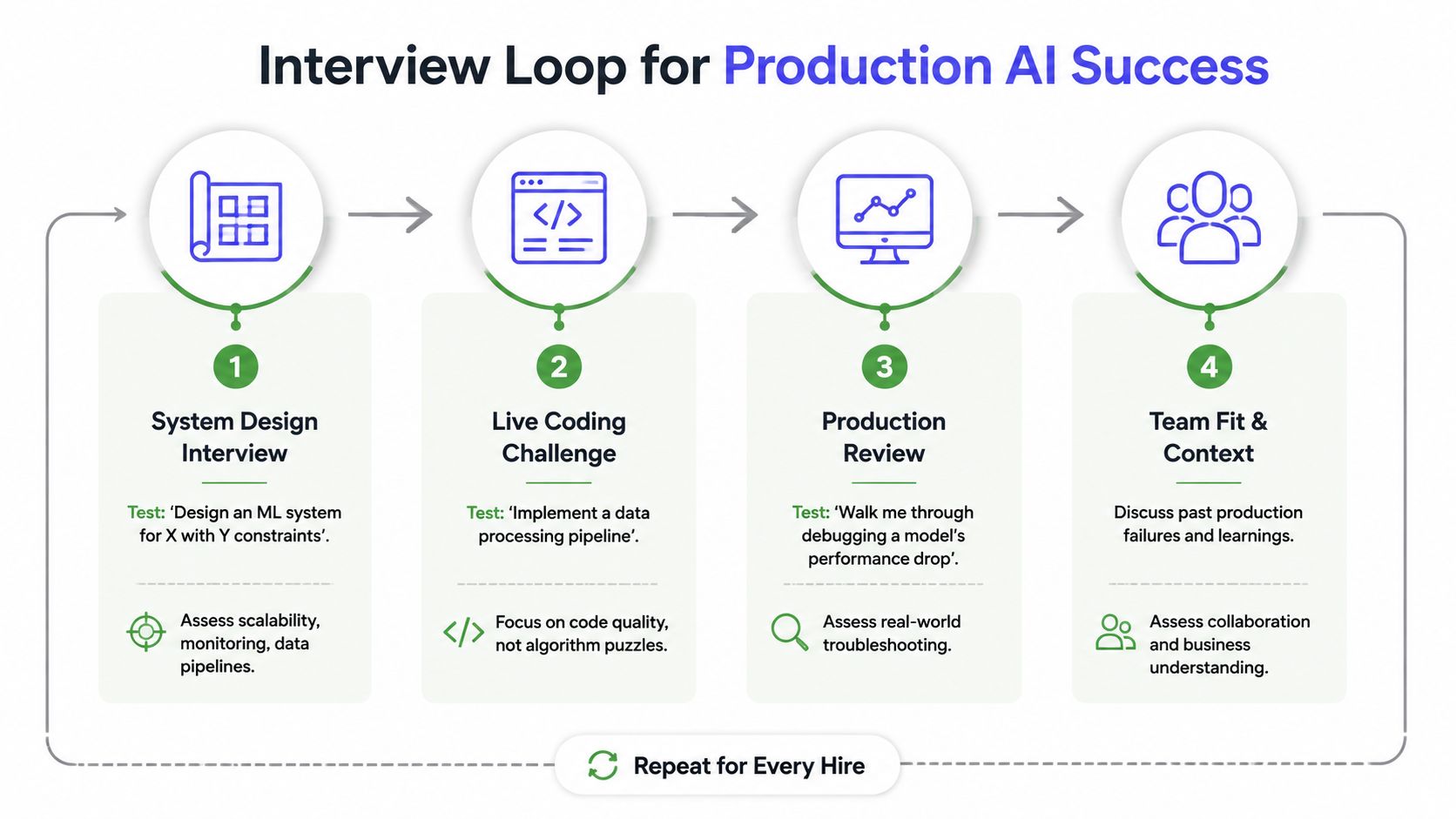
Use four interview stages, each tied to a real production behavior.
The four-stage loop
System design interview: Ask, “Design a retrieval-augmented generation system for an internal knowledge workflow with strict document permissions and a measurable quality bar.” Assess data flow, retrieval, access control, evaluation, monitoring, and rollback.
Live coding challenge: Give the candidate a small data-processing task with missing values, schema changes, and an explicit output contract. Evaluate readable code, tests, error handling, and communication. Don't use algorithm puzzles as the main signal.
Production review: Ask, “A model's answer quality has dropped after a data-source change. Walk me through your investigation.” Strong candidates separate data drift, retrieval failure, model behavior, prompt changes, and evaluation defects.
Team and context discussion: Ask about a production failure, what the candidate owned, what they changed, and how they communicated the incident. Listen for accountability without blame.
Score candidates across production readiness, cross-functional collaboration, and tradeoff reasoning. For an MLOps specialist, emphasize deployment safety, observability, and incident handling. For an AI governance lead, test policy interpretation, approval workflows, evidence collection, and communication with engineering and legal teams.
Hiring standard: Require candidates to explain what they would deliberately not build. Restraint is part of production judgment.
Take-home work should use a realistic brief, a constrained data description, an evaluation plan, and a short operational design. Give candidates enough context to make tradeoffs, but don't demand unpaid implementation of a company feature.
Use the same core dimensions at every level, then adjust the expected depth. Mid-level candidates should demonstrate reliable execution. Senior candidates should make system and prioritization decisions. Principal candidates should explain how their decisions affect multiple teams, risk owners, and long-term platform cost.
Retaining AI Talent and Measuring Team Impact
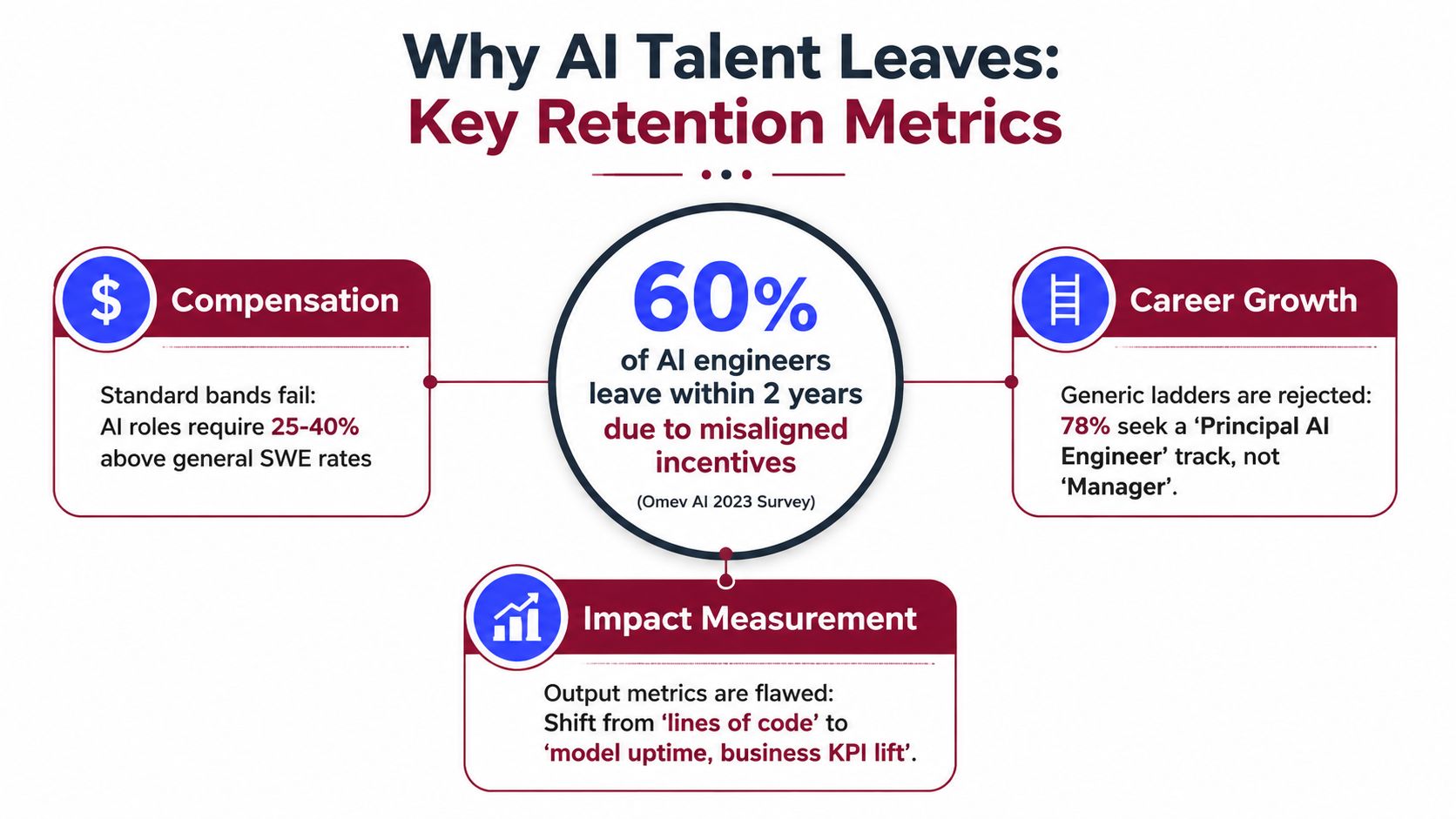
AI engineers leave when ownership is vague, career paths are generic, and evaluations reward activity instead of operating results. Compensation matters, but it cannot repair a team that ships prototypes without users, assigns unclear on-call duties, or waits months for platform approvals.
The market already pays a premium for AI capability. Use compensation data when setting bands, but do not create unexplained exceptions. Tie higher pay to scarce responsibilities, including production ownership, governance, deployment reliability, and difficult system integration. Retention starts with matching authority, scope, and reward to the specialized role.
Build a career system around impact
Give specialists a path to advance without forcing them into people management. An evaluation engineer can become the authority on quality systems. An MLOps engineer can own platform reliability across products. A governance specialist should receive recognition for reducing risk while enabling useful releases.
Measure the team with operating signals:
- Deployment health: Track whether releases pass defined evaluation and approval gates.
- Reliability: Review model and workflow service-level objectives, incident response, rollback readiness, and recurring failure patterns.
- Quality: Compare offline evaluations with human review and user feedback. A larger model inventory is not a success metric.
- Business connection: Tie AI behavior to adoption, workflow completion, decision quality, or another agreed business outcome.
- Knowledge continuity: Require runbooks, design records, ownership maps, and handoff plans so one departure does not erase system memory.
Pluralsight reports that 95% of organizations check for AI skills when hiring, while 70% consider them mandatory or highly preferred. It also reports that two-thirds of companies have abandoned AI adoption projects because staff lacked AI skills, according to the 2025 AI Skills Report. Retention therefore protects delivery. Losing the person who understands evaluation, data lineage, and deployment failure modes can delay several workstreams, not just one requisition.
Watch for warning signs: senior engineers stop joining design reviews, incidents remain assigned to the same person, platform requests stay unresolved, and career discussions focus only on management. Respond by restoring decision rights, funding documentation, pairing specialists across teams, and giving experienced engineers a clear technical leadership path.
Leadership test: If your most experienced AI engineer left tomorrow, could another engineer safely deploy, monitor, and roll back the systems they own?
ThirstySprout helps enterprises scope and source remote AI engineers, MLOps specialists, data engineers, AI product talent, and fractional teams around the production bottleneck to remove. Visit ThirstySprout to start a pilot, review specialized candidate profiles, and build a hiring plan aligned with deployment maturity.
Hire from the Top 1% Talent Network
Ready to accelerate your hiring or scale your company with our top-tier technical talent? Let's chat.