

You've probably seen this already. One team is testing a support bot with OpenAI. Another is building forecasting models in Python notebooks. A third just bought an AI tool without security review. Nobody is sure which data is approved, who owns model monitoring, or how to decide which use case matters first.
That's where an AI Center of Excellence becomes useful.
For a startup or scaleup, an AI CoE isn't a big-corporate committee that slows everyone down. It's a lightweight operating system for AI. It helps you decide what to build, how to build it safely, who approves it, and how knowledge gets reused instead of lost in Slack threads and abandoned repos.
TL;DR
- An AI Center of Excellence aligns AI work to business value instead of letting pilots spread without standards.
- Start centralized, then evolve. Early on, a small core team sets patterns. As adoption grows, that team should shift from gatekeeper to guardrail.
- Use a startup-friendly model. If you can't afford a full in-house CoE, a fractional or federated setup is often the practical answer.
- Begin with one charter, one scoring rubric, one approval path, and one pilot. Keep it simple.
- Blend internal ownership with external specialists when you need speed on MLOps, LLM systems, or data pipelines.
Introduction to AI Center of Excellence
A founder at a Series A SaaS company told me the same story I hear often. Their product team wanted an AI assistant. Their operations lead wanted internal automation. Their engineering team had two promising prototypes, but neither was production-ready. Legal had concerns. Security had questions. Nobody owned the final call.
So the company did what many fast-moving teams do. They kept shipping pieces.
The result was predictable. Prompts lived in product code with no review process. Model choices changed from sprint to sprint. Teams debated tools instead of agreeing on outcomes. The company wasn't short on enthusiasm. It was short on coordination.
An AI Center of Excellence solves that exact problem. Think of it as a small command group that gives AI work a home. It creates standards, captures lessons from past projects, helps teams choose the right use cases, and makes sure AI work supports the business instead of becoming a collection of disconnected experiments.
If you're a founder or engineering leader, you don't need a heavyweight program office. You need a practical model that answers a few basic questions.
- What should we build first
- Who approves riskier AI use cases
- Which standards are mandatory
- When do we hire full-time versus use fractional specialists
- How do we avoid bottlenecks as AI use spreads
Practical rule: If your teams are already using AI in more than one place, you need coordination before you need more tooling.
Understanding the Key Concepts
An AI Center of Excellence is easiest to understand if you picture an airport hub.
Flights come from many places. They use different aircraft, crews, and schedules. But the hub keeps everything coordinated. It sets rules, directs traffic, shares infrastructure, and helps each route connect to the larger system.
That's what an AI CoE does for AI initiatives.

What an AI CoE actually is
An AI CoE is a specialized organizational unit that helps the company adopt AI in a repeatable way. It usually owns or guides a few shared functions:
- Governance: approval paths, responsible AI rules, risk review
- Operating model: who owns standards versus execution
- Integration strategy: how AI fits product, data, and platform workflows
- Knowledge reuse: templates, architecture patterns, lessons learned
- Use case selection: picking work that has business value and realistic delivery paths
This matters more now because AI is no longer a fringe experiment for most companies. In early 2024, 72 percent of organizations reported AI adoption, up from the roughly 50 percent level seen over the prior six years, and 65 percent said their organizations were regularly using generative AI, according to McKinsey's State of AI in early 2024.
When adoption rises that fast, unmanaged sprawl becomes the primary risk.
Centralized, federated, and hybrid models
Teams often get stuck on one question. Should the CoE own everything?
Not usually.
Here's the simple version:
| Model | Best for | Risk |
|---|---|---|
| Centralized | Early-stage companies that need clear standards fast | Can become a bottleneck |
| Federated | Larger organizations with strong business-unit autonomy | Standards can drift |
| Hybrid or hub-and-spoke | Teams that want shared standards and local execution | Needs strong coordination |
For startups, the best answer is often a fractional hybrid. A small central group defines standards and supports architecture. Product and engineering squads still own delivery.
A good CoE doesn't replace product teams. It helps product teams stop reinventing the same AI decisions.
Why the CoE exists
Without a CoE, teams often confuse activity with progress. They launch pilots, but don't define who owns evaluation, rollback, monitoring, or model updates.
With a CoE, the company gets a single place to answer questions like:
- Is this use case worth doing now?
- What data is approved for this model?
- What happens if the output is wrong?
- Which tooling becomes standard across teams?
That shift is subtle but powerful. AI stops being an exciting side project and starts acting like a managed business capability.
Building the AI CoE Playbook
The first version of your playbook should fit in one working doc. If it takes fifty pages to explain, nobody will use it.

Start with roles, not org charts
A startup doesn't need a huge CoE headcount. It needs clear ownership. In practice, these roles matter first:
- AI product manager: translates business goals into scoped use cases and acceptance criteria
- Machine learning engineer: builds and evaluates models or LLM workflows
- MLOps lead: handles deployment, monitoring, versioning, and reliability
- Domain owner: validates whether outputs are useful in the actual workflow
- Security or compliance partner: reviews data handling and high-risk use cases
If one person wears two hats, that's fine. What matters is that the responsibilities still exist.
A simple mini-case: a B2B support startup building an internal ticket summarizer might have an engineering manager acting as AI PM, one ML engineer building evaluation flows, and a fractional MLOps specialist setting up deployment checks. That is already a workable CoE nucleus.
Choose the operating model that matches your stage
A small company usually starts with a centralized hub. That hub defines standards and approves the first few projects.
Later, execution should spread closer to product teams. Microsoft's guidance is useful here. An AI CoE must transition from a centralized gatekeeper model to an advisory guardrail model once approval delays and knowledge bottlenecks start slowing teams, as outlined in the Azure Cloud Adoption Framework for AI centers of excellence.
That means the CoE stops approving every tiny decision and starts embedding rules into platform workflows.
Build the minimum technical backbone in the first month
The first month matters because this is when bad habits harden.
Stack AI's guidance on building an internal AI CoE-roles-processes-and-tooling) says technical implementation requires establishing core logging and access controls within the first 30 days, alongside assets like a reference architecture diagram, risk tiering checklist, and prioritization scoring rubric.
That list is practical because each item solves a real startup problem:
- Logging and access controls: stop your production system from becoming a black box
- Reference architecture: gives engineers a default pattern for LLM apps, APIs, data access, and monitoring
- Risk checklist: separates low-risk internal copilots from customer-facing or regulated use cases
- Prioritization rubric: prevents the loudest stakeholder from setting the roadmap
Here's a sample intake scorecard you can copy into Notion:
| Criteria | Question | Score 1 to 5 |
|---|---|---|
| Business fit | Does this use case support a current company priority? | |
| Data readiness | Do we have usable data and access approval? | |
| Delivery path | Can the team ship a pilot with current skills? | |
| Risk level | Can we manage errors without customer harm? | |
| Reuse potential | Will this create patterns other teams can reuse? |
Use the total score as a discussion aid, not as a robot judge.
A second mini-case: a fintech startup compares two AI ideas. One is an internal analyst copilot using approved documents. The other is a customer-facing loan explanation assistant. The internal copilot usually wins first because risk is lower, the feedback loop is tighter, and the team can learn faster.
A useful walkthrough on the operating pieces sits below.
Keep the charter short and operational
Your charter should answer five things:
- Mission: Why this CoE exists
- Scope: Which AI work is in scope, and what is not
- Decision rights: Who approves use cases, tools, and exceptions
- Cadence: How often the team reviews progress and risk
- Assets: Which templates and standards every project must use
If your charter doesn't tell teams how to start a project on Monday morning, it's too abstract.
Governance Framework and Metrics
Governance sounds heavy, but the best startup governance is small and sharp.
A minimal viable framework should focus on just a few controls. Mario Thomas's guidance on building an AI Centre of Excellence recommends starting with four critical elements: a simple approval process for AI initiatives, basic responsible AI guidelines, an audit of shadow AI, and clear escalation paths for high-risk applications.
The minimum governance layer
For most startups, that looks like this:
- Approval path: one intake form, one reviewer group, one documented decision
- Responsible AI rules: plain-language guidance on data use, human review, and unacceptable use cases
- Shadow AI audit: a lightweight inventory of AI tools already used across teams
- Escalation route: a clear process for anything customer-facing, compliance-sensitive, or agentic
If you're building agents, the pause and override rule matters. Humans need the ability to stop or override high-impact actions.
When to stop being the bottleneck
At this stage, many CoEs fail. They work well at first, then become a queue.
The right move is to shift from gatekeeper to guardrail. In practice, that means platform teams enforce shared controls through templates, deployment checks, and standard pipelines, while the CoE focuses on policy, reviews, and coaching rather than hand-holding every project.
For a deeper look at practical operating controls, this guide on AI governance best practices is a useful companion.
Governance should reduce repeated debate. If every project has the same argument about data, model approval, and monitoring, your rules aren't clear enough.
Sample CoE KPIs
You don't need dozens of metrics. You need a few that connect AI work to business outcomes and delivery quality. Oracle's checklist for AI CoEs stresses that organizations should define specific and measurable KPIs for each AI-enabled business model, product, and service, then revisit them regularly and report results even when they fall short, as described in Oracle's AI CoE checklist PDF.
| KPI | Description | Measurement Frequency |
|---|---|---|
| Use case throughput | How many AI initiatives move from intake to approved pilot | Monthly |
| Time to production | How long it takes a validated pilot to reach production use | Monthly |
| Adoption by team | Whether intended users actually use the AI workflow | Monthly |
| Quality outcome | The task-specific performance measure chosen for the use case | Weekly or monthly |
| Risk incidents | Escalations, policy exceptions, or deployment issues | Monthly |
The key is consistency. Pick metrics that each project owner can collect.
Talent Strategy for Startups and Scaleups
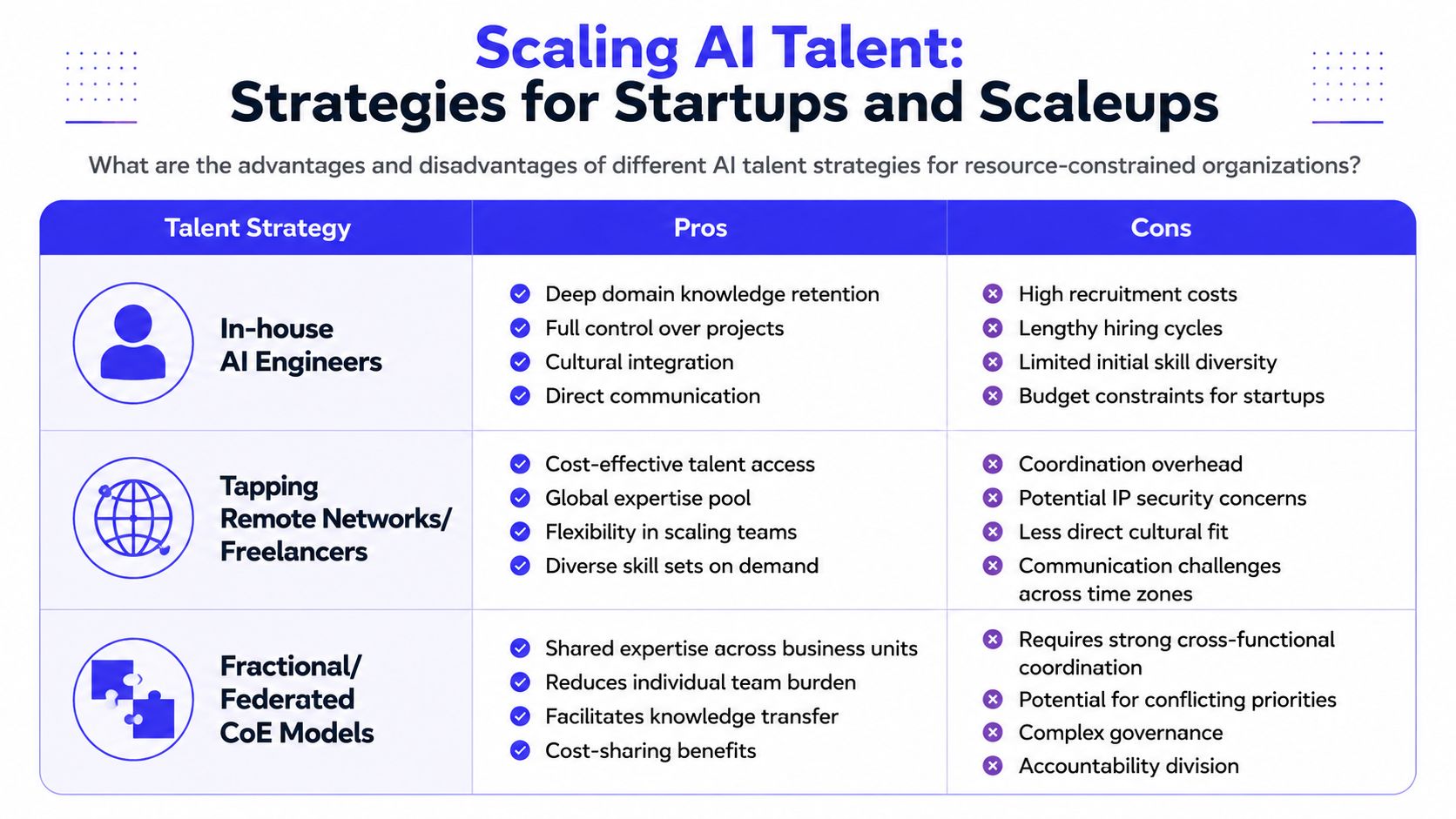
Most advice about AI CoEs assumes you have budget for a full internal team. Many startups don't.
That's why talent strategy matters as much as governance. If you can't staff the right mix of AI product, ML engineering, and MLOps quickly, your CoE becomes a planning exercise instead of a delivery function.
Why the usual CoE advice breaks for startups
InsightCentric points out a real gap in CoE guidance. Most content assumes a centralized hub model, but doesn't explain how startups or Series A to B companies can operationalize a CoE without the budget for a full-time multidisciplinary team. The same piece notes that 70% of AI initiatives fail due to organizational silos rather than technical flaws.
That's exactly why a fractional or federated CoE makes sense for smaller companies.
Instead of hiring every specialist at once, you create a small internal core and plug in targeted outside expertise where needed. For example:
- Internal engineering manager owns roadmap and stakeholder alignment
- Fractional MLOps expert sets deployment standards
- Contract data engineer cleans and pipelines source data
- Product squad owns workflow integration and feedback
This structure is leaner than a traditional hub and less chaotic than pure freelancing.
When to use remote AI specialists
Oracle notes that 60% of enterprises report a shortage of skilled AI engineers as their primary barrier, and also highlights the gap in practical strategies for integrating external specialists into a CoE, in its discussion of AI centers of excellence.
That shortage shows up fast in startups. You might have one strong backend engineer, but no one who has deployed retrieval systems, set up model evaluation, or built reliable monitoring around LLM applications.
Use external specialists when:
- You need a missing specialty fast
- The use case is important but not permanent enough for a full-time hire
- Your internal team can own the domain, but not the infrastructure or model ops
- You want to transfer know-how into internal teams instead of outsourcing the whole function
A helpful analogy is film production. You keep your core creative team, but bring in a specialist editor, sound engineer, or colorist when the project needs that skill.
For teams thinking about workforce planning beyond engineering, this Comprehensive guide to predictive HR is useful because it shows how companies can forecast talent needs instead of reacting to hiring gaps late.
You'll also want a team design that supports knowledge transfer, not dependency. This piece on building high-performing teams is a good reference when you're deciding how much to centralize versus embed.
External talent should leave behind assets, patterns, and documentation. If they leave and your team is lost, you bought output, not capability.
Sample Roadmap and Charter Templates
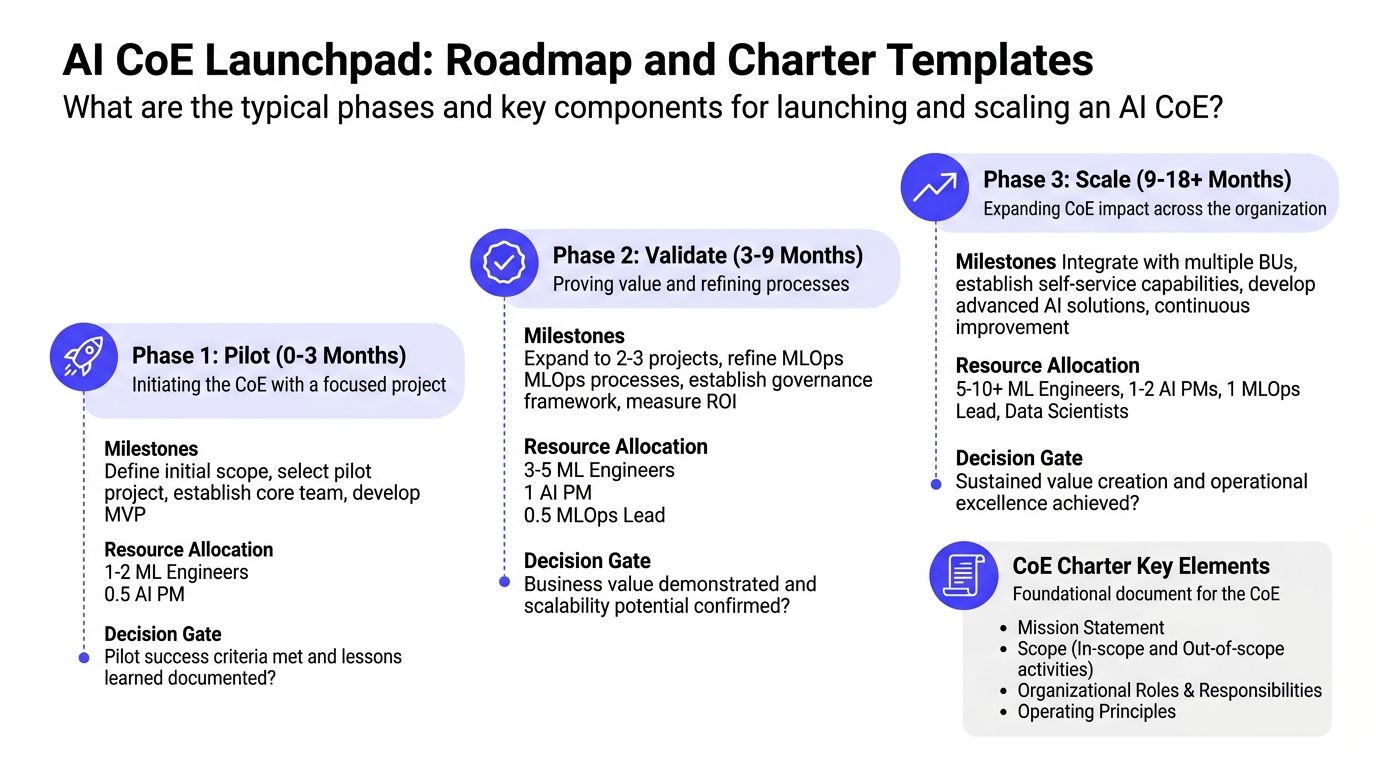
The simplest roadmap for an AI CoE is Pilot, Validate, Scale.
That sequence matters because broad launches create noise. Focused launches create evidence.
The roadmap template
You can turn that into a simple operating template.
| Phase | Focus | Exit question |
|---|---|---|
| Pilot | Prove the use case is useful and technically viable | Did the pilot solve a real problem with acceptable risk? |
| Validate | Test repeatability, refine process, document controls | Can another team reproduce this pattern with the same standards? |
| Scale | Expand adoption, automate controls, create self-service support | Can this run reliably without the CoE touching every task? |
A copy-ready charter outline
A strong charter doesn't need corporate language. It needs clarity.
Use this outline:
Mission
- We help the company adopt AI in ways that improve product, operations, or customer experience while maintaining clear governance and reusable standards.
In scope
- AI use case prioritization
- Tooling standards
- Risk review for higher-impact projects
- Shared architecture and deployment patterns
Out of scope
- Owning every product backlog
- Running every experiment for every team
- Replacing engineering managers or product owners
Operating principles
- Start with business value
- Favor reusable patterns over custom one-offs
- Default to human oversight for high-impact actions
- Document decisions and lessons learned
Cadence
- Weekly use case review
- Monthly steering review
- Lightweight retrospective after each pilot
A practical example helps here. Suppose your first pilot is contract summarization for internal legal operations. The charter should define the data boundary, required reviewer, evaluation criteria, and who can approve expansion into customer-facing workflows. Without that, “pilot success” stays vague.
If you need a broader planning companion, this AI implementation roadmap can help translate charter language into delivery phases.
A simple decision gate template
Before each phase ends, ask three questions:
- Value: Did users save time or improve decision quality?
- Reliability: Did the workflow perform consistently enough for the intended use?
- Risk: Are the safeguards appropriate for broader rollout?
If the answer is no to any one of them, don't scale yet. Fix the weak point first.
Practical Next Steps
Most companies don't need more AI ideas. They need a cleaner way to choose, govern, and staff the right ones.
If you want to get moving this month, do these three things.
Run a fast maturity check
List every AI initiative already happening across product, ops, support, data, and engineering. Then mark each one as approved, informal, or unknown.
You're looking for three signals:
- Duplicate efforts: multiple teams solving the same problem differently
- Missing ownership: useful prototypes with no production path
- Unseen risk: customer-facing or sensitive use cases with weak review
That inventory becomes your starting map.
Draft the smallest possible CoE charter
Don't wait for perfect wording. Open a doc and define mission, scope, approval path, escalation route, and one intake rubric.
If your team is investing in AI-driven visibility or discovery, it also helps to understand how AI assistants and search systems evaluate business content. This guide to strategies for ChatGPT and Gemini is useful because it connects AI readiness with content structure and discoverability.
Build the first core team with blended talent
Pick one internal owner. Add the technical capability you already have. Then fill the gaps deliberately.
That might mean:
- an internal product lead owning the pilot,
- a staff engineer defining integration points,
- a fractional MLOps specialist setting up deployment and monitoring,
- and a domain expert reviewing outputs every week.
This approach is usually better than waiting until you can afford a complete in-house AI department. The goal isn't to build a perfect org chart. It's to create a repeatable system for responsible delivery.
Start with one use case, one charter, one scoring rubric, and one review cadence. Small systems are easier to adopt, and easier to improve.
A good AI Center of Excellence should make your company faster, not slower. If it becomes a bureaucracy, trim it. If it becomes invisible, strengthen it. The best version sits in the middle. Clear enough to create standards. Light enough to keep teams shipping.
If you're building AI features and need senior help fast, ThirstySprout can help you start a pilot with vetted AI engineers, MLOps specialists, and fractional AI leaders who've shipped production systems. If you want to move from scattered experiments to a workable AI CoE, start a pilot or see sample profiles.
Hire from the Top 1% Talent Network
Ready to accelerate your hiring or scale your company with our top-tier technical talent? Let's chat.