

Generic advice on team building usually starts with trust, culture, and communication. That's necessary, but it's not enough for AI teams.
Remote AI and machine learning teams fail in more specific ways. The common pattern isn't just poor morale. It's role confusion between machine learning engineers and MLOps engineers, product leaders measuring output differently than technical leads, and deployment pipelines that trap good model work in notebooks. That's why most advice on how to build high performing teams falls apart the moment a startup tries to ship AI into production.
Why Most AI Team Building Advice Fails
If you're a founder, CTO, or engineering lead, the biggest mistake is assuming a strong culture will compensate for weak operating design. It won't. In AI teams, vague ownership becomes expensive fast. One person thinks success means model accuracy. Another thinks success means feature adoption. A third thinks success means reducing infra cost. Everyone works hard. The team still misses.
One reason this happens is that most guides ignore the failure mode inside hybrid AI-human teams, where senior engineers and non-technical product leaders clash on velocity metrics. Data cited by FranklinCovey says 68% of AI startups fail due to misaligned expectations between technical velocity and business ROI in this hybrid setup, and most team-building advice still doesn't address the need for translation layers such as AI Product Managers (FranklinCovey on high-performing teams).
What actually works
High-performing AI teams don't run on values alone. They run on a clear operating model.
Three moves matter most:
- Define structure before hiring: Decide whether you need a centralized AI function or product-aligned pods. Don't hire “AI generalists” to cover unresolved org design.
- Vet for shipped judgment, not only model depth: Strong candidates can explain trade-offs around latency, data freshness, monitoring, and rollback, not just training approaches.
- Make deployment part of team design: If the team can't get work into production cleanly, your best engineers will feel blocked and your roadmap will drift.
Practical rule: If your product lead and ML lead can't agree on what counts as “done,” you don't have a performance problem yet. You have a design problem.
The five-part playbook
A practical AI team playbook usually has five parts:
- Team structure that makes ownership visible.
- Vetting that filters for production experience and remote execution.
- Operating system for communication, experimentation, delivery, and handoffs.
- Performance management tied to business outcomes, not vanity research metrics.
- Retention design so strong engineers can see impact quickly and grow clearly.
That's the difference between a team that discusses AI all quarter and a team that ships it.
Design Your Remote AI Team Structure
Remote AI teams fail less from lack of talent than from bad interfaces. The common breakdown is structural. One person owns the model, another owns the data pipeline, nobody owns deployment reliability, and the product lead assumes the team will sort it out. In a colocated team, that confusion can limp along for a while. In a remote AI team, it turns into queue time, handoff churn, and stalled launches.
Team structure decides who can make which decision without a meeting. That matters more in AI than in standard product engineering because the work crosses three systems at once: product logic, data pipelines, and production infrastructure. If those ownership lines are fuzzy, your MLE becomes the default resolver for everything from feature store bugs to model rollback decisions.
Choose a model based on bottlenecks, not preference
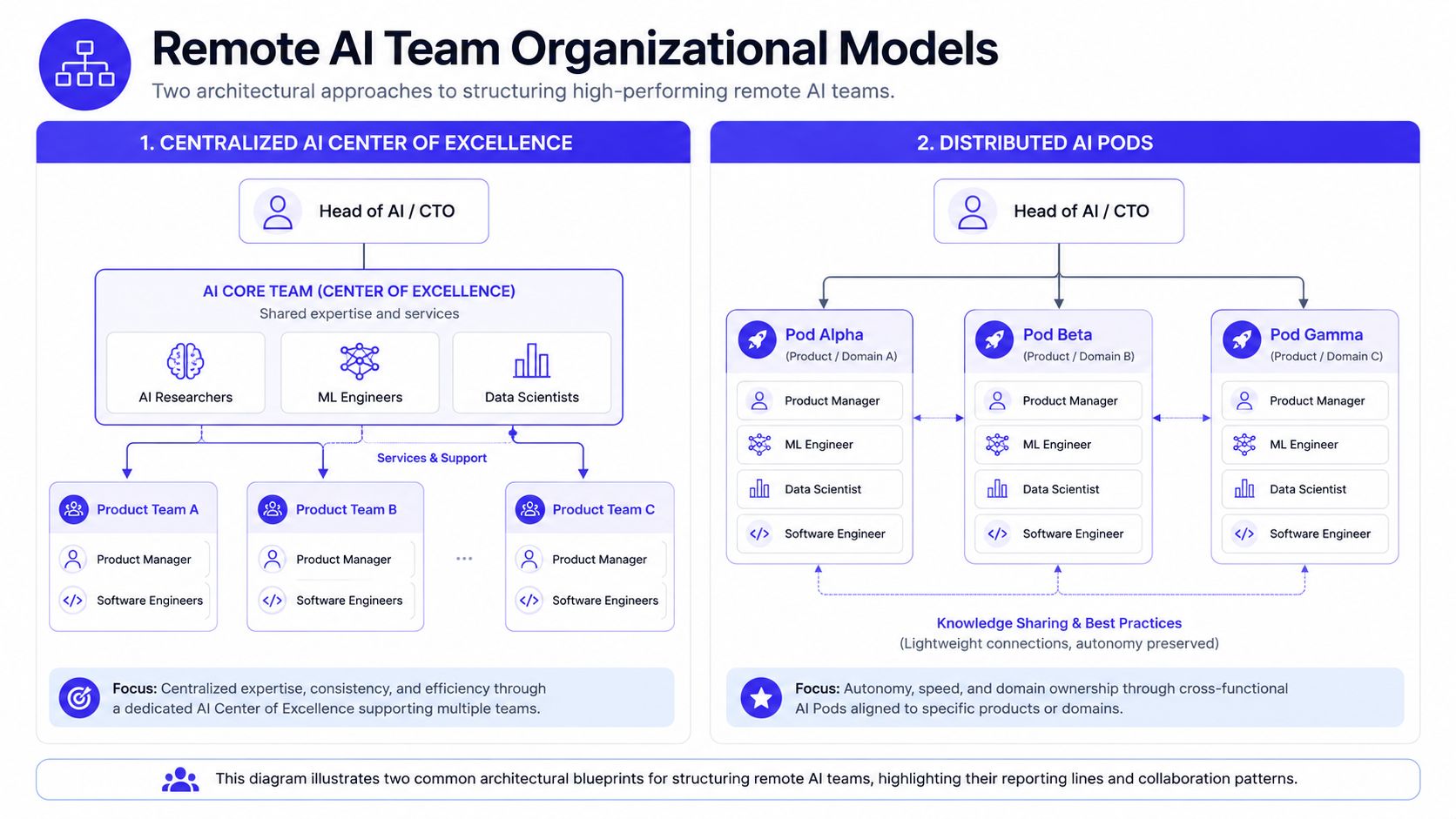
Early-stage teams usually have two workable options.
| Model | Best fit | Strength | Risk |
|---|---|---|---|
| Centralized AI center of excellence | Early teams with scarce specialist talent | Shared standards, easier staffing, better reuse | Product teams may wait on a central queue |
| Distributed AI pods | Teams with multiple active AI initiatives | Faster product alignment, clearer accountability | Standards can drift if leadership is weak |
A centralized model works well when you have one or two senior AI specialists, uneven demand from product teams, and no mature MLOps foundation. It gives you one place to define data contracts, evaluation standards, deployment rules, and vendor choices. The cost is predictable. The AI team starts acting like an internal agency, and product teams wait in line.
Distributed pods work better once AI is tied to multiple product lines and each line needs fast iteration. A pod can own one domain end to end, which reduces translation loss between product, engineering, and ML. The trade-off is duplication. Without shared review mechanisms, each pod picks different tooling, different offline metrics, and different monitoring thresholds. Six months later, you are supporting three versions of the same stack.
For remote-first execution, org design and collaboration norms have to match. A pod structure without clear async decision rules usually creates more cross-team noise, not more speed. If you are setting those habits from scratch, this guide on best practices for remote teams is a useful companion to the structure decisions.
Define role boundaries before the first urgent launch
Role confusion is a bigger problem in AI teams than title inflation. Founders often hire an "AI engineer" and assume that covers model development, data prep, serving, observability, and production support. It does not. Those jobs pull in different directions, and remote teams pay the price quickly because assumptions stay hidden longer.
| Role | Owns | Should not silently inherit |
|---|---|---|
| Machine Learning Engineer | Model implementation, evaluation, serving logic, inference constraints | Data platform reliability, production infra ownership |
| MLOps Engineer | Training pipelines, model registry, CI/CD, observability, rollback paths | Product prioritization, feature definition |
| Data Engineer | Source pipelines, transformations, data quality, lineage, warehouse readiness | Model tuning, prompt iteration, serving stack decisions |
| AI Product Manager | Problem framing, ROI alignment, scope, success criteria, cross-functional translation | Writing production code or carrying model deployment work |
The dangerous case is the half-defined middle. For example, if the MLE is expected to ship models but nobody owns inference latency in production, the MLE inherits platform work by default. If the data engineer maintains batch pipelines but nobody owns feature freshness SLAs, model quality issues get mislabeled as training problems. If the AI PM defines the use case but not the business threshold for acceptable error, teams argue about model quality after the build is done.
Write these boundaries down early. Then attach decision rights to them.
Add one shared layer, even in pod structures
Remote AI teams need a thin platform layer even when product pods own delivery. That layer can sit with a small central AI group, a platform team, or a senior MLOps lead. What matters is that someone owns the shared standards for experiment tracking, model registry, deployment paths, monitoring, and rollback.
Without that layer, pod autonomy turns into tool sprawl. With too much central control, delivery slows down.
A good rule is simple. Centralize the parts that improve reuse and safety. Keep product-specific iteration inside the pod.
A practical structure choice
A seed-stage SaaS company with one machine learning engineer, one data engineer, and no platform support usually gets better results from a centralized setup. One lead can standardize the stack, support a narrow roadmap, and avoid building three partial systems at once.
A Series B company running search, support automation, and forecasting in parallel usually needs pods with a shared platform spine. Otherwise the central team becomes a ticket queue, product managers route around it, and every urgent request bypasses standards.
If you expect to scale the team across regions, structure also affects hiring. A centralized team can absorb strong specialists faster because reporting lines and code ownership are simpler. Pod models demand more senior hires who can operate with local autonomy. That hiring reality is one reason the 2026 guide for hiring remote talent is useful when planning team shape, not just recruiting channels.
Implement a Vetting System for Top AI Talent
Hiring is where team quality gets locked in. Most startups lose signal because they hire for résumé familiarity, not operating judgment.
The best remote AI hires can explain what they shipped, what broke, and what they'd change. They can work through imperfect data, changing product constraints, and asynchronous collaboration without losing momentum. If your interview loop can't test those things, you'll hire polished talkers and spend months unwinding the mismatch.
Build a hiring funnel that surfaces production judgment
A practical funnel for senior remote AI roles usually has four stages.
Portfolio and scoping review
Ask for examples of production work. Look for ownership language, deployment context, and measurable business framing. Avoid candidates who only describe model architectures.Technical screen
Keep it conversational. Probe data assumptions, model selection, latency trade-offs, and failure handling.Take-home or live design exercise
Use a real problem, not puzzle trivia. The goal is to see how the candidate scopes ambiguity and makes trade-offs.Cross-functional interview
Include product or platform stakeholders. A remote AI hire has to translate decisions across disciplines.
If you're widening your search internationally, this 2026 guide for hiring remote talent offers a useful market view for distributed hiring programs and regional talent planning.
For teams that want external help formalizing evaluation stages, ThirstySprout's candidate vetting engine is one example of a structured screening workflow built for remote technical hiring.
Five interview questions for a senior MLE
These questions create more signal than generic “tell me about a project” prompts.
System design question
“You're building a retrieval-augmented feature for customer support. How would you separate prototype architecture from production architecture?”Trade-off question
“If product wants better answer quality and platform wants lower inference cost, what levers do you test first?”Failure question
“Tell me about a model or AI feature that behaved well offline and poorly in production. What did you miss?”Collaboration question
“How do you explain model uncertainty to a product manager who wants a fixed delivery date?”Ownership question
“What do you expect the boundary to be between ML engineering, data engineering, and MLOps on a small team?”
Good candidates answer with constraints, dependencies, and sequencing. Weak ones stay abstract.
A practical take-home brief
Here's a format that works for a senior AI engineer or MLE hire.
Build a recommendation or classification prototype using a provided dataset. Submit a short architecture note, assumptions, evaluation approach, deployment sketch, and one page on risks you'd expect in production.
Ask for these deliverables:
- A repo or notebook with clear setup instructions
- A short design memo explaining approach and trade-offs
- An evaluation summary that shows what metric they chose and why
- A production note covering monitoring, drift, and rollback concerns
Then score it with a simple rubric.
| Evaluation area | What strong looks like |
|---|---|
| Problem framing | Clarifies goals, assumptions, and missing information |
| Technical choices | Selects methods appropriate to data and constraints |
| Code quality | Clean structure, readable naming, reproducible setup |
| Production thinking | Notes monitoring, serving, failure modes, and maintenance |
| Communication | Writes clearly for technical and non-technical stakeholders |
What doesn't work
Three patterns consistently produce bad hires:
- Whiteboard trivia: It favors recall over judgment.
- Unstructured panel interviews: Every interviewer asks versions of the same question.
- Take-homes with vague prompts: You can't compare candidates fairly if success criteria aren't explicit.
A strong vetting system doesn't try to discover genius. It tries to reduce hiring error.
Build Your Remote AI Operating System
Once the team is in place, performance depends on the system they work inside. Remote AI teams need more than agile rituals copied from app development. Model work has uncertainty. Data changes underneath you. Evaluation is iterative. Deployment usually involves more stakeholders than a normal feature release.
That's why the operating model has to connect product decisions, experimentation, infra, and communication in one loop.
Use a lightweight ML delivery cadence
A workable cadence is usually shorter and more explicit than teams expect.
Use one shared brief for every AI initiative. It should include the user problem, target workflow, available data, likely constraints, evaluation method, and deployment owner. If that brief is missing, the team starts experimenting before anyone agrees on what success looks like.
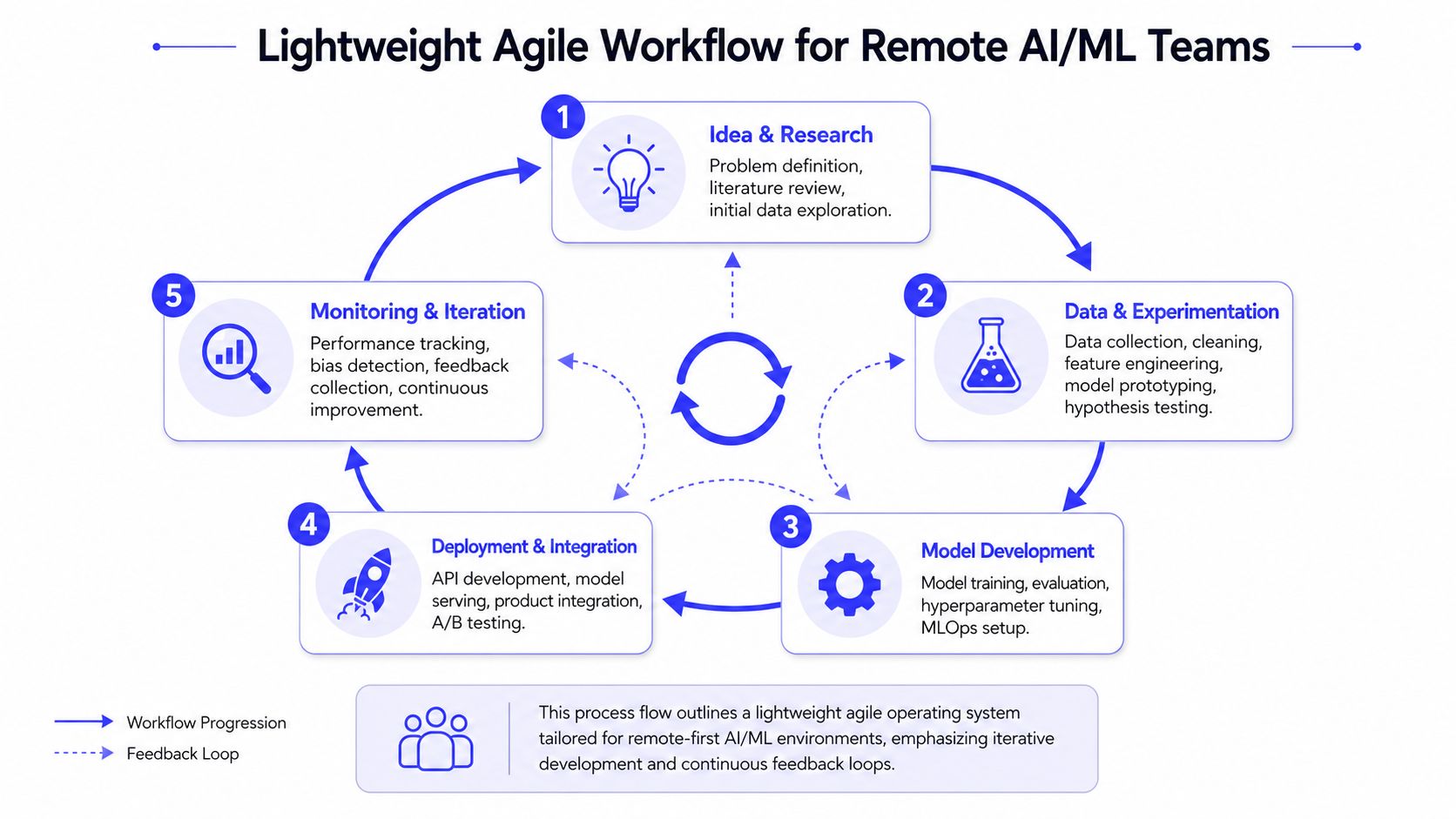
Then run work in a loop like this:
- Discovery and framing
Product, AI, and platform agree on the problem and the operational constraint. - Experimentation
The team tests a narrow set of approaches and documents assumptions. - Hardening
Engineers package, validate, and prepare the model or workflow for deployment. - Release
The team ships behind a controlled rollout path. - Review
Product and engineering inspect output quality, operational issues, and next bets.
Define communication rules before urgency does it for you
Remote AI teams lose time in small ways. A product manager posts a scope question in Slack. A data engineer answers six hours later. An MLE sees it the next morning. A deployment issue sits in the wrong channel because nobody defined what is urgent and what is not.
Research on remote team practices highlights the value of setting quiet hours for uninterrupted work and assigning different communication platforms to different message types so people know expected response windows (Zartis on remote team communication norms).
A simple channel policy works well:
- Urgent production issues go to one incident channel with immediate response expectations.
- Product clarifications live in one project thread or ticket system.
- Research discussion stays async unless a decision is blocked.
- Status updates happen on a fixed written cadence, not in ad hoc pings.
Good remote teams don't communicate more. They communicate with clearer routing.
Minimum viable MLOps for a startup
You don't need a giant platform team to avoid chaos. You do need a minimum standard stack.
At a minimum, define these layers:
| Layer | Minimum standard |
|---|---|
| Experiment tracking | One agreed system for runs, params, and evaluation notes |
| Artifact management | One model registry or versioned storage path |
| Deployment workflow | One repeatable CI/CD path for model or inference service changes |
| Monitoring | Basic checks for quality, drift signals, and service health |
| Ownership | A named person for release approval and rollback |
Mini-case on process drift
A remote team can look productive while slowly disconnecting from product value. One common example is an MLE team running weekly experiments while product reviews happen monthly. The result is polished technical output with no shipping path.
The fix is simple but often resisted. Pair every experiment stream with a product review rhythm and a deployment owner. If nobody owns the release path, the project turns into a research archive.
Drive Performance and Retention for AI Engineers
Retention problems on AI teams rarely start with pay. They start when strong engineers spend months producing artifacts that never change the product.
Remote setups make this worse. Work gets split across data engineering, ML engineering, platform, and product. If nobody owns the path from experiment to user impact, performance reviews drift toward proxy metrics like notebooks shipped, evals run, or tickets closed. That is how teams look busy while top performers start taking recruiter calls.
Set AI OKRs around business outcomes
Good AI OKRs tie model work to an operational result that another team can verify. Support should see lower handling time. Ops should see less manual review. Customers should complete a task faster or with fewer errors. If the outcome only exists inside an experiment tracker, it is not ready to anchor performance.
Weak AI OKRs usually describe activity:
- Train a new model
- Improve prompt quality
- Build evaluation pipeline
Those are work items. They do not tell an engineer what changed for the business.
Use outcome-based targets instead:
- Reduce manual review load in a specific workflow
- Improve answer usefulness for support agents in a defined use case
- Shorten the time between experiment approval and production release
The trade-off is real. Outcome-based OKRs take more effort to define because product, engineering, and data have to agree on what success looks like before the quarter starts. That extra work saves time later. It cuts down on the familiar remote AI failure mode where one team optimizes offline metrics while another team absorbs production pain.
High-performing teams also make expectations legible. Engineers should know whether they are being judged on shipped impact, system quality, research output, or cross-team leadership. In practice, every senior AI role needs some mix of all four. The weighting should change by role.
Retention in AI teams depends on visible impact and technical progression
Strong AI engineers stay where they can ship, learn from production, and grow without being pushed into the wrong job. A remote team loses people faster when release ownership is fuzzy, incidents are handled by whoever notices Slack first, and promotion criteria reward novelty over reliability.
Three retention levers matter more than perks:
A fast path to production
Engineers need a release path with clear approval, rollback, and post-release review. If every launch depends on favors from platform, security, and product ops, the best people stop proposing ambitious work.Dual career tracks
Senior ICs should be able to advance through architecture, model quality, platform contribution, and technical leadership. Forcing every strong engineer into management is still one of the easiest ways to lose a staff-level MLE.Learning tied to current problems
Fund paper reviews, internal demos, targeted conferences, and architecture sessions that connect to active systems. Generic learning budgets feel generous but do little for retention if engineers cannot apply what they learn.
If you are aligning engineering retention with broader people operations, this HR and finance leaders' retention guide is a useful non-technical complement.
Hiring quality also shows up here. Teams that hire for interview performance but ignore production judgment usually pay for it six months later through slow ramp, handoff friction, and avoidable churn. Review quality of hire metrics for technical teams alongside retention and promotion data, especially for remote AI hires.
The fastest way to lose a strong AI engineer is to make production someone else's problem.
A simple review pattern
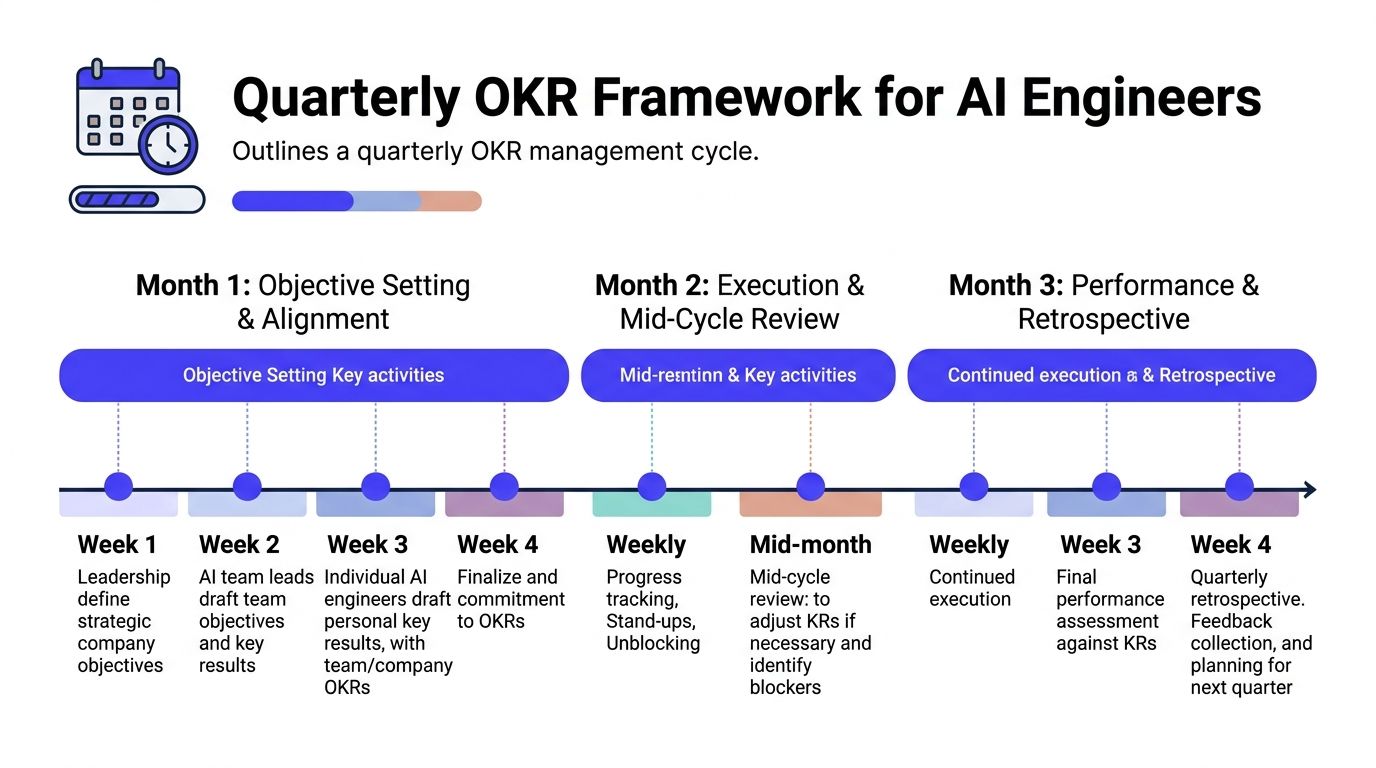
Quarterly reviews for AI engineers should cover three lenses:
| Review lens | What to discuss |
|---|---|
| Business impact | What changed in the product, workflow, or customer experience |
| Technical quality | Reliability, maintainability, observability, and sound trade-offs |
| Team contribution | Mentoring, documentation, incident response, and cross-functional clarity |
This structure prevents two common mistakes. One is over-rewarding visible heroics, like rescuing a release that should have been better planned. The other is rewarding research sophistication with no operational result.
For remote AI teams, I add one more practical test during reviews. Ask whether the engineer reduced dependency drag. Did they clarify ownership between MLE and data engineering? Did they improve an eval or deployment step that blocked other people? Did they leave the system easier to ship from than they found it?
That is the kind of performance that compounds. It improves output, reduces attrition risk, and gives senior engineers a reason to keep building with you.
Your 90-Day High-Performance Team Plan
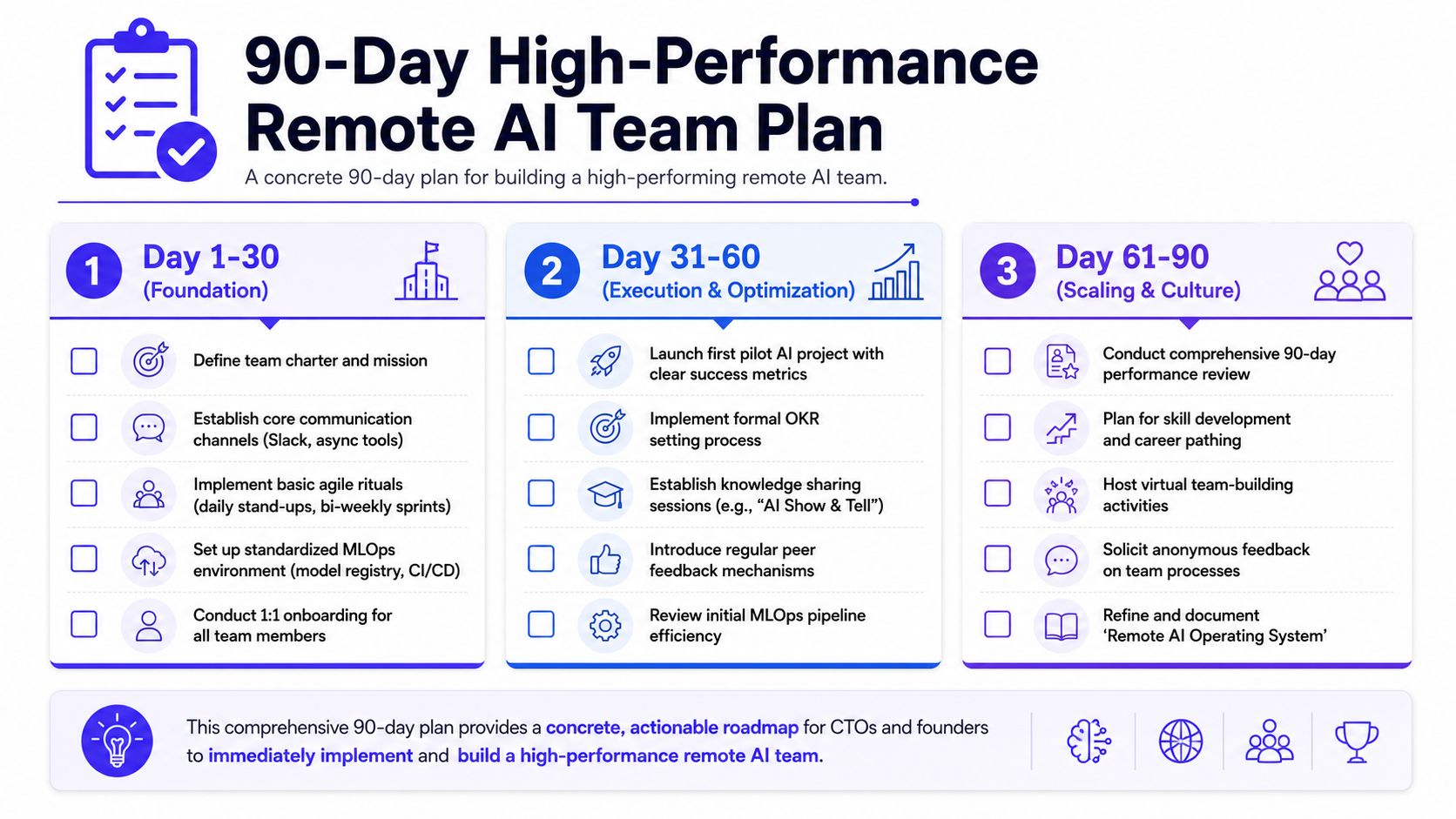
If you want to know how to build high performing teams in an AI startup, don't start with an offsite. Start with a 90-day operating plan.
The first quarter should lock down role clarity, hiring signal, communication rules, deployment flow, and measurable expectations. That creates momentum without pretending you can perfect the org chart in a week.
Days 1 to 30
Start with design, not recruiting volume.
- Write the team charter
Define what the AI team owns, what it supports, and how success is judged. - Name role boundaries
Separate ML engineering, MLOps, data engineering, and AI product ownership. - Choose your operating model
Pick centralized or pod-based structure based on current product demands. - Create one communication map
Set quiet hours, decision channels, escalation rules, and async expectations. - Standardize the first delivery path
Pick the minimum MLOps workflow the whole team will use.
Leaders of high-performing remote teams should define SMART goals for each role and implement a tracking mechanism tied to business outcomes, not just activity logs (Analytics 365 on high-performance remote teams).
Days 31 to 60
At this point, execution starts to reveal friction.
| Action | Output |
|---|---|
| Launch one pilot | A scoped AI initiative with named success criteria |
| Run the hiring loop | Structured interviews and calibrated scorecards |
| Onboard with working sessions | New hires map systems, stakeholders, and release flow |
| Start a show-and-tell rhythm | Team members share useful industry work and internal lessons |
| Review pipeline blockers | Identify where approvals, tooling, or handoffs stall shipping |
A monthly show-and-tell sounds lightweight, but it creates a reliable knowledge-sharing rhythm and gives remote teams a reason to learn in public.
Here's a short clip that complements the operating discipline required for strong teams:
Days 61 to 90
By this point, you should be tuning the system instead of debating the basics.
Use this checklist:
- Set the first quarterly OKRs tied to business impact
- Run a retro on the first pilot with product, engineering, and platform in the same room
- Audit handoffs between experimentation and deployment
- Check manager cadence for coaching, feedback, and unblockers
- Document the remote AI operating system in one shared place
A remote AI team becomes high performing when work moves cleanly from idea to deployment, and everyone can point to the same definition of success.
What to do next
Three practical next steps:
- Download the checklist and turn the 90-day plan into assigned owners and due dates.
- See sample profiles for the exact role gaps you've identified, especially MLOps, AI product, and senior ML engineering.
- Start a pilot with one production-bound use case rather than a broad AI mandate.
If you're building or fixing a remote AI team, ThirstySprout can help you scope the right team shape, review role gaps, and connect with vetted AI engineers, MLOps specialists, data engineers, and AI product talent. The practical next step is simple. Start a Pilot, review Sample Profiles, or book a short scoping call to turn this playbook into a team plan you can execute in the next 90 days.
Hire from the Top 1% Talent Network
Ready to accelerate your hiring or scale your company with our top-tier technical talent? Let's chat.