

Your team spans San Francisco, New York, London, and Bangalore. A data scientist is blocked on dataset access. An ML engineer lost the morning to status calls instead of finishing a retrieval experiment. Your MLOps lead sees a regression in production and cannot tell whether it came from code, infrastructure, or feature freshness. Nobody is obviously underperforming, yet the team ships slower than the roadmap requires.
That is the fundamental remote leadership problem. In AI and ML teams, the bottleneck is usually not effort. It is operating design.
Beyond Zoom: A Framework for High-Performance Remote AI Teams. TL;DR: Building a strong remote AI team takes more than video calls and good intentions. It requires clear operating rules for hiring, onboarding, async communication, decision records, code review, model delivery, security, and performance management. This playbook gives technical leaders 10 practical ways to hire, manage, and scale remote AI teams that ship reliably without burning people out. It includes templates, MLOps-specific examples, and the business logic behind each practice.
The difference matters because AI work creates failure modes that generic remote-work advice misses. Model handoffs break when assumptions live in Slack. Experiments become hard to reproduce when tooling is fragmented. Review quality drops when engineers cannot explain trade-offs in writing. Teams that handle remote work well treat these as system problems, then build process around them.
That same principle should shape team design from the start. If you are building distributed engineering capacity, this guide to hiring remote developers for distributed technical teams is a useful companion. It also aligns with the broader future of skills-based hiring, which matters even more in remote environments where written judgment and execution matter more than polished interview performance.
The practices in this guide are designed to reduce drag, protect focus, and make execution visible across time zones. If meeting overload is already cutting into output, review practical ways on how to prevent virtual meeting fatigue.
1. Rigorous Remote Hiring & Vetting
A remote AI team usually succeeds or fails before day one. If your hiring loop rewards polished live performance over written reasoning, you'll miss people who are excellent in a distributed environment and hire people who need constant synchronous support.
The fix is simple. Make the hiring process resemble the job. Remote engineers write, document, leave context, review code asynchronously, and unblock themselves. Your interview loop should test those behaviors directly.
What to evaluate instead of performance theater
A good take-home gives candidates enough room to show judgment. A bad one turns into unpaid labor or a puzzle contest.
Use something small and realistic. For an ML engineer, give a compact customer review dataset and ask them to build a simple sentiment classifier, document data cleaning and modeling choices in README.md, and submit through a pull request. You're not just reviewing model quality. You're reviewing naming, commit hygiene, assumptions, and whether another engineer can follow the work.
A strong interview question is also operational, not abstract: “Describe a time you had to solve a complex technical problem with a team spread across multiple time zones. How did you communicate progress and blockers? What was the outcome?”
Practical rule: If a candidate can't explain trade-offs clearly in writing, they'll struggle in a remote architecture discussion.
For hiring remote developers, the bar is different than for a co-located team. You're not only assessing technical depth. You're also assessing their suitability for remote work.
A simple vetting rubric
- Written clarity: Can they explain assumptions, risks, and limitations in plain English?
- Async discipline: Do they leave enough context in the PR so a reviewer in another time zone can move it forward?
- Practical modeling judgment: Did they choose a sensible baseline before reaching for complexity?
- Collaboration maturity: Do they describe how they ask for help without creating chaos?
Skills-based evaluation is a better fit than pedigree-based filtering for distributed teams. That shift is part of the broader future of skills-based hiring.
What doesn't work is six rounds of whiteboarding, vague scorecards, and no written exercise. That process selects for stamina and improvisation. Remote AI work rewards consistency and clarity.
2. Structured Onboarding with a First-Week Win
Most remote onboarding fails in subtle ways. The laptop works. Accounts are provisioned. The new hire attends meetings. But they still don't know how work flows through the team.
That's why I prefer a tightly documented onboarding sequence with a first-week ship. Not a fake task. A real contribution with bounded risk.
Here's the visual I'd hand to any hiring manager building that system:
What the first week should produce
A good first-week task proves five things at once. The engineer can run the stack, submit code, go through review, understand team standards, and contribute to something users or operators care about.
For an MLOps startup, one strong first-week task is “Add GPU memory profiling to our training script and expose it in the run logs.” That's not glamorous, but it's perfect. It touches environment setup, observability, CI, and team conventions.
Use a scorecard that's visible to the manager and the new hire:
- Environment ready: Local or cloud dev setup works.
- Access complete: Repo, secrets manager, issue tracker, model registry, and dashboards are available.
- First PR merged: A small but real code change lands.
- First team sync attended: The engineer sees how decisions happen.
- First doc edit shipped: They improve the written system too.
The payoff is speed to contribution. What's more, it reduces uncertainty. That's a major part of improving time to productivity for technical hires.
Where onboarding often breaks
Teams often overload the first week with passive learning. Too many calls. Too many docs without a path. Too much “shadowing” and not enough shipping.
Remote employees need trust and development support to stay for the long term. Quantum Workplace's summary notes that 62% of employees believe working remotely positively impacts engagement, yet only 5% of remote workers are likely to stay with their company long-term unless they receive intentional trust-building and development support, according to Quantum Workplace on remote work best practices. Onboarding is where that support starts.
A first-week win turns belonging from a slogan into an experience.
3. Asynchronous Communication as the Default
If your team needs a meeting to answer every question, your remote model won't scale. You'll spend your best engineering hours in status loops, timezone compromises, and repeated explanations.
Async communication fixes that, but only if you make it the default rather than the fallback.
A stack that supports written execution
Use each tool for one job. That sounds obvious, but a lot of remote confusion comes from overlapping channels.
A clean pattern looks like this:
- Slack: Urgent operational events, quick coordination, incident response.
- Jira or Asana: Task ownership, priorities, due dates, dependencies.
- Notion or Confluence: Specs, RFCs, operating rules, onboarding docs.
- Loom: Walkthroughs that are easier shown than written.
- GitHub or GitLab PRs: Technical discussion attached to code.
That setup works because it gives the team a durable record. It also supports engineers looking for asynchronous remote jobs, where contribution depends on documented context rather than constant overlap.
Write for the person who wakes up six hours later and needs to keep moving without a call.
How to make async actually work
Teams say they're async-first, then expect immediate Slack replies. That isn't async. That's chat-driven work with guilt attached.
Set explicit norms around response times, decision logs, and what counts as urgent. The underserved shift here is from activity monitoring to outcome-based autonomy. ICAgile recommends setting clear bi-weekly outcomes rather than just tasks and giving people full autonomy in how they reach them in ICAgile's remote team management guidance.
What doesn't work is replacing every meeting with long chat threads. Good async communication is structured. Use templates for updates, require clear asks, and close loops with written decisions.
For AI teams, this matters even more. Model evaluation, prompt changes, infra changes, and dataset assumptions all need a paper trail.
4. Documented Decision-Making with RFCs
Remote teams don't fail because people disagree. They fail because disagreement stays implicit until after implementation starts.
A lightweight Request for Comments process fixes that. You don't need bureaucracy. You need a repeatable way to capture why a decision is being proposed, what alternatives were considered, and how you'll know if it worked.
A one-page RFC is usually enough
Keep the template short enough that people will use it. For most engineering decisions, one page is fine.
A workable RFC structure includes:
- Problem statement: What pain are we fixing?
- Proposed change: What are we adopting or changing?
- Alternatives considered: What did we reject and why?
- Success metrics: What observable result would count as a win?
- Risks and constraints: Security, cost, data, latency, ownership.
- Rollback plan: How do we back out if the bet fails?
For an AI team, this is essential when changing a retrieval strategy, introducing a new feature store, or moving model serving infrastructure.
Example from a RAG stack decision
Say your team wants to move from FAISS to Pinecone for a retrieval-augmented generation workflow. Without an RFC, one engineer might optimize for speed of setup, another for retrieval quality, and your security lead for data boundary control. You won't discover the conflict until late.
With an RFC, async comments surface those concerns before code lands. One reviewer may ask whether tenant isolation requirements affect the vector store choice. Another may question migration effort from the current indexing path. That's exactly the discussion you want in writing.
The hidden benefit is managerial. RFCs reduce founder bottlenecks. Leaders can review a short document, leave comments, and approve or redirect without scheduling another call.
What doesn't work is making architecture decisions in Slack fragments or relying on whoever talked last in a meeting. Distributed AI systems are too expensive to run on memory and vibes.
5. Disciplined Collaboration with Pair Programming and Reviews
Your on-call channel lights up at 6:40 a.m. A training job that passed yesterday is now drifting, the feature pipeline shows inconsistent null handling, and two engineers have conflicting theories in Slack. This is the kind of work remote AI teams should not handle through scattered comments and long review queues. They need a clear rule for when to jump on a call, how to work together, and what a good review must cover.
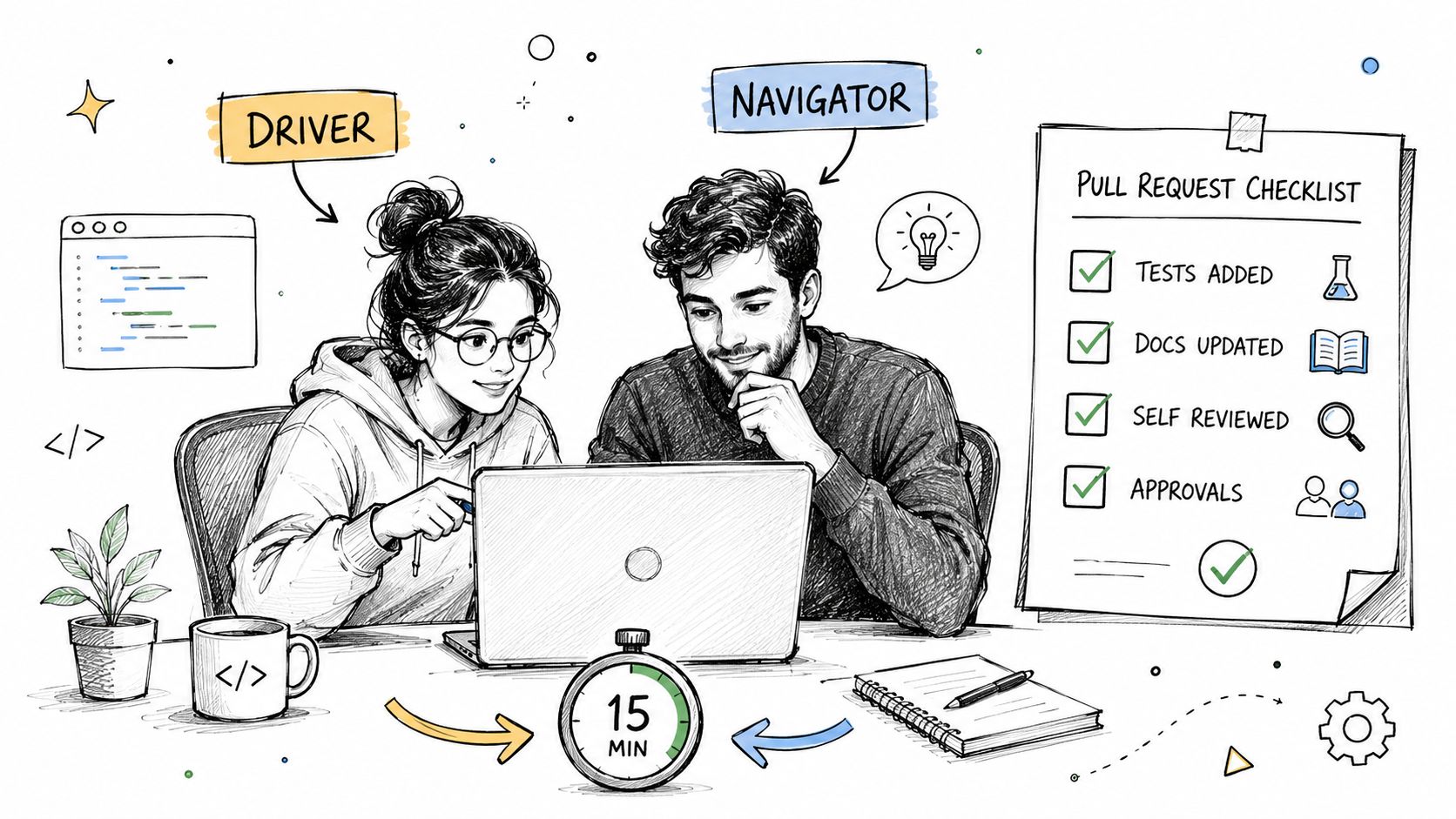
Remote collaboration works best when it is deliberate. Pair on work that carries production risk, hidden system behavior, or high learning value. Review everything else with enough structure that quality does not depend on who happens to be online.
When pairing pays off
Use pairing for failure analysis, architecture forks, and handoffs across experience levels. A flaky inference service, a retrieval regression after an embedding model swap, or a suspicious jump in offline metrics are good candidates. A routine dependency bump usually is not.
A simple format works well. Set a 60 to 90 minute session with one explicit goal, one driver, one reviewer, and a written outcome. For example, in a feature leakage investigation, the senior engineer can drive first and explain the diagnostic sequence: inspect the data contract, check train and validation split logic, verify point-in-time joins, then confirm evaluation code paths. Halfway through, switch control. The junior engineer takes the keyboard and talks through the next checks. You solve the issue faster, and you transfer judgment instead of just closing a ticket.
That trade-off matters. Pairing is expensive. It pulls two people into one task. Use it where reduced risk, faster debugging, or faster skill transfer is worth more than parallel throughput.
Review standards for remote AI teams
Code review in an AI/ML team has to cover more than style and correctness. A clean diff can still break reproducibility, degrade latency, or change model behavior.
Use a short checklist for every pull request:
- Intent: Does the PR description explain what changed, why it changed, and what could break?
- Tests: Are core paths, edge cases, and failure modes covered?
- ML impact: Could this change affect training stability, evaluation results, feature generation, or inference latency?
- Data changes: Did schema, labeling logic, feature definitions, or join assumptions change?
- Operational safety: Is there a rollback path, and are alerts or dashboards affected?
- Documentation: Did the author update the runbook, model card, or pipeline notes if behavior changed?
The review comment itself matters too. “Fix this” creates churn. “This refactor changes batch ordering. Can you add a regression test to confirm it does not alter evaluation output?” gives the author a concrete next step and leaves useful context for the next reviewer.
I also recommend setting service levels for reviews. Critical fixes get a fast path. Normal PRs should have a target first response time, usually within one working day. Without that rule, remote teams drift into a bad pattern where authors stack more changes onto unreviewed branches, conflicts grow, and release confidence drops.
One more practice separates strong teams from merely polite ones. Review for operational consequences, not just local code quality. In an ML repository, a small change to feature normalization can invalidate cached datasets, break training reproducibility, or make offline and online behavior diverge. Reviewers should ask those questions every time.
What fails in practice is treating “LGTM” as an acceptable default. In a distributed engineering team, reviews are part quality control, part mentorship, and part institutional memory. If you want a remote AI team to move quickly without repeating the same production mistakes, disciplined pairing and disciplined reviews are how you get there.
6. A Centralized, Secure MLOps Toolchain
If every engineer has a different local setup, your remote team will lose time on reproducibility before it loses time on model quality. AI work creates enough uncertainty already. Your tooling should remove the avoidable kind.
A centralized MLOps stack gives distributed teams one way to run experiments, one place to store results, and one path to production.
A practical reference architecture
Here's a simple pattern that works well for startups and scale-ups:
- GitHub: Source control and pull requests.
- GitHub Actions: CI for tests, linting, and triggered workflows.
- Cloud compute: Training and batch jobs on managed VMs or Kubernetes.
- Weights & Biases or MLflow: Experiment tracking.
- Model registry: Versioned promotion path for approved artifacts.
- Secrets manager: Central handling of keys, tokens, and credentials.
A representative environment.yml or requirements.txt checked into the repo matters more than teams like to admit. It reduces “works on my machine” drift. It also makes CI meaningful because everyone is using the same dependency expectations.
Why standardization is now an executive concern
Remote work infrastructure is no longer a temporary patch. The remote workplace services market is projected to grow from $20.1 billion to $58.5 billion by 2027, reflecting a 23.8% compound annual growth rate, according to Breeze's remote work market summary. That market signal matters because it reflects sustained investment in distributed operations, not a brief adjustment period.
For AI teams, toolchain consistency directly affects delivery quality. If experiment metadata is scattered across notebooks, local folders, and chat threads, you can't reproduce a result with confidence. If promotion criteria live in a lead engineer's head, you can't scale the team.
The more remote your team becomes, the more your tooling becomes your management system.
What doesn't work is a loose collection of favorite tools with no default path. Standardization always feels slower at the start. It pays back when incidents happen, hires ramp, and auditors ask questions.
7. Outcome-Driven Performance Metrics
Monday looks busy. Slack is active, calendars are full, and every engineer appears online. By Friday, the model still has not shipped, the evaluation set is stale, and nobody can say whether last week's changes improved accuracy, latency, or cost. Remote AI teams get into trouble when visibility is based on activity instead of delivery.
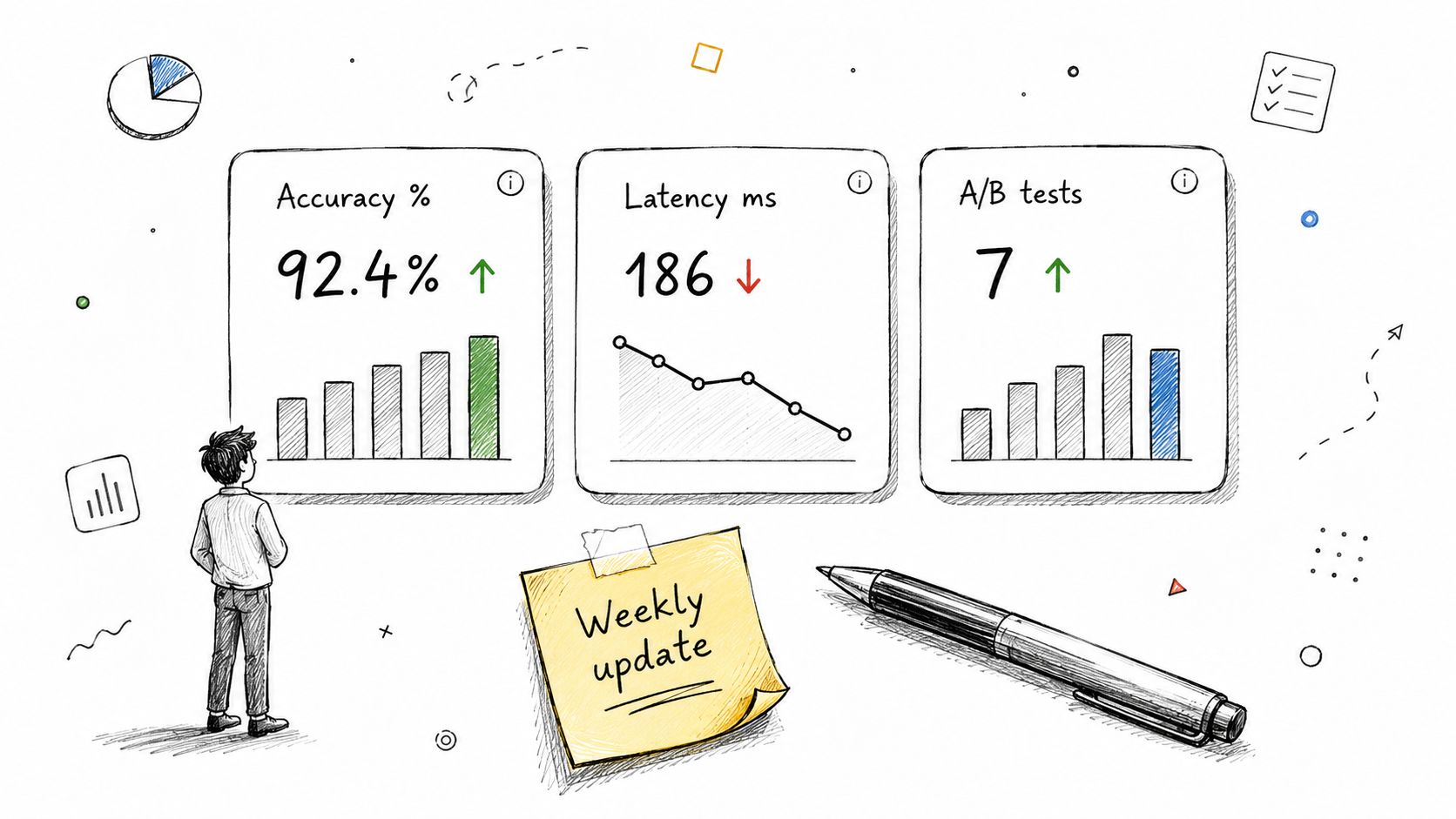
The fix is operational, not cultural. Define a small set of outcome metrics tied to product and model performance, make ownership explicit, and review them on a predictable cadence. For AI and ML teams, that means measuring what changed in the system and what changed for the user.
For a retrieval-augmented generation team, a practical scorecard usually includes:
- Retrieval quality: Precision@5, hit rate, or another relevance metric your team already trusts
- User-facing performance: p95 or p99 latency on the production path
- Cost control: inference and embedding spend against a weekly or monthly budget
- Quality in production: user feedback, fallback rate, escalation rate, or another signal that shows whether answers are useful
A metric only helps if someone can act on it. Each one should have an owner, a target range, and a review point. If retrieval quality drops after a chunking change, the team should know who investigates, what gets rolled back, and how quickly a decision is made.
I also recommend a fixed async weekly update. Keep it short enough that people will use it and specific enough that leaders can spot delivery risk early:
- Outcome moved: what changed in a metric, system behavior, or customer experience
- Next bet: the highest-value task for the next week
- Blocked by: a dependency, decision, or missing input that needs attention
That format cuts status theater. It also gives managers a better read on execution than green dots ever will.
Goal-setting needs the same discipline. A good remote goal defines the business result, the time window, and the constraint set. Unduit uses a solid example in its remote team management best practices: reduce data pipeline latency by 20% within 4 weeks using the existing Spark stack. That works because it is testable and bounded. The engineer knows what to improve, when it is due, and what architecture is in scope.
There is a trade-off here. Outcome-driven management is stronger than activity tracking, but only if the metrics are chosen carefully. Engineers will optimize what leadership reviews. If you only track shipping speed, quality drops. If you only track model quality, costs drift. If you only track utilization, people protect busyness instead of customer impact.
As noted earlier, many companies still monitor remote employee activity and justify it as control or risk management. In practice, surveillance creates performative work, weaker trust, and worse signal for technical leaders. AI teams need clearer ownership and better instrumentation, not software that counts keystrokes.
If you want to benchmark how outcome ownership shows up in adjacent AI and security roles, you can explore Binance AI security careers. The useful takeaway is not the job board itself. It is the pattern. Strong remote technical teams define success in terms of system reliability, automation impact, and measurable risk reduction.
Visible goals, visible blockers, and visible outcomes scale. Presence does not.
8. Proactive Security for Distributed Endpoints
Remote AI teams expose more than code. They expose data pipelines, model artifacts, API credentials, notebooks, evaluation datasets, and customer context. If you're still relying on the idea of a trusted office network, your security model is behind your operating model.
A distributed team needs a zero-trust posture. Every device, every session, and every access path should be treated as potentially risky until verified.
Baseline controls that shouldn't be optional
You don't need enterprise theater. You do need consistency.
A solid starting baseline includes:
- Least-privilege access: Engineers get only the systems they need.
- Temporary credentials: Avoid permanent shared access paths.
- Multi-factor authentication: Required on every critical service.
- Mobile device management: Laptops need policy enforcement and recovery options.
- Centralized secrets: No secrets in local files or shared chat messages.
- Audit trails: Access and changes need to be reviewable.
A practical onboarding gate is simple: no repo access until security training is completed, multi-factor authentication is enabled, and device management is active on the laptop.
Security without culture damage
Leaders often overcorrect here. They introduce heavy monitoring, shared admin shortcuts, or cumbersome approval layers that slow everything down. That creates shadow workflows fast.
A better approach is secure-by-default tooling. Use audited, time-bound access for production systems. Keep model and data credentials in a real secrets manager. Require pull-request based infrastructure changes where possible. For AI-specific work, separate environments for experimentation and production inference so accidental crossover is harder.
There's also a talent angle. Teams building in AI security often expect this level of discipline already, which is one reason some engineers look toward roles like those highlighted in Binance AI security careers.
What doesn't work is pretending trust and security are opposites. Good remote security reduces ambiguity. It doesn't criminalize normal engineering work.
9. Intentional Culture Building Across Time Zones
Culture in remote teams isn't office perks moved onto Zoom. It's how fairly you distribute inconvenience, how clearly you share context, and whether people feel visible when they aren't physically present.
That's especially important in AI teams, where a lot of high-value work happens without immediate visibility. A model quality improvement, a cleaner feature pipeline, or a safer deployment path can be easy to miss unless leaders make contribution legible.
Practices that create connection without draining people
The first rule is fairness. If the same region always takes the late call, resentment builds. Rotate recurring meeting times and publish the schedule in advance.
The second rule is optionality. Social connection matters, but forced fun usually backfires. A monthly AI demo day works well because it centers on craft. Engineers can show a tool, experiment, failure, or learning. Record it so people outside the time window can still benefit.
There's also a practical way to reduce meeting fatigue while preserving continuity. Neat points to a stronger pattern than “make meetings better.” Successful teams transform conversations and meetings into accessible databases, as described in Neat's practices for managing remote teams. That means notes, decisions, snippets, and recordings become reusable assets rather than one-time events.
If a meeting produces no durable artifact, the team will likely have the same meeting again.
Recognition matters more remotely
Recognition needs a cadence, not just spontaneity. Publicly call out work that improved reliability, reduced waste, clarified architecture, or unblocked another team. Remote employees often don't see the ambient signs that their work is valued.
Trust is part of this too. Gallagher's research, cited by Quantum Workplace earlier, found that only 57% of employees strongly agree they feel trusted when working remotely. Teams feel that gap quickly. You close it through clarity, consistency, and visible appreciation, not through slogans.
What doesn't work is trying to manufacture startup energy with more calls. Connection grows from fairness, memory, and respect for people's time.
10. Transparent Career Growth and Remote Mentorship
A remote ML engineer can ship strong work for six months and still ask a fair question at review time: how is promotion decided here? If the answer depends on who presents well on calls, who works near leadership's time zone, or who gets assigned the visible incident, the process is broken.
Career growth has to survive distance. For AI and ML teams, that means promotion criteria, mentoring, and evidence of impact all need a written system. Otherwise, strong people plateau, then leave.
Make growth criteria explicit
Start with a level matrix that defines scope, technical judgment, communication, and mentoring at each stage. Keep it specific to your stack and operating model. A generic engineering ladder misses work that matters on ML teams, such as improving data quality, hardening evaluation pipelines, reducing inference cost, or creating clearer experiment reviews.
For example:
- L3 engineer: Owns well-bounded features or pipeline components, writes clear implementation docs, runs experiments with support, and hands off work cleanly.
- L4 engineer: Owns services or ML systems end to end, drives cross-functional delivery, improves review quality, and mentors less experienced engineers.
- L5 engineer: Sets technical direction across systems, handles ambiguous trade-offs in model quality, latency, cost, and risk, and raises the capability of multiple teams.
This reduces politics. It also gives managers a better way to coach. “Be more senior” is vague. “Show that you can own an evaluation framework used by two teams” is coachable.
Promotion packets should rely on artifacts, not memory. On remote AI teams, good evidence includes RFCs, architecture decisions, postmortems, experiment summaries, model launch reviews, dataset change logs, and examples of cross-team influence. That protects quieter engineers and rewards work that improves the system, not just work that gets airtime.
Separate mentorship from delivery management
Mentorship works best as a distinct operating rhythm. Keep it out of sprint status meetings. Once growth conversations get mixed with delivery pressure, people optimize for short-term updates instead of long-term development.
A bi-weekly mentorship session is enough for many teams. Use it to review skill gaps, decision quality, stakeholder management, review habits, and promotion evidence. For ML specialists, discuss areas that often stall career progression: experiment design, reproducibility, model governance, production readiness, and how to explain trade-offs to non-technical partners.
The mentor does not need to be the direct manager. In fact, for senior ICs and ML researchers, a separate mentor is often better. Managers focus on staffing and execution. Mentors can focus on craft, judgment, and career direction without every conversation turning into resource planning.
Remote work remains a strong employee expectation, as noted earlier. That changes the retention equation. If compensation is competitive but growth feels opaque, strong engineers have options. They will use them.
One operational detail matters here too. Mentorship should respect focus time. Reclaim recommends blocking 2 to 4 hours daily for uninterrupted work, and notes that each quick check on Slack or email costs 23 minutes of refocus time in Reclaim's remote work best practices. Schedule mentoring with intent, keep it prepared, and leave room for real discussion instead of turning it into another sprawling call.
Good remote career systems are visible and boring. That is the goal. Engineers should know what the next level requires, how their work will be assessed, and who is responsible for helping them get there.
10-Point Remote Team Best Practices Comparison
| Practice | 🔄 Implementation Complexity | Resource Requirements | ⚡ Efficiency / Time-to-value | ⭐📊 Expected Outcomes | 💡 Ideal Use Cases & Key Advantages |
|---|---|---|---|---|---|
| 1. Rigorous Remote Hiring & Vetting | Medium, design process and rubric required | Moderate, take‑home tasks, reviewer time, ATS updates | Medium, longer selection, faster ramp (2–3 weeks) | High, reduces mis‑hires 20–30%; quicker new‑hire productivity | Remote-first hiring for senior/AI roles; surfaces async & documentation skills |
| 2. Structured Onboarding with a First‑Week Win | Low–Medium, create timeline & checklist | Low, onboarding buddy, pre‑onboarding packet, starter tasks | High, new hire ships a small win within week one | High, cuts ramp to <2 weeks; immediate measurable value ($5k–$10k for senior hires) | New hires and contractors; validates setup and builds momentum |
| 3. Asynchronous Communication as the Default | Medium, cultural shift and clear guidelines | Low–Moderate, handbook, docs platform, tooling (Notion, Slack) | High, increases focus time up to ~40% | High, searchable institutional memory; fewer meetings and timezone friction | Distributed teams across time zones; scaling remote hiring |
| 4. Documented Decision‑Making with RFCs | Low, lightweight template + discipline | Low, doc repo, reviewers, defined thresholds | Medium, adds review time but prevents rework | High, reduces engineering rework >25%; documents trade‑offs | Cross‑team architectural changes and high‑impact technical decisions |
| 5. Disciplined Collaboration: Pair Programming & Reviews | Medium, scheduling and rules to enforce | Moderate, pairing tools, reviewer bandwidth, checklists | Medium, some overhead, reduces incidents over time | High, cuts production bugs/incidents up to ~50%; knowledge sharing | Critical bugs, onboarding juniors, complex or high‑risk features |
| 6. Centralized, Secure MLOps Toolchain | High, integrate infra, CI/CD, tracking, registry | High, cloud envs, W&B/MLflow, feature store, CI tools | High, increases experiment velocity ~30% | High, reproducibility, governance, faster experiments | Regulated industries, growing ML teams needing reproducible pipelines |
| 7. Outcome‑Driven Performance Metrics | Low, define 3–5 metrics and dashboard | Low, dashboard tooling, weekly updates, discipline | High, replaces long status meetings; quick visibility | High, aligns work to business value; frees deep work time | Project teams replacing status meetings; product‑aligned AI work |
| 8. Proactive Security for Distributed Endpoints | High, implement zero‑trust, policies, tooling | High, SSO, MDM, secrets manager, training, audits | Medium, upfront effort; significant long‑term risk reduction | Very High, reduces breach risk; eases compliance (SOC2, ISO) | Enterprise customers, regulated data, remote endpoint exposure |
| 9. Intentional Culture Building Across Time Zones | Medium, plans for fair scheduling and channels | Low–Moderate, small budget, comms channels, rotating schedules | Medium, boosts morale and retention over time | Medium, improves retention 15–20%; inclusive engagement | Global teams wanting higher retention without mandatory events |
| 10. Transparent Career Growth & Remote Mentorship | Low–Medium, document ladders and mentorship process | Moderate, mentors, development budget, career docs | Medium, prevents attrition; accelerates internal mobility | High, clearer promotions, better retention and talent growth | Scaling teams that must retain and grow junior talent remotely |
Your Next 3 Steps to a World-Class Remote Team
A remote AI team rarely breaks because people are far apart. It breaks when nobody can answer three basic questions under pressure: what changed, who approved it, and where the evidence lives. If a model regression hits production at 9:10 a.m. and the answer is buried across Slack threads, notebooks, and private docs, the team has an execution problem.
Start by writing a one-page remote operating manual. Keep it specific enough that a new engineer can follow it without interpretation. Define which decisions belong in Slack, which belong in Jira, where RFCs live, how quickly non-urgent messages need a response, and what qualifies for a meeting. For AI and ML teams, add the details generic remote advice misses: where experiment runs are logged, how evaluation results are named and stored, how prompt changes are versioned, and who can approve a deployment that affects model behavior. Teams that skip this work pay for it in repeated experiments, slower incident response, and avoidable debate about what was "decided."
Then fix the first week.
Remote onboarding should end with a useful result, not a calendar full of intro calls. Give every new hire a checklist that covers access, environment setup, reading order, ownership map, and one scoped task that ships in week one. In practice, that might be a small PR to the training pipeline, a cleaned dataset with validation checks, a monitoring alert that catches drift earlier, or a documented eval workflow the next hire can reuse. I have found that a two-person support model works well for ML teams: one onboarding buddy for tools and systems, one manager for priorities, context, and quality bar. That split keeps support responsive without blurring accountability.
Use the third step to change how the team is managed. Stop asking for visible activity and start reviewing visible outcomes for one important initiative. Pick three measures: one for quality, one for delivery reliability, and one for cost. For model serving, that can be answer quality, latency, and inference spend. For data platforms, it can be freshness, pipeline failure rate, and adoption by downstream teams. Review them in writing each week and use them to make trade-offs explicit. Should the next sprint improve eval coverage, reduce token cost, harden rollback paths, or retrain a weak model? Good metrics make that discussion faster and less political.
This is the shift remote technical leaders need to make. Engineers should not wait for permission to do obvious work, and managers should not need meetings to see whether the team is healthy. Clear rules, recorded decisions, and a small set of outcome metrics give distributed teams room to move.
If you need outside help setting that up, ThirstySprout works with companies hiring remote AI engineers, MLOps specialists, data engineers, and AI product talent. That is useful when the gap is not headcount alone, but the ability to get new people productive inside a disciplined remote operating model.
Strong remote AI teams are built from repeatable habits. Document them. Review them weekly. Fix the friction that slows decisions, handoffs, and releases. That is how remote execution gets better.
Hire from the Top 1% Talent Network
Ready to accelerate your hiring or scale your company with our top-tier technical talent? Let's chat.