

You're probably in the same spot as a lot of founders right now. Product wants an AI feature in market this quarter. Engineering has good backend people, but no one who's run GPU infrastructure, model monitoring, prompt regression tests, or an AI incident process in production. Hiring a full internal team feels slow. Outsourcing everything feels risky.
My advice is simple. Don't treat this as a talent question first. Treat it as an operating model decision. Your first major AI feature needs speed, production discipline, and a clear line around what IP stays inside your company.
If the feature is strategic but your AI operations muscle is weak, managed AI services are often the fastest safe path. If the feature itself is your moat, keep core product logic, proprietary data pipelines, and evaluation design in-house. Buy operational support around them.
What Are Managed AI Services and Who Needs Them
- Managed AI services are for teams that need to ship AI soon without building the whole AI operations stack internally.
- This is an operating partnership, not a freelancer arrangement. The provider owns ongoing performance, availability, and improvement in production.
- The category is scaling fast because companies are moving from AI pilots to real operations. The global AI managed services market is projected at $127.29 billion in 2026 and $1,534.22 billion by 2034, with a 36.5% CAGR, according to StrategyMRC's AI managed services market forecast.
A lot of founders hear “managed AI” and think outsourced model development. That's too narrow. A managed provider isn't just building something and handing it over. They're taking responsibility for running AI systems in production, with explicit accountability for performance, availability, and continuous improvement. That's the key distinction.
Who should seriously consider it
You should look hard at managed AI services if any of these are true:
- You need speed: your team has a clear use case, but no appetite to spend months building MLOps, observability, and incident response from scratch.
- You lack specialist coverage: nobody on staff owns model lifecycle operations, GPU infrastructure, or AI governance.
- You need operational confidence: you're moving beyond a demo into a customer-facing workflow where failure hurts trust or revenue.
Practical rule: If your product team knows the problem and your engineers know the app, but no one owns AI production operations, you don't have an AI team yet. You have an AI experiment.
This decision shows up outside pure software teams too. If you're in services, advisory, or workflow-heavy delivery, the pressure is similar. Teams exploring offering AI services for consultants run into the same constraint. The opportunity is obvious, but the operational burden arrives faster than most firms expect.
The Three AI Team Models Compared
You're six weeks from a launch. The demo works. Customers want a pilot. Then critical questions show up. Who owns evals, model drift, latency spikes, prompt regressions, access controls, and incident response at 2 a.m.?
That is the actual build versus buy decision.
- Build an in-house AI team.
- Use staff augmentation.
- Use a managed AI service.
Founders usually pick the option that feels familiar. That is a mistake. For a first major AI feature, you should choose based on three things: how fast you need to ship, how much operational risk you can absorb, and whether the intelligence itself is core IP or just part of the product experience.
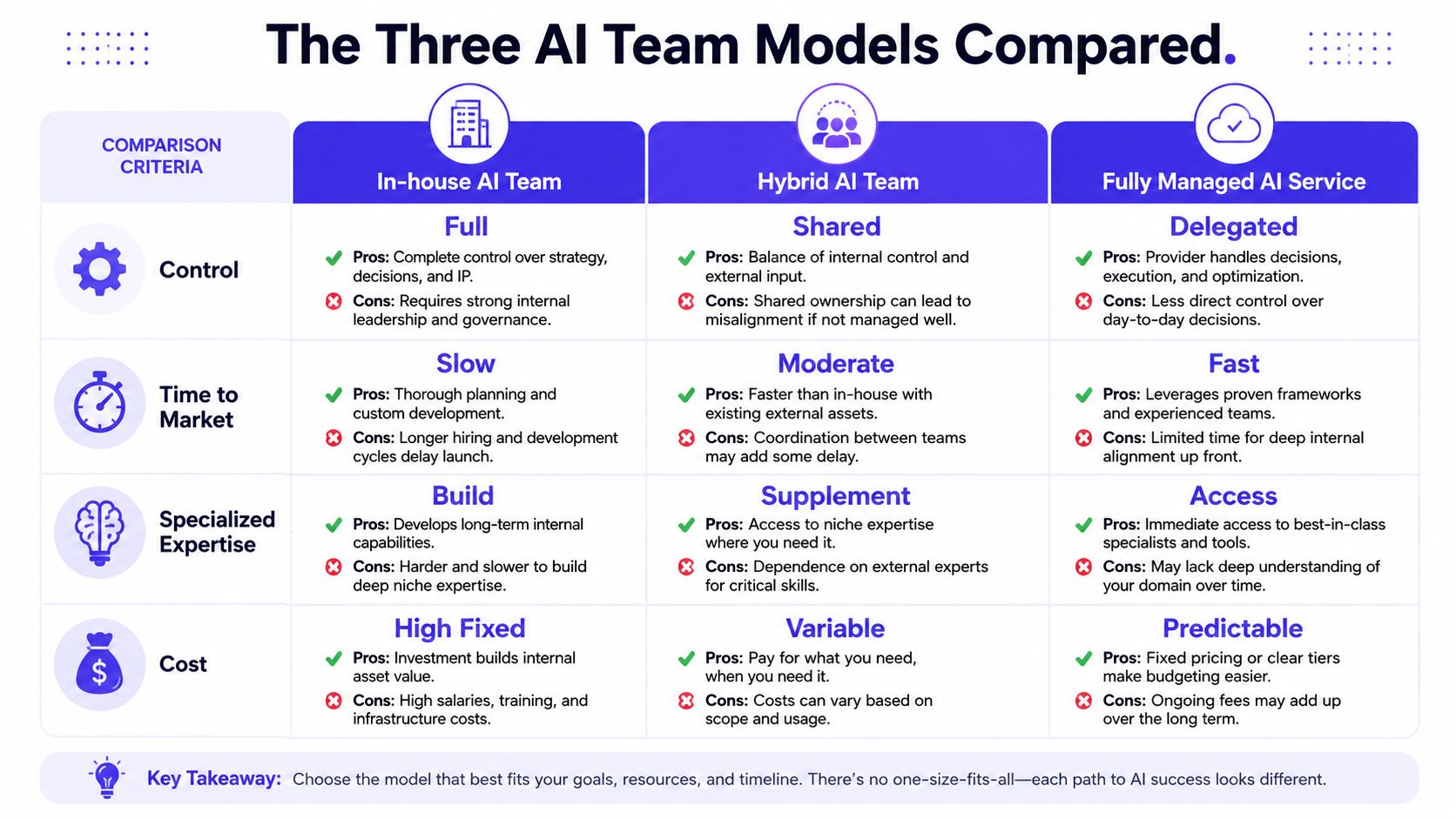
The comparison that actually matters
| Criteria | In-House Team | Staff Augmentation | Managed AI Service |
|---|---|---|---|
| Control | Highest. You own roadmap, stack, review standards, and hiring. | Medium. You assign work, but quality depends on contractors you do not fully control. | Lower on day-to-day execution. You set outcomes and constraints, the provider runs delivery. |
| Time to market | Slowest. Hiring, onboarding, and platform setup take time. | Faster than hiring, but your team still has to manage the work. | Fastest when the blocker is production setup and ongoing operations. |
| Cost model | High fixed cost with long-term commitment. | Flexible, but scope creep is common if ownership is fuzzy. | Operating expense. Easier to forecast if the statement of work is precise. |
| Best use case | Core model behavior, proprietary data advantage, long-term platform ownership. | A temporary capacity gap, a missing specialist, or a short delivery push. | First production AI feature, regulated workflows, model operations, and infrastructure management. |
| Management burden | Highest. You own architecture, hiring, QA, incidents, and uptime. | Still high. Added people need direction, context, and code review. | Lower. The provider should own runbooks, monitoring, and operational response. |
| Knowledge retention | Best internal retention. | Mixed. It depends on process and documentation. | Risky unless the contract requires documentation, handoff assets, and access to logs and configs. |
Here's the rule I give founders. Keep product judgment and domain context inside your company. Buy the heavy operational layer first. Hire internally only when the model behavior itself is the product moat.
How to decide without overthinking it
Use a simple decision test.
Choose in-house if model quality is your defensible advantage and you expect AI to become a permanent function across the company. This is the right call if you are building proprietary ranking, pricing, recommendation, fraud, or workflow intelligence that compounds into core IP.
Choose staff augmentation if your architecture is already defined, your internal lead can manage execution tightly, and you just need more hands for a fixed period. If you need a clearer breakdown, this comparison of managed services vs staff augmentation covers the ownership line well.
Choose managed AI services if your team knows the product problem but does not want to assemble MLOps, infra, monitoring, security controls, and support processes from scratch. For a startup shipping its first serious AI feature, this is usually the right answer.
Why? Because your first AI release usually fails operationally, not strategically. The model can be good enough while the system around it is fragile.
What each model gets wrong
In-house teams are often too slow for a first release. Founders hire one ML engineer and expect a full function. That person then becomes researcher, platform owner, evaluator, prompt engineer, and on-call operator. Progress stalls.
Staff augmentation looks cheaper than it is. You still need an internal lead who can write specs, review output, integrate the work, and own quality. If you do not have that person, you are renting motion, not getting outcomes.
Managed services can ship quickly, but they create a different risk. You can lose visibility into how decisions are made, how systems are configured, and what happens if you want to bring the capability in-house later. That is why contracting discipline matters as much as technical skill.
My recommendation for a first major AI feature
For most seed to Series B companies, start with a managed provider if all three of these are true:
- You need to launch within one or two quarters.
- The AI feature supports the product, but is not the company's primary moat.
- You do not have internal coverage for platform operations, evaluation, security, and incident response.
Build in-house once usage is proven, the workflow is stable, and you can clearly name what IP must stay internal.
Use staff augmentation only if you already have a strong internal technical owner. Without that, augmentation becomes management overhead disguised as flexibility.
The contracting lesson shows up in other functions too. This guide on HR for SMBs is useful for the same reason. Outsourcing works when you keep strategic ownership and define operational accountability with precision.
Keep the decisions that shape your moat. Outsource the parts that slow down launch and add operational risk.
Two Common Managed AI Service Engagements
The best way to judge managed AI services is to look at how they work in a real operating context. Here are two patterns I see often.
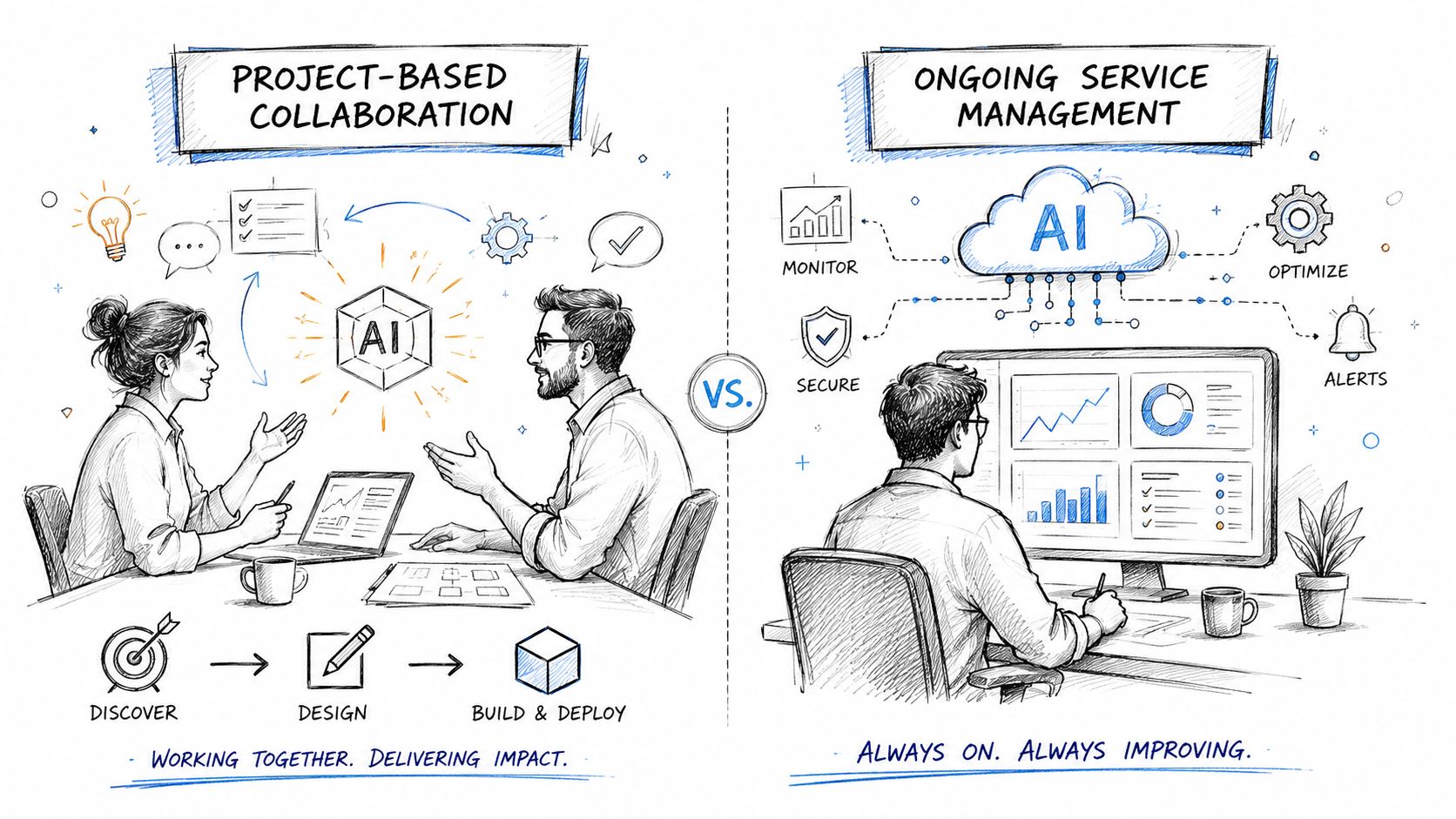
Example one, RAG for customer support
A Series B SaaS company wants an AI support assistant trained on product docs, help center articles, and internal resolution notes. The product goal is straightforward. Deflect repetitive tickets and help support reps answer faster. The engineering reality is not.
The internal team can build the application layer. They know the auth model, the support workflow, and the customer context. What they don't have is a mature retrieval-augmented generation stack in production. They haven't built evaluation loops, prompt versioning, retrieval quality monitoring, or incident handling for bad answers.
A managed provider typically steps in on the operational side:
- Infrastructure ownership: vector database hosting, embedding pipelines, job scheduling, and environment management.
- Runtime operations: latency monitoring, retrieval failures, fallback routing, and alerting.
- Lifecycle work: benchmark tests on production-like queries, regression checks after model or prompt changes, and controlled rollout.
The startup should still own some pieces. Keep the document taxonomy, approval policy, prompt intent, and answer quality rubric internal. Those are product decisions. Don't outsource your definition of a good answer.
What good looks like: Your provider runs the platform. Your product and engineering leaders still decide what the assistant should and shouldn't do.
Example two, fraud model operations in fintech
A fintech startup already has a fraud detection model live. The challenge isn't model invention. The challenge is staying reliable as behavior changes, data shifts, and regulators ask hard questions.
Managed AI services can expand beyond infrastructure into lifecycle accountability. The provider may handle monitoring for performance drift, retraining workflows, change management, rollback plans, and incident-style reporting when the system causes operational or compliance issues.
A healthy division of labor looks like this:
| Keep in-house | Hand to managed partner |
|---|---|
| Risk policy and fraud thresholds | Monitoring and operational alerting |
| Feature definitions tied to your domain | Retraining pipelines and scheduled evaluations |
| Investigator feedback loop | Deployment orchestration and rollback support |
| Regulatory interpretation with legal/compliance | Documentation artifacts for model changes and incidents |
A simple architecture split
Below is a representative handoff line for a first AI feature.
App team owns:- User workflow- Product requirements- Domain prompts and policies- Acceptance criteria- Human review pathsManaged provider owns:- Model hosting or infra operations- Kubernetes or Slurm orchestration- Monitoring and alerting- Incident response- Capacity planning- Benchmark reruns after material changesThis model works because it protects core IP while avoiding the classic startup mistake of pretending a generalist backend team can absorb AI operations overnight.
Key Business Benefits and Hidden Risks
Managed AI services can be a strong move. They are not a free lunch. If you choose this path, do it for the right reasons and protect yourself in the contract.
The upside is real
The hard business case is speed plus focus. According to ArticSledge's overview of AI managed services, organizations adopting this model typically realize 20–40% cost reductions and 30–50% faster time-to-market compared with building internal AI capabilities.
Those gains make sense. You avoid upfront infrastructure investment, skip part of the specialist hiring cycle, and reduce the load on your existing engineering managers.
For a startup, the hidden value is attention. Every hour your team spends untangling orchestration issues or chasing model incidents is an hour not spent on product learning. Managed AI services can buy back founder and engineering bandwidth.
The risks are also real
Here's where I get blunt. Most failed vendor relationships don't fail because the tech is bad. They fail because the client gave away too much control over the wrong layer.
The biggest risks are:
- Vendor lock-in: your prompts, evals, deployment assumptions, or monitoring stack become too provider-specific.
- Weak governance: the vendor touches sensitive data, but your team can't verify handling, access, or model behavior.
- Capability atrophy: over time, no one inside your company understands how the system really works.
- Misaligned incentives: the provider optimizes uptime while you care about answer quality, risk tolerance, or customer trust.
You should never outsource judgment. You can outsource operations.
A practical scorecard
| Area | Benefit | Risk | Mitigation |
|---|---|---|---|
| Speed | Faster launch and fewer setup delays | Teams may skip requirements discipline | Write explicit pilot success criteria before work starts |
| Cost | Lower fixed overhead | Monthly spend can hide weak ROI | Tie fees to milestones and measurable service scope |
| Quality | Mature runbooks and operational coverage | Provider may optimize technical metrics, not business outcomes | Define quality thresholds tied to your task |
| Security and compliance | Better process maturity than many startups have internally | Data handling can become opaque | Reserve audit rights and require evidence of controls |
| Internal learning | Team gets leverage quickly | AI know-how stays outside | Keep one internal technical owner accountable |
My rule on core IP
Keep these in-house whenever possible:
- Problem framing
- Evaluation criteria
- Prompt and workflow design
- Domain-specific labels and taxonomies
- Customer-facing policy decisions
Buy these first:
- Infrastructure operations
- Monitoring and alerting
- Incident response
- Capacity planning
- Change management process
That split gives you speed without giving away your moat.
How to Select and Vet a Managed AI Partner
Teams often evaluate AI vendors backward. They start with demos. Start with failure conditions instead.
A solid process has five phases. AI Technology Authority's evaluation framework lays them out clearly: define requirements, screen against threshold criteria such as ISO/IEC 42001 and SOC 2 Type II, conduct technical due diligence, run a benchmark pilot on production-representative data, and align contract milestones with pilot outcomes.
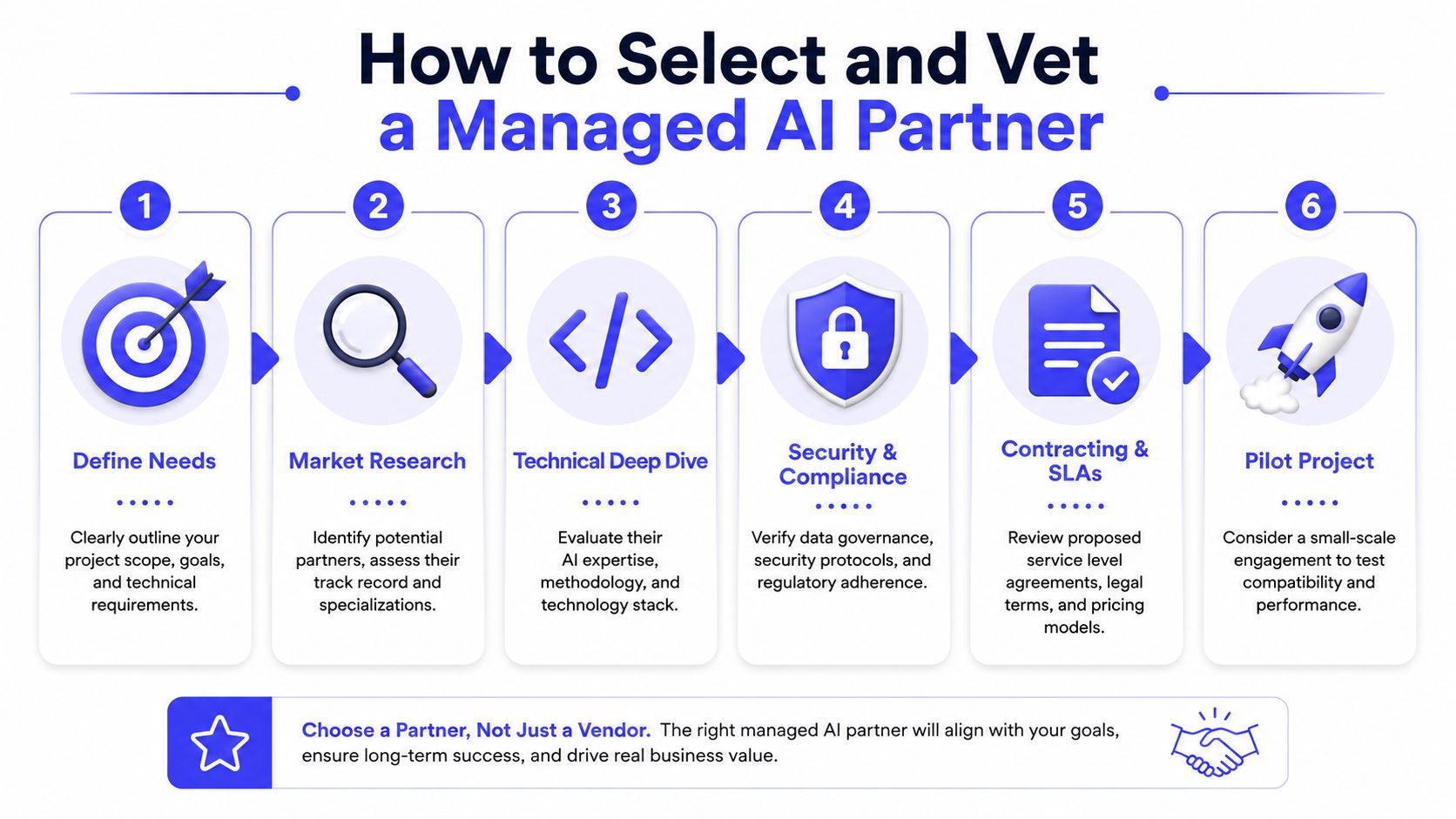
The shortlist checklist
If you need a market map before diligence starts, this roundup of top AI consulting firms is a decent starting point. Then use a tighter screen.
Ask every candidate for these five things:
A written use-case fit statement
They should restate your use case, data categories, latency constraints, accuracy thresholds, and regulatory needs in their own words.Control evidence
Ask whether they meet threshold criteria such as SOC 2 Type II and, where relevant, ISO/IEC 42001. If they dodge the question, move on.Technical operating model
You want clarity on orchestration, monitoring, incident response, rollback, audit logs, and what counts as a material change that triggers re-testing.Pilot design
The pilot must use production-representative data and document failure modes, not just happy-path demos.Contract milestone mapping
Pilot metrics should connect directly to go-live conditions and remediation obligations.
Questions worth asking in the first call
- What exactly do you own after launch?
- What logs do you preserve for audits and AI incident review?
- How do you handle model version changes or provider swaps?
- What's your rollback process if benchmark performance regresses?
- Who on our side needs to stay accountable for acceptance and governance?
Screening rule: If a vendor can't explain re-testing after model or configuration changes, they're not offering mature managed AI services. They're offering optimism.
A founder-friendly scorecard
| Question | Strong answer | Weak answer |
|---|---|---|
| How will success be measured? | Specific metrics and pass/fail thresholds | “We'll optimize as we go” |
| How do you manage changes? | Versioning, regression tests, rollback path | “Updates are usually seamless” |
| What happens if quality slips? | Remediation timeline and escalation process | “We rarely see that” |
| Can we inspect what happened? | Preserved logs and auditable actions | Black-box process |
That process sounds heavier than a fast-moving startup wants. It's still lighter than cleaning up a broken production AI launch.
Your Contracting and Governance Checklist
The contract is where you either control the risk or inherit it. Don't rely on goodwill. Don't rely on slide decks. Put the operating expectations in writing.
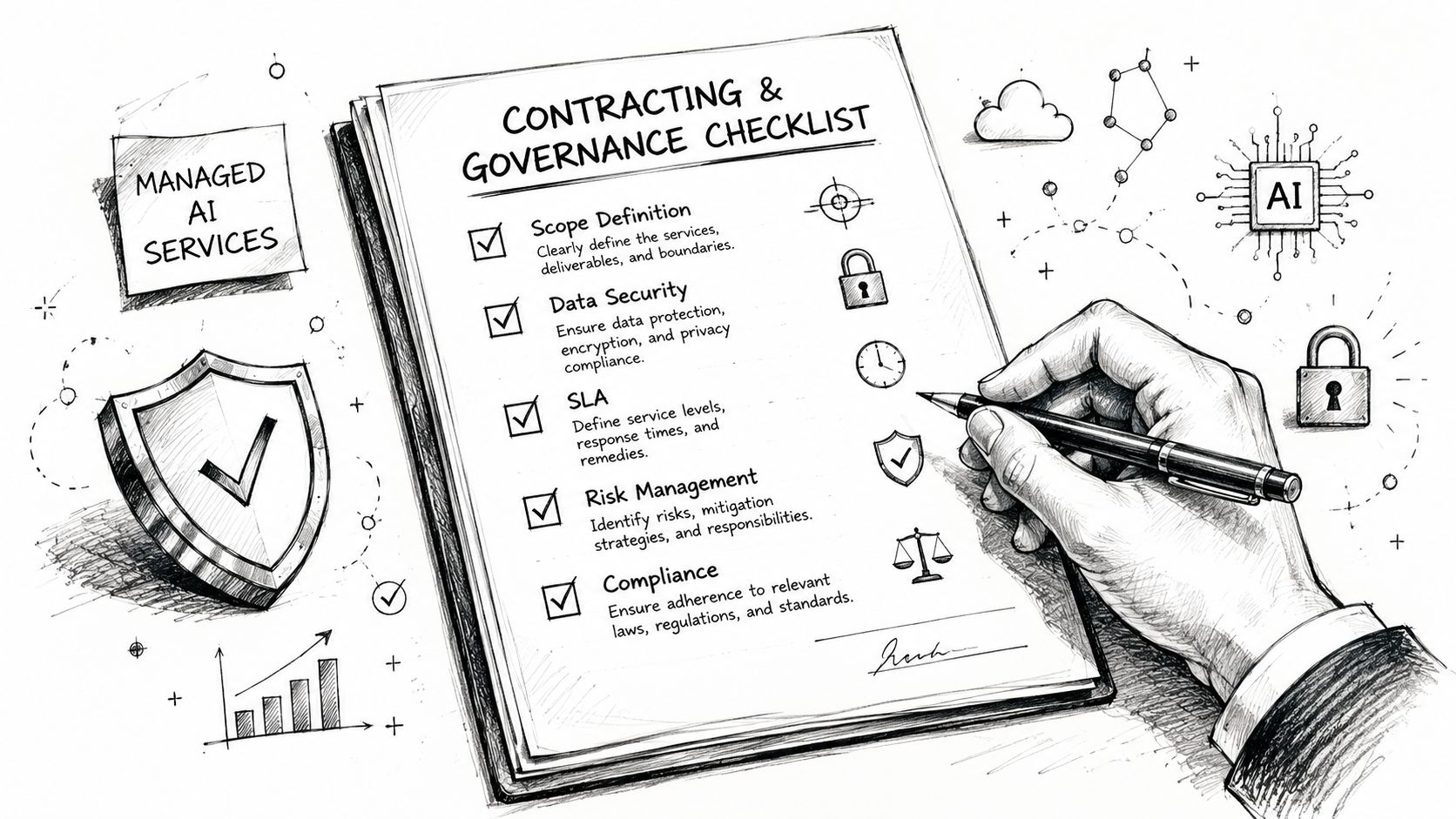
Non-negotiable clauses
According to Digeniotech's AI vendor management playbook, effective governance requires model version stability, such as pinning to a specific version for 12 months, minimum accuracy thresholds for specific tasks, and audit rights to verify compliance and model behavior.
Put these in every agreement:
- Version stability: lock the model version or define exactly when changes are allowed.
- Task-specific quality thresholds: don't accept vague “best efforts” language.
- Audit rights: preserve your right to inspect data handling, controls, and behavior.
- Material change triggers: require notice and re-testing after meaningful updates.
- Rollback obligations: if quality regresses, the provider needs a defined fallback path.
- Incident reporting: require documented reporting for failures that affect quality, privacy, security, or operations.
Governance isn't optional in regulated work
If your AI system touches regulated workflows, involve counsel early. This RNC Group AI law analysis is worth reviewing because it highlights how fast the legal environment is shifting and why governance language can't be an afterthought.
You should also maintain your own internal policy. A practical starting point is this guide to AI governance best practices.
Contracts don't create trust. They create accountability when trust gets tested.
Copy this checklist into your doc
- Scope of responsibility
- Service levels and incident response
- Model version policy
- Task-level acceptance metrics
- Logging and auditability
- Data handling obligations
- Re-testing triggers
- Rollback rights
- Remediation timeline
- Termination rights if benchmarks fail
Your Next Steps to Get Started
If you're making this decision in the next week, keep it simple.
Step one, pick one use case
Choose a single AI feature with obvious business value and manageable blast radius. A support copilot, internal search assistant, or model monitoring function is usually a better first candidate than an all-in platform rewrite.
Write down five things before you talk to vendors:
- User workflow
- Data involved
- What good output looks like
- What failure looks like
- What your team must keep as core IP
Step two, decide your boundary
Use one sentence to define the split.
For example: “We own product logic, prompts, evaluation, and customer policy. The partner owns infrastructure operations, monitoring, incident response, and deployment controls.”
That sentence prevents half the confusion that usually shows up later.
Step three, run a small pilot
Shortlist a few partners, use the vetting checklist above, and insist on a pilot with explicit pass/fail criteria. Don't start with a broad transformation pitch. Start with one production-shaped problem, one benchmark set, and one governance path.
If the pilot works, expand the scope carefully. If it doesn't, you'll know before your customers do.
The bigger strategic point is this. Managed AI services are a tactical accelerator, not a substitute for owning your product intelligence. Use them to move faster where operations are heavy. Build your long-term moat around the workflows, data assets, and evaluation discipline only your company can own.
If you need to ship an AI feature fast but still want to retain core product IP, ThirstySprout can help you structure the right team model. Start a Pilot if you want senior AI engineers, MLOps talent, or a fractional technical lead to define the boundary between managed services and your in-house core. Or See Sample Profiles if you're ready to build the long-term team behind your AI roadmap.
Hire from the Top 1% Talent Network
Ready to accelerate your hiring or scale your company with our top-tier technical talent? Let's chat.