

A lot of AI projects stall before they start because the team picks the wrong first artifact.
A founder asks for an AI copilot. Engineering starts wiring model calls and retrieval. Product wants polished flows. Design wants user interviews. Three weeks later, nobody agrees on whether the project is proving feasibility or testing usability. That confusion is expensive.
The difference between proof of concept and prototype matters most when you're deciding where to spend scarce time from ML engineers, product leads, and designers. In AI work, that choice is sharper because the technical unknowns are often real. Model quality, latency, orchestration, data access, and compliance can kill an idea early. So can a confusing UX that makes users mistrust the system.
TLDR What You Need to Know
Teams waste time here by trying to answer feasibility, usability, and stakeholder buy-in with one artifact. In AI projects, that usually burns the wrong people first. ML engineers get pulled into UI debates, or product and design start polishing a flow before anyone knows whether the model can produce reliable output.
A proof of concept and a prototype solve different problems.
- A proof of concept (POC) answers “Can this work under our real technical constraints?” In AI, that usually means model quality, retrieval accuracy, latency, evaluation criteria, data access, guardrails, or integration with existing systems.
- A prototype answers “Will users understand it, trust it, and use it the way we expect?” In AI, that usually means interaction design, workflow fit, confidence signals, edit and approval patterns, and how people respond to imperfect output.
- Choose a POC when the main risk sits in the stack. Staff it with an ML engineer, a data or platform engineer if data access is messy, and a technical lead who can define a pass or fail threshold.
- Choose a prototype when the main risk sits in adoption. Staff it with a product manager, UX designer, frontend engineer, and an AI lead who can keep the concept grounded in what the model can do.
My rule is simple. If the argument is about prompts, evals, latency, orchestration, or source data, run a POC first. If the argument is about user trust, handoff points, approval flow, or where AI belongs in the product, build a prototype.
| Dimension | Proof of Concept | Prototype |
|---|---|---|
| Primary question | Can it work in our environment? | Will people understand and use it? |
| Main risk reduced | Technical failure | Adoption and workflow failure |
| Typical audience | Engineering, data, security, technical leadership | Product, design, business stakeholders, pilot users |
| Deliverable | Focused experiment with success criteria | Clickable or coded experience for feedback |
| Best fit in AI | Model, data, latency, integration uncertainty | UX, trust, explainability, workflow uncertainty |
| Typical staffing | ML engineer, data/platform support, tech lead | AI PM, UX designer, frontend engineer, AI lead |
Who This Guide Is For
You're probably dealing with an AI request that sounds simple in a meeting and messy the moment the team starts scoping it.
A CTO gets asked to “add AI search.” A product lead wants an internal copilot for account managers. A founder wants customer support automation but isn't sure whether the company's knowledge base is usable enough for retrieval-augmented generation. Everyone wants progress fast. Nobody wants to fund a long build that falls apart in review.
That's who this is for.
- CTOs and heads of engineering who need to decide whether to spend the next sprint on technical validation or product exploration
- Founders and product leaders who need a clear artifact to show stakeholders without overcommitting budget
- AI and data leaders who know that model feasibility and user acceptance are separate risks
- Talent and procurement teams who need to staff the right specialists for the current stage, not the eventual roadmap
Most failed early AI initiatives don't fail because the idea was bad. They fail because the team tried to answer every question with one artifact.
If you need to justify team shape, timeline, and what “done” means for the next few weeks, this is the practical split to use.
Your Quick Decision Framework
The cleanest way to choose between a POC and a prototype is to identify the single biggest risk in front of you.
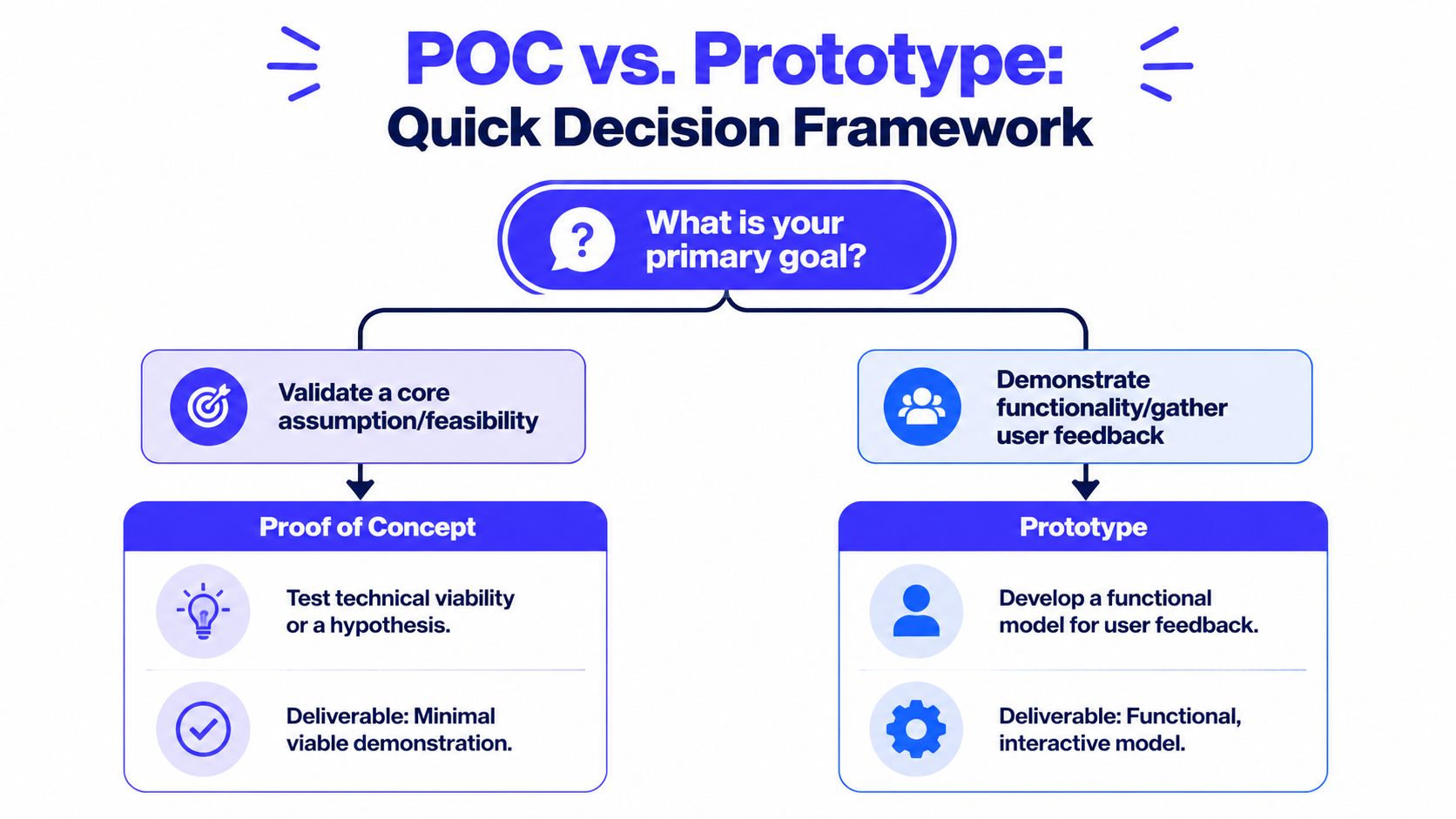
Start with the risk, not the artifact
Ask one question first.
What must be proven before you can responsibly spend more money?
If the answer sounds like any of these, you want a POC:
- Model fit risk. Can the model complete the task at an acceptable quality level?
- Integration risk. Can the LLM, vector store, data source, or orchestration layer work inside your current stack?
- Operational risk. Can your pipeline support the required throughput, latency, or handoff pattern?
- Data risk. Is your source data structured well enough to support retrieval, classification, or summarization?
If the answer sounds like these, you want a prototype:
- Workflow risk. Do users understand where AI fits into the task?
- Trust risk. Do they know when to rely on the output and when to verify it?
- Interaction risk. Is the prompt, control surface, or review step intuitive?
- Positioning risk. Can stakeholders visualize the feature clearly enough to approve the next step?
A useful product planning companion is this guide on product development strategy, especially when you're deciding what to validate first and what to defer.
Use the shortest path to certainty
According to Coherent Solutions' breakdown of validation stages, a POC is designed to reduce technical risks within the development process, whereas a prototype is built to reduce the risk of user dissatisfaction with the final product. A POC confirms if the concept can be built; a prototype shows what a functional product will look like for evaluation.
That distinction should change who you assign.
- A POC usually needs a senior ML engineer, AI engineer, data engineer, or solution architect.
- A prototype often needs an AI product manager, UX designer, and sometimes a front-end engineer to make interactions realistic enough for feedback.
Working rule: If nobody outside the technical team needs to touch it yet, a POC is often enough.
When the core question is about interaction design, it helps to review how product teams frame clickable flows and early interface tests. This Webtwizz founder's guide is a solid reference for that decision.
A short explainer can also help align non-technical stakeholders before the work starts.
The five minute decision tree
Name the unknown
Write one sentence that starts with either “We don't know if we can…” or “We don't know if users will…”.Check the audience
If the artifact is mainly for engineers and internal decision-makers, lean POC. If you need reactions from users, prospects, or non-technical stakeholders, lean prototype.Define the success signal
Technical success points toward POC. Behavioral or usability feedback points toward prototype.Strip out everything else
Don't test architecture, UX, pricing, and onboarding all at once. Pick the first blocker only.
Practical Examples in AI Projects
A lot of AI teams lose time here. They build a polished demo to answer a feasibility question, or they run a technical experiment when the actual risk is user adoption. In AI projects, that mistake is expensive because the people you need for each path are different.
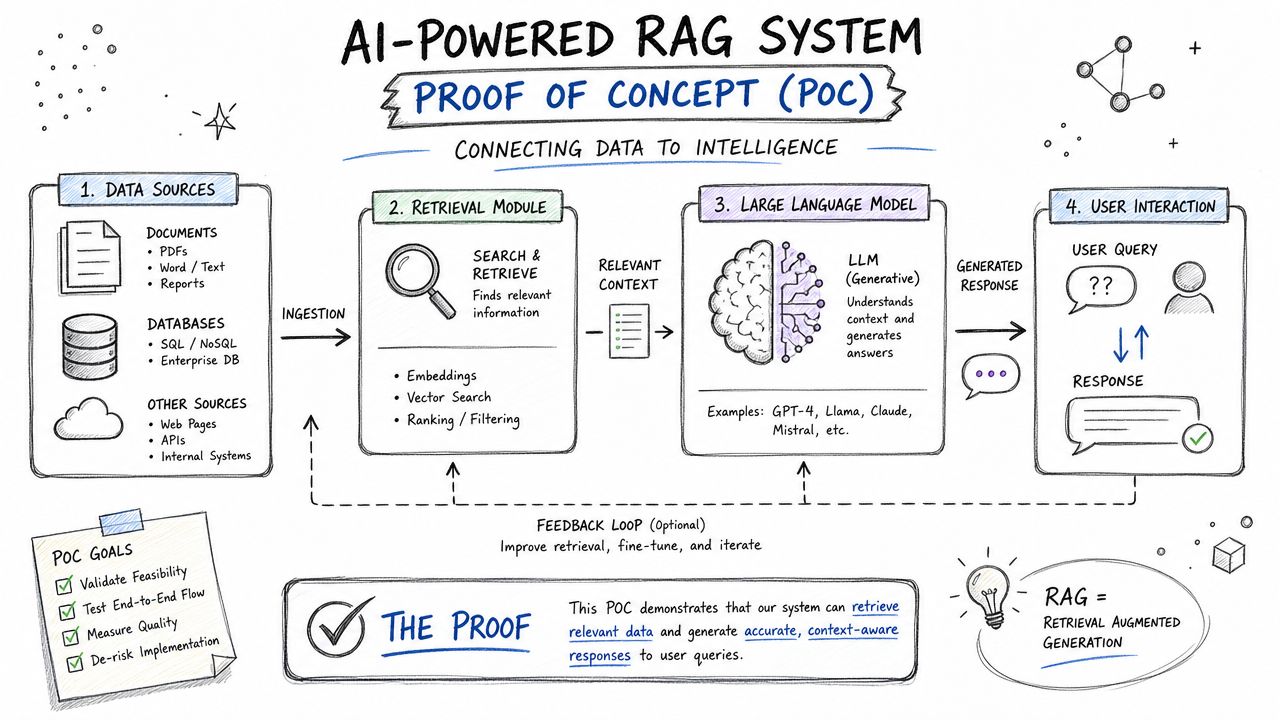
Example one, a RAG support assistant POC
A B2B software company wants an AI support assistant trained on its help center, ticket history, and product docs. The executive question sounds simple: can we answer support questions automatically with acceptable accuracy and risk?
That is a feasibility problem, so the team starts with a POC. The hard questions sit in the data and model behavior, not in the interface. Are the documents current? Do the tickets contain contradictory advice? Can retrieval find the right source under messy, real phrasing? Will the model cite the source correctly or invent a confident answer when context is weak?
A good POC for this case stays narrow.
POC scope
- Document ingestion test using a sample of real support content
- Retrieval test against representative support questions
- Prompt and orchestration check to see whether answers use the right source material
- Failure mode review for refusal, escalation, and follow-up behavior
Team
- One senior ML engineer
- One part-time data engineer if source systems are inconsistent
- One product lead to define acceptance criteria with support leadership
In practice, this team often learns more from bad results than good ones. If retrieval fails because articles use inconsistent product names, that is useful. If the model answers well only when prompts are carefully staged, that is useful too. The point is to find out whether the company has a credible path before it commits design, frontend work, security review, and stakeholder rollout.
What they do not build
- No polished support widget
- No chat history experience
- No end-user authentication flow
- No branded UI
Success here means one of two outcomes. The team proves the technical path is good enough to fund the next phase, or it finds a blocker early enough to avoid a larger mistake.
Example two, an AI copilot prototype
A SaaS company wants to add an AI copilot for account managers inside its product. The model can probably generate summaries and draft follow-ups. The bigger risk is whether account managers will trust it, notice it at the right moment, and stay in control.
That calls for a prototype.
The team maps a few high-value moments: drafting a follow-up email, summarizing account activity, and suggesting next steps before a renewal call. Then it creates an interactive prototype with simulated outputs. No live model calls. No production data pipeline. The work is about workflow fit, trust signals, and approval controls.
A practical reference for this stage is this guide to high-fidelity wireframes for realistic product interaction testing, especially when the team needs credible user feedback before committing engineers to build the full flow.
Prototype scope
- Entry point into the copilot
- Prompting or action selection UI
- Output review and editing flow
- Human approval before send or save
- Error and uncertainty states
Team
- AI product manager
- UX designer
- Front-end engineer if clickable realism matters for testing
- Customer-facing lead to recruit interview participants
This team is answering different questions from the RAG POC team. Do users want the assistant inline or in a side panel? Do they need citations, confidence cues, or editable drafts? Should the AI suggest actions automatically, or wait for an explicit request? Those answers shape adoption more than model quality does.
A simple staffing scorecard
| Situation | Start with | Core roles |
|---|---|---|
| Unclear model behavior | POC | ML engineer, AI engineer |
| Unclear data readiness | POC | Data engineer, ML engineer |
| Unclear user trust | Prototype | AI PM, UX designer |
| Unclear workflow adoption | Prototype | UX designer, product lead |
Deep Dive Comparison Across Business Dimensions
Generic comparisons miss the part that matters. A CTO doesn't just need definitions. You need to know what each choice means for staffing, timeline pressure, and business risk.
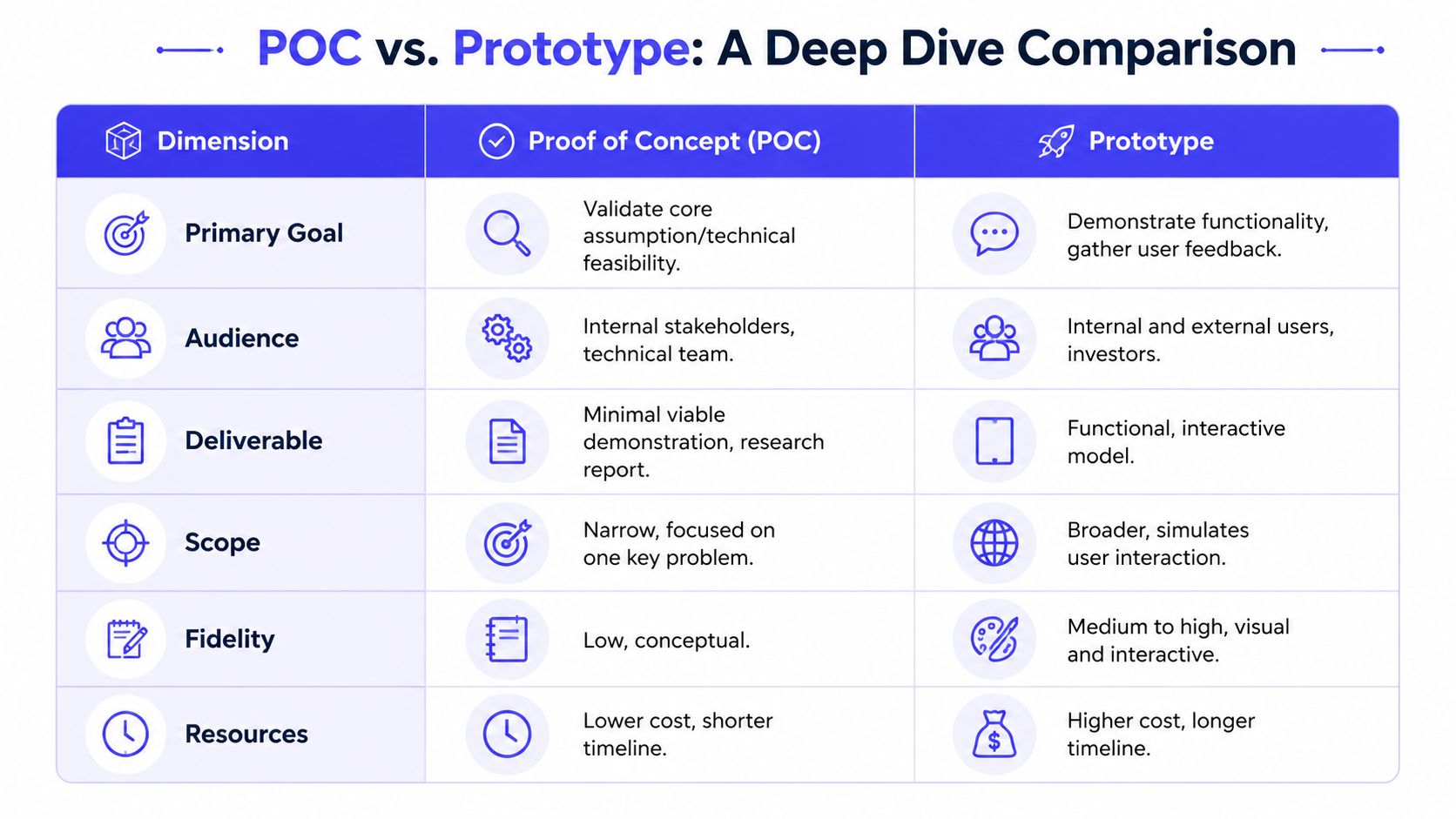
The side by side view
Svitla's guide to PoC, prototype, and MVP describes a Proof of Concept as a days-to-week exercise to answer “Can we build it?” by de-risking technical feasibility, while a prototype is a 2–4 week preliminary version to answer “How will it look and feel?” by validating UI and UX design concepts. It also notes that the POC validates the technical premise before the prototype visualizes the product for stakeholders.
That sequencing is especially useful in AI projects because technical feasibility and usable interaction often fail for different reasons.
| Business dimension | Proof of Concept | Prototype |
|---|---|---|
| Main decision | Is the technical path credible? | Is the product interaction credible? |
| Best audience | Engineering leaders, architects, data owners | Users, product leaders, investors, internal stakeholders |
| Output | Experiment, demo, or narrow validation artifact | Clickable flow, mock interface, interactive model |
| Fidelity | Low visual fidelity is fine | Medium to high interaction fidelity matters |
| Scope | Narrow and hypothesis-driven | Broader journey across key user moments |
| Team shape | Senior technical specialists | Product, design, and sometimes front-end |
| AI examples | RAG retrieval, model classification, tool calling | Copilot UX, review workflow, trust cues |
| Bad use case | Selling the vision to non-technical stakeholders | Proving deep infrastructure feasibility |
What works and what doesn't
What works for a POC
- Isolating one technical assumption
- Using representative data, even if the interface is ugly
- Letting a senior engineer move fast with few dependencies
- Defining clear kill criteria before anyone starts coding
What fails in a POC
- Trying to make it look production-ready
- Adding stakeholder-friendly polish before proving the hard part
- Turning a technical experiment into a stealth MVP
- Assigning junior staff to a problem that needs judgment under uncertainty
If the only thing your POC proves is that a demo can be stitched together, you still don't know whether the system is viable.
What works for a prototype
- Simulating AI output when the question is user behavior
- Testing review, edit, approval, and fallback moments
- Putting rough concepts in front of real target users early
- Iterating quickly on wording, controls, and interaction order
What fails in a prototype
- Wiring real model calls too early
- Asking users broad opinion questions instead of observing task completion
- Overdesigning screens before validating the workflow
- Skipping edge cases like uncertainty, refusal, and correction
Team and hiring implications in AI
AI projects differ from ordinary feature work.
For a POC, one strong senior engineer can often outperform a larger mixed team. You need someone who can evaluate model behavior, data constraints, integration trade-offs, and failure modes without requiring heavy process. In practice, that often means an ML engineer, AI engineer, or solutions architect.
For a prototype, technical depth matters less than product sense. The critical hires are usually:
- AI product manager to define the task, user promise, and feedback loop
- UX designer to model trust, explainability, and handoff moments
- Front-end engineer when stakeholders need more realism than a design tool can provide
If your team struggles with interaction quality, Uxia's guide to prototyping is a useful reference for turning rough ideas into testable product flows.
A practical interview question for staffing
When hiring for a POC lead, ask:
“Tell me about a time you killed an AI idea early because the technical premise didn't hold. What did you test first, and what evidence changed the decision?”
When hiring for a prototype lead, ask:
“How do you test trust in an AI workflow before the underlying model is production-ready?”
Those questions surface the difference between people who build artifacts and people who reduce risk.
Checklist Scoping Your Initiative
What's often needed isn't a longer debate. It's a one-page scoping brief.
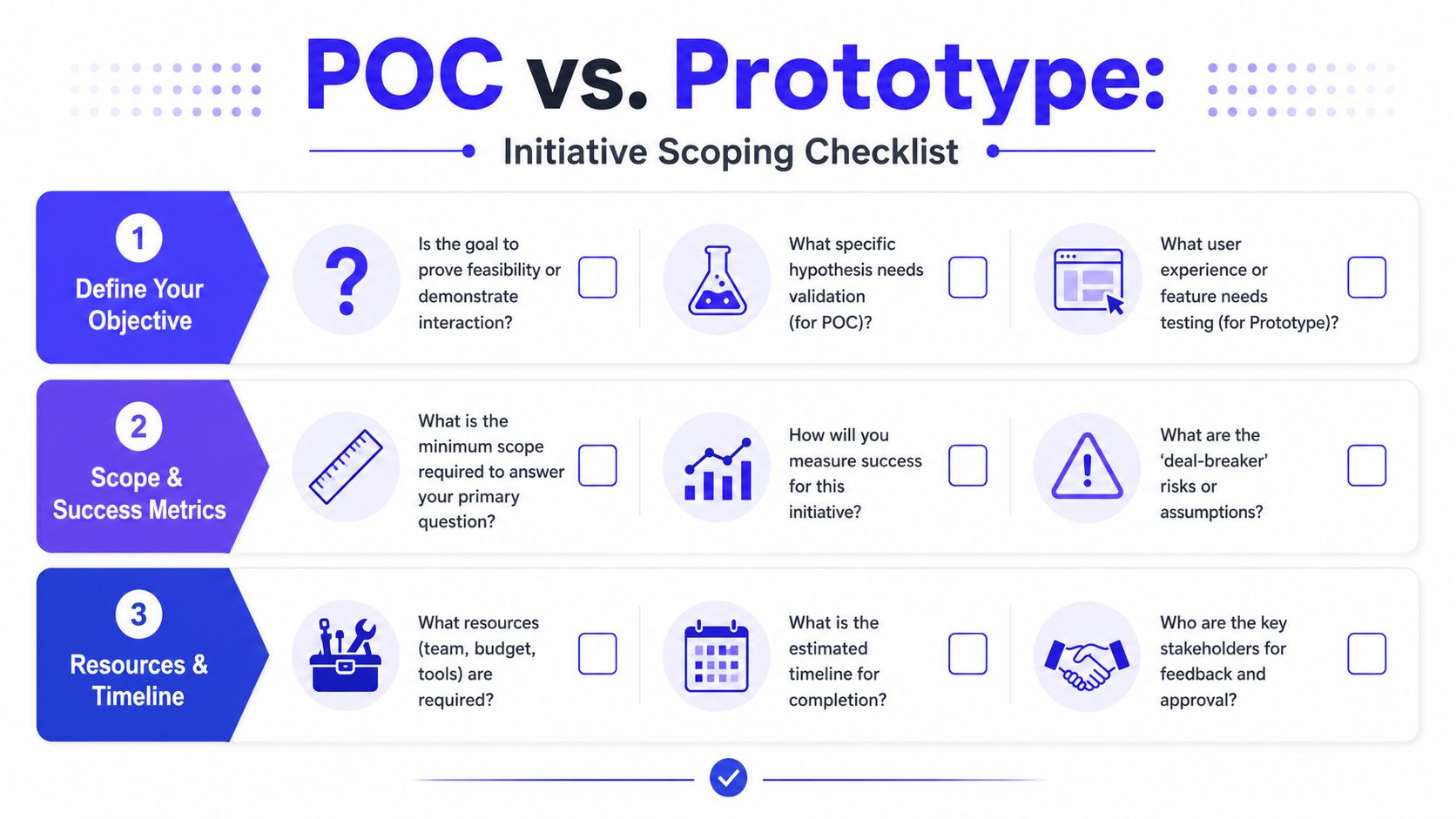
Use this checklist before assigning the team
Copy this into Notion, a kickoff doc, or your sprint planning template.
Primary question
Write one sentence. If it starts with “Can we build,” you're probably scoping a POC. If it starts with “Will users understand or adopt,” you're probably scoping a prototype.Primary risk
Name the biggest risk as either technical or user-facing. Don't list five. Pick one.Decision owner
Identify who will decide go, no-go, or revise after the artifact is complete.Audience
State whether the output is for engineers only, leadership review, or external users and stakeholders.
Define success before anyone starts
Success criteria
For a POC, use technical pass-fail criteria. For a prototype, use observable feedback criteria tied to task flow and comprehension.Deal breakers
List the conditions that would stop the initiative. This prevents teams from “finding a way to continue” after weak evidence.Minimum scope
Cut anything that doesn't answer the primary question. If it doesn't help the decision, remove it.
Scoping advice: The smaller artifact usually produces the better decision, as long as it targets the real uncertainty.
Resource planning template
- Core roles needed
Name the minimum team, not the eventual delivery team. - Tools
For POCs, that may be notebooks, scripts, APIs, and test datasets. For prototypes, it may be Figma and a lightweight testing setup. - Timeline
Use the shortest realistic window that still lets the team evaluate the right evidence. - Review ritual
Decide in advance how results will be presented and who must attend.
If you want a structured starting point for the technical side, this actionable proof of concept template is helpful for shaping the hypothesis, scope, and acceptance criteria.
What To Do Next
If your AI initiative feels fuzzy, don't ask the team to “just start building.” Force the first decision.
Use this sequence instead.
Step one, write the real question
Open a blank doc and write one sentence:
- We don't know if we can ______.
- We don't know if users will ______.
That sentence determines the artifact. It also prevents the team from mixing technical validation and UX exploration into one confused sprint.
Step two, scope the smallest useful artifact
If the uncertainty is technical, scope a narrow POC with one clear hypothesis and one owner. If the uncertainty is user-facing, scope a prototype around the highest-risk flow.
If you need outside support shaping the plan, this resource on product development consulting services can help frame the initiative before you commit larger engineering capacity.
Step three, staff for the current risk
Don't staff a prototype like a platform project. Don't staff a POC like a product launch.
For AI work, this matters a lot:
- POC staffing should prioritize senior technical judgment.
- Prototype staffing should prioritize product thinking, UX clarity, and user feedback quality.
The wrong mix creates the wrong artifact. You end up with an impressive demo that proves nothing, or a technically valid backend nobody wants to use.
The difference between proof of concept and prototype isn't academic. It's how you decide whether your next AI feature needs an ML engineer first, or an AI PM and designer first. Teams that get this right learn faster, spend less on avoidable rework, and make cleaner go or no-go decisions.
If you need to de-risk an AI feature without hiring a full team upfront, ThirstySprout can help you start a pilot with vetted AI engineers, ML specialists, AI product leaders, and designers who know how to scope the right first step. Start a Pilot, or see sample profiles to match the work to the right expertise.
Hire from the Top 1% Talent Network
Ready to accelerate your hiring or scale your company with our top-tier technical talent? Let's chat.