

You're probably making this call under pressure. One roadmap says “add AI.” Your customers want smarter search, better recommendations, or churn prediction. Finance approved one role first. The problem isn't comparing two job descriptions. It's deciding which failure will hit your team first in production.
That's why most data engineering vs ML engineering articles miss the point. They compare responsibilities. You need to protect uptime, margin, and product quality.
Target query: data engineering vs ML engineering
Meta description: Compare data engineering vs ML engineering by role, skills, KPIs, and salary. Use a practical framework to decide which hire your AI team needs first.
TL;DR
- Hire a data engineer first if your biggest risk is stale, broken, or poorly governed data.
- Hire an ML engineer first if your biggest risk is model quality, inference latency, drift, or serving cost.
- The cleanest split is simple: data engineers ship the data substrate; ML engineers ship the learned system that runs on top of it.
- The pay gap is real. 2026 U.S. summaries commonly place data engineers around roughly $126K base and about $150K total compensation, while ML engineers are often reported in the $160K to $197K range, with some 2026 summaries putting median total compensation near $262K and senior levels materially higher, according to StackTower's 2026 ML engineer salary summary.
- If both problems are showing up at once, start with a senior data engineer with MLOps literacy. That hire removes more blockers.
Who this is for
- CTOs and heads of engineering choosing the next AI or data hire
- Founders adding the first production ML feature
- product and platform leads trying to fix a shaky AI pipeline before it becomes an incident
What the Comparison Actually Decides
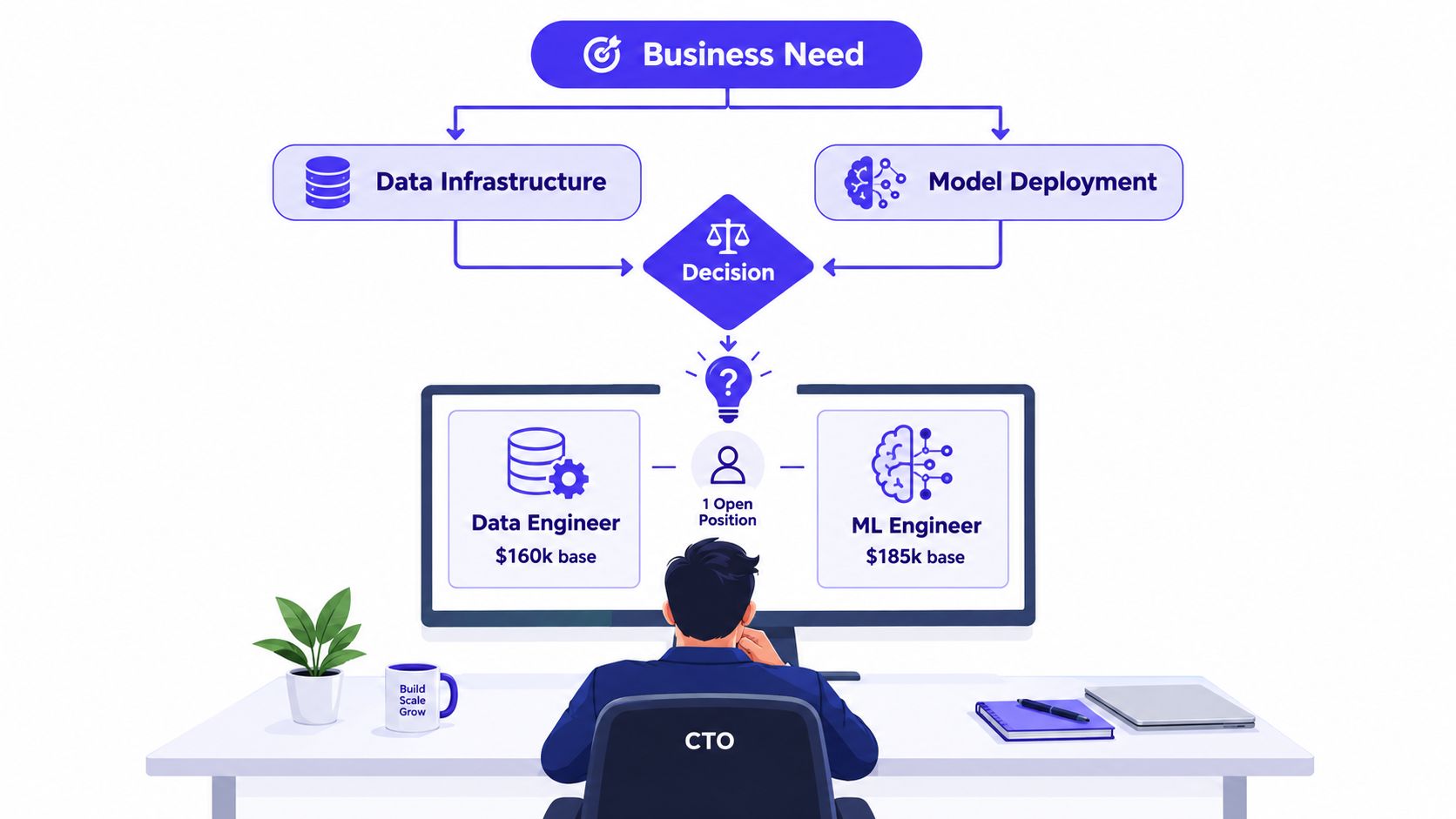
A CTO at a Series A SaaS company usually isn't asking an academic question. They're staring at one approved hire and one production roadmap. The choice is which failure is about to hurt the business.
The fastest way to decide
Use this rule. Ask which part of your production chain breaks first:
| Failure point | What breaks in practice | First role to hire |
|---|---|---|
| Data freshness | dashboards drift, feature values arrive late, training sets are unreliable | Data Engineer |
| Model quality | predictions are mediocre, experiments stall, accuracy degrades in production | ML Engineer |
| Serving cost and latency | inference gets slow or expensive, rollback risk rises, product margins get squeezed | ML Engineer |
That framing is more useful than a side by side responsibilities list because it maps directly to on call pain.
The three links in the chain
Data freshness comes first in more teams than they admit. If event ingestion is flaky, schemas change without warning, or warehouse models don't line up, every downstream use case gets weaker. Practical production metrics for data engineering include pipeline SLA, freshness, failure rate, cost per GB processed, domain coverage, and time to onboard a new source, as summarized by Kulturo's role comparison.
Model quality becomes the deciding factor once the data layer is mostly stable. ML engineering owns training, evaluation, deployment, and monitoring. The role exists because machine learning moved from research into production systems, and that need accelerated through the 2010s and after 2017, as noted in Axial Search's ML engineering jobs analysis.
Practical rule: Don't ask “Which role is more important?” Ask “Which incident are we more likely to get paged for next month?”
Serving cost is the under-discussed third failure. Many AI teams don't fail because the model is wrong. They fail because the model is too slow, too expensive, or too brittle to run under real traffic. Recent coverage also notes that the boundary between the roles is getting blurrier as pipelines absorb inference components and AI techniques automate parts of data work, which is why this 2025 analysis of AI-enabled pipelines is directionally useful.
The comparison isn't abstract. In data engineering vs ML engineering, you're deciding which weak link in the production AI chain needs ownership first.
Defining Each Role by What It Ships
Job descriptions are sloppy. Quarterly output is clearer.
What a data engineer ships
A data engineer ships dependable data products. That means tested pipelines, predictable schemas, and a warehouse or lakehouse that downstream teams can trust.
In practical terms, a strong senior data engineer might deliver:
- A modeled warehouse layer in dbt on BigQuery or Snowflake
- A scheduled orchestration flow in Airflow or Dagster with backfill support
- Data quality checks and contracts that prevent downstream breakage
- A schema change process that product and analytics teams can follow
The role split is consistent across comparisons: data engineers center on pipelines, infrastructure, and data quality, while ML engineers center on model training, evaluation, deployment, and serving infrastructure, as outlined in this role breakdown at DataDriven.
If you're screening candidates, their portfolio should show those shipped systems. Generic “worked on ETL” bullets are weak. A sharper benchmark is seeing how candidates describe ownership, tooling, and reliability trade-offs, which is why guides on keywords for 2026 data engineer resume are useful for building a hiring scorecard, even if you're the one doing the interviewing.
For teams building model-ready pipelines, ThirstySprout's view of AI data engineering is close to how modern hiring should frame the role: not just ETL, but retrieval context, feature readiness, lineage, and validation for AI systems.
What an ML engineer ships
An ML engineer ships a model system that survives production. Not a notebook. Not a benchmark screenshot. A working service or batch scorer with monitoring and rollback.
A senior ML engineer's quarter often ends with:
- A feature store module tied to training and serving
- A training pipeline on SageMaker or Vertex AI
- A serving endpoint behind an API
- Monitoring for drift, latency, and failures
- An experimentation path for A/B rollout and rollback
One useful lifecycle definition spells out that ML engineers own data preprocessing, feature engineering, model training, evaluation, deployment, and monitoring, not just algorithm work, in this ML lifecycle overview.
The boundary isn't “one works with data, one works with models.” Both work with pipelines. The difference is what they own in production.
Data engineers own the substrate. ML engineers own the learned artifact and the runtime around it.
Side by Side Skills, Stack, and KPIs
A churn model project makes the split obvious. The data engineer unblocks the feature layer and training data. The ML engineer turns that feature layer into a scorer the business can use.
Comparison table
| Dimension | Data Engineer | ML Engineer |
|---|---|---|
| Core skills | SQL, Python, distributed computing, data pipeline design, data modeling, warehousing | Python, statistical modeling, model evaluation, ML frameworks, feature-store architecture, MLOps |
| Primary stack | dbt, Airflow, Dagster, Spark, Beam, BigQuery, Snowflake | PyTorch, TensorFlow, scikit-learn, XGBoost, SageMaker, Vertex AI, BentoML, Triton |
| Shipped deliverables | ingestion pipelines, warehouse models, contracts, quality checks, source onboarding | training pipelines, features, model endpoints, deployment workflows, monitoring and rollback |
| Measured KPIs | pipeline SLA, freshness, failure rate, cost per GB processed, domain coverage, source onboarding time | inference latency, throughput, drift, rollback rate, A/B results, serving error rate |
Why the skills diverge
For hiring scorecards, this is one of the cleanest distinctions. One comparison maps data engineering to depth in SQL, distributed computing, data pipeline design, and data modeling or warehousing, while ML engineering leans into PyTorch or TensorFlow, model evaluation, feature-store architecture, MLOps, and statistical modeling, according to Interview Kickstart's role comparison.
If you're defining the ML side more tightly, this ThirstySprout overview of what a machine learning engineer does is a useful internal reference point for interview loops and role scoping.
The KPI split matters more than the tool list
Most hiring mistakes happen because teams compare tools, not success metrics.
For data engineering, the useful operational metrics are the ones tied to throughput and reliability. You care about whether the organization can ingest, validate, and expose usable data on time. If freshness and failure rate are trending badly, a model hire won't save you.
For ML engineering, the core metrics shift toward online behavior. Benchmark guidance for feature-store-backed ML systems emphasizes p50, p95, and p99 latency, requests per second, and error rate for online serving, while offline feature generation is assessed with job completion time, GB per hour processed, and resource utilization. The same benchmark source also reports large performance gaps between serving setups, including one independent comparison where Hopsworks averaged 83.95% faster than SageMaker, 94.7% faster than Vertex, and 92.7% faster than another major cloud alternative in a reading benchmark, plus another benchmark summary where Redis Enterprise was 3x faster and 14x less expensive than DynamoDB for high-throughput use cases, according to the feature store benchmark study.
If two roles are measured by different failure metrics, they aren't interchangeable hires.
How Data and ML Engineering Collaborate
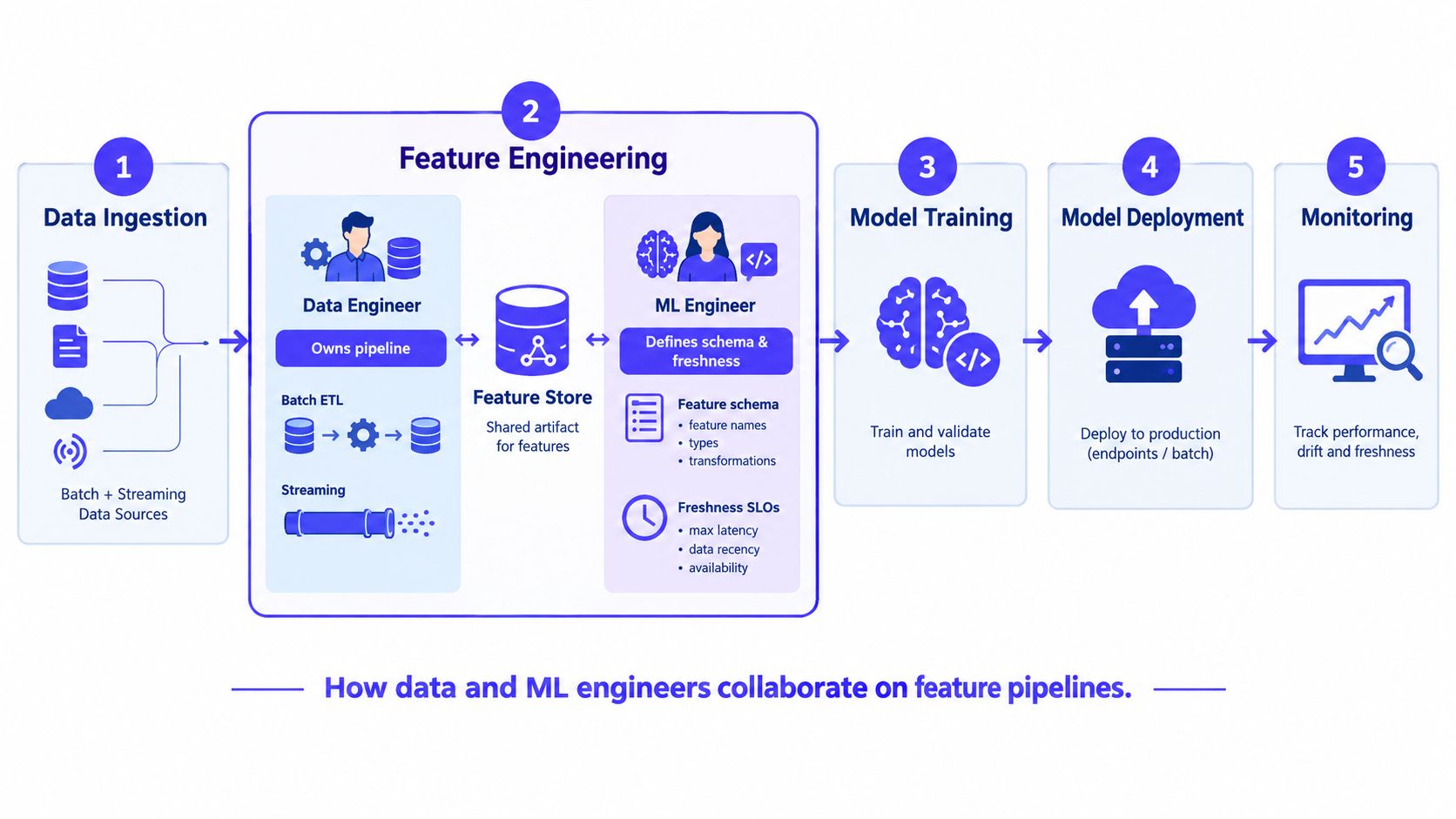
The handoff between these roles shouldn't feel like a ticket queue. It should feel like a shared production contract.
Where they touch the same system
A recommendation feature is a clean example.
The data engineer builds clickstream ingestion, sessionized events, user and item feature tables, and a low-latency path into a feature store. The ML engineer defines which features matter, trains a retrieval model, validates offline ranking behavior, and deploys inference behind a service.
They usually share ownership across five stages:
Feature pipeline design
Data engineering owns the batch and streaming movement. ML engineering defines feature schema and freshness requirements.Training data versioning
Data engineering maintains source tables and lineage. ML engineering registers datasets, labels, and reproducible training inputs.Model training
ML engineering owns the training loop and evaluation. Data engineering often helps with distributed I/O and data access patterns.Deployment
Data engineering may expose feature endpoints or serving data paths. ML engineering packages the model and chooses serving topology.Monitoring
Data engineering watches lineage and freshness. ML engineering tracks drift, latency, and rollback behavior.
This explainer is a good companion if you want a visual walkthrough of how the workflow fits together:
The friction points to expect
Three arguments come up constantly:
- Schema drift between training and serving
- Late-arriving labels that break evaluation windows
- Unclear rollback ownership when model output goes bad
Those aren't edge cases. They're the normal seams between the roles.
The healthiest teams don't separate data and ML work into silos. They define shared service levels for feature correctness, freshness, and serving behavior.
That's also why the line between the roles has moved. Pipelines increasingly include inference steps such as embeddings and classification, while AI techniques are also being used to automate cleaning and optimization. In practice, modern teams need reliability on both sides of the boundary.
Two Real Hiring Scenarios
You don't need another generic “it depends.” You need pattern recognition.
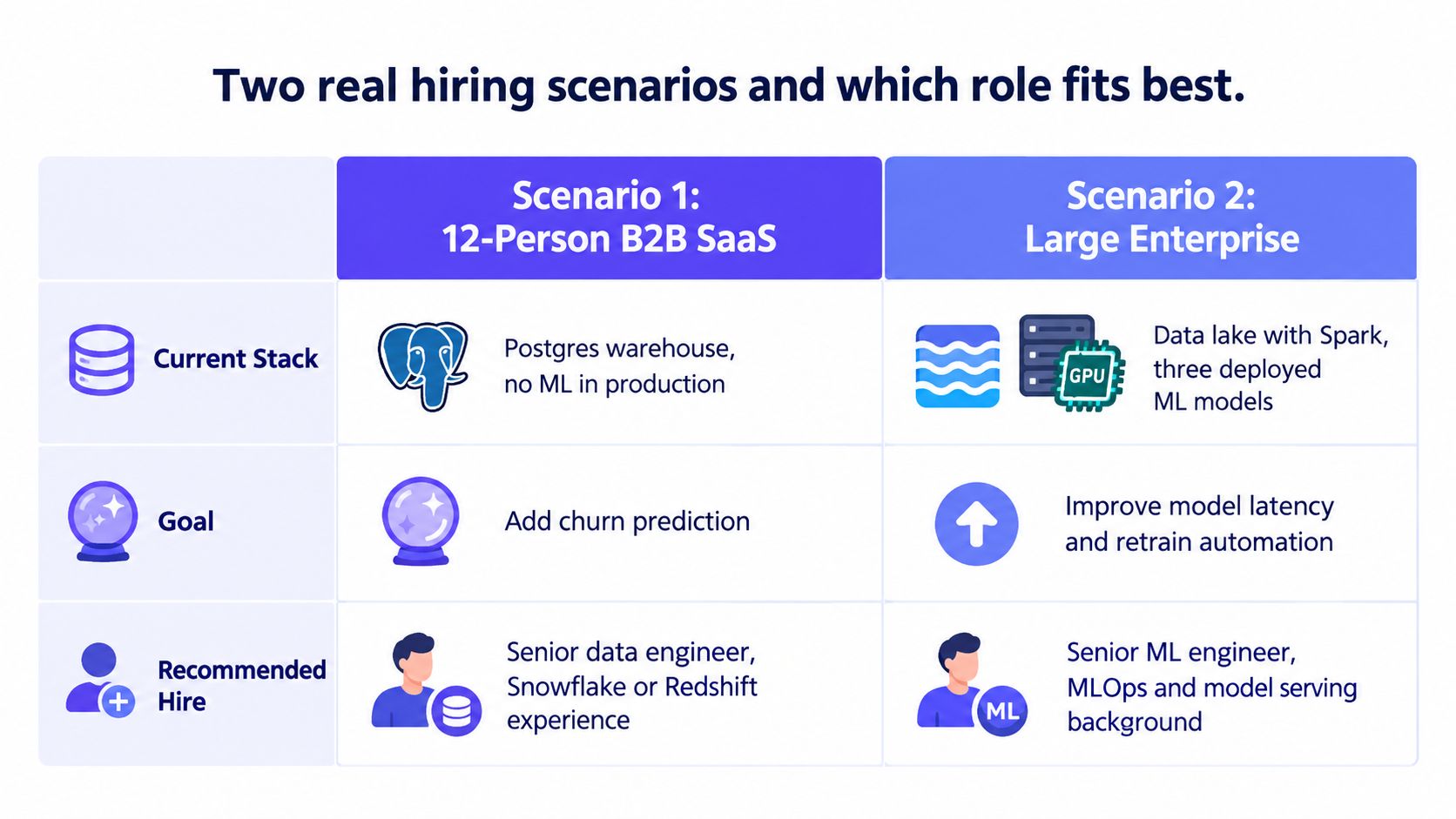
Scenario one
A 12-person B2B SaaS team has Postgres, a rough warehouse, and no ML in production. The CTO wants churn prediction.
Hire a senior data engineer first.
Why? Because the model isn't the bottleneck. The bottleneck is whether the company can produce a trustworthy feature layer from product events, billing history, support signals, and account metadata. Without that substrate, a churn model becomes a demo.
A strong first 90 days here usually look like:
- Unified event modeling across core product actions
- Warehouse cleanup in BigQuery or Snowflake
- Reliable orchestration in Airflow or Prefect
- A feature layer prototype in Feast or a warehouse-native pattern
- Training-ready datasets that won't change shape midstream
The business outcome is simple. The company becomes able to test churn models, not just talk about them.
Scenario two
A Series B marketplace already runs Airflow, dbt, and a feature store. The problem is that recommendations are slow, online results drift, and experimentation confidence is dropping.
Hire an ML engineer.
This team has already paid the data foundation tax. The pain is now online inference behavior and production model performance.
The right hire usually brings:
- PyTorch or TensorFlow depth
- hands-on experience with retrieval or ranking systems
- deployment familiarity with Triton, Ray Serve, or BentoML
- judgment on shadow deployment, rollback, and monitoring
A realistic 90-day target here is a cleaner retrieval stack, tighter serving behavior, and a monitoring loop that catches model regressions before they become product complaints.
The hiring lesson
The first scenario fails on data readiness. The second fails on model operations.
That's the whole point of this comparison. Data engineering vs ML engineering isn't solved by seniority labels or title inflation. It's solved by identifying the production constraint.
Compensation and the Hidden Scarcity
Compensation follows the failure point.
If a company is losing on data freshness, broken pipelines, or schema drift, the market does not force it to pay top-of-band ML rates first. If the company is losing on model quality in production, online latency, or inference cost, it usually does. That is the cleanest way to read pay differences between data engineering and ML engineering.
What compensation is actually signaling
Salary bands are not just about title prestige. They reflect how rare it is to find someone who can improve the specific part of the AI system that is currently failing.
Data engineers are easier to benchmark because the role is more standardized. Warehouses, orchestration, transformation, and data quality have settled patterns. ML engineering is pricier because the role sits at a messier intersection of software engineering, applied modeling, deployment, evaluation, and runtime economics. Teams pay more when they need one person to handle that whole chain.
InterviewStack's 2026 comparison summarizes a consistent U.S. base-pay premium for ML engineers over data engineers across multiple salary aggregators. That premium gets larger on teams shipping recommendation systems, LLM features, or high-throughput inference.
Comparison table
| Hiring context | Data Engineer pay signal | ML Engineer pay signal | What the premium usually means |
|---|---|---|---|
| Stable analytics and data platform work | More predictable market pricing | Higher than DE without necessarily returning more value | Do not pay ML rates for a warehouse problem |
| Production models with online serving | Often lower than ML comp in the same market | Clear premium across salary summaries | You are paying for deployment, monitoring, and iteration speed |
| Senior hires | Competitive, but usually less inflated | Premium widens materially at senior levels | Scarcity is strongest for people who have already handled production incidents |
| Top tech markets | Strong, but less spiky | Can rise sharply with total compensation | The market pays extra for people who can control serving quality and cost |
Why the scarcity is real
The expensive hire is not the person who can train a model notebook. The expensive hire is the person who can stop a production AI feature from degrading margins or user trust.
That shortage is real because very few candidates are strong across model behavior, software reliability, and cost control at the same time. A data engineer can be excellent without touching inference systems. An ML engineer hired for production work usually cannot afford that kind of specialization gap.
This is also why many teams mis-hire. They see an AI roadmap, pay the ML premium, and then discover the first system failure is stale data or inconsistent event definitions. In that case, the company bought the wrong scarcity.
For leadership teams trying to avoid a bad full-time hire, it's often smarter to think in terms of operating model first. If you're weighing a principal hire against interim technical oversight, this guide on paying for fractional leadership outcomes is a useful frame.
You can also benchmark role economics against AI engineering salary expectations when planning total team cost rather than a single title.
Hiring filter: Pay the ML premium when model quality in production, serving latency, or inference cost is the constraint. If the first failure is data freshness or pipeline reliability, hire data engineering first.
Which Role to Hire First
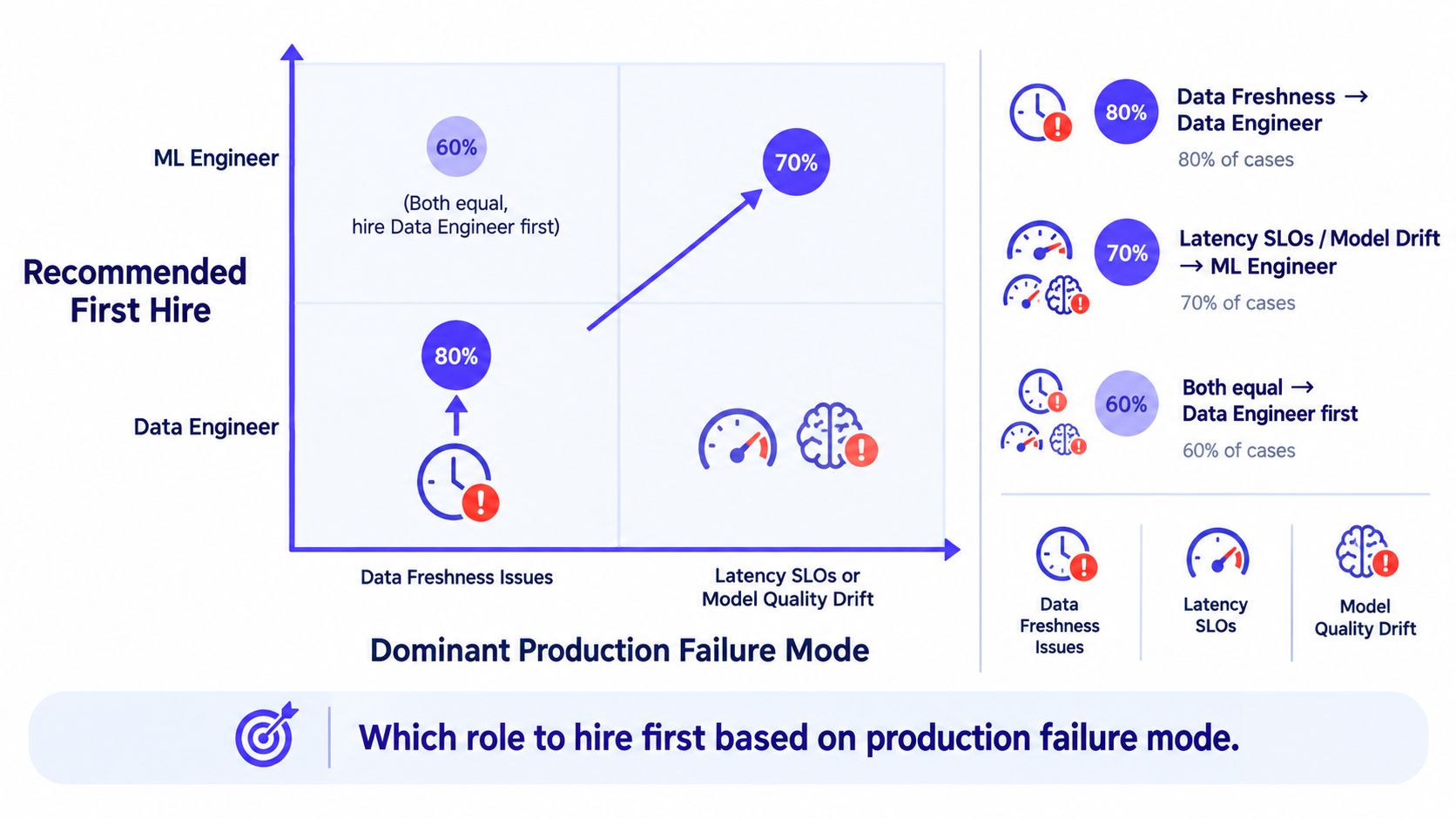
A team can answer this in 15 minutes if they stop arguing about titles and look at incidents.
Four rules that work
Broken foundation means data engineer first.
If your warehouse can't answer basic business questions consistently, your AI feature won't become more trustworthy than your source data. This is the common early-stage SaaS case.
Latency or serving cost pressure means ML engineer first.
If the model already exists but online performance is weak, the next dollar belongs on inference, deployment, and monitoring. This is common in marketplaces and product-led AI apps.
LLM features and computer vision usually lean ML engineer.
If the feature itself is model-centric, the burden shifts toward prompt or model orchestration, evaluation, latency control, and production runtime behavior. The exception is when retrieval or upstream data quality is obviously broken.
Analytics-only companies usually need data engineering longer.
If your primary output is dashboards, self-serve analytics, and reporting reliability, data engineering stays the higher-value path.
Persona-based recommendations
Early-stage SaaS CTO
If customer events are inconsistent and feature definitions keep changing, hire a data engineer.Marketplace founder
If ranking or recommendation speed affects conversion, hire an ML engineer.Fintech product lead
If governance, lineage, and reproducible data matter more than model novelty, hire a data engineer.Internal AI platform lead
If teams already have data products but need deployment standards and runtime safeguards, hire an ML engineer.
The anti-patterns
One mistake shows up constantly. Teams hire an ML engineer before the warehouse is stable enough to support repeatable training and evaluation.
The opposite mistake is quieter but just as damaging. Teams keep polishing pipelines while production models drift, latency rises, and no one owns rollback.
If both signals are firing, my recommendation is simple: hire a senior data engineer with MLOps literacy first. That person stabilizes the broader system and gives the eventual ML engineer a platform instead of a cleanup job.
Pre-Hire Checklist and Next Step
You can run this diagnostic in a week. It's enough to stop guessing.
One-week hiring diagnostic
Check pipeline freshness
Review your current SLA or de facto expectation for core tables and feature inputs. If freshness misses are a recurring complaint, that's a data engineer signal.Review pipeline failures and incident patterns
Look at broken DAGs, source contract changes, and downstream data trust issues. Frequent reliability pain points point to data engineering.Measure inference behavior
Pull your current p95 latency, throughput, and error rate for any model-backed endpoint. If those are your loudest production issues, that's an ML engineer signal.Audit feature coverage
Ask whether your most important product or business entities are available in reusable feature form. Weak coverage usually means data engineering first.Review drift and rollback history
If model output changes in ways your team catches late, or if no one owns rollback logic, you need ML engineering.Check who owns production model monitoring
If the answer is “kind of the data science team” or “whoever built it,” you have an ML ownership gap.
A simple decision template
Choose data engineer first when the stack can't reliably produce model-ready inputs.
Choose ML engineer first when the stack already produces solid inputs but the learned system is the unstable part.
Choose a data engineer with MLOps literacy when both are weak and you only get one hire.
If you want to pressure-test that decision before committing to a six-figure hire, bring your current stack, data pain points, and AI roadmap into a short staffing review. A written recommendation is cheaper than hiring the wrong specialist.
ThirstySprout helps startups and enterprise teams hire senior AI, ML, MLOps, and data engineering talent for exactly this kind of decision. If you need a practical recommendation on whether your next hire should be a data engineer, an ML engineer, or a hybrid production ML builder, visit ThirstySprout and start a pilot or review sample profiles.
Hire from the Top 1% Talent Network
Ready to accelerate your hiring or scale your company with our top-tier technical talent? Let's chat.