

A startup team has a working retrieval-augmented generation prototype, but the product stops short of launch. The answers look plausible in a demo, yet fresh documents arrive late, duplicate records confuse retrieval, and nobody can explain which source produced a response. The model isn't the only problem. The data path is unreliable.
That's the situation this guide addresses. AI data engineering is the reliability and operations layer behind production AI. It determines whether models receive trustworthy data, whether features stay consistent between training and serving, and whether teams can detect a broken pipeline before customers do.
Introduction Who This Guide Is For and What You Will Build
This guide is for three groups making different decisions around the same delivery problem.
CTOs and Heads of Engineering need to choose an architecture that can support production workloads without creating an operations burden the team can't staff. Founders and Product Leads need to decide which AI feature is realistic, what data it requires, and how quickly a useful pilot can reach users. Talent Ops and Procurement need to scope the right capability, distinguish data engineering from machine learning engineering, and evaluate outside support.
The pressure is increasing because data engineering now sits directly in the AI delivery path. One industry report says 90% of artificial intelligence and machine learning projects rely directly on data engineering pipelines, while 82% of organizations use real-time streaming in their pipeline architectures (Folio3's data engineering statistics). The same source reports that 30–40% of data pipelines fail every week, with organizations experiencing an average of 67 monthly data incidents and needing about 15 hours to resolve each incident (the same industry report). These figures describe an operational problem, not merely a tooling problem.
You'll learn how to:
- Scope the work: Separate ingestion, transformation, retrieval, feature serving, evaluation, and governance.
- Choose an architecture: Match batch or streaming patterns to latency and freshness needs.
- Define ownership: Decide whether you need a data engineer, machine learning engineer, MLOps specialist, or a blended role.
- Control risk: Use contracts, validation, lineage, and human review before AI-generated logic reaches production.
- Start pragmatically: Build a pilot that proves data quality and business value before expanding the platform.
The practical examples focus on a retrieval system for a knowledge base and a streaming personalization platform. Both examples treat data as a product dependency with owners, tests, and observable failure modes.
What AI Data Engineering Really Means
Think of an AI system as a supply chain. Raw material enters from applications, logs, documents, APIs, and event streams. The team cleans and reshapes it, turns it into useful inputs, stores it in the right form, and delivers it to a model when the model needs it.
That analogy separates three concerns teams often combine:
- Storage answers where data lives.
- Movement answers how data travels between systems.
- AI readiness answers whether the data is correct, contextualized, timely, and usable by a model.
A warehouse can store millions of records and still fail an AI feature. The records may lack provenance, contain duplicates, use incompatible identifiers, or arrive too late for the intended prediction. AI data engineering connects those concerns into one operating system for model inputs.
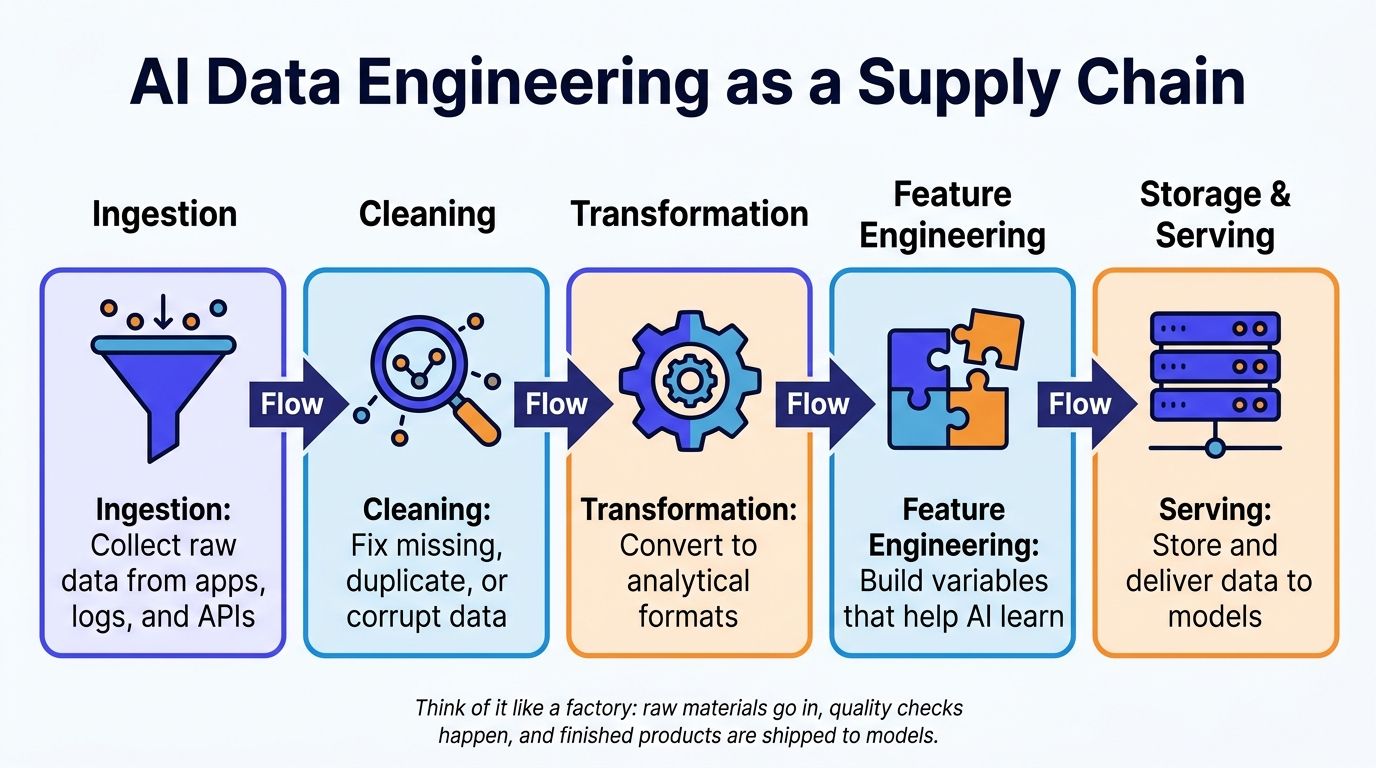
The five stages of the supply chain
Ingestion collects raw data from applications, APIs, files, logs, and event brokers. The design question is not just whether you can load the data. It's whether you can identify late, repeated, malformed, or missing events.
Cleaning applies quality controls. Teams check fields, identifiers, duplicates, invalid values, and source-specific anomalies. A document pipeline might remove repeated headers and detect an empty file. A transaction pipeline might reject an event with an impossible timestamp.
Transformation converts raw material into a form the model or downstream service can use. That may mean joining entities, normalizing categories, creating analytical tables, or splitting documents into retrieval units.
Feature engineering creates variables or representations that help a model learn or retrieve. For a forecasting system, that might be a rolling demand signal. For a language model application, it might be embeddings, metadata, access permissions, and document relationships.
Storage and serving deliver the result to training jobs, batch predictions, retrieval systems, or online inference. The serving layer must preserve the assumptions made earlier, otherwise the model sees a different representation in production than it saw during development.
Cloud adoption, multi-cloud architectures, and continuous data movement have raised the cost of weak boundaries. A pipeline can cross an operational database, object storage, warehouse, vector index, feature store, and model endpoint. AI data engineering keeps those handoffs explicit so teams can connect data freshness and integrity to model quality, time-to-value, and production stability.
How AI Data Engineering Differs From Data Engineering ML Engineering and MLOps
The roles overlap, but they don't own the same failure modes. A useful hiring conversation starts with the handoff, not the job title.
| Role | Owns | Key skills | When to hire |
|---|---|---|---|
| Data Engineer | Reliable movement, transformation, storage, and access for business data | SQL, distributed processing, orchestration, schemas, warehouses, testing | Hire first when source systems are fragmented or analytics and AI inputs are unreliable |
| AI Data Engineer | Model-ready data, retrieval context, feature pipelines, validation, lineage, and evaluation inputs | Data architecture, document processing, feature design, data contracts, observability, AI evaluation | Add when an AI feature depends on continuously changing context or specialized training and serving data |
| Machine Learning Engineer | Model development, training workflows, inference logic, and model integration | Modeling, experimentation, Python, training systems, model APIs, performance trade-offs | Hire when a validated data path exists but model behavior or inference quality is the main constraint |
| MLOps Engineer | Deployment, release automation, runtime monitoring, infrastructure, and rollback | Containers, cloud platforms, CI/CD, model registries, monitoring, incident response | Hire when models must run reliably across environments and releases need operational controls |
Where the boundaries matter
A data engineer might build a daily customer table. An AI data engineer decides whether that table contains the right context, whether its identifiers match the retrieval or feature layer, and whether its changes can be evaluated against business rules.
A machine learning engineer may train a ranking model. The AI data engineer ensures the training examples reflect production events and that the online system can access equivalent inputs. The MLOps engineer then packages, deploys, monitors, and rolls back the service.
Small teams often combine these responsibilities. That's reasonable for a pilot, provided one person owns each handoff. Enterprise teams usually separate them because the blast radius of a broken source, model, or deployment is different.
Hiring rule: Hire for the first unowned failure mode. If nobody can explain why the model's inputs are stale or inconsistent, start with AI data engineering. If inputs are sound but releases are fragile, prioritize MLOps.
One practical way to test scope is to ask: “When a customer receives a wrong answer, who can trace it from the response back to the source record, transformation, retrieval result, and deployed version?” If the answer is unclear, the team has an ownership gap rather than just a staffing gap.
Core Architectures and Patterns That Power AI Systems
Architecture should follow the product promise. A periodic report doesn't need a streaming platform. A fraud or personalization decision may fail if the relevant event arrives too late.
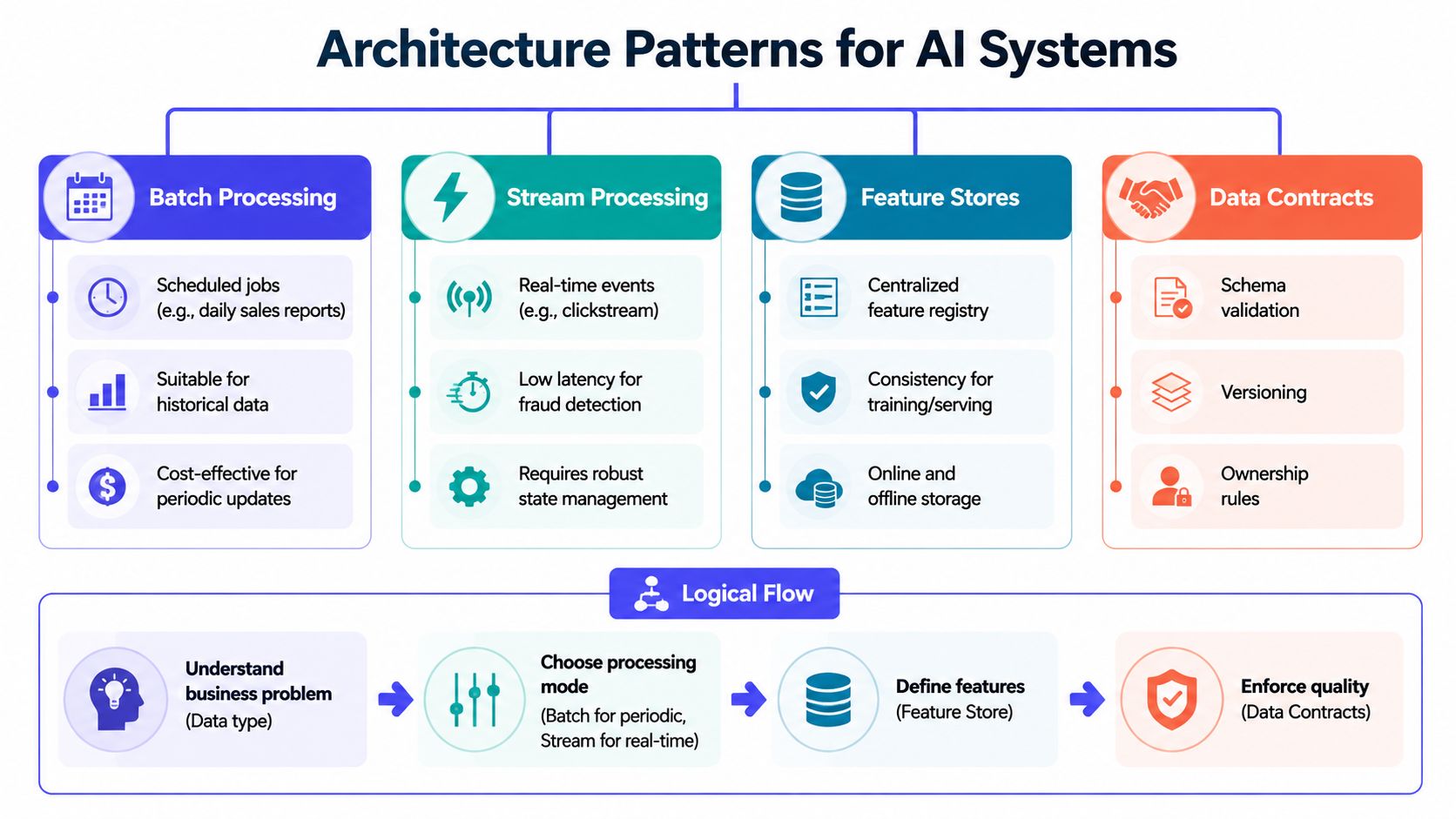
Batch processing
Batch pipelines collect and process data on a schedule. They work well for historical analysis, periodic feature refreshes, document indexing, and use cases where a delay is acceptable. Batch is usually easier to test and operate because jobs have clear boundaries and predictable resource needs.
The trade-off is freshness. If a product promise depends on a user's latest action, a batch job may create stale predictions or irrelevant retrieval results.
Stream processing
Stream processing handles events as they arrive. It suits clickstream-driven recommendations, event-triggered workflows, and decisions where low latency matters. It also adds operational demands, including state management, replay behavior, ordering, deduplication, and recovery after a consumer fails.
Don't adopt streaming because it sounds modern. Adopt it when the business requirement needs continuously updated state and batch cannot meet that requirement.
Feature stores
A feature store gives teams a managed place to define, register, and serve model features. Its most important value is consistency between offline training data and online inference. Without that consistency, a model can perform well in testing and behave differently in production because the feature calculation changed.
A feature store can be unnecessary for a small application with a few stable features. It becomes more valuable when multiple models share features, online latency matters, or teams need clear ownership and versioning.
Data contracts
A data contract states what an upstream producer promises about structure, meaning, ownership, and change. It can include schema rules, allowed values, identifiers, freshness expectations, and versioning behavior.
The contract catches breakage at the boundary instead of allowing an upstream change to corrupt downstream training or retrieval. For teams working with vector search, the contract should also cover document identity, metadata, permissions, and re-indexing behavior. A useful primer is what vector search is and how it supports retrieval.
A practical selection sequence
- Define the business decision. Identify what the model must decide and what happens when it is late.
- Classify the data. Separate historical records, current state, events, documents, and sensitive attributes.
- Choose processing mode. Use batch for periodic updates. Use streaming for decisions tied to incoming events.
- Define shared inputs. Introduce a feature store only when reuse, consistency, or online serving justifies its cost.
- Set the boundary. Write contracts for every upstream dataset or event that can affect model behavior.
Tool Stacks and How to Choose Without Overengineering
Tool selection should reduce risk, not create a second platform project. Start with the data path your feature needs, then choose the least complex tool that satisfies latency, reliability, integration, and team-skill requirements.
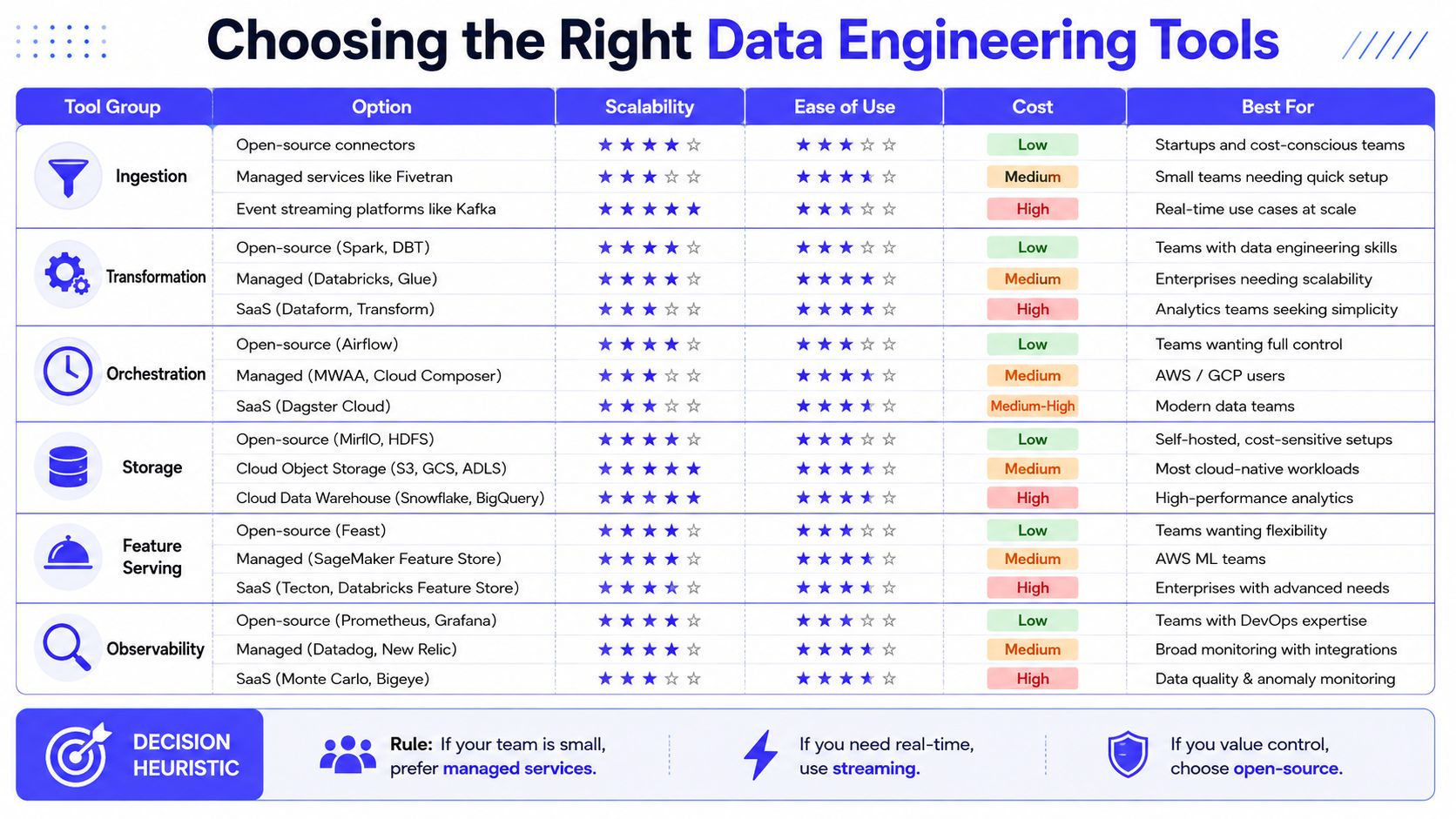
| Function | Lower operational burden | More control or scale | Decision question |
|---|---|---|---|
| Ingestion | Managed connectors such as Fivetran | Open-source connectors or Kafka for event streams | Are sources mostly application systems, or do you need real-time event control? |
| Transformation | Managed SQL transformation workflows | Distributed processing with Spark or similar systems | Can warehouse-native SQL handle the data shape and volume? |
| Orchestration | Managed workflow services | Airflow or platform-native schedulers | Who will own retries, dependencies, backfills, and alert response? |
| Storage | A managed warehouse or lakehouse | Separate object storage and compute layers | Do you need one governed access layer or specialized workloads? |
| Feature serving | Direct tables or a managed feature service | A dedicated feature store with online and offline layers | Do multiple models need consistent, low-latency features? |
| Observability | Platform-native checks and logs | Specialized lineage, quality, and anomaly systems | Can the team identify the business impact of a failure quickly? |
Use a maturity-based rule
For a small team, managed services often win because they reduce integration and maintenance work. Open-source components can provide control and flexibility, but the team must own upgrades, security, scaling, and incident response.
Streaming platforms such as Kafka can support high-throughput event architectures, yet they introduce state and replay concerns. A warehouse plus scheduled transformations may be the better first choice when the feature can tolerate periodic refreshes.
Unified data and AI platforms, multimodal lakehouses, and context engineering are emerging responses to probabilistic systems. The important question isn't whether a platform includes an AI label. Ask whether it supports retrieval, chunking, multimodal inputs, ontology, governance, evaluation, and traceability as first-class concerns.
Use this practical guide to data pipeline tools to compare options by workload and operating model, not by feature count.
Architecture test: If adopting a tool requires a new specialist before the feature has proven value, document the reason. If the reason is only future scale, start with a simpler boundary and define the migration trigger.
Operating Reliably: Metrics, Pitfalls, and Governance
A production pipeline can show green while delivering data that misleads a model or product decision. Reliability requires evidence that data is accurate, complete, consistent across systems, unique where required, valid against its schema, timely for the decision, and understandable to its owners. These are established ETL data-quality dimensions, measured through correct-value rates, missing entities, duplicate entities, and documented entities (an ETL data quality framework).
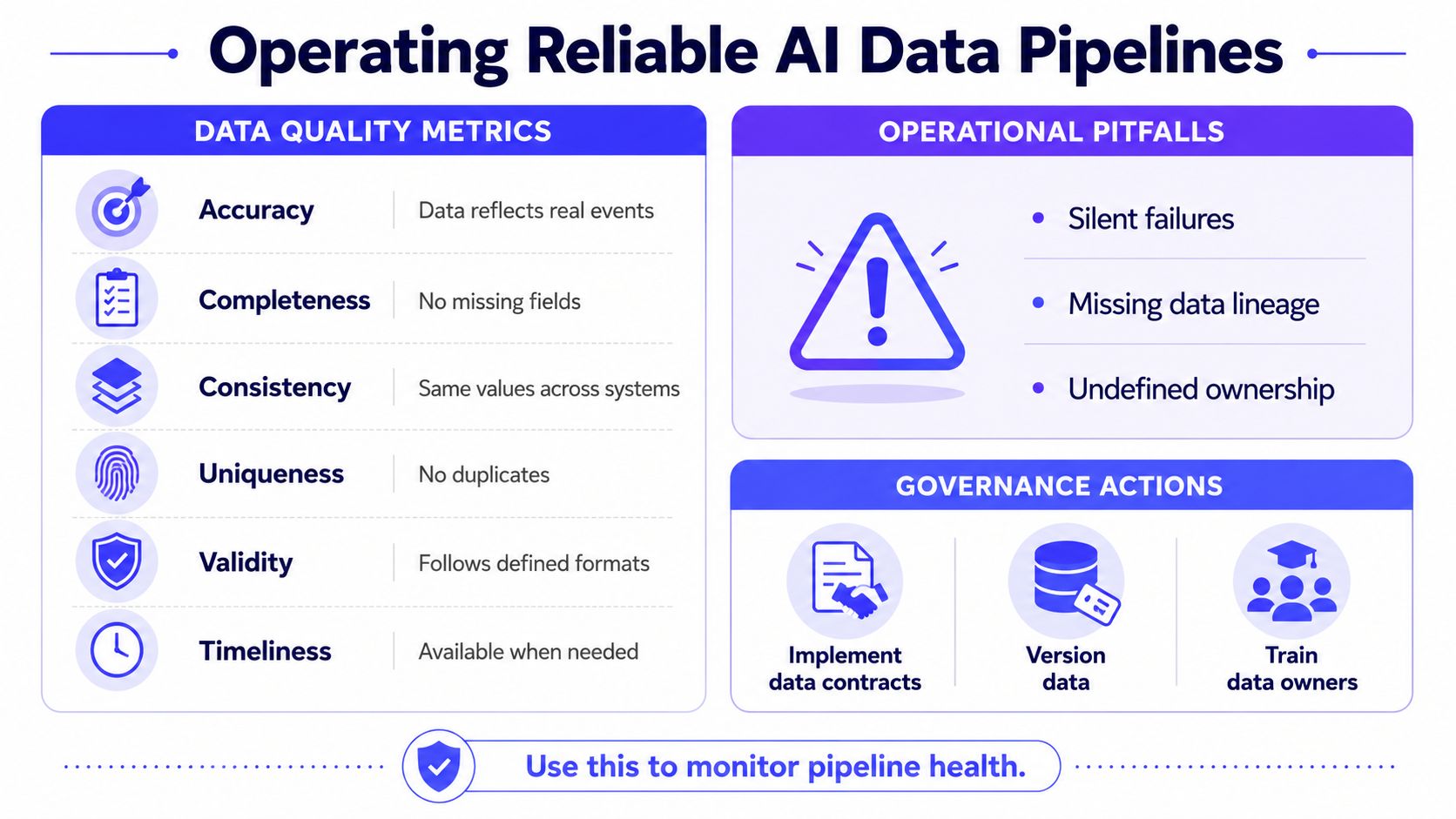
Measure the pipeline and the incident
Track arrival, transformation invariants, schema changes, and whether downstream consumers receive usable outputs. Track the operational consequences as well. Recurring failures, incidents, and long resolution efforts make incident frequency and time to resolve management metrics, not merely engineering metrics. If the figures were cited earlier, refer back to that source rather than creating a duplicate link.
A useful check connects a technical condition to a business question:
- Accuracy: Does the value reflect the actual event?
- Completeness: Are required entities and fields present?
- Consistency: Do customer, product, or account values agree across systems?
- Uniqueness: Did ingestion create duplicate records?
- Validity: Does the value follow its declared format and range?
- Timeliness: Did the data arrive before the model needed it?
- Interpretability: Can a reviewer understand its origin and meaning?
These checks are the guardrails around a probabilistic system. They do not guarantee a correct answer, but they show whether the system had the right inputs and whether a failure began upstream.
Treat AI-generated logic as untrusted until tested
AI assistants can produce SQL, transformations, tests, and pipeline changes quickly. They can also assume the wrong business definition or miss the context of a dataset. A 2025 industry survey summarized by Apply Data found that 72% of respondents prioritized AI-assisted coding, while only 24% prioritized AI-assisted pipeline management, including testing, observability, and quality controls (the survey summary). The same survey identified incorrect logic or assumptions as the most common failure and poor understanding of data context as another frequent problem. Treat generated code like a proposed change from a junior engineer: useful, reviewable, and untrusted until it passes tests.
Use repository-level tests, business-rule assertions, lineage checks, and an evaluation harness. A 2026 benchmark of AI agents working on real dbt projects found that larger-scale tests with stronger invariants and more complex specifications exposed quality differences more effectively. It also found that the evaluation harness influenced quality and cost efficiency, with one setup achieving a 4 percentage-point higher Pass@1 at 3.9× lower cost than another approach (the benchmark report).
Connect governance to delivery
NIST guidance connects AI governance with existing risk controls and broader data governance, including standards for experimental design, data quality, and model training (NIST AI risk-management guidance). Dataset documentation guidance recommends recording a data statement, datasheet, or data nutrition label for small to medium datasets from identified sources, including provenance, languages, and common categories (NIST dataset documentation guidance).
Assign an owner, preserve provenance, version important inputs, and define approval paths for changes. These data engineering best practices can help turn those controls into repeatable team routines. Governance works when it appears in pull requests, deployment checks, incident reviews, and evaluation records, rather than sitting in a separate policy document.
Putting It Into Practice Examples Hiring and Next Steps
Consider a support team indexing a knowledge base for a retrieval-augmented generation feature. The first version can use a scheduled ingestion job, document extraction, cleaning, chunking, metadata validation, embeddings, and a vector index. The product team should evaluate answer quality against a reviewed question set, while the data engineer monitors source freshness, failed documents, permission metadata, and index completeness.
A practical pilot sequence is:
- Map the sources: List document owners, formats, update behavior, permissions, and expected provenance.
- Build the narrow path: Index a representative subset and keep the original source identifier on every chunk.
- Test retrieval and answers: Review whether the system finds the right context before judging the model's response.
- Add failure controls: Quarantine malformed files, flag stale sources, and require human review for changes to parsing or chunking logic.
- Decide on expansion: Move to broader coverage only when the team can explain quality failures and operational ownership.
For an enterprise personalization system, the architecture may use application events, a stream processor, an offline warehouse, a feature registry, and an online serving layer. The team should explicitly test late events, duplicate events, missing identifiers, and the difference between offline feature calculations and online feature values.
The hiring brief should name those responsibilities instead of asking for a generic “AI engineer.”
| Assessment area | Evidence to request |
|---|---|
| Data reliability | A pipeline design with schemas, retries, backfills, and ownership |
| AI context | A document or feature model that preserves provenance and meaning |
| Validation | Invariants, edge cases, data-quality checks, and failure handling |
| Production judgment | A clear choice between batch and streaming with trade-offs |
| Communication | A short explanation for a product lead describing risk and delivery order |
A useful take-home asks the candidate to design a small ingestion and validation workflow, document assumptions, show how they would test it, and explain what they would postpone. Score the submission on correctness, traceability, operational simplicity, and clarity. For hiring support, ThirstySprout can match teams with remote data engineers, machine learning specialists, and MLOps practitioners for full-time, contract, or fractional engagements.
Start with three actions. First, choose one AI feature and map every data dependency. Second, assign an owner to each handoff and write the first quality checks. Third, run a focused pilot in 2–4 weeks, measuring data freshness, retrieval or feature correctness, incident handling, and user value rather than model output alone.
ThirstySprout helps startups and enterprises hire remote data engineers and broader AI specialists for production gaps, focused pilots, and full-time, contract, or fractional work. Visit ThirstySprout to start a pilot or see how the right AI data engineering capability can help you ship a reliable feature within 2–4 weeks.
Hire from the Top 1% Talent Network
Ready to accelerate your hiring or scale your company with our top-tier technical talent? Let's chat.