

Most advice about data engineering skills required still starts and ends with SQL, Python, and Spark. Those tools matter, but that checklist misses the work that determines whether a data platform earns trust: handling failures, protecting sensitive data, explaining trade-offs, and keeping pipelines correct after requirements change.
The hiring signal has shifted toward operational ownership. A 2026 analysis of 78 real job postings found communication and cross-functional collaboration in 69% of roles, ahead of ETL/ELT and pipeline work at 64%, SQL at 55%, and Python at 50% (Dice job-posting analysis). That doesn't make technical fundamentals less important. It shows that production engineers must combine them with judgment.
This guide gives hiring teams and engineering leaders a practical framework for evaluating the full profile, from query design to incident response and AI data infrastructure.
Why the Old Data Engineering Checklist Is Failing Hiring Teams
A candidate can write elegant SQL and still be unprepared to own a production pipeline. If they cannot explain idempotency, backfills, recovery behavior, or the response to a silent data-quality failure, a long tool list proves little. Spark, Kafka, and cloud services show exposure. They do not show operational judgment.
The familiar SQL, Python, and Spark screen persists because it is easy to administer and produces a tidy score. Production systems fail for different reasons: a retry duplicates records, an upstream schema changes without warning, a late event corrupts a metric, or an access policy exposes sensitive data. The engineer's response to those conditions matters more than recalling a syntax trick.
The market data supports a broader hiring standard. A 2026 analysis of 6,877 active data engineer postings found Data Pipelines in 74% of roles, while SQL and Python each appeared in 71% (2026 data engineering skills analysis). AWS appeared in 44%, Data Quality in 43%, and Data Modeling in 38%. Snowflake, Databricks, Airflow, and dbt each appeared in the range of 24% to 31%. The pattern favors durable fundamentals, supported by enough cloud and orchestration knowledge to run systems after deployment.
Hiring rule: Treat tool names as evidence of exposure, not proof of competence.
What the checklist misses
A production-ready engineer evaluates the system around the code:
- Failure boundaries: What happens when an upstream source is late, malformed, duplicated, or unavailable?
- Recovery paths: Can the job restart safely, replay data, and backfill a defined time range?
- Service expectations: Which data must be fresh, and what response follows when its service-level objective is missed?
- Ownership: Who gets paged, who investigates, and who communicates the impact?
- Change management: How will schema changes, migrations, and new consumers avoid breaking existing users?
LeetCode-style interviews can test focused problem solving, but they rarely show whether a candidate can operate a distributed system under imperfect conditions. A better evaluation asks candidates to reason through failure, recovery, communication, and trade-offs.
The role now resembles platform engineering for data more than simple extract, transform, and load work. Hiring teams that score only implementation speed may reject engineers who protect reliability and select candidates whose demos create expensive maintenance. Senior hiring signals should therefore include ownership across the pipeline's full operating life, not just the tools used to build it.
Core Data Engineering Skills That Still Dominate Job Postings
Tools change faster than hiring requirements. Warehouses, scheduled transformations, APIs, and batch workloads still make up much of the operating base, so pipeline construction, SQL, and Python remain the skills that open the door. The 2026 posting analysis cited earlier found these fundamentals across a large share of roles. A separate review of 78 production job postings found ETL/ELT and pipeline work in 64% of them, SQL in 55%, and Python in 50% (production data engineering skills analysis).
Senior candidates separate themselves by showing how those skills support reliable decisions, not by listing more tools.
SQL is more than query fluency
Competent engineers use window functions, common table expressions, joins, indexing or partitioning strategies, and query plans. They also identify the business grain of each table. A query can return a plausible result while counting revenue, retention, or customers more than once.
A practical exercise could ask a candidate to turn raw order events into a daily customer summary while handling updates and cancellations. Strong candidates clarify whether the output is append-only, identify the natural key, and explain how they would avoid scanning unchanged history. They also state which assumptions need confirmation from analysts or business owners.
Python should handle the messy edges
Python earns its place where SQL is insufficient, particularly for API ingestion, pagination, authentication, rate limits, file parsing, retries, and custom validation. The production test is not whether someone can write a loop. It is whether the code records progress, handles malformed payloads, and resumes without duplicating data.
For teams building ingestion workflows, this practical guide to ETL with Python offers a useful reference for evaluating implementation choices.
Modeling determines downstream trust
Data modeling turns technical design into usable analytics. Engineers should understand facts, dimensions, grain, surrogate keys, and slowly changing dimensions. They should also know when a normalized model reduces risk compared with a wide analytical table.
Incremental transformation reveals whether someone understands operating cost and historical change. On a large warehouse table, a full refresh may be easy to write but expensive and slow to run. A competent engineer defines a stable watermark or change key, handles updates and deletions, and provides a reconciliation path for historical corrections. That design also needs a clear explanation for analysts who depend on the resulting tables.
| Skill | Production application | Beginner vs. competent |
|---|---|---|
| SQL | Joins, aggregations, windows, query optimization | Beginner gets the result. Competent protects grain, cost, and performance. |
| Python | API ingestion, parsing, validation, retries | Beginner handles the happy path. Competent resumes safely and records failures. |
| Data modeling | Facts, dimensions, history, consumption patterns | Beginner copies source tables. Competent models business meaning and change. |
| ETL and ELT | Moving, transforming, and validating data | Beginner builds a sequence. Competent designs retries, dependencies, and recovery. |
| Pipeline testing | Schema, freshness, uniqueness, and business rules | Beginner checks row counts. Competent tests correctness and failure behavior. |
The hiring distinction is practical: can the engineer make a system that remains understandable, affordable, and useful after its first release? Tool familiarity shows exposure. Ownership shows whether the work will hold up for the people and decisions that depend on it.
Advanced Production Skills That Separate Seniors From Mid-Level Engineers
Mid-level engineers can usually build a working pipeline. Senior engineers decide how it should behave when reality disagrees with the design. That requires a combination of distributed-systems reasoning, operational discipline, and clear communication.
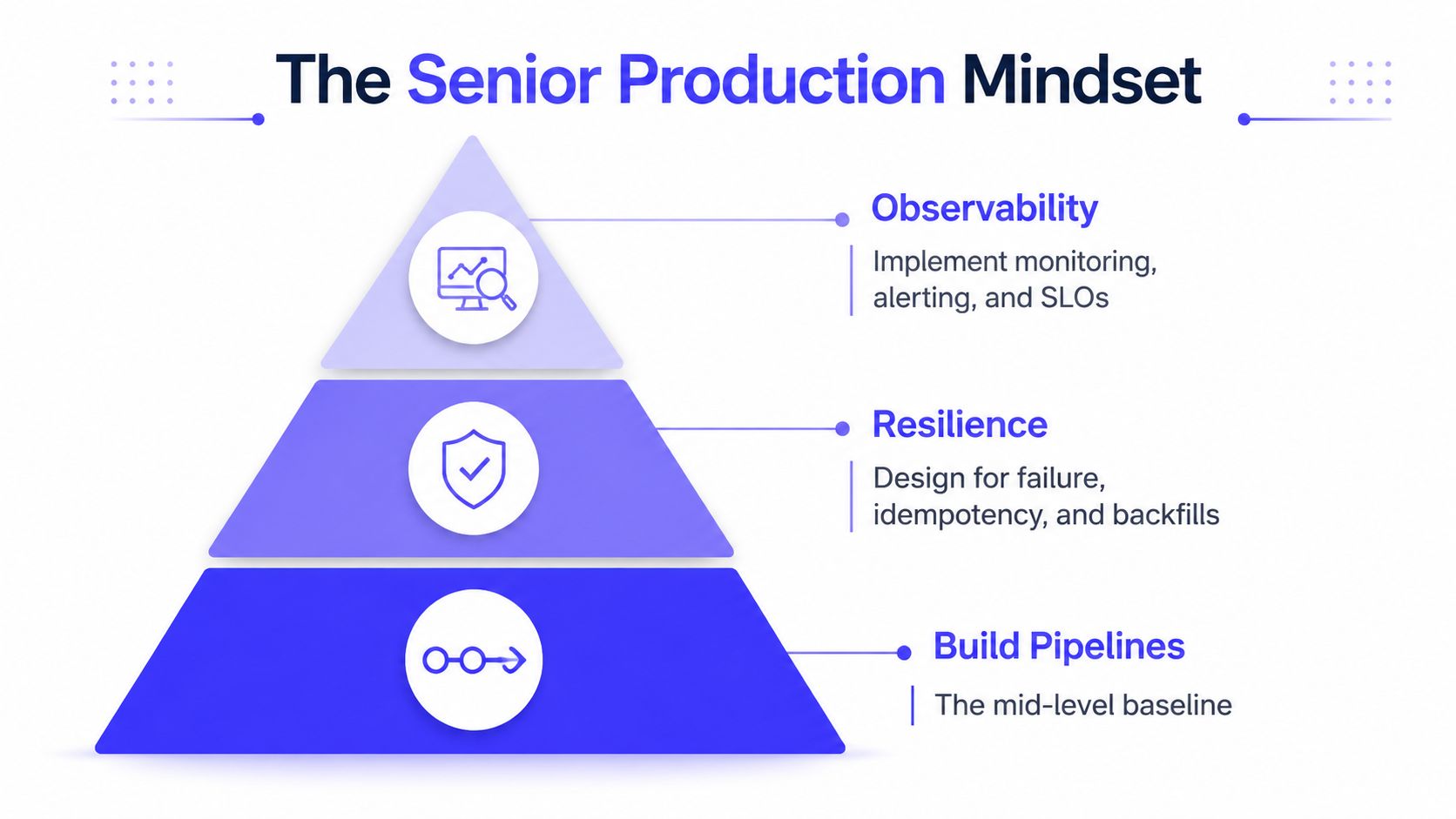
The foundation is still pipeline construction. Above it sits resilience, including idempotency, retries, replay, and backfills. At the top sits observability, where the team can detect and explain whether data is fresh, complete, and correct.
Streaming requires semantic judgment
Kafka and Flink aren't seniority badges by themselves. The candidate must understand partitioning, consumer behavior, event time, watermarks, late-arriving data, replay, and delivery guarantees.
Ask how they would process payment events when a consumer restarts after writing to a downstream store. A strong answer discusses stable event identifiers, deduplication, transaction boundaries, and reconciliation. “Use exactly-once” isn't enough. Exactly-once semantics depend on the full path, including the source, processing engine, sink, and side effects.
Real-time work also carries a product trade-off. The benefits of real-time data processing are meaningful when users or operations teams need fresh signals, but streaming adds infrastructure, testing, and debugging complexity. Don't introduce it merely because batch sounds old.
Orchestration is dependency design
Airflow and Dagster should express meaningful dependencies, not become a collection of oversized scripts. Good workflow design separates extract, validate, transform, publish, and reconcile stages where those boundaries help recovery.
A senior engineer can explain:
- Retry policy: Which failures are transient, and which require intervention?
- Backfill behavior: Can a historical range run without overwriting unrelated data?
- Concurrency: What prevents overlapping runs from corrupting shared outputs?
- SLA response: Who is notified when a critical dataset misses its freshness target?
- Dynamic work: When should task generation be explicit rather than hidden inside runtime code?
The practical test is a broken DAG. Give the candidate a task dependency that allows publication before validation, then ask them to diagnose the risk and redesign it.
For broader operating guidance, use these data engineering best practices as a review checklist for workflow ownership, testing, and reliability.
Observability and security belong in the baseline
Data observability should cover freshness, volume, schema, and distribution. A pipeline can succeed technically while delivering an empty partition or a column full of nulls. Senior engineers connect alerts to business impact instead of paging on every unusual value.
Security requires similar specificity. Candidates should understand role-based access, column-level controls, personally identifiable information masking, audit logs, secret management, and least privilege. The right design depends on the platform and sensitivity of the data, but the reasoning should be explicit.
A senior data engineer doesn't promise that failures won't happen. They make failures visible, recoverable, and explainable.
Emerging AI and Platform Skills Reshaping the Role
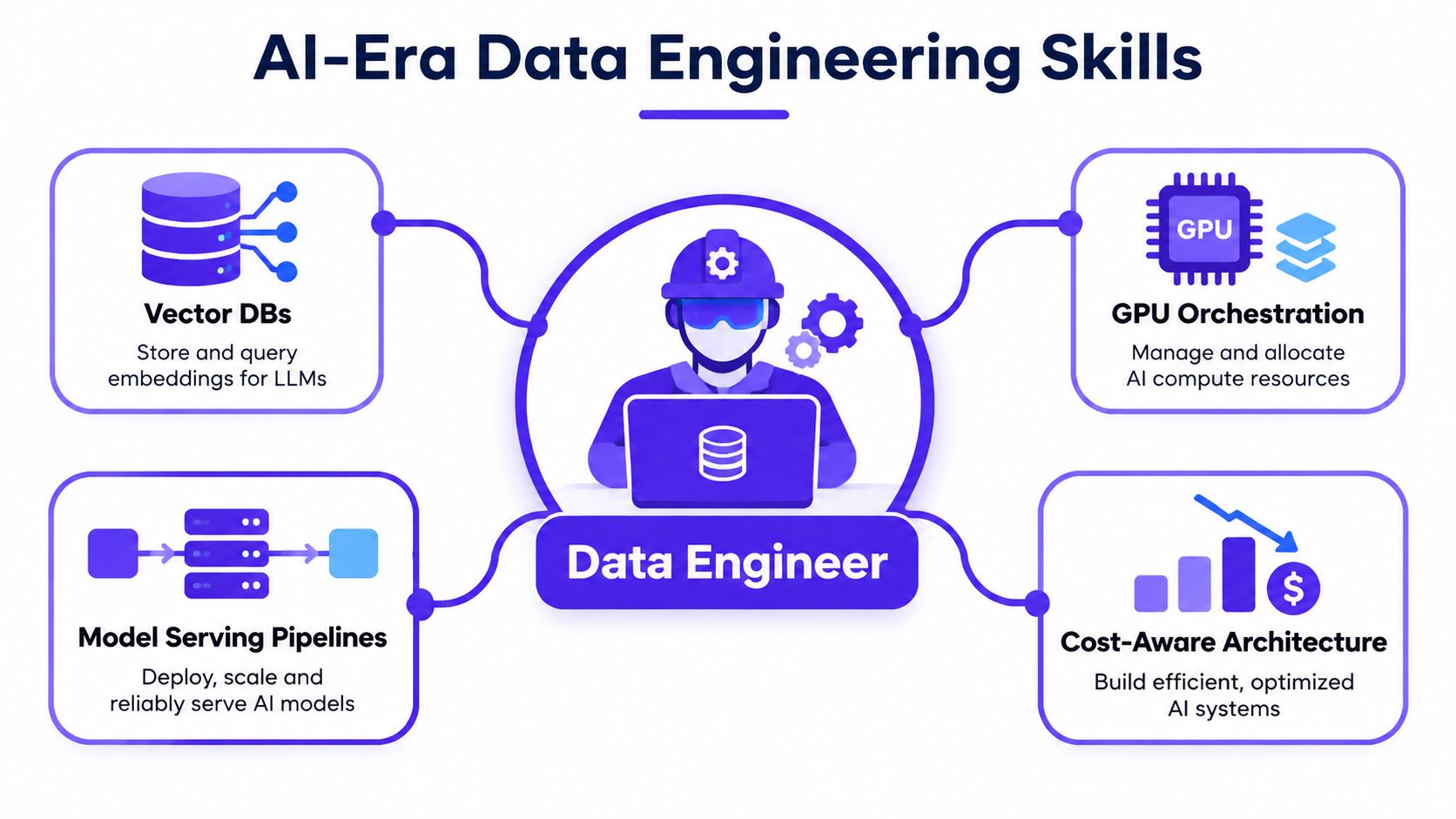
AI infrastructure is expanding the data engineering boundary, but it isn't replacing the fundamentals. Teams still need reliable ingestion, modeling, lineage, access control, and reproducible transformations. They now also need engineers who can prepare data for retrieval, model training, evaluation, and online serving.
The emerging profile is often a workflow engineer. This person connects warehouses, object stores, vector databases, model services, and product systems while keeping versions and contracts clear.
LLM pipelines need data discipline
A retrieval-augmented generation pipeline isn't just a document splitter. The engineer must decide how to identify document versions, remove stale chunks, preserve metadata, re-embed changed content, and measure retrieval quality.
A practical design might assign each document a stable identifier and version, then derive chunk identifiers from both values. When the source changes, the pipeline can identify affected chunks instead of rebuilding everything blindly. The engineer should also track embedding model changes because a new model can make existing vectors inconsistent with new ones.
Vector databases are part of a wider system
Pinecone and Weaviate can support retrieval workloads, but the vector store doesn't replace the warehouse. The warehouse remains useful for source truth, governance, joins, and auditability. The vector database serves a specialized access pattern.
Candidates should explain when to keep metadata in the vector index and when to resolve it from a governed system. They should also discuss deletion, tenant isolation, filtering, access control, and reindexing. Tool familiarity without lifecycle thinking is resume decoration.
Contracts connect producers and consumers
Data contracts define expectations between an upstream producer and a downstream consumer. They can specify field names, types, nullability, allowed changes, ownership, and quality checks. Protobuf registries, schema registries, or a custom contract layer can all work if the team enforces the agreement in delivery workflows.
Feature stores and model-serving pipelines add another layer. Engineers need to understand offline and online consistency, feature freshness, point-in-time correctness, and collaboration with machine-learning engineers. They don't need to own every model, but they must understand the data guarantees the model depends on.
One 2026 role analysis describes LLM orchestration, vector databases, retrieval-augmented generation pipeline design, and embedding lifecycle management as appearing in data engineer job descriptions, while Kubernetes is generally useful but not core for most roles (changing data engineering skills analysis). Treat these as role-specific signals, not universal requirements.
The strongest candidates connect AI features to cost, reliability, and governance. They don't propose GPUs, vector search, or streaming unless the use case justifies the operational burden.
Skill Expectations by Seniority Level
A role description should match the decisions the engineer will own. Requiring a junior candidate to design a multi-region platform creates an unrealistic filter. Hiring a mid-level engineer and expecting independent architecture ownership creates a predictable ramp problem.
The UK market provides evidence that demand remains broad. In the 6 months ending 25 August 2026, 1,595 permanent UK jobs cited Data Engineering skills, equal to 1.47% of permanent UK jobs, compared with 1,063 a year earlier (UK Data Engineering jobs data). The skill area also improved its year-on-year rank by 25 places in that dataset.
| Skill category | Junior, 0-2 years | Mid-level, 2-5 years | Senior, 5+ years |
|---|---|---|---|
| SQL and modeling | Writes joins, aggregations, and basic models | Designs analytical models and handles history | Sets modeling standards and resolves competing consumer needs |
| Python and pipelines | Extends existing ingestion and transformations | Owns a pipeline from source to published output | Designs platform patterns and migration paths |
| Cloud and infrastructure | Uses existing cloud resources safely | Provisions and maintains services with review | Makes architecture and cost trade-offs across platforms |
| Orchestration | Debugs scheduled tasks | Designs dependencies, retries, and backfills | Defines workflow standards and recovery expectations |
| Streaming | Understands events and basic consumers | Builds or maintains streaming workflows | Chooses streaming only where latency justifies complexity |
| Quality and observability | Adds tests and responds to alerts | Implements freshness, schema, and volume checks | Defines reliability objectives and incident practices |
| Collaboration | Documents work and asks clear questions | Coordinates with analysts, product, and application teams | Owns stakeholder relationships and mentors engineers |
A junior candidate doesn't need Kafka expertise unless the role centers on streaming. A senior candidate, however, should be able to explain why Kafka is needed, what guarantees the system provides, and how the team will operate it.
For accurate scope and responsibilities, use this data engineering job description as a starting point, then adapt it to your architecture and business constraints.
How to Evaluate Data Engineering Candidates in Interviews
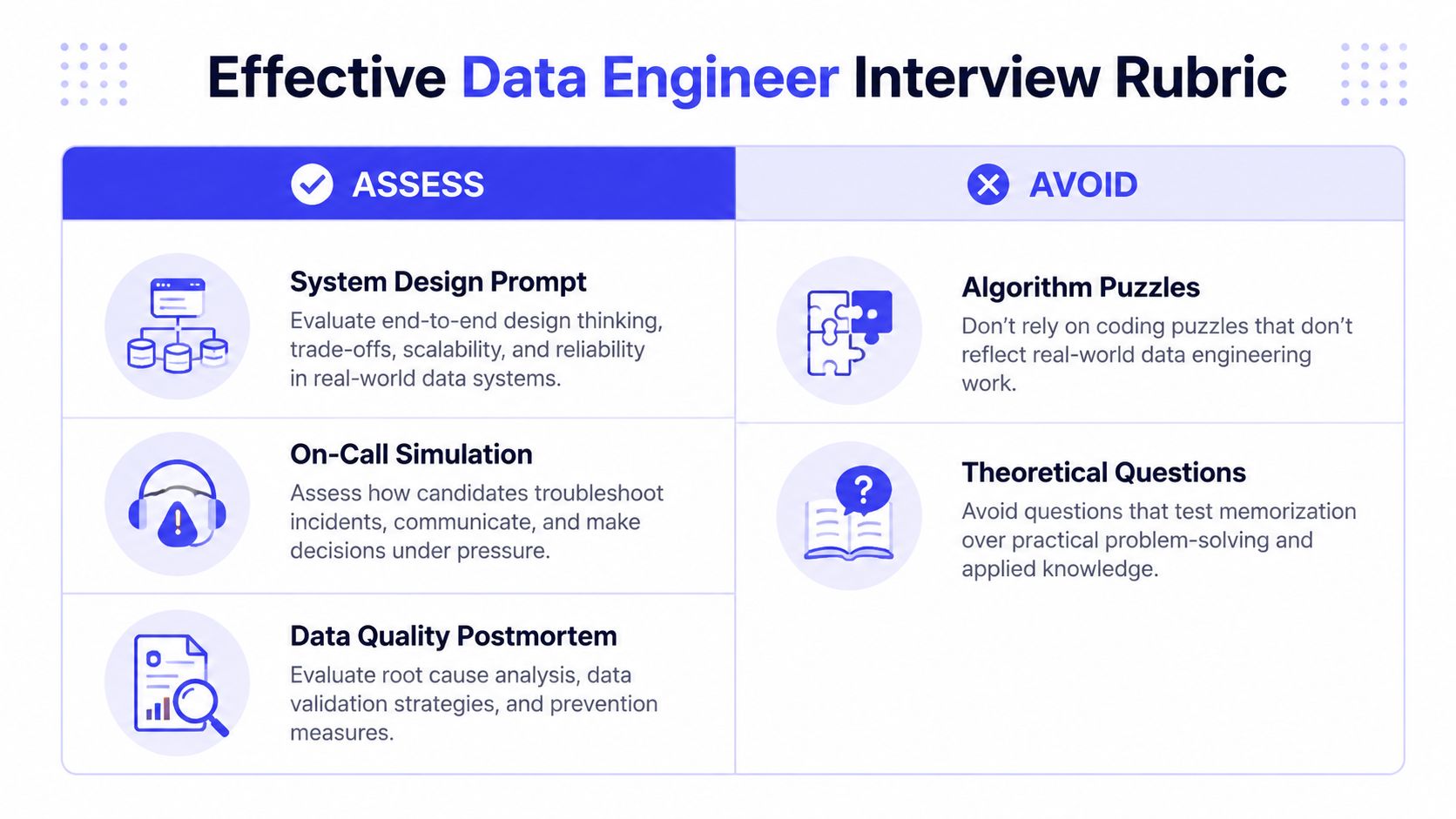
The interview should simulate the decisions the engineer will make at work. A practical loop can assess fundamentals, system design, debugging, and communication without turning the process into an endurance test.
Use three production-oriented exercises
First, test SQL and modeling together. Provide a realistic schema with customers, orders, status changes, and late corrections. Ask for a historical customer summary and require the candidate to state the grain, keys, incremental strategy, and tests.
Second, run a pipeline design discussion. Give the candidate an event source, a warehouse, a freshness requirement, and an unreliable upstream system. Ask how they handle duplicates, late-arriving records, backfills, schema changes, and partial failure.
Third, debug a broken workflow. Present an Airflow DAG with an incorrect dependency, an unsafe retry, and a task that writes directly to a shared output. Look for diagnosis, not memorized syntax.
Score reasoning, not tool recitation
Use a consistent rubric:
- Correctness: Does the solution produce the intended result at the right grain?
- Resilience: Can it retry, resume, replay, and backfill safely?
- Observability: Does the candidate define useful checks and actionable alerts?
- Security: Do access and sensitive-data concerns appear in the design?
- Communication: Can the candidate explain trade-offs to a non-specialist?
- Maintainability: Are naming, tests, documentation, and ownership clear?
Red flags include defaulting to full refreshes without discussing scale, treating row counts as complete testing, and claiming idempotency without identifying the key or write strategy. Another warning sign is a design that assumes every dependency will be available exactly when expected.
A time-boxed take-home should use a small synthetic dataset and ask for an ingestion job, transformation, tests, and a short operations note. Candidates should explain what they would improve with more time. For broader perspective on how founders approach technical hiring, Founder Connects on hiring engineers offers useful context, but your scorecard should remain specific to the production role.
A 90-Day Plan to Ramp a New Data Engineer to Production
A structured ramp turns a hiring decision into an observable process. The team shouldn't throw a new hire into legacy Spark jobs and judge them on how quickly they decode undocumented assumptions.
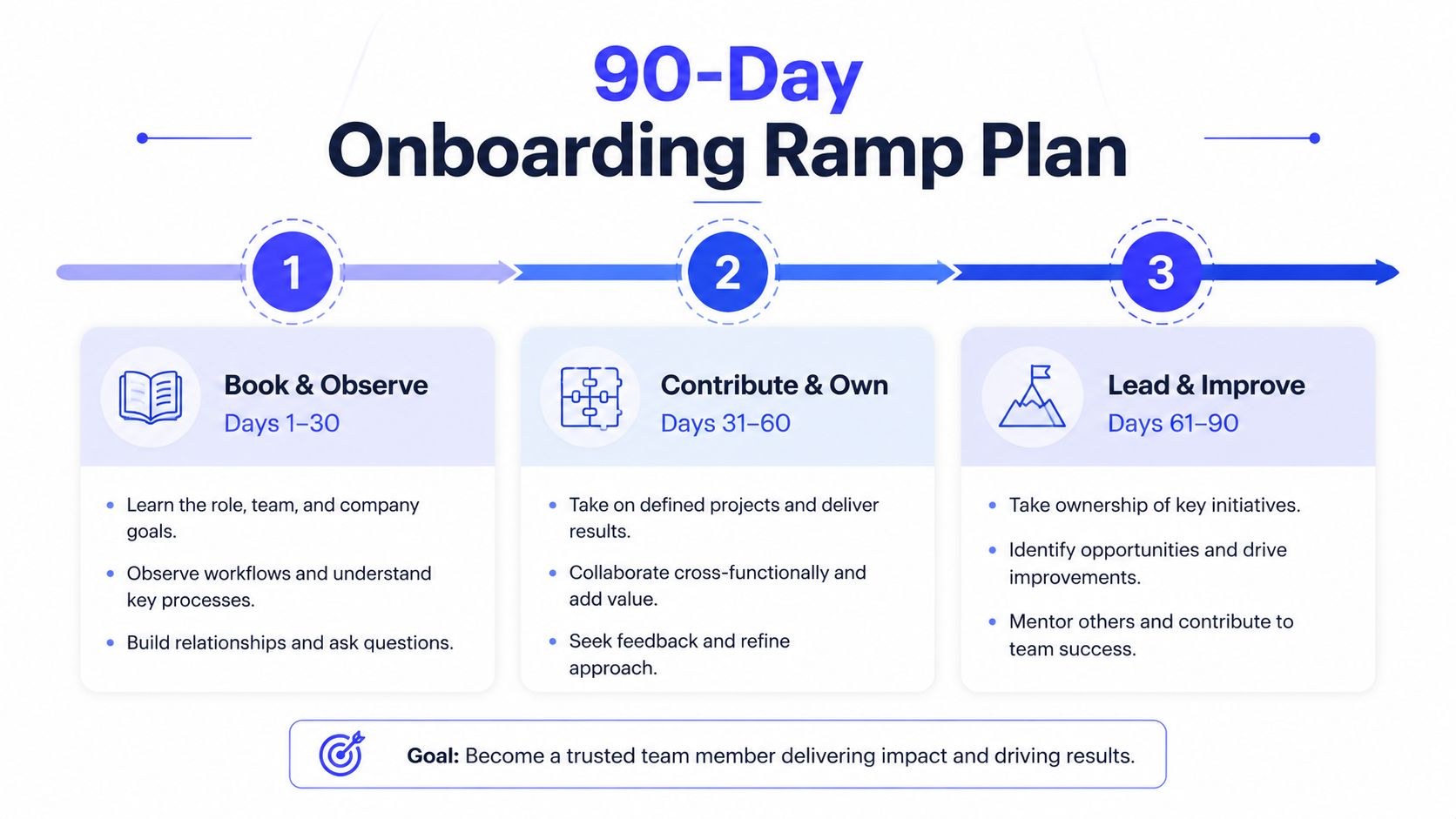
Days 1-30
The engineer sets up access, runs the local and deployment workflows, maps key datasets, and shadows incident reviews. Their first production contribution should be small, such as a bug fix, a missing test, or documentation that removes a known point of confusion.
The gate is evidence of understanding, not speed. They should explain one important pipeline from source to consumer and identify its main failure modes.
Days 31-60
The engineer owns a medium-complexity pipeline end to end. That includes tests, basic freshness or failure alerts, documentation, and participation in the on-call process.
They should be able to merge a routine change with the expected review process, investigate a failed run, and communicate impact without waiting for a senior engineer to narrate every step.
Days 61-90
The engineer proposes and delivers a reliability or infrastructure improvement. Examples include safer backfills, better schema-drift detection, clearer access controls, or a reduction in unnecessary recomputation.
Readiness means they can resolve a production incident with limited escalation, explain the root cause, and leave the system easier to operate than they found it.
Use this checklist today:
- Define ownership: Name the pipelines and decisions the engineer will own at each phase.
- Prepare access: Provide repositories, environments, credentials through approved controls, and runbooks.
- Choose a first win: Select a bounded production improvement with clear acceptance criteria.
- Schedule feedback: Review progress at each phase gate.
- Measure readiness: Evaluate independent diagnosis, safe changes, communication, and follow-through.
Start by rewriting your scorecard around reliability, modeling, and collaboration, then test candidates with a production-shaped exercise. If you need experienced help building the team, ThirstySprout matches companies with remote data engineers and broader AI talent for full-time, contract, or fractional engagements. Visit ThirstySprout to start a pilot or review sample profiles for your data platform needs.
Hire from the Top 1% Talent Network
Ready to accelerate your hiring or scale your company with our top-tier technical talent? Let's chat.