

Your analytics backlog is growing, machine learning projects are waiting on unreliable pipelines, and nobody can answer a basic question: who owns the full path from source data to production decision? That's the point at which you need more than another senior engineer. You need a data engineering lead who can own the operating model, reduce delivery risk, and make the data foundation usable for analytics, products, and artificial intelligence.
The role is now a recurring hiring category, not vague leadership jargon. In the UK, IT Jobs Watch recorded 243 permanent Lead Data Engineer openings in the six months to 1 September 2026, with a median salary of £90,000 from 169 quoted salaries in the sample. The same source reported 111 permanent openings outside London in the six months to 2 August 2026, with a median salary of £82,500. In the US, Salary.com reported an average annual salary of $122,065 for a Data Engineering Lead as of 1 July 2026, with a 25th to 75th percentile range of $112,083 to $132,646. See the UK Lead Data Engineer market data and US Data Engineering Lead salary data.
What a Data Engineering Lead Actually Owns
A data engineering lead owns the data delivery system, not just a collection of pipelines. That system includes architecture, prioritization, reliability, governance, team capability, and the working agreements that keep consumers unblocked.
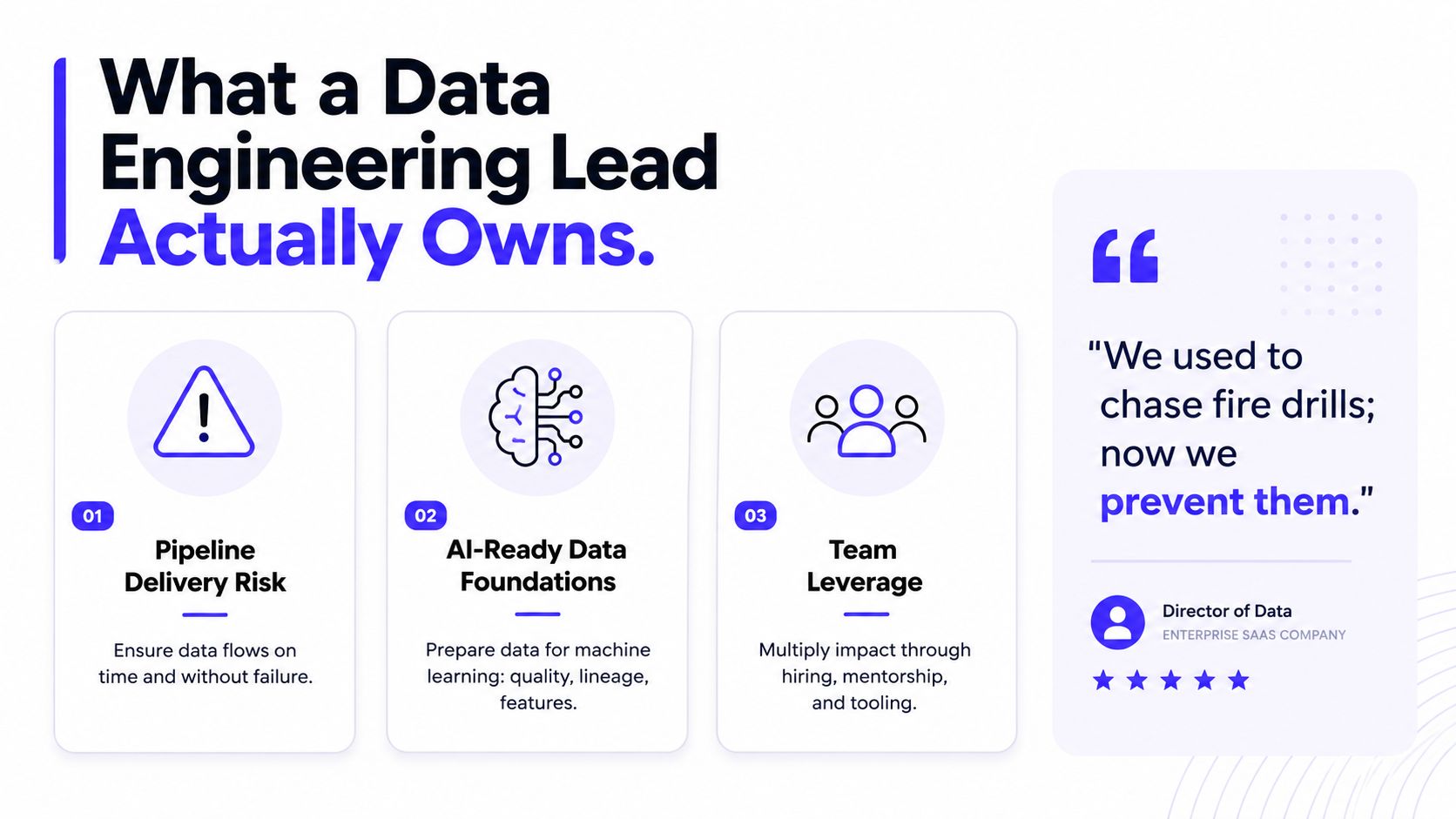
The role has three operating-model mandates:
- Pipeline delivery risk: Make sure critical data arrives when consumers need it, with monitoring, testing, incident response, and recovery plans.
- AI-ready data foundations: Build trustworthy inputs for machine learning and AI through quality controls, lineage, contracts, appropriate modeling, and usable access patterns.
- Team leverage: Increase the team's output through hiring, coaching, standards, tooling, and clear ownership.
What should happen in week one
Start with an inventory, not a reorganization. The lead should identify the critical ingestion paths, production consumers, recurring failures, undocumented dependencies, and decisions that currently sit between teams.
A useful first-week output includes:
- A map from source systems through ingestion, transformation, storage, semantic layers, and consumption.
- A list of reliability risks ranked by business impact.
- A draft pattern for data contracts with major consumers.
- A delivery review with product, analytics, machine learning, and platform representatives.
- A decision log for architecture, vendors, and standards.
By day 30, good looks concrete. You should have a documented ingestion-to-consumption topology, a prioritized reliability backlog, an agreed contract pattern with consumers, and a weekly delivery review that stakeholders attend.
Practical rule: If the lead can't explain what breaks, who depends on it, and what happens next, they don't yet own the operating model.
The role isn't “senior individual contributor plus manager.” It's the accountable point for how data work gets designed, delivered, operated, and improved. A data engineering manager role blueprint describes the operating scope in practical terms, including roadmap ownership, target-state architecture, monitoring, incident response, postmortems, continuous integration and delivery, testing, and data contracts.
How the Role Came to Exist
The job exists because the data stack kept accumulating layers that no single specialist could manage in isolation.
Edgar F. Codd's relational model in 1970 established a foundation for structured databases and later SQL. IBM's System R followed in 1974, and Oracle launched a relational database management system in 1979. Those systems created the need for schema discipline, transaction thinking, and durable data models.
In 1988, Barry Devlin and Paul Murphy introduced the business data warehouse concept. Bill Inmon later formalized data warehousing principles, giving analytics teams an architectural basis for bringing operational data into a consistent reporting environment.
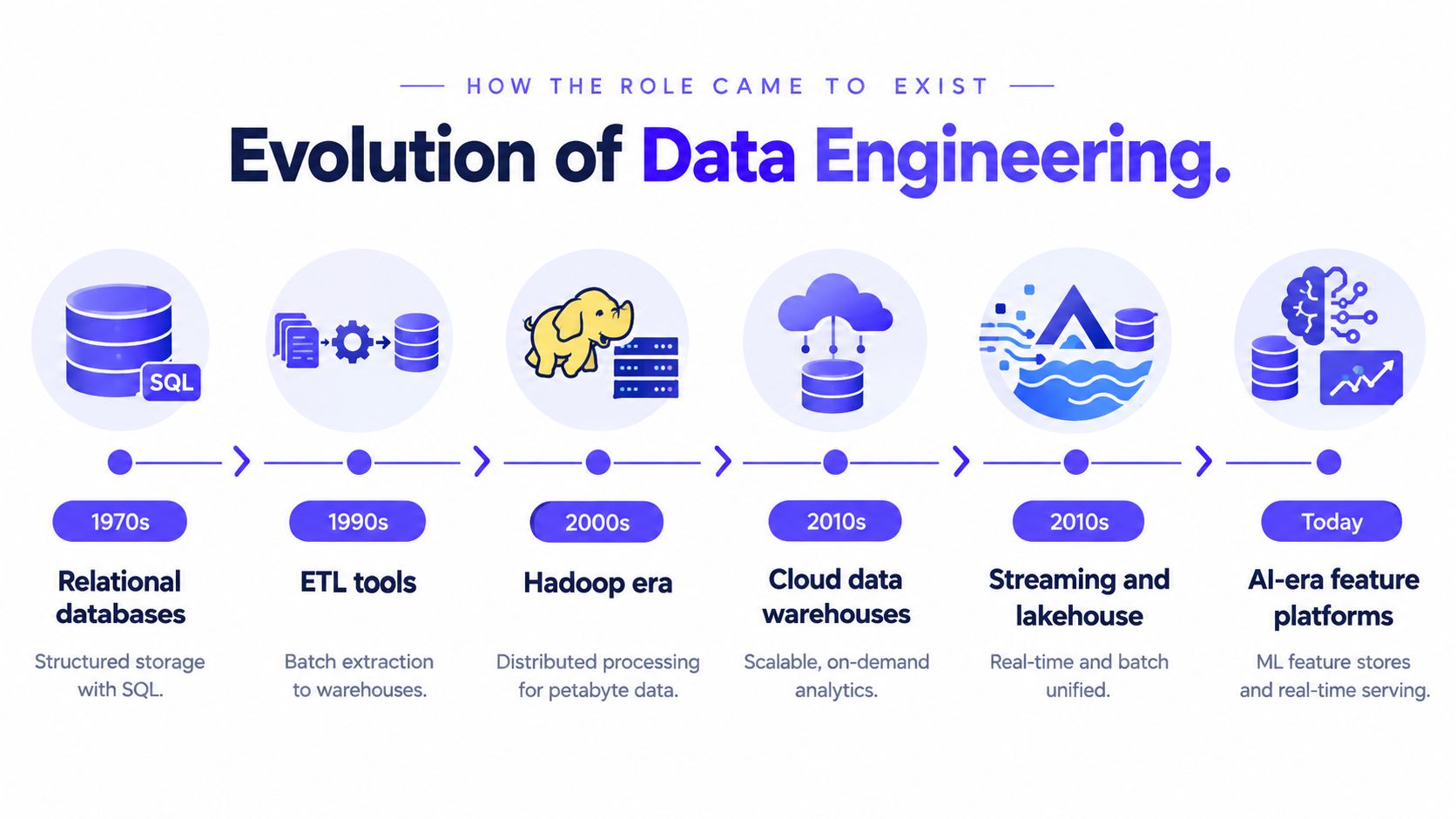
The 2000s changed the scale and shape of the problem. Google introduced the Google File System in 2003 and MapReduce in 2004. Amazon Web Services launched S3 in 2006, and Apache Spark emerged in 2010 as a faster alternative to MapReduce. James Dixon coined “data lake” in 2011, while Airbnb built Apache Airflow in 2014, making workflow orchestration central to production data work. These milestones are summarized in this history of data engineering.
Each shift added a capability the modern lead must coordinate:
- Relational systems require schema discipline.
- Warehouse programs require batch extraction and repeatable modeling.
- Distributed systems introduce schema-on-read and processing trade-offs.
- Cloud platforms separate storage and compute decisions.
- Streaming systems demand attention to delivery semantics and freshness.
- Lakehouse architectures bring storage, analytics, and governance closer together.
- AI platforms add feature freshness, lineage, and serving requirements.
The result is an end-to-end accountability problem. Analysts, database administrators, platform engineers, analytics engineers, and machine learning engineers may own parts of the stack, but someone must own the outcome across all of it. That person is the data engineering lead.
Core Responsibilities Broken Down
A strong lead turns broad accountability into visible weekly behavior. The following five pillars give you a better evaluation framework than a list of tools.
| Pillar | Weekly Behaviours | Tooling Signals | Failure Modes to Probe |
|---|---|---|---|
| Architecture | Runs design reviews, records decisions, and checks the target state against new requests | Snowflake, BigQuery, Databricks, dbt, Kafka, Spark, Airflow | Chooses tools by fashion, ignores operating cost, or creates duplicate platforms |
| Delivery | Maintains a prioritized roadmap, exposes dependencies, estimates work, and demos shipped outcomes | Backlog systems, architecture decision records, release workflows | Accepts every request, hides uncertainty, or misses commitments without escalation |
| Reliability | Reviews incidents, tracks service-level objectives, tests changes, and maintains backfill playbooks | Observability, data-quality tests, alerts, incident tooling, continuous integration and delivery | Treats failed jobs as isolated events and relies on manual reruns |
| Governance | Approves lineage, access controls, personally identifiable information handling, and documentation | Catalogs, lineage tools, role-based access, data contracts | Makes governance a late compliance exercise |
| People | Holds 1:1s, coaches engineers, reviews code standards, and improves on-call practice | Career frameworks, review templates, runbooks, rotation schedules | Becomes the only person who understands critical systems |
Architecture isn't a diagram exercise. The lead must decide when a batch process is sufficient, when change data capture or event streams are justified, and how warehouse, lakehouse, and streaming components fit together. Those choices affect latency, cost, reliability, and the number of operational paths the team must support. The lead data engineer role blueprint connects these decisions to end-to-end extract, transform, and load or extract, load, and transform ownership, incremental loads, monitoring, performance tuning, and data-quality automation.
Delivery is where architecture meets demand. A lead should be able to explain why a requested feature is sequenced behind reliability work, which dependency blocks a machine learning launch, and what a smaller first release looks like.
Reliability needs artifacts, not assurances. Ask for service-level objectives, alert ownership, incident timelines, postmortems, and documented recovery procedures. Governance should appear during design, not after a consumer discovers that a sensitive field was copied into an uncontrolled environment.
People leadership completes the model. The data engineering best practices guide is useful context, but your hiring process should still ask candidates to show the actual review routines, mentoring plans, and standards they've used.
Working With ML, Product, and Platform Teams
The data engineering lead sits at the junction of several teams, but that doesn't mean they own everything. Clear boundaries prevent duplicated work and make conflict resolvable.
| Partner Team | What the Lead Owns | What the Partner Owns | Shared Artefact |
|---|---|---|---|
| Data science | Reliable training data and feature pipelines | Model design, experimentation, and evaluation | Feature definition and data contract |
| Machine learning engineering | Production data movement and upstream dependencies | Model serving, inference code, and deployment integration | Training-to-serving pipeline design |
| Product management | Feasibility, sequencing, delivery risk, and data dependencies | Product priorities, user outcomes, and scope | Launch plan with acceptance criteria |
| Analytics engineering | Source reliability and platform standards | Semantic models, metrics, and analyst-facing transformations | Metric definition and ownership record |
| Platform or site reliability engineering | Data workload requirements and operational interfaces | Shared infrastructure, networking, identity, and platform reliability | Runbook and service boundary |
The lead commits to predictable interfaces. That means documented schemas, freshness expectations, ownership, escalation paths, and a clear answer when a source system changes. Partners must provide definitions, priority, acceptance criteria, and timely feedback. Without those inputs, the lead can't distinguish an urgent business requirement from an interesting technical request.
Lines blur around feature stores, embeddings, real-time inference, and reverse extract, transform, and load. Don't resolve that ambiguity by giving every team partial ownership. Name the system owner, the consumer owner, and the person who arbitrates trade-offs.
A practical model is a weekly data council chaired by the lead. Product brings launch priorities, machine learning brings training and inference dependencies, analytics brings metric conflicts, and platform brings infrastructure constraints. The lead leaves the meeting with decisions, named owners, and an updated delivery sequence.
The council's value isn't the meeting itself. It's the reduction of unresolved dependencies that otherwise surface as late launch surprises.
Skills and Signals That Predict Success
Tool familiarity is a weak hiring signal on its own. A candidate may know Airflow, Spark, or Databricks and still fail to create standards, manage risk, or earn trust across teams.
Use a matrix that tests technical depth, leadership behavior, and judgment under ambiguity.
| Capability Area | Specific Skill | Screening Signal | Interview Question |
|---|---|---|---|
| Technical depth | SQL, Python, and data modeling | Explains trade-offs between normalized, dimensional, and consumption-oriented models | “Show how you'd model a changing customer entity for analytics and machine learning.” |
| Technical depth | Distributed compute and streaming | Distinguishes throughput, freshness, recovery, and operational burden | “When would you choose batch over streaming for a customer metric?” |
| Technical depth | Orchestration and observability | Describes retries, alert ownership, lineage, and recovery without hand-waving | “Walk me through your response to a failed production workflow.” |
| Technical depth | Infrastructure as code and security | Treats permissions, environments, and deployment as engineering concerns | “How would you prevent a sensitive field from reaching an uncontrolled consumer?” |
| Leadership behavior | Writing and influence | Produces a design document that clarifies decisions for technical and nontechnical readers | “Tell me about a design document that changed a team's direction.” |
| Leadership behavior | Hiring, mentoring, and conflict resolution | Gives specific examples of raising capability and resolving disagreement | “How did you help an engineer grow into broader ownership?” |
| Decision-making | Prioritization under ambiguity | Makes constraints explicit and explains what they declined | “Which data request would you reject or defer, and how would you communicate it?” |
Three signals matter most in production.
First, can they delete a pipeline? Strong leads remove duplicate paths and make consolidation decisions. They don't preserve every workflow because someone once depended on it.
Second, can they write the design document everyone reads? The document should clarify the problem, options, risks, ownership, and decision. It shouldn't exist only to record a choice already made.
Third, can they say no without damaging the relationship? A lead who accepts every request creates hidden delivery risk. A lead who refuses without offering a viable alternative loses influence.
Use the data engineering skills guide to expand the technical screening rubric, but keep the interview anchored to production outcomes rather than certification lists.
Two Real-World Snapshots of the Role in Action
Snapshot A in a greenfield SaaS team
A Series B software-as-a-service company hired its first lead after data requests began competing with machine learning delivery. The lead started with a discovery audit, mapping ingestion paths, warehouse models, ownership gaps, and the dependencies behind the most important dashboards and model inputs.
The lead then wrote an architecture decision record that compared the existing options, established a contract pattern for core sources, and separated immediate reliability work from longer-term platform changes. Instead of trying to build everything personally, the lead hired two senior engineers, assigned clear ownership, and introduced design reviews and delivery demos.
The measurable result was a cut in dashboard latency, but the more important change was operational. Stakeholders could see what was committed, machine learning engineers knew which datasets were stable enough for training, and the team stopped treating every data request as an emergency.
The turnaround came from three observable behaviors:
- Auditing before rebuilding: The lead found duplication and unclear ownership before selecting more tools.
- Writing decisions down: The architecture record made trade-offs reviewable.
- Scaling through people: Hiring and coaching created more durable capacity than personal heroics.
Snapshot B in a struggling retail program
A mid-market retailer had recurring pipeline incidents and declining trust from merchandising and finance teams. The new lead didn't promise a new platform immediately. They first separated critical workflows from low-value jobs, stabilized service-level expectations, and created a visible incident review.
The lead also killed dead pipelines, renegotiated the roadmap with stakeholders, and rebuilt on-call practice around named ownership and usable runbooks. The team's credibility returned because people could see which workflows mattered, what the team could support, and how failures would be handled.
The observable behaviors were different from the greenfield case:
- Reducing scope: The lead stopped spending operational energy on pipelines with no current consumer.
- Making risk visible: Stakeholders saw incidents, dependencies, and trade-offs in the same review.
- Sharing operational ownership: On-call stopped depending on one engineer's memory.
These examples show why the role isn't defined by the number of pipelines someone has built. It's defined by whether they improve the system that decides what gets built, operated, retired, and trusted.
Hiring Checklist and Rate Bands
Start interviews with situations the candidate has handled. Generic questions about favorite tools won't tell you whether they can protect a launch, manage an incident, or grow a team.
| Competency | Must-Ask Question | Green Flag Signal | Red Flag Signal |
|---|---|---|---|
| Architecture trade-offs | “Describe a platform decision you reversed.” | Explains evidence, migration risk, and stakeholder impact | Claims the original decision was simply wrong |
| Incident ownership | “Tell me about the most serious data incident you led.” | Gives a timeline, containment steps, root cause, and prevention work | Focuses on blame or only describes the technical symptom |
| Stakeholder conflict | “When did you defer a high-profile request?” | Offers an alternative and preserves the relationship | Treats product or business partners as obstacles |
| Team scaling | “How did you raise the capability of a data team?” | Describes hiring, coaching, standards, and measurable ownership changes | Talks only about personal technical output |
| Governance | “How did you handle sensitive data in a new pipeline?” | Names access, lineage, review, and consumer controls | Assumes governance belongs to another team |
| Delivery discipline | “How do you expose uncertainty in a roadmap?” | Uses dependencies, risk levels, and explicit decision points | Hides uncertainty until a deadline slips |
Use this take-home prompt:
Design a 30-60-90 plan to consolidate five overlapping ingestion paths into a single contract-tested platform. Evaluate the plan on clarity, sequencing, risk management, and stakeholder mapping. Don't grade code volume.
The exercise should reveal whether the candidate can create an operating sequence, not whether they can produce an impressive architecture diagram. Reference checks should probe delivery reliability, incident ownership, and the growth of direct reports. Charisma is not a substitute for evidence.
For role definition, use a structured data engineering job description rather than a broad “build scalable pipelines” posting. Candidates entering a high-stakes role can also benefit from a practical Baz Porter executive survival plan, especially around establishing context, relationships, and early priorities.
The compensation figures in your hiring plan must be validated against the market and role scope. IT Jobs Watch recorded a UK median of £90,000 for permanent Lead Data Engineer listings in its six-month sample to 1 September 2026, while the US average reported by Salary.com was $122,065 as of 1 July 2026. Those sources give you an external reference point, but they don't validate the unsupported rate bands often repeated in hiring templates. Don't present unverified base or total-compensation ranges as market facts.
Your offer should state the sign-on structure, equity terms, on-call expectations, decision rights, and 90-day review criteria. A lead will evaluate those mechanics closely because they reveal whether the company understands the job it's hiring for.
Next Steps, KPIs, and How to Get Started
Take three actions this week.
- Audit delivery risk. Count production pipelines with no documented owner, incidents older than 30 days, and stakeholder escalations from the last quarter. Use the result to define the first problem the lead must solve.
- Write a one-page charter. Name the five ownership pillars, decision rights, partner responsibilities, and the three outcomes that matter most.
- Open a calibrated search. Build a shortlist against architecture, reliability, governance, delivery, and people signals. Don't run a job-ad lottery and hope the right operating-model owner appears.
Start instrumentation from day 30. Useful measures include the percentage of production jobs meeting their p95 freshness service-level objective, median days from a data request to production read, the percentage of ingestion routed through contract-tested paths rather than ad hoc paths, and team-health signals such as skip-level feedback and regrettable attrition.
Choose KPIs that expose risk instead of rewarding activity. Pipeline count, tickets closed, and tools adopted can rise while trust falls. A lead succeeds when consumers receive dependable data, delivery trade-offs become visible, platforms become easier to operate, and the team develops enough capability that critical knowledge no longer sits with one person.
If you need to validate the charter, compare candidates, or decide whether you need a lead, manager, architect, or fractional specialist, start with a readiness diagnostic and a hiring calibration session. ThirstySprout can provide sample profiles for remote data engineering talent across full-time, contract, and fractional engagements, matched to production data-platform and AI delivery needs.
ThirstySprout helps companies find remote data engineering and AI talent for pipeline hardening, observability, data platforms, and production AI delivery. Visit ThirstySprout to request sample profiles, start a pilot, or book a hiring calibration session for your data engineering lead search.
Hire from the Top 1% Talent Network
Ready to accelerate your hiring or scale your company with our top-tier technical talent? Let's chat.