

TL;DR
- Choose the right architecture first: Use REST for public APIs, GraphQL for mobile/front-end, and gRPC for high-performance internal microservices.
- Implement non-negotiable security: Use OAuth 2.0 with JWTs for authentication, implement rate limiting with the token bucket algorithm, and add a Redis caching layer to slash latency.
- Automate everything: Build a CI/CD pipeline with GitHub Actions and Docker to automate testing and deployment, reducing manual errors and increasing velocity.
- Prioritize Developer Experience (DX): Auto-generate interactive documentation from an OpenAPI spec and provide client SDKs in key languages like Python and Node.js to accelerate adoption.
Who This Guide Is For
This guide is for technical leaders who are on the hook for delivering real business value—CTOs, Heads of Engineering, and Founders at fast-moving companies. You've moved past the "what if" stage and need to build a production-ready API that works, scales, and supports the business.
This playbook is for you if:
- You're scoping a new AI feature and need a solid API to power an ML model or plug into a service like OpenAI.
- You're launching a new revenue stream by building an API as a product that partners and developers will pay for.
- You're building your core product, and this API is the foundation. Its performance and reliability can make or break the entire venture.
This is an execution plan for operators who need to make smart decisions in weeks, not months. We're focused on pragmatic choices for getting an API to market that adds direct business value, not another system that becomes a maintenance nightmare.
Quick Framework: The Production-Ready API Blueprint
Building a production-grade API requires a deliberate, step-by-step approach. Following this framework ensures you cover the critical pillars of design, implementation, and developer experience, preventing costly technical debt down the road.
- Strategic Design: Nail down the fundamentals. Choose the right architecture (REST vs. gRPC), define crystal-clear API contracts with tools like OpenAPI, and establish a clear versioning strategy from day one.
- Robust Implementation: Build it to last. Implement security as a non-negotiable, automate everything with CI/CD pipelines, and set up real observability so you're never flying blind.
- Developer Experience (DX): An API is only as good as its adoption. Focus on creating excellent documentation, providing helpful SDKs, and maintaining backward compatibility to earn developer trust.
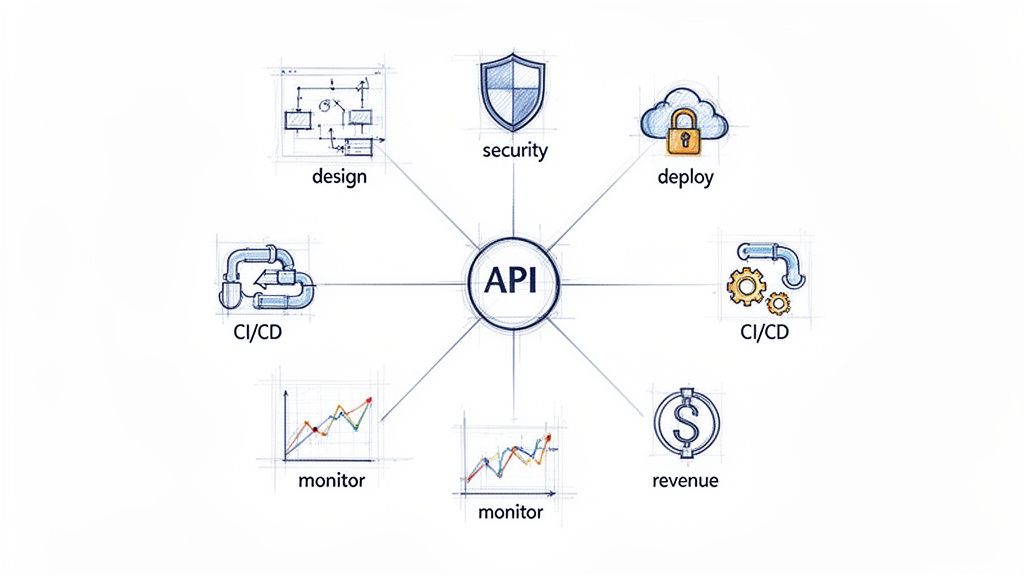
This diagram shows the full lifecycle of a production API, from initial design and security planning through to deployment, monitoring, and monetization.
Following this approach creates a powerful business asset that can unlock new product features, open up partner integrations, and directly fuel growth. It’s about playing the long game, where stability and happy developers are the true metrics for success. Making the right architectural calls early is a cornerstone of sound software architecture best practices and will save you from a world of refactoring pain.
Practical Examples of API Architecture and Security
Theory is one thing; execution is another. Here are two practical examples of how to implement key parts of your API strategy.
Example 1: JWT Authentication Middleware in Node.js
Security isn't an add-on; it's a core requirement. This code snippet shows a simple but effective JSON Web Token (JWT) authentication middleware for a Node.js Express application. It acts as a security checkpoint for your protected endpoints.
// A simple JWT authentication middleware in Node.js/Expressconst jwt = require('jsonwebtoken');function authenticateToken(req, res, next) {// Expects the header format: "Authorization: Bearer TOKEN"const authHeader = req.headers['authorization'];const token = authHeader && authHeader.split(' ')[1];if (token == null) {return res.sendStatus(401); // No token, no entry.}jwt.verify(token, process.env.JWT_SECRET, (err, user) => {if (err) {return res.sendStatus(403); // Bad token, access denied.}req.user = user; // Token is valid, attach user info to the request.next(); // Proceed to the actual route handler.});}This middleware acts as a bouncer, checking for a valid JWT in the Authorization header before allowing a request to access protected business logic.
Example 2: High-Availability API with Docker and Kubernetes
For a business-critical API, you need resilience. This architecture diagram shows a typical high-availability setup using Docker for containerization and Kubernetes for orchestration.
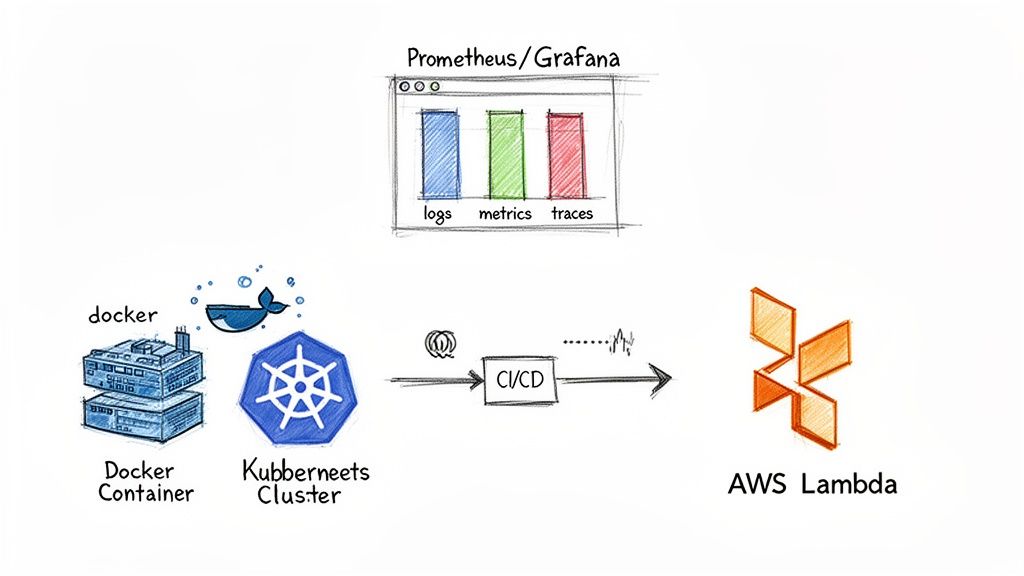
This architecture uses Kubernetes to automatically manage container scaling and failover, ensuring the API remains available even if underlying servers fail.
This setup provides incredible resilience. If a server goes down, Kubernetes automatically moves your API containers to a healthy one with minimal or zero downtime.
Deep Dive: Key Decisions, Trade-offs, and Pitfalls
Before writing a single line of code, you must make foundational decisions that will impact your API's entire lifecycle. Getting these wrong creates technical debt, frustrates developers, and hinders scalability.
Picking the Right Architectural Style
There is no single "best" API architecture. The right choice depends entirely on your use case.
- REST (Representational State Transfer): The industry default for public-facing APIs and standard resource-based operations (e.g., users, products). Its stateless nature and use of standard HTTP methods make it a reliable and widely understood choice.
- GraphQL: Ideal for mobile apps or complex front-ends. It allows clients to request exactly the data they need, solving the over-fetching and under-fetching problems common with REST. For a deeper look, see our comparison of GraphQL vs REST APIs.
- gRPC: The champion for high-speed, low-latency communication between internal microservices. It uses HTTP/2 and Protocol Buffers for highly efficient, strongly-typed connections. While not suited for public APIs, it's a powerhouse for backend infrastructure.
This decision tree shows how business goals directly map to architectural choices for your API.
API Architectural Style Decision Matrix
This table breaks down the key trade-offs to help you align technical needs with the right solution.
Define Your API Contract: Your Product's UI
Your API contract is the formal agreement between your API and its consumers. For REST APIs, the OpenAPI Specification (formerly Swagger) is the industry standard. It creates a machine-readable definition of your API used to auto-generate documentation, client SDKs, and server stubs.
Your API contract is your product's user interface. If it’s confusing or inconsistent, developers will misuse it or give up. Treat it with the same care as your primary application UI.
Well-designed APIs are known to cut development time for consumers by up to 40%. In a competitive market, clarity and ease of use are non-negotiable.
Plan for Change With Smart Versioning
Your API will evolve. A clear versioning strategy manages this evolution without breaking client integrations. The simplest and most common approach is URI versioning:
https://api.example.com/v1/usershttps://api.example.com/v2/users
This method is explicit. When you introduce a breaking change, you increment the version number in the URL. This allows existing users to continue on the old version without interruption. For more, review established API Design Best Practices.
Building for Security, Performance, and Scale
An API's value lies in its reliability and security under load. Neglecting these areas erodes user trust and increases infrastructure costs.
Nailing Down Authentication and Authorization
- Authentication: Confirms who is making the request.
- Authorization: Confirms if they have permission for the requested action.
For most modern APIs, OAuth 2.0 and JSON Web Tokens (JWTs) are the standard. OAuth 2.0 provides a solid framework for granting limited access, while a JWT acts as a secure "passport" for the user. Always stay current on essential security best practices when securing your API.
Stopping Abuse with Rate Limiting and Throttling
An API without rate limits invites abuse. A single runaway script can grind your service to a halt. Rate limiting protects your service's stability by controlling traffic flow. The token bucket algorithm is a common and effective implementation:
- Each API key has a "bucket" that holds a set number of tokens.
- Tokens are added to the bucket at a steady, fixed rate (e.g., 10 tokens per second).
- Each API request consumes one token.
- If the bucket is empty, the request is rejected with a
429 Too Many Requestserror.
This allows for short bursts of activity while enforcing a fair average rate over time.
Slashing Latency with Smart Caching
Not every API request needs to hit your database. For data that doesn't change frequently, a caching layer can dramatically improve response times and reduce backend load.
A well-implemented caching strategy can be the single most impactful performance optimization you make. Reducing latency from 200ms to 20ms is a user experience feature that drives retention.
A tool like Redis is perfect for this. When a request comes in, first check Redis for a cached response. If there's a "cache hit," return the data immediately. If it's a "cache miss," fetch the data from your database, store a copy in Redis with an expiration time (TTL), and then return it.
Automating Releases with CI/CD
Manual deployments are slow and error-prone. A Continuous Integration/Continuous Deployment (CI/CD) pipeline automates the entire release process, from code commit to production. GitHub Actions is an excellent tool for defining this workflow in a file that lives alongside your code.
A typical CI/CD pipeline for an API includes these stages:
- Build: Code is compiled and packaged into a deployable Docker image.
- Test: Automated unit, integration, and contract tests are run.
- Deploy to Staging: The new version is pushed to a pre-production environment.
- Deploy to Production: The change is rolled out to users, often using blue-green or canary strategies to minimize risk.
This automation directly shortens time-to-market and allows your team to ship updates with confidence. If your team is new to this, it's worth reviewing best practices for developing in the cloud.
Cost-Effective and Scalable with Serverless
For APIs with unpredictable or spiky traffic, a serverless approach with a service like AWS Lambda can significantly reduce costs. You only pay for the compute time you use, eliminating the expense of idle infrastructure.
The Three Pillars of Observability
You cannot manage what you cannot see. Observability provides insight into your API's performance through logs, metrics, and traces.
- Logs: Timestamped records of specific events, essential for debugging errors.
- Metrics: Aggregated numerical data over time (e.g., error rate, latency), used for spotting trends and triggering alerts.
- Traces: The end-to-end journey of a single request through your system, crucial for finding bottlenecks in a microservices architecture.
Proactive monitoring isn't about preventing failure—it's about detecting it instantly and having the data to resolve it before customers notice.
Tools like Prometheus (for metrics) and Grafana (for visualization) are a powerful open-source combination for monitoring key "RED" metrics:
- Rate (requests per second)
- Errors (number of failed requests)
- Duration (request latency)
Setting up alerts on these metrics (e.g., "alert if error rate >1% for 5 minutes") shifts your team from reactive to proactive.
Checklist: Crafting a World-Class Developer Experience
An API without adoption is a cost center. A world-class developer experience (DX) turns your API into a product people want to use.
Excellent DX is a competitive advantage that reduces partner onboarding time, slashes support tickets, and builds long-term trust.
- Swagger UI: Creates interactive documentation where developers can make live API calls from their browser.
- Redoc: Generates a clean, modern, three-pane static documentation site with excellent readability.
An SDK is a marketing tool. It signals a commitment to developer success and can be the deciding factor when a team chooses your API over a competitor's.
/v2/users) to introduce breaking changes without disrupting existing integrations. This builds trust and proves you are a reliable partner.- Backend Engineer: Owns the core logic, database design, and API architecture.
- DevOps/MLOps Engineer: Manages the CI/CD pipeline, cloud infrastructure (AWS, GCP, Azure), and observability stack.
- Quality Assurance (QA) Engineer: Designs and implements the automated testing strategy to ensure quality and reliability.
Backend API Engineer Skills Matrix
Use this matrix to objectively assess candidates and focus on what they've actually done.
A great engineer isn’t an expense; they are an investment in velocity and stability. A single senior engineer can often deliver in a month what a less experienced team might wrestle with for a full quarter.
What to Do Next
- Scope Your API: Use the decision matrix in this guide to choose the right architecture (REST, GraphQL, or gRPC) based on your immediate business goals.
- Define Your Security Model: Outline your authentication and authorization strategy using OAuth 2.0 and JWTs. Plan your rate-limiting approach.
- Assemble Your Team: Traditional hiring is slow. To move faster, partner with a specialized talent network to access pre-vetted senior engineers who can start in 2–4 weeks instead of 3–4 months.
An API is a product, and you need a world-class team to build a world-class product. ThirstySprout connects you with senior AI and backend engineers who have the production-grade experience needed to build, scale, and secure your most critical APIs. You can start your pilot in as little as two weeks.
Hire from the Top 1% Talent Network
Ready to accelerate your hiring or scale your company with our top-tier technical talent? Let's chat.