

The strongest signal that this role is no longer niche is simple, more than 100,000 U.S. AI-industry job postings per year now ask for AI ethics or governance skills, with demand concentrated in finance and information roles, according to Georgetown CSET. That tells you this is no longer an academic side topic. It's an operational hire for companies that want to ship AI without stepping into avoidable trust, compliance, or product risk.
TL;DR
- An AI ethics specialist is most useful as a governance operator, someone who turns principles into review steps, documentation, and release gates.
- Hire one when AI is moving into customer-facing, regulated, or high-stakes workflows, especially if product, legal, and engineering are already feeling friction.
- The best candidates can work across NIST AI RMF, ISO/IEC 42001, and sector rules like GDPR, SOC 2, or HIPAA where relevant, then translate that into auditable controls.
- A first hire can be full-time, contract, or fractional. The right model depends on whether you need ongoing ownership or a limited-risk audit.
- Start with a clear decision on authority. Advisory roles influence. Function-owning roles can block risky launches and require pre-deployment review.
If you're building an internal AI function, this role fits naturally alongside the broader thinking in AI in human resources management, especially when HR, product, and legal all touch model-driven decisions. For teams formalizing governance, the internal playbook on AI governance best practices is the right companion read.
Why Your Next Hire Might Be an AI Ethics Specialist
The hiring market already says this role matters. Georgetown CSET found that over 100,000 U.S. AI-industry job postings per year now require AI ethics or governance skills, and the strongest demand sits in financial and information sectors. That's a clear sign that responsible AI has moved from slide decks into staffing plans, budget lines, and workflow ownership.
For operators, the takeaway is blunt. If your AI systems touch lending, hiring, healthcare, customer support, fraud, or any other high-trust process, you need someone whose job is to reduce avoidable model risk before it becomes a customer issue or a regulatory one. That's especially true when product teams are pushing speed and no one owns the ethics checkpoint.
Practical rule: hire for the control plane, not the slogan. If a candidate can't explain how ethics becomes a review, a record, or a release gate, they're not ready.
The role also maps well to teams already thinking about adjacent functions like hire remote MLOps engineers, because the same release discipline that keeps models healthy can also keep them accountable. In practice, the first real win is often not “better ethics messaging.” It's a cleaner launch process, fewer escalations, and fewer surprises for legal and leadership.
What this hire is for
- Risk reduction: catch biased, opaque, or poorly governed use cases early.
- Operational clarity: define who reviews what before a model ships.
- Cross-functional alignment: keep engineering, legal, product, and leadership on the same page.
- Audit readiness: create records that show how decisions were made.
The business case is usually easier than leaders expect. You're not paying for abstract virtue. You're buying a function that lowers launch friction in sensitive AI programs.
The Role Beyond Buzzwords What an AI Ethicist Actually Does
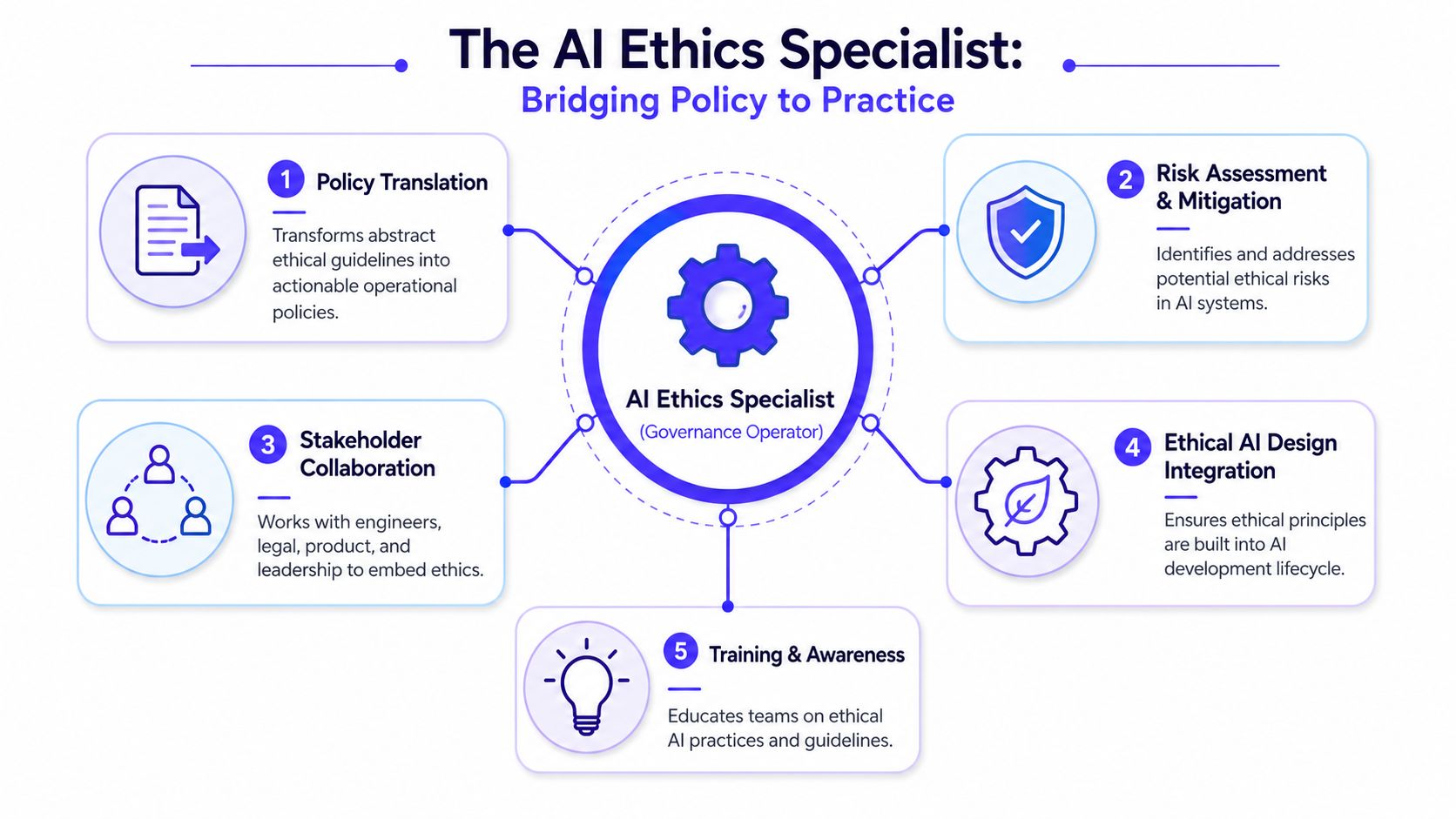
The best way to think about this role is as a governance operator. Coursera's framing is useful here, because the job is less about philosophy and more about repeatable workflows, like risk assessments, policy design, cross-functional reviews, and incident response across the AI lifecycle (Coursera on the AI ethicist role). In other words, the job is to turn broad principles into things your teams can execute.
A fintech example makes this concrete. Say a company wants to launch an automated loan recommendation model. Engineering has performance metrics, legal has disclosure concerns, and product wants speed. The ethics specialist steps in before launch, asks where the training data came from, checks whether review steps exist for adverse outcomes, and pushes for a documented escalation path if the model behaves badly.
That work sounds simple until you see what it prevents. A biased model can become a customer complaint, a board-level issue, or a public relations problem before an effective reaction is possible. The specialist's job is to create the controls that make those failures visible early, not after users are already affected.
A useful internal test is this, if a decision can't be reviewed later, it wasn't governed well enough before release.
What the day-to-day looks like
The strongest candidates spend their time on practical artifacts, not abstract memos. They help teams write model documentation, define review thresholds, document risk registers, and decide who has to sign off before launch. They also help teams decide what happens after release, because governance doesn't stop once the model is live.
A useful pattern is to keep the role embedded in decision points. That means the specialist sits close enough to engineering to understand implementation, close enough to legal to understand obligation, and close enough to product to understand scope. If they sit too far from one of those groups, the controls become decorative.
A simple workflow
- Intake: identify the use case, data source, and user impact.
- Review: check for bias, transparency gaps, and policy conflicts.
- Document: record the decision, the risk, and the mitigation.
- Escalate: route high-risk issues to the right owner.
- Monitor: watch for issues after release and update controls.
A practical interview for this kind of role often sounds like the one you'd use for an AI talent placement agency screening process, because you're testing judgment, not just vocabulary. You want evidence that the person can make governance usable under real delivery pressure.
Core Skills and Responsibilities Matrix

The best candidates can do three things at once. They understand how models fail, they understand how organizations govern risk, and they know how to move people who don't report to them. That mix matters because the role lives in the gap between policy and execution.
The clearest source-backed way to define the job is through the frameworks it must touch. An effective specialist should be able to operate across NIST AI RMF and ISO/IEC 42001, then turn fairness and transparency into auditable artifacts like risk registers, bias reviews, and model documentation (job description guidance). That's where many candidates fall short. They know the language, but they can't make it concrete.
Skills to look for and what they should produce
| Skill area | What it should translate into | What good looks like |
|---|---|---|
| Technical understanding | Model and data review | Spots weak data provenance, hidden bias, and missing documentation |
| Regulatory and policy fluency | Control mapping | Converts broad obligations into review steps and evidence trails |
| Cross-functional influence | Decision alignment | Gets engineering, product, and legal to act on the same risk view |
| Operational discipline | Repeatable governance | Builds checks that survive shipping pressure and team turnover |
A practical job description should make each of those outcomes explicit. Don't ask for “ethics awareness” and stop there. Ask for the ability to write review criteria, maintain decision records, and explain trade-offs to non-specialists. That's the difference between a symbolic hire and a working control function.
What good responsibility statements sound like
- Policy development: turn principles into approval criteria and review steps.
- Bias identification: examine data, output patterns, and user impact for skew.
- Stakeholder engagement: bring engineering, legal, product, and leadership into one review process.
- Reporting and advocacy: write clear risk memos that lead to action.
- Compliance monitoring: keep the controls aligned with relevant obligations.
If you want a team structure that supports this role, the framework used when you hire AI engineers is a useful reference point. The ethics hire shouldn't be isolated from delivery, because the controls need to sit where work happens.
Framework How to Hire an AI Ethics Specialist
The first decision is not who to hire. It's what kind of authority the role needs. A weak version of this hire gives advice and waits for others to act. A strong version has enough ownership to block risky launches, review vendors, and require pre-deployment assessment when needed (government job description guidance.pdf)).
Choose the right hiring model
Full-time works when governance is continuous. Use it if AI touches multiple products, if you're in a regulated sector, or if the role needs to own an internal review function.
Contract fits a defined engagement. It works well for a first audit, a policy reset, or a one-time launch review.
Fractional is the cleanest fit for early-stage teams that need strong judgment without a permanent headcount commitment. It's also useful when you need senior oversight while you're still building the internal process.
| Model | Best fit | Trade-off |
|---|---|---|
| Full-time | Ongoing ownership and deep integration | Harder to hire and more overhead |
| Contract | Specific project or interim coverage | Less continuity |
| Fractional | Strategic guidance with lower commitment | Limited availability |
Decide whether the role is advisory or function-owning
Advisory roles influence. Function-owning roles enforce. That distinction changes everything, from how the job is scoped to how the person interacts with leadership. If you expect this hire to shape release decisions, their charter has to say so clearly.
A startup that's adding its first AI feature can usually start with a fractional specialist for a limited-scope review. A scale-up shipping customer-facing models in a sensitive domain usually needs a full-time owner. If you're unsure, start by mapping the highest-risk use case and ask who would own the stop or go decision if something looks off.
Hire the authority that matches the risk, not the org chart that already exists.
If you need broader delivery support around the same time, the operating model used in AI center of excellence planning can help you place the role inside a larger governance system instead of making it a lone reviewer.
A Practical Interview Kit with Scorecard
A good interview process should test judgment under pressure, not just familiarity with responsible AI language. The easiest mistake is to ask broad theory questions and then hire the person who sounds most polished. That usually selects for vocabulary, not operational skill.
The strongest candidates can explain trade-offs in plain English. They can also show how they'd handle a review when the business wants speed and the model raises concerns. That's the signal you want.
Sample interview questions
| Question Category | Sample Question | What to Look For |
|---|---|---|
| Behavioral | Tell me about a time you had to explain an ethical risk to engineers. | Clear communication and practical influence |
| Scenario | A model is showing biased outcomes, but launch is near. What do you do? | Judgment, escalation, and trade-off awareness |
| Governance | How would you create an AI ethics review process from scratch? | Structure, repeatability, and ownership |
| Technical | How do you think about data bias versus model bias? | Real understanding of failure points |
| Leadership | What would you do if a senior leader wanted approval before review was complete? | Backbone and process discipline |
A useful take-home is short and concrete. Ask the candidate to review a proposed AI-powered hiring tool and write a one-page risk memo for the CTO. You'll learn how they prioritize issues, what evidence they ask for, and whether they can be concise without becoming vague.
Simple scorecard
Score each area from 1 to 5:
- Technical judgment
- Policy and regulatory fluency
- Cross-functional communication
- Operational rigor
- Ability to escalate clearly
Use the same scorecard across every finalist. That keeps the process consistent and makes it easier to compare candidates with very different backgrounds.
For process discipline, a structured interview flow similar to the one described in Humantext.pro interview advice can help keep screening fair and comparable. For a role this sensitive, the final step should also include a thorough background check, verification of employment history, detailed references, and, depending on the risk profile, criminal background checks and online presence reviews (screening guidance).
Organizational Placement and Salary Benchmarks
Where this person sits determines how much they can change. If the role reports into legal, it will usually be strongest on compliance and documentation. If it reports into the CTO, it can get closer to engineering decisions. If it sits with product, it can shape design choices earlier.
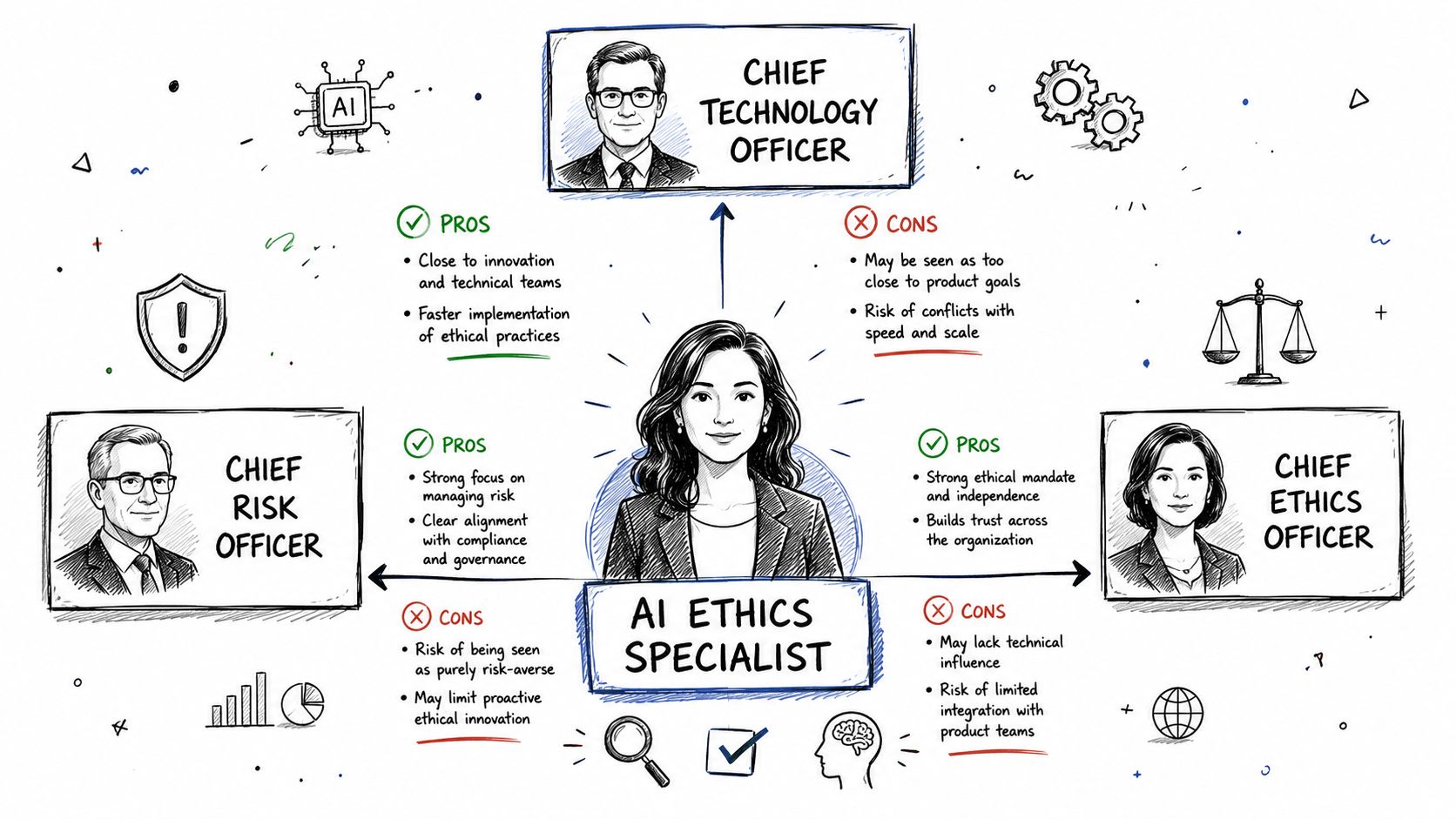
There isn't one correct structure. There is only the one that matches your risk profile and your current delivery bottleneck. If your main problem is release discipline, proximity to engineering matters. If your main problem is regulatory readiness, legal may make more sense.
Placement trade-offs
Legal reporting gives the role authority on obligations and records, but it can slow integration into product planning.
CTO reporting gives the role better access to technical teams and release decisions, but the person needs strong support from legal to avoid becoming overly engineering-centric.
Product reporting works well when the main goal is to embed ethics early in design, especially in customer-facing workflows.
A good rule is to place the role where it can see the highest-risk decisions earliest. That usually means a cross-functional path, even if the formal line sits in one department.
Budget clarity
I'm not going to invent salary numbers here, because the verified data you gave me doesn't include them. What matters more than a generic benchmark is matching compensation to scope, authority, and whether the hire is full-time, contract, or fractional. A function-owning role with release authority should never be priced like a lightweight advisory engagement.
If you're building the internal structure around this hire, the operating model used for an AI center of excellence can help you decide whether the ethics specialist should be central, embedded, or both. The goal is to give them enough access to influence decisions before they harden into product risk.
Your AI Ethics Hiring Checklist and Next Steps
Use this checklist before you post the role:
- Define authority: advisory, gatekeeping, or function-owning.
- Pick the hiring model: full-time, contract, or fractional.
- Write outcomes first: risk registers, review gates, documentation, and escalation paths.
- Build the interview kit: behavioral questions, scenario prompts, and a scorecard.
- Run screening properly: employment checks, references, and risk-based background review.
- Place the role where it can act early: legal, CTO, or product, depending on your risk profile.
The fastest path is usually to start with one high-risk use case, one clear owner, and one review workflow. If you do that well, the rest of the governance stack gets easier to standardize.
A CTA for ThirstySprout. Start with a short scope call, define the first AI use case you want to de-risk, and we can help you pilot a vetted remote AI ethics specialist in weeks, not months.
Hire from the Top 1% Talent Network
Ready to accelerate your hiring or scale your company with our top-tier technical talent? Let's chat.