

AI engineer hiring grew by more than 25% year over year in 2025, reaching record levels and outpacing overall hiring growth by nearly 30%, according to LinkedIn's 2025 AI Labor Market Update. That sounds like a talent shortage story. For many teams, it's an assessment problem.
The candidates who can explain transformers, build a notebook prototype, or discuss model architecture are easier to find than the engineers who can operate an AI system after launch. Production candidates need to design evaluations, control inference costs, monitor degradation, implement guardrails, and respond when the system fails. This playbook shows how to identify those capabilities in a remote hiring process, move quickly, and avoid confusing theoretical fluency with delivery ability.
The AI Hiring Market Has Shifted
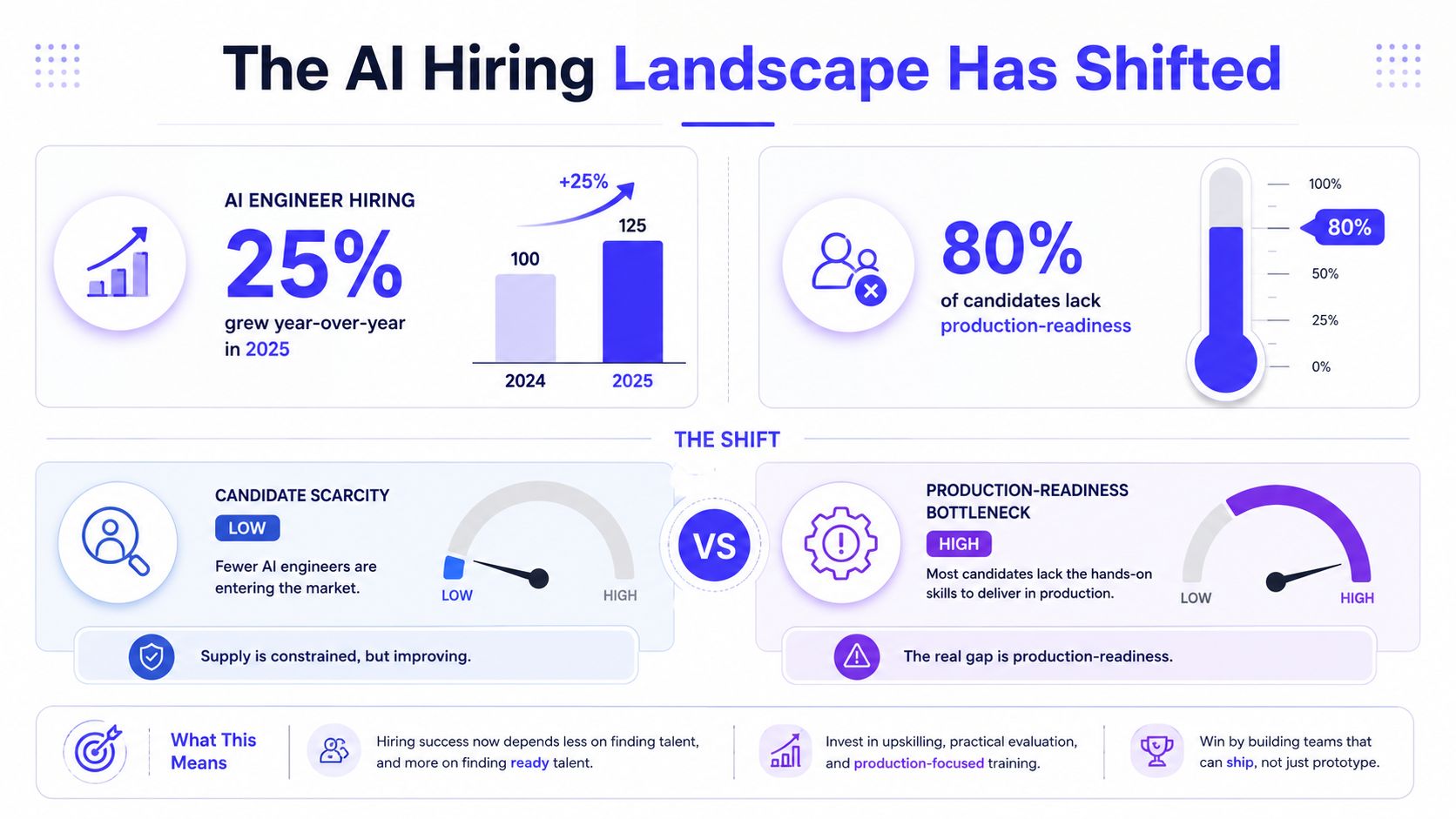
Veritone recorded 35,445 AI-related positions in Q1 2025, up 25.2% year over year and 8.8% from the previous quarter. AI/Machine Learning Engineer was among the three most-open titles and grew the fastest, rising 41.8% year over year and 13.1% quarter over quarter, according to Veritone's Q1 2025 labor-market analysis.
The U.S. labor market shows the same pattern at a more detailed level. Companies are hiring engineers to build, deploy, and operate AI systems inside real products, not only to prototype generative AI features. The hiring signal matters because production work demands different evidence from research fluency.
Scarcity is only half the problem
Candidate supply matters, but it is not the only constraint. UK labor-market data found that 97% of organizations reported at least one AI skills gap, while 57% reported technical gaps and 35% struggled to fill AI roles, according to Autodesk's AI Jobs Report. The practical question is whether a candidate can turn a promising model or workflow into a dependable production service.
Use a scorecard built around delivery capabilities. Assess whether the candidate can define an evaluation set, identify failure modes, choose an appropriate retrieval or inference strategy, instrument the service, control operating costs, and explain how the team will handle incidents. A candidate with narrower model knowledge but strong operational judgment may create more value than a broad theorist who has never owned a live system.
Practical rule: Hire for the hardest production capability your roadmap needs, not for the most impressive collection of keywords.
Traditional interviews often separate knowledge from context. A candidate may answer an attention-mechanism question correctly while missing data leakage, weak retrieval, unsafe tool access, or an unmonitorable deployment design. Capability-based screening puts those trade-offs in front of the candidate and observes how they reason about reliability, cost, monitoring, and guardrails.
For founders defining a role for the first time, AI recruitment for startups can provide useful context on role scoping and talent searches. The hiring team still owns the production bar. A recruiter cannot substitute for a clear system brief, calibrated rubric, and technical interviewer who understands the actual work.
Sourcing Senior AI Engineers Who Can Ship
Senior AI engineers rarely respond to generic descriptions of “cutting-edge” work. They respond to a credible problem, a realistic technical environment, and evidence that the team understands the difference between a demo and a production service.
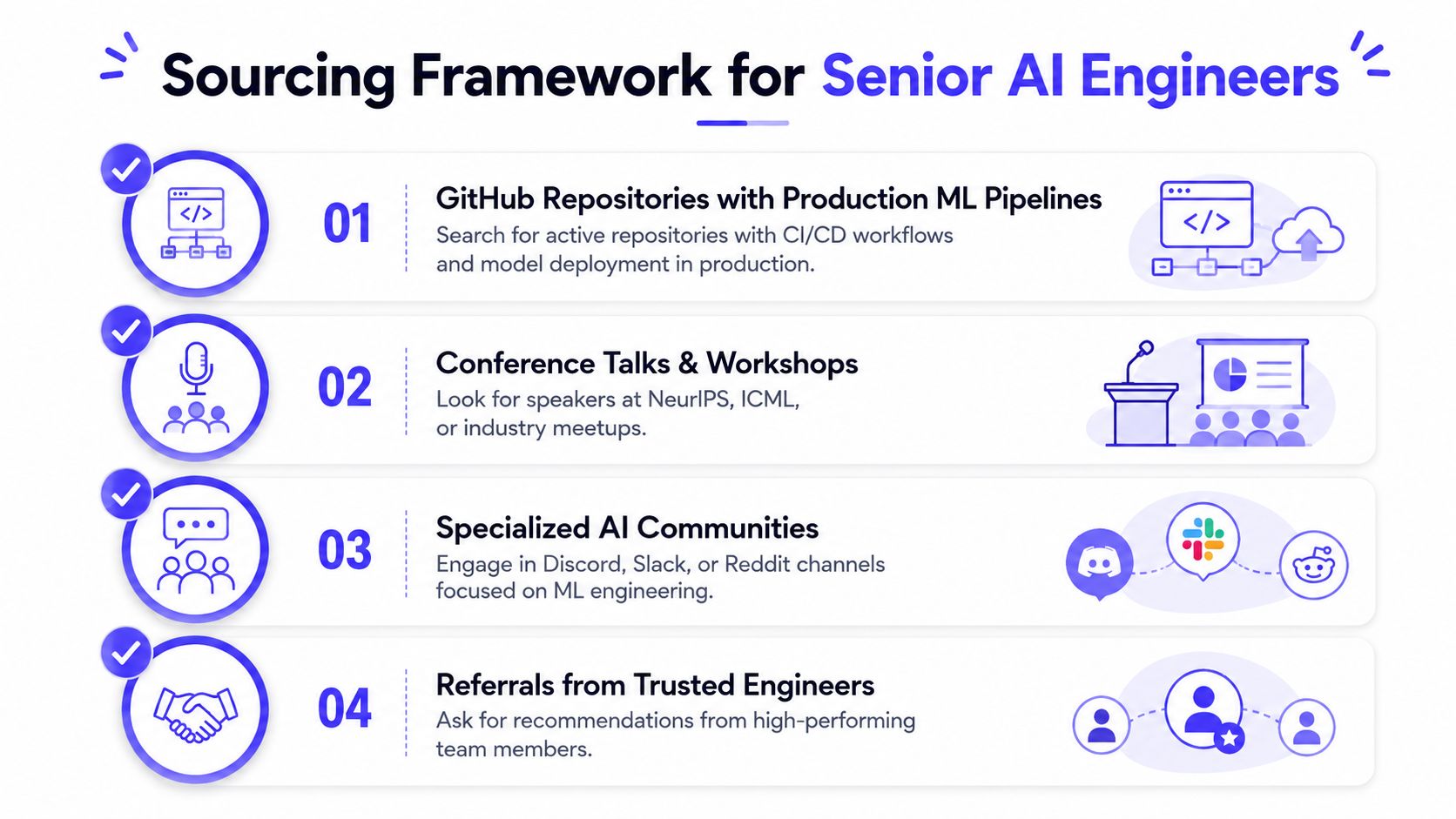
Start with work artifacts rather than titles. Search GitHub for repositories that include deployment configuration, tests, continuous integration, model or prompt versioning, evaluation code, and operational documentation. Look at conference speaker lists and workshop contributors from applied AI and machine learning operations communities. Read technical blogs that discuss latency, retrieval quality, observability, rollback plans, or infrastructure trade-offs. Open-source contributions to projects such as LangChain or vLLM can be useful signals, but contribution volume alone doesn't prove production ownership.
A practical sourcing score
Use a pre-screen scorecard before scheduling a call. Keep it focused on evidence.
| Signal | Strong evidence | Weak evidence |
|---|---|---|
| Production ownership | Explains deployment, monitoring, rollback, and on-call decisions | Lists models or platforms without describing operations |
| Evaluation discipline | Can describe test data, quality thresholds, and regression checks | Relies on informal demos or anecdotal feedback |
| Systems judgment | Discusses latency, cost, privacy, and failure handling together | Optimizes model quality while ignoring constraints |
| Communication | Writes clear design notes and explains decisions to non-specialists | Uses dense terminology without connecting it to outcomes |
| Scope and ownership | Separates personal contribution from team output | Claims responsibility for broad projects without specifics |
A useful outreach note references something the candidate built:
I read your write-up on monitoring retrieval quality in a production search system. We're dealing with a similar problem, but our constraints include strict data boundaries and a small platform team. Would you be open to a short conversation about the design trade-offs you'd make?
That message works better than praise because it gives the candidate a technical reason to engage. It also lets you test their depth before the interview. Ask what broke, which metric changed, what they rolled back, and what they'd redesign now.
Red flags in the first conversation
Be cautious when a candidate can describe a prototype but not its operating boundary. Common warning signs include no explanation of data freshness, no distinction between offline and online evaluation, vague answers about alerting, and an assumption that a larger model solves every quality issue. Another concern is inability to explain how they worked with product, security, or infrastructure partners.
Remote teams can use a specialist partner or a remote staffing agency when they need additional sourcing reach. The partner should still present evidence tied to your scorecard, not a stack of resumes optimized for keyword matching.
Capability-Based Evaluation Over Theoretical Knowledge
The best evaluation separates two tracks. Production machine learning delivery asks whether the engineer can build and operate the system. Applied AI literacy asks whether they can make sound decisions with product, data, security, and platform partners.
This doesn't make fundamentals irrelevant. An engineer still needs enough technical depth to understand model behavior, data quality, evaluation limits, and system constraints. The change is that you test those fundamentals inside a realistic decision instead of treating isolated recall as the primary signal.
| Theoretical Knowledge Signal | Production-Readiness Signal | Assessment Method |
|---|---|---|
| Explains attention or transformer architecture | Chooses an architecture based on quality, latency, cost, and maintenance constraints | Ask the candidate to compare two feasible designs for a user-facing feature |
| Defines precision and recall | Designs an evaluation set for retrieval-augmented generation, including hard negatives and regression checks | Review a short evaluation plan and probe how it handles changing data |
| Names fine-tuning methods | Explains when prompting, retrieval, fine-tuning, or a smaller model is appropriate | Give a scenario with quality and infrastructure constraints |
| Describes model drift conceptually | Detects degradation, identifies likely causes, and selects a rollback or retraining response | Run a production incident discussion |
| Lists safety techniques | Implements guardrails at input, retrieval, generation, and tool-use boundaries | Ask for a layered safety design and failure analysis |
| Writes algorithmic code from scratch | Debugs a failing pipeline, tests edge cases, and verifies AI-assisted output | Use a repository-based coding exercise |
| Discusses cloud services | Designs a deployable service with secrets management, observability, scaling, and rollback | Conduct an architecture review |
A candidate who can explain why a retrieval system returns plausible but irrelevant documents is showing a more valuable signal than someone who can recite vector database terminology. Look for a sequence of reasoning: inspect the query and corpus, separate retrieval from generation errors, define a measurable test set, change one variable at a time, and verify the result.
The same principle applies to AI-assisted development. Tools can accelerate implementation, but the engineer must inspect generated code, challenge assumptions, run meaningful tests, and remain accountable for the design. A realistic interview that includes ambiguity and verification often reveals more than a puzzle designed to test memory.
Use AI engineer interview questions to expand the question bank, then adapt every question to the system your new hire will own.
Technical Assessments That Predict Success
A reliable AI hiring process needs several signals because no single interview reveals production judgment. Technical hiring funnels can be inefficient. Companies interview an average of 21 candidates for one software engineering hire, only 3% of applicants are invited to interview, and 27% of interviewed candidates receive an offer, according to Rockstar Developer University's engineering interview statistics. Use those figures to justify calibration, not to add more rounds. Each assessment should expose whether a candidate can ship a monitored, cost-aware system with practical guardrails.
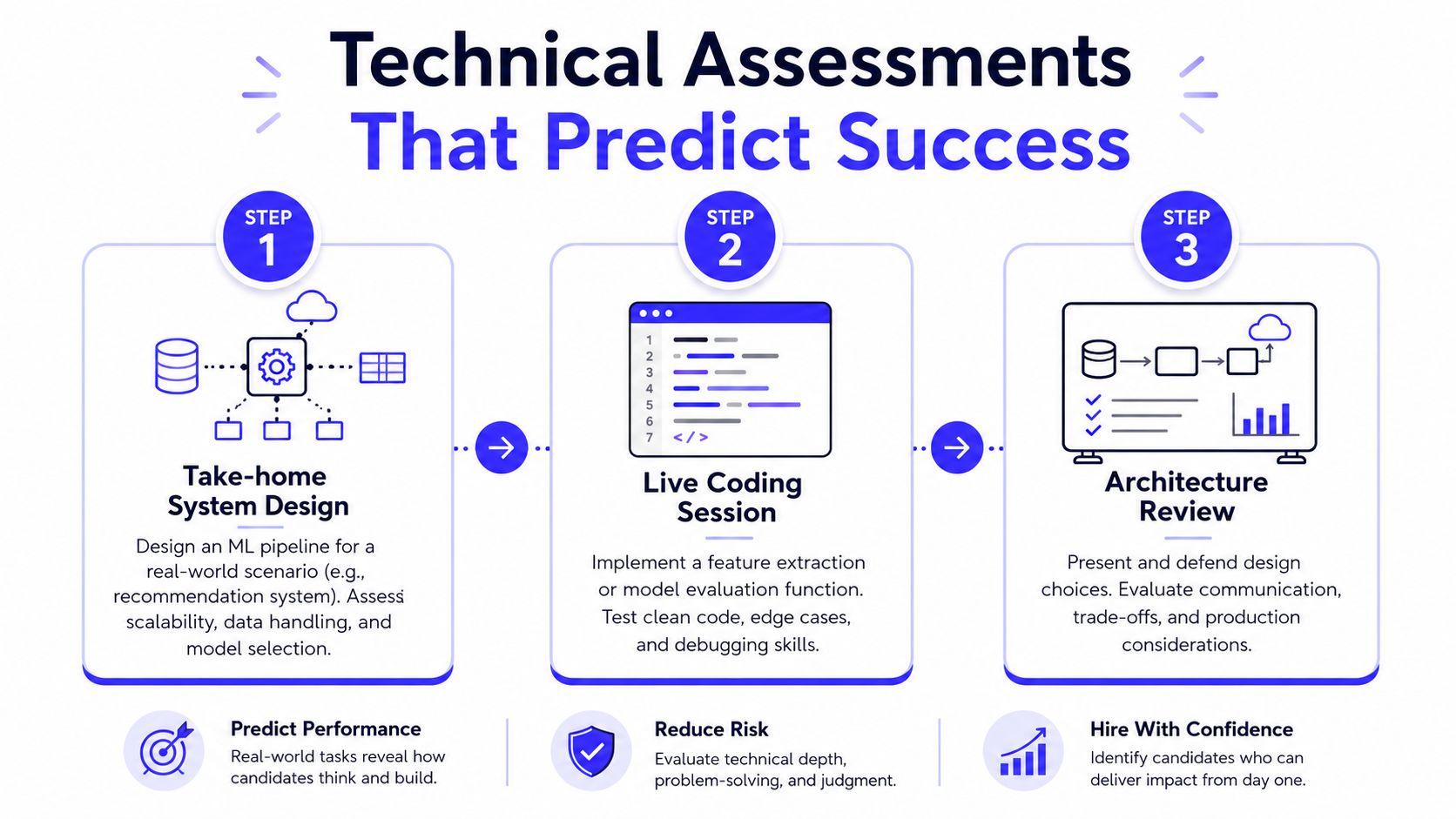
Use a three-part process
1. Take-home system design. Give the candidate a bounded problem that resembles the role:
Design a retrieval-augmented generation pipeline for a 50k-document knowledge base. Describe ingestion, chunking, indexing, retrieval, reranking, generation, evaluation, monitoring, access control, and rollback. State which assumptions you need to validate.
Score problem framing, evaluation design, reliability, security, cost awareness, and clarity. Do not grade candidates on whether they select your preferred vendor. Grade the decisions they identify, the trade-offs they explain, and how they would detect quality or cost regression after launch.
2. Live debugging and optimization. Provide a small service with a retrieval-quality regression, an inefficient inference path, or a failing evaluation test. Ask the candidate to inspect the code, reproduce the issue, form a hypothesis, make one focused change, and explain what they would monitor after release.
Strong candidates test and verify the result. They isolate the failure before changing the model or increasing context, then discuss the effect on latency, spend, and answer quality.
3. Production scenario discussion. Ask, “A customer reports that answer quality dropped after yesterday's document update. What do you check first, and how do you protect users while investigating?” Look for a clear sequence: detection, containment, diagnosis, remediation, and follow-up. Candidates should address rollback, data changes, retrieval metrics, user impact, and communication.
Calibrate the interviewers
Assign each interviewer a defined signal and provide one scoring rubric. “Strong” should mean the candidate supplied concrete evidence, not that the discussion felt impressive. Require written feedback before the panel discussion so the loudest voice does not replace independent observations.
Single-pass interviews remain noisy. Strong engineers can still fail a technical interview on a subsequent attempt about 22% of the time, reinforcing the need for multiple signals and repeatable scoring. If a candidate narrowly misses one round but shows sound production judgment elsewhere, review the complete evidence instead of applying an automatic veto. Use AI engineer interview questions to broaden the question bank, then adapt each question to the system the hire will own.
Compensation and Engagement Models
Compensation decisions should follow role scope, scarcity, geography, employment structure, and business risk. Avoid building a package around the title alone. An applied AI engineer integrating models into an existing product has a different market position and delivery profile from a research specialist or an engineer responsible for an entire machine learning platform.
Choose the engagement around the work
Full-time hiring fits core product ownership, sensitive systems, and roadmaps that require continuity. It gives the engineer time to understand your data, users, architecture, and operating model. The trade-off is a longer commitment and a higher cost of getting the role definition wrong.
Contract hiring works well for a bounded migration, evaluation system, deployment project, or urgent production gap. Write acceptance criteria before the contract starts. Otherwise, the team may buy activity without receiving a reliable capability.
Fractional engagement makes sense when you need senior architecture, hiring calibration, or technical direction but don't yet have enough ongoing work for a full-time specialist. Fractional leadership won't replace an engineer who must own daily implementation. It can, however, prevent an early architecture mistake and help a broader team make sound decisions.
Use the AI engineering salary guide as one input, then validate the range against the candidate's actual responsibilities. Compensation should reflect whether the engineer owns production incidents, customer-facing quality, infrastructure, compliance requirements, or team leadership.
Make the offer legible
Candidates need to understand the work, decision authority, working hours, remote expectations, and growth path. Explain how the team handles technical disagreement and whether the engineer can influence architecture. Equity can matter, but vague upside won't compensate for unclear scope or a process that signals indecision.
For contract-to-hire, define the conversion criteria before work begins. Include deliverables, review points, ownership boundaries, and the people who make the conversion decision. Don't use the arrangement as an extended interview with moving goalposts. Senior engineers notice that pattern quickly and may choose a team offering clearer trust.
A practical decision rule is simple. Hire full-time when the capability is central and recurring. Contract when the outcome is defined and temporary. Use fractional expertise when the primary risk is architectural judgment or capability planning.
Onboarding for Immediate Impact
A senior AI engineer shouldn't spend the early months guessing how your system works or waiting for access. Remote onboarding needs an explicit path from context to ownership, with written decisions and small production changes that create useful feedback.
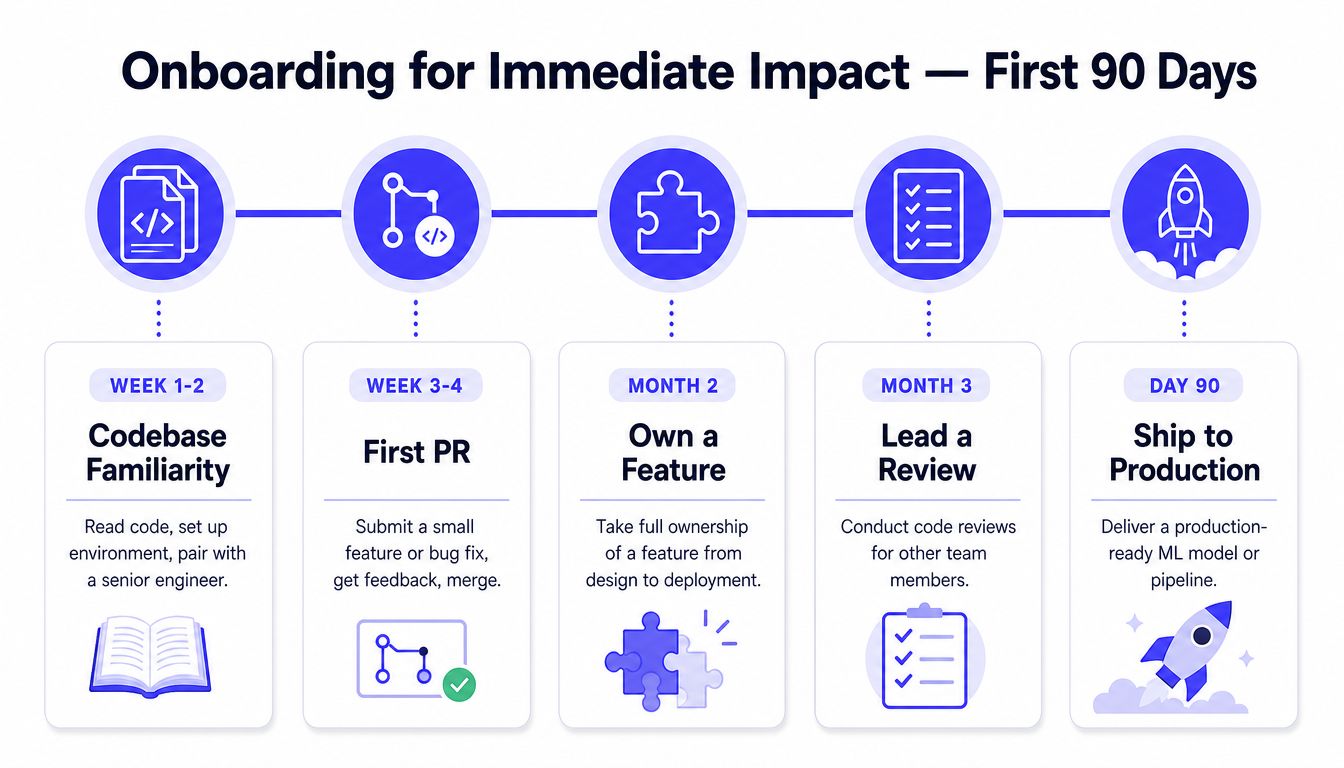
The first phase is Week 1–2, focused on codebase familiarity and environment setup. Give the new hire architecture notes, service ownership maps, data-handling rules, local setup instructions, and a named technical partner. Ask them to trace one request from user input through retrieval or inference, logging, storage, and response delivery.
A 30-60-90 day plan
| Period | Expected contribution | Evidence of healthy ramp |
|---|---|---|
| Week 1–2 | Set up tools, read key code, map the production path, and ask targeted questions | Written system map and a small list of verified risks |
| Week 3–4 | Ship a small bug fix, test improvement, monitoring change, or evaluation update | Merged pull request with review feedback addressed |
| Month 2 | Own a feature from design through deployment | Clear success criteria, evaluation results, rollout plan, and operational owner |
| Month 3 | Lead a technical review or initiative | Decision record that explains alternatives, risks, and follow-up work |
Choose an onboarding project that improves the system without blocking the critical roadmap. Examples include adding regression cases to an existing evaluation suite, improving traceability for model outputs, or instrumenting latency across retrieval and generation. The project should be small enough to finish, but real enough to expose your development and release process.
Remote readiness is part of delivery, not a personality preference. Guidance from remote interview preparation resources emphasizes written communication, self-management, asynchronous collaboration, remote tools, stable technical setup, and cross-time-zone coordination. Apply the same expectations after hiring. Require design notes, decisions, and handoffs to live where the whole team can find them.
Track ramp through observable behaviors. The engineer should move from asking broad orientation questions to raising specific system risks, then to making bounded decisions and owning outcomes. A mismatch often appears when the new hire avoids production responsibility, waits for synchronous direction across time zones, or proposes major rewrites before understanding the current constraints.
For more detail on measuring the transition from onboarding to independent contribution, use time to productivity as a planning reference.
Speed-to-Hire Without Sacrificing Quality
Specialized hiring takes planning. Senior individual-contributor production machine learning roles at Series B and later U.S. AI and data companies have a median time-to-fill of 70 days, according to DataDriven's 2026 ML engineer hiring benchmarks. That doesn't mean every search should take 70 days. It means the workflow must account for a narrow candidate pool, technical evaluation, and offer competition rather than treating speed as an afterthought.
The fastest reliable process removes waiting, not rigor. Approve the role scope and compensation range before sourcing. Give candidates the assessment brief early. Reserve interview slots in advance, and assign one decision owner who can resolve disagreements.
A practical hiring timeline
| Stage | Operating standard | Owner |
|---|---|---|
| Role intake | Define one primary production outcome, required capabilities, and non-negotiable constraints | Hiring manager and technical lead |
| Resume review | Review qualified profiles within 48 hours | Hiring manager |
| Initial conversation | Test motivation, communication, availability, and evidence of shipped work | Recruiter or talent partner |
| Technical assessment | Use one bounded design task and one focused live session | Technical interviewers |
| Debrief | Submit independent written scores before discussion | Interview panel |
| Decision | Resolve open questions with targeted follow-up, not another broad round | Hiring manager |
| Offer | Prepare the package and decision path before final interviews | Hiring manager and talent lead |
Async assessments help distributed teams respect time zones, but they need a clear time boundary and an explicit policy on AI tools. If AI assistance is allowed, evaluate how the candidate frames the task, verifies output, tests edge cases, and takes ownership of the result. If it's not allowed for a particular exercise, state that before the candidate starts.
Committee approval often causes more delay than sourcing. Send stakeholders a short decision memo with the candidate's evidence against the scorecard, unresolved risks, compensation range, and proposed mitigation. Don't reopen the entire role definition after the final interview unless new evidence justifies it.
References should confirm the same capabilities you assessed. Ask former collaborators how the engineer handled ambiguous requirements, production incidents, incomplete data, and disagreement about system design. Those conversations are most useful when they test specific claims rather than invite general praise.
A high-quality process is fast because every stage has a purpose. It doesn't add rounds to create comfort. It creates enough independent evidence to make a confident decision, then moves before the candidate's attention shifts elsewhere.
Hiring standard: Shorten the gaps between decisions, not the depth of the evidence.
ThirstySprout helps teams source and evaluate remote AI engineers, machine learning specialists, MLOps practitioners, and broader AI teams for full-time, contract, or fractional work. Visit ThirstySprout to define your production capability gap, review relevant talent, and start a focused pilot with a team that can work across your stack and time zone.
Hire from the Top 1% Talent Network
Ready to accelerate your hiring or scale your company with our top-tier technical talent? Let's chat.